Key Assumptions of The Cognitive
Perspective
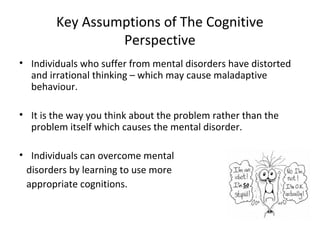
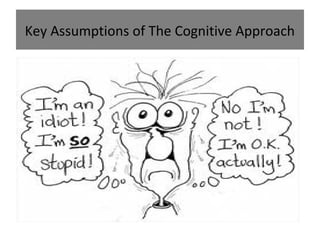
• Individuals who suffer from mental disorders have distorted
and irrational thinking – which may cause maladaptive
behaviour.
• It is the way you think about the problem rather than the
problem itself which causes the mental disorder.
• Individuals can overcome mental
disorders by learning to use more
appropriate cognitions.
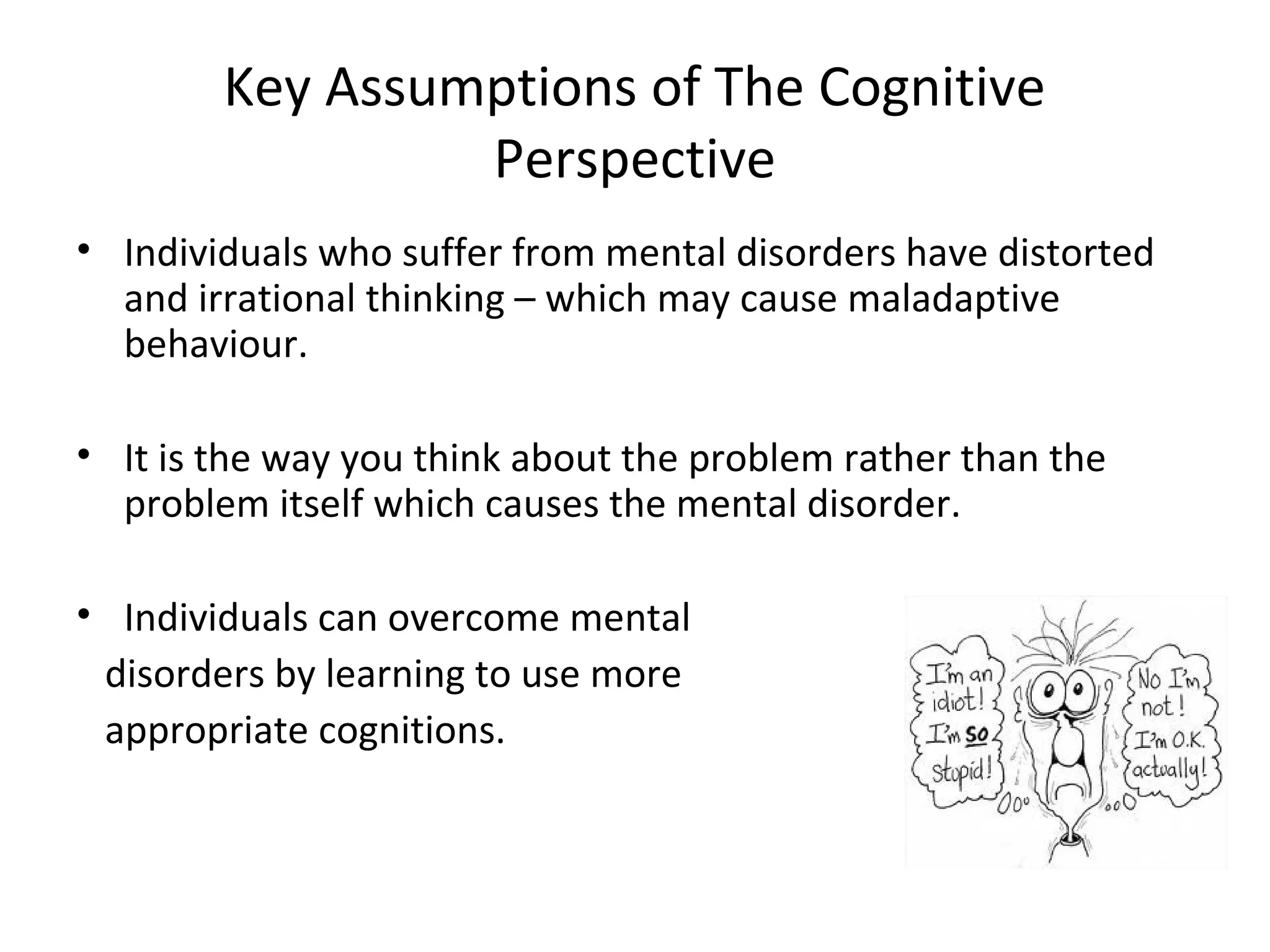
Key Assumptions of The Cognitive Approach
• Individuals who suffer from mental disorders have distorted
and irrational thinking – which may cause maladaptive
behaviour.
• It is the way you think about the problem rather than the
problem itself which causes the mental disorder.
• Individuals can overcome mental disorders by learning to use
more appropriate cognitions. If people think in more positive
ways, they can be helped to feel better
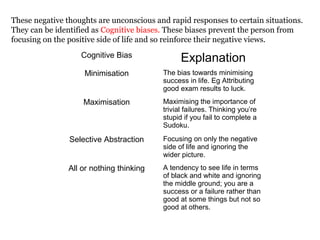
These negative thoughts are unconscious and rapid responses to certain situations.
They can be identified as Cognitive biases. These biases prevent the person from
focusing on the positive side of life and so reinforce their negative views.
Cognitive Bias

Explanation

Minimisation

The bias towards minimising
success in life. Eg Attributing
good exam results to luck.

Maximisation

Maximising the importance of
trivial failures. Thinking you’re
stupid if you fail to complete a
Sudoku.

Selective Abstraction

Focusing on only the negative
side of life and ignoring the
wider picture.

All or nothing thinking

A tendency to see life in terms
of black and white and ignoring
the middle ground; you are a
success or a failure rather than
good at some things but not so
good at others.
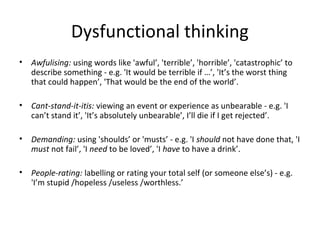
Dysfunctional thinking
•

Awfulising: using words like 'awful’, 'terrible’, 'horrible’, 'catastrophic’ to
describe something - e.g. 'It would be terrible if …’, 'It’s the worst thing
that could happen’, 'That would be the end of the world’.

•

Cant-stand-it-itis: viewing an event or experience as unbearable - e.g. 'I
can’t stand it’, 'It’s absolutely unbearable’, I’ll die if I get rejected’.

•

Demanding: using 'shoulds’ or 'musts’ - e.g. 'I should not have done that, 'I
must not fail’, 'I need to be loved’, 'I have to have a drink’.

•

People-rating: labelling or rating your total self (or someone else’s) - e.g.
'I’m stupid /hopeless /useless /worthless.’
What are irrational self defeating
beliefs?
• It blocks you from achieving your goals and purposes;
• It creates extreme emotions which persist, and which distress
and immobilise;
•

and it leads to behaviours that harm yourself, others, and
your life in general.
Rational thinking = Realistic thinking

• It is based on reality - it emphasises seeing
things as they really are, seeing things in
perspective;
• It helps you achieve your goals and purposes;
• It creates emotions you can handle; and
• It helps you behave in ways which promote
your aims and survival.
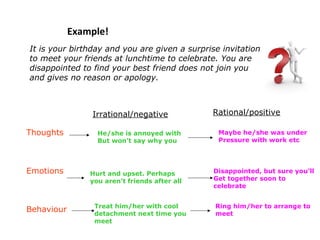
Example!
It is your birthday and you are given a surprise invitation
to meet your friends at lunchtime to celebrate. You are
disappointed to find your best friend does not join you
and gives no reason or apology.

Irrational/negative
Thoughts

Emotions

Behaviour

He/she is annoyed with
But won’t say why you

Hurt and upset. Perhaps
you aren’t friends after all

Treat him/her with cool
detachment next time you
meet

Rational/positive
Maybe he/she was under
Pressure with work etc

Disappointed, but sure you’ll
Get together soon to
celebrate
Ring him/her to arrange to
meet
Complete the activity
about seeing your boyfriend in Starbucks with a
girl !
Cognitive Theory
• Beck and Ellis are the two psychologists most
often associated with this explanation who
suggested that:• Irrational thinking (Ellis 1962) and
• The cognitive triad and errors in logic (Beck
1967)

create abnormal behaviour.
Aaron Beck
• Beck believed that people who are
depressed make fundamental errors
in logic
• People who have become depressed
have developed negative selfschemas
• They have a tendency to view
themselves, the world and the future
in pessimistic ways – the triad of
impairments
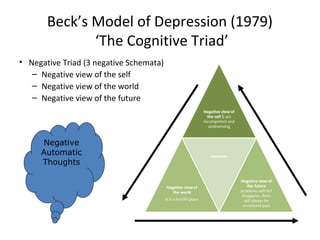
Beck’s Model of Depression (1979)
‘The Cognitive Triad’
• Negative Triad (3 negative Schemata)
– Negative view of the self
– Negative view of the world
– Negative view of the future

Negative
Automatic
Thoughts
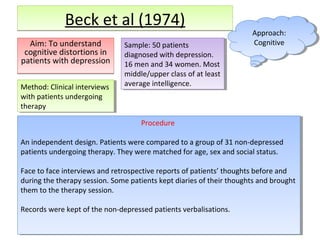
Beck et al (1974)
Aim: To understand
cognitive distortions in
patients with depression
Method: Clinical interviews
with patients undergoing
therapy
therapy

Sample: 50 patients
Sample: 50 patients
diagnosed with depression.
16 men and 34 women. Most
middle/upper class of at least
average intelligence.

Approach:
Approach:
Cognitive
Cognitive

Procedure
Procedure
An independent design. Patients were compared to aagroup of 31 non-depressed
An independent design. Patients were compared to group of 31 non-depressed
patients undergoing therapy. They were matched for age, sex and social status.
Face to face interviews and retrospective reports of patients’ thoughts before and
during the therapy session. Some patients kept diaries of their thoughts and brought
them to the therapy session.
Records were kept of the non-depressed patients verbalisations.
Beck et al (1974)
Beck et al (1974)
Results
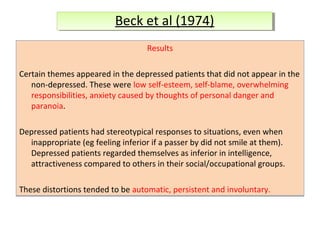
Certain themes appeared in the depressed patients that did not appear in the
non-depressed. These were low self-esteem, self-blame, overwhelming
responsibilities, anxiety caused by thoughts of personal danger and
paranoia.
Depressed patients had stereotypical responses to situations, even when
inappropriate (eg feeling inferior if a passer by did not smile at them).
Depressed patients regarded themselves as inferior in intelligence,
attractiveness compared to others in their social/occupational groups.
These distortions tended to be automatic, persistent and involuntary.
Albert Ellis
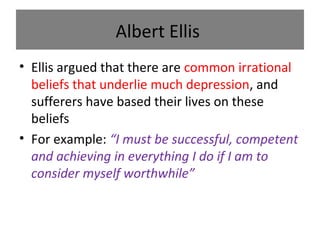
• Ellis argued that there are common irrational
beliefs that underlie much depression, and
sufferers have based their lives on these
beliefs
• For example: “I must be successful, competent
and achieving in everything I do if I am to
consider myself worthwhile”
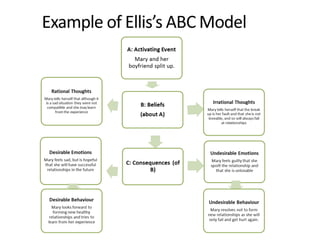
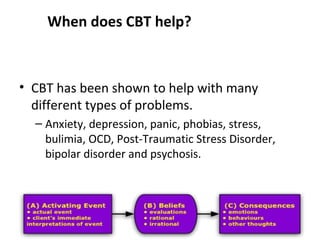
Ellis’ ABC model
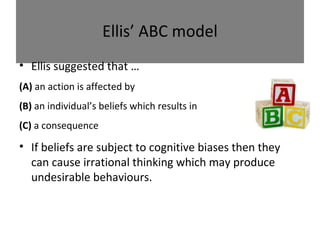
• Ellis suggested that …
(A) an action is affected by
(B) an individual’s beliefs which results in
(C) a consequence

• If beliefs are subject to cognitive biases then they
can cause irrational thinking which may produce
undesirable behaviours.
Example:

Emma overhears a remark made
in class ‘she really gets on my
nerves’. It could have referred to
anyone but Emma believes that
she is unworthy and people don’t
want to be friends with her. She
withdraws from the friendship
group and becomes more and
more isolated and depressed.
Evaluation
• Depressed people
undoubtedly have
negative thoughts but do
the negative thoughts
help cause depression, or
do they merely occur as a
result of being
depressed?
Evaluation
• This approach may
succeed in changing the
depressed person’s
thinking, but may not
discover the underlying
cause of the depression.
• Past events, which have a
powerful influence on the
individual, are often
neglected.
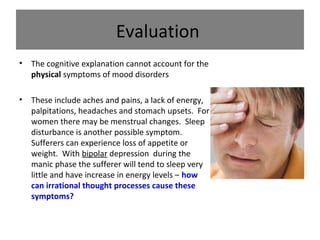
Evaluation
•

The cognitive explanation cannot account for the
physical symptoms of mood disorders

•

These include aches and pains, a lack of energy,
palpitations, headaches and stomach upsets. For
women there may be menstrual changes. Sleep
disturbance is another possible symptom.
Sufferers can experience loss of appetite or
weight. With bipolar depression during the
manic phase the sufferer will tend to sleep very
little and have increase in energy levels – how
can irrational thought processes cause these
symptoms?
Evaluation of the Cognitive Approach
• There is much evidence for cognitive biases and dysfunctional
thinking and beliefs in depression and anxiety disorders
• Therapy based on this model can be very effective for anxiety
disorders and depression
• No account of biological or genetic factors in psychopathology
• The disorder may lead to dysfunctional thinking, rather than
dysfunctional thinking causing the disorder (chicken/egg)

• Takes no account of situational or environmental factors
Cognitive Therapy
• Cognitive Behaviour Therapy (CBT)
• Aim – to challenge irrational and dysfunctional
thought processes
What is CBT?

• It is a way of talking about:
– how you think about yourself, the world and other people
– how what you do affects your thoughts and feelings.

• CBT can help people to change how they think ('Cognitive')
and what they do ('Behaviour'). These changes can help them
to feel better.
• It focuses on the 'here and now' problems and difficulties.
Instead of focusing on the causes of distress or symptoms in
the past, it looks for ways to improve the state of mind now.
When does CBT help?

• CBT has been shown to help with many
different types of problems.
– Anxiety, depression, panic, phobias, stress,
bulimia, OCD, Post-Traumatic Stress Disorder,
bipolar disorder and psychosis.
How does it work?
• CBT can help to break the vicious circle of
maladaptive thinking, feelings and behaviour.
• When the parts of the sequence are clearly outlined
and understood, they can be changed.
• CBT aims to get the person to a point where they can
‘DIY', and work out their own ways of tackling their
problems.
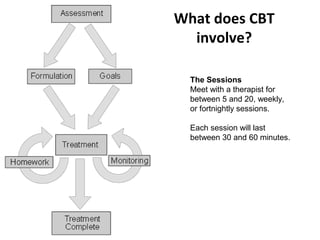
What does CBT
involve?
The Sessions
Meet with a therapist for
between 5 and 20, weekly,
or fortnightly sessions.
Each session will last
between 30 and 60 minutes.
How effective is CBT?
• CBT is effective in reducing symptoms of
depression and in preventing relapse (Kuyken
et al, 2007)
• It is the most effective psychological
treatment for moderate and severe
depression.
• It is as effective as antidepressants for many
types of depression (Fava et al, 1994).
CBT and Drug Treatment
• Keller et al (2000)
• Recovery rates (from depression)
– 55% drugs alone
– 52% CBT alone
– 85% when used together.
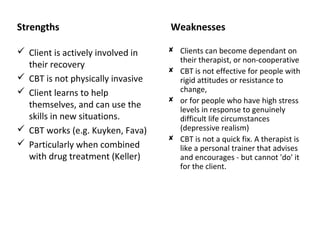
Strengths

Weaknesses

 Client is actively involved in
their recovery
 CBT is not physically invasive
 Client learns to help
themselves, and can use the
skills in new situations.
 CBT works (e.g. Kuyken, Fava)
 Particularly when combined
with drug treatment (Keller)

 Clients can become dependant on
their therapist, or non-cooperative
 CBT is not effective for people with
rigid attitudes or resistance to
change,
 or for people who have high stress
levels in response to genuinely
difficult life circumstances
(depressive realism)
 CBT is not a quick fix. A therapist is
like a personal trainer that advises
and encourages - but cannot 'do' it
for the client.
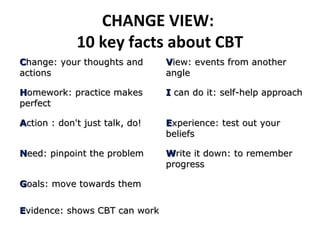
CHANGE VIEW:
10 key facts about CBT
Change: your thoughts and
actions

View: events from another
angle

Homework: practice makes
perfect

I can do it: self-help approach

Action : don't just talk, do!

Experience: test out your
beliefs

Need: pinpoint the problem

Write it down: to remember
progress

Goals: move towards them
Evidence: shows CBT can work
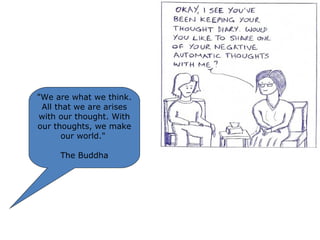
"We are what we think.
All that we are arises
with our thought. With
our thoughts, we make
our world."
The Buddha

Cognitive approach to abnormality AS

  • 1.
    Key Assumptions ofThe Cognitive Perspective • Individuals who suffer from mental disorders have distorted and irrational thinking – which may cause maladaptive behaviour. • It is the way you think about the problem rather than the problem itself which causes the mental disorder. • Individuals can overcome mental disorders by learning to use more appropriate cognitions.
  • 2.
    Key Assumptions ofThe Cognitive Approach • Individuals who suffer from mental disorders have distorted and irrational thinking – which may cause maladaptive behaviour. • It is the way you think about the problem rather than the problem itself which causes the mental disorder. • Individuals can overcome mental disorders by learning to use more appropriate cognitions. If people think in more positive ways, they can be helped to feel better
  • 3.
    These negative thoughtsare unconscious and rapid responses to certain situations. They can be identified as Cognitive biases. These biases prevent the person from focusing on the positive side of life and so reinforce their negative views. Cognitive Bias Explanation Minimisation The bias towards minimising success in life. Eg Attributing good exam results to luck. Maximisation Maximising the importance of trivial failures. Thinking you’re stupid if you fail to complete a Sudoku. Selective Abstraction Focusing on only the negative side of life and ignoring the wider picture. All or nothing thinking A tendency to see life in terms of black and white and ignoring the middle ground; you are a success or a failure rather than good at some things but not so good at others.
  • 4.
    Dysfunctional thinking • Awfulising: usingwords like 'awful’, 'terrible’, 'horrible’, 'catastrophic’ to describe something - e.g. 'It would be terrible if …’, 'It’s the worst thing that could happen’, 'That would be the end of the world’. • Cant-stand-it-itis: viewing an event or experience as unbearable - e.g. 'I can’t stand it’, 'It’s absolutely unbearable’, I’ll die if I get rejected’. • Demanding: using 'shoulds’ or 'musts’ - e.g. 'I should not have done that, 'I must not fail’, 'I need to be loved’, 'I have to have a drink’. • People-rating: labelling or rating your total self (or someone else’s) - e.g. 'I’m stupid /hopeless /useless /worthless.’
  • 5.
    What are irrationalself defeating beliefs? • It blocks you from achieving your goals and purposes; • It creates extreme emotions which persist, and which distress and immobilise; • and it leads to behaviours that harm yourself, others, and your life in general.
  • 6.
    Rational thinking =Realistic thinking • It is based on reality - it emphasises seeing things as they really are, seeing things in perspective; • It helps you achieve your goals and purposes; • It creates emotions you can handle; and • It helps you behave in ways which promote your aims and survival.
  • 7.
    Example! It is yourbirthday and you are given a surprise invitation to meet your friends at lunchtime to celebrate. You are disappointed to find your best friend does not join you and gives no reason or apology. Irrational/negative Thoughts Emotions Behaviour He/she is annoyed with But won’t say why you Hurt and upset. Perhaps you aren’t friends after all Treat him/her with cool detachment next time you meet Rational/positive Maybe he/she was under Pressure with work etc Disappointed, but sure you’ll Get together soon to celebrate Ring him/her to arrange to meet
  • 8.
    Complete the activity aboutseeing your boyfriend in Starbucks with a girl !
  • 9.
    Cognitive Theory • Beckand Ellis are the two psychologists most often associated with this explanation who suggested that:• Irrational thinking (Ellis 1962) and • The cognitive triad and errors in logic (Beck 1967) create abnormal behaviour.
  • 10.
    Aaron Beck • Beckbelieved that people who are depressed make fundamental errors in logic • People who have become depressed have developed negative selfschemas • They have a tendency to view themselves, the world and the future in pessimistic ways – the triad of impairments
  • 11.
    Beck’s Model ofDepression (1979) ‘The Cognitive Triad’ • Negative Triad (3 negative Schemata) – Negative view of the self – Negative view of the world – Negative view of the future Negative Automatic Thoughts
  • 12.
    Beck et al(1974) Aim: To understand cognitive distortions in patients with depression Method: Clinical interviews Method: Clinical interviews with patients undergoing with patients undergoing therapy therapy Sample: 50 patients Sample: 50 patients diagnosed with depression. diagnosed with depression. 16 men and 34 women. Most 16 men and 34 women. Most middle/upper class of at least middle/upper class of at least average intelligence. average intelligence. Approach: Approach: Cognitive Cognitive Procedure Procedure An independent design. Patients were compared to aagroup of 31 non-depressed An independent design. Patients were compared to group of 31 non-depressed patients undergoing therapy. They were matched for age, sex and social status. patients undergoing therapy. They were matched for age, sex and social status. Face to face interviews and retrospective reports of patients’ thoughts before and Face to face interviews and retrospective reports of patients’ thoughts before and during the therapy session. Some patients kept diaries of their thoughts and brought during the therapy session. Some patients kept diaries of their thoughts and brought them to the therapy session. them to the therapy session. Records were kept of the non-depressed patients verbalisations. Records were kept of the non-depressed patients verbalisations.
  • 13.
    Beck et al(1974) Beck et al (1974) Results Certain themes appeared in the depressed patients that did not appear in the non-depressed. These were low self-esteem, self-blame, overwhelming responsibilities, anxiety caused by thoughts of personal danger and paranoia. Depressed patients had stereotypical responses to situations, even when inappropriate (eg feeling inferior if a passer by did not smile at them). Depressed patients regarded themselves as inferior in intelligence, attractiveness compared to others in their social/occupational groups. These distortions tended to be automatic, persistent and involuntary.
  • 14.
    Albert Ellis • Ellisargued that there are common irrational beliefs that underlie much depression, and sufferers have based their lives on these beliefs • For example: “I must be successful, competent and achieving in everything I do if I am to consider myself worthwhile”
  • 16.
    Ellis’ ABC model •Ellis suggested that … (A) an action is affected by (B) an individual’s beliefs which results in (C) a consequence • If beliefs are subject to cognitive biases then they can cause irrational thinking which may produce undesirable behaviours.
  • 17.
    Example: Emma overhears aremark made in class ‘she really gets on my nerves’. It could have referred to anyone but Emma believes that she is unworthy and people don’t want to be friends with her. She withdraws from the friendship group and becomes more and more isolated and depressed.
  • 18.
    Evaluation • Depressed people undoubtedlyhave negative thoughts but do the negative thoughts help cause depression, or do they merely occur as a result of being depressed?
  • 19.
    Evaluation • This approachmay succeed in changing the depressed person’s thinking, but may not discover the underlying cause of the depression. • Past events, which have a powerful influence on the individual, are often neglected.
  • 20.
    Evaluation • The cognitive explanationcannot account for the physical symptoms of mood disorders • These include aches and pains, a lack of energy, palpitations, headaches and stomach upsets. For women there may be menstrual changes. Sleep disturbance is another possible symptom. Sufferers can experience loss of appetite or weight. With bipolar depression during the manic phase the sufferer will tend to sleep very little and have increase in energy levels – how can irrational thought processes cause these symptoms?
  • 21.
    Evaluation of theCognitive Approach • There is much evidence for cognitive biases and dysfunctional thinking and beliefs in depression and anxiety disorders • Therapy based on this model can be very effective for anxiety disorders and depression • No account of biological or genetic factors in psychopathology • The disorder may lead to dysfunctional thinking, rather than dysfunctional thinking causing the disorder (chicken/egg) • Takes no account of situational or environmental factors
  • 22.
    Cognitive Therapy • CognitiveBehaviour Therapy (CBT) • Aim – to challenge irrational and dysfunctional thought processes
  • 23.
    What is CBT? •It is a way of talking about: – how you think about yourself, the world and other people – how what you do affects your thoughts and feelings. • CBT can help people to change how they think ('Cognitive') and what they do ('Behaviour'). These changes can help them to feel better. • It focuses on the 'here and now' problems and difficulties. Instead of focusing on the causes of distress or symptoms in the past, it looks for ways to improve the state of mind now.
  • 24.
    When does CBThelp? • CBT has been shown to help with many different types of problems. – Anxiety, depression, panic, phobias, stress, bulimia, OCD, Post-Traumatic Stress Disorder, bipolar disorder and psychosis.
  • 25.
    How does itwork? • CBT can help to break the vicious circle of maladaptive thinking, feelings and behaviour. • When the parts of the sequence are clearly outlined and understood, they can be changed. • CBT aims to get the person to a point where they can ‘DIY', and work out their own ways of tackling their problems.
  • 26.
    What does CBT involve? TheSessions Meet with a therapist for between 5 and 20, weekly, or fortnightly sessions. Each session will last between 30 and 60 minutes.
  • 29.
    How effective isCBT? • CBT is effective in reducing symptoms of depression and in preventing relapse (Kuyken et al, 2007) • It is the most effective psychological treatment for moderate and severe depression. • It is as effective as antidepressants for many types of depression (Fava et al, 1994).
  • 30.
    CBT and DrugTreatment • Keller et al (2000) • Recovery rates (from depression) – 55% drugs alone – 52% CBT alone – 85% when used together.
  • 31.
    Strengths Weaknesses  Client isactively involved in their recovery  CBT is not physically invasive  Client learns to help themselves, and can use the skills in new situations.  CBT works (e.g. Kuyken, Fava)  Particularly when combined with drug treatment (Keller)  Clients can become dependant on their therapist, or non-cooperative  CBT is not effective for people with rigid attitudes or resistance to change,  or for people who have high stress levels in response to genuinely difficult life circumstances (depressive realism)  CBT is not a quick fix. A therapist is like a personal trainer that advises and encourages - but cannot 'do' it for the client.
  • 32.
    CHANGE VIEW: 10 keyfacts about CBT Change: your thoughts and actions View: events from another angle Homework: practice makes perfect I can do it: self-help approach Action : don't just talk, do! Experience: test out your beliefs Need: pinpoint the problem Write it down: to remember progress Goals: move towards them Evidence: shows CBT can work
  • 33.
    "We are whatwe think. All that we are arises with our thought. With our thoughts, we make our world." The Buddha

Editor's Notes

  • #2 Life events happen, and people in general will have an adaptive response to them.
  • #3 Life events happen, and people in general will have an adaptive response to them.
  • #12 Beck built on the idea of maladaptive responses, and suggested that people with depression become trapped in a cycle of negative thoughts Negative view of the self (I am incompetent and undeserving) Negative view of the world (it is a hostile place) Negative view of the future (problems will not disappear, there will always be emotional pain) Attributions are internal or external ( the cause is seen as internal (it’s my fault’, or due to external circumstances beyond their control Attributions can be specific or global, i.e. The cause may be specific to a particular event or apply to all events Attributions can be stable or unstable (the individual consistently makes the same types of attribution, or they can vary over time and situation) In depression attributions for negative events are internal, global and stable. Attributions for positive events are external, specific and unstable.
  • #17 Let’s look at the worksheet…
  • #18 Example: Emma overhears a remark made in class ‘she really gets on my nerves’. It could have referred to anyone but Emma believes that she is unworthy and people don’t want to be friends with her. She withdraws from the friendship group and becomes more and more isolated and depressed.
  • #28 Handout with process Then worksheet