1
 We learn by association
› Our minds naturally connect events that
occur in sequence
› Aristotle 2000 years ago
› John Locke and David Hume 200 yrs ago
 Associative Learning
› learning that two events occur together
 two stimuli
 a response and its consequences
2
What Is Learning?
Learning is acquiring new
knowledge, behaviors,
skills, values, preferences
or understanding, and
may involve synthesizing
different types of
information.
3
۩
۞ It is simply a
change in
behavior – a
form of
adaptation
and a mode of
adjustment
4
۩ Learning can be
defined as a
process which
brings relatively
permanent
changes in the
behavior of Learner
through experience
and Practice.
۞
5
 Verbal learning:(Involving verbel
expressions)
 Learning of Motor Skills:
(Walking,Swiming,Dancing,Typing)
 Effective Learning:
(habbits,interest,attitudes)
 Cognative learning: (learning of
concepts, principles , problem-solving)
6
The learning can
be classified into:
Trail and error Learning
Conditioining Learning
Shaping
Insightful learning
Associate learning.... Etc.
7
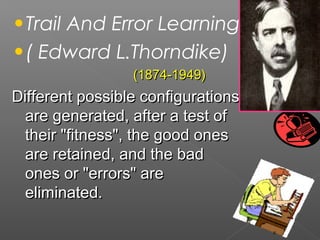
•Trail And Error Learning
•( Edward L.Thorndike)
(1874-1949)(1874-1949)
Different possible configurationsDifferent possible configurations
are generated, after a test ofare generated, after a test of
their "fitness", the good onestheir "fitness", the good ones
are retained, and the badare retained, and the bad
ones or "errors" areones or "errors" are
eliminated.eliminated.
8
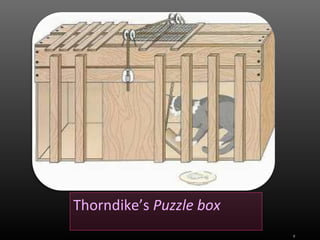
Thorndike’s Puzzle box
9
1. The law of Effect – This
states that if the
responses are
rewarded and the
reward is satisfying or
pleasant, the
connection or behavior
is strengthened. If the
effect is unpleasant or
annoying, the
connection is
weakened.
10
1. 2.The Law of
readiNESS– It stresses
need motivation of learners
through building up of the
proper background and
fostering the proper
mindset. This includes the
understanding that
learning follows a
maturation level. It says
that an appropriate
learning activity depends
on the capacity of the
learner.
11
3. The Law of Exercise –
This states that more
connections are exercised,
the stronger the
connections become.
When a connection or
behavior has not been
practiced or repeated, its
strength decreases. As the
saying goes, “Practice
makes perfect.”
12
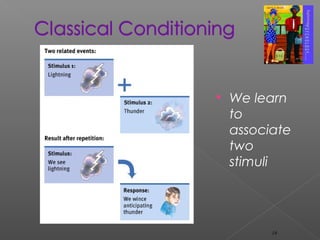
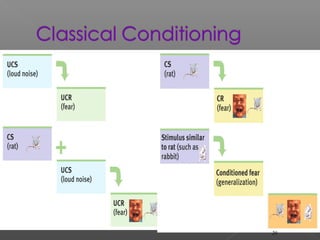
 Classical conditioning is a form of
learning in which people (or any
organism) learns to associate two stimuli
that occur in sequence.
 Classical conditioning occurs when a
person forms a mental association
between two stimuli, so that
encountering one stimulus means the
person thinks of the other.
Condition: to make people or animals act or react in a
particular way by gradually getting them used to a specific
pattern of events. 13
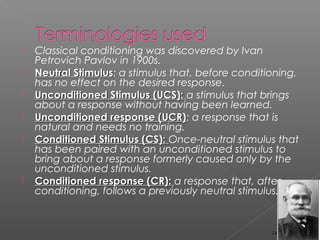
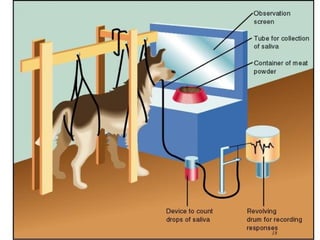
 Classical conditioning was discovered by Ivan
Petrovich Pavlov in 1900s.
 Neutral StimulusNeutral Stimulus: a stimulus that, before conditioning,
has no effect on the desired response.
 Unconditioned Stimulus (UCS):Unconditioned Stimulus (UCS): a stimulus that brings
about a response without having been learned.
 Unconditioned response (UCR)Unconditioned response (UCR): a response that is
natural and needs no training.
 Conditioned Stimulus (CS):Conditioned Stimulus (CS): Once-neutral stimulus that
has been paired with an unconditioned stimulus to
bring about a response formerly caused only by the
unconditioned stimulus.
 Conditioned response (CR):Conditioned response (CR): a response that, after
conditioning, follows a previously neutral stimulus.
14
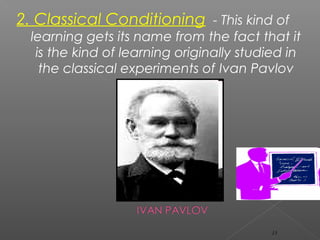
2. Classical Conditioning - This kind of
learning gets its name from the fact that it
is the kind of learning originally studied in
the classical experiments of Ivan Pavlov
(1849-1936).
15
 We learn
to
associate
two
stimuli
16
 Pavlov introduced the
concept of conditioning
and established many of
its basic principles. He was
the first to conduct
systematic studies of
conditioned responses.
17
18
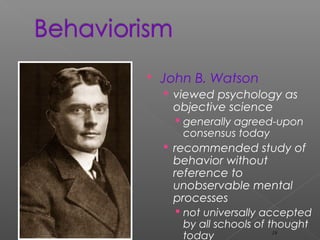
 John B. Watson
 viewed psychology as
objective science
 generally agreed-upon
consensus today
 recommended study of
behavior without
reference to
unobservable mental
processes
 not universally accepted
by all schools of thought
today 19
20
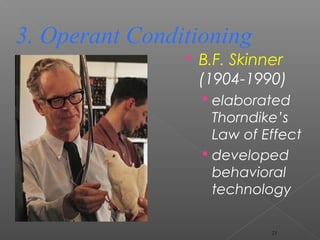
 B.F. Skinner
(1904-1990)
 elaborated
Thorndike’s
Law of Effect
 developed
behavioral
technology
3. Operant Conditioning
21
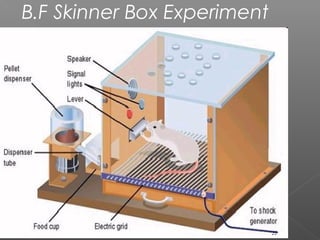
B.F Skinner Box Experiment
22
4. Operant Conditioning –
Operant conditioning is also called
“Instrumental conditioning.” It is a kind of
learning , in which an animal or human
performs some behavior, and the
following consequences, increase or
decrease the chances that they will
repeat to perform the same behavior or
response. And this response is called
Operant Response.
23
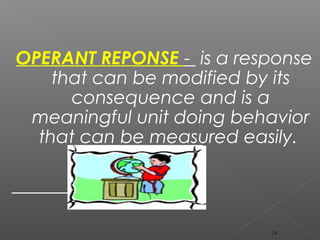
OPERANT REPONSE - is a response
that can be modified by its
consequence and is a
meaningful unit doing behavior
that can be measured easily.
24
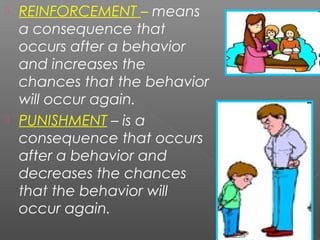
 REINFORCEMENT – means
a consequence that
occurs after a behavior
and increases the
chances that the behavior
will occur again.
 PUNISHMENT – is a
consequence that occurs
after a behavior and
decreases the chances
that the behavior will
occur again.
25
 OPERANT CONDITIONING IS GOOD FOR CHILD REARING,
SHAPING BEHAVIORS .
 EX: A YOUNG BOY HAD TEMPER TANTRUMS DURING BEDTIME
TO GET ENOUGH ATTENTION FROM PARENTS….
 EX: ALONE IN A CRIB, A BABY MAY KICK AND TWIST AND COO
SPONTANEOUSLY. THIS BEHAVIOR WILL BE REPEATED WHEN
THIS IS FOLLOWED BY PARENTAL ATTENTION.
 EX: DOG WILL PICK UP THE BALL MORE OFTEN IF THIS ACTION
IS FOLLOWED BY PETTING OR A FOOD REWARD.
26
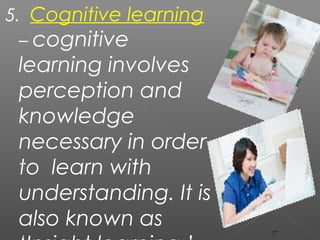
5. Cognitive learning
– cognitive
learning involves
perception and
knowledge
necessary in order
to learn with
understanding. It is
also known as 27
Insight – is a mental process marked
by the sudden and expected solution
to a problem: a phenomenon often
called the “ah-ah experience.”
28
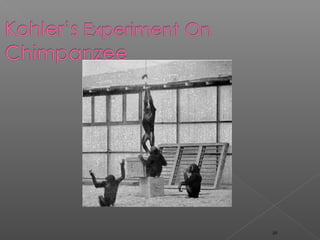
Kohler Experiment:
Kohler constructed a variety of problems for
the
chimps, each of which involved obtaining
food
that was not directly accessible.
In the simplest task, food was put on the
other side of a barrier.
Dogs and cats in previous experiments had
faced the barrier in order to reach the food,
rather
than moving away from the goal to
circumvent
the barrier. The chimps, however, presented29
30
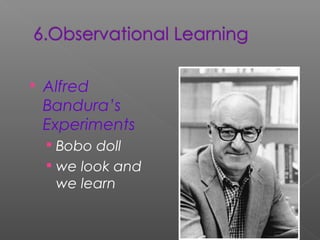
 Alfred
Bandura’s
Experiments
 Bobo doll
 we look and
we learn
31
 Prosocial Behavior
positive, constructive,
helpful behavior
opposite of antisocial
behavior
32
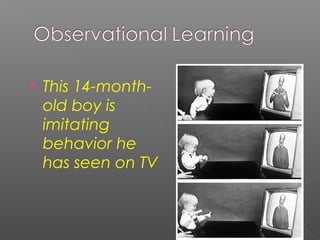
 This 14-month-
old boy is
imitating
behavior he
has seen on TV
33
34
35

Psychology chapter learning presentation

  • 1.
  • 2.
     We learnby association › Our minds naturally connect events that occur in sequence › Aristotle 2000 years ago › John Locke and David Hume 200 yrs ago  Associative Learning › learning that two events occur together  two stimuli  a response and its consequences 2
  • 3.
    What Is Learning? Learningis acquiring new knowledge, behaviors, skills, values, preferences or understanding, and may involve synthesizing different types of information. 3
  • 4.
    ۩ ۞ It issimply a change in behavior – a form of adaptation and a mode of adjustment 4
  • 5.
    ۩ Learning canbe defined as a process which brings relatively permanent changes in the behavior of Learner through experience and Practice. ۞ 5
  • 6.
     Verbal learning:(Involvingverbel expressions)  Learning of Motor Skills: (Walking,Swiming,Dancing,Typing)  Effective Learning: (habbits,interest,attitudes)  Cognative learning: (learning of concepts, principles , problem-solving) 6
  • 7.
    The learning can beclassified into: Trail and error Learning Conditioining Learning Shaping Insightful learning Associate learning.... Etc. 7
  • 8.
    •Trail And ErrorLearning •( Edward L.Thorndike) (1874-1949)(1874-1949) Different possible configurationsDifferent possible configurations are generated, after a test ofare generated, after a test of their "fitness", the good onestheir "fitness", the good ones are retained, and the badare retained, and the bad ones or "errors" areones or "errors" are eliminated.eliminated. 8
  • 9.
  • 10.
    1. The lawof Effect – This states that if the responses are rewarded and the reward is satisfying or pleasant, the connection or behavior is strengthened. If the effect is unpleasant or annoying, the connection is weakened. 10
  • 11.
    1. 2.The Lawof readiNESS– It stresses need motivation of learners through building up of the proper background and fostering the proper mindset. This includes the understanding that learning follows a maturation level. It says that an appropriate learning activity depends on the capacity of the learner. 11
  • 12.
    3. The Lawof Exercise – This states that more connections are exercised, the stronger the connections become. When a connection or behavior has not been practiced or repeated, its strength decreases. As the saying goes, “Practice makes perfect.” 12
  • 13.
     Classical conditioningis a form of learning in which people (or any organism) learns to associate two stimuli that occur in sequence.  Classical conditioning occurs when a person forms a mental association between two stimuli, so that encountering one stimulus means the person thinks of the other. Condition: to make people or animals act or react in a particular way by gradually getting them used to a specific pattern of events. 13
  • 14.
     Classical conditioningwas discovered by Ivan Petrovich Pavlov in 1900s.  Neutral StimulusNeutral Stimulus: a stimulus that, before conditioning, has no effect on the desired response.  Unconditioned Stimulus (UCS):Unconditioned Stimulus (UCS): a stimulus that brings about a response without having been learned.  Unconditioned response (UCR)Unconditioned response (UCR): a response that is natural and needs no training.  Conditioned Stimulus (CS):Conditioned Stimulus (CS): Once-neutral stimulus that has been paired with an unconditioned stimulus to bring about a response formerly caused only by the unconditioned stimulus.  Conditioned response (CR):Conditioned response (CR): a response that, after conditioning, follows a previously neutral stimulus. 14
  • 15.
    2. Classical Conditioning- This kind of learning gets its name from the fact that it is the kind of learning originally studied in the classical experiments of Ivan Pavlov (1849-1936). 15
  • 16.
  • 17.
     Pavlov introducedthe concept of conditioning and established many of its basic principles. He was the first to conduct systematic studies of conditioned responses. 17
  • 18.
  • 19.
     John B.Watson  viewed psychology as objective science  generally agreed-upon consensus today  recommended study of behavior without reference to unobservable mental processes  not universally accepted by all schools of thought today 19
  • 20.
  • 21.
     B.F. Skinner (1904-1990) elaborated Thorndike’s Law of Effect  developed behavioral technology 3. Operant Conditioning 21
  • 22.
    B.F Skinner BoxExperiment 22
  • 23.
    4. Operant Conditioning– Operant conditioning is also called “Instrumental conditioning.” It is a kind of learning , in which an animal or human performs some behavior, and the following consequences, increase or decrease the chances that they will repeat to perform the same behavior or response. And this response is called Operant Response. 23
  • 24.
    OPERANT REPONSE -is a response that can be modified by its consequence and is a meaningful unit doing behavior that can be measured easily. 24
  • 25.
     REINFORCEMENT –means a consequence that occurs after a behavior and increases the chances that the behavior will occur again.  PUNISHMENT – is a consequence that occurs after a behavior and decreases the chances that the behavior will occur again. 25
  • 26.
     OPERANT CONDITIONINGIS GOOD FOR CHILD REARING, SHAPING BEHAVIORS .  EX: A YOUNG BOY HAD TEMPER TANTRUMS DURING BEDTIME TO GET ENOUGH ATTENTION FROM PARENTS….  EX: ALONE IN A CRIB, A BABY MAY KICK AND TWIST AND COO SPONTANEOUSLY. THIS BEHAVIOR WILL BE REPEATED WHEN THIS IS FOLLOWED BY PARENTAL ATTENTION.  EX: DOG WILL PICK UP THE BALL MORE OFTEN IF THIS ACTION IS FOLLOWED BY PETTING OR A FOOD REWARD. 26
  • 27.
    5. Cognitive learning –cognitive learning involves perception and knowledge necessary in order to learn with understanding. It is also known as 27
  • 28.
    Insight – isa mental process marked by the sudden and expected solution to a problem: a phenomenon often called the “ah-ah experience.” 28
  • 29.
    Kohler Experiment: Kohler constructeda variety of problems for the chimps, each of which involved obtaining food that was not directly accessible. In the simplest task, food was put on the other side of a barrier. Dogs and cats in previous experiments had faced the barrier in order to reach the food, rather than moving away from the goal to circumvent the barrier. The chimps, however, presented29
  • 30.
  • 31.
     Alfred Bandura’s Experiments  Bobodoll  we look and we learn 31
  • 32.
     Prosocial Behavior positive,constructive, helpful behavior opposite of antisocial behavior 32
  • 33.
     This 14-month- oldboy is imitating behavior he has seen on TV 33
  • 34.
  • 35.