Applied Behaviour Analysis
Prachi Bhavesh Sanghvi
Uma Sreekanth
Overview
• Definition
• Goal
• Techniques
• Intervention in practice
• Application
• Issues and Challenges
• ABA and Autism
• Research
Prachi Sanghvi, M.Sc. Clinical Psychology
The term ‘Applied Behavior Analysis’ introduced
in Baer, Wolf and Risley’s article (1968) in the
first issue of Journal of Applied Behavior
Analysis
(Miltonberger, 2012)
Prachi Sanghvi, M.Sc. Clinical Psychology
Definition:
“Applied Behavior Analysis is
the process of systematically applying interventions
based on the principles of learning theory
to improve socially significant behaviors
to a meaningful degree and to demonstrate that
the interventions employed are responsible for the
improvement in behavior”
(Baer et. al, 1968)
Prachi Sanghvi, M.Sc. Clinical Psychology
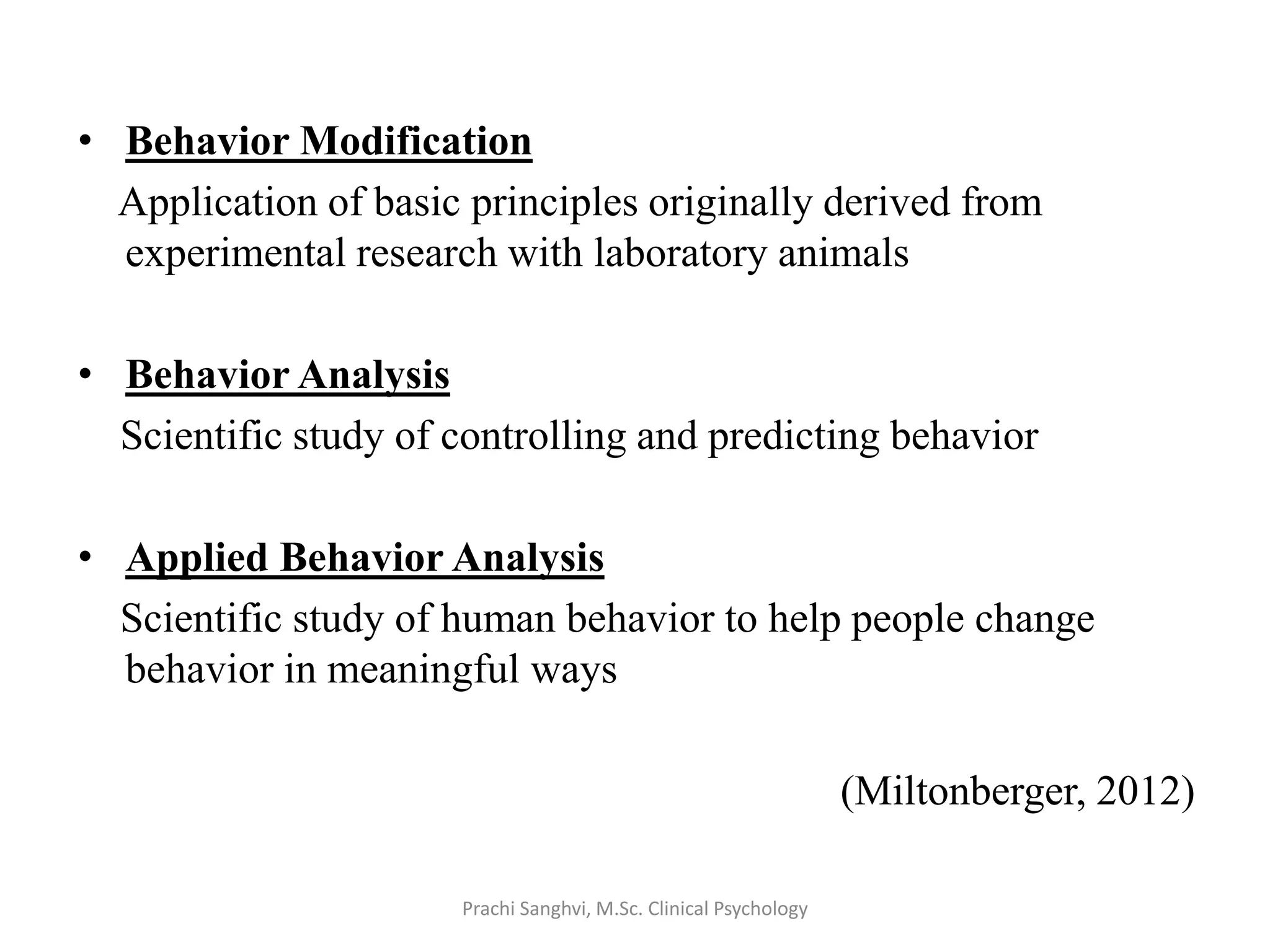
• Behavior Modification
Application of basic principles originally derived from
experimental research with laboratory animals
• Behavior Analysis
Scientific study of controlling and predicting behavior
• Applied Behavior Analysis
Scientific study of human behavior to help people change
behavior in meaningful ways
(Miltonberger, 2012)
Prachi Sanghvi, M.Sc. Clinical Psychology
• Draws primarily on operant conditioning as the basis for
developing interventions (Hersen & Sledge, 2002)
• Goal
 Increase adaptive behavior (reinforcement and stimulus control)
Reduce maladaptive behavior (punishment and extinction)
(Sommers-Flanagan & Sommers-Flanagan, 2004)
Prachi Sanghvi, M.Sc. Clinical Psychology
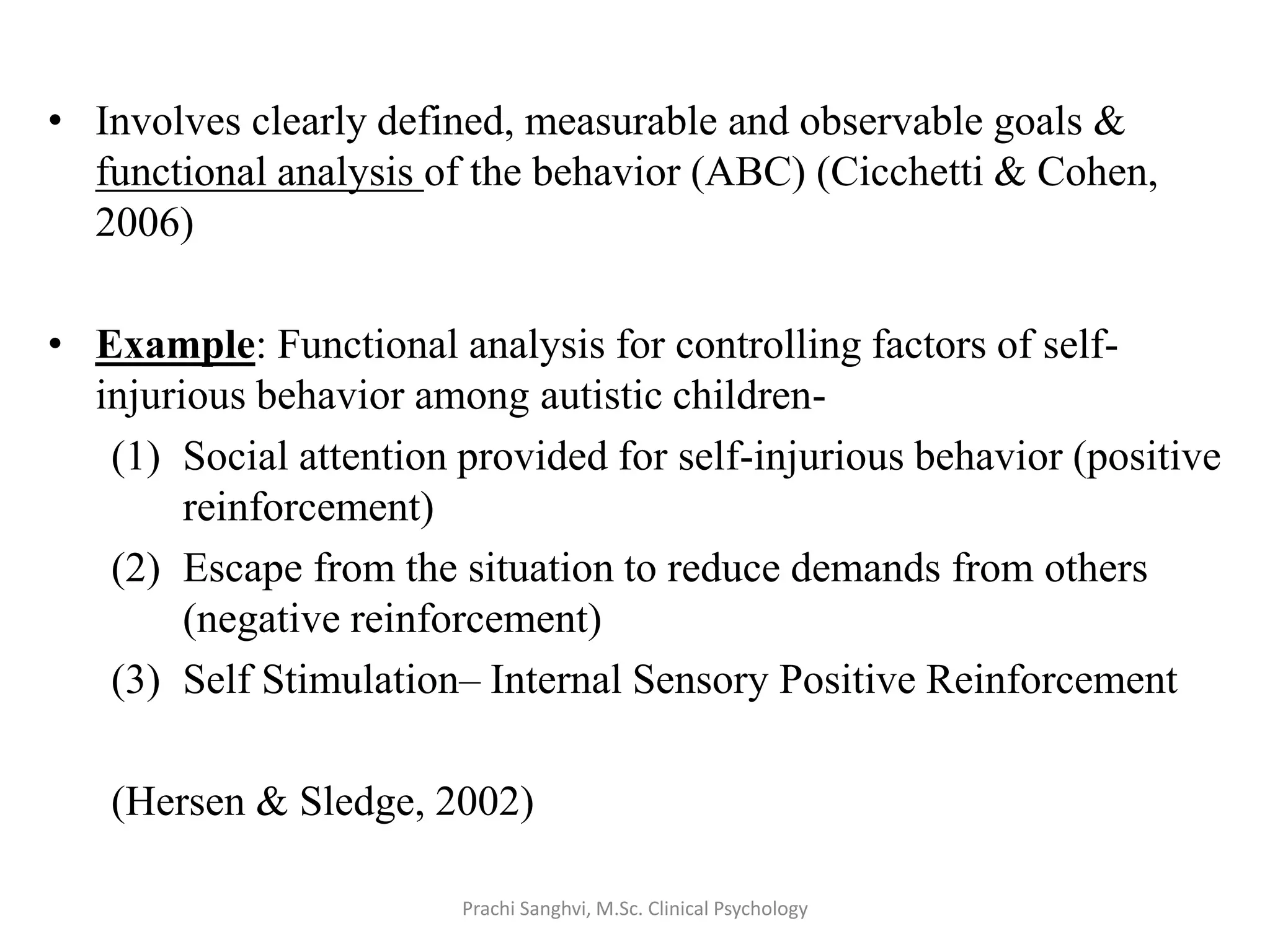
• Involves clearly defined, measurable and observable goals &
functional analysis of the behavior (ABC) (Cicchetti & Cohen,
2006)
• Example: Functional analysis for controlling factors of self-
injurious behavior among autistic children-
(1) Social attention provided for self-injurious behavior (positive
reinforcement)
(2) Escape from the situation to reduce demands from others
(negative reinforcement)
(3) Self Stimulation– Internal Sensory Positive Reinforcement
(Hersen & Sledge, 2002)
Prachi Sanghvi, M.Sc. Clinical Psychology
Techniques
Reinforcement
Attention Shaping Chaining
Token
Economy
Prachi Sanghvi, M.Sc. Clinical Psychology
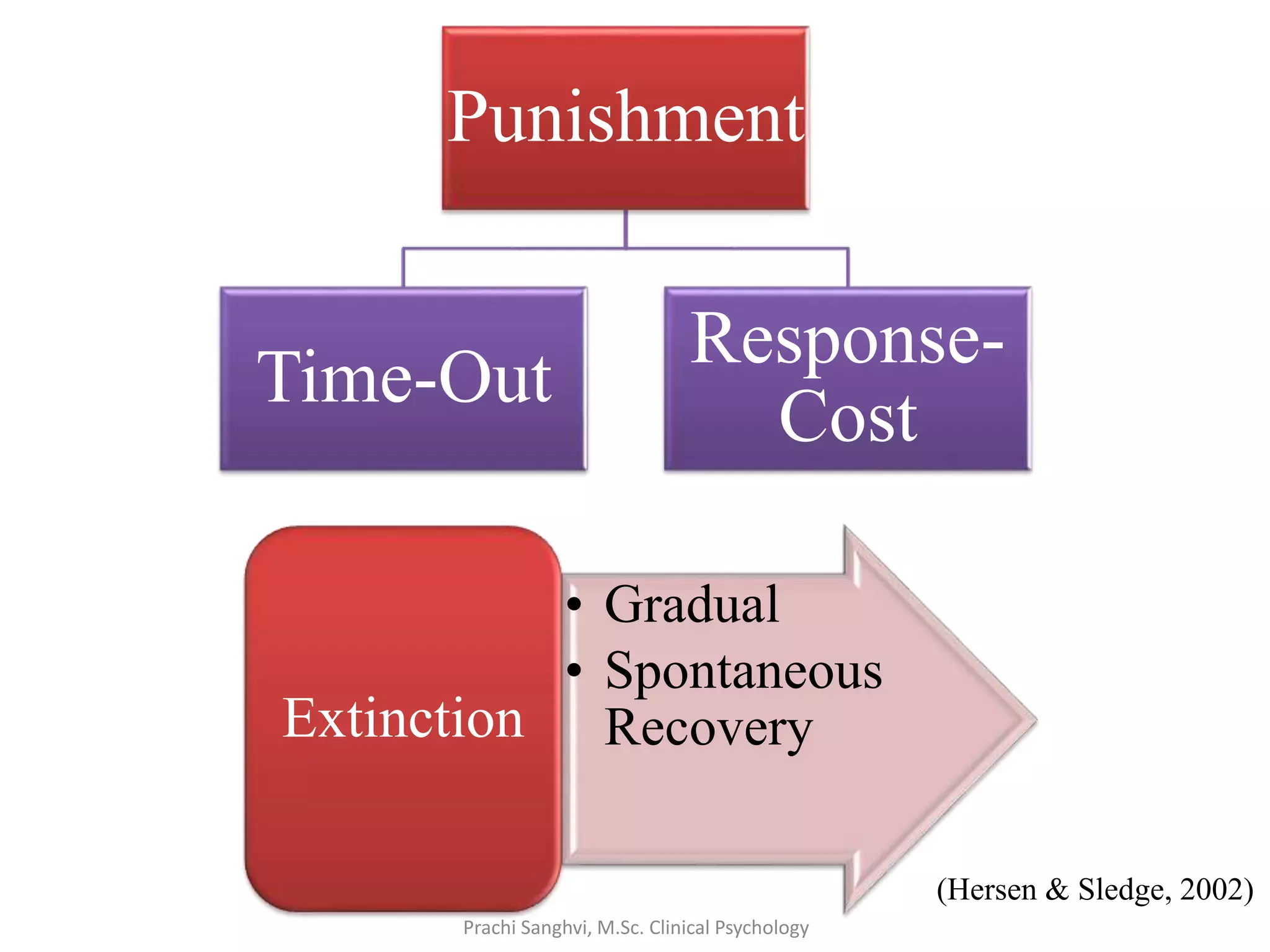
Punishment
Time-Out
Response-
Cost
• Gradual
• Spontaneous
RecoveryExtinction
(Hersen & Sledge, 2002)
Prachi Sanghvi, M.Sc. Clinical Psychology
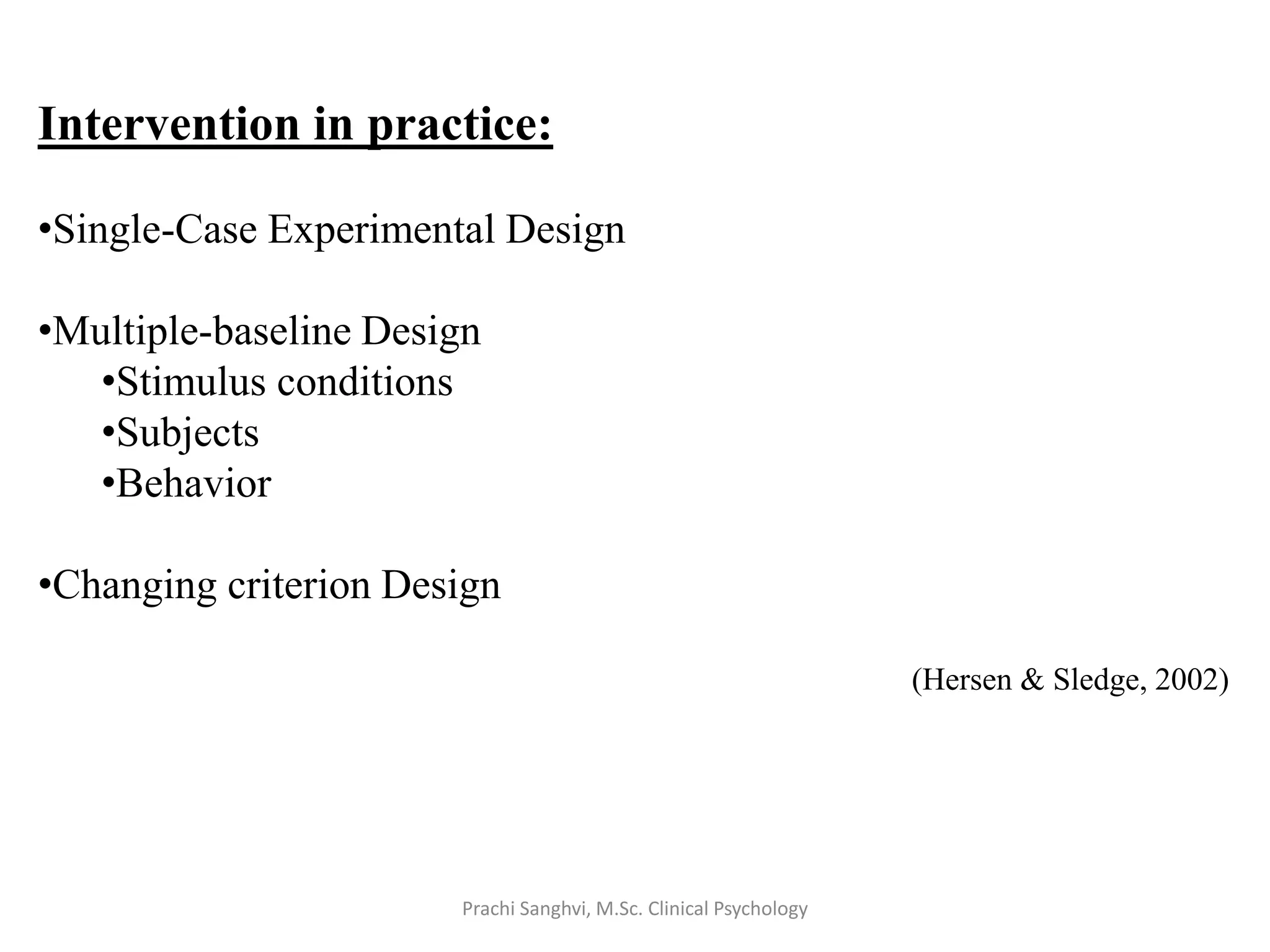
Intervention in practice:
•Single-Case Experimental Design
•Multiple-baseline Design
•Stimulus conditions
•Subjects
•Behavior
•Changing criterion Design
(Hersen & Sledge, 2002)
Prachi Sanghvi, M.Sc. Clinical Psychology
Application
Therapy
Education
Health
Daily Life
Sports
Organization
(Hersen & Sledge, 2002)
Prachi Sanghvi, M.Sc. Clinical Psychology
Implementation and program
effectiveness
• Target behavior carefully defined,
immediacy, continuity
• Inconsistent implementation of
contingencies
• Training of behavior-change agents
• Careful assessment and supervision
Response maintenance and Transfer
of learning
• Programming naturally occurring
reinforcers
• Gradually removing or fading the
contingencies
• Expanding stimulus control
• Training the general case
Issues and Challenges:
(Hersen & Sledge, 2002)Prachi Sanghvi, M.Sc. Clinical Psychology
Applied Behavioral Analysis and Autistic Children:
Teaching Formats:
 Discreet Trial Training
 Natural Environment Training-
1. Incidental Training
2. Milieu teaching
3. Pivotal response training
• Interventions work best when
Children are less than 5 years of age
30 hours of treatment/week
Continue treatment for 2 years at least
After which, 40% will be able to function in public school system
(Pierce & Cheney, 2004)
Prachi Sanghvi, M.Sc. Clinical Psychology
Research:
•Teach developmentally delayed children self-care
•Increase academic skills
•Prevent industrial accidents
(Pierce & Cheney, 2004)
Prachi Sanghvi, M.Sc. Clinical Psychology
References
• Baer DM, Wolf MM, Risley TR. Some current dimensions of applied behavior
analysis. Journal of Applied Behavior Analysis. 1968; 1:91–97.
• Cicchetti D, Cohen DJ. Developmental Psychopathology, Volume Three: Risk,
Disorder, and Adaptation. 2nd ed. John Wiley & Sons, Inc.; 2006.
• Hersen M, Sledge W. Encyclopedia of Psychotherapy. Elsevier Science; 2002.
• Miltonberger RG. Behavior Modification: Principles and procedures. 5th ed.
Wadsworth Cengage Learning. 2012.
• Pierce D, Cheney C. Behavioral Analysis and Learning. 3rd ed. Lawrence
Erlbaum Associates, Publishers.; 2004
• Sommers-Flanagan J, Sommers-Flanagan R. Counseling and Psychotherapy
Theories in Context and Practice: Skills, Strategies and Techniques. John Wiley
& Sons, Inc.; 2004.
Prachi Sanghvi, M.Sc. Clinical Psychology

Applied Behaviour Analysis

  • 1.
    Applied Behaviour Analysis PrachiBhavesh Sanghvi Uma Sreekanth
  • 2.
    Overview • Definition • Goal •Techniques • Intervention in practice • Application • Issues and Challenges • ABA and Autism • Research Prachi Sanghvi, M.Sc. Clinical Psychology
  • 3.
    The term ‘AppliedBehavior Analysis’ introduced in Baer, Wolf and Risley’s article (1968) in the first issue of Journal of Applied Behavior Analysis (Miltonberger, 2012) Prachi Sanghvi, M.Sc. Clinical Psychology
  • 4.
    Definition: “Applied Behavior Analysisis the process of systematically applying interventions based on the principles of learning theory to improve socially significant behaviors to a meaningful degree and to demonstrate that the interventions employed are responsible for the improvement in behavior” (Baer et. al, 1968) Prachi Sanghvi, M.Sc. Clinical Psychology
  • 5.
    • Behavior Modification Applicationof basic principles originally derived from experimental research with laboratory animals • Behavior Analysis Scientific study of controlling and predicting behavior • Applied Behavior Analysis Scientific study of human behavior to help people change behavior in meaningful ways (Miltonberger, 2012) Prachi Sanghvi, M.Sc. Clinical Psychology
  • 6.
    • Draws primarilyon operant conditioning as the basis for developing interventions (Hersen & Sledge, 2002) • Goal  Increase adaptive behavior (reinforcement and stimulus control) Reduce maladaptive behavior (punishment and extinction) (Sommers-Flanagan & Sommers-Flanagan, 2004) Prachi Sanghvi, M.Sc. Clinical Psychology
  • 7.
    • Involves clearlydefined, measurable and observable goals & functional analysis of the behavior (ABC) (Cicchetti & Cohen, 2006) • Example: Functional analysis for controlling factors of self- injurious behavior among autistic children- (1) Social attention provided for self-injurious behavior (positive reinforcement) (2) Escape from the situation to reduce demands from others (negative reinforcement) (3) Self Stimulation– Internal Sensory Positive Reinforcement (Hersen & Sledge, 2002) Prachi Sanghvi, M.Sc. Clinical Psychology
  • 8.
  • 9.
  • 10.
    Intervention in practice: •Single-CaseExperimental Design •Multiple-baseline Design •Stimulus conditions •Subjects •Behavior •Changing criterion Design (Hersen & Sledge, 2002) Prachi Sanghvi, M.Sc. Clinical Psychology
  • 11.
    Application Therapy Education Health Daily Life Sports Organization (Hersen &Sledge, 2002) Prachi Sanghvi, M.Sc. Clinical Psychology
  • 12.
    Implementation and program effectiveness •Target behavior carefully defined, immediacy, continuity • Inconsistent implementation of contingencies • Training of behavior-change agents • Careful assessment and supervision Response maintenance and Transfer of learning • Programming naturally occurring reinforcers • Gradually removing or fading the contingencies • Expanding stimulus control • Training the general case Issues and Challenges: (Hersen & Sledge, 2002)Prachi Sanghvi, M.Sc. Clinical Psychology
  • 13.
    Applied Behavioral Analysisand Autistic Children: Teaching Formats:  Discreet Trial Training  Natural Environment Training- 1. Incidental Training 2. Milieu teaching 3. Pivotal response training • Interventions work best when Children are less than 5 years of age 30 hours of treatment/week Continue treatment for 2 years at least After which, 40% will be able to function in public school system (Pierce & Cheney, 2004) Prachi Sanghvi, M.Sc. Clinical Psychology
  • 14.
    Research: •Teach developmentally delayedchildren self-care •Increase academic skills •Prevent industrial accidents (Pierce & Cheney, 2004) Prachi Sanghvi, M.Sc. Clinical Psychology
  • 15.
    References • Baer DM,Wolf MM, Risley TR. Some current dimensions of applied behavior analysis. Journal of Applied Behavior Analysis. 1968; 1:91–97. • Cicchetti D, Cohen DJ. Developmental Psychopathology, Volume Three: Risk, Disorder, and Adaptation. 2nd ed. John Wiley & Sons, Inc.; 2006. • Hersen M, Sledge W. Encyclopedia of Psychotherapy. Elsevier Science; 2002. • Miltonberger RG. Behavior Modification: Principles and procedures. 5th ed. Wadsworth Cengage Learning. 2012. • Pierce D, Cheney C. Behavioral Analysis and Learning. 3rd ed. Lawrence Erlbaum Associates, Publishers.; 2004 • Sommers-Flanagan J, Sommers-Flanagan R. Counseling and Psychotherapy Theories in Context and Practice: Skills, Strategies and Techniques. John Wiley & Sons, Inc.; 2004. Prachi Sanghvi, M.Sc. Clinical Psychology