Behavior Modification
Dr. Sushma Rathee
Assistant Clinical Psychologist , PGIMER,
Chandigarh
Email: sushmaratheecp@gmail.com
1
What is Behavior
Modification?
Systematic application of learning principles
and techniques to assess and improve
individuals covert and overt behaviors in
order to help them function more fully in
society.
Characteristics of Behavior
Modification
 Emphasized defining and measuring
behavior
 Treatment focuses greatly on the
environment.
 Methods and rationales can be
described precisely.
Characteristics of Behavior
Modification
 Techniques are often applied by
individuals in everyday life.
- Applied not theoretical
 Most techniques are based on
research on learning
 Emphasizes scientific method
 Accountability is placed on everyone
involved.
Misconceptions about Behavior
modification
1. Rewards and reinforcement are
nothing more than bribes.
2. It is drugs, psychosurgery, ECT
3. It only changes symptoms not
underlying problems.
Misconceptions about Behavior
modification
4. Can be applied to simple, but not
complex problems
5. Behavior analysts are cold non-
empathetic people.
6. Behavior modifiers deal only with
observable behavior.
7. Behavior modification is outdated.
Steps in Behavior
Modification
 Scientific use of behavior (learning)
principles
◦ Goal setting
◦ Behavioral Definitions
◦ Functional Analysis
◦ Objective measurement
◦ Data collection
◦ Evaluation ~
Behavior Modification
 Step 1: Identify Target behavior
 Step 2: Functionally Analyze the Situation
 Step 3: Arrange Antecedents and Provide
Consequences
 Step 4: Evaluate Results
Gholipour A. 2006. Organizational
Behavior. University of Tehran.
Behavior Modification Techniques
Develop a new behavior
Successive
Approximation
Principle
To teach a child to act in a
manner in which he has
seldom or never before
behaved, reward
successive steps to the
final behavior (also called
shaping).
Cont…
Develop a new behavior
Continuous
Reinforcement
Principle
To develop a new
behavior that the child
has not previously
exhibited, arrange for an
immediate reward after
each correct performance.
Cont…
Develop a new behavior
Negative
Reinforcement
Principle
To increase a child's
performance in a particular
way, arrange for him to avoid
or escape a mild aversive
situation by improving his
behavior or by allowing him to
avoid the aversive situation by
behaving appropriately.
Cont…
Develop a new behavior
Cueing
Principle
To teach a child to
remember to act at a
specific time, arrange for
him to receive a cue for the
correct performance just
before the action is
expected rather than after
he has performed it
incorrectly.
Cont…
Strengthen a new behavior
Decreasing
Reinforcement
Principle
To encourage a child to
continue performing an
established behavior with
few or no rewards,
gradually require a longer
time period or more correct
responses before a correct
behavior is rewarded.
Cont…
Strengthen a new behavior
Variable
Reinforcement
Principle
To improve or increase a
child's performance of a
certain activity, provide the
child with an intermittent
reward.
Cont…
Maintain an established behavior
Substitution
Principle
To change reinforcers when
a previously effective
reward is no longer
controlling behavior,
present it just before (or as
soon as possible to) the
time you present the new,
hopefully more effective
reward.
Cont…
Stop an inappropriate behavior
Satiation
Principle
To stop a child from acting
in a particular way, you may
allow him to continue (or
insist that he continue)
performing the undesired
act until he tires of it.
Cont…
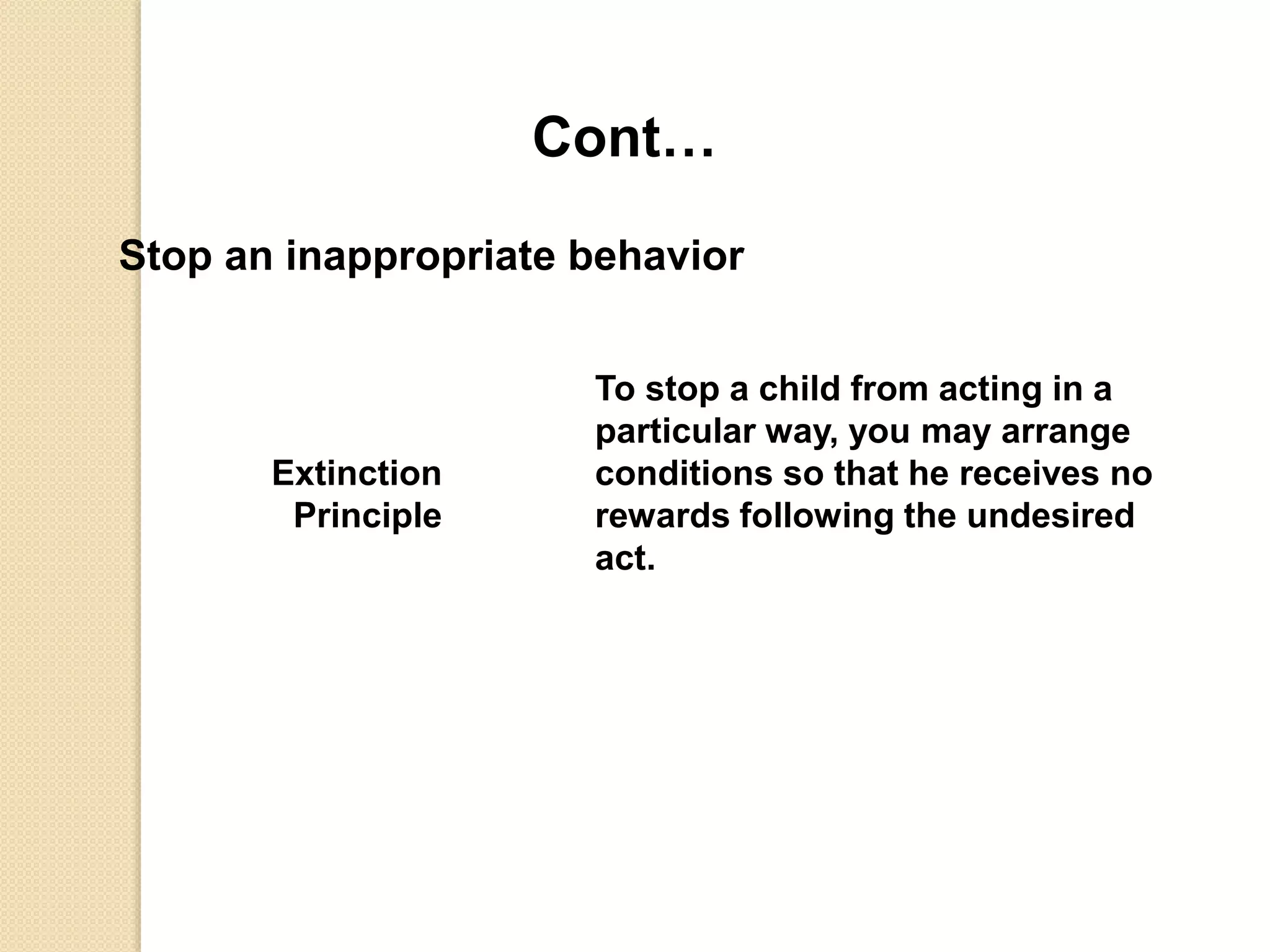
Stop an inappropriate behavior
Extinction
Principle
To stop a child from acting in a
particular way, you may arrange
conditions so that he receives no
rewards following the undesired
act.
Cont…
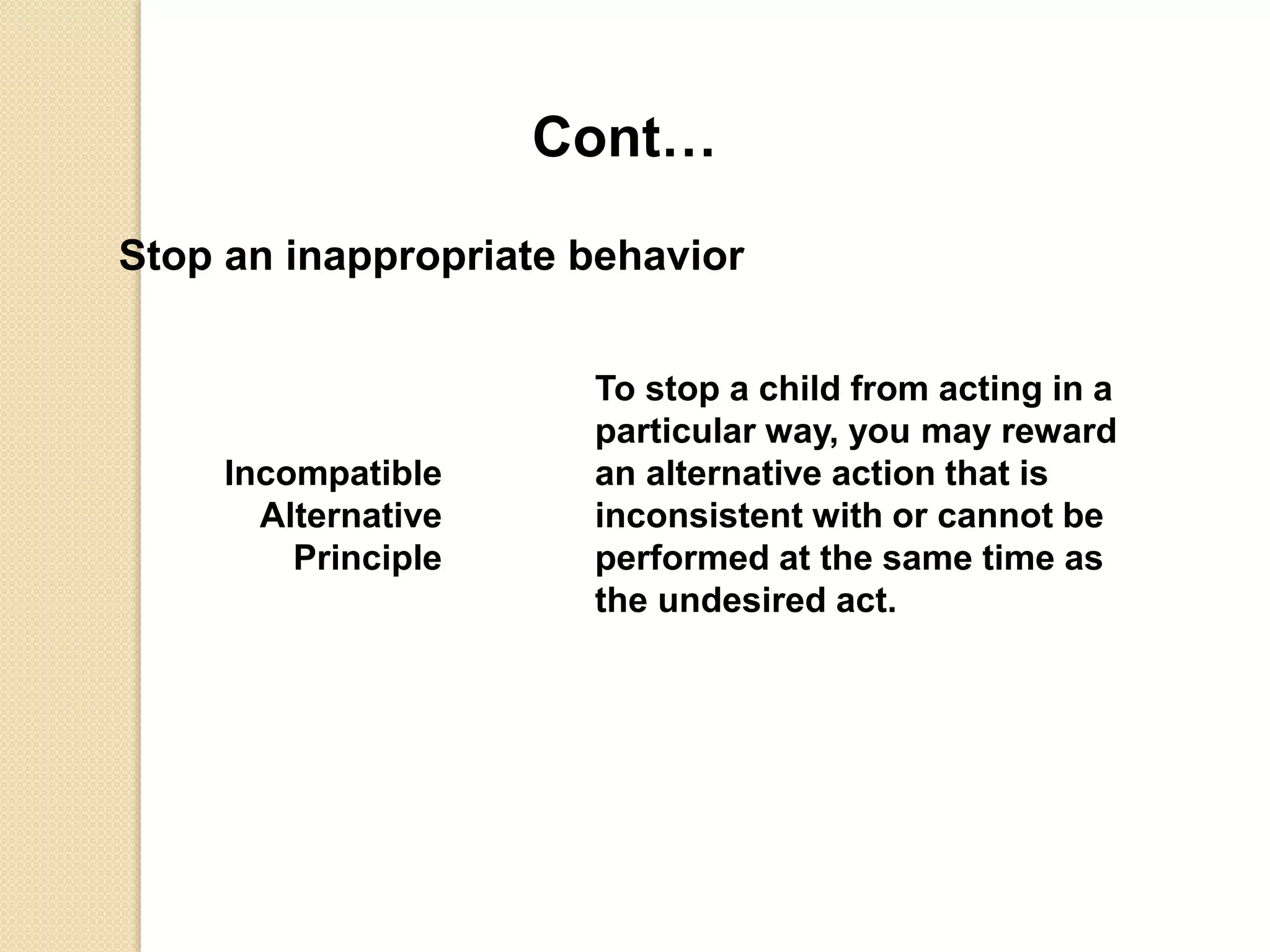
Stop an inappropriate behavior
Incompatible
Alternative
Principle
To stop a child from acting in a
particular way, you may reward
an alternative action that is
inconsistent with or cannot be
performed at the same time as
the undesired act.
Cont…
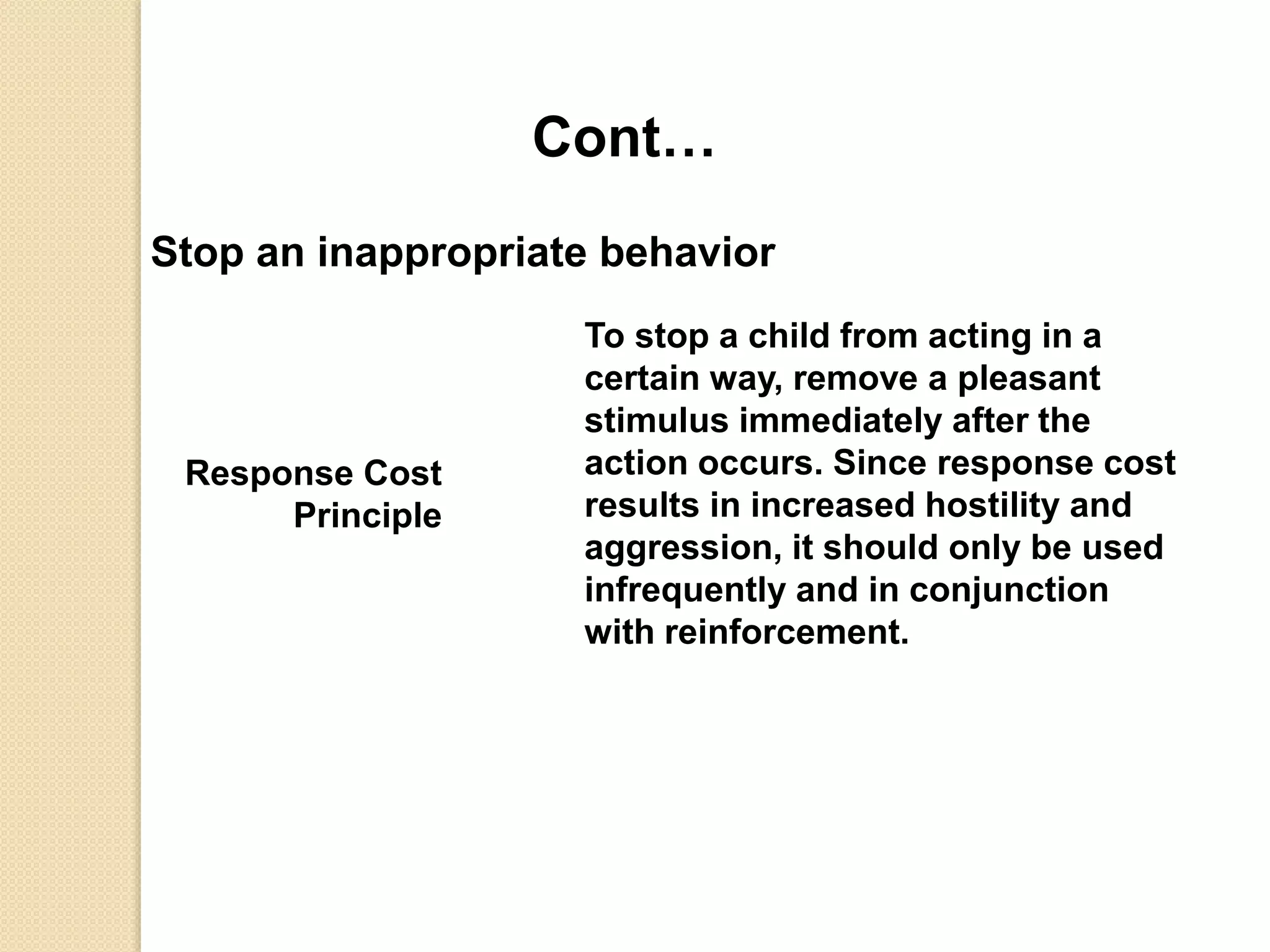
Stop an inappropriate behavior
Response Cost
Principle
To stop a child from acting in a
certain way, remove a pleasant
stimulus immediately after the
action occurs. Since response cost
results in increased hostility and
aggression, it should only be used
infrequently and in conjunction
with reinforcement.
Cont…
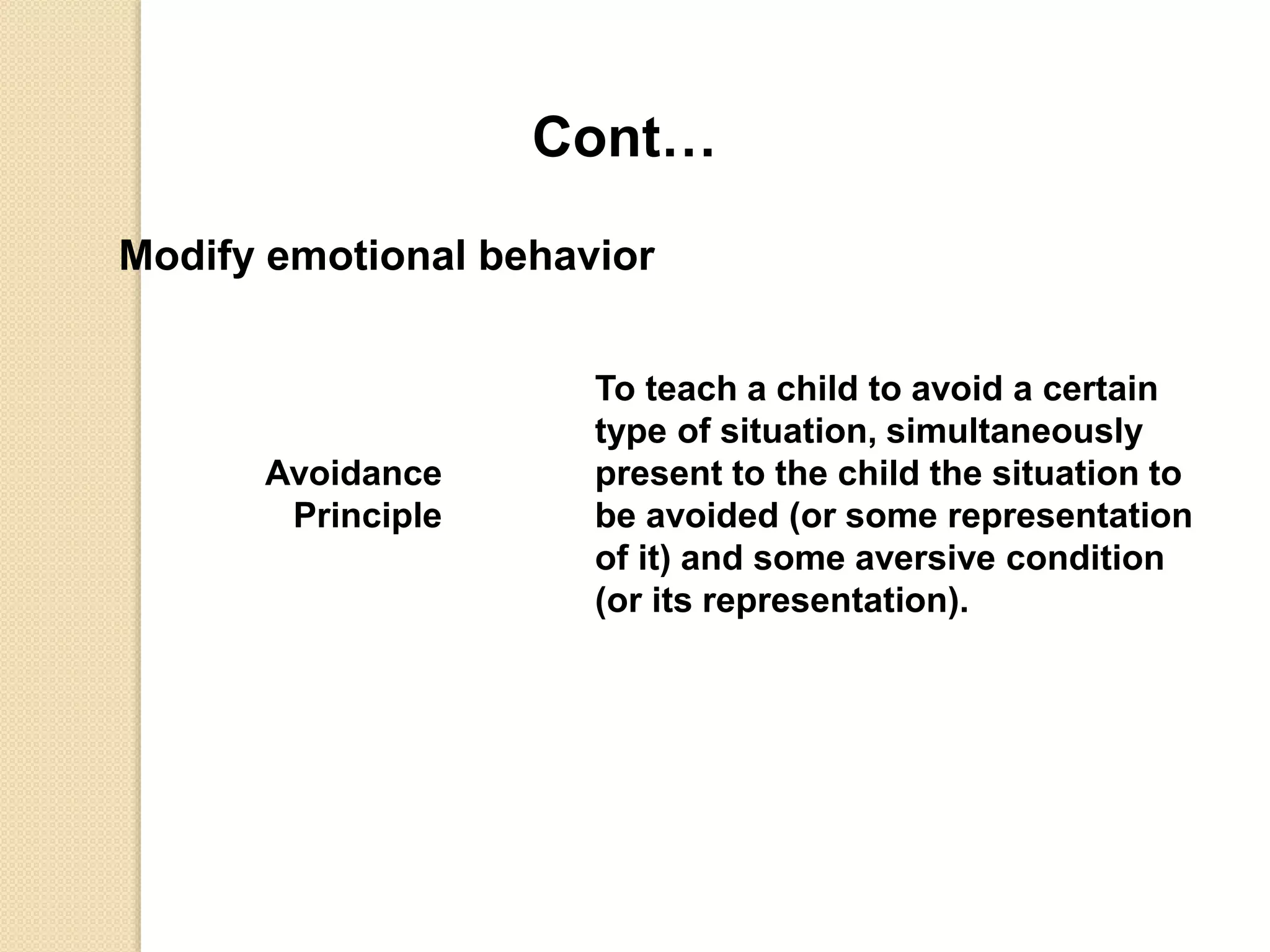
Modify emotional behavior
Avoidance
Principle
To teach a child to avoid a certain
type of situation, simultaneously
present to the child the situation to
be avoided (or some representation
of it) and some aversive condition
(or its representation).
Cont…
Modify emotional behavior
Fear Reduction
Principle
To help a child overcome his fear of
a particular situation, gradually
increase his exposure to the feared
situation while he is otherwise
comfortable, relaxed, secure or
rewarded.
Principles of Behavior Modification
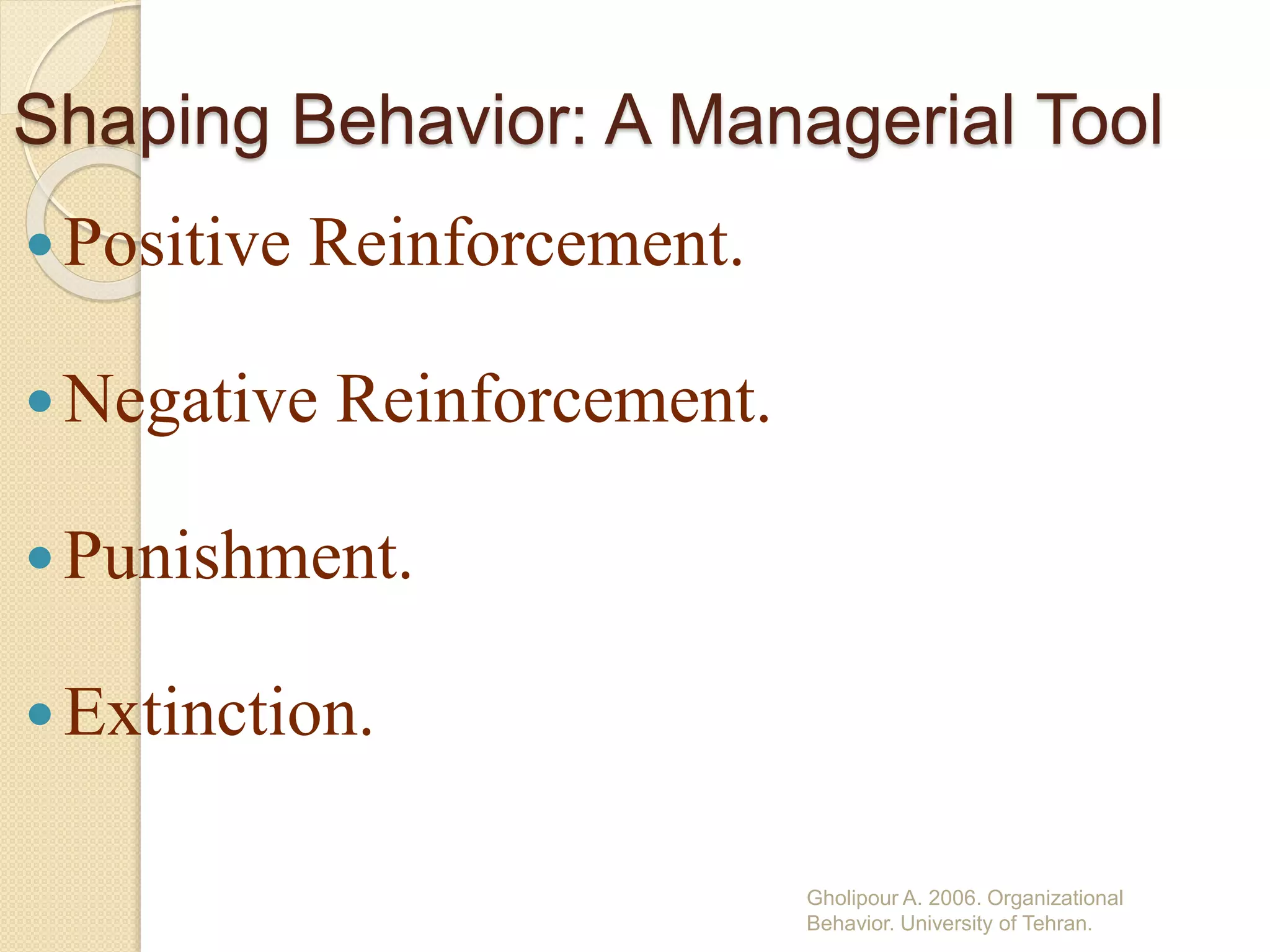
Shaping Behavior: A Managerial Tool
Positive Reinforcement.
Negative Reinforcement.
Punishment.
Extinction.
Gholipour A. 2006. Organizational
Behavior. University of Tehran.
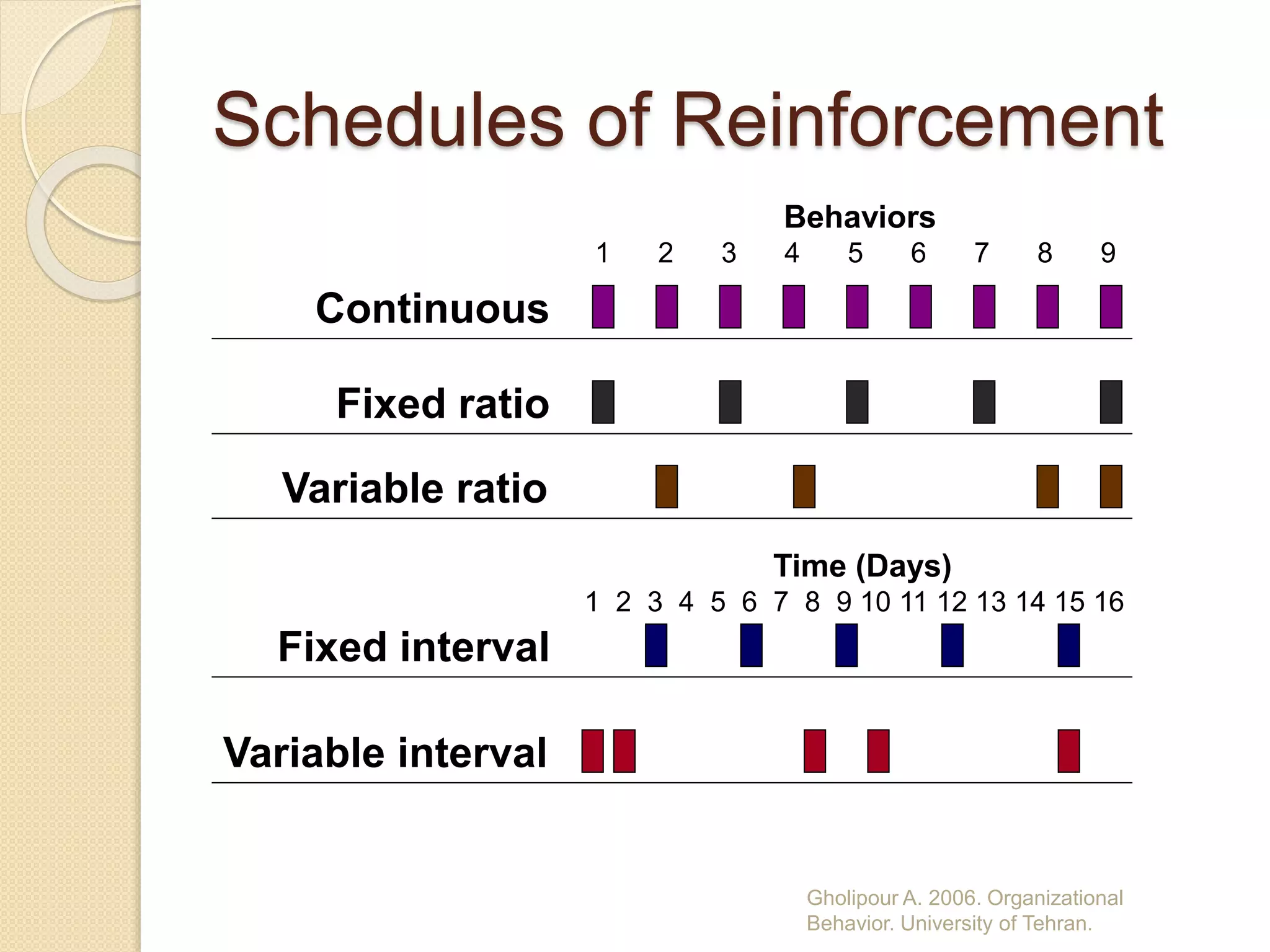
Schedules of Reinforcement
Gholipour A. 2006. Organizational
Behavior. University of Tehran.
Behaviors
1 2 3 4 5 6 7 8 9
Continuous
Fixed ratio
Variable ratio
Fixed interval
Time (Days)
1 2 3 4 5 6 7 8 9 10 11 12 13 14 15 16
Variable interval
Positive Reinforcement
 Positive Reinforcer: stimulus or event
that when presented immediately
following a behavior causes the
behavior to increase in frequency.
◦ Immediate
◦ Contingent
◦ Increases behavior: Always!
Negative Reinforcement
 Immediate removal (escape) or
prevention (avoidance) of an aversive
stimulus contingent upon a behavior
that increases the probability of that
behavior in the future.
 Remember: Reinforcement of any kind
increases behavior!
Punishment
Process of reducing behavior by
immediately presenting an aversive
condition (or removing a reinforcer)
contingent upon a response that
results in a decrease in the frequency
of that response
Punishment always decreases
behavior!
Type I Punishment: Adding Aversive
Stimulation
1. Reprimand
2. Spanking
Remember: If it does not decrease
behavior it is not punishment.
Type II Punishment (Penalty):
removing reinforcement
1. Response Cost
2. Time-Out
Remember: It must decrease behavior or
it is not punishment!
Guidelines For implementing
Punishment
 Target Behavior must be operationally
defined
 Choose an alternate response to reinforce
 Minimize the causes of the undesirable
response
 Use an effective punisher: not paired with
R+ and is available
 Apply: Consistently and Immediately
 Keep records and have someone else
help you monitor!
 State the Rules to the individual
When should punishment be
used?
 The person’s behavior should be a
danger to himself or others.
 Use only after trying reinforcing
procedures
 Social Validity/Informed Consent
 Reliability of Measurement:
Helper/supervisor
 Do not use punishment as a means
to show superiority
Schedules of Reinforcement
 Intermittent: Reinforcement occurs once in a
while.
 Continuous: Reinforcement after each
response.
 Resistance to Extinction: The number
responses or amount of time before a
response extinguishes.
 Intermittent > Continuous
Punishers
1. Verbal reprimand
2. Planned ignoring
3. Extinction
4. Response interruption
5. Time out
6. Removing a privilege
7. Suspension from work
33
Punishment
1. To stop a problem behavior immediately to
prevent harm
2. To teach alternative positive behavior
3. Immediate effect
4. The effect does not last.
5. should be used when the side effects of
punishment are clearly outweighed by the
potential benefits.
34
Factors affect the effectiveness
of punishers
1. Adaptation
A punisher may lose its effectiveness if
it was delivered frequently in a short
period of time.
2. Conditioned punisher
Saying “No!” will lose its effectiveness if
it is not paired with another punisher.
35
Factors affect the effectiveness of
reinforcers/punishers
1. Contingency
A reinforcer/punisher should be
delivered contingent to the target
behavior
2. Immediacy
A reinforcer/punisher should be
provided immediately following the
target behavior.
36
Replacement Behavior
1. Target behavior serves a purpose
(fulfilling practical or psychological
needs)
2. Replacement behavior provides an
alternative means for achieving the same
purpose as the target behavior
3. The focus should be on teaching the
person to access the same reinforcers37
Replacement Behavior
1. Don’t just take the behavior away.
2. What maintains problem behavior can
maintain appropriate behavior if you
know what the function of the behavior
is
3. Teach skills that will replace the problem
behavior
38
Replacement Behavior
 For behavior maintained by escape
1. Evaluate task/activity and determine
aversive qualities
2. Modify task or alter environment
3. Teach functional communication skills
4. Escape card
5. Desensitization when situation cannot
be avoided
39
Behavioral approach to Teaching:
Mastery Learning
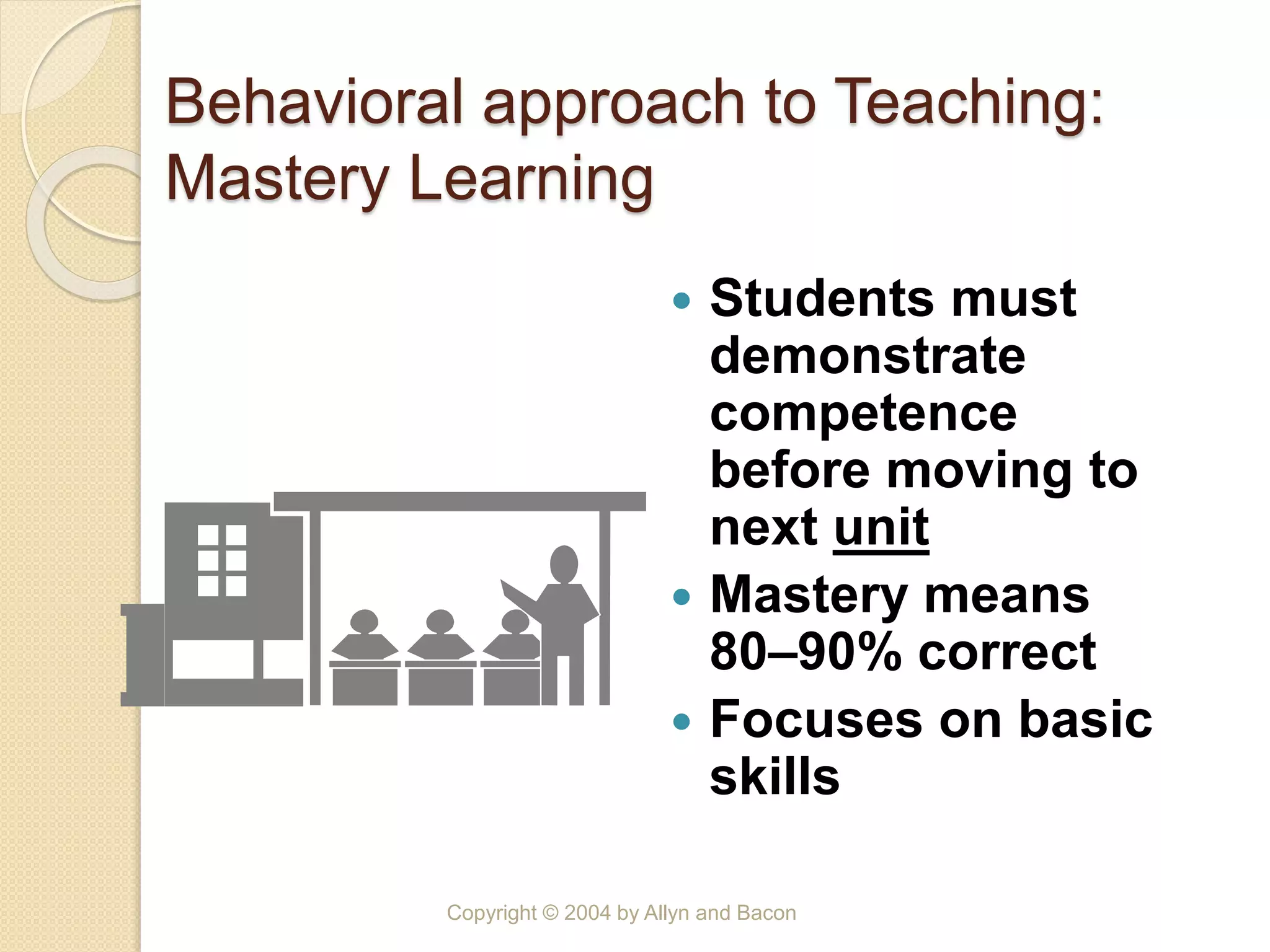
 Students must
demonstrate
competence
before moving to
next unit
 Mastery means
80–90% correct
 Focuses on basic
skills
Copyright © 2004 by Allyn and Bacon
Behavioral Management
 Group
consequences
 Token
reinforcement
 Contingency
contracts
Copyright © 2004 by Allyn and Bacon
Recent Approaches: Self-Regulated
Learning
 The responsibility and ability to learn rest with the
student (student takes active role in own B-mod).
 Self-management (for lifelong learning)
◦ Set goals and make the goals public
◦ Standards and effect on performance
◦ Record & evaluate performance
◦ Promote self-reinforcement
Copyright © 2004 by Allyn and Bacon
Recent Approaches: Cognitive Behavior
Modification & Self-Instruction
 Similar to self-regulated learning
 Adds thinking and self-talk
◦ Vygotsky (private speech)
◦ Meichenbaum (cognitive self instruction)
 More cognitive than behavioral approach
Copyright © 2004 by Allyn and Bacon
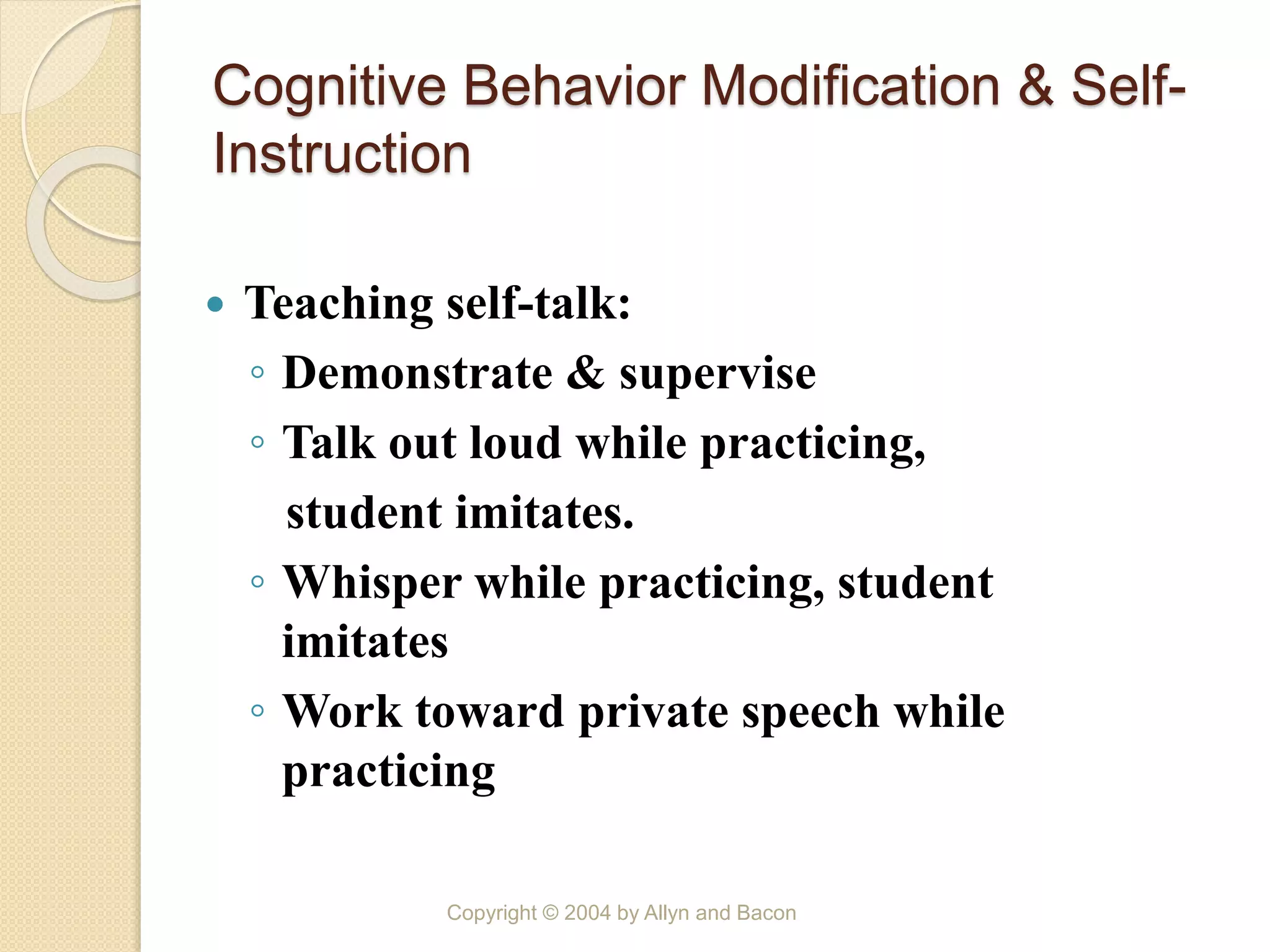
Cognitive Behavior Modification & Self-
Instruction
 Teaching self-talk:
◦ Demonstrate & supervise
◦ Talk out loud while practicing,
student imitates.
◦ Whisper while practicing, student
imitates
◦ Work toward private speech while
practicing
Copyright © 2004 by Allyn and Bacon
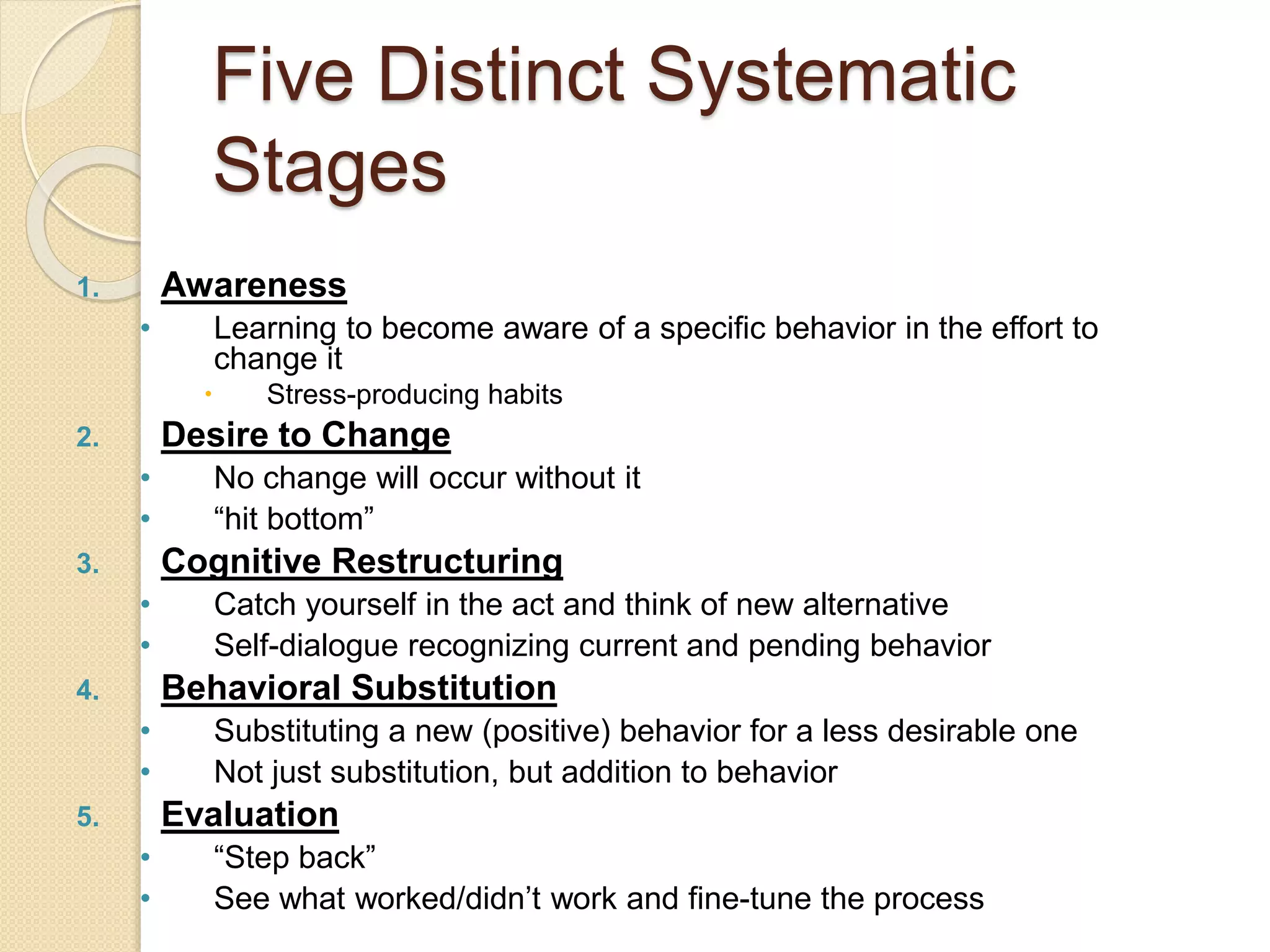
Five Distinct Systematic
Stages
1. Awareness
• Learning to become aware of a specific behavior in the effort to
change it
 Stress-producing habits
2. Desire to Change
• No change will occur without it
• “hit bottom”
3. Cognitive Restructuring
• Catch yourself in the act and think of new alternative
• Self-dialogue recognizing current and pending behavior
4. Behavioral Substitution
• Substituting a new (positive) behavior for a less desirable one
• Not just substitution, but addition to behavior
5. Evaluation
• “Step back”
• See what worked/didn’t work and fine-tune the process
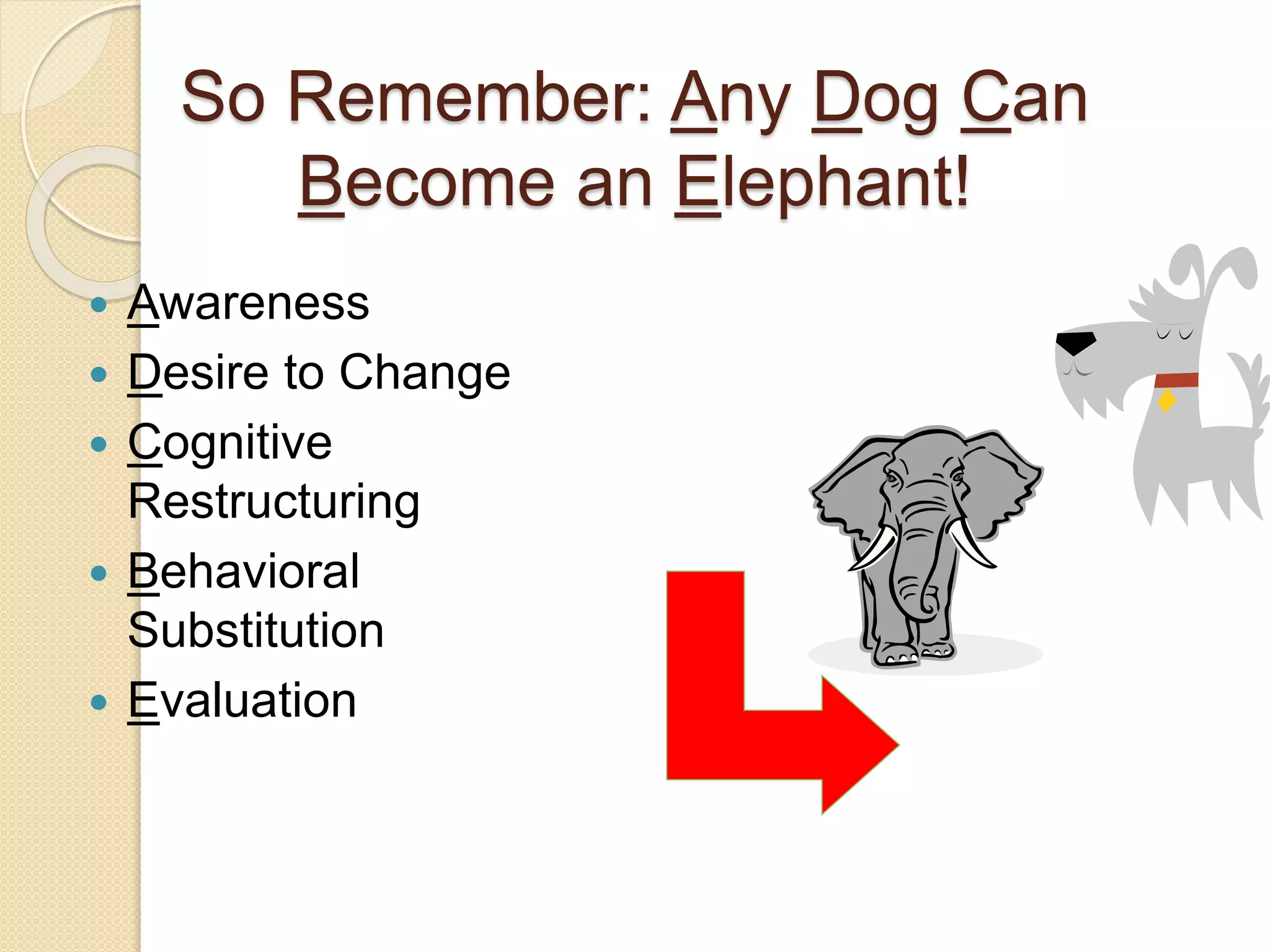
So Remember: Any Dog Can
Become an Elephant!
 Awareness
 Desire to Change
 Cognitive
Restructuring
 Behavioral
Substitution
 Evaluation
Thanks
Gholipour A. 2006. Organizational
Behavior. University of Tehran.

Behavior modification

  • 1.
    Behavior Modification Dr. SushmaRathee Assistant Clinical Psychologist , PGIMER, Chandigarh Email: sushmaratheecp@gmail.com 1
  • 2.
    What is Behavior Modification? Systematicapplication of learning principles and techniques to assess and improve individuals covert and overt behaviors in order to help them function more fully in society.
  • 3.
    Characteristics of Behavior Modification Emphasized defining and measuring behavior  Treatment focuses greatly on the environment.  Methods and rationales can be described precisely.
  • 4.
    Characteristics of Behavior Modification Techniques are often applied by individuals in everyday life. - Applied not theoretical  Most techniques are based on research on learning  Emphasizes scientific method  Accountability is placed on everyone involved.
  • 5.
    Misconceptions about Behavior modification 1.Rewards and reinforcement are nothing more than bribes. 2. It is drugs, psychosurgery, ECT 3. It only changes symptoms not underlying problems.
  • 6.
    Misconceptions about Behavior modification 4.Can be applied to simple, but not complex problems 5. Behavior analysts are cold non- empathetic people. 6. Behavior modifiers deal only with observable behavior. 7. Behavior modification is outdated.
  • 7.
    Steps in Behavior Modification Scientific use of behavior (learning) principles ◦ Goal setting ◦ Behavioral Definitions ◦ Functional Analysis ◦ Objective measurement ◦ Data collection ◦ Evaluation ~
  • 8.
    Behavior Modification  Step1: Identify Target behavior  Step 2: Functionally Analyze the Situation  Step 3: Arrange Antecedents and Provide Consequences  Step 4: Evaluate Results Gholipour A. 2006. Organizational Behavior. University of Tehran.
  • 9.
    Behavior Modification Techniques Developa new behavior Successive Approximation Principle To teach a child to act in a manner in which he has seldom or never before behaved, reward successive steps to the final behavior (also called shaping).
  • 10.
    Cont… Develop a newbehavior Continuous Reinforcement Principle To develop a new behavior that the child has not previously exhibited, arrange for an immediate reward after each correct performance.
  • 11.
    Cont… Develop a newbehavior Negative Reinforcement Principle To increase a child's performance in a particular way, arrange for him to avoid or escape a mild aversive situation by improving his behavior or by allowing him to avoid the aversive situation by behaving appropriately.
  • 12.
    Cont… Develop a newbehavior Cueing Principle To teach a child to remember to act at a specific time, arrange for him to receive a cue for the correct performance just before the action is expected rather than after he has performed it incorrectly.
  • 13.
    Cont… Strengthen a newbehavior Decreasing Reinforcement Principle To encourage a child to continue performing an established behavior with few or no rewards, gradually require a longer time period or more correct responses before a correct behavior is rewarded.
  • 14.
    Cont… Strengthen a newbehavior Variable Reinforcement Principle To improve or increase a child's performance of a certain activity, provide the child with an intermittent reward.
  • 15.
    Cont… Maintain an establishedbehavior Substitution Principle To change reinforcers when a previously effective reward is no longer controlling behavior, present it just before (or as soon as possible to) the time you present the new, hopefully more effective reward.
  • 16.
    Cont… Stop an inappropriatebehavior Satiation Principle To stop a child from acting in a particular way, you may allow him to continue (or insist that he continue) performing the undesired act until he tires of it.
  • 17.
    Cont… Stop an inappropriatebehavior Extinction Principle To stop a child from acting in a particular way, you may arrange conditions so that he receives no rewards following the undesired act.
  • 18.
    Cont… Stop an inappropriatebehavior Incompatible Alternative Principle To stop a child from acting in a particular way, you may reward an alternative action that is inconsistent with or cannot be performed at the same time as the undesired act.
  • 19.
    Cont… Stop an inappropriatebehavior Response Cost Principle To stop a child from acting in a certain way, remove a pleasant stimulus immediately after the action occurs. Since response cost results in increased hostility and aggression, it should only be used infrequently and in conjunction with reinforcement.
  • 20.
    Cont… Modify emotional behavior Avoidance Principle Toteach a child to avoid a certain type of situation, simultaneously present to the child the situation to be avoided (or some representation of it) and some aversive condition (or its representation).
  • 21.
    Cont… Modify emotional behavior FearReduction Principle To help a child overcome his fear of a particular situation, gradually increase his exposure to the feared situation while he is otherwise comfortable, relaxed, secure or rewarded.
  • 22.
  • 23.
    Shaping Behavior: AManagerial Tool Positive Reinforcement. Negative Reinforcement. Punishment. Extinction. Gholipour A. 2006. Organizational Behavior. University of Tehran.
  • 24.
    Schedules of Reinforcement GholipourA. 2006. Organizational Behavior. University of Tehran. Behaviors 1 2 3 4 5 6 7 8 9 Continuous Fixed ratio Variable ratio Fixed interval Time (Days) 1 2 3 4 5 6 7 8 9 10 11 12 13 14 15 16 Variable interval
  • 25.
    Positive Reinforcement  PositiveReinforcer: stimulus or event that when presented immediately following a behavior causes the behavior to increase in frequency. ◦ Immediate ◦ Contingent ◦ Increases behavior: Always!
  • 26.
    Negative Reinforcement  Immediateremoval (escape) or prevention (avoidance) of an aversive stimulus contingent upon a behavior that increases the probability of that behavior in the future.  Remember: Reinforcement of any kind increases behavior!
  • 27.
    Punishment Process of reducingbehavior by immediately presenting an aversive condition (or removing a reinforcer) contingent upon a response that results in a decrease in the frequency of that response Punishment always decreases behavior!
  • 28.
    Type I Punishment:Adding Aversive Stimulation 1. Reprimand 2. Spanking Remember: If it does not decrease behavior it is not punishment.
  • 29.
    Type II Punishment(Penalty): removing reinforcement 1. Response Cost 2. Time-Out Remember: It must decrease behavior or it is not punishment!
  • 30.
    Guidelines For implementing Punishment Target Behavior must be operationally defined  Choose an alternate response to reinforce  Minimize the causes of the undesirable response  Use an effective punisher: not paired with R+ and is available  Apply: Consistently and Immediately  Keep records and have someone else help you monitor!  State the Rules to the individual
  • 31.
    When should punishmentbe used?  The person’s behavior should be a danger to himself or others.  Use only after trying reinforcing procedures  Social Validity/Informed Consent  Reliability of Measurement: Helper/supervisor  Do not use punishment as a means to show superiority
  • 32.
    Schedules of Reinforcement Intermittent: Reinforcement occurs once in a while.  Continuous: Reinforcement after each response.  Resistance to Extinction: The number responses or amount of time before a response extinguishes.  Intermittent > Continuous
  • 33.
    Punishers 1. Verbal reprimand 2.Planned ignoring 3. Extinction 4. Response interruption 5. Time out 6. Removing a privilege 7. Suspension from work 33
  • 34.
    Punishment 1. To stopa problem behavior immediately to prevent harm 2. To teach alternative positive behavior 3. Immediate effect 4. The effect does not last. 5. should be used when the side effects of punishment are clearly outweighed by the potential benefits. 34
  • 35.
    Factors affect theeffectiveness of punishers 1. Adaptation A punisher may lose its effectiveness if it was delivered frequently in a short period of time. 2. Conditioned punisher Saying “No!” will lose its effectiveness if it is not paired with another punisher. 35
  • 36.
    Factors affect theeffectiveness of reinforcers/punishers 1. Contingency A reinforcer/punisher should be delivered contingent to the target behavior 2. Immediacy A reinforcer/punisher should be provided immediately following the target behavior. 36
  • 37.
    Replacement Behavior 1. Targetbehavior serves a purpose (fulfilling practical or psychological needs) 2. Replacement behavior provides an alternative means for achieving the same purpose as the target behavior 3. The focus should be on teaching the person to access the same reinforcers37
  • 38.
    Replacement Behavior 1. Don’tjust take the behavior away. 2. What maintains problem behavior can maintain appropriate behavior if you know what the function of the behavior is 3. Teach skills that will replace the problem behavior 38
  • 39.
    Replacement Behavior  Forbehavior maintained by escape 1. Evaluate task/activity and determine aversive qualities 2. Modify task or alter environment 3. Teach functional communication skills 4. Escape card 5. Desensitization when situation cannot be avoided 39
  • 40.
    Behavioral approach toTeaching: Mastery Learning  Students must demonstrate competence before moving to next unit  Mastery means 80–90% correct  Focuses on basic skills Copyright © 2004 by Allyn and Bacon
  • 41.
    Behavioral Management  Group consequences Token reinforcement  Contingency contracts Copyright © 2004 by Allyn and Bacon
  • 42.
    Recent Approaches: Self-Regulated Learning The responsibility and ability to learn rest with the student (student takes active role in own B-mod).  Self-management (for lifelong learning) ◦ Set goals and make the goals public ◦ Standards and effect on performance ◦ Record & evaluate performance ◦ Promote self-reinforcement Copyright © 2004 by Allyn and Bacon
  • 43.
    Recent Approaches: CognitiveBehavior Modification & Self-Instruction  Similar to self-regulated learning  Adds thinking and self-talk ◦ Vygotsky (private speech) ◦ Meichenbaum (cognitive self instruction)  More cognitive than behavioral approach Copyright © 2004 by Allyn and Bacon
  • 44.
    Cognitive Behavior Modification& Self- Instruction  Teaching self-talk: ◦ Demonstrate & supervise ◦ Talk out loud while practicing, student imitates. ◦ Whisper while practicing, student imitates ◦ Work toward private speech while practicing Copyright © 2004 by Allyn and Bacon
  • 45.
    Five Distinct Systematic Stages 1.Awareness • Learning to become aware of a specific behavior in the effort to change it  Stress-producing habits 2. Desire to Change • No change will occur without it • “hit bottom” 3. Cognitive Restructuring • Catch yourself in the act and think of new alternative • Self-dialogue recognizing current and pending behavior 4. Behavioral Substitution • Substituting a new (positive) behavior for a less desirable one • Not just substitution, but addition to behavior 5. Evaluation • “Step back” • See what worked/didn’t work and fine-tune the process
  • 46.
    So Remember: AnyDog Can Become an Elephant!  Awareness  Desire to Change  Cognitive Restructuring  Behavioral Substitution  Evaluation
  • 47.
    Thanks Gholipour A. 2006.Organizational Behavior. University of Tehran.