
E3145/3/1
PIPING AND INSTRUMENTATION DRAWING (PNID)
PIPING AND INSTRUMENTATION DRAWING
(PNID)
OBJECTIVES
General Objective : To understand and to apply the concept of piping and
instrumentation drawing (PNID).
Specific Objectives : At the end of the unit you will be able to :
 State the definition of PNID.
 Discuss the comparison between pneumatic control
system and hydraulic control system.
 Draw the instruments symbols.
 Name the symbols of pneumatic system components
and hydraulic system components.
UNIT3
E3145/3/2
PIPING AND INSTRUMENTATION DRAWING (PNID)
3.0 Explanation of PNID
Piping and instrumentation drawing (PNID) includes the components
of pneumatic control system and hydraulic control system. Pneumatic control
system uses compressible fluid meanwhile the hydraulic control system uses
incompressible fluid.
The basic components of pneumatic system are : compressor , air
tank, air dryer, regulator, directional control valve and actuator. For hydraulic
system the components are : pump, motor or cylinder, oil tank and valve.
Basically, pneumatic system is widely used in the electronic, food, and
automotive industry. Below are the uses of pneumatic system :
• Transferring of materials
• Drilling system
• Material handling (clamping, shifting, positioning, orienting)
• Stamping
• Packaging
• Automation
INPUTINPUT
Piping and instrumentation
drawing (PNID) includes the
components of pneumatic
control system and hydraulic
control system.
E3145/3/3
PIPING AND INSTRUMENTATION DRAWING (PNID)
Meanwhile, hydraulic system is normally used to operate :
• Back hoe
• Bull dozer
• CNC machine
• Load loader
• Die casting machine
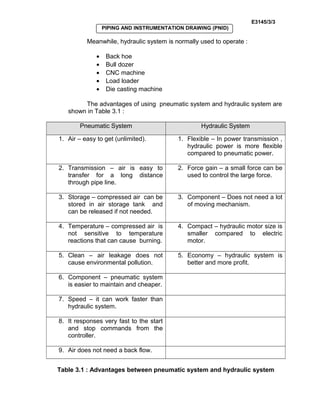
The advantages of using pneumatic system and hydraulic system are
shown in Table 3.1 :
Pneumatic System Hydraulic System
1. Air – easy to get (unlimited). 1. Flexible – In power transmission ,
hydraulic power is more flexible
compared to pneumatic power.
2. Transmission – air is easy to
transfer for a long distance
through pipe line.
2. Force gain – a small force can be
used to control the large force.
3. Storage – compressed air can be
stored in air storage tank and
can be released if not needed.
3. Component – Does not need a lot
of moving mechanism.
4. Temperature – compressed air is
not sensitive to temperature
reactions that can cause burning.
4. Compact – hydraulic motor size is
smaller compared to electric
motor.
5. Clean – air leakage does not
cause environmental pollution.
5. Economy – hydraulic system is
better and more profit.
6. Component – pneumatic system
is easier to maintain and cheaper.
7. Speed – it can work faster than
hydraulic system.
8. It responses very fast to the start
and stop commands from the
controller.
9. Air does not need a back flow.
Table 3.1 : Advantages between pneumatic system and hydraulic system
E3145/3/4
PIPING AND INSTRUMENTATION DRAWING (PNID)
(Source : Jubaidi Bin Razali, Pneumatik & Hidraulik)
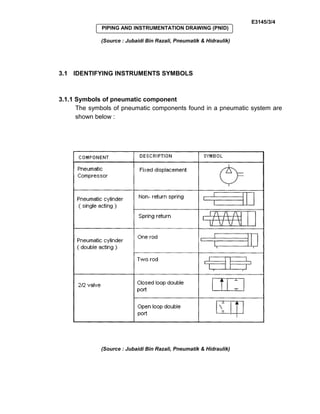
3.1 IDENTIFYING INSTRUMENTS SYMBOLS
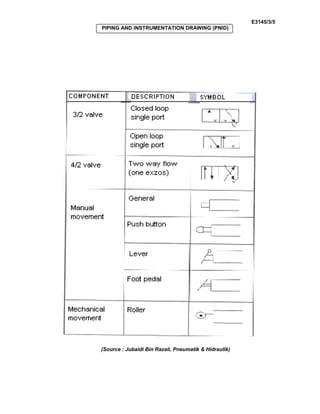
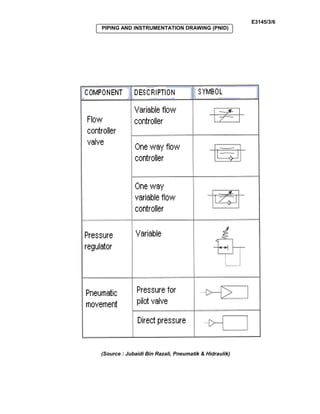
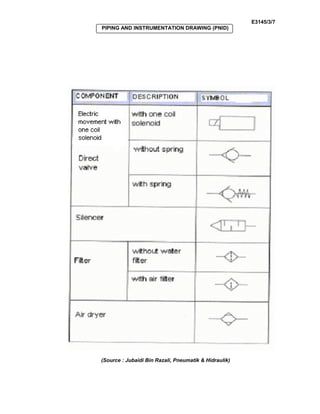
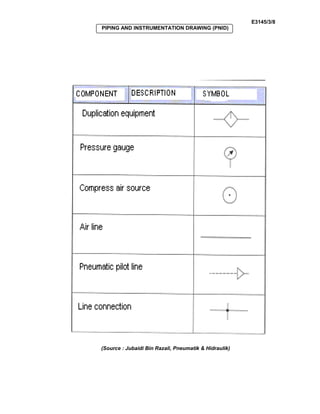
3.1.1 Symbols of pneumatic component
The symbols of pneumatic components found in a pneumatic system are
shown below :
(Source : Jubaidi Bin Razali, Pneumatik & Hidraulik)
E3145/3/5
PIPING AND INSTRUMENTATION DRAWING (PNID)
(Source : Jubaidi Bin Razali, Pneumatik & Hidraulik)
E3145/3/6
PIPING AND INSTRUMENTATION DRAWING (PNID)
(Source : Jubaidi Bin Razali, Pneumatik & Hidraulik)
E3145/3/7
PIPING AND INSTRUMENTATION DRAWING (PNID)
(Source : Jubaidi Bin Razali, Pneumatik & Hidraulik)
E3145/3/8
PIPING AND INSTRUMENTATION DRAWING (PNID)
(Source : Jubaidi Bin Razali, Pneumatik & Hidraulik)
E3145/3/9
PIPING AND INSTRUMENTATION DRAWING (PNID)
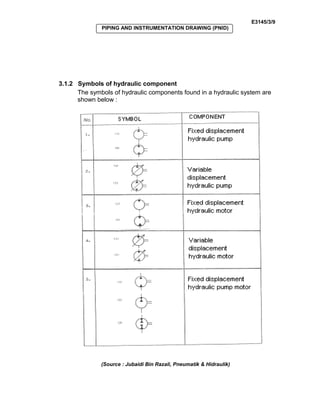
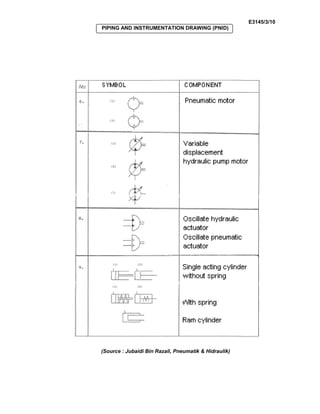
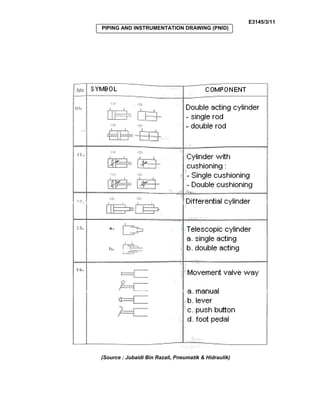
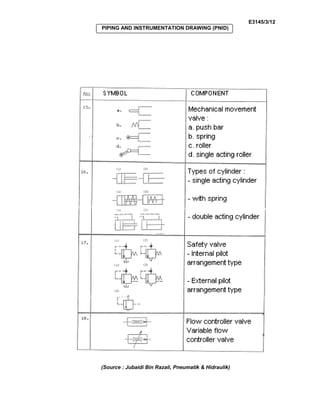
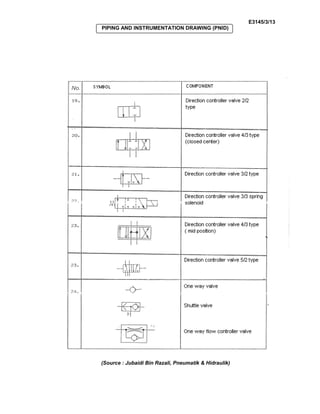
3.1.2 Symbols of hydraulic component
The symbols of hydraulic components found in a hydraulic system are
shown below :
(Source : Jubaidi Bin Razali, Pneumatik & Hidraulik)
E3145/3/10
PIPING AND INSTRUMENTATION DRAWING (PNID)
(Source : Jubaidi Bin Razali, Pneumatik & Hidraulik)
E3145/3/11
PIPING AND INSTRUMENTATION DRAWING (PNID)
(Source : Jubaidi Bin Razali, Pneumatik & Hidraulik)
E3145/3/12
PIPING AND INSTRUMENTATION DRAWING (PNID)
(Source : Jubaidi Bin Razali, Pneumatik & Hidraulik)
E3145/3/13
PIPING AND INSTRUMENTATION DRAWING (PNID)
(Source : Jubaidi Bin Razali, Pneumatik & Hidraulik)
E3145/3/14
PIPING AND INSTRUMENTATION DRAWING (PNID)
(Source : Jubaidi Bin Razali, Pneumatik & Hidraulik)
E3145/3/15
PIPING AND INSTRUMENTATION DRAWING (PNID)
Activity 3
TEST YOUR UNDERSTANDING BEFORE YOU CONTINUE WITH THE
NEXT INPUT…!
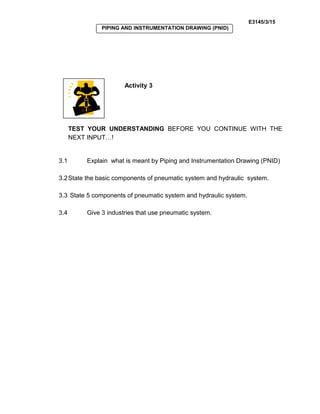
3.1 Explain what is meant by Piping and Instrumentation Drawing (PNID)
3.2State the basic components of pneumatic system and hydraulic system.
3.3 State 5 components of pneumatic system and hydraulic system.
3.4 Give 3 industries that use pneumatic system.
E3145/3/16
PIPING AND INSTRUMENTATION DRAWING (PNID)
Feedback To Activity 3
3.1 Piping and instrumentation drawing (PNID) includes the components
of pneumatic control system and hydraulic control system. Pneumatic
control system uses a compressible fluid while the hydraulic control
system uses incompressible fluid.
3.2The basic components of pneumatic system are : compressor , air tank,
air dryer, regulator, directional control valve and actuator. The basic
components of hydraulic system are : tank, filter, pump, valve, motor
and cylinder.
3.3 Pneumatic system components
a. Pneumatic compressor
b. Pneumatic cylinder (single acting)
c. Pneumatic cylinder (double acting)
d. Valve 2/2
e. Flow controller valve
Hydraulic system components
a. Fixed displacement hydraulic pump
b. Double acting cylinder
c. Differential cylinder
d. Pneumatic motor
e. Direction controller valve 2/2 type
3.4 a. Food industry
b. Automotive industry
c. Electronic industry
E3145/3/17
PIPING AND INSTRUMENTATION DRAWING (PNID)
KEY FACTS
1. Piping and instrumentation drawing (PNID) includes :
• components of pneumatic control system
• components of hydraulic control system
2. The basic components of pneumatic system are :
• compressor
• air tank
• air dryer
• regulator
• directional control valve
• actuator
3. The basic components of hydraulic system are :
• pump
• motor or cylinder
• oil tank
• valve.
E3145/3/18
PIPING AND INSTRUMENTATION DRAWING (PNID)
SELF-ASSESSMENT
You are approaching success. Try all the questions in this self-assessment
section and check your answers with those given in the Feedback on Self-
Assessment given on the next page. If you face any problems, discuss it
with your lecturer. Good luck.
Q3-1 Define the word ‘PNEUMATIC’ and explain how this system functions.
Q3-2 State the advantages between pneumatic system and hydraulic
system.
Q3-3 State 5 advantages of pneumatic system.
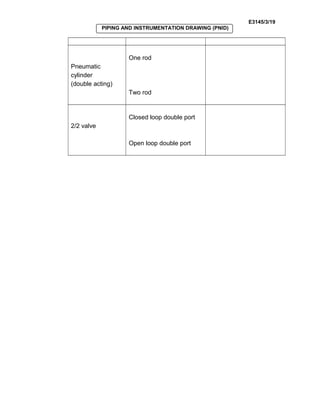
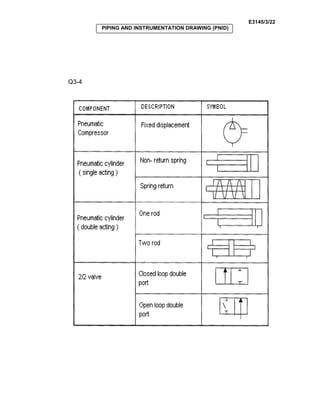
Q3-4 Draw the symbols of the pneumatic components given below in the
space provided.
COMPONENT DESCRIPTION SYMBOLS
Pneumatic
compressor
Fixed displacement
Pneumatic
cylinder
(single acting)
Non-return spring
Spring return
E3145/3/19
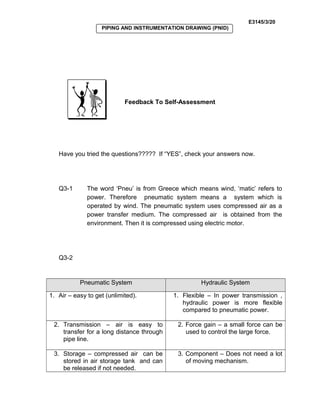
PIPING AND INSTRUMENTATION DRAWING (PNID)
Pneumatic
cylinder
(double acting)
One rod
Two rod
2/2 valve
Closed loop double port
Open loop double port
E3145/3/20
PIPING AND INSTRUMENTATION DRAWING (PNID)
Feedback To Self-Assessment
Have you tried the questions????? If “YES”, check your answers now.
Q3-1 The word ‘Pneu’ is from Greece which means wind, ‘matic’ refers to
power. Therefore pneumatic system means a system which is
operated by wind. The pneumatic system uses compressed air as a
power transfer medium. The compressed air is obtained from the
environment. Then it is compressed using electric motor.
Q3-2
Pneumatic System Hydraulic System
1. Air – easy to get (unlimited). 1. Flexible – In power transmission ,
hydraulic power is more flexible
compared to pneumatic power.
2. Transmission – air is easy to
transfer for a long distance through
pipe line.
2. Force gain – a small force can be
used to control the large force.
3. Storage – compressed air can be
stored in air storage tank and can
be released if not needed.
3. Component – Does not need a lot
of moving mechanism.
E3145/3/21
PIPING AND INSTRUMENTATION DRAWING (PNID)
4. Temperature – compressed air is
not sensitive to temperature
reactions that can cause burning.
4. Compact – hydraulic motor size is
smaller compared to electric motor.
5. Clean – air leakage does not cause
environmental pollution.
5. Economy – hydraulic system is
better and more profit.
6. Component – pneumatic system is
easier to maintain and cheaper.
7. Speed – it can work faster than
hydraulic system.
8. It responses very fast to the start
and stop commands from the
controller.
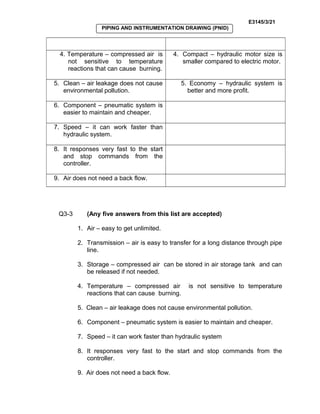
9. Air does not need a back flow.
Q3-3 (Any five answers from this list are accepted)
1. Air – easy to get unlimited.
2. Transmission – air is easy to transfer for a long distance through pipe
line.
3. Storage – compressed air can be stored in air storage tank and can
be released if not needed.
4. Temperature – compressed air is not sensitive to temperature
reactions that can cause burning.
5. Clean – air leakage does not cause environmental pollution.
6. Component – pneumatic system is easier to maintain and cheaper.
7. Speed – it can work faster than hydraulic system
8. It responses very fast to the start and stop commands from the
controller.
9. Air does not need a back flow.
E3145/3/22
PIPING AND INSTRUMENTATION DRAWING (PNID)
Q3-4
E3145/3/23
PIPING AND INSTRUMENTATION DRAWING (PNID)

Basic Control System unit3

  • 1.
    E3145/3/1 PIPING AND INSTRUMENTATIONDRAWING (PNID) PIPING AND INSTRUMENTATION DRAWING (PNID) OBJECTIVES General Objective : To understand and to apply the concept of piping and instrumentation drawing (PNID). Specific Objectives : At the end of the unit you will be able to :  State the definition of PNID.  Discuss the comparison between pneumatic control system and hydraulic control system.  Draw the instruments symbols.  Name the symbols of pneumatic system components and hydraulic system components. UNIT3
  • 2.
    E3145/3/2 PIPING AND INSTRUMENTATIONDRAWING (PNID) 3.0 Explanation of PNID Piping and instrumentation drawing (PNID) includes the components of pneumatic control system and hydraulic control system. Pneumatic control system uses compressible fluid meanwhile the hydraulic control system uses incompressible fluid. The basic components of pneumatic system are : compressor , air tank, air dryer, regulator, directional control valve and actuator. For hydraulic system the components are : pump, motor or cylinder, oil tank and valve. Basically, pneumatic system is widely used in the electronic, food, and automotive industry. Below are the uses of pneumatic system : • Transferring of materials • Drilling system • Material handling (clamping, shifting, positioning, orienting) • Stamping • Packaging • Automation INPUTINPUT Piping and instrumentation drawing (PNID) includes the components of pneumatic control system and hydraulic control system.
  • 3.
    E3145/3/3 PIPING AND INSTRUMENTATIONDRAWING (PNID) Meanwhile, hydraulic system is normally used to operate : • Back hoe • Bull dozer • CNC machine • Load loader • Die casting machine The advantages of using pneumatic system and hydraulic system are shown in Table 3.1 : Pneumatic System Hydraulic System 1. Air – easy to get (unlimited). 1. Flexible – In power transmission , hydraulic power is more flexible compared to pneumatic power. 2. Transmission – air is easy to transfer for a long distance through pipe line. 2. Force gain – a small force can be used to control the large force. 3. Storage – compressed air can be stored in air storage tank and can be released if not needed. 3. Component – Does not need a lot of moving mechanism. 4. Temperature – compressed air is not sensitive to temperature reactions that can cause burning. 4. Compact – hydraulic motor size is smaller compared to electric motor. 5. Clean – air leakage does not cause environmental pollution. 5. Economy – hydraulic system is better and more profit. 6. Component – pneumatic system is easier to maintain and cheaper. 7. Speed – it can work faster than hydraulic system. 8. It responses very fast to the start and stop commands from the controller. 9. Air does not need a back flow. Table 3.1 : Advantages between pneumatic system and hydraulic system
  • 4.
    E3145/3/4 PIPING AND INSTRUMENTATIONDRAWING (PNID) (Source : Jubaidi Bin Razali, Pneumatik & Hidraulik) 3.1 IDENTIFYING INSTRUMENTS SYMBOLS 3.1.1 Symbols of pneumatic component The symbols of pneumatic components found in a pneumatic system are shown below : (Source : Jubaidi Bin Razali, Pneumatik & Hidraulik)
  • 5.
    E3145/3/5 PIPING AND INSTRUMENTATIONDRAWING (PNID) (Source : Jubaidi Bin Razali, Pneumatik & Hidraulik)
  • 6.
    E3145/3/6 PIPING AND INSTRUMENTATIONDRAWING (PNID) (Source : Jubaidi Bin Razali, Pneumatik & Hidraulik)
  • 7.
    E3145/3/7 PIPING AND INSTRUMENTATIONDRAWING (PNID) (Source : Jubaidi Bin Razali, Pneumatik & Hidraulik)
  • 8.
    E3145/3/8 PIPING AND INSTRUMENTATIONDRAWING (PNID) (Source : Jubaidi Bin Razali, Pneumatik & Hidraulik)
  • 9.
    E3145/3/9 PIPING AND INSTRUMENTATIONDRAWING (PNID) 3.1.2 Symbols of hydraulic component The symbols of hydraulic components found in a hydraulic system are shown below : (Source : Jubaidi Bin Razali, Pneumatik & Hidraulik)
  • 10.
    E3145/3/10 PIPING AND INSTRUMENTATIONDRAWING (PNID) (Source : Jubaidi Bin Razali, Pneumatik & Hidraulik)
  • 11.
    E3145/3/11 PIPING AND INSTRUMENTATIONDRAWING (PNID) (Source : Jubaidi Bin Razali, Pneumatik & Hidraulik)
  • 12.
    E3145/3/12 PIPING AND INSTRUMENTATIONDRAWING (PNID) (Source : Jubaidi Bin Razali, Pneumatik & Hidraulik)
  • 13.
    E3145/3/13 PIPING AND INSTRUMENTATIONDRAWING (PNID) (Source : Jubaidi Bin Razali, Pneumatik & Hidraulik)
  • 14.
    E3145/3/14 PIPING AND INSTRUMENTATIONDRAWING (PNID) (Source : Jubaidi Bin Razali, Pneumatik & Hidraulik)
  • 15.
    E3145/3/15 PIPING AND INSTRUMENTATIONDRAWING (PNID) Activity 3 TEST YOUR UNDERSTANDING BEFORE YOU CONTINUE WITH THE NEXT INPUT…! 3.1 Explain what is meant by Piping and Instrumentation Drawing (PNID) 3.2State the basic components of pneumatic system and hydraulic system. 3.3 State 5 components of pneumatic system and hydraulic system. 3.4 Give 3 industries that use pneumatic system.
  • 16.
    E3145/3/16 PIPING AND INSTRUMENTATIONDRAWING (PNID) Feedback To Activity 3 3.1 Piping and instrumentation drawing (PNID) includes the components of pneumatic control system and hydraulic control system. Pneumatic control system uses a compressible fluid while the hydraulic control system uses incompressible fluid. 3.2The basic components of pneumatic system are : compressor , air tank, air dryer, regulator, directional control valve and actuator. The basic components of hydraulic system are : tank, filter, pump, valve, motor and cylinder. 3.3 Pneumatic system components a. Pneumatic compressor b. Pneumatic cylinder (single acting) c. Pneumatic cylinder (double acting) d. Valve 2/2 e. Flow controller valve Hydraulic system components a. Fixed displacement hydraulic pump b. Double acting cylinder c. Differential cylinder d. Pneumatic motor e. Direction controller valve 2/2 type 3.4 a. Food industry b. Automotive industry c. Electronic industry
  • 17.
    E3145/3/17 PIPING AND INSTRUMENTATIONDRAWING (PNID) KEY FACTS 1. Piping and instrumentation drawing (PNID) includes : • components of pneumatic control system • components of hydraulic control system 2. The basic components of pneumatic system are : • compressor • air tank • air dryer • regulator • directional control valve • actuator 3. The basic components of hydraulic system are : • pump • motor or cylinder • oil tank • valve.
  • 18.
    E3145/3/18 PIPING AND INSTRUMENTATIONDRAWING (PNID) SELF-ASSESSMENT You are approaching success. Try all the questions in this self-assessment section and check your answers with those given in the Feedback on Self- Assessment given on the next page. If you face any problems, discuss it with your lecturer. Good luck. Q3-1 Define the word ‘PNEUMATIC’ and explain how this system functions. Q3-2 State the advantages between pneumatic system and hydraulic system. Q3-3 State 5 advantages of pneumatic system. Q3-4 Draw the symbols of the pneumatic components given below in the space provided. COMPONENT DESCRIPTION SYMBOLS Pneumatic compressor Fixed displacement Pneumatic cylinder (single acting) Non-return spring Spring return
  • 19.
    E3145/3/19 PIPING AND INSTRUMENTATIONDRAWING (PNID) Pneumatic cylinder (double acting) One rod Two rod 2/2 valve Closed loop double port Open loop double port
  • 20.
    E3145/3/20 PIPING AND INSTRUMENTATIONDRAWING (PNID) Feedback To Self-Assessment Have you tried the questions????? If “YES”, check your answers now. Q3-1 The word ‘Pneu’ is from Greece which means wind, ‘matic’ refers to power. Therefore pneumatic system means a system which is operated by wind. The pneumatic system uses compressed air as a power transfer medium. The compressed air is obtained from the environment. Then it is compressed using electric motor. Q3-2 Pneumatic System Hydraulic System 1. Air – easy to get (unlimited). 1. Flexible – In power transmission , hydraulic power is more flexible compared to pneumatic power. 2. Transmission – air is easy to transfer for a long distance through pipe line. 2. Force gain – a small force can be used to control the large force. 3. Storage – compressed air can be stored in air storage tank and can be released if not needed. 3. Component – Does not need a lot of moving mechanism.
  • 21.
    E3145/3/21 PIPING AND INSTRUMENTATIONDRAWING (PNID) 4. Temperature – compressed air is not sensitive to temperature reactions that can cause burning. 4. Compact – hydraulic motor size is smaller compared to electric motor. 5. Clean – air leakage does not cause environmental pollution. 5. Economy – hydraulic system is better and more profit. 6. Component – pneumatic system is easier to maintain and cheaper. 7. Speed – it can work faster than hydraulic system. 8. It responses very fast to the start and stop commands from the controller. 9. Air does not need a back flow. Q3-3 (Any five answers from this list are accepted) 1. Air – easy to get unlimited. 2. Transmission – air is easy to transfer for a long distance through pipe line. 3. Storage – compressed air can be stored in air storage tank and can be released if not needed. 4. Temperature – compressed air is not sensitive to temperature reactions that can cause burning. 5. Clean – air leakage does not cause environmental pollution. 6. Component – pneumatic system is easier to maintain and cheaper. 7. Speed – it can work faster than hydraulic system 8. It responses very fast to the start and stop commands from the controller. 9. Air does not need a back flow.
  • 22.
  • 23.