Hydraulic and Pneumatic
Actuators
Fluid Power: Pneumatics vs. Hydraulics
• Fluid power denotes the use of a pressurized fluid to
drive linear or rotary actuators.
• The subject can be broadly divided into two fields:
pneumatics and hydraulics.
• In the first, the working fluid is compressed air, and in
the second, it usually is oil (sometimes water-oil
emulsions).
• The two fields have a great deal in common, but
there are also some basic differences:
Differences Between Pneumatics vs.
Hydraulics System
• Pressure Levels:
– In industrial pneumatic circuits range from 5 to 10 bar,
– whereas hydraulic circuits commonly operate at pressures up to
200 bar or even much higher.
• Actuating Forces:
– Because of the relatively low air pressures used, pneumatic
actuators can produce only low or medium size forces,
– whereas hydraulic actuators are suitable for very high loads.
• Element Cost:
– Hydraulic cylinders and valves can cost from 5 to 10 times more
than similar size pneumatic elements.
Differences Between Pneumatics vs.
Hydraulics System
• Transmission Lines:
– Hydraulic transmission lines are usually made of metal
tubing needed to withstand the high working
pressures and to avoid leaks.
– In pneumatics, flexible plastic tubing is used, and the
fittings can usually be connected by hands.
– Also, in hydraulic systems, return lines are needed to
return the oil from each cylinder back to the reservoir.
– In pneumatic systems, only a single line is needed,
since the air is simply exhausted back to the
atmosphere after it has done its job.
Differences Between Pneumatics vs.
Hydraulics System
• Speed Control:
– Because of the compressibility of air, it is difficult to control the
speed of pneumatic cylinders or motors accurately.
– Therefore, whenever constant actuator speeds are
required-despite sudden load changes-a hydraulic system
should be used.
• Actuation Speeds:
– Since compressed air expands very quickly the piston velocities
in pneumatic cylinders are usually very high provided the
actuating valves and air supply tubing are properly sized.
– In hydraulic cylinders, piston velocity is usually low being
determined by the flow rate of the pump.
Differences Between Pneumatics vs.
Hydraulics System
• The Power Source:
– In hydraulic systems, constant displacement pumps are
used, so that the oil flow rate is constant, regardless of
load pressure. The pump does not produce pressure, but
rather a constant flow. The pressure developed in the
system depends on the opposing load.
– The situation is exactly the opposite in pneumatic systems:
a pressure regulator connected at the compressor-receiver
outlet keeps air pressure essentially constant, whereas the
air flow rate into any given cylinder is determined by the
load.
Components of Hydraulic and
Pneumatic System
Power supply
Directional control valves
Pressure control valves
Cylinders
Process control valves
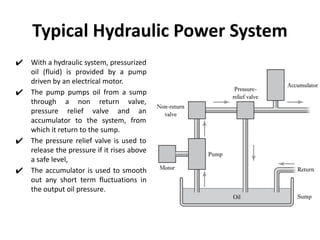
Typical Hydraulic Power System
✔ With a hydraulic system, pressurized
oil (fluid) is provided by a pump
driven by an electrical motor.
✔ The pump pumps oil from a sump
through a non return valve,
pressure relief valve and an
accumulator to the system, from
which it return to the sump.
✔ The pressure relief valve is used to
release the pressure if it rises above
a safe level,
✔ The accumulator is used to smooth
out any short term fluctuations in
the output oil pressure.
Accumulator
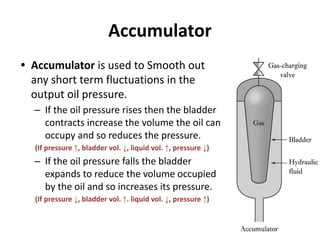
• Accumulator is used to Smooth out
any short term fluctuations in the
output oil pressure.
– If the oil pressure rises then the bladder
contracts increase the volume the oil can
occupy and so reduces the pressure.
(If pressure ↑, bladder vol. ↓, liquid vol. ↑, pressure ↓)
– If the oil pressure falls the bladder
expands to reduce the volume occupied
by the oil and so increases its pressure.
(If pressure ↓, bladder vol. ↑. liquid vol. ↓, pressure ↑)
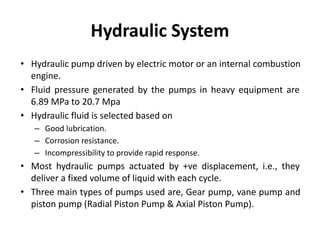
Hydraulic System
• Hydraulic pump driven by electric motor or an internal combustion
engine.
• Fluid pressure generated by the pumps in heavy equipment are
6.89 MPa to 20.7 Mpa
• Hydraulic fluid is selected based on
– Good lubrication.
– Corrosion resistance.
– Incompressibility to provide rapid response.
• Most hydraulic pumps actuated by +ve displacement, i.e., they
deliver a fixed volume of liquid with each cycle.
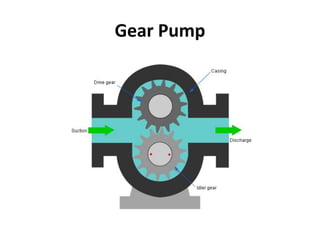
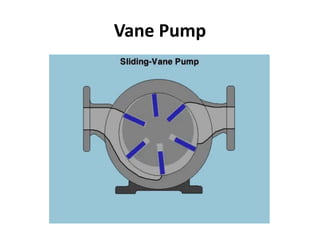
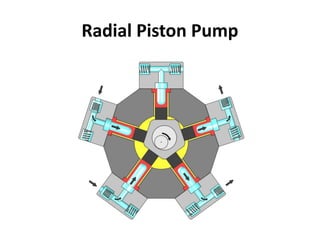
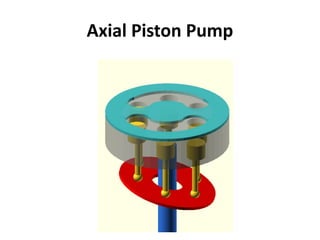
• Three main types of pumps used are, Gear pump, vane pump and
piston pump (Radial Piston Pump & Axial Piston Pump).
Gear Pump
Vane Pump
Radial Piston Pump
Axial Piston Pump
Typical Pneumatic Power System
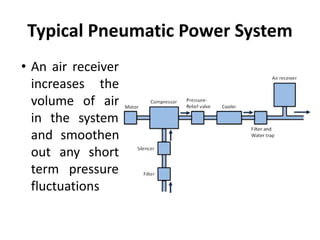
• An air receiver
increases the
volume of air
in the system
and smoothen
out any short
term pressure
fluctuations
Pneumatic System
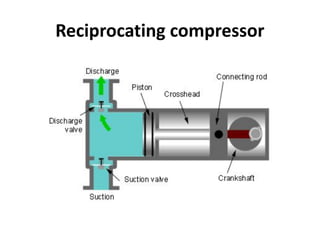
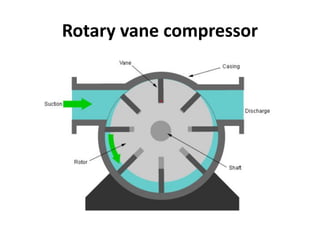
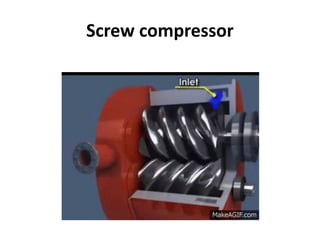
• Commonly used air compressors are ones in
which successive volumes of air are isolated
and then compressed.
• These are Reciprocating compressor, Rotary
vane compressor and Screw compressor.
Reciprocating compressor
Rotary vane compressor
Screw compressor
Directional Control Valves
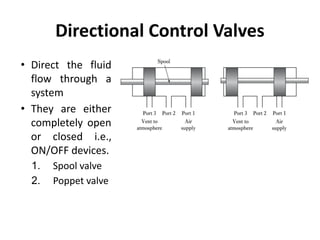
• Direct the fluid
flow through a
system
• They are either
completely open
or closed i.e.,
ON/OFF devices.
1. Spool valve
2. Poppet valve
Directional Control Valves
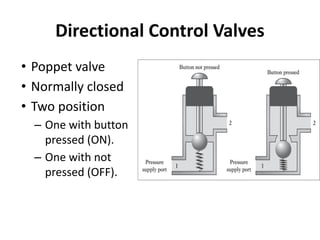
• Poppet valve
• Normally closed
• Two position
– One with button
pressed (ON).
– One with not
pressed (OFF).
Valve Symbols
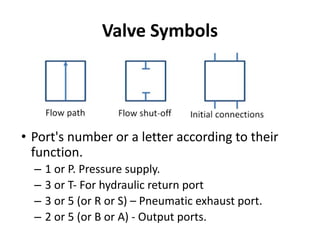
• Port's number or a letter according to their
function.
– 1 or P. Pressure supply.
– 3 or T- For hydraulic return port
– 3 or 5 (or R or S) – Pneumatic exhaust port.
– 2 or 5 (or B or A) - Output ports.
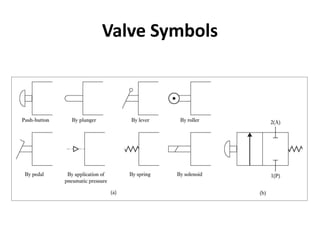
Valve Symbols
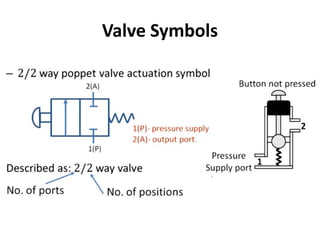
Valve Symbols
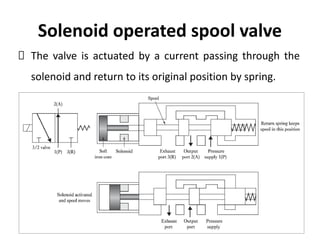
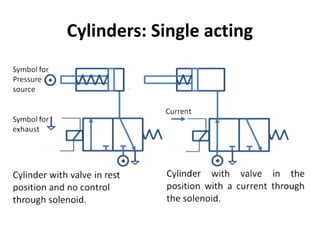
Solenoid operated spool valve
The valve is actuated by a current passing through the
solenoid and return to its original position by spring.
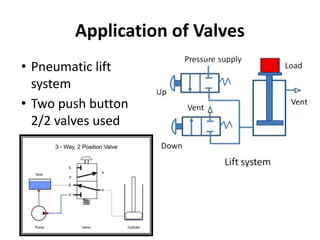
Application of Valves
• Pneumatic lift
system
• Two push button
2/2 valves used
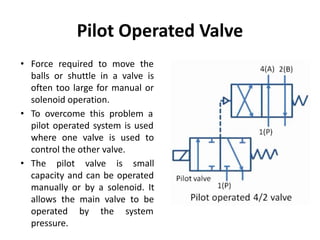
Pilot Operated Valve
• Force required to move the
balls or shuttle in a valve is
often too large for manual or
solenoid operation.
• To overcome this problem a
pilot operated system is used
where one valve is used to
control the other valve.
• The pilot valve is small
capacity and can be operated
manually or by a solenoid. It
allows the main valve to be
operated by the system
pressure.
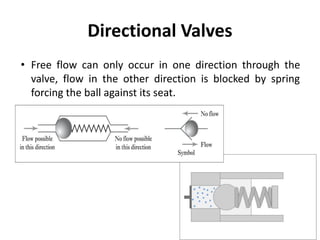
Directional Valves
• Free flow can only occur in one direction through the
valve, flow in the other direction is blocked by spring
forcing the ball against its seat.
Pressure Control Valve
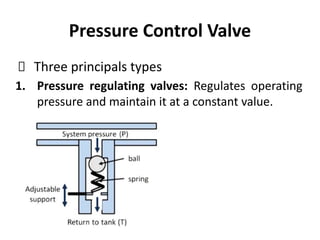
Three principals types
1. Pressure regulating valves: Regulates operating
pressure and maintain it at a constant value.
Pressure Control Valve
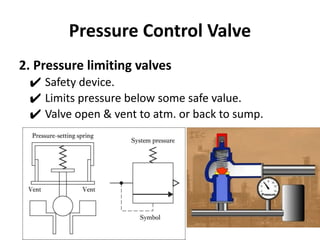
2. Pressure limiting valves
✔ Safety device.
✔ Limits pressure below some safe value.
✔ Valve open & vent to atm. or back to sump.
Pressure Control Valve
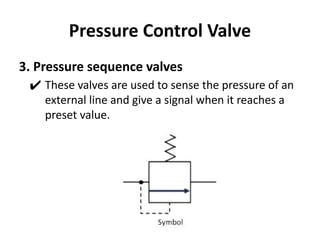
3. Pressure sequence valves
✔ These valves are used to sense the pressure of an
external line and give a signal when it reaches a
preset value.
Hydraulic / Pneumatic linear
actuators, Cylinders
Both hydraulic and pneumatic actuators have the
same principles, differences being in size
The cylinder consists of a cylindrical tube along
which a piston/ram can slide
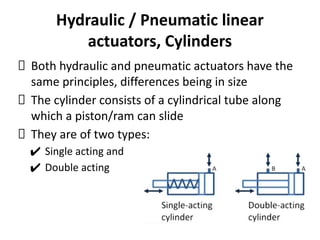
They are of two types:
✔ Single acting and
✔ Double acting
Cylinders: Single acting
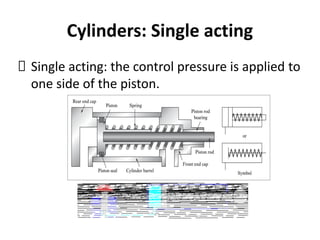
Single acting: the control pressure is applied to
one side of the piston.
Cylinders: Single acting
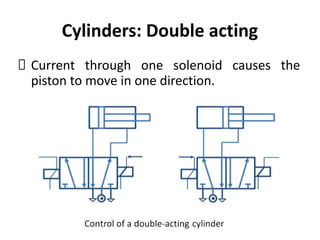
Cylinders: Double acting
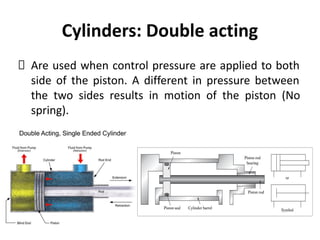
Are used when control pressure are applied to both
side of the piston. A different in pressure between
the two sides results in motion of the piston (No
spring).
Cylinders: Double acting
Current through one solenoid causes the
piston to move in one direction.
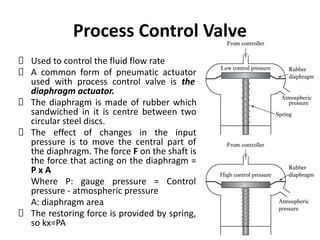
Process Control Valve
Used to control the fluid flow rate
A common form of pneumatic actuator
used with process control valve is the
diaphragm actuator.
The diaphragm is made of rubber which
sandwiched in it is centre between two
circular steel discs.
The effect of changes in the input
pressure is to move the central part of
the diaphragm. The force F on the shaft is
the force that acting on the diaphragm =
P x A
Where P: gauge pressure = Control
pressure - atmospheric pressure
A: diaphragm area
The restoring force is provided by spring,
so kx=PA
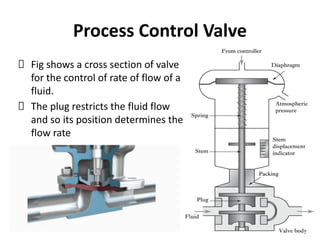
Process Control Valve
Fig shows a cross section of valve
for the control of rate of flow of a
fluid.
The plug restricts the fluid flow
and so its position determines the
flow rate
Process Control Valve
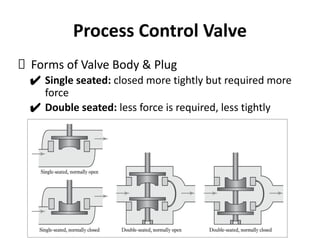
Forms of Valve Body & Plug
✔ Single seated: closed more tightly but required more
force
✔ Double seated: less force is required, less tightly
Process Control Valve
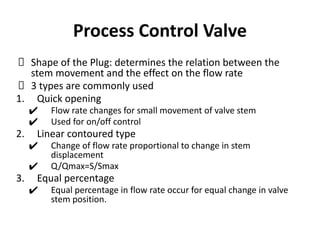
Shape of the Plug: determines the relation between the
stem movement and the effect on the flow rate
3 types are commonly used
1. Quick opening
✔ Flow rate changes for small movement of valve stem
✔ Used for on/off control
2. Linear contoured type
✔ Change of flow rate proportional to change in stem
displacement
✔ Q/Qmax=S/Smax
3. Equal percentage
✔ Equal percentage in flow rate occur for equal change in valve
stem position.
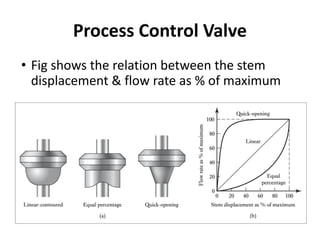
Process Control Valve
• Fig shows the relation between the stem
displacement & flow rate as % of maximum
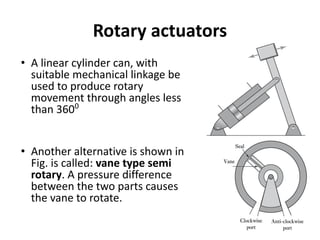
Rotary actuators
• A linear cylinder can, with
suitable mechanical linkage be
used to produce rotary
movement through angles less
than 3600
• Another alternative is shown in
Fig. is called: vane type semi
rotary. A pressure difference
between the two parts causes
the vane to rotate.
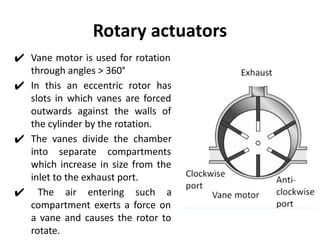
Rotary actuators
✔ Vane motor is used for rotation
through angles > 360°
✔ In this an eccentric rotor has
slots in which vanes are forced
outwards against the walls of
the cylinder by the rotation.
✔ The vanes divide the chamber
into separate compartments
which increase in size from the
inlet to the exhaust port.
✔ The air entering such a
compartment exerts a force on
a vane and causes the rotor to
rotate.
DOC-20240201-WA0004..pdf

DOC-20240201-WA0004..pdf

  • 1.
  • 2.
    Fluid Power: Pneumaticsvs. Hydraulics • Fluid power denotes the use of a pressurized fluid to drive linear or rotary actuators. • The subject can be broadly divided into two fields: pneumatics and hydraulics. • In the first, the working fluid is compressed air, and in the second, it usually is oil (sometimes water-oil emulsions). • The two fields have a great deal in common, but there are also some basic differences:
  • 3.
    Differences Between Pneumaticsvs. Hydraulics System • Pressure Levels: – In industrial pneumatic circuits range from 5 to 10 bar, – whereas hydraulic circuits commonly operate at pressures up to 200 bar or even much higher. • Actuating Forces: – Because of the relatively low air pressures used, pneumatic actuators can produce only low or medium size forces, – whereas hydraulic actuators are suitable for very high loads. • Element Cost: – Hydraulic cylinders and valves can cost from 5 to 10 times more than similar size pneumatic elements.
  • 4.
    Differences Between Pneumaticsvs. Hydraulics System • Transmission Lines: – Hydraulic transmission lines are usually made of metal tubing needed to withstand the high working pressures and to avoid leaks. – In pneumatics, flexible plastic tubing is used, and the fittings can usually be connected by hands. – Also, in hydraulic systems, return lines are needed to return the oil from each cylinder back to the reservoir. – In pneumatic systems, only a single line is needed, since the air is simply exhausted back to the atmosphere after it has done its job.
  • 5.
    Differences Between Pneumaticsvs. Hydraulics System • Speed Control: – Because of the compressibility of air, it is difficult to control the speed of pneumatic cylinders or motors accurately. – Therefore, whenever constant actuator speeds are required-despite sudden load changes-a hydraulic system should be used. • Actuation Speeds: – Since compressed air expands very quickly the piston velocities in pneumatic cylinders are usually very high provided the actuating valves and air supply tubing are properly sized. – In hydraulic cylinders, piston velocity is usually low being determined by the flow rate of the pump.
  • 6.
    Differences Between Pneumaticsvs. Hydraulics System • The Power Source: – In hydraulic systems, constant displacement pumps are used, so that the oil flow rate is constant, regardless of load pressure. The pump does not produce pressure, but rather a constant flow. The pressure developed in the system depends on the opposing load. – The situation is exactly the opposite in pneumatic systems: a pressure regulator connected at the compressor-receiver outlet keeps air pressure essentially constant, whereas the air flow rate into any given cylinder is determined by the load.
  • 7.
    Components of Hydraulicand Pneumatic System Power supply Directional control valves Pressure control valves Cylinders Process control valves
  • 8.
    Typical Hydraulic PowerSystem ✔ With a hydraulic system, pressurized oil (fluid) is provided by a pump driven by an electrical motor. ✔ The pump pumps oil from a sump through a non return valve, pressure relief valve and an accumulator to the system, from which it return to the sump. ✔ The pressure relief valve is used to release the pressure if it rises above a safe level, ✔ The accumulator is used to smooth out any short term fluctuations in the output oil pressure.
  • 9.
    Accumulator • Accumulator isused to Smooth out any short term fluctuations in the output oil pressure. – If the oil pressure rises then the bladder contracts increase the volume the oil can occupy and so reduces the pressure. (If pressure ↑, bladder vol. ↓, liquid vol. ↑, pressure ↓) – If the oil pressure falls the bladder expands to reduce the volume occupied by the oil and so increases its pressure. (If pressure ↓, bladder vol. ↑. liquid vol. ↓, pressure ↑)
  • 10.
    Hydraulic System • Hydraulicpump driven by electric motor or an internal combustion engine. • Fluid pressure generated by the pumps in heavy equipment are 6.89 MPa to 20.7 Mpa • Hydraulic fluid is selected based on – Good lubrication. – Corrosion resistance. – Incompressibility to provide rapid response. • Most hydraulic pumps actuated by +ve displacement, i.e., they deliver a fixed volume of liquid with each cycle. • Three main types of pumps used are, Gear pump, vane pump and piston pump (Radial Piston Pump & Axial Piston Pump).
  • 11.
  • 12.
  • 13.
  • 14.
  • 15.
    Typical Pneumatic PowerSystem • An air receiver increases the volume of air in the system and smoothen out any short term pressure fluctuations
  • 16.
    Pneumatic System • Commonlyused air compressors are ones in which successive volumes of air are isolated and then compressed. • These are Reciprocating compressor, Rotary vane compressor and Screw compressor.
  • 17.
  • 18.
  • 19.
  • 20.
    Directional Control Valves •Direct the fluid flow through a system • They are either completely open or closed i.e., ON/OFF devices. 1. Spool valve 2. Poppet valve
  • 21.
    Directional Control Valves •Poppet valve • Normally closed • Two position – One with button pressed (ON). – One with not pressed (OFF).
  • 22.
    Valve Symbols • Port'snumber or a letter according to their function. – 1 or P. Pressure supply. – 3 or T- For hydraulic return port – 3 or 5 (or R or S) – Pneumatic exhaust port. – 2 or 5 (or B or A) - Output ports.
  • 23.
  • 24.
  • 25.
    Solenoid operated spoolvalve The valve is actuated by a current passing through the solenoid and return to its original position by spring.
  • 26.
    Application of Valves •Pneumatic lift system • Two push button 2/2 valves used
  • 27.
    Pilot Operated Valve •Force required to move the balls or shuttle in a valve is often too large for manual or solenoid operation. • To overcome this problem a pilot operated system is used where one valve is used to control the other valve. • The pilot valve is small capacity and can be operated manually or by a solenoid. It allows the main valve to be operated by the system pressure.
  • 28.
    Directional Valves • Freeflow can only occur in one direction through the valve, flow in the other direction is blocked by spring forcing the ball against its seat.
  • 29.
    Pressure Control Valve Threeprincipals types 1. Pressure regulating valves: Regulates operating pressure and maintain it at a constant value.
  • 30.
    Pressure Control Valve 2.Pressure limiting valves ✔ Safety device. ✔ Limits pressure below some safe value. ✔ Valve open & vent to atm. or back to sump.
  • 31.
    Pressure Control Valve 3.Pressure sequence valves ✔ These valves are used to sense the pressure of an external line and give a signal when it reaches a preset value.
  • 32.
    Hydraulic / Pneumaticlinear actuators, Cylinders Both hydraulic and pneumatic actuators have the same principles, differences being in size The cylinder consists of a cylindrical tube along which a piston/ram can slide They are of two types: ✔ Single acting and ✔ Double acting
  • 33.
    Cylinders: Single acting Singleacting: the control pressure is applied to one side of the piston.
  • 34.
  • 35.
    Cylinders: Double acting Areused when control pressure are applied to both side of the piston. A different in pressure between the two sides results in motion of the piston (No spring).
  • 36.
    Cylinders: Double acting Currentthrough one solenoid causes the piston to move in one direction.
  • 37.
    Process Control Valve Usedto control the fluid flow rate A common form of pneumatic actuator used with process control valve is the diaphragm actuator. The diaphragm is made of rubber which sandwiched in it is centre between two circular steel discs. The effect of changes in the input pressure is to move the central part of the diaphragm. The force F on the shaft is the force that acting on the diaphragm = P x A Where P: gauge pressure = Control pressure - atmospheric pressure A: diaphragm area The restoring force is provided by spring, so kx=PA
  • 38.
    Process Control Valve Figshows a cross section of valve for the control of rate of flow of a fluid. The plug restricts the fluid flow and so its position determines the flow rate
  • 39.
    Process Control Valve Formsof Valve Body & Plug ✔ Single seated: closed more tightly but required more force ✔ Double seated: less force is required, less tightly
  • 40.
    Process Control Valve Shapeof the Plug: determines the relation between the stem movement and the effect on the flow rate 3 types are commonly used 1. Quick opening ✔ Flow rate changes for small movement of valve stem ✔ Used for on/off control 2. Linear contoured type ✔ Change of flow rate proportional to change in stem displacement ✔ Q/Qmax=S/Smax 3. Equal percentage ✔ Equal percentage in flow rate occur for equal change in valve stem position.
  • 41.
    Process Control Valve •Fig shows the relation between the stem displacement & flow rate as % of maximum
  • 42.
    Rotary actuators • Alinear cylinder can, with suitable mechanical linkage be used to produce rotary movement through angles less than 3600 • Another alternative is shown in Fig. is called: vane type semi rotary. A pressure difference between the two parts causes the vane to rotate.
  • 43.
    Rotary actuators ✔ Vanemotor is used for rotation through angles > 360° ✔ In this an eccentric rotor has slots in which vanes are forced outwards against the walls of the cylinder by the rotation. ✔ The vanes divide the chamber into separate compartments which increase in size from the inlet to the exhaust port. ✔ The air entering such a compartment exerts a force on a vane and causes the rotor to rotate.