E3145/1/1
INTRODUCTION TO CONTROL SYSTEM
OBJECTIVES
General Objective : To know and to apply the concept of control system.
Specific Objectives : At the end of the unit you will be able to :
 Explain the basic concept of control system with general
block diagram of control system.
 State the definition and terminology of control system
elements.
 Classify and differentiate the two categories of control
system : open-loop and closed-loop systems.
 Draw the block diagram of electrical equipments based
on control system types.
 List the advantages and disadvantages of open-loop
and closed-loop control systems.
UNIT1
E3145/1/2
INTRODUCTION TO CONTROL SYSTEM
1.0 THE BASIC CONCEPT OF CONTROL SYSTEM
Automatic control has played a vital role in the advance of engineering
and science. In addition to its extreme importance in space-vehicle
system, missile-guidance systems, air-craft-autopiloting systems, robotic
systems and the likes, automatic control has become an important and
integral part of modern manufacturing and industrial processes. For
example, automatic control is essential in the numerical of machine tools
in the manufacturing industries.
The controlled variable is the quantity or condition that is measured
and controlled. The manipulated variable is the quantity or condition that
is varied by the controller so as to affect the value of the controlled
variable. Normally, the controlled variable is the output of the system.
Control means measuring the value of the controlled variable of the
system and applying the manipulated variable to the system to correct or
limit deviation of the measured value from a desired value.
INPUTINPUT
Control system is a
characteristic which
influences our lifes today.
We use this system in many
fields. For example, in
industries, domestic,
medical, robotics, generation
of electrical energy and so
on.
E3145/1/3
INTRODUCTION TO CONTROL SYSTEM
In studying control engineering, we first need to define additional
terms that are necessary to describe control systems, such as plants,
disturbances, processes, feedback control systems and etc. Then a
description of closed-loop and open-loop control systems and their
advantages and disadvantages will be given in the following sections.
1.1 IDENTIFYING THE DEFINITION AND TERMINOLOGY RELATED
TO CONTROL SYSTEM
The various definitions of the system variables and components are
as mentioned below:
1.1.1 Pneumatic Control Systems
The working medium in a pneumatic control systems uses a
compressible fluid, such as air because it may be exhausted to the
atmosphere at the end of the device’s work cycle, thus eliminating the need
for return lines.
1.1.2 Hydraulic Control Systems
Hydraulic control systems is the study of incompressible liquids, and
hydraulic devices use an incompressible fluid, such as oil, for their working
medium. Liquid level systems consisting of storage tanks and connecting
pipes are a class of hydraulic systems whose driving force is due to relative
difference in the liquid heights in the tanks.
1.1.3 Reference Input
It is the actual signal input to the control system.
1.1.4 Process
E3145/1/4
INTRODUCTION TO CONTROL SYSTEM
Any operation to be controlled. For example, chemical, economic, and
biological processes.
1.1.5 Feedback Element
It is the unit which provides the means for feeding back to the output
quantity in order to compare it with the reference input.
1.1.6 Disturbances
A disturbance is a signal that tends to adversely affect the
value of the output of a system. If the disturbance is generated within
the system, it is called internal, while an external disturbance is
generated outside the system and is an input.
E3145/1/5
INTRODUCTION TO CONTROL SYSTEM
Activity 1A
TEST YOUR UNDERSTANDING BEFORE YOU CONTINUE WITH THE
NEXT INPUT…!
1.1 Define the elements given below :
a) Controlled variable
b) Manipulated variable
c) Control
1.2Define the elements given below :
a) Reference input
b) Feedback element
c) Disturbances
d) Process
e) Hydraulic Control System
f) Pneumatic Control System
E3145/1/6
INTRODUCTION TO CONTROL SYSTEM
Feedback To Activity 1A
1.1 a) Controlled variable is the quantity or condition that is
measured and controlled. Controlled variable is the output of
the system.
b) Manipulated variable is the quantity or condition there is
varied by the controller so as to affect the value of the
controlled variable.
c) Control means measuring the value of the controlled variable
of the system and applying the manipulated variable to the
system to correct or limit deviation of the measured value from
a desired value.
1.2 a) Reference Input
It is the actual signal input to the control system.
b) Feedback Element
It is the unit which provides the means for feeding back to the
output quantity in order to compare it with the reference input.
c) Disturbances
A disturbance is a signal that tends to adversely affect the
E3145/1/7
INTRODUCTION TO CONTROL SYSTEM
value of the output of a system. If the disturbance is generated
within the system, it is called internal , while an external
disturbance is generated outside the system and is an input.
d) Process
Any operation to be controlled. For example, chemical,
economic, and biological processes.
e) Hydraulic Control Systems
Hydraulic control systems is the studied of incompressible
liquids, and hydraulic device use an incompressible fluid, such
as oil, for their working medium. Liquid level systems consisting
of storage tanks and connecting pipes are a class of hydraulic
systems whose driving force is due to relative difference in the
liquid heights in the tanks.
f) Pneumatic Control Systems
The working medium in a pneumatic control systems using a
compressible fluid, such as air because it may be exhausted to
the atmosphere at the end of the device’s work cycle, thus
eliminating the need for return lines.
E3145/1/8
INTRODUCTION TO CONTROL SYSTEM
1.2 EXPLANATION OF CONTROL SYSTEM TYPES
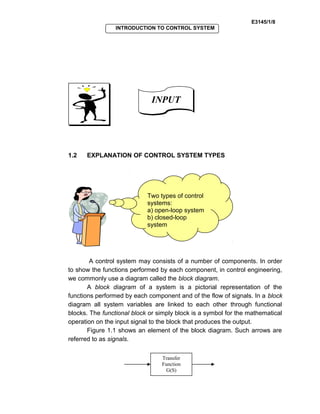
A control system may consists of a number of components. In order
to show the functions performed by each component, in control engineering,
we commonly use a diagram called the block diagram.
A block diagram of a system is a pictorial representation of the
functions performed by each component and of the flow of signals. In a block
diagram all system variables are linked to each other through functional
blocks. The functional block or simply block is a symbol for the mathematical
operation on the input signal to the block that produces the output.
Figure 1.1 shows an element of the block diagram. Such arrows are
referred to as signals.
INPUTINPUT
Two types of control
systems:
a) open-loop system
b) closed-loop
system
Transfer
Function
G(S)
E3145/1/9
INTRODUCTION TO CONTROL SYSTEM
Figure 1.1 Element of a block diagram
(Source : Katsuhiko Ogata (1990), Modern Control Engineering)
The advantages of the block diagram representation of a system
lies in the fact that it is easy to form the overall block diagram for the entire
system by merely connecting the blocks of the components according to the
signal flow and that it is possible to evaluate the contribution of each
component to the overall performance of the system.
Summing Point
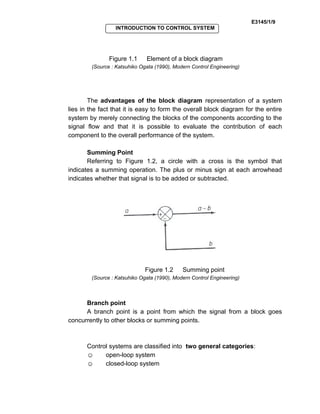
Referring to Figure 1.2, a circle with a cross is the symbol that
indicates a summing operation. The plus or minus sign at each arrowhead
indicates whether that signal is to be added or subtracted.
Figure 1.2 Summing point
(Source : Katsuhiko Ogata (1990), Modern Control Engineering)
Branch point
A branch point is a point from which the signal from a block goes
concurrently to other blocks or summing points.
Control systems are classified into two general categories:
☺ open-loop system
☺ closed-loop system
E3145/1/10
INTRODUCTION TO CONTROL SYSTEM
The distinction is determined by the control action, which is that quantity
responsible for activating the system to produce the output.
1.2.1 Open-loop Control System
An open-loop control system is one in which the control action is
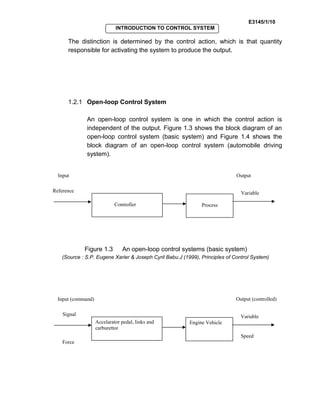
independent of the output. Figure 1.3 shows the block diagram of an
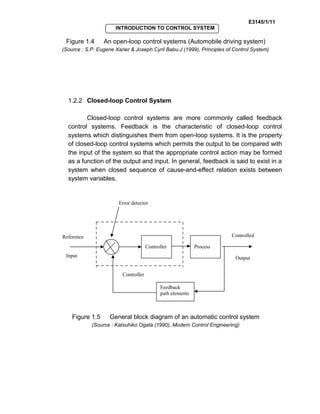
open-loop control system (basic system) and Figure 1.4 shows the
block diagram of an open-loop control system (automobile driving
system).
Figure 1.3 An open-loop control systems (basic system)
(Source : S.P. Eugene Xarier & Joseph Cyril Babu.J (1999), Principles of Control System)
Controller
Reference
Input
Process
Variable
Output
Accelarator pedal, links and
carburettor
Signal
Force
Input (command)
Engine Vehicle
Variable
Speed
Output (controlled)
E3145/1/11
INTRODUCTION TO CONTROL SYSTEM
Figure 1.4 An open-loop control systems (Automobile driving system)
(Source : S.P. Eugene Xarier & Joseph Cyril Babu.J (1999), Principles of Control System)
1.2.2 Closed-loop Control System
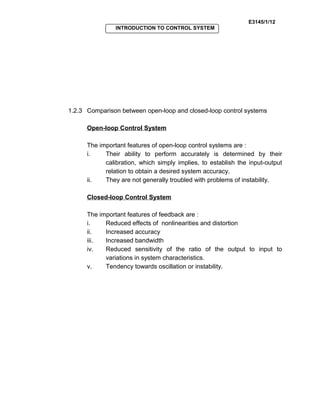
Closed-loop control systems are more commonly called feedback
control systems. Feedback is the characteristic of closed-loop control
systems which distinguishes them from open-loop systems. It is the property
of closed-loop control systems which permits the output to be compared with
the input of the system so that the appropriate control action may be formed
as a function of the output and input. In general, feedback is said to exist in a
system when closed sequence of cause-and-effect relation exists between
system variables.
Figure 1.5 General block diagram of an automatic control system
(Source : Katsuhiko Ogata (1990), Modern Control Engineering)
Reference
Input Output
Controlled
Error detector
Controller
Controller Process
Feedback
path elements
E3145/1/12
INTRODUCTION TO CONTROL SYSTEM
1.2.3 Comparison between open-loop and closed-loop control systems
Open-loop Control System
The important features of open-loop control systems are :
i. Their ability to perform accurately is determined by their
calibration, which simply implies, to establish the input-output
relation to obtain a desired system accuracy.
ii. They are not generally troubled with problems of instability.
Closed-loop Control System
The important features of feedback are :
i. Reduced effects of nonlinearities and distortion
ii. Increased accuracy
iii. Increased bandwidth
iv. Reduced sensitivity of the ratio of the output to input to
variations in system characteristics.
v. Tendency towards oscillation or instability.
E3145/1/13
INTRODUCTION TO CONTROL SYSTEM
1.3 EXAMPLES OF APPLICATION CONTROL SYSTEMS TYPES ON
ELECTRICAL EQUIPMENTS
1.3.1 Open-loop control system
1. Washing machine
Soaking, washing, and rinsing in the washer operate on a time
basis. The machine does not measure the output signal, that is,
the cleanliness of the clothes.
2. Electric coffeemaker
One possible input for automatic electric coffeemaker is the
amount of coffee used. Most coffeemakers have a dial which
can be set for weak, medium or strong coffee. This setting
usually regulates a timing mechanism. The brewing-time is
therefore another possible input. The output of any
coffeemaker can be chosen as coffee strength.
Examples of application of
control system on electrical
equipments : washing
machine, toaster,
coffeemaker, refrigerator,
room lamp and etc.
E3145/1/14
INTRODUCTION TO CONTROL SYSTEM
1.3.2 Closed-loop System
1. Automatic toaster
Assume that each heating element supplies the same amount
of heat to both sides of the bread, and toast quality can be
determined by its colour. The toaster is initially calibrated for a
desired toast quality by means of the colour adjustment knob.
This setting never needs readjustment unless the toast quality
criterion changes. When the switch is closed, the bread is
toasted until the colour detector sees the desired colour. Then
the switch is automatically opened by means of the feedback
linkage, which may be electrical or mechanical.
2. Automatic Refrigerator
The input is the reference temperature and the output is the
actual refrigerator temperature.
E3145/1/15
INTRODUCTION TO CONTROL SYSTEM
Activity 1B
TEST YOUR UNDERSTANDING BEFORE YOU CONTINUE WITH THE
NEXT INPUT…!
1.3Many closed-loop and open-loop control system may be found in homes.
Identify the electrical equipment below and describe them of the
system is open-loop or closed-loop control systems.
a. Electrical oven
b. Blender
c. Electric automatic kettle
d. Iron
e. Lamp
1.4State the differences between open-loop and closed-loop control
systems.
1.5 Give the two general categories of control system.
E3145/1/16
INTRODUCTION TO CONTROL SYSTEM
Feedback To Activity 1B
1.3 a. Closed-loop control system
b. Open-loop control system
c. Closed-loop control system
d. Closed-loop control system
e. Open-loop control system
1.4
Open-loop control system Closed-loop control system
i. Their ability to perform
accurately is determined by
their calibration, which simply
implies, to establish the
input-output relation to obtain
a desired system accuracy.
ii. They are not generally
troubled with problems of
instability.
i. Reduced effects of
nonlinearities and
distortion
ii. Increased accuracy
iii. Increased bandwidth
iv. Reduced sensitivity of the
ratio of the output to input
to variations in system
characteristics.
v. Tendency towards
oscillation or instability.
E3145/1/17
INTRODUCTION TO CONTROL SYSTEM
3 1.5 a) Open-loop system
b) Closed-loop system
KEY FACTS
1. Control system are classified into two general categories : open-loop
and closed-loop systems.
2. In control engineering, to show the function performed by each
component, we commonly use a diagram called the block diagram.
E3145/1/18
INTRODUCTION TO CONTROL SYSTEM
SELF-ASSESSMENT
You are approaching success. Try all the questions in this self-assessment
section and check your answers with those given in the Feedback on Self-
Assessment given on the next page. If you face any problems, discuss it
with your lecturer. Good luck.
Q1-1 Name the major parts of a closed-loop control system.
Q1-2
(a) Draw the block diagram of open-loop and closed-loop control
systems.
(b) List the advantages of the block diagram.
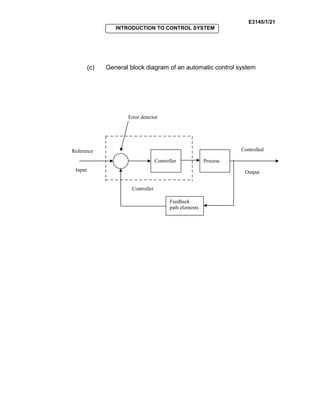
(c ) Draw the general block diagram of an automatic control system.
E3145/1/19
INTRODUCTION TO CONTROL SYSTEM
Feedback To Self-Assessment
Have you tried the questions????? If “YES”, check your answers now.
Q1-1 i. Reference input
ii. Controller
iii. Process
iv. Output
v. Feedback element
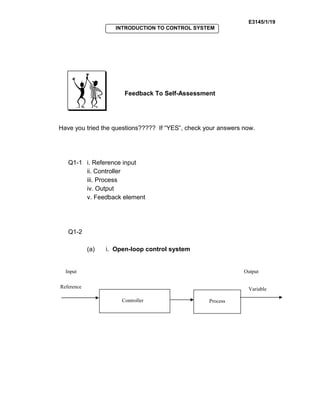
Q1-2
(a) i. Open-loop control system
Controller
Reference
Input
Process
Variable
Output
E3145/1/20
INTRODUCTION TO CONTROL SYSTEM
ii. Closed loop control system
(b) The advantages of the block diagram representation of a system lies
in the fact that it is easy to form the overall block diagram for the entire
system by merely connecting the blocks of the components according
to the signal flow and that it is possible to evaluate the contribution of
each component to the overall performance of the system.
Reference
Input Output
Controlled
Error detector
Controller
Controller Process
Feedback
path elements
E3145/1/21
INTRODUCTION TO CONTROL SYSTEM
(c) General block diagram of an automatic control system
Reference
Input Output
Controlled
Error detector
Controller
Controller Process
Feedback
path elements

Basic Control System unit1

  • 1.
    E3145/1/1 INTRODUCTION TO CONTROLSYSTEM INTRODUCTION TO CONTROL SYSTEM OBJECTIVES General Objective : To know and to apply the concept of control system. Specific Objectives : At the end of the unit you will be able to :  Explain the basic concept of control system with general block diagram of control system.  State the definition and terminology of control system elements.  Classify and differentiate the two categories of control system : open-loop and closed-loop systems.  Draw the block diagram of electrical equipments based on control system types.  List the advantages and disadvantages of open-loop and closed-loop control systems. UNIT1
  • 2.
    E3145/1/2 INTRODUCTION TO CONTROLSYSTEM 1.0 THE BASIC CONCEPT OF CONTROL SYSTEM Automatic control has played a vital role in the advance of engineering and science. In addition to its extreme importance in space-vehicle system, missile-guidance systems, air-craft-autopiloting systems, robotic systems and the likes, automatic control has become an important and integral part of modern manufacturing and industrial processes. For example, automatic control is essential in the numerical of machine tools in the manufacturing industries. The controlled variable is the quantity or condition that is measured and controlled. The manipulated variable is the quantity or condition that is varied by the controller so as to affect the value of the controlled variable. Normally, the controlled variable is the output of the system. Control means measuring the value of the controlled variable of the system and applying the manipulated variable to the system to correct or limit deviation of the measured value from a desired value. INPUTINPUT Control system is a characteristic which influences our lifes today. We use this system in many fields. For example, in industries, domestic, medical, robotics, generation of electrical energy and so on.
  • 3.
    E3145/1/3 INTRODUCTION TO CONTROLSYSTEM In studying control engineering, we first need to define additional terms that are necessary to describe control systems, such as plants, disturbances, processes, feedback control systems and etc. Then a description of closed-loop and open-loop control systems and their advantages and disadvantages will be given in the following sections. 1.1 IDENTIFYING THE DEFINITION AND TERMINOLOGY RELATED TO CONTROL SYSTEM The various definitions of the system variables and components are as mentioned below: 1.1.1 Pneumatic Control Systems The working medium in a pneumatic control systems uses a compressible fluid, such as air because it may be exhausted to the atmosphere at the end of the device’s work cycle, thus eliminating the need for return lines. 1.1.2 Hydraulic Control Systems Hydraulic control systems is the study of incompressible liquids, and hydraulic devices use an incompressible fluid, such as oil, for their working medium. Liquid level systems consisting of storage tanks and connecting pipes are a class of hydraulic systems whose driving force is due to relative difference in the liquid heights in the tanks. 1.1.3 Reference Input It is the actual signal input to the control system. 1.1.4 Process
  • 4.
    E3145/1/4 INTRODUCTION TO CONTROLSYSTEM Any operation to be controlled. For example, chemical, economic, and biological processes. 1.1.5 Feedback Element It is the unit which provides the means for feeding back to the output quantity in order to compare it with the reference input. 1.1.6 Disturbances A disturbance is a signal that tends to adversely affect the value of the output of a system. If the disturbance is generated within the system, it is called internal, while an external disturbance is generated outside the system and is an input.
  • 5.
    E3145/1/5 INTRODUCTION TO CONTROLSYSTEM Activity 1A TEST YOUR UNDERSTANDING BEFORE YOU CONTINUE WITH THE NEXT INPUT…! 1.1 Define the elements given below : a) Controlled variable b) Manipulated variable c) Control 1.2Define the elements given below : a) Reference input b) Feedback element c) Disturbances d) Process e) Hydraulic Control System f) Pneumatic Control System
  • 6.
    E3145/1/6 INTRODUCTION TO CONTROLSYSTEM Feedback To Activity 1A 1.1 a) Controlled variable is the quantity or condition that is measured and controlled. Controlled variable is the output of the system. b) Manipulated variable is the quantity or condition there is varied by the controller so as to affect the value of the controlled variable. c) Control means measuring the value of the controlled variable of the system and applying the manipulated variable to the system to correct or limit deviation of the measured value from a desired value. 1.2 a) Reference Input It is the actual signal input to the control system. b) Feedback Element It is the unit which provides the means for feeding back to the output quantity in order to compare it with the reference input. c) Disturbances A disturbance is a signal that tends to adversely affect the
  • 7.
    E3145/1/7 INTRODUCTION TO CONTROLSYSTEM value of the output of a system. If the disturbance is generated within the system, it is called internal , while an external disturbance is generated outside the system and is an input. d) Process Any operation to be controlled. For example, chemical, economic, and biological processes. e) Hydraulic Control Systems Hydraulic control systems is the studied of incompressible liquids, and hydraulic device use an incompressible fluid, such as oil, for their working medium. Liquid level systems consisting of storage tanks and connecting pipes are a class of hydraulic systems whose driving force is due to relative difference in the liquid heights in the tanks. f) Pneumatic Control Systems The working medium in a pneumatic control systems using a compressible fluid, such as air because it may be exhausted to the atmosphere at the end of the device’s work cycle, thus eliminating the need for return lines.
  • 8.
    E3145/1/8 INTRODUCTION TO CONTROLSYSTEM 1.2 EXPLANATION OF CONTROL SYSTEM TYPES A control system may consists of a number of components. In order to show the functions performed by each component, in control engineering, we commonly use a diagram called the block diagram. A block diagram of a system is a pictorial representation of the functions performed by each component and of the flow of signals. In a block diagram all system variables are linked to each other through functional blocks. The functional block or simply block is a symbol for the mathematical operation on the input signal to the block that produces the output. Figure 1.1 shows an element of the block diagram. Such arrows are referred to as signals. INPUTINPUT Two types of control systems: a) open-loop system b) closed-loop system Transfer Function G(S)
  • 9.
    E3145/1/9 INTRODUCTION TO CONTROLSYSTEM Figure 1.1 Element of a block diagram (Source : Katsuhiko Ogata (1990), Modern Control Engineering) The advantages of the block diagram representation of a system lies in the fact that it is easy to form the overall block diagram for the entire system by merely connecting the blocks of the components according to the signal flow and that it is possible to evaluate the contribution of each component to the overall performance of the system. Summing Point Referring to Figure 1.2, a circle with a cross is the symbol that indicates a summing operation. The plus or minus sign at each arrowhead indicates whether that signal is to be added or subtracted. Figure 1.2 Summing point (Source : Katsuhiko Ogata (1990), Modern Control Engineering) Branch point A branch point is a point from which the signal from a block goes concurrently to other blocks or summing points. Control systems are classified into two general categories: ☺ open-loop system ☺ closed-loop system
  • 10.
    E3145/1/10 INTRODUCTION TO CONTROLSYSTEM The distinction is determined by the control action, which is that quantity responsible for activating the system to produce the output. 1.2.1 Open-loop Control System An open-loop control system is one in which the control action is independent of the output. Figure 1.3 shows the block diagram of an open-loop control system (basic system) and Figure 1.4 shows the block diagram of an open-loop control system (automobile driving system). Figure 1.3 An open-loop control systems (basic system) (Source : S.P. Eugene Xarier & Joseph Cyril Babu.J (1999), Principles of Control System) Controller Reference Input Process Variable Output Accelarator pedal, links and carburettor Signal Force Input (command) Engine Vehicle Variable Speed Output (controlled)
  • 11.
    E3145/1/11 INTRODUCTION TO CONTROLSYSTEM Figure 1.4 An open-loop control systems (Automobile driving system) (Source : S.P. Eugene Xarier & Joseph Cyril Babu.J (1999), Principles of Control System) 1.2.2 Closed-loop Control System Closed-loop control systems are more commonly called feedback control systems. Feedback is the characteristic of closed-loop control systems which distinguishes them from open-loop systems. It is the property of closed-loop control systems which permits the output to be compared with the input of the system so that the appropriate control action may be formed as a function of the output and input. In general, feedback is said to exist in a system when closed sequence of cause-and-effect relation exists between system variables. Figure 1.5 General block diagram of an automatic control system (Source : Katsuhiko Ogata (1990), Modern Control Engineering) Reference Input Output Controlled Error detector Controller Controller Process Feedback path elements
  • 12.
    E3145/1/12 INTRODUCTION TO CONTROLSYSTEM 1.2.3 Comparison between open-loop and closed-loop control systems Open-loop Control System The important features of open-loop control systems are : i. Their ability to perform accurately is determined by their calibration, which simply implies, to establish the input-output relation to obtain a desired system accuracy. ii. They are not generally troubled with problems of instability. Closed-loop Control System The important features of feedback are : i. Reduced effects of nonlinearities and distortion ii. Increased accuracy iii. Increased bandwidth iv. Reduced sensitivity of the ratio of the output to input to variations in system characteristics. v. Tendency towards oscillation or instability.
  • 13.
    E3145/1/13 INTRODUCTION TO CONTROLSYSTEM 1.3 EXAMPLES OF APPLICATION CONTROL SYSTEMS TYPES ON ELECTRICAL EQUIPMENTS 1.3.1 Open-loop control system 1. Washing machine Soaking, washing, and rinsing in the washer operate on a time basis. The machine does not measure the output signal, that is, the cleanliness of the clothes. 2. Electric coffeemaker One possible input for automatic electric coffeemaker is the amount of coffee used. Most coffeemakers have a dial which can be set for weak, medium or strong coffee. This setting usually regulates a timing mechanism. The brewing-time is therefore another possible input. The output of any coffeemaker can be chosen as coffee strength. Examples of application of control system on electrical equipments : washing machine, toaster, coffeemaker, refrigerator, room lamp and etc.
  • 14.
    E3145/1/14 INTRODUCTION TO CONTROLSYSTEM 1.3.2 Closed-loop System 1. Automatic toaster Assume that each heating element supplies the same amount of heat to both sides of the bread, and toast quality can be determined by its colour. The toaster is initially calibrated for a desired toast quality by means of the colour adjustment knob. This setting never needs readjustment unless the toast quality criterion changes. When the switch is closed, the bread is toasted until the colour detector sees the desired colour. Then the switch is automatically opened by means of the feedback linkage, which may be electrical or mechanical. 2. Automatic Refrigerator The input is the reference temperature and the output is the actual refrigerator temperature.
  • 15.
    E3145/1/15 INTRODUCTION TO CONTROLSYSTEM Activity 1B TEST YOUR UNDERSTANDING BEFORE YOU CONTINUE WITH THE NEXT INPUT…! 1.3Many closed-loop and open-loop control system may be found in homes. Identify the electrical equipment below and describe them of the system is open-loop or closed-loop control systems. a. Electrical oven b. Blender c. Electric automatic kettle d. Iron e. Lamp 1.4State the differences between open-loop and closed-loop control systems. 1.5 Give the two general categories of control system.
  • 16.
    E3145/1/16 INTRODUCTION TO CONTROLSYSTEM Feedback To Activity 1B 1.3 a. Closed-loop control system b. Open-loop control system c. Closed-loop control system d. Closed-loop control system e. Open-loop control system 1.4 Open-loop control system Closed-loop control system i. Their ability to perform accurately is determined by their calibration, which simply implies, to establish the input-output relation to obtain a desired system accuracy. ii. They are not generally troubled with problems of instability. i. Reduced effects of nonlinearities and distortion ii. Increased accuracy iii. Increased bandwidth iv. Reduced sensitivity of the ratio of the output to input to variations in system characteristics. v. Tendency towards oscillation or instability.
  • 17.
    E3145/1/17 INTRODUCTION TO CONTROLSYSTEM 3 1.5 a) Open-loop system b) Closed-loop system KEY FACTS 1. Control system are classified into two general categories : open-loop and closed-loop systems. 2. In control engineering, to show the function performed by each component, we commonly use a diagram called the block diagram.
  • 18.
    E3145/1/18 INTRODUCTION TO CONTROLSYSTEM SELF-ASSESSMENT You are approaching success. Try all the questions in this self-assessment section and check your answers with those given in the Feedback on Self- Assessment given on the next page. If you face any problems, discuss it with your lecturer. Good luck. Q1-1 Name the major parts of a closed-loop control system. Q1-2 (a) Draw the block diagram of open-loop and closed-loop control systems. (b) List the advantages of the block diagram. (c ) Draw the general block diagram of an automatic control system.
  • 19.
    E3145/1/19 INTRODUCTION TO CONTROLSYSTEM Feedback To Self-Assessment Have you tried the questions????? If “YES”, check your answers now. Q1-1 i. Reference input ii. Controller iii. Process iv. Output v. Feedback element Q1-2 (a) i. Open-loop control system Controller Reference Input Process Variable Output
  • 20.
    E3145/1/20 INTRODUCTION TO CONTROLSYSTEM ii. Closed loop control system (b) The advantages of the block diagram representation of a system lies in the fact that it is easy to form the overall block diagram for the entire system by merely connecting the blocks of the components according to the signal flow and that it is possible to evaluate the contribution of each component to the overall performance of the system. Reference Input Output Controlled Error detector Controller Controller Process Feedback path elements
  • 21.
    E3145/1/21 INTRODUCTION TO CONTROLSYSTEM (c) General block diagram of an automatic control system Reference Input Output Controlled Error detector Controller Controller Process Feedback path elements