www.themegallery.com
UNIT 2-UNIT 2- BASIC QUALITY CONCEPT
© Mechanical Engineering Department
LOGOOUTLINEOUTLINE
 Introduction
 Definition of Quality
 Zero Defect
 Customer
 Quality Associated Terms and Concepts
 Inspection
 Sampling
 SPC vs Acceptance Sampling
LOGOINTRODUCTIONINTRODUCTION
 an essential factor to be considered in every
product or services.
 without adequate quality, it is not possible to
compete in the market.
 the future of an industry is driven by customers.
 at present industries are facing the following
challenges :
 increasing demands of customers
 increasing competition
 technological changes
 law becoming powerful
LOGODEFINITION OF QUALITY
 Quality is not merely the goodness or otherwise of a
finished product but it is the ultimate objective of the
company and it is what customers expect from a
product.
 Some definitions of quality have been given
 Conformance to specifications and standards.
 Fitness of use.
 Productivity, competitive costs, timely delivery and total
customer satisfaction.
 Hence a definition of quality is the totality of featureshe totality of features
and characteristics of a product or service thatand characteristics of a product or service that
bears on its ability to satisfy stated or impliedbears on its ability to satisfy stated or implied
needs.needs.
LOGODEFINITION OF QUALITY
 Hence a quality product should meet the following
requirements
 Quality raw material should be used.
 Quality parts should be used.
 Assemblies should be of good quality.
 Should adopt quality process and processing
conditions.
 Should give high reliability.
 Should be aesthetic.
 Should conform to standards.
 Quality services.
LOGODEFINITION OF QUALITY
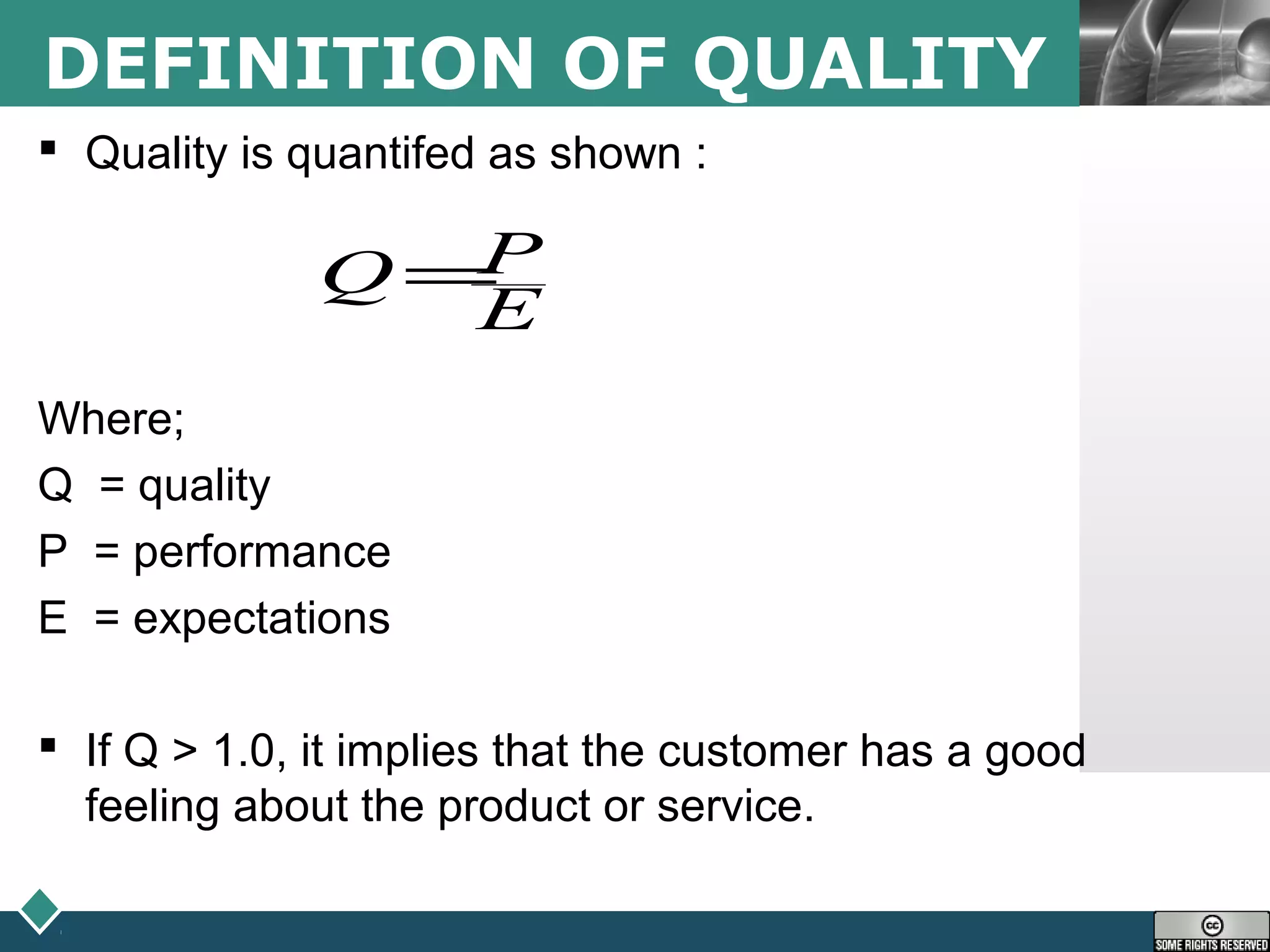
 Quality is quantifed as shown :
Where;
Q = quality
P = performance
E = expectations
 If Q > 1.0, it implies that the customer has a good
feeling about the product or service.
E
PQ =
LOGODIMENSIONS OF QUALITY
1. Performance
2. Features
3. Conformance
4. Reliability
5. Durability
6. Service
7. Response
8. Asthetics
9. Reputation
LOGOZERO DEFECT
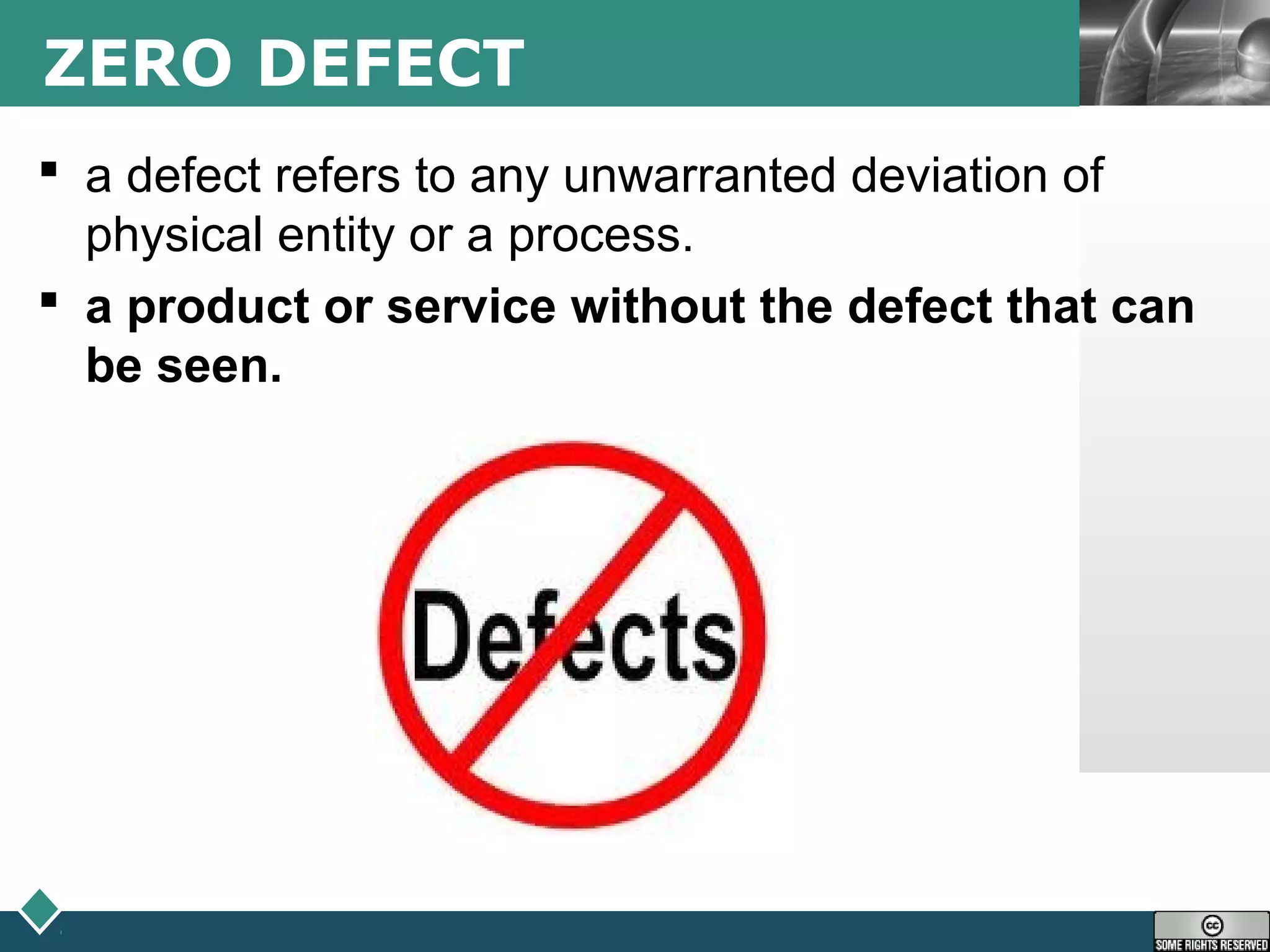
 a defect refers to any unwarranted deviation of
physical entity or a process.
 a product or service without the defect that can
be seen.
LOGOZERO DEFECT
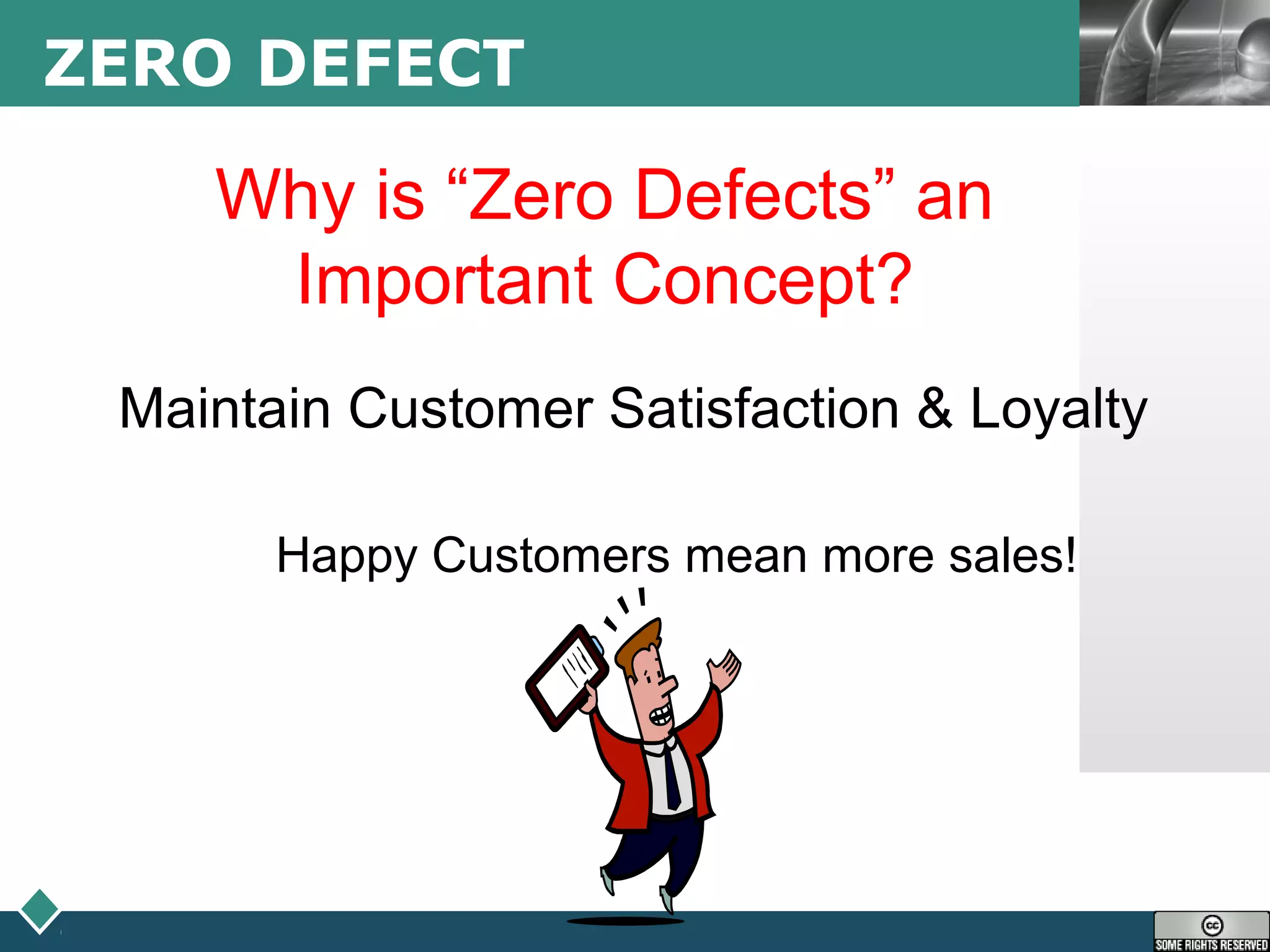
Why is “Zero Defects” an
Important Concept?
Maintain Customer Satisfaction & Loyalty
Happy Customers mean more sales!
LOGOZERO DEFECT
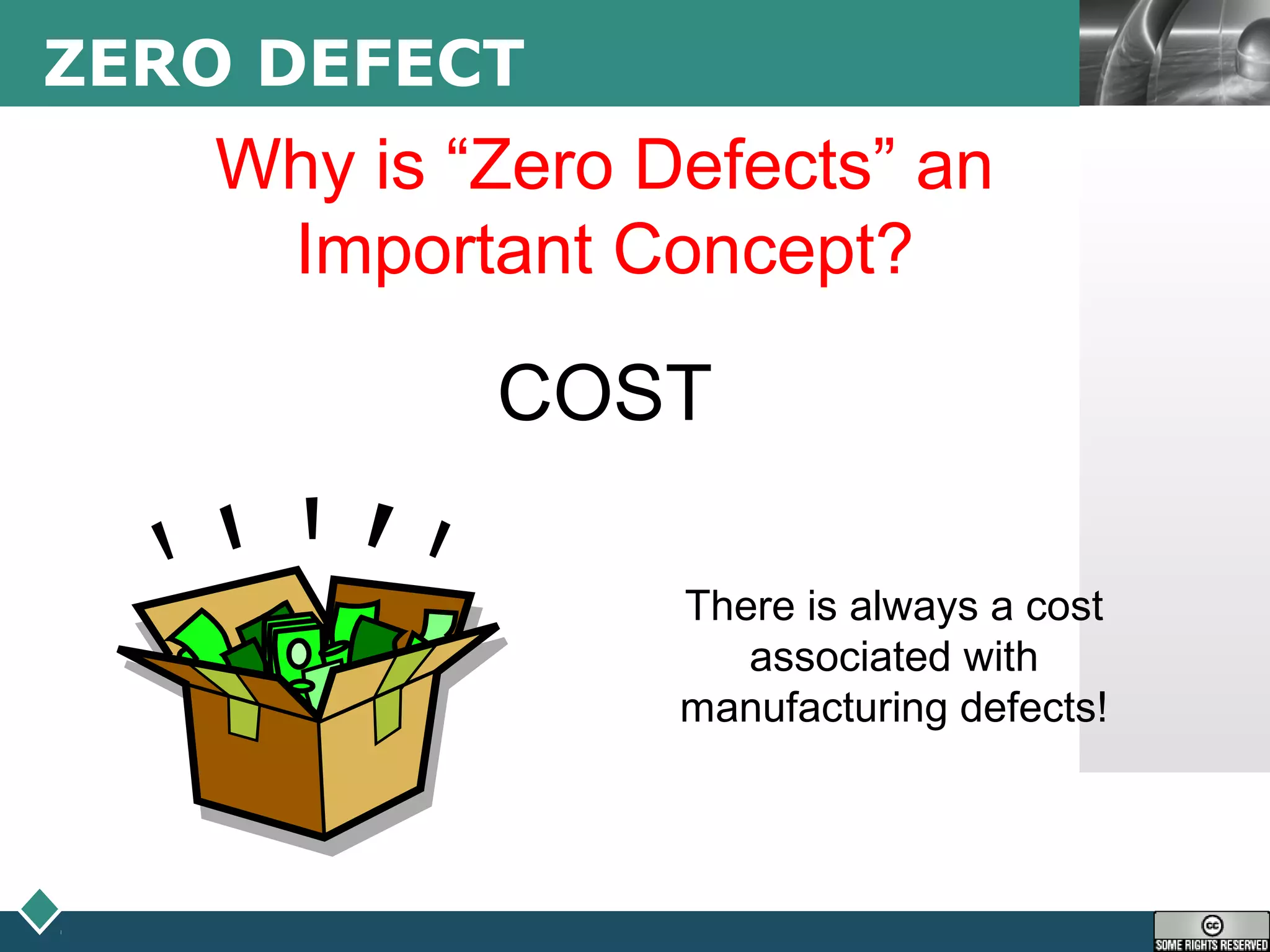
Why is “Zero Defects” an
Important Concept?
COST
There is always a cost
associated with
manufacturing defects!
LOGOZERO DEFECT
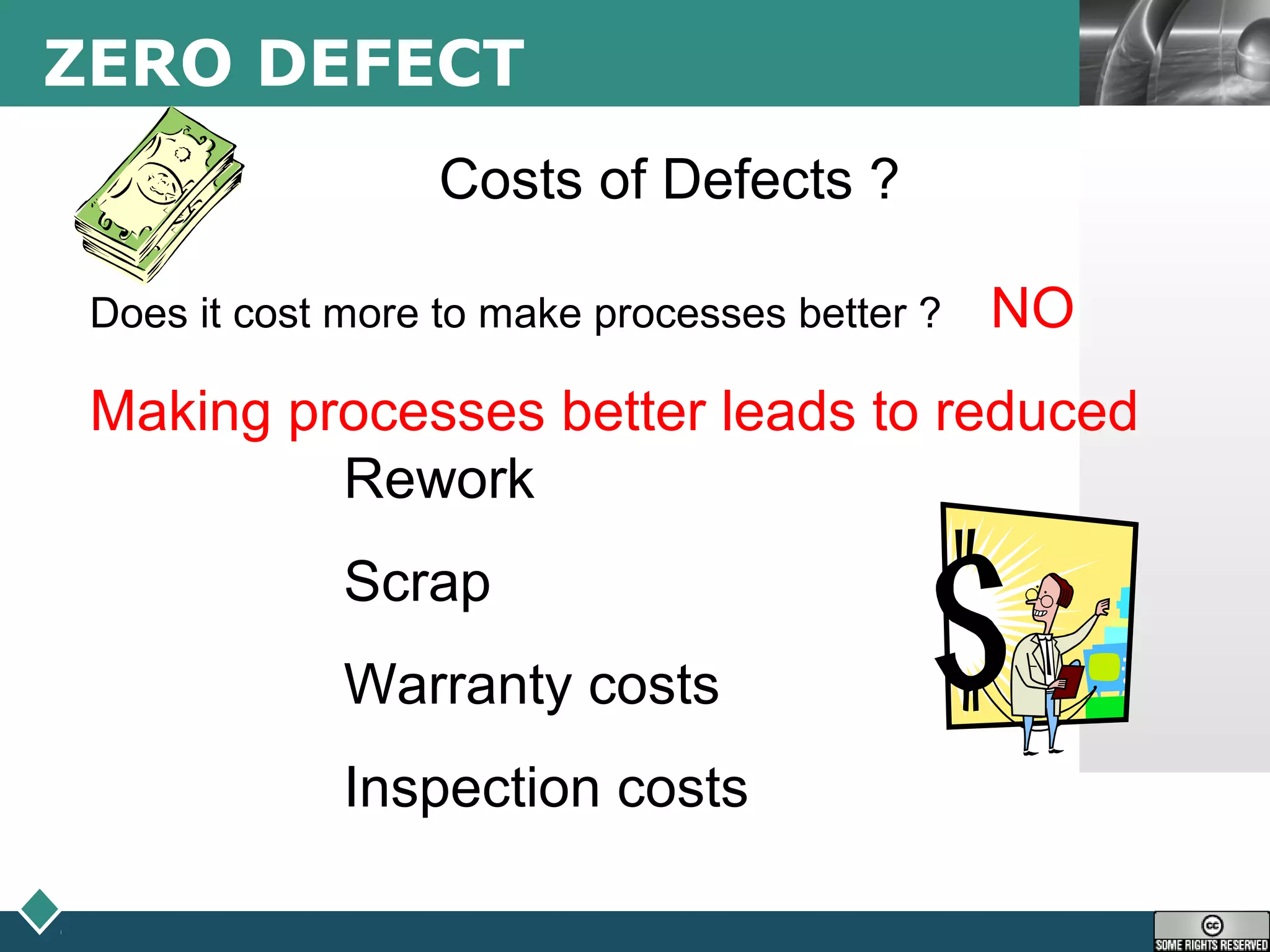
Costs of Defects ?
Does it cost more to make processes better ? NO
Making processes better leads to reduced
Rework
Scrap
Warranty costs
Inspection costs
LOGOZERO DEFECT
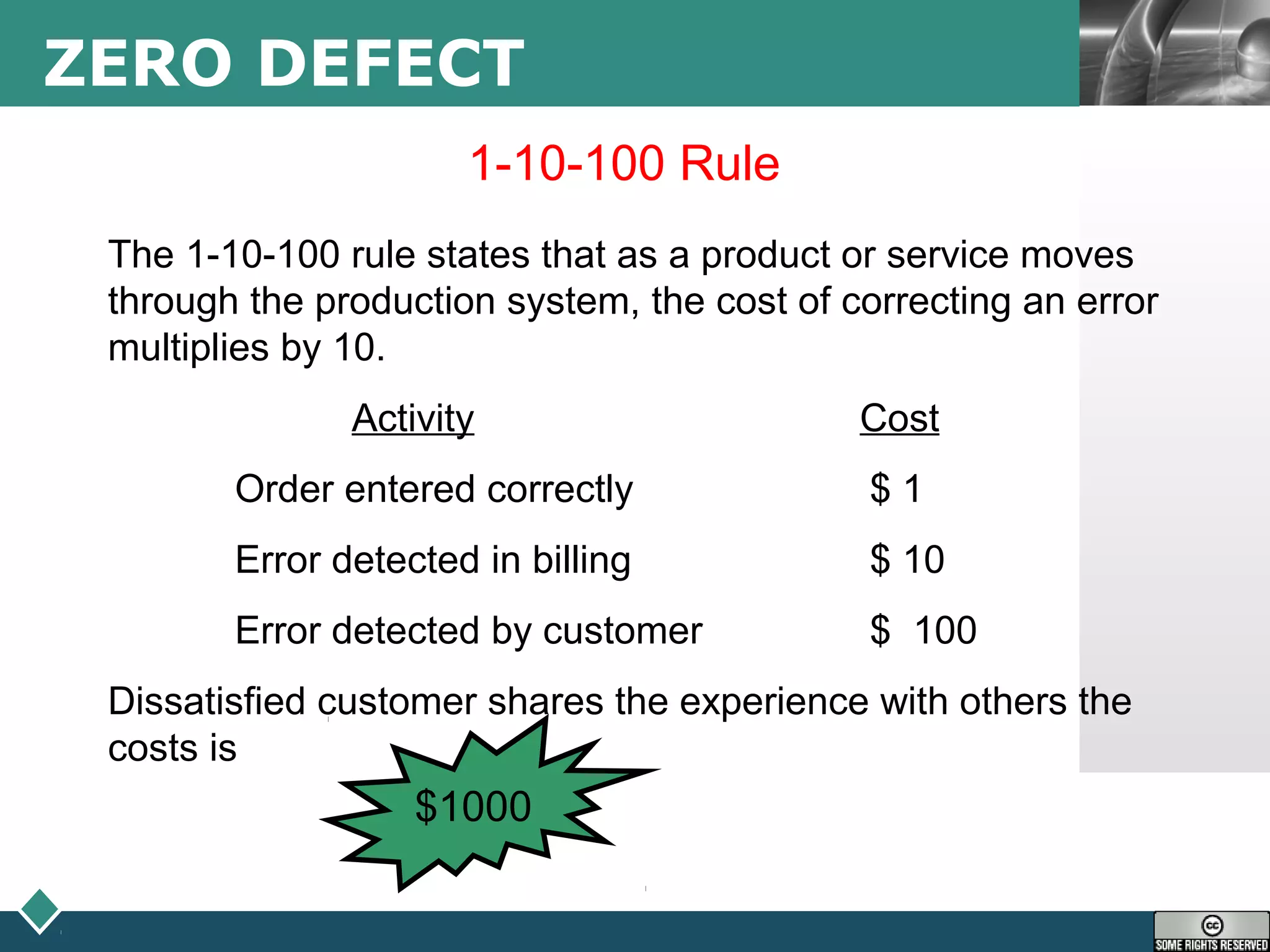
1-10-100 Rule
The 1-10-100 rule states that as a product or service moves
through the production system, the cost of correcting an error
multiplies by 10.
Activity Cost
Order entered correctly $ 1
Error detected in billing $ 10
Error detected by customer $ 100
Dissatisfied customer shares the experience with others the
costs is
$1000
LOGOCUSTOMER
 customer satisfaction has become a
measure of quality.
 an organisation’s success depends
largely on its customers.
 satisfied customers will automatically
contribute towards increasing the
profit.
 customer satisfaction is the goal of
TQM.
LOGOCUSTOMER
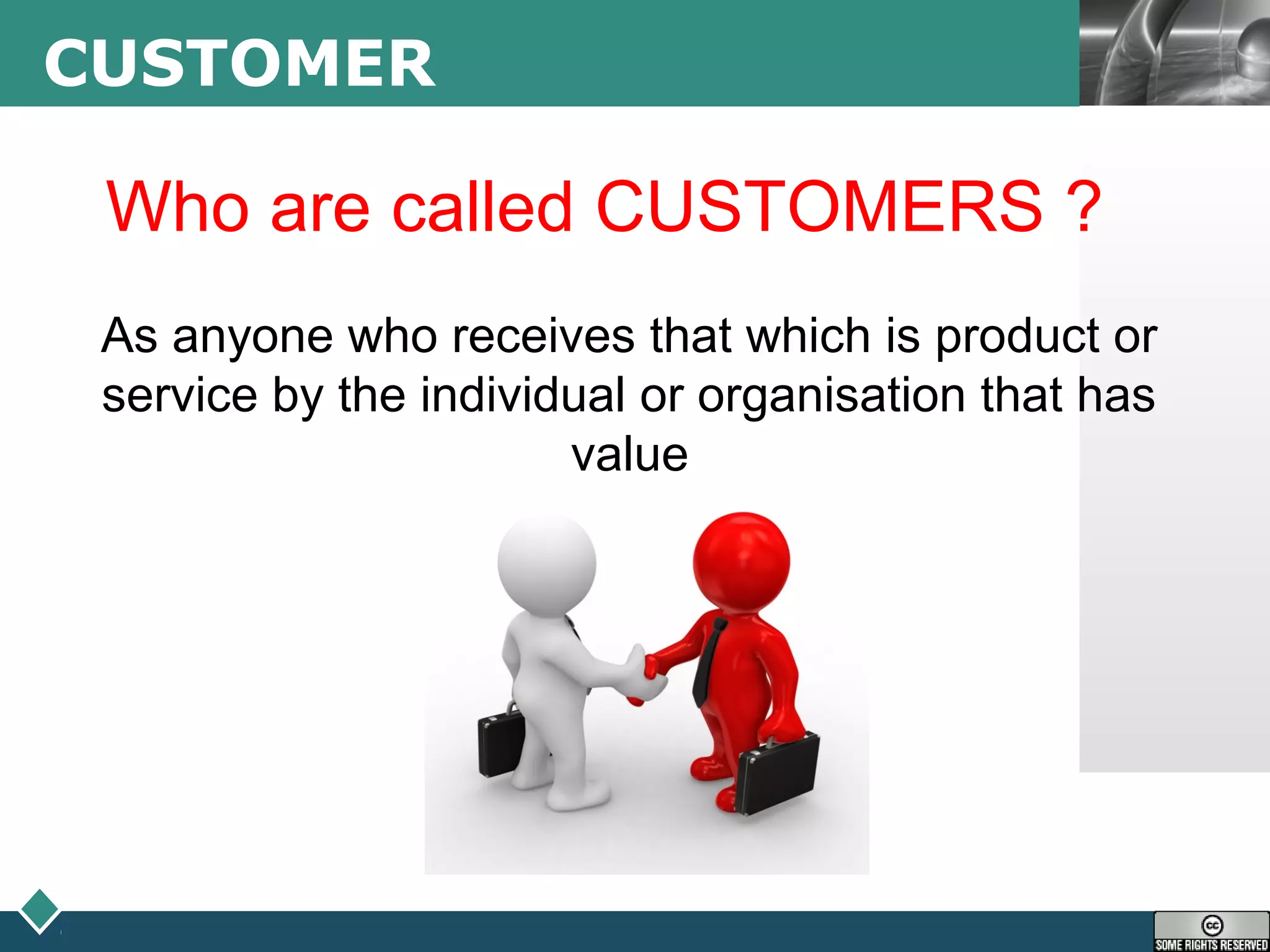
Who are called CUSTOMERS ?
As anyone who receives that which is product or
service by the individual or organisation that has
value
LOGO
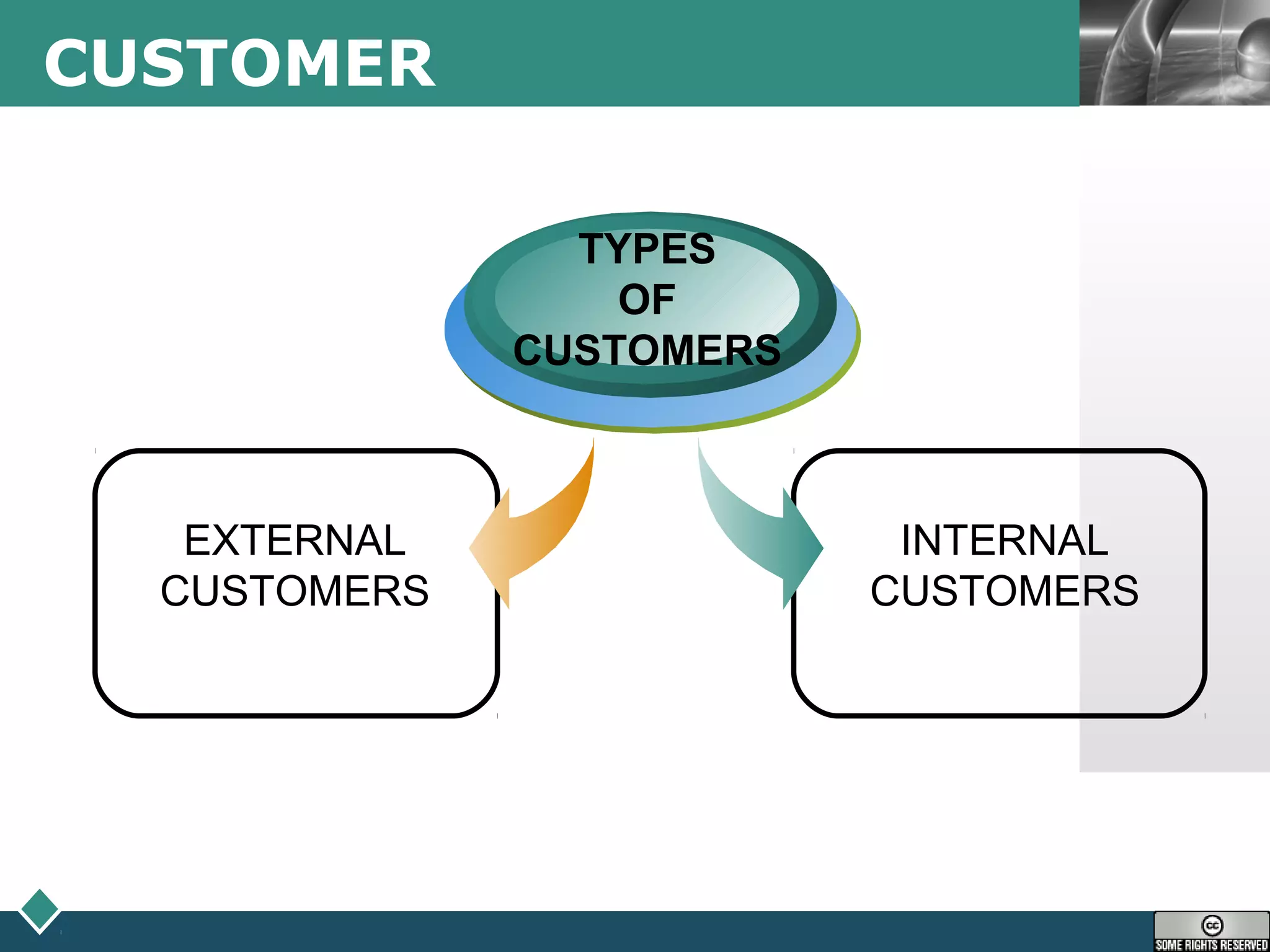
TYPES
OF
CUSTOMERS
CUSTOMER
EXTERNAL
CUSTOMERS
INTERNAL
CUSTOMERS
LOGOEXTERNAL CUSTOMER
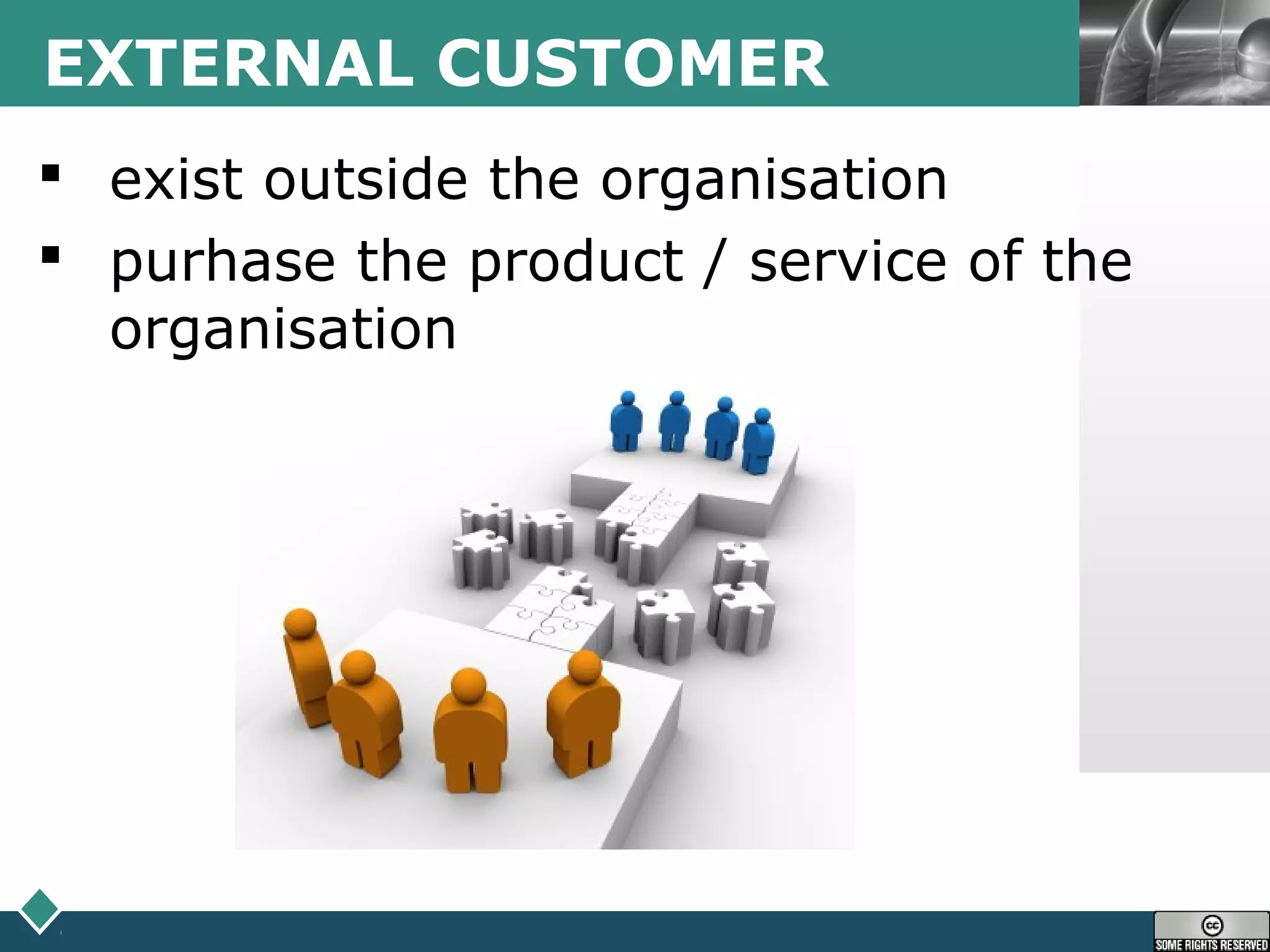
 exist outside the organisation
 purhase the product / service of the
organisation
LOGOINTERNAL CUSTOMER
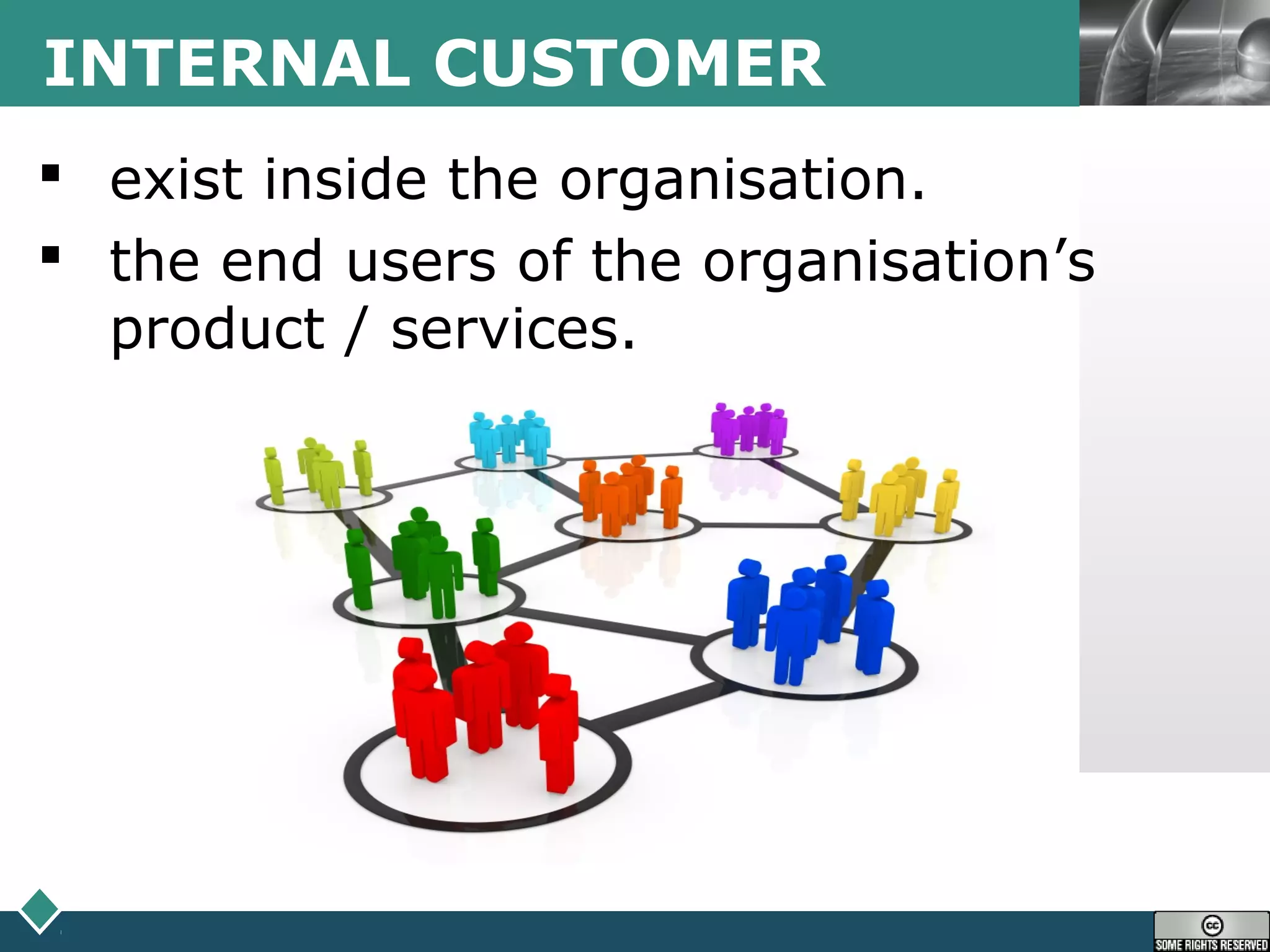
 exist inside the organisation.
 the end users of the organisation’s
product / services.
LOGOImportance of Quality to Customer
 customers are retained by the
organisation for a longer period.
 customers recommend the product /
services of the organisation to other.
 it costs more to attract a new customer
than in retaining an existing one.
 organisations can take up their profits
(25 – 125%) by retaining just 5% more
of their exixting customers.
LOGOQuality Associated Terms
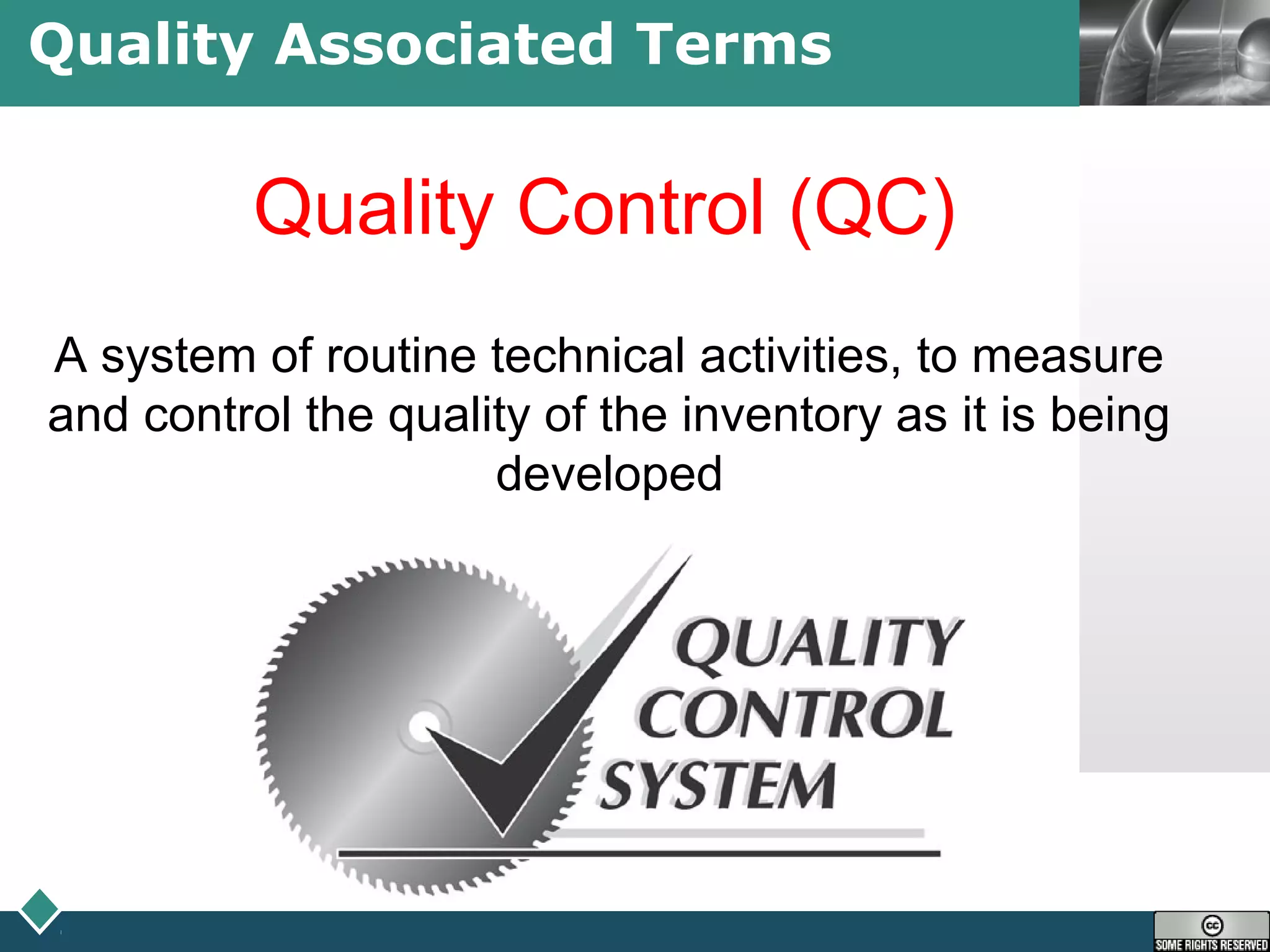
Quality Control (QC)
A system of routine technical activities, to measure
and control the quality of the inventory as it is being
developed
LOGOQuality Associated Terms
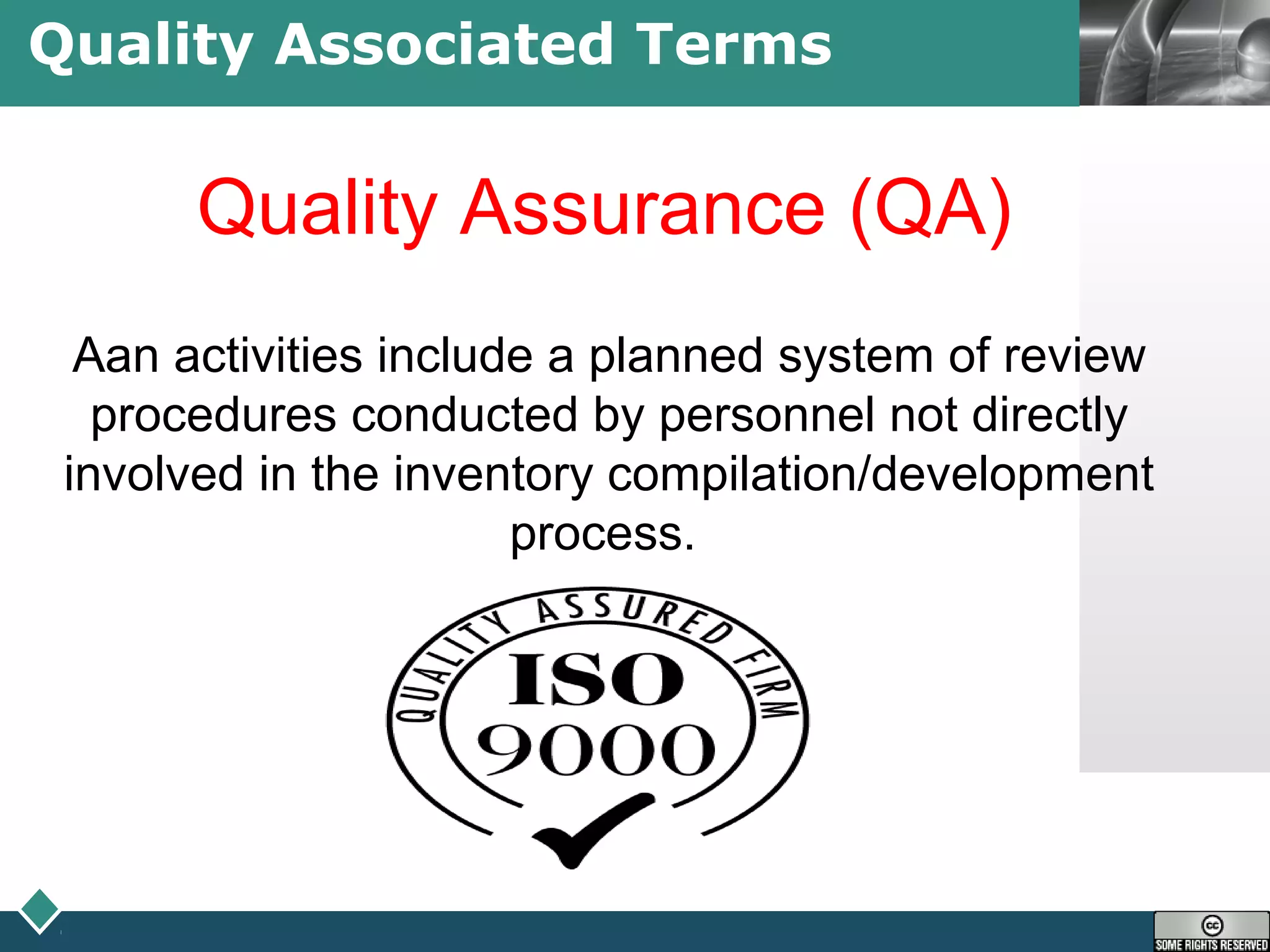
Quality Assurance (QA)
Aan activities include a planned system of review
procedures conducted by personnel not directly
involved in the inventory compilation/development
process.
LOGOQuality Associated Terms
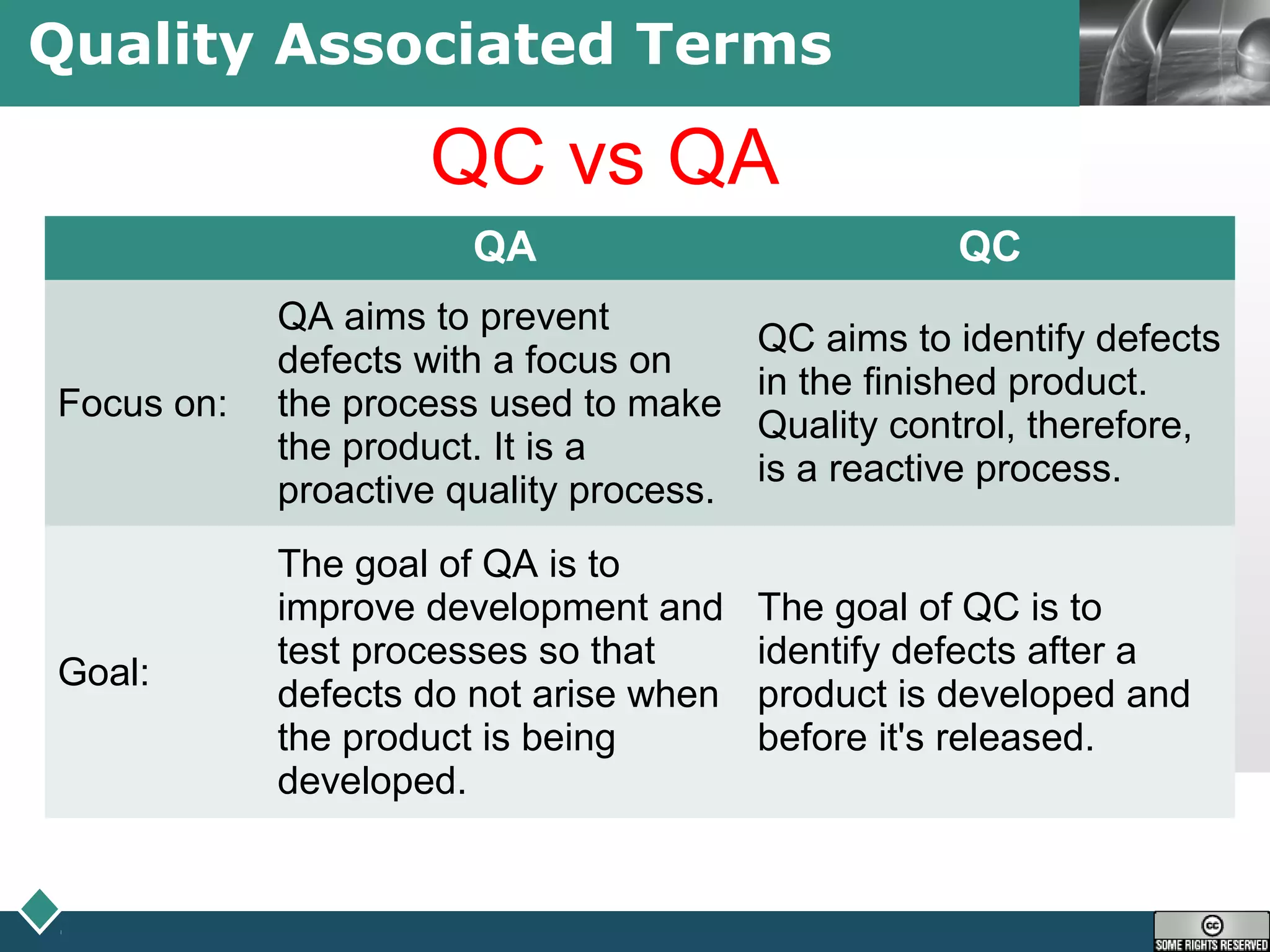
QC vs QA
QA QC
Focus on:
QA aims to prevent
defects with a focus on
the process used to make
the product. It is a
proactive quality process.
QC aims to identify defects
in the finished product.
Quality control, therefore,
is a reactive process.
Goal:
The goal of QA is to
improve development and
test processes so that
defects do not arise when
the product is being
developed.
The goal of QC is to
identify defects after a
product is developed and
before it's released.
LOGOQuality Associated Terms
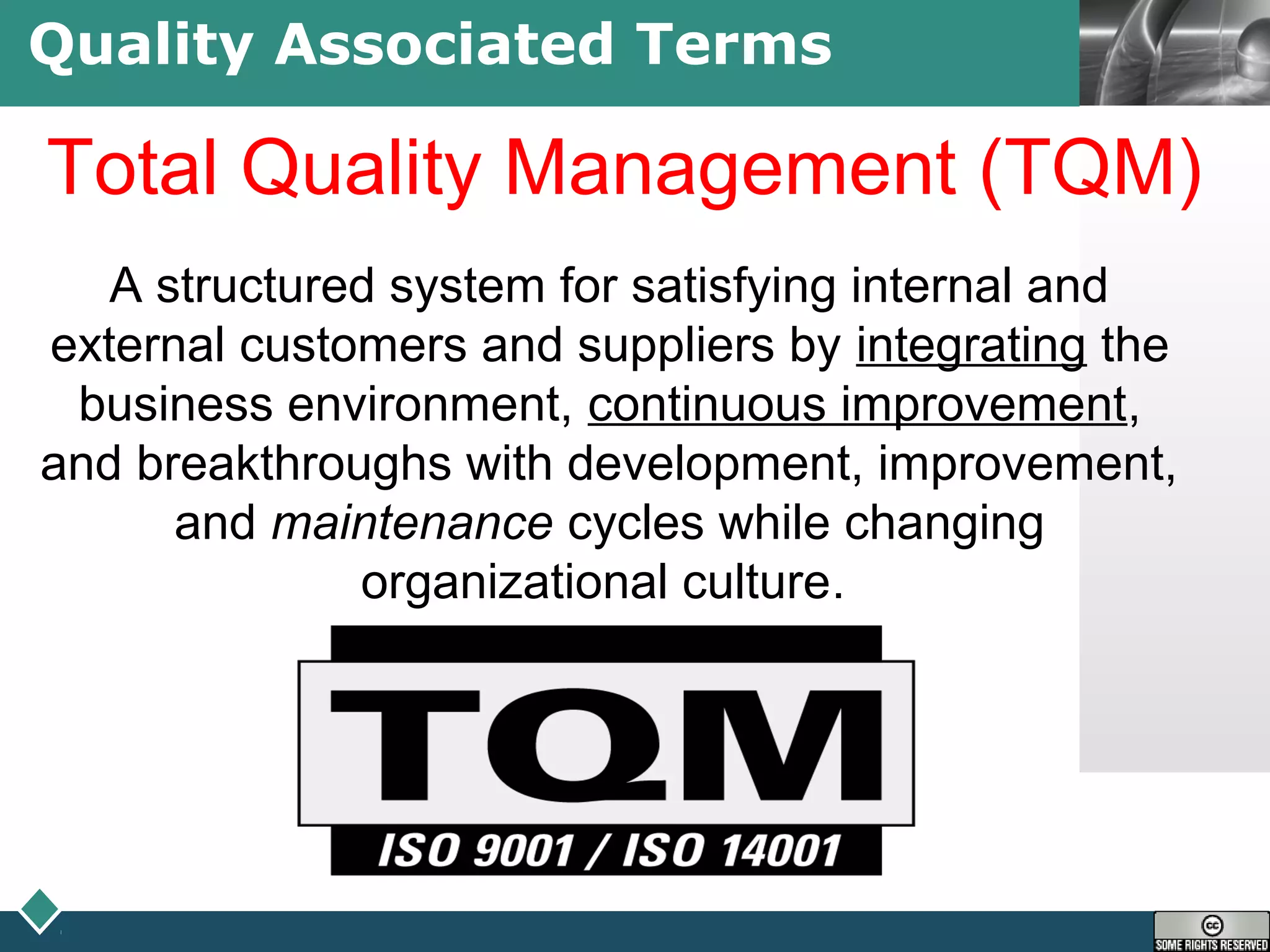
Total Quality Management (TQM)
A structured system for satisfying internal and
external customers and suppliers by integrating the
business environment, continuous improvement,
and breakthroughs with development, improvement,
and maintenance cycles while changing
organizational culture.
LOGOQuality Associated Terms
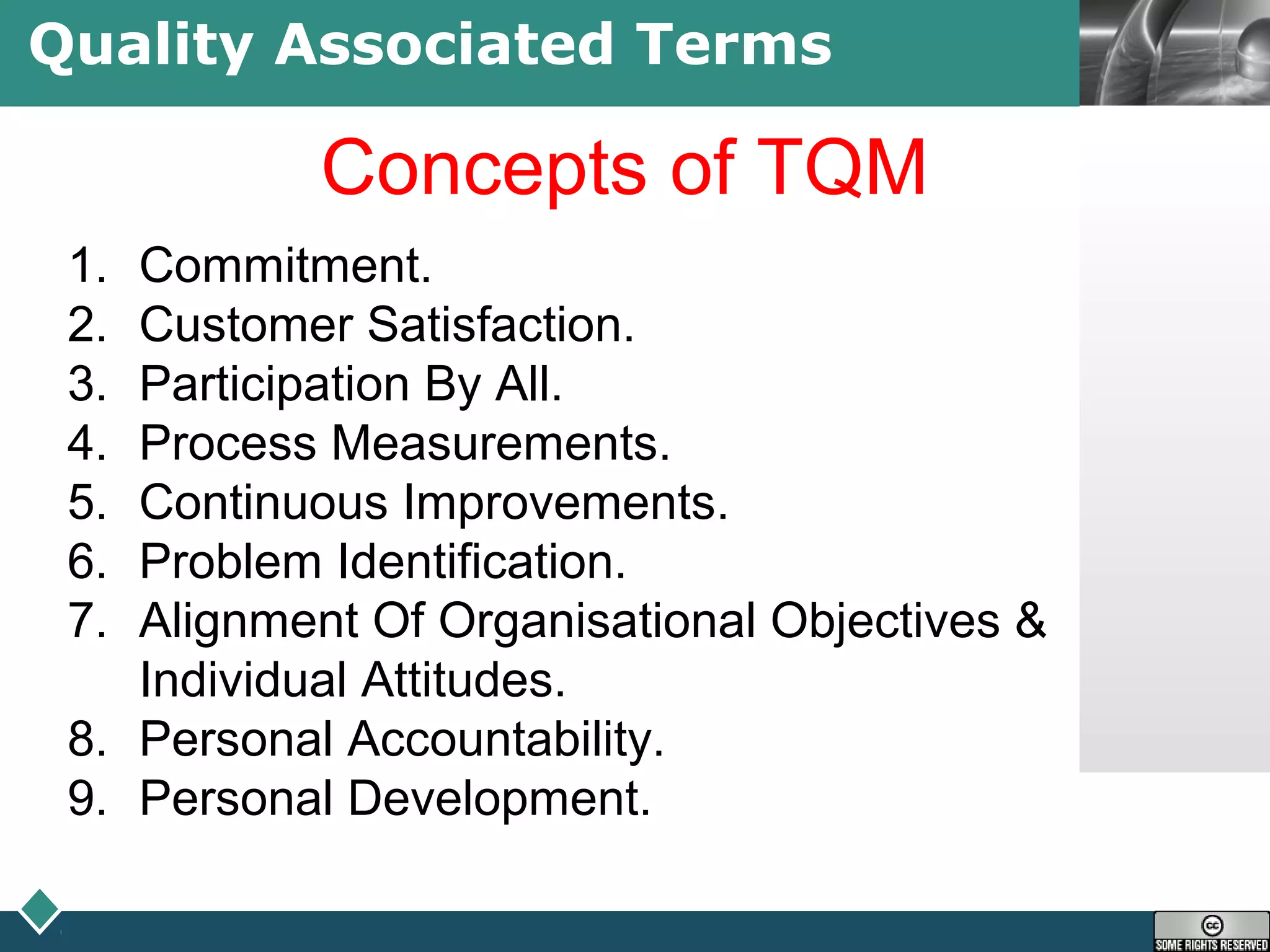
Concepts of TQM
1. Commitment.
2. Customer Satisfaction.
3. Participation By All.
4. Process Measurements.
5. Continuous Improvements.
6. Problem Identification.
7. Alignment Of Organisational Objectives &
Individual Attitudes.
8. Personal Accountability.
9. Personal Development.
LOGOQuality Associated Terms
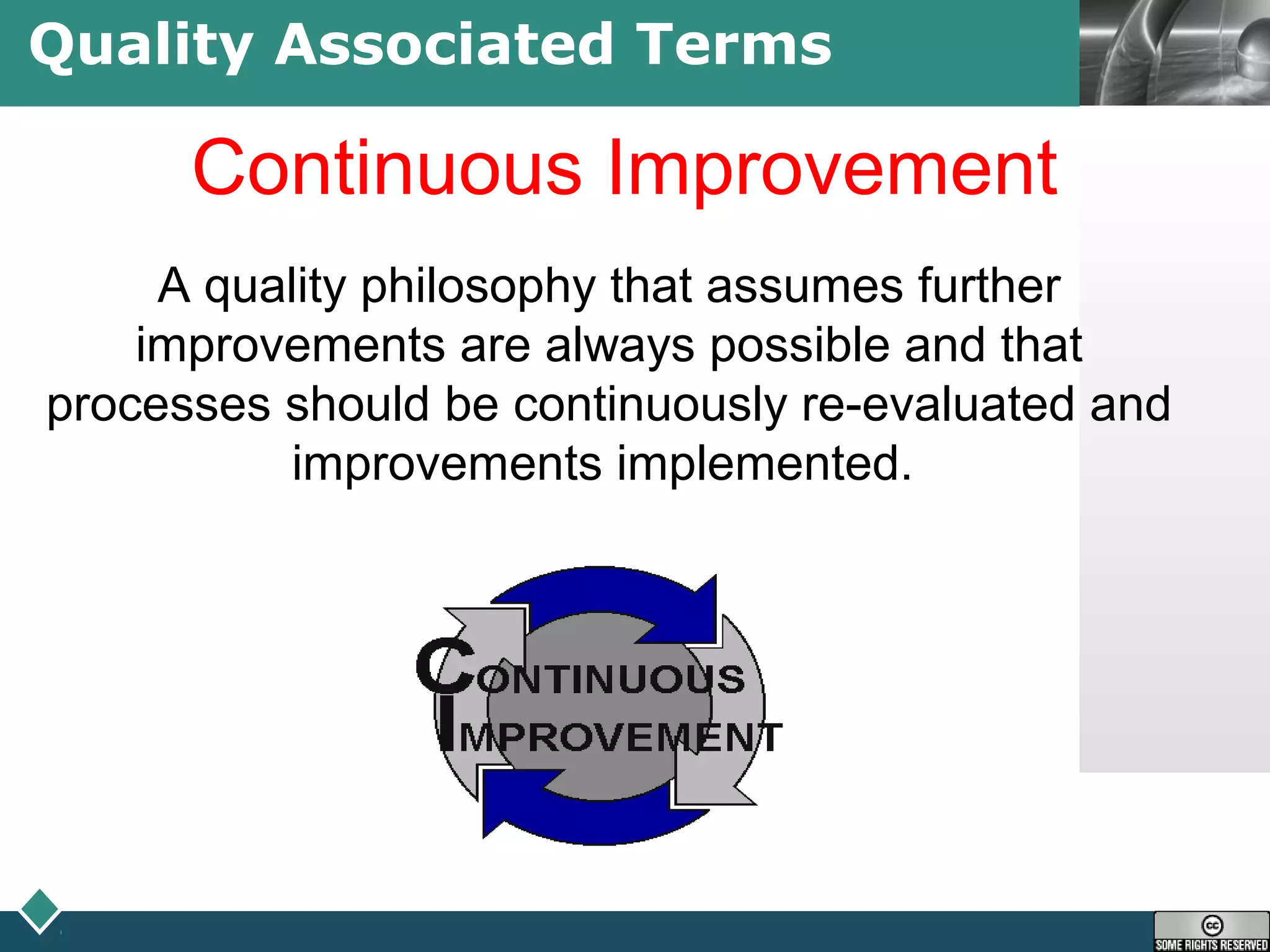
Continuous Improvement
A quality philosophy that assumes further
improvements are always possible and that
processes should be continuously re-evaluated and

improvements implemented.
LOGOQuality Associated Terms
Continuous Improvement
 Represents continual improvementRepresents continual improvement
of all processesof all processes
 Involves all operations and workInvolves all operations and work
centers including suppliers andcenters including suppliers and
customerscustomers
People, Equipment, Materials,People, Equipment, Materials,
ProceduresProcedures
LOGOQuality Associated Terms
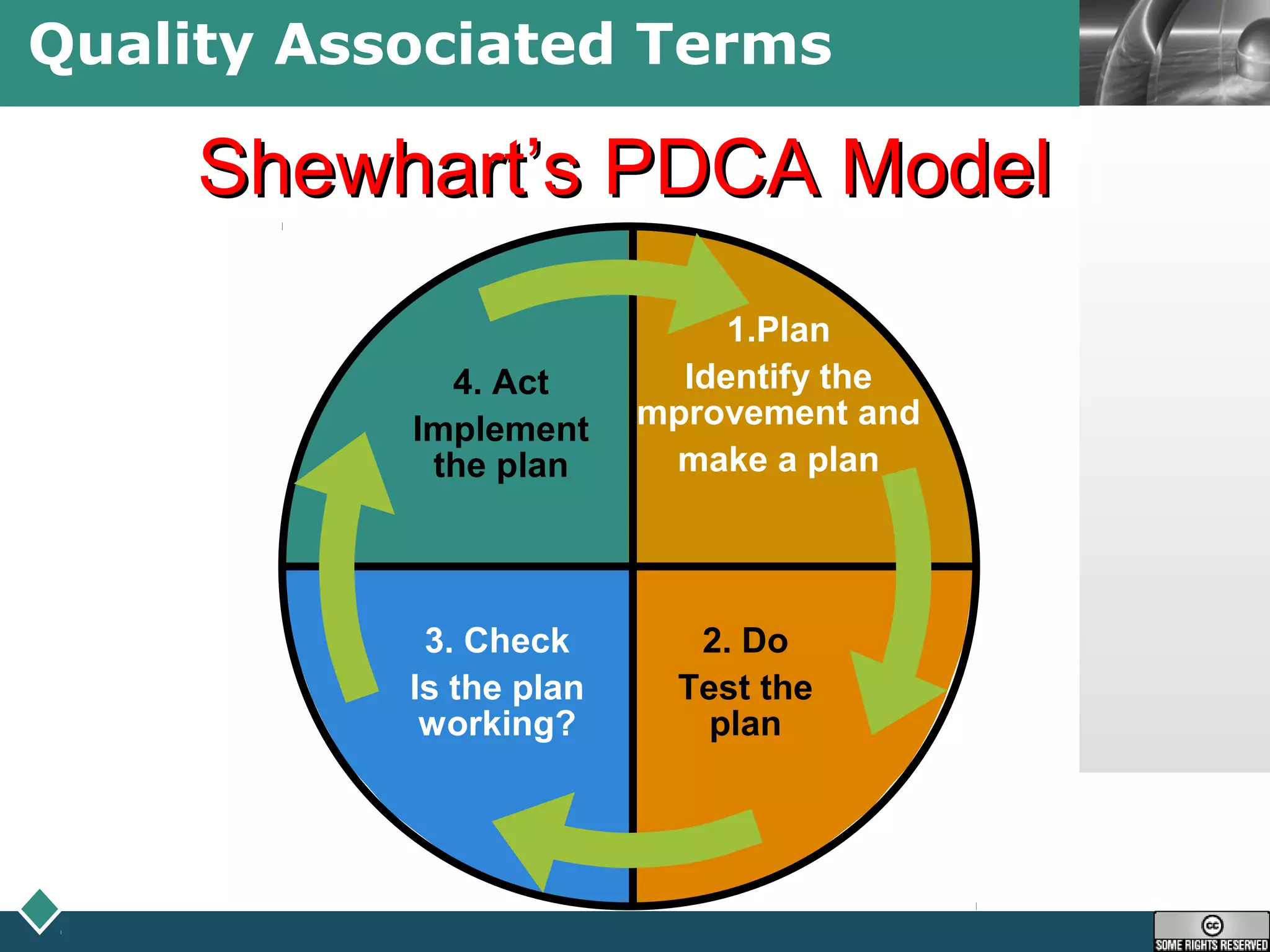
Shewhart’s PDCA ModelShewhart’s PDCA Model
2. Do
Test the
plan
3. Check
Is the plan
working?
4. Act
Implement
the plan
1.Plan
Identify the
improvement and
make a plan
LOGOQuality Associated Terms
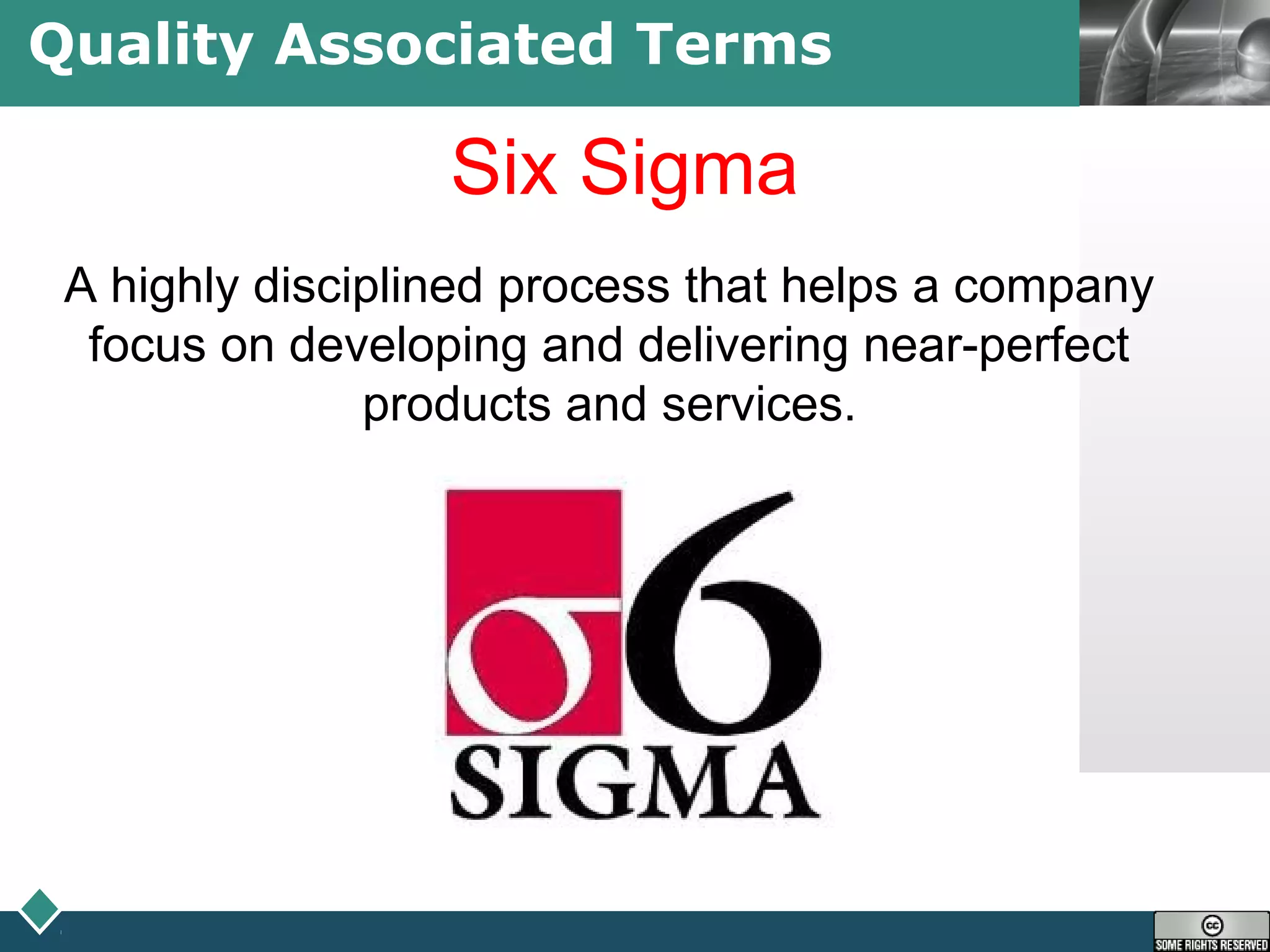
Six Sigma
A highly disciplined process that helps a company
focus on developing and delivering near-perfect
products and services.
LOGOQuality Associated Terms
Six Sigma
 Originally developed by Motorola, SixOriginally developed by Motorola, Six
Sigma refers to an extremely highSigma refers to an extremely high
measure of process capabilitymeasure of process capability
 A Six Sigma capable process willA Six Sigma capable process will
return no more than 3.4 defects perreturn no more than 3.4 defects per
million operations (DPMO)million operations (DPMO)
 Highly structured approach to processHighly structured approach to process
improvementimprovement
LOGOQuality Associated Terms
Six Sigma
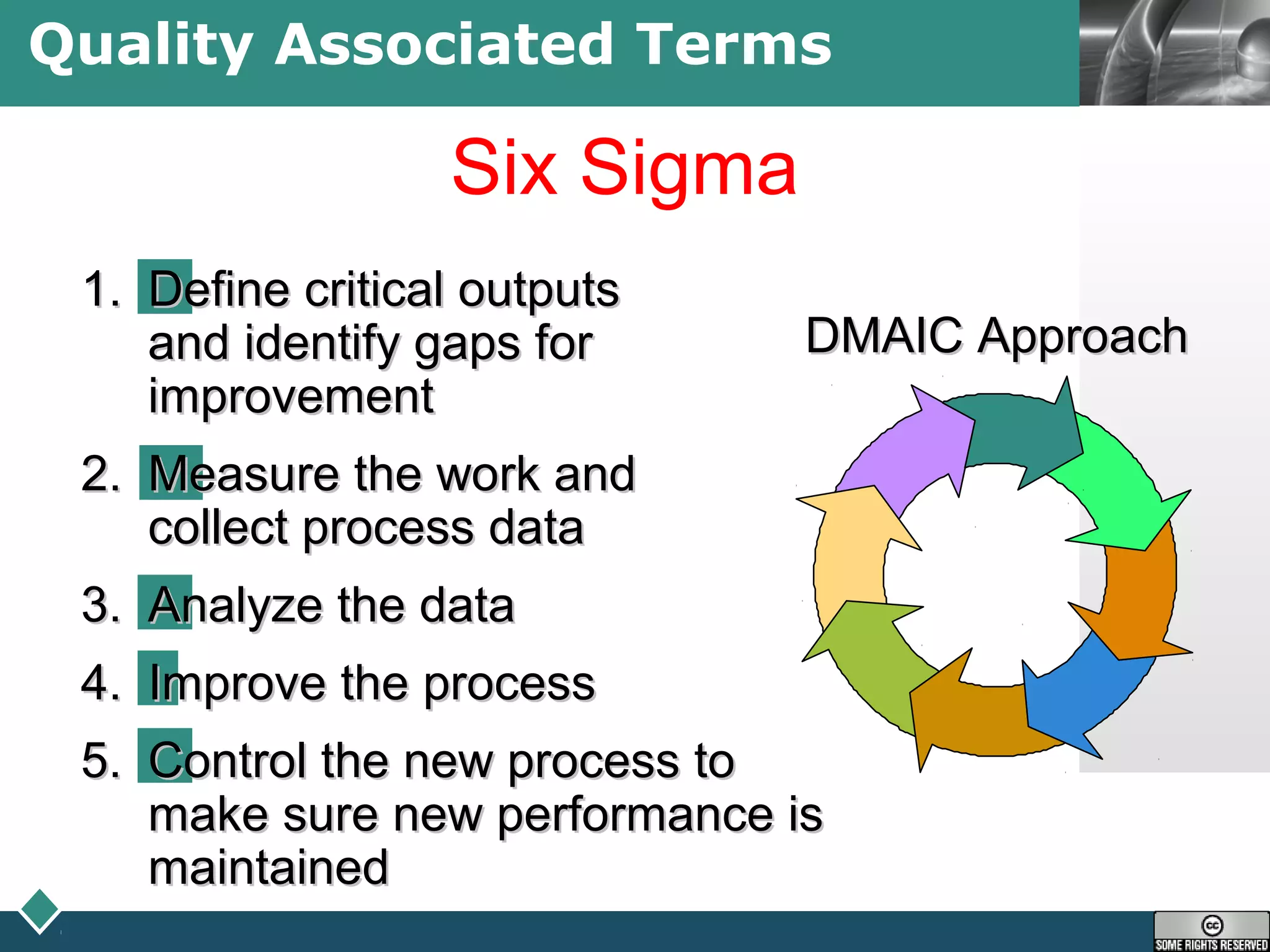
1.1. Define critical outputsDefine critical outputs
and identify gaps forand identify gaps for
improvementimprovement
2.2. Measure the work andMeasure the work and
collect process datacollect process data
3.3. Analyze the dataAnalyze the data
4.4. Improve the processImprove the process
5.5. Control the new process toControl the new process to
make sure new performance ismake sure new performance is
maintainedmaintained
DMAIC ApproachDMAIC Approach
LOGOQuality Associated Terms
Six Sigma Implementation
 Emphasize DPMO as a standard metricEmphasize DPMO as a standard metric
 Provide extensive trainingProvide extensive training
 Focus on corporate sponsor supportFocus on corporate sponsor support
(Champions)(Champions)
 Create qualified process improvementCreate qualified process improvement
experts (Black Belts, Green Belts, etc.)experts (Black Belts, Green Belts, etc.)
 Set stretch objectivesSet stretch objectives
This cannot be accomplished without a major commitment from
top level management
LOGOINSPECTION
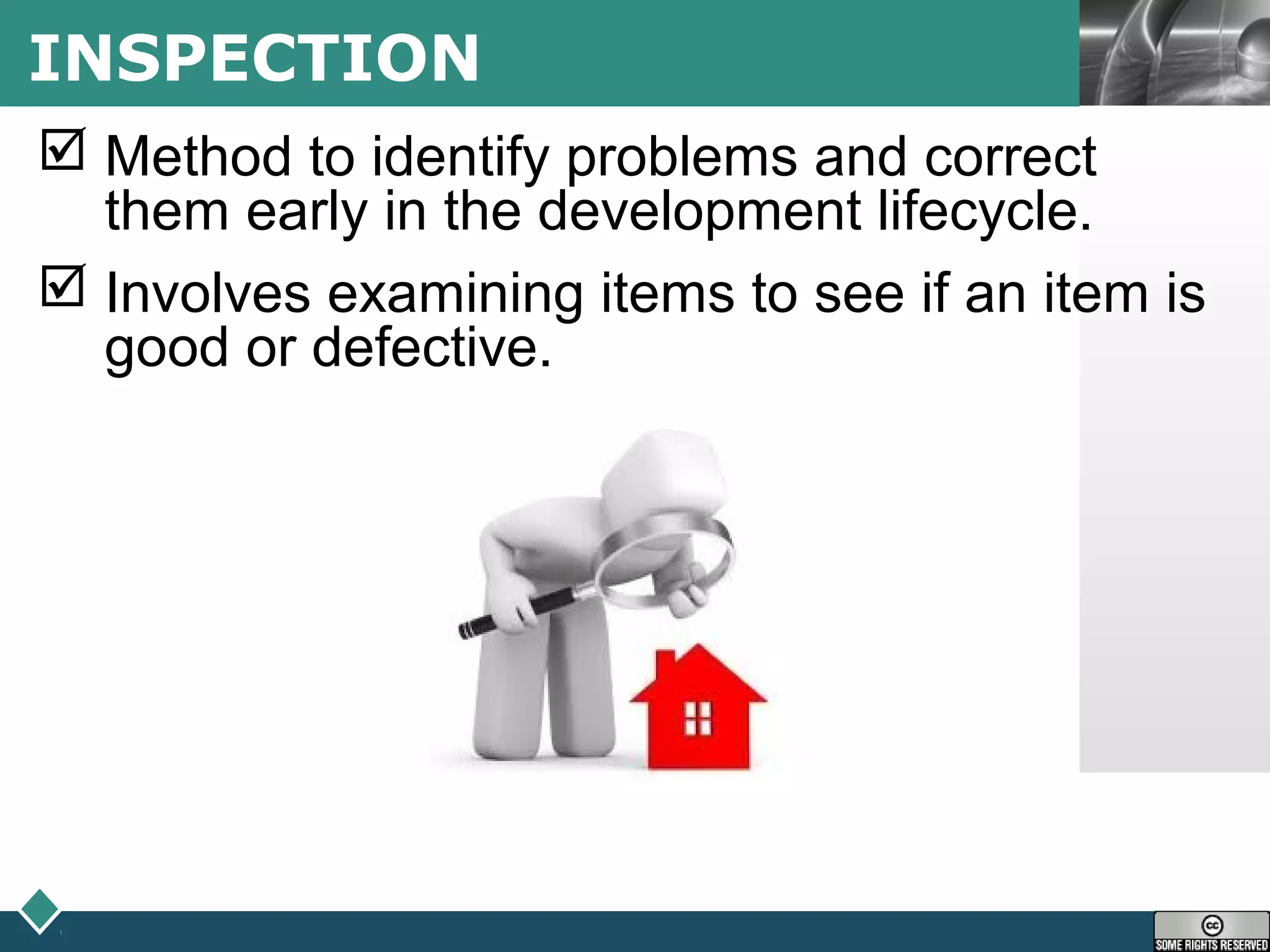
 Method to identify problems and correct
them early in the development lifecycle.
 Involves examining items to see if an item is
good or defective.
LOGOINSPECTION
Purpose of Inspection
1. To distinguish good lots from bad lots.
2. To distinguish good pieces from bad pieces.
3. To determine if the process is changing.
4. To determine if the process is approaching the
specification limits.
5. To rate quality of product.
6. To rate accuracy of inspectors.
7. To measure the precision of the measuring
instrument.
8. To secure products – design information.
9. To measure process capability.
LOGOINSPECTION
When and Where to InspectWhen and Where to Inspect
1. At the supplier’s plant while the supplier is
producing
2. At your facility upon receipt of goods from the
supplier
3. Before costly or irreversible processes
4. During the step-by-step production processes
5. When production or service is complete
6. Before delivery from your facility
7. At the point of customer contact
LOGOINSPECTION
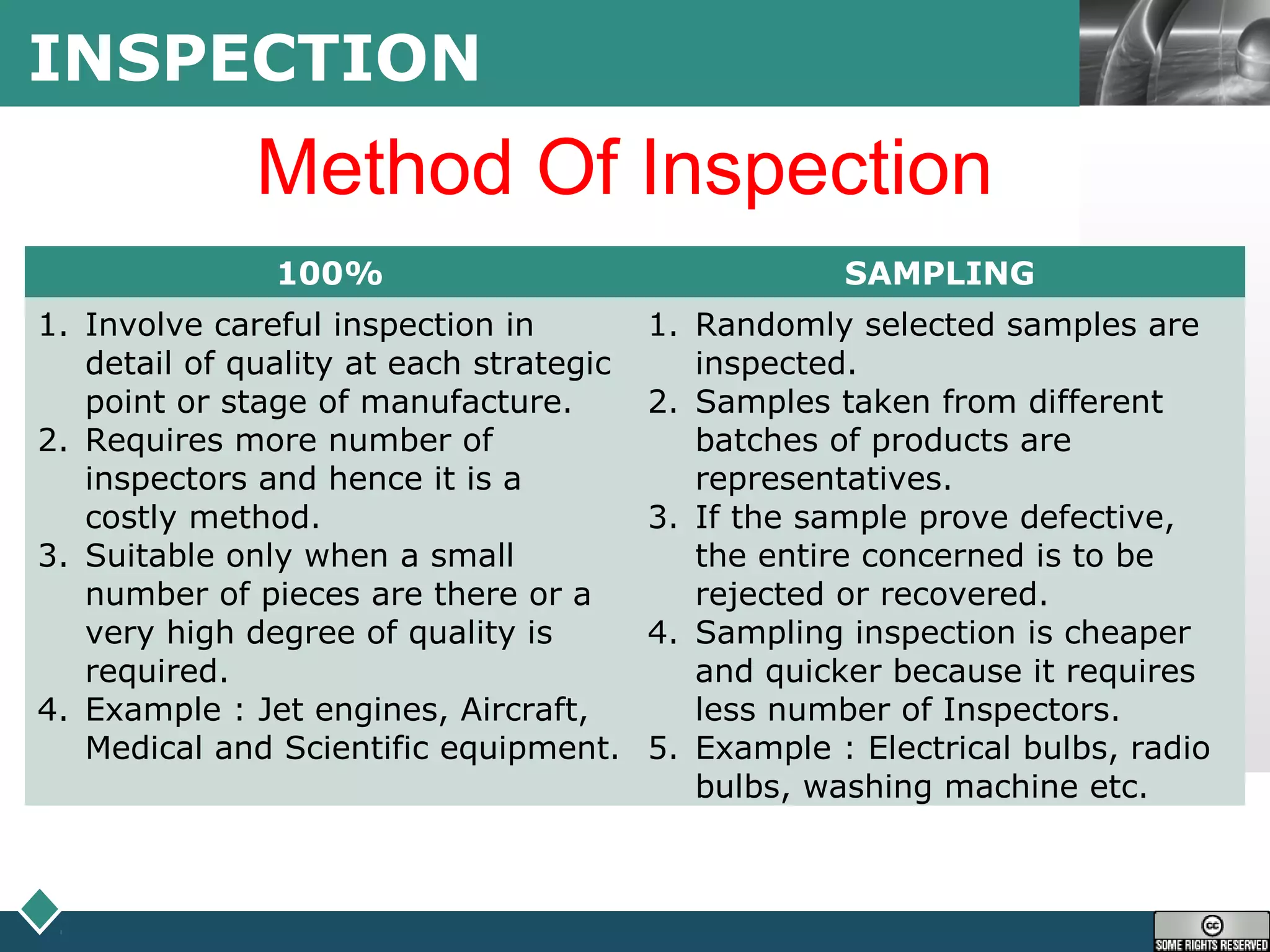
Method Of Inspection
100% SAMPLING
1. Involve careful inspection in
detail of quality at each strategic
point or stage of manufacture.
2. Requires more number of
inspectors and hence it is a
costly method.
3. Suitable only when a small
number of pieces are there or a
very high degree of quality is
required.
4. Example : Jet engines, Aircraft,
Medical and Scientific equipment.
1. Randomly selected samples are
inspected.
2. Samples taken from different
batches of products are
representatives.
3. If the sample prove defective,
the entire concerned is to be
rejected or recovered.
4. Sampling inspection is cheaper
and quicker because it requires
less number of Inspectors.
5. Example : Electrical bulbs, radio
bulbs, washing machine etc.
LOGOSAMPLING
sampling is a process that helps to
determine whether to accept or reject
the sample being observed
LOGOSAMPLING
Why sample taken for inspection?
 Economical and take less time
 Less handling damage
 Fewer inspectors
 Applicability to destructive testing
 Entire lot rejection (motivation for
improvement)
 Reduce the amount of inspection error
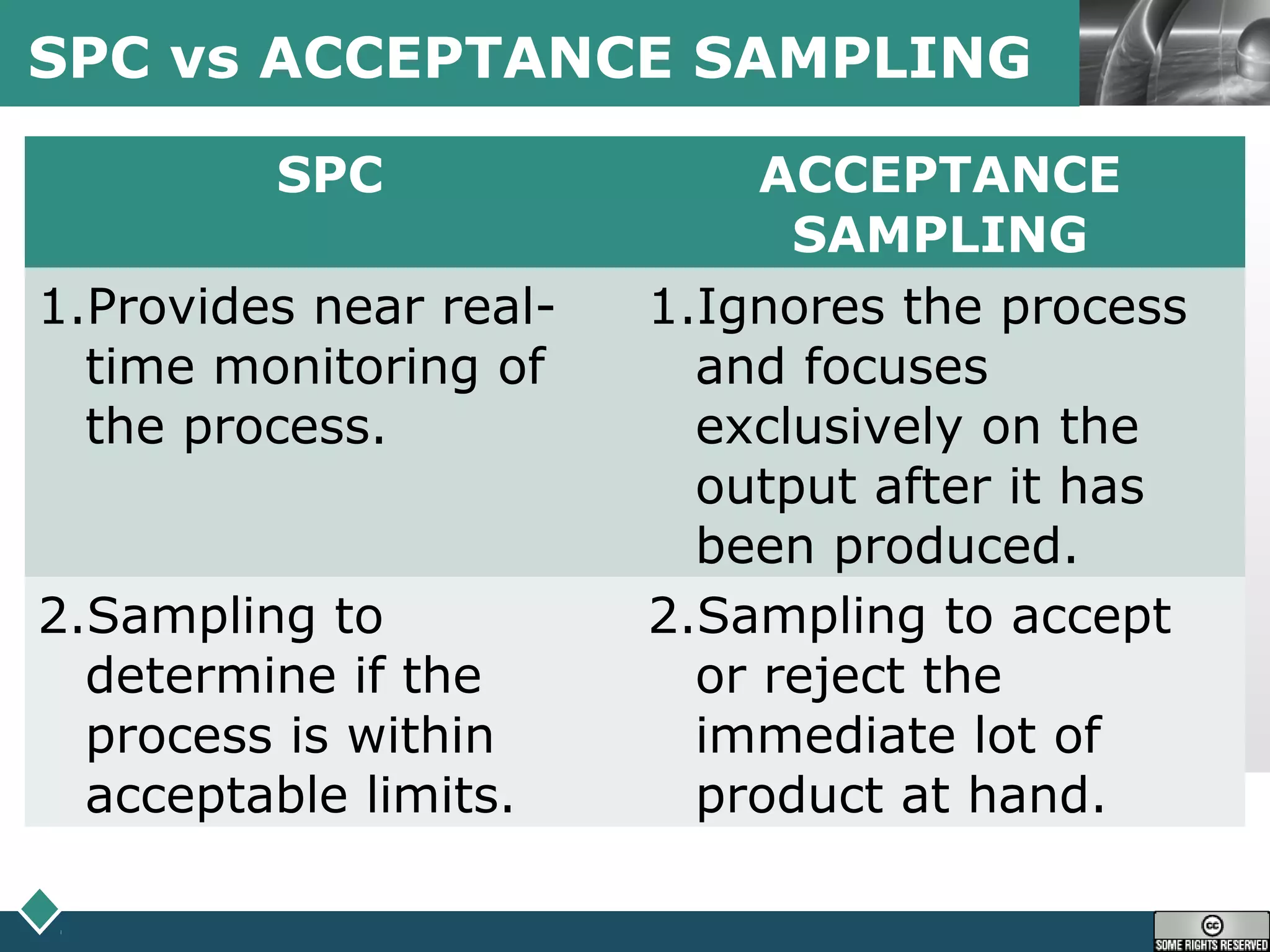
LOGOSPC vs ACCEPTANCE SAMPLING
SPC ACCEPTANCE
SAMPLING
1.Provides near real-
time monitoring of
the process.
1.Ignores the process
and focuses
exclusively on the
output after it has
been produced.
2.Sampling to
determine if the
process is within
acceptable limits.
2.Sampling to accept
or reject the
immediate lot of
product at hand.
LOGO
Click to edit company slogan .

JF608: Quality Control - Unit 2

  • 1.
    www.themegallery.com UNIT 2-UNIT 2-BASIC QUALITY CONCEPT © Mechanical Engineering Department
  • 2.
    LOGOOUTLINEOUTLINE  Introduction  Definitionof Quality  Zero Defect  Customer  Quality Associated Terms and Concepts  Inspection  Sampling  SPC vs Acceptance Sampling
  • 3.
    LOGOINTRODUCTIONINTRODUCTION  an essentialfactor to be considered in every product or services.  without adequate quality, it is not possible to compete in the market.  the future of an industry is driven by customers.  at present industries are facing the following challenges :  increasing demands of customers  increasing competition  technological changes  law becoming powerful
  • 4.
    LOGODEFINITION OF QUALITY Quality is not merely the goodness or otherwise of a finished product but it is the ultimate objective of the company and it is what customers expect from a product.  Some definitions of quality have been given  Conformance to specifications and standards.  Fitness of use.  Productivity, competitive costs, timely delivery and total customer satisfaction.  Hence a definition of quality is the totality of featureshe totality of features and characteristics of a product or service thatand characteristics of a product or service that bears on its ability to satisfy stated or impliedbears on its ability to satisfy stated or implied needs.needs.
  • 5.
    LOGODEFINITION OF QUALITY Hence a quality product should meet the following requirements  Quality raw material should be used.  Quality parts should be used.  Assemblies should be of good quality.  Should adopt quality process and processing conditions.  Should give high reliability.  Should be aesthetic.  Should conform to standards.  Quality services.
  • 6.
    LOGODEFINITION OF QUALITY Quality is quantifed as shown : Where; Q = quality P = performance E = expectations  If Q > 1.0, it implies that the customer has a good feeling about the product or service. E PQ =
  • 7.
    LOGODIMENSIONS OF QUALITY 1.Performance 2. Features 3. Conformance 4. Reliability 5. Durability 6. Service 7. Response 8. Asthetics 9. Reputation
  • 8.
    LOGOZERO DEFECT  adefect refers to any unwarranted deviation of physical entity or a process.  a product or service without the defect that can be seen.
  • 9.
    LOGOZERO DEFECT Why is“Zero Defects” an Important Concept? Maintain Customer Satisfaction & Loyalty Happy Customers mean more sales!
  • 10.
    LOGOZERO DEFECT Why is“Zero Defects” an Important Concept? COST There is always a cost associated with manufacturing defects!
  • 11.
    LOGOZERO DEFECT Costs ofDefects ? Does it cost more to make processes better ? NO Making processes better leads to reduced Rework Scrap Warranty costs Inspection costs
  • 12.
    LOGOZERO DEFECT 1-10-100 Rule The1-10-100 rule states that as a product or service moves through the production system, the cost of correcting an error multiplies by 10. Activity Cost Order entered correctly $ 1 Error detected in billing $ 10 Error detected by customer $ 100 Dissatisfied customer shares the experience with others the costs is $1000
  • 13.
    LOGOCUSTOMER  customer satisfactionhas become a measure of quality.  an organisation’s success depends largely on its customers.  satisfied customers will automatically contribute towards increasing the profit.  customer satisfaction is the goal of TQM.
  • 14.
    LOGOCUSTOMER Who are calledCUSTOMERS ? As anyone who receives that which is product or service by the individual or organisation that has value
  • 15.
  • 16.
    LOGOEXTERNAL CUSTOMER  existoutside the organisation  purhase the product / service of the organisation
  • 17.
    LOGOINTERNAL CUSTOMER  existinside the organisation.  the end users of the organisation’s product / services.
  • 18.
    LOGOImportance of Qualityto Customer  customers are retained by the organisation for a longer period.  customers recommend the product / services of the organisation to other.  it costs more to attract a new customer than in retaining an existing one.  organisations can take up their profits (25 – 125%) by retaining just 5% more of their exixting customers.
  • 19.
    LOGOQuality Associated Terms QualityControl (QC) A system of routine technical activities, to measure and control the quality of the inventory as it is being developed
  • 20.
    LOGOQuality Associated Terms QualityAssurance (QA) Aan activities include a planned system of review procedures conducted by personnel not directly involved in the inventory compilation/development process.
  • 21.
    LOGOQuality Associated Terms QCvs QA QA QC Focus on: QA aims to prevent defects with a focus on the process used to make the product. It is a proactive quality process. QC aims to identify defects in the finished product. Quality control, therefore, is a reactive process. Goal: The goal of QA is to improve development and test processes so that defects do not arise when the product is being developed. The goal of QC is to identify defects after a product is developed and before it's released.
  • 22.
    LOGOQuality Associated Terms TotalQuality Management (TQM) A structured system for satisfying internal and external customers and suppliers by integrating the business environment, continuous improvement, and breakthroughs with development, improvement, and maintenance cycles while changing organizational culture.
  • 23.
    LOGOQuality Associated Terms Conceptsof TQM 1. Commitment. 2. Customer Satisfaction. 3. Participation By All. 4. Process Measurements. 5. Continuous Improvements. 6. Problem Identification. 7. Alignment Of Organisational Objectives & Individual Attitudes. 8. Personal Accountability. 9. Personal Development.
  • 24.
    LOGOQuality Associated Terms ContinuousImprovement A quality philosophy that assumes further improvements are always possible and that processes should be continuously re-evaluated and improvements implemented.
  • 25.
    LOGOQuality Associated Terms ContinuousImprovement  Represents continual improvementRepresents continual improvement of all processesof all processes  Involves all operations and workInvolves all operations and work centers including suppliers andcenters including suppliers and customerscustomers People, Equipment, Materials,People, Equipment, Materials, ProceduresProcedures
  • 26.
    LOGOQuality Associated Terms Shewhart’sPDCA ModelShewhart’s PDCA Model 2. Do Test the plan 3. Check Is the plan working? 4. Act Implement the plan 1.Plan Identify the improvement and make a plan
  • 27.
    LOGOQuality Associated Terms SixSigma A highly disciplined process that helps a company focus on developing and delivering near-perfect products and services.
  • 28.
    LOGOQuality Associated Terms SixSigma  Originally developed by Motorola, SixOriginally developed by Motorola, Six Sigma refers to an extremely highSigma refers to an extremely high measure of process capabilitymeasure of process capability  A Six Sigma capable process willA Six Sigma capable process will return no more than 3.4 defects perreturn no more than 3.4 defects per million operations (DPMO)million operations (DPMO)  Highly structured approach to processHighly structured approach to process improvementimprovement
  • 29.
    LOGOQuality Associated Terms SixSigma 1.1. Define critical outputsDefine critical outputs and identify gaps forand identify gaps for improvementimprovement 2.2. Measure the work andMeasure the work and collect process datacollect process data 3.3. Analyze the dataAnalyze the data 4.4. Improve the processImprove the process 5.5. Control the new process toControl the new process to make sure new performance ismake sure new performance is maintainedmaintained DMAIC ApproachDMAIC Approach
  • 30.
    LOGOQuality Associated Terms SixSigma Implementation  Emphasize DPMO as a standard metricEmphasize DPMO as a standard metric  Provide extensive trainingProvide extensive training  Focus on corporate sponsor supportFocus on corporate sponsor support (Champions)(Champions)  Create qualified process improvementCreate qualified process improvement experts (Black Belts, Green Belts, etc.)experts (Black Belts, Green Belts, etc.)  Set stretch objectivesSet stretch objectives This cannot be accomplished without a major commitment from top level management
  • 31.
    LOGOINSPECTION  Method toidentify problems and correct them early in the development lifecycle.  Involves examining items to see if an item is good or defective.
  • 32.
    LOGOINSPECTION Purpose of Inspection 1.To distinguish good lots from bad lots. 2. To distinguish good pieces from bad pieces. 3. To determine if the process is changing. 4. To determine if the process is approaching the specification limits. 5. To rate quality of product. 6. To rate accuracy of inspectors. 7. To measure the precision of the measuring instrument. 8. To secure products – design information. 9. To measure process capability.
  • 33.
    LOGOINSPECTION When and Whereto InspectWhen and Where to Inspect 1. At the supplier’s plant while the supplier is producing 2. At your facility upon receipt of goods from the supplier 3. Before costly or irreversible processes 4. During the step-by-step production processes 5. When production or service is complete 6. Before delivery from your facility 7. At the point of customer contact
  • 34.
    LOGOINSPECTION Method Of Inspection 100%SAMPLING 1. Involve careful inspection in detail of quality at each strategic point or stage of manufacture. 2. Requires more number of inspectors and hence it is a costly method. 3. Suitable only when a small number of pieces are there or a very high degree of quality is required. 4. Example : Jet engines, Aircraft, Medical and Scientific equipment. 1. Randomly selected samples are inspected. 2. Samples taken from different batches of products are representatives. 3. If the sample prove defective, the entire concerned is to be rejected or recovered. 4. Sampling inspection is cheaper and quicker because it requires less number of Inspectors. 5. Example : Electrical bulbs, radio bulbs, washing machine etc.
  • 35.
    LOGOSAMPLING sampling is aprocess that helps to determine whether to accept or reject the sample being observed
  • 36.
    LOGOSAMPLING Why sample takenfor inspection?  Economical and take less time  Less handling damage  Fewer inspectors  Applicability to destructive testing  Entire lot rejection (motivation for improvement)  Reduce the amount of inspection error
  • 37.
    LOGOSPC vs ACCEPTANCESAMPLING SPC ACCEPTANCE SAMPLING 1.Provides near real- time monitoring of the process. 1.Ignores the process and focuses exclusively on the output after it has been produced. 2.Sampling to determine if the process is within acceptable limits. 2.Sampling to accept or reject the immediate lot of product at hand.
  • 38.
    LOGO Click to editcompany slogan .