Control Systems
1
Department of Electronics & Communication Engineering,
Madan Mohan Malaviya University of Technology, Gorakhpur
Subject Code: BEC-26 Third Year ECE
Shadab A. Siddique
Assistant Professor
Unit-I
UNIT- I
➢ Introduction to Control Systems
❖ Control System – Definition and Practical Examples
❖ Basic Components of a Control System
➢ Feedback Control Systems:
❖ Feedback and its Effect
❖ Types of Feedback Control Systems
❖ Transfer Function
➢ Block Diagrams:
❖ Representation and reduction
❖ Signal Flow Graphs
➢ Modeling of Physical Systems:
❖ Electrical Networks and Mechanical Systems
❖ Force-Voltage Analogy
❖ Force-Current Analogy
Shadab. A. Siddique
2
UNIT-I: Basic Components of a control system, Feedback and its effect, Types of
feedback control Systems, Block diagrams: representation and reduction, Signal Flow
Graphs, Modeling of Physical Systems: Electrical Networks and Mechanical Systems,
Force-voltage analogy, Force-current analogy.
Course Assessment methods:
Continuous assessment through tutorials, attendance, home assignments,
quizzes, practical work, record, viva voce and Three Minor tests and One
Major Theory & Practical Examination
Course Outcomes:
The students are expected to be able to demonstrate the following knowledge,
skills and attitudes after completing this course,
✓ Describe the response characteristic and differentiate between the open loop
and closed loop of a control system.
3
Shadab. A. Siddique
UNIT- I
➢ Introduction to Control Systems
❖ Control System – Definition and Practical Examples
❖ Basic Components of a Control System
➢ Feedback Control Systems:
❖ Feedback and its Effect
❖ Types of Feedback Control Systems
❖ Transfer Function
➢ Block Diagrams:
❖ Representation and reduction
❖ Signal Flow Graphs
➢ Modeling of Physical Systems:
❖ Electrical Networks and Mechanical Systems
❖ Force-Voltage Analogy
❖ Force-Current Analogy 4
Shadab. A. Siddique
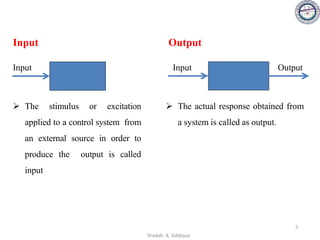
Input
➢ The stimulus or excitation
applied to a control system from
an external source in order to
produce the output is called
input
Input
Output
➢ The actual response obtained from
a system is called as output.
Output
Input
5
Shadab. A. Siddique
Control
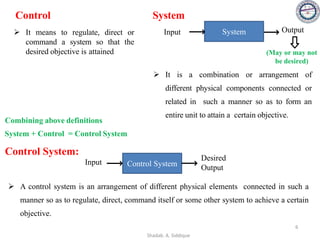
➢ It means to regulate, direct or
command a system so that the
desired objective is attained
System
➢ It is a combination or arrangement of
different physical components connected or
related in such a manner so as to form an
entire unit to attain a certain objective.
Input Output
System
Control System:
➢ A control system is an arrangement of different physical elements connected in such a
manner so as to regulate, direct, command itself or some other system to achieve a certain
objective.
Combining above definitions
System + Control = Control System
Input
Desired
Output
Control System
(May or may not
be desired)
6
Shadab. A. Siddique
Difference between System and Control System
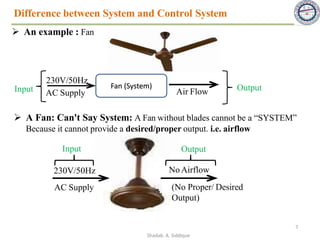
➢ An example : Fan
230V/50Hz
AC Supply Air Flow
Input Output
➢ A Fan: Can't Say System: A Fan without blades cannot be a “SYSTEM”
Because it cannot provide a desired/proper output. i.e. airflow
Fan (System)
Input
230V/50Hz
AC Supply
NoAirflow
(No Proper/ Desired
Output)
Output
7
Shadab. A. Siddique
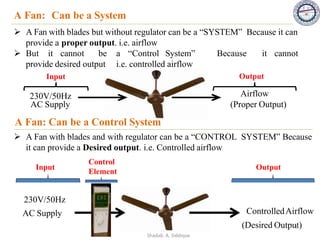
A Fan: Can be a System
➢ A Fan with blades but without regulator can be a “SYSTEM” Because it can
provide a proper output. i.e. airflow
➢ But it cannot be a “Control System” Because it cannot
provide desired output i.e. controlled airflow
230V/50Hz
AC Supply
Airflow
(Proper Output)
Input Output
A Fan: Can be a Control System
➢ A Fan with blades and with regulator can be a “CONTROL SYSTEM” Because
it can provide a Desired output. i.e. Controlled airflow
230V/50Hz
AC Supply ControlledAirflow
(Desired Output)
Input Output
Control
Element
8
Shadab. A. Siddique
UNIT- I
➢ Introduction to Control Systems
❖ Control System – Definition and Practical Examples
❖ Basic Components of a Control System
➢ Feedback Control Systems:
❖ Feedback and its Effect
❖ Types of Feedback Control Systems
➢ Block Diagrams:
❖ Representation and reduction
❖ Signal Flow Graphs
➢ Modeling of Physical Systems:
❖ Electrical Networks and Mechanical Systems
❖ Force-Voltage Analogy
❖ Force-Current Analogy
9
Shadab. A. Siddique
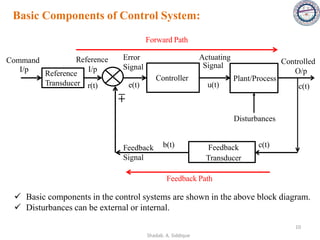
Basic Components of Control System:
✓ Basic components in the control systems are shown in the above block diagram.
✓ Disturbances can be external or internal.
Reference
Transducer
Controller Plant/Process
Feedback
Transducer
Command
I/p
Reference
I/p
Feedback
Signal
Actuating
Signal
Error
Signal
Controlled
O/p
r(t) e(t)
b(t) c(t)
c(t)
u(t)
Feedback Path
Forward Path
∓
Disturbances
10
Shadab. A. Siddique
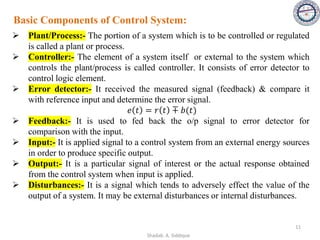
➢ Plant/Process:- The portion of a system which is to be controlled or regulated
is called a plant or process.
➢ Controller:- The element of a system itself or external to the system which
controls the plant/process is called controller. It consists of error detector to
control logic element.
➢ Error detector:- It received the measured signal (feedback) & compare it
with reference input and determine the error signal.
𝑒 𝑡 = 𝑟 𝑡 ∓ 𝑏(𝑡)
➢ Feedback:- It is used to fed back the o/p signal to error detector for
comparison with the input.
➢ Input:- It is applied signal to a control system from an external energy sources
in order to produce specific output.
➢ Output:- It is a particular signal of interest or the actual response obtained
from the control system when input is applied.
➢ Disturbances:- It is a signal which tends to adversely effect the value of the
output of a system. It may be external disturbances or internal disturbances.
Basic Components of Control System:
11
Shadab. A. Siddique
Classification of Control System:
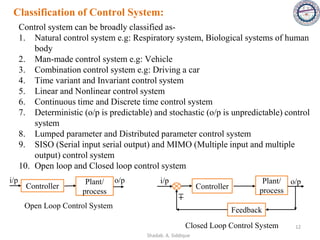
Control system can be broadly classified as-
1. Natural control system e.g: Respiratory system, Biological systems of human
body
2. Man-made control system e.g: Vehicle
3. Combination control system e.g: Driving a car
4. Time variant and Invariant control system
5. Linear and Nonlinear control system
6. Continuous time and Discrete time control system
7. Deterministic (o/p is predictable) and stochastic (o/p is unpredictable) control
system
8. Lumped parameter and Distributed parameter control system
9. SISO (Serial input serial output) and MIMO (Multiple input and multiple
output) control system
10. Open loop and Closed loop control system
Controller
Plant/
process
o/p
i/p
Open Loop Control System
Controller
Plant/
process
o/p
i/p
Feedback
∓
Closed Loop Control System 12
Shadab. A. Siddique
Classification of Control System
(Depending on control action)
Open Loop Control System Closed Loop Control System
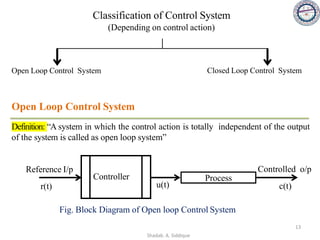
Open Loop Control System
Definition: “A system in which the control action is totally independent of the output
of the system is called as open loop system”
Fig. Block Diagram of Open loop Control System
Controller Process
Reference I/p
r(t) u(t)
Controlled o/p
c(t)
13
Shadab. A. Siddique
OLCS Examples
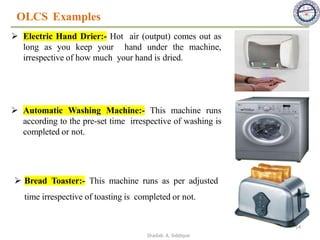
➢ Electric Hand Drier:- Hot air (output) comes out as
long as you keep your hand under the machine,
irrespective of how much your hand is dried.
➢ Automatic Washing Machine:- This machine runs
according to the pre-set time irrespective of washing is
completed or not.
➢ Bread Toaster:- This machine runs as per adjusted
time irrespective of toasting is completed or not.
14
Shadab. A. Siddique
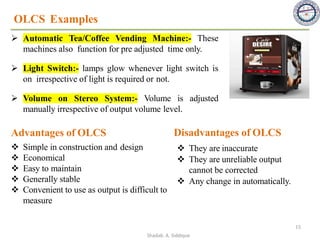
➢ Automatic Tea/Coffee Vending Machine:- These
machines also function for pre adjusted time only.
OLCS Examples
➢ Light Switch:- lamps glow whenever light switch is
on irrespective of light is required or not.
➢ Volume on Stereo System:- Volume is adjusted
manually irrespective of output volume level.
Advantages of OLCS
❖ Simple in construction and design
❖ Economical
❖ Easy to maintain
❖ Generally stable
❖ Convenient to use as output is difficult to
measure
❖ They are inaccurate
❖ They are unreliable output
cannot be corrected
❖ Any change in automatically.
Disadvantages of OLCS
15
Shadab. A. Siddique
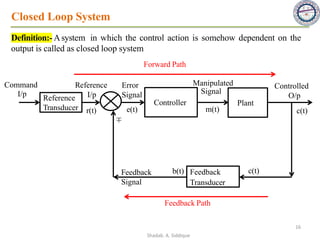
Closed Loop System
Definition:- Asystem in which the control action is somehow dependent on the
output is called as closed loop system
Reference
Transducer
Controller Plant
Feedback
Transducer
Command
I/p
Reference
I/p
Feedback
Signal
Manipulated
Signal
Error
Signal
Controlled
O/p
r(t) e(t)
b(t) c(t)
c(t)
m(t)
Feedback Path
Forward Path
±
16
Shadab. A. Siddique
CLCS Examples
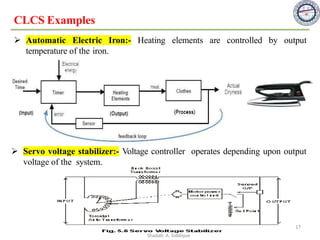
➢ Automatic Electric Iron:- Heating elements are controlled by output
temperature of the iron.
➢ Servo voltage stabilizer:- Voltage controller operates depending upon output
voltage of the system.
17
Shadab. A. Siddique
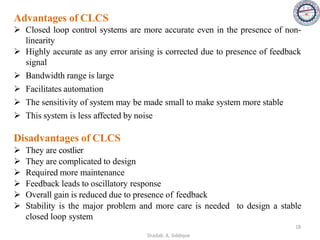
Advantages of CLCS
➢ Closed loop control systems are more accurate even in the presence of non-
linearity
➢ Highly accurate as any error arising is corrected due to presence of feedback
signal
➢ Bandwidth range is large
➢ Facilitates automation
➢ The sensitivity of system may be made small to make system more stable
➢ This system is less affected by noise
Disadvantages of CLCS
➢ They are costlier
➢ They are complicated to design
➢ Required more maintenance
➢ Feedback leads to oscillatory response
➢ Overall gain is reduced due to presence of feedback
➢ Stability is the major problem and more care is needed to design a stable
closed loop system
18
Shadab. A. Siddique
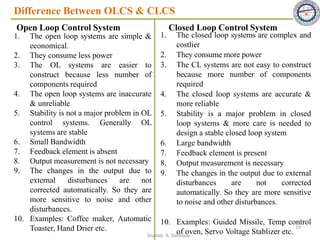
Difference Between OLCS & CLCS
Open Loop Control System Closed Loop Control System
1. The closed loop systems are complex and
costlier
2. They consume more power
3. The CL systems are not easy to construct
because more number of components
required
4. The closed loop systems are accurate &
more reliable
5. Stability is a major problem in closed
loop systems & more care is needed to
design a stable closed loop system
6. Large bandwidth
7. Feedback element is present
8. Output measurement is necessary
9. The changes in the output due to external
disturbances are not corrected
automatically. So they are more sensitive
to noise and other disturbances.
10. Examples: Guided Missile, Temp control
of oven, Servo Voltage Stablizer etc.
1. The open loop systems are simple &
economical.
2. They consume less power
3. The OL systems are easier to
construct because less number of
components required
4. The open loop systems are inaccurate
& unreliable
5. Stability is not a major problem in OL
control systems. Generally OL
systems are stable
6. Small Bandwidth
7. Feedback element is absent
8. Output measurement is not necessary
9. The changes in the output due to
external disturbances are not
corrected automatically. So they are
more sensitive to noise and other
disturbances.
10. Examples: Coffee maker, Automatic
Toaster, Hand Drier etc. 19
Shadab. A. Siddique
UNIT- I (15 Marks)
➢ Introduction to Control system
❖ Control System – Definition and Practical Examples
❖ Basic Components of a Control System
➢ Feedback Control Systems:
❖ Feedback and its Effect
❖ Types of Feedback Control Systems
❖ Transfer Function
➢ Block Diagrams:
❖ Representation and reduction
❖ Signal Flow Graphs
➢ Modeling of Physical Systems:
❖ Electrical Networks and Mechanical Systems
❖ Force-Voltage Analogy
❖ Force-Current Analogy
20
Shadab. A. Siddique
Feedback and its Effect:
The effect of parameter variation on the system performance can be analyzed by
sensitivity of the system.
➢ Effect of Parameter variation in open loop control system:
Consider an open loop control system whose transfer function will be
G(s)
R(s) C(s) C(s)
R(s)
= G(s) = T(s)
C s = G s . R s
Let ∆G(s) be the changes in G(s) due to parameter variation, the corresponding
change in the output be ∆C(s)
C(s) + ∆C(s) = [G(s) + ∆G(s)] R(s)
= G(s) . R(s) + ∆G(s) . R(s)
C(s) + ∆C(s) = C(s) + ∆G(s) . R(s)
Therefore, ∆C(s) = ∆G(s) . R(s)
➢ Effect of Parameter variation in closed loop control system:
R(s)
G(s)
C(s)
H(s)
B(s)
+
±
E(s)
Consider a closed loop control system whose
transfer function is given by,
C(s) G(s)
=
R(s) 1 ± G(s).H(s)
TF = T(s) =
21
Shadab. A. Siddique
C(s) + ∆C(s)
R(s)
=
G(s) + ∆G(s)
1 ± [G(s) + ∆G(s)] . H(s)
C(s) + ∆C(s =
G(s) . R(s) + ∆G(s) . R(s)
1 ± [G(s) + ∆G(s)] . H(s)
∆C(s) =
G(s) . R(s) + ∆G(s) . R(s)
1 ± [G(s) + ∆G(s)] . H(s)
− C(s)
Assumption: G(s) . H(s) ≈ [G(s) + ∆G(s)] . H(s)
∆C(s) =
G(s) . R(s) + ∆G(s) . R(s)
1 ± G(s) . H(s)
− C(s)
∆C(s =
G(s) . R(s)
1 ± G(s) . H(s)
+
∆G(s) . R(s)
1 ± G(s) . H(s)
− C(s)
∆C(s = C s +
∆G(s) . R(s)
1 ± G(s) . H(s)
− C(s)
Therefore,
|1 ± G(s) . H(s)| ≥ 1
Let ∆G(s) be the changes in G(s) due to
parameter variation in system. The
corresponding change in the output is ∆C(s)
➢ Sensitivity of a control system:
An effect in the system parameters due to
parameter variation can be studied
mathematically by defining the term
sensitivity of a control system.
Let the variable in a system is varying by T
due to the variation in parameters K of the
system. The sensitivity of system
parameters K is expressed by,
S =
% Change in T
% Change in K
𝐾 𝑐𝑎𝑛 𝑏𝑒 𝑜𝑝𝑒𝑛 𝑙𝑜𝑜𝑝 𝑔𝑎𝑖𝑛 𝑜𝑟 𝑓𝑒𝑒𝑑𝑏𝑎𝑐𝑘
S =
d ln T
d ln K
=
∆T/T
∆K/K
=
𝝏T/T
𝝏K/K
𝑆𝐾
𝑇
=
K 𝝏T
𝑇 𝝏K
∆C(s) =
∆G(s) . R(s)
1 ± G(s) . H(s)
A symbolic representation 𝑆𝐾
𝑇
represents
the sensitivity of a variable T with respect
to the variation in the parameter K.
T may be the transfer function of output
variable & K may be the gain or feedback
factor.
22
Shadab. A. Siddique
SG
T
=
G(s) 𝜕𝑇
𝑇(𝑠) 𝜕𝐾
For open loop control system:
T(s) =
C(s)
R(s)
= G(s)
Forward path transfer function = Gain = G(s)
SG
T
=
G(s) 𝜕𝐺(𝑠)
𝐺(𝑠) 𝜕𝐺(𝑠)
= 1
---------------- (1)
SG
T
= 1
For closed loop control system:
T(s) =
C(s)
R(s)
= G(s) =
G(s)
1 + G(s) . H(s)
Forward path transfer function = Gain = G(s)
SG
T
=
G s
G(s)
1 + G(s) . H(s)
.
𝜕[
G(s)
1 + G(s) . H(s)
}
𝜕𝐺(𝑠)
SG
T
= [1 + G(s) . H(s)] .
1 + G(s)H(s) −G(s)H(s)
[1 + G(s)H(s)]2
SG
T
=
1
1 + G(s)H(s)
---------------- (2)
Comparing equation (1) and (2), it can be
observed that due to feedback the sensitivity
function get reduces by the factor
1
1 + G(s)H(s)
compared to an open loop
transfer function.
➢ Sensitivity of T(s) with H(s):
Let K be the gain ( forward path transfer function) & T be the overall transfer function of
the control system.
23
Shadab. A. Siddique Maj. G. S. Tripathi
Shadab. A. Siddique
➢ Sensitivity of T(s) with H(s):
Let us calculate the sensitivity function which indicates the sensitivity of overall transfer
function T(s) with respect to feedback path transfer function H(s). Such a function can be
expressed as,
SH
T
=
H(s) 𝜕𝑇(𝑠)
𝑇(𝑠) 𝜕𝐻(𝑠)
For closed loop control system,
T(s) =
C(s)
R(s)
= G(s) =
G(s)
1 + G(s)H(s)
Feedback path transfer function = H(s)
SH
T
=
H s
G(s)
1 + G(s)H(s)
.
𝜕[
G(s)
1 + G(s)H(s)
}
𝜕𝐻(𝑠)
SH
T
=
H(s) . [1 + G(s)H(s)]
G(s)
. [
−G(s)
[1 + G(s)H(s)]2 . G(s) ]
SH
T
=
− G(s)H(s)
1 + G(s)H(s)
---------------- (3)
It can be observed from equation (2) and (3) that the closed loop system is more sensitive
to variation in feedback path parameter than the variation in forward path parameter i.e.
gain. 24
Shadab. A. Siddique
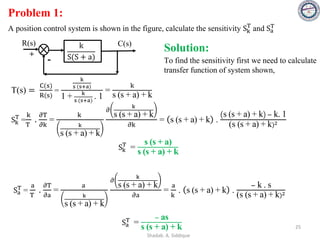
Problem 1:
A position control system is shown in the figure, calculate the sensitivity Sk
T
and Sa
T
R(s) k
S(S + a)
C(s)
+
- To find the sensitivity first we need to calculate
transfer function of system shown,
Solution:
T(s) =
C(s)
R(s)
=
k
s (s+a)
1 + k
s (s+a)
. 1
=
k
s (s + a) + k
Sk
T
=
k
T
.
𝜕T
𝜕k
=
k
k
s (s + a) + k
𝜕
k
s (s + a) + k
𝜕k
= s (s + a) + k .
s (s + a) + k − k. 1
(s (s + a) + k)2
Sa
T =
a
T
.
𝜕T
𝜕a
=
a
k
s (s + a) + k
𝜕
k
s (s + a) + k
𝜕a
=
a
k
. s (s + a) + k .
− k . s
(s (s + a) + k)2
Sk
T
=
s (s + a)
s (s + a) + k
Sa
T =
− as
s (s + a) + k 25
Shadab. A. Siddique
Problem 2:
In the system shown in the figure, calculate the system sensitivity i SG1
T
(ii) SG2
T
and (ii) SH
T
R(s) C(s)
+
-
G1 G1
H
1
s + 1
1
s + 2
G1 = , G2 = and H = s
Solution:
[G1(s) . R(s) + H(s) . C(s)] . G2(s) = C(s)
G1 . R(s) . G2(s) = C(s) . [1 - H(s) . G2(s)]
T(s) =
C(s)
R(s)
=
G1(s) . G2(s)
1 + H(s) . G2(s)
(i) SG1
T
=
G1
T
.
𝜕T
𝜕G1
=
G1
G1G2
1 + G2H
𝜕
G1G2
1 + G2H
𝜕G1 =
1 + G2H
G2 .
G2 (1 + G2H)
(1 + HG2)2 = 1
(ii) SG2
T
=
G2
T
.
𝜕T
𝜕G2
=
G2
G1G2
1 + G2H
𝜕
G1G2
1 + G2H
𝜕G2 =
1 + G2H
G1 .
G1 (1 + G2H)− G1G2H
(1 + HG2)2 =
1
1 + G2H
(iii) SH
T
=
H
T
.
𝜕T
𝜕H
=
H
G1G2
1 + G2H
𝜕
G1G2
1 + G2H
𝜕H
=
H (1 + G2H)
G1G2
.
− G1 G2
(1 + HG2)2 . G2 =
− HG2
1 + G2H
SH
T
=
− HG2
1 + G2H
=
− s . 1
s + 2
1 + s . 1
s + 2
=
− s
2s + 2
SG2
T
=
1
1 + G2H
=
1
1 + s . 1
s + 2
=
s + 2
2s + 2
26
Shadab. A. Siddique
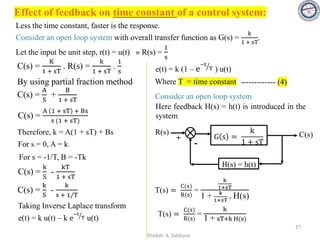
Effect of feedback on time constant of a control system:
Less the time constant, faster is the response.
Consider an open loop system with overall transfer function as G(s) =
k
1 + sT
.
Let the input be unit step, r(t) = u(t) » R(s) =
1
s
By using partial fraction method
C(s) =
A
S
+
B
1 + sT
C(s) =
A 1 + sT + Bs
s (1 + sT)
C(s) =
K
1 + sT
. R(s) =
k
1 + sT
.
1
s
Therefore, k = A(1 + sT) + Bs
For s = 0, A = k
For s = -1/T, B = -Tk
C(s) =
k
S
-
kT
1 + sT
C(s) =
k
S
-
k
s + 1/T
Taking Inverse Laplace transform
e(t) = k u(t) – k e ൗ
−t
T u(t)
e(t) = k (1 – e ൗ
−t
T ) u(t)
Consider an open loop system
+
-
G s =
k
1 + sT
H(s) = h(t)
R(s) C(s)
Here feedback H(s) = h(t) is introduced in the
system
T(s) =
C(s)
R(s)
=
k
1+sT
1 + k
1+sT
. H(s)
T(s) =
C(s)
R(s)
=
k
1 + sT+k H(s)
Where T = time constant ------------- (4)
27
Shadab. A. Siddique
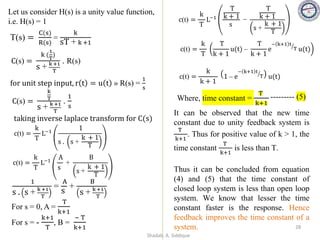
Let us consider H(s) is a unity value function,
i.e. H(s) = 1
T(s) =
C(s)
R(s)
=
k
sT + k +1
C(s) =
k (
1
T
)
s + k +1
T
. R(s)
for unit step input, r t = u t » R(s) =
1
s
C(s) =
k
T
s + k +1
T
.
1
s
taking inverse laplace transform for C(s)
c(t) =
k
T
L−1
1
s . s +
k + 1
T
1
s . s + k +1
T
=
A
s
+
B
s + k +1
T
c(t) =
k
T
L−1
A
s
+
B
s +
k + 1
T
c(t) =
k
T
L−1
T
k + 1
s
−
T
k + 1
s +
k + 1
T
c(t) =
k
T
T
k + 1
u(t) –
T
k + 1
e ൗ
− k+1 t
T u(t)
c(t) =
k
k + 1
1 – e ൗ
− k+1 t
T u(t)
Where, time constant =
T
k+1
--------- (5)
It can be observed that the new time
constant due to unity feedback system is
T
k+1
. Thus for positive value of k > 1, the
time constant
T
k+1
is less than T.
Thus it can be concluded from equation
(4) and (5) that the time constant of
closed loop system is less than open loop
system. We know that lesser the time
constant faster is the response. Hence
feedback improves the time constant of a
system.
For s = 0, A =
T
k+1
For s = -
k+1
T
, B =
− T
k+1 28
Shadab. A. Siddique
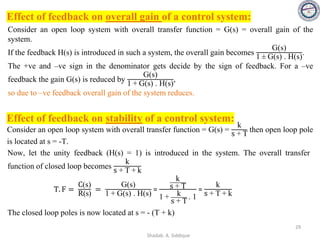
Effect of feedback on overall gain of a control system:
Consider an open loop system with overall transfer function = G(s) = overall gain of the
system.
If the feedback H(s) is introduced in such a system, the overall gain becomes
G(s)
1 ± G(s) . H(s)
.
The +ve and –ve sign in the denominator gets decide by the sign of feedback. For a –ve
feedback the gain G(s) is reduced by
G(s)
1 + G(s) . H(s)
,
so due to –ve feedback overall gain of the system reduces.
Effect of feedback on stability of a control system:
Consider an open loop system with overall transfer function = G(s) =
k
s + T
then open loop pole
is located at s = -T.
T. F =
C(s)
R(s)
=
G(s)
1 + G(s) . H(s)
=
k
s + T
1 + k
s + T
. 1
=
k
s + T + k
Now, let the unity feedback (H(s) = 1) is introduced in the system. The overall transfer
function of closed loop becomes
k
s + T + k
The closed loop poles is now located at s = - (T + k)
29
Shadab. A. Siddique
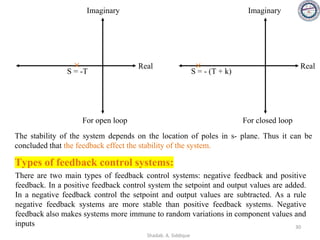
Imaginary Imaginary
Real Real
S = -T S = - (T + k)
× ×
For open loop For closed loop
The stability of the system depends on the location of poles in s- plane. Thus it can be
concluded that the feedback effect the stability of the system.
There are two main types of feedback control systems: negative feedback and positive
feedback. In a positive feedback control system the setpoint and output values are added.
In a negative feedback control the setpoint and output values are subtracted. As a rule
negative feedback systems are more stable than positive feedback systems. Negative
feedback also makes systems more immune to random variations in component values and
inputs
Types of feedback control systems:
30
Shadab. A. Siddique
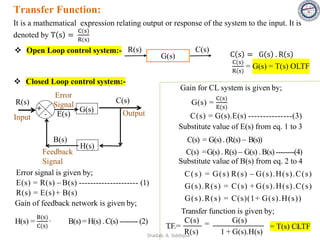
Transfer Function:
It is a mathematical expression relating output or response of the system to the input. It is
denoted by T s =
C(s)
R(s)
❖ Open Loop control system:-
G(s)
R(s) C(s)
C s = G s . R s
C(s)
R(s)
= G(s) = T(s) OLTF
❖ Closed Loop control system:-
R(s)
G(s)
C(s)
Output
H(s)
B(s)
+
Error
Signal
E(s)
Feedback
Signal
Input -
Error signal is given by;
E(s) = R(s) −B(s) --------------------- (1)
R(s) = E(s)+ B(s)
Gain of feedback network is given by;
H(s) =
B(s)
C(s)
,
B(s) = H(s) .C(s) -------- (2)
Gain for CL system is given by;
G(s) =
C(s)
E(s)
Substitute value of E(s) from eq. 1 to 3
C(s) = G(s).(R(s) − B(s))
C(s) =G(s) .R(s) − G(s) . B(s) --------(4)
Substitute value of B(s) from eq. 2 to 4
C(s) = G(s) R(s) − G(s).H(s).C(s)
G(s).R(s) = C(s) + G(s).H(s).C(s)
G(s).R(s) = C(s)(1+ G(s).H(s))
Transfer function is given by;
C(s) G(s)
=
R(s) 1 + G(s).H(s)
T
.F.=
C(s) = G(s).E(s) ---------------(3)
= T(s) CLTF
31
Shadab. A. Siddique
UNIT- I (15 Marks)
➢ Introduction to Control system
❖ Control System – Definition and Practical Examples
❖ Basic Components of a Control System
➢ Feedback Control Systems:
❖ Feedback and its Effect
❖ Types of Feedback Control Systems
➢ Block Diagrams:
❖ Representation and reduction
❖ Signal Flow Graphs
➢ Modeling of Physical Systems:
❖ Electrical Networks and Mechanical Systems
❖ Force-Voltage Analogy
❖ Force-Current Analogy
32
Shadab. A. Siddique
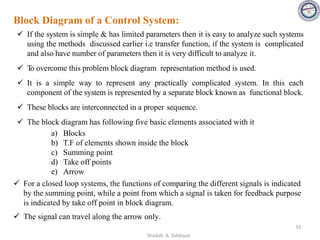
Block Diagram of a Control System:
✓ For a closed loop systems, the functions of comparing the different signals is indicated
by the summing point, while a point from which a signal is taken for feedback purpose
is indicated by take off point in block diagram.
✓ The signal can travel along the arrow only.
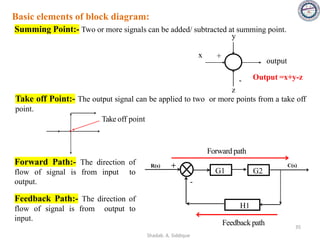
a) Blocks
b) T.F of elements shown inside the block
c) Summing point
d) Take off points
e) Arrow
✓ If the system is simple & has limited parameters then it is easy to analyze such systems
using the methods discussed earlier i.e transfer function, if the system is complicated
and also have number of parameters then it is very difficult to analyze it.
✓ T
o overcome this problem block diagram representation method is used.
✓ It is a simple way to represent any practically complicated system. In this each
component of the system is represented by a separate block known as functional block.
✓ These blocks are interconnected in a proper sequence.
✓ The block diagram has following five basic elements associated with it
33
Shadab. A. Siddique
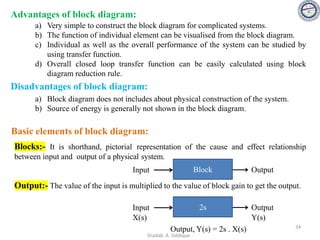
Advantages of block diagram:
a) Very simple to construct the block diagram for complicated systems.
b) The function of individual element can be visualised from the block diagram.
c) Individual as well as the overall performance of the system can be studied by
using transfer function.
d) Overall closed loop transfer function can be easily calculated using block
diagram reduction rule.
Disadvantages of block diagram:
a) Block diagram does not includes about physical construction of the system.
b) Source of energy is generally not shown in the block diagram.
Basic elements of block diagram:
Blocks:- It is shorthand, pictorial representation of the cause and effect relationship
between input and output of a physical system.
Input Output
Block
Output:- The value of the input is multiplied to the value of block gain to get the output.
Input
X(s)
Output
Y(s)
2s
Output, Y(s) = 2s . X(s) 34
Shadab. A. Siddique
Output =x+y-z
+
x
-
output
Summing Point:- Two or more signals can be added/ subtracted at summing point.
Basic elements of block diagram:
z
y
Take off Point:- The output signal can be applied to two or more points from a take off
point.
Take off point
Forward Path:- The direction of
flow of signal is from input to
output.
G1 G2
H1
-
R(s) + C(s)
Forward path
Feedbackpath
Feedback Path:- The direction of
flow of signal is from output to
input.
35
Shadab. A. Siddique
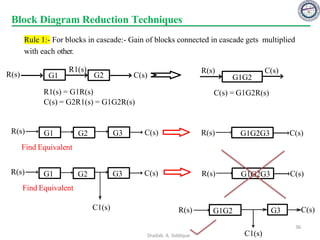
Rule 1:- For blocks in cascade:- Gain of blocks connected in cascade gets multiplied
with each other.
Block Diagram Reduction Techniques
G1 G2
R(s)
R1(s)
C(s)
R1(s) = G1R(s)
C(s) = G2R1(s) = G1G2R(s)
C(s) = G1G2R(s)
G1G2
R(s) C(s)
R(s) C(s)
Find Equivalent
G1G2G3
R(s) C(s)
G1 G2 G3
R(s) C(s)
Find Equivalent
G1 G2 G3
C1(s)
G1G2G3
R(s) C(s)
G1G2
R(s) C(s)
G3
C1(s)
36
Shadab. A. Siddique
C(s)= (G1-G2+G3) R(s)
G1-G2+G3
R(s) C(s)
G1
G2
R(s) C(s)
G3
R1(s)
R3(s)
+
+
R2(s)
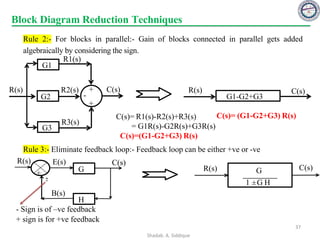
C(s)= R1(s)-R2(s)+R3(s)
= G1R(s)-G2R(s)+G3R(s)
C(s)=(G1-G2+G3) R(s)
Rule 2:- For blocks in parallel:- Gain of blocks connected in parallel gets added
algebraically by considering the sign.
-
Rule 3:- Eliminate feedback loop:- Feedback loop can be either +ve or -ve
C(s)
G
H
R(s)
+
+
-
R(s) C(s)
G
1 ±G H
B(s)
E(s)
- Sign is of –ve feedback
+ sign is for +ve feedback
Block Diagram Reduction Techniques
37
Shadab. A. Siddique
E(s) = R(s) −B(s) and
C(s) =G.E(s) = G[R(s) − B(s)] =GR(s)−GB(s)
From Shown Figure,
But, B(s) =H.C(s)
C(s) =G.R(s)−G . H . C(s)
C(s) + G.H.C(s) = GR(s)
C(s)[1+G.H(s)]= G.R(s)
For Negative Feedback
C(s)
G
H
R(s)
−
B(s)
E(s)
For Positive Feedback
C(s)
G
H
R(s)
+
B(s)
E(s)
E(s) = R(s) +B(s) and
C(s) =G.E(s) = G[R(s) + B(s)] =GR(s)+GB(s)
From Shown Figure,
But, B(s) =H.C(s)
C(s) =G.R(s)+G . H . C(s)
C(s) −G.H.C(s) = GR(s)
C(s)[1−G.H(s)]= G.R(s)
+
+
C(s)
R(s)
=
G(𝑠)
1+G(s)H(s)
C(s)
R(s)
=
G(𝑠)
1− G(s)H(s)
Block Diagram Reduction Techniques
38
Shadab. A. Siddique
C(s)
B2
R(s) + X +
-
B1
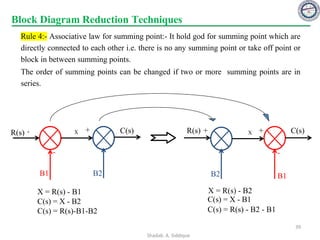
X = R(s) - B1
C(s) = X - B2
C(s) = R(s)-B1-B2
C(s)
B1
R(s) + X +
-
B2
X = R(s) - B2
C(s) = X - B1
C(s) = R(s) - B2 - B1
Rule 4:- Associative law for summing point:- It hold god for summing point which are
directly connected to each other i.e. there is no any summing point or take off point or
block in between summing points.
The order of summing points can be changed if two or more summing points are in
series.
Block Diagram Reduction Techniques
39
Shadab. A. Siddique
Block Diagram Reduction Techniques
Rule 5:- Shift summing point before block:-
R(s) C(s)
X
+
G
C(s) = R(s)G + X C(s) = G [R(s) + X/G]
= GR(s) + X
+
C(s)
R(s) +
G
1/G
X
+
C(s)
R(s) +
G
X
C(s) = G [R(s)+X]
= GR(s)+GX
C(s) = GR(s)+XG
= GR(s)+XG
+
R(s) C(s)
X
+
G
G
+
Rule 6:- Shift summing point after block:-
40
Shadab. A. Siddique
R(s) C(s)
G
C(s) = GR(s) and
X = C(s) = GR(s)
C(s) = GR(s) and
X = GR(s)
X
R(s) C(s)
X
G
G
Block Diagram Reduction Techniques
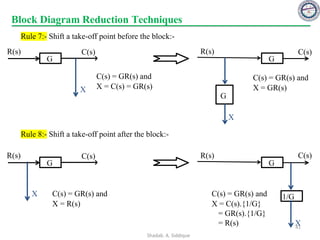
Rule 7:- Shift a take-off point before the block:-
Rule 8:- Shift a take-off point after the block:-
R(s) C(s)
G
C(s) = GR(s) and
X = R(s)
C(s) = GR(s) and
X = C(s).{1/G}
= GR(s).{1/G}
= R(s)
X
R(s) C(s)
X
G
1/G
41
Shadab. A. Siddique
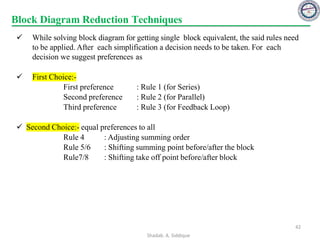
✓ While solving block diagram for getting single block equivalent, the said rules need
to be applied. After each simplification a decision needs to be taken. For each
decision we suggest preferences as
✓ First Choice:-
First preference : Rule 1 (for Series)
Second preference : Rule 2 (for Parallel)
Third preference : Rule 3 (for Feedback Loop)
✓ Second Choice:- equal preferences to all
Rule 4 : Adjusting summing order
Rule 5/6 : Shifting summing point before/after the block
Rule7/8 : Shifting take off point before/after block
Block Diagram Reduction Techniques
42
Shadab. A. Siddique
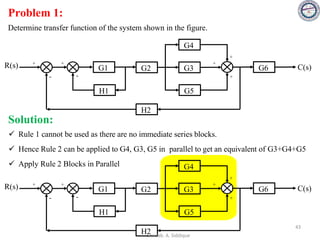
G4
R(s) C(s)
Problem 1:
Determine transfer function of the system shown in the figure.
Solution:
G1 G2 G3 G6
+ +
G5
H1
H2
+
+
+
-
-
✓ Rule 1 cannot be used as there are no immediate series blocks.
✓ Hence Rule 2 can be applied to G4, G3, G5 in parallel to get an equivalent of G3+G4+G5
✓ Apply Rule 2 Blocks in Parallel G4
R(s) C(s)
G1 G2 G3 G6
+ +
G5
H1
H2
+
+
+
-
-
43
Shadab. A. Siddique
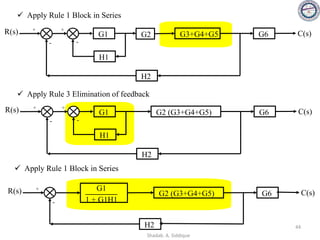
R(s) C(s)
G1 G2 G3+G4+G5 G6
+ +
H1
H2
-
-
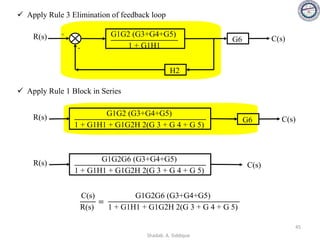
✓ Apply Rule 1 Block in Series
✓ Apply Rule 3 Elimination of feedback
R(s) C(s)
G1 G2 (G3+G4+G5) G6
+ +
H1
H2
-
-
R(s) C(s)
G1
1 + G1H1
G2 (G3+G4+G5) G6
+
H2
-
✓ Apply Rule 1 Block in Series
44
Shadab. A. Siddique
✓ Apply Rule 3 Elimination of feedback loop
R(s) C(s)
G1G2 (G3+G4+G5)
1 + G1H1
G6
+
H2
-
✓ Apply Rule 1 Block in Series
R(s) C(s)
G1G2 (G3+G4+G5)
1 + G1H1 + G1G2H 2(G 3 + G 4 + G 5)
G6
R(s) C(s)
G1G2G6 (G3+G4+G5)
1 + G1H1 + G1G2H 2(G 3 + G 4 + G 5)
C(s)
R(s)
=
G1G2G6 (G3+G4+G5)
1 + G1H1 + G1G2H 2(G 3 + G 4 + G 5)
45
Shadab. A. Siddique
R(s) C(s)
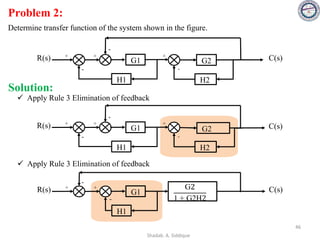
Problem 2:
Determine transfer function of the system shown in the figure.
G1 G2
+ +
H2
H1
-
-
-
+
Solution:
✓ Apply Rule 3 Elimination of feedback
R(s) C(s)
G1 G2
+ +
H2
H1
-
-
-
+
✓ Apply Rule 3 Elimination of feedback
R(s) C(s)
G1
+ +
H1
-
-
G2
1 + G2H2
46
Shadab. A. Siddique
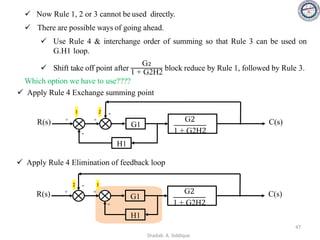
✓ Now Rule 1, 2 or 3 cannot be used directly.
✓ There are possible ways of going ahead.
✓ Use Rule 4 & interchange order of summing so that Rule 3 can be used on
G.H1 loop.
✓ Shift take off point after
G2
1 + G2H2
block reduce by Rule 1, followed by Rule 3.
Which option we have to use????
✓ Apply Rule 4 Exchange summing point
R(s) C(s)
G1
+ +
H1
-
-
G2
1 + G2H2
✓ Apply Rule 4 Elimination of feedback loop
R(s) C(s)
G1
+ +
H1
-
-
G2
1 + G2H2
2 1
1 2
47
Shadab. A. Siddique
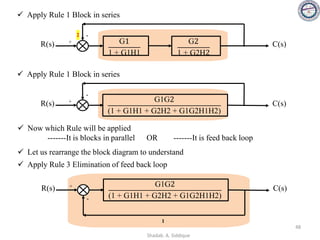
✓ Apply Rule 1 Block in series
R(s) C(s)
+
-
G2
1 + G2H2
2
G1
1 + G1H1
✓ Apply Rule 1 Block in series
R(s) C(s)
+
-
G1G2
(1 + G1H1 + G2H2 + G1G2H1H2)
✓ Now which Rule will be applied
-------It is blocks in parallel OR -------It is feed back loop
✓ Let us rearrange the block diagram to understand
✓ Apply Rule 3 Elimination of feed back loop
R(s) C(s)
+
-
G1G2
(1 + G1H1 + G2H2 + G1G2H1H2)
1
48
Shadab. A. Siddique
R(s) C(s)
G1G2
(1 + G1H1 + G2H2 + G1G2H1H2 + G1G2)
C(s)
R(s)
=
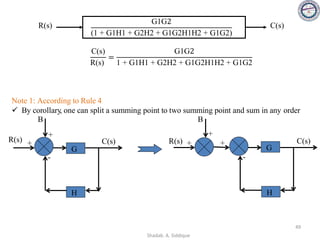
G1G2
1 + G1H1 + G2H2 + G1G2H1H2 + G1G2
Note 1: According to Rule 4
✓ By corollary, one can split a summing point to two summing point and sum in any order
G
H
+
-
R(s) C(s)
B
G
H
+
-
R(s) C(s)
+
B
+
+
49
Shadab. A. Siddique
UNIT- I (15 Marks)
➢ Introduction to Control system
❖ Control System – Definition and Practical Examples
❖ Basic Components of a Control System
➢ Feedback Control Systems:
❖ Feedback and its Effect
❖ Types of Feedback Control Systems
➢ Block Diagrams:
❖ Representation and reduction
❖ Signal Flow Graphs
➢ Modeling of Physical Systems:
❖ Electrical Networks and Mechanical Systems
❖ Force-Voltage Analogy
❖ Force-Current Analogy
50
Shadab. A. Siddique
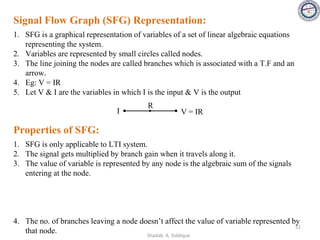
Signal Flow Graph (SFG) Representation:
1. SFG is a graphical representation of variables of a set of linear algebraic equations
representing the system.
2. Variables are represented by small circles called nodes.
3. The line joining the nodes are called branches which is associated with a T.F and an
arrow.
4. Eg: V = IR
5. Let V & I are the variables in which I is the input & V is the output
R
V = IR
I
Properties of SFG:
1. SFG is only applicable to LTI system.
2. The signal gets multiplied by branch gain when it travels along it.
3. The value of variable is represented by any node is the algebraic sum of the signals
entering at the node.
4. The no. of branches leaving a node doesn’t affect the value of variable represented by
that node.
51
Shadab. A. Siddique
Introduction
52
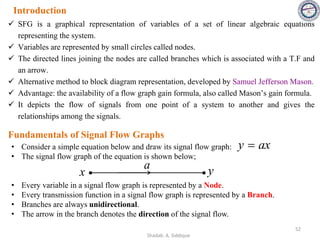
✓ SFG is a graphical representation of variables of a set of linear algebraic equations
representing the system.
✓ Variables are represented by small circles called nodes.
✓ The directed lines joining the nodes are called branches which is associated with a T.F and
an arrow.
✓ Alternative method to block diagram representation, developed by Samuel Jefferson Mason.
✓ Advantage: the availability of a flow graph gain formula, also called Mason’s gain formula.
✓ It depicts the flow of signals from one point of a system to another and gives the
relationships among the signals.
Fundamentals of Signal Flow Graphs
• Consider a simple equation below and draw its signal flow graph:
• The signal flow graph of the equation is shown below;
• Every variable in a signal flow graph is represented by a Node.
• Every transmission function in a signal flow graph is represented by a Branch.
• Branches are always unidirectional.
• The arrow in the branch denotes the direction of the signal flow.
ax
y =
x y
a
Shadab. A. Siddique
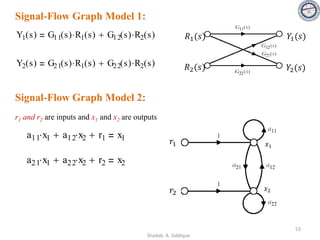
Signal-Flow Graph Model 1:
Y1 s
( ) G11 s
( ) R1 s
( )
 G12 s
( ) R2 s
( )

+
Y2 s
( ) G21 s
( ) R1 s
( )
 G22 s
( ) R2 s
( )

+
53
𝑅1(𝑠)
𝑅2(𝑠)
𝑌1(𝑠)
𝑌2(𝑠)
a11 x1
 a12 x2

+ r1
+ x1
a21 x1
 a22 x2

+ r2
+ x2
r1 and r2 are inputs and x1 and x2 are outputs
𝑟1
𝑟2
𝑥1
𝑥2
Signal-Flow Graph Model 2:
Shadab. A. Siddique
3
4
2
0
3
3
1
2
2
1
0
1
hx
x
gx
fx
x
ex
dx
x
cx
bx
ax
x
=
+
=
+
=
+
+
=
b
x4
x3
x2
x1
x0
h
f
g
e
d
c
a
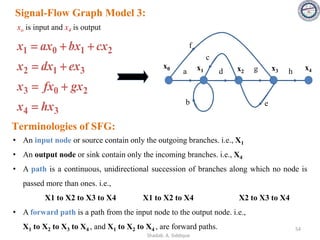
xo is input and x4 is output
54
Signal-Flow Graph Model 3:
• An input node or source contain only the outgoing branches. i.e., X1
• An output node or sink contain only the incoming branches. i.e., X4
• A path is a continuous, unidirectional succession of branches along which no node is
passed more than ones. i.e.,
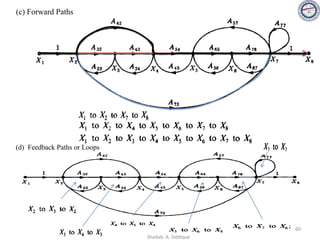
X1 to X2 to X3 to X4 X1 to X2 to X4 X2 to X3 to X4
• A forward path is a path from the input node to the output node. i.e.,
X1 to X2 to X3 to X4 , and X1 to X2 to X4 , are forward paths.
Terminologies of SFG:
Shadab. A. Siddique
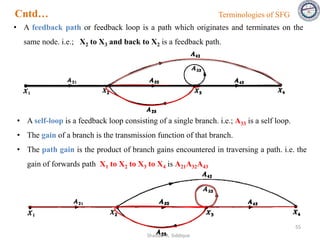
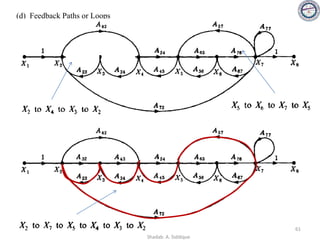
• A feedback path or feedback loop is a path which originates and terminates on the
same node. i.e.; X2 to X3 and back to X2 is a feedback path.
• A self-loop is a feedback loop consisting of a single branch. i.e.; A33 is a self loop.
• The gain of a branch is the transmission function of that branch.
• The path gain is the product of branch gains encountered in traversing a path. i.e. the
gain of forwards path X1 to X2 to X3 to X4 is A21A32A43
Cntd… Terminologies of SFG
55
Shadab. A. Siddique
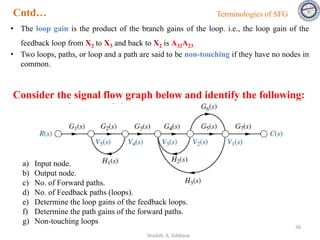
• The loop gain is the product of the branch gains of the loop. i.e., the loop gain of the
feedback loop from X2 to X3 and back to X2 is A32A23.
• Two loops, paths, or loop and a path are said to be non-touching if they have no nodes in
common.
Cntd… Terminologies of SFG
a) Input node.
b) Output node.
c) No. of Forward paths.
d) No. of Feedback paths (loops).
e) Determine the loop gains of the feedback loops.
f) Determine the path gains of the forward paths.
g) Non-touching loops
Consider the signal flow graph below and identify the following:
56
Shadab. A. Siddique
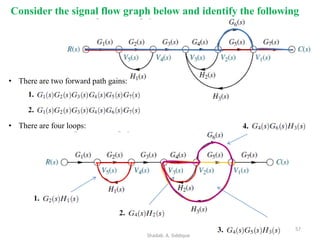
• There are two forward path gains:
57
Consider the signal flow graph below and identify the following
• There are four loops:
Shadab. A. Siddique
58
Consider the signal flow graph below and identify the following
• Nontouching loop gains:
a) Input node: R(s)
b) Output node: C(s)
c) No of Forward paths: two
d) No. of Feedback paths (loops): four
e) Determine the loop gains of the feedback loops:
1. G2(s)H1(s)
2. G4(s)H2(s)
3. G4(s)G5(s)H3(s)
4. G4(s)G6(s)H3(s)
f) Determine the path gains of the forward paths:
1. G1(s) G2(s) G3(s) G4(s) G5(s) G7(s)
2. G1(s) G2(s) G3(s) G4(s) G6(s) G7(s)
g) Non-touching loops:
1. [G2(s)H1(s)][G4(s)H2(s)]
2. [G2(s)H1(s)][G4(s)G5(s)H3(s)]
3. [G2(s)H1(s)][G4(s)G6(s)H3(s)]
Shadab. A. Siddique
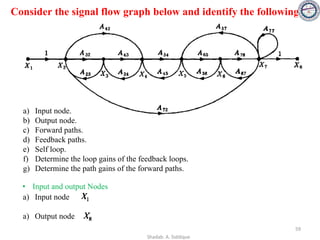
Consider the signal flow graph below and identify the following:
a) Input node.
b) Output node.
c) Forward paths.
d) Feedback paths.
e) Self loop.
f) Determine the loop gains of the feedback loops.
g) Determine the path gains of the forward paths.
59
a) Input node
a) Output node
• Input and output Nodes
Shadab. A. Siddique
(c) Forward Paths
60
(d) Feedback Paths or Loops
Shadab. A. Siddique
(d) Feedback Paths or Loops
61
Shadab. A. Siddique
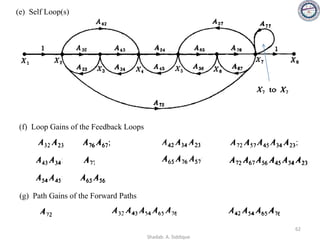
(e) Self Loop(s)
62
(f) Loop Gains of the Feedback Loops
(g) Path Gains of the Forward Paths
Shadab. A. Siddique
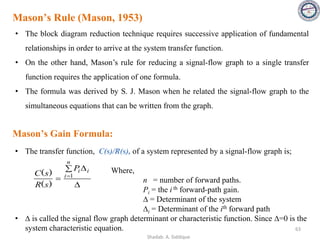
Mason’s Rule (Mason, 1953)
• The block diagram reduction technique requires successive application of fundamental
relationships in order to arrive at the system transfer function.
• On the other hand, Mason’s rule for reducing a signal-flow graph to a single transfer
function requires the application of one formula.
• The formula was derived by S. J. Mason when he related the signal-flow graph to the
simultaneous equations that can be written from the graph.
63
• The transfer function, C(s)/R(s), of a system represented by a signal-flow graph is;
Where,
n = number of forward paths.
Pi = the i th forward-path gain.
∆ = Determinant of the system
∆i = Determinant of the ith forward path
• ∆ is called the signal flow graph determinant or characteristic function. Since ∆=0 is the
system characteristic equation.

 
= =
n
i
i
i
P
s
R
s
C 1
)
(
)
(
Mason’s Gain Formula:
Shadab. A. Siddique
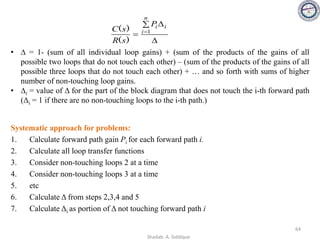
• ∆ = 1- (sum of all individual loop gains) + (sum of the products of the gains of all
possible two loops that do not touch each other) – (sum of the products of the gains of all
possible three loops that do not touch each other) + … and so forth with sums of higher
number of non-touching loop gains.
• ∆i = value of Δ for the part of the block diagram that does not touch the i-th forward path
(Δi = 1 if there are no non-touching loops to the i-th path.)
64

 
= =
n
i
i
i
P
s
R
s
C 1
)
(
)
(
Systematic approach for problems:
1. Calculate forward path gain Pi for each forward path i.
2. Calculate all loop transfer functions
3. Consider non-touching loops 2 at a time
4. Consider non-touching loops 3 at a time
5. etc
6. Calculate Δ from steps 2,3,4 and 5
7. Calculate Δi as portion of Δ not touching forward path i
Shadab. A. Siddique
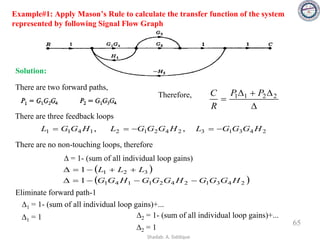
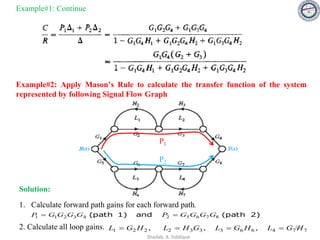
Example#1: Apply Mason’s Rule to calculate the transfer function of the system
represented by following Signal Flow Graph
Therefore,
2
4
3
1
3
2
4
2
1
2
1
4
1
1 H
G
G
G
L
H
G
G
G
L
H
G
G
L −
=
−
=
= ,
,
65


+

= 2
2
1
1 P
P
R
C
There are two forward paths,
Solution:
There are three feedback loops
There are no non-touching loops, therefore
∆ = 1- (sum of all individual loop gains)
( )
3
2
1
1 L
L
L +
+
−
=

( )
2
4
3
1
2
4
2
1
1
4
1
1 H
G
G
G
H
G
G
G
H
G
G −
−
−
=

Eliminate forward path-1
∆1 = 1- (sum of all individual loop gains)+...
∆1 = 1 ∆2 = 1- (sum of all individual loop gains)+...
∆2 = 1
Shadab. A. Siddique
Example#1: Continue
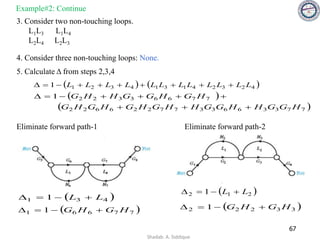
Example#2: Apply Mason’s Rule to calculate the transfer function of the system
represented by following Signal Flow Graph
P1
P2
1. Calculate forward path gains for each forward path.
2)
(path
and
1)
(path 8
7
6
5
2
4
3
2
1
1 G
G
G
G
P
G
G
G
G
P =
=
2. Calculate all loop gains. 7
7
4
6
6
3
3
3
2
2
2
1 H
G
L
H
G
L
G
H
L
H
G
L =
=
=
= ,
,
,
Solution:
66
Shadab. A. Siddique
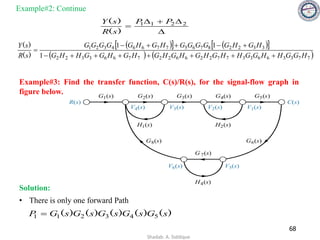
3. Consider two non-touching loops.
L1L3 L1L4
L2L4 L2L3
Example#2: Continue
4. Consider three non-touching loops: None.
( ) ( )
4
2
3
2
4
1
3
1
4
3
2
1
1 L
L
L
L
L
L
L
L
L
L
L
L +
+
+
+
+
+
+
−
=

( )
( )
7
7
3
3
6
6
3
3
7
7
2
2
6
6
2
2
7
7
6
6
3
3
2
2
1
H
G
G
H
H
G
G
H
H
G
H
G
H
G
H
G
H
G
H
G
G
H
H
G
+
+
+
+
+
+
+
−
=

5. Calculate Δ from steps 2,3,4
Eliminate forward path-1
( )
4
3
1 1 L
L +
−
=

( )
7
7
6
6
1 1 H
G
H
G +
−
=

Eliminate forward path-2
( )
3
3
2
2
2 1 H
G
H
G +
−
=

( )
2
1
2 1 L
L +
−
=

67
Shadab. A. Siddique


+

= 2
2
1
1 P
P
s
R
s
Y
)
(
)
(
68
( )
  ( )
 
( ) ( )
7
7
3
3
6
6
3
3
7
7
2
2
6
6
2
2
7
7
6
6
3
3
2
2
3
3
2
2
8
7
6
5
7
7
6
6
4
3
2
1
1
1
1
H
G
G
H
H
G
G
H
H
G
H
G
H
G
H
G
H
G
H
G
G
H
H
G
H
G
H
G
G
G
G
G
H
G
H
G
G
G
G
G
s
R
s
Y
+
+
+
+
+
+
+
−
+
−
+
+
−
=
)
(
)
(
Example#2: Continue
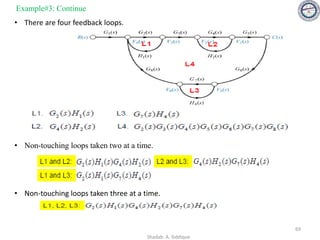
Example#3: Find the transfer function, C(s)/R(s), for the signal-flow graph in
figure below.
• There is only one forward Path
)
(
)
(
)
(
)
(
)
( s
G
s
G
s
G
s
G
s
G
P 5
4
3
2
1
1 =
Solution:
Shadab. A. Siddique
69
• There are four feedback loops.
Example#3: Continue
• Non-touching loops taken two at a time.
• Non-touching loops taken three at a time.
Shadab. A. Siddique
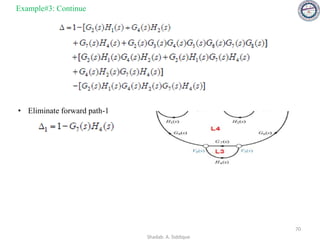
• Eliminate forward path-1
70
Example#3: Continue
Shadab. A. Siddique
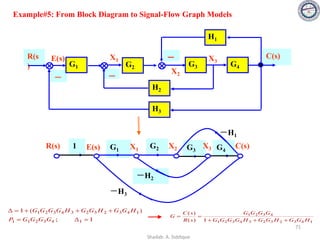
G1 G4
G3
Example#5: From Block Diagram to Signal-Flow Graph Models
-
-
-
C(s)
R(s
) G1 G2
H2
H1
G4
G3
H3
E(s) X1
X2
X3
R(s) C(s)
-H2
-H1
-H3
X1
X2 X3
E(s)
1 G2
1
;
)
(
1
1
4
3
2
1
1
1
4
3
2
3
2
3
4
3
2
1
=

=
+
+
+
=

G
G
G
G
P
H
G
G
H
G
G
H
G
G
G
G
1
4
3
2
3
2
3
4
3
2
1
4
3
2
1
1
)
(
)
(
H
G
G
H
G
G
H
G
G
G
G
G
G
G
G
s
R
s
C
G
+
+
+
=
=
71
Shadab. A. Siddique
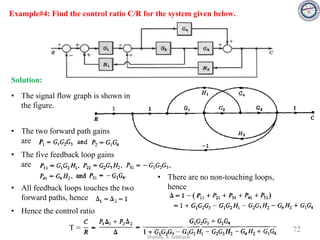
Example#4: Find the control ratio C/R for the system given below.
• The two forward path gains
are
• The signal flow graph is shown in
the figure.
• The five feedback loop gains
are
• Hence the control ratio
• There are no non-touching loops,
hence
• All feedback loops touches the two
forward paths, hence
72
T =
Solution:
Shadab. A. Siddique
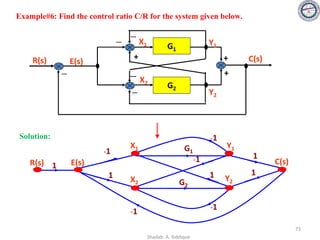
G1
G2
+
-
+
-
-
-
+ C(s)
R(s) E(s)
Y2
Y1
X1
X2
-
1
-1
1
-1
-1
-1
-1
1
1
G1
G2
1
R(s) E(s) C(s)
X1
X2
Y2
Y1
Example#6: Find the control ratio C/R for the system given below.
73
Solution:
Shadab. A. Siddique
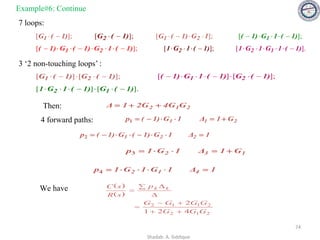
7 loops:
3 ‘2 non-touching loops’ :
2
1
2 G
4G
2G
1
Δ +
+
=
Then:
4 forward paths: 2
1
1 G
1
Δ
1
G
1)
(
p +
=


−
=
1
1
Δ
1
G
1)
(
G
1)
(
p 2
2
1 =


−


−
=
2
1
3
2 G
1
Δ
1
G
1
p +
=


=
3
1
Δ
1
G
1
G
1
p 4
1
2 =




=
4
We have
2
1
2
2
1
1
2
4
2
1
2
G
G
G
G
G
G
G
p
s
R
s
C k
k
+
+
+
−
=

 
=
)
(
)
(
Example#6: Continue
74
Shadab. A. Siddique
UNIT- I (15 Marks)
➢ Introduction to Control system
❖ Control System – Definition and Practical Examples
❖ Basic Components of a Control System
➢ Feedback Control Systems:
❖ Feedback and its Effect
❖ Types of Feedback Control Systems
➢ Block Diagrams:
❖ Representation and reduction
❖ Signal Flow Graphs
➢ Modeling of Physical Systems:
❖ Electrical Networks and Mechanical Systems
❖ Force-Voltage Analogy
❖ Force-Current Analogy
S. A. Siddique
75
Mathematic Modeling of Dynamical Systems
• The set of mathematical equation describing the dynamic characteristics of a system is
called mathematical model of a system.
• Dynamics/ mathematical equation of many systems can be written in terms of
differential equations
– Mechanical, thermal, electrical, economic, biological systems etc.
• We said that these D.E.’s can be derived using basic physicallaws
• All systems we will study will be ‘causal’, i.e. the system’s response at any time ‘t’
depends only on past and not future inputs
• Recall transfer functions:
– It is the ratio of Laplace Transform of output to Laplace Transform of input, when
initial conditions are zero.
– We assume
• Zero initial conditions
• Linearity
• Time Invariance
76
Shadab. A. Siddique Maj. G. S. Tripathi
Similarities in Mechanical and Electrical Systems
3 basic components in mechanical systems:
– Mass
– Spring
– Damper
✓ 3 basic components in electrical systems:
– Resistance
– Capacitor
– Inductor
• Basic form of differential equations is the same.
• Therefore, learning to model one type of system easily leads to modeling method for the
other.
• Also, electrical and mechanical systems can be easily cascaded in block diagrams due to
this similarity.
• In fact, many other types of systems have similar forms
• We will begin with electrical systems. This will make modeling mech easier!
Modelling Electrical Systems (Nise)
• Current (i) is the rate of flow of charge (q)
• Taking Laplace transform
• Impedance (complex resistance) is defined as
• It’s mathematical inverse is called admittance.
i t =
dq(t)
dt
⇒ q t = න i(t) dt
I s = sQ(s) ⇒ Q S =
1
s
I(s)
z =
v
i
Z s =
V(s))
I(s)
⇒
77
Shadab. A. Siddique
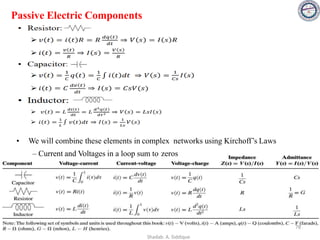
Passive Electric Components
• We will combine these elements in complex networks using Kirchoff’s Laws
– Current and Voltages in a loop sum to zeros
78
Shadab. A. Siddique
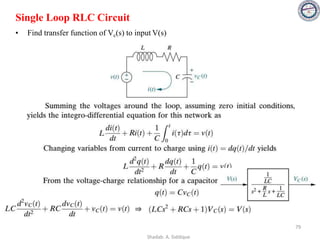
Single Loop RLC Circuit
• Find transfer function of Vc(s) to input V(s)
⇒
79
Shadab. A. Siddique
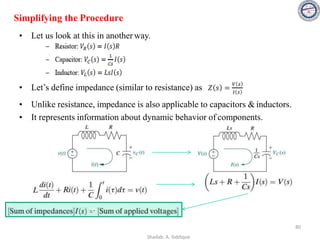
Simplifying the Procedure
• Let us look at this in another way.
• Let’s define impedance (similar to resistance) as
• Unlike resistance, impedance is also applicable to capacitors & inductors.
• It represents information about dynamic behavior of components.
c
80
Shadab. A. Siddique
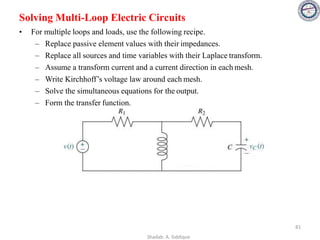
Solving Multi-Loop Electric Circuits
• For multiple loops and loads, use the following recipe.
– Replace passive element values with their impedances.
– Replace all sources and time variables with their Laplace transform.
– Assume a transform current and a current direction in each mesh.
– Write Kirchhoff’s voltage law around each mesh.
– Solve the simultaneous equations for the output.
– Form the transfer function.
81
Shadab. A. Siddique
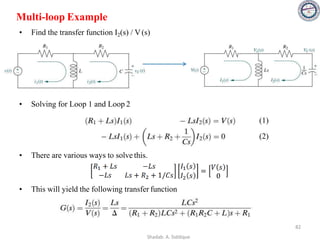
Multi-loop Example
• Find the transfer function I2(s) / V (s)
• Solving for Loop 1 and Loop 2
• There are various ways to solve this.
• This will yield the following transfer function
(1)
(2)
82
Shadab. A. Siddique
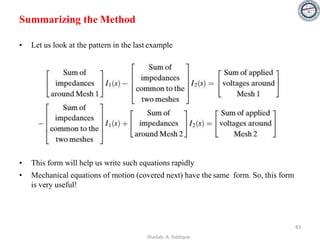
Summarizing the Method
• Let us look at the pattern in the last example
• This form will help us write such equations rapidly
• Mechanical equations of motion (covered next) have the same form. So, this form
is very useful!
83
Shadab. A. Siddique
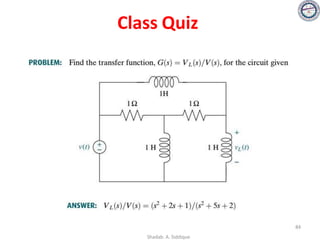
Class Quiz
84
Shadab. A. Siddique
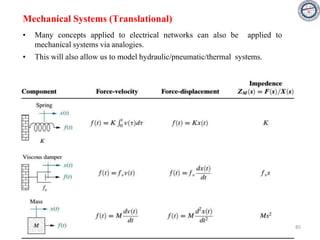
Mechanical Systems (Translational)
• Many concepts applied to electrical networks can also be applied to
mechanical systems via analogies.
• This will also allow us to model hydraulic/pneumatic/thermal systems.
85
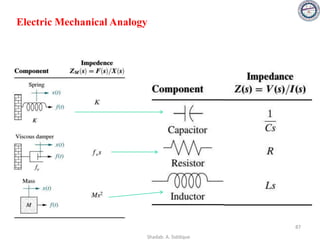
Electrical/Mechanical Analogies
• Mechanical systems, like electrical networks, have 3 passive, linear components:
– Two of them (spring and mass) are energy-storage elements; one of them,
the viscous damper, dissipates energy.
– The two energy-storage elements are analogous to the two electrical
energy-storage elements, the inductor and capacitor. The energy dissipater
is analogous to electrical resistance.
• Displacement ‘x’ is analogous to current I
• Force ‘f’ is analogous to voltage ‘v’
• Impedance (Z=V/I) is therefore Z=F/X
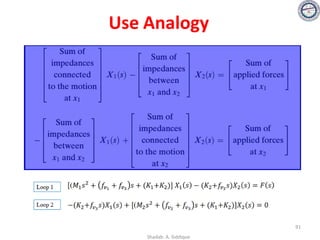
• Since, [Sum of Impedances] I(s) = [Sum of applied voltages]
• Hence, [Sum of Impedances] X(s) = [Sum of applied forces]
86
Shadab. A. Siddique
Electric Mechanical Analogy
87
Shadab. A. Siddique
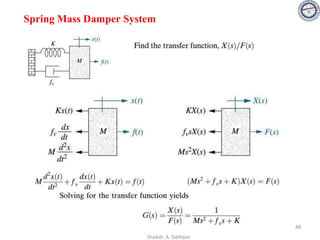
Spring Mass Damper System
88
Shadab. A. Siddique
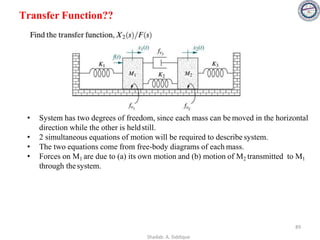
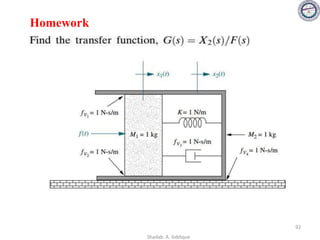
Transfer Function??
• System has two degrees of freedom, since each mass can be moved in the horizontal
direction while the other is heldstill.
• 2 simultaneous equations of motion will be required to describe system.
• The two equations come from free-body diagrams of each mass.
• Forces on M1 are due to (a) its own motion and (b) motion of M2 transmitted to M1
through thesystem.
89
Shadab. A. Siddique
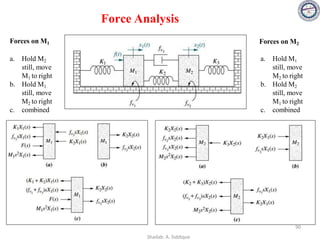
Force Analysis
a. Hold M2
still, move
M1 to right
b. Hold M1
still, move
M2 to right
c. combined
a. Hold M1
still, move
M2 to right
b. Hold M2
still, move
M1 to right
c. combined
Forces on M1 Forces on M2
90
Shadab. A. Siddique
Use Analogy
91
Shadab. A. Siddique
Homework
92
Shadab. A. Siddique
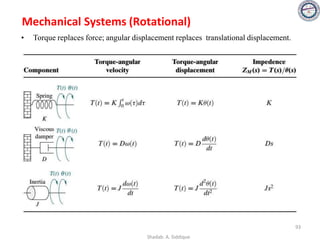
Mechanical Systems (Rotational)
• Torque replaces force; angular displacement replaces translational displacement.
93
Shadab. A. Siddique
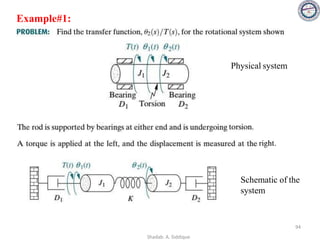
Example#1:
Physical system
Schematic of the
system
94
Shadab. A. Siddique
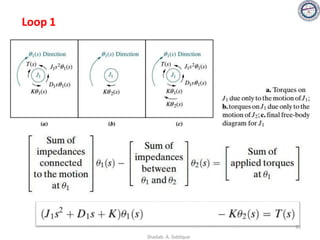
Loop 1
95
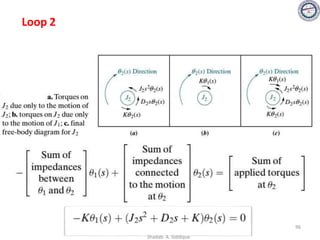
Shadab. A. Siddique
Loop 2
96
Shadab. A. Siddique
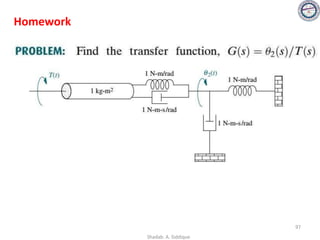
Homework
97
Shadab. A. Siddique
UNIT- I (15 Marks)
➢ Introduction to Control system
❖ Control System – Definition and Practical Examples
❖ Basic Components of a Control System
➢ Feedback Control Systems:
❖ Feedback and its Effect
❖ Types of Feedback Control Systems
➢ Block Diagrams:
❖ Representation and reduction
❖ Signal Flow Graphs
➢ Modeling of Physical Systems:
❖ Electrical Networks and Mechanical Systems
❖ Force-Voltage Analogy
❖ Force-Current Analogy
S. A. Siddique
98
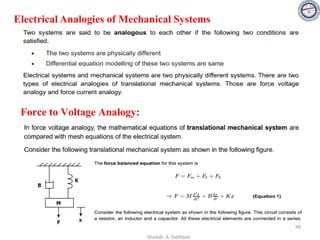
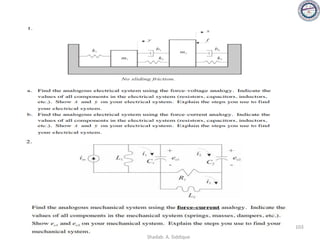
Force to Voltage Analogy:
Electrical Analogies of Mechanical Systems
99
Shadab. A. Siddique
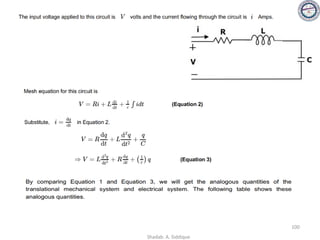
100
Shadab. A. Siddique
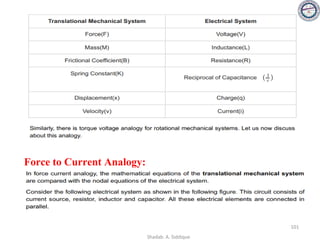
Force to Current Analogy:
101
Shadab. A. Siddique
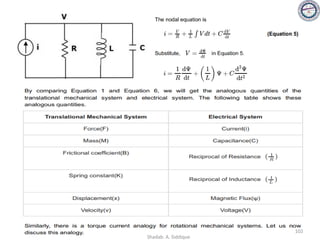
102
Shadab. A. Siddique
103
Shadab. A. Siddique
UNIT-I
The End
Thank You
104

BEC 26 control-Systems_unit-I_pdf

  • 1.
    Control Systems 1 Department ofElectronics & Communication Engineering, Madan Mohan Malaviya University of Technology, Gorakhpur Subject Code: BEC-26 Third Year ECE Shadab A. Siddique Assistant Professor Unit-I
  • 2.
    UNIT- I ➢ Introductionto Control Systems ❖ Control System – Definition and Practical Examples ❖ Basic Components of a Control System ➢ Feedback Control Systems: ❖ Feedback and its Effect ❖ Types of Feedback Control Systems ❖ Transfer Function ➢ Block Diagrams: ❖ Representation and reduction ❖ Signal Flow Graphs ➢ Modeling of Physical Systems: ❖ Electrical Networks and Mechanical Systems ❖ Force-Voltage Analogy ❖ Force-Current Analogy Shadab. A. Siddique 2 UNIT-I: Basic Components of a control system, Feedback and its effect, Types of feedback control Systems, Block diagrams: representation and reduction, Signal Flow Graphs, Modeling of Physical Systems: Electrical Networks and Mechanical Systems, Force-voltage analogy, Force-current analogy.
  • 3.
    Course Assessment methods: Continuousassessment through tutorials, attendance, home assignments, quizzes, practical work, record, viva voce and Three Minor tests and One Major Theory & Practical Examination Course Outcomes: The students are expected to be able to demonstrate the following knowledge, skills and attitudes after completing this course, ✓ Describe the response characteristic and differentiate between the open loop and closed loop of a control system. 3 Shadab. A. Siddique
  • 4.
    UNIT- I ➢ Introductionto Control Systems ❖ Control System – Definition and Practical Examples ❖ Basic Components of a Control System ➢ Feedback Control Systems: ❖ Feedback and its Effect ❖ Types of Feedback Control Systems ❖ Transfer Function ➢ Block Diagrams: ❖ Representation and reduction ❖ Signal Flow Graphs ➢ Modeling of Physical Systems: ❖ Electrical Networks and Mechanical Systems ❖ Force-Voltage Analogy ❖ Force-Current Analogy 4 Shadab. A. Siddique
  • 5.
    Input ➢ The stimulusor excitation applied to a control system from an external source in order to produce the output is called input Input Output ➢ The actual response obtained from a system is called as output. Output Input 5 Shadab. A. Siddique
  • 6.
    Control ➢ It meansto regulate, direct or command a system so that the desired objective is attained System ➢ It is a combination or arrangement of different physical components connected or related in such a manner so as to form an entire unit to attain a certain objective. Input Output System Control System: ➢ A control system is an arrangement of different physical elements connected in such a manner so as to regulate, direct, command itself or some other system to achieve a certain objective. Combining above definitions System + Control = Control System Input Desired Output Control System (May or may not be desired) 6 Shadab. A. Siddique
  • 7.
    Difference between Systemand Control System ➢ An example : Fan 230V/50Hz AC Supply Air Flow Input Output ➢ A Fan: Can't Say System: A Fan without blades cannot be a “SYSTEM” Because it cannot provide a desired/proper output. i.e. airflow Fan (System) Input 230V/50Hz AC Supply NoAirflow (No Proper/ Desired Output) Output 7 Shadab. A. Siddique
  • 8.
    A Fan: Canbe a System ➢ A Fan with blades but without regulator can be a “SYSTEM” Because it can provide a proper output. i.e. airflow ➢ But it cannot be a “Control System” Because it cannot provide desired output i.e. controlled airflow 230V/50Hz AC Supply Airflow (Proper Output) Input Output A Fan: Can be a Control System ➢ A Fan with blades and with regulator can be a “CONTROL SYSTEM” Because it can provide a Desired output. i.e. Controlled airflow 230V/50Hz AC Supply ControlledAirflow (Desired Output) Input Output Control Element 8 Shadab. A. Siddique
  • 9.
    UNIT- I ➢ Introductionto Control Systems ❖ Control System – Definition and Practical Examples ❖ Basic Components of a Control System ➢ Feedback Control Systems: ❖ Feedback and its Effect ❖ Types of Feedback Control Systems ➢ Block Diagrams: ❖ Representation and reduction ❖ Signal Flow Graphs ➢ Modeling of Physical Systems: ❖ Electrical Networks and Mechanical Systems ❖ Force-Voltage Analogy ❖ Force-Current Analogy 9 Shadab. A. Siddique
  • 10.
    Basic Components ofControl System: ✓ Basic components in the control systems are shown in the above block diagram. ✓ Disturbances can be external or internal. Reference Transducer Controller Plant/Process Feedback Transducer Command I/p Reference I/p Feedback Signal Actuating Signal Error Signal Controlled O/p r(t) e(t) b(t) c(t) c(t) u(t) Feedback Path Forward Path ∓ Disturbances 10 Shadab. A. Siddique
  • 11.
    ➢ Plant/Process:- Theportion of a system which is to be controlled or regulated is called a plant or process. ➢ Controller:- The element of a system itself or external to the system which controls the plant/process is called controller. It consists of error detector to control logic element. ➢ Error detector:- It received the measured signal (feedback) & compare it with reference input and determine the error signal. 𝑒 𝑡 = 𝑟 𝑡 ∓ 𝑏(𝑡) ➢ Feedback:- It is used to fed back the o/p signal to error detector for comparison with the input. ➢ Input:- It is applied signal to a control system from an external energy sources in order to produce specific output. ➢ Output:- It is a particular signal of interest or the actual response obtained from the control system when input is applied. ➢ Disturbances:- It is a signal which tends to adversely effect the value of the output of a system. It may be external disturbances or internal disturbances. Basic Components of Control System: 11 Shadab. A. Siddique
  • 12.
    Classification of ControlSystem: Control system can be broadly classified as- 1. Natural control system e.g: Respiratory system, Biological systems of human body 2. Man-made control system e.g: Vehicle 3. Combination control system e.g: Driving a car 4. Time variant and Invariant control system 5. Linear and Nonlinear control system 6. Continuous time and Discrete time control system 7. Deterministic (o/p is predictable) and stochastic (o/p is unpredictable) control system 8. Lumped parameter and Distributed parameter control system 9. SISO (Serial input serial output) and MIMO (Multiple input and multiple output) control system 10. Open loop and Closed loop control system Controller Plant/ process o/p i/p Open Loop Control System Controller Plant/ process o/p i/p Feedback ∓ Closed Loop Control System 12 Shadab. A. Siddique
  • 13.
    Classification of ControlSystem (Depending on control action) Open Loop Control System Closed Loop Control System Open Loop Control System Definition: “A system in which the control action is totally independent of the output of the system is called as open loop system” Fig. Block Diagram of Open loop Control System Controller Process Reference I/p r(t) u(t) Controlled o/p c(t) 13 Shadab. A. Siddique
  • 14.
    OLCS Examples ➢ ElectricHand Drier:- Hot air (output) comes out as long as you keep your hand under the machine, irrespective of how much your hand is dried. ➢ Automatic Washing Machine:- This machine runs according to the pre-set time irrespective of washing is completed or not. ➢ Bread Toaster:- This machine runs as per adjusted time irrespective of toasting is completed or not. 14 Shadab. A. Siddique
  • 15.
    ➢ Automatic Tea/CoffeeVending Machine:- These machines also function for pre adjusted time only. OLCS Examples ➢ Light Switch:- lamps glow whenever light switch is on irrespective of light is required or not. ➢ Volume on Stereo System:- Volume is adjusted manually irrespective of output volume level. Advantages of OLCS ❖ Simple in construction and design ❖ Economical ❖ Easy to maintain ❖ Generally stable ❖ Convenient to use as output is difficult to measure ❖ They are inaccurate ❖ They are unreliable output cannot be corrected ❖ Any change in automatically. Disadvantages of OLCS 15 Shadab. A. Siddique
  • 16.
    Closed Loop System Definition:-Asystem in which the control action is somehow dependent on the output is called as closed loop system Reference Transducer Controller Plant Feedback Transducer Command I/p Reference I/p Feedback Signal Manipulated Signal Error Signal Controlled O/p r(t) e(t) b(t) c(t) c(t) m(t) Feedback Path Forward Path ± 16 Shadab. A. Siddique
  • 17.
    CLCS Examples ➢ AutomaticElectric Iron:- Heating elements are controlled by output temperature of the iron. ➢ Servo voltage stabilizer:- Voltage controller operates depending upon output voltage of the system. 17 Shadab. A. Siddique
  • 18.
    Advantages of CLCS ➢Closed loop control systems are more accurate even in the presence of non- linearity ➢ Highly accurate as any error arising is corrected due to presence of feedback signal ➢ Bandwidth range is large ➢ Facilitates automation ➢ The sensitivity of system may be made small to make system more stable ➢ This system is less affected by noise Disadvantages of CLCS ➢ They are costlier ➢ They are complicated to design ➢ Required more maintenance ➢ Feedback leads to oscillatory response ➢ Overall gain is reduced due to presence of feedback ➢ Stability is the major problem and more care is needed to design a stable closed loop system 18 Shadab. A. Siddique
  • 19.
    Difference Between OLCS& CLCS Open Loop Control System Closed Loop Control System 1. The closed loop systems are complex and costlier 2. They consume more power 3. The CL systems are not easy to construct because more number of components required 4. The closed loop systems are accurate & more reliable 5. Stability is a major problem in closed loop systems & more care is needed to design a stable closed loop system 6. Large bandwidth 7. Feedback element is present 8. Output measurement is necessary 9. The changes in the output due to external disturbances are not corrected automatically. So they are more sensitive to noise and other disturbances. 10. Examples: Guided Missile, Temp control of oven, Servo Voltage Stablizer etc. 1. The open loop systems are simple & economical. 2. They consume less power 3. The OL systems are easier to construct because less number of components required 4. The open loop systems are inaccurate & unreliable 5. Stability is not a major problem in OL control systems. Generally OL systems are stable 6. Small Bandwidth 7. Feedback element is absent 8. Output measurement is not necessary 9. The changes in the output due to external disturbances are not corrected automatically. So they are more sensitive to noise and other disturbances. 10. Examples: Coffee maker, Automatic Toaster, Hand Drier etc. 19 Shadab. A. Siddique
  • 20.
    UNIT- I (15Marks) ➢ Introduction to Control system ❖ Control System – Definition and Practical Examples ❖ Basic Components of a Control System ➢ Feedback Control Systems: ❖ Feedback and its Effect ❖ Types of Feedback Control Systems ❖ Transfer Function ➢ Block Diagrams: ❖ Representation and reduction ❖ Signal Flow Graphs ➢ Modeling of Physical Systems: ❖ Electrical Networks and Mechanical Systems ❖ Force-Voltage Analogy ❖ Force-Current Analogy 20 Shadab. A. Siddique
  • 21.
    Feedback and itsEffect: The effect of parameter variation on the system performance can be analyzed by sensitivity of the system. ➢ Effect of Parameter variation in open loop control system: Consider an open loop control system whose transfer function will be G(s) R(s) C(s) C(s) R(s) = G(s) = T(s) C s = G s . R s Let ∆G(s) be the changes in G(s) due to parameter variation, the corresponding change in the output be ∆C(s) C(s) + ∆C(s) = [G(s) + ∆G(s)] R(s) = G(s) . R(s) + ∆G(s) . R(s) C(s) + ∆C(s) = C(s) + ∆G(s) . R(s) Therefore, ∆C(s) = ∆G(s) . R(s) ➢ Effect of Parameter variation in closed loop control system: R(s) G(s) C(s) H(s) B(s) + ± E(s) Consider a closed loop control system whose transfer function is given by, C(s) G(s) = R(s) 1 ± G(s).H(s) TF = T(s) = 21 Shadab. A. Siddique
  • 22.
    C(s) + ∆C(s) R(s) = G(s)+ ∆G(s) 1 ± [G(s) + ∆G(s)] . H(s) C(s) + ∆C(s = G(s) . R(s) + ∆G(s) . R(s) 1 ± [G(s) + ∆G(s)] . H(s) ∆C(s) = G(s) . R(s) + ∆G(s) . R(s) 1 ± [G(s) + ∆G(s)] . H(s) − C(s) Assumption: G(s) . H(s) ≈ [G(s) + ∆G(s)] . H(s) ∆C(s) = G(s) . R(s) + ∆G(s) . R(s) 1 ± G(s) . H(s) − C(s) ∆C(s = G(s) . R(s) 1 ± G(s) . H(s) + ∆G(s) . R(s) 1 ± G(s) . H(s) − C(s) ∆C(s = C s + ∆G(s) . R(s) 1 ± G(s) . H(s) − C(s) Therefore, |1 ± G(s) . H(s)| ≥ 1 Let ∆G(s) be the changes in G(s) due to parameter variation in system. The corresponding change in the output is ∆C(s) ➢ Sensitivity of a control system: An effect in the system parameters due to parameter variation can be studied mathematically by defining the term sensitivity of a control system. Let the variable in a system is varying by T due to the variation in parameters K of the system. The sensitivity of system parameters K is expressed by, S = % Change in T % Change in K 𝐾 𝑐𝑎𝑛 𝑏𝑒 𝑜𝑝𝑒𝑛 𝑙𝑜𝑜𝑝 𝑔𝑎𝑖𝑛 𝑜𝑟 𝑓𝑒𝑒𝑑𝑏𝑎𝑐𝑘 S = d ln T d ln K = ∆T/T ∆K/K = 𝝏T/T 𝝏K/K 𝑆𝐾 𝑇 = K 𝝏T 𝑇 𝝏K ∆C(s) = ∆G(s) . R(s) 1 ± G(s) . H(s) A symbolic representation 𝑆𝐾 𝑇 represents the sensitivity of a variable T with respect to the variation in the parameter K. T may be the transfer function of output variable & K may be the gain or feedback factor. 22 Shadab. A. Siddique
  • 23.
    SG T = G(s) 𝜕𝑇 𝑇(𝑠) 𝜕𝐾 Foropen loop control system: T(s) = C(s) R(s) = G(s) Forward path transfer function = Gain = G(s) SG T = G(s) 𝜕𝐺(𝑠) 𝐺(𝑠) 𝜕𝐺(𝑠) = 1 ---------------- (1) SG T = 1 For closed loop control system: T(s) = C(s) R(s) = G(s) = G(s) 1 + G(s) . H(s) Forward path transfer function = Gain = G(s) SG T = G s G(s) 1 + G(s) . H(s) . 𝜕[ G(s) 1 + G(s) . H(s) } 𝜕𝐺(𝑠) SG T = [1 + G(s) . H(s)] . 1 + G(s)H(s) −G(s)H(s) [1 + G(s)H(s)]2 SG T = 1 1 + G(s)H(s) ---------------- (2) Comparing equation (1) and (2), it can be observed that due to feedback the sensitivity function get reduces by the factor 1 1 + G(s)H(s) compared to an open loop transfer function. ➢ Sensitivity of T(s) with H(s): Let K be the gain ( forward path transfer function) & T be the overall transfer function of the control system. 23 Shadab. A. Siddique Maj. G. S. Tripathi Shadab. A. Siddique
  • 24.
    ➢ Sensitivity ofT(s) with H(s): Let us calculate the sensitivity function which indicates the sensitivity of overall transfer function T(s) with respect to feedback path transfer function H(s). Such a function can be expressed as, SH T = H(s) 𝜕𝑇(𝑠) 𝑇(𝑠) 𝜕𝐻(𝑠) For closed loop control system, T(s) = C(s) R(s) = G(s) = G(s) 1 + G(s)H(s) Feedback path transfer function = H(s) SH T = H s G(s) 1 + G(s)H(s) . 𝜕[ G(s) 1 + G(s)H(s) } 𝜕𝐻(𝑠) SH T = H(s) . [1 + G(s)H(s)] G(s) . [ −G(s) [1 + G(s)H(s)]2 . G(s) ] SH T = − G(s)H(s) 1 + G(s)H(s) ---------------- (3) It can be observed from equation (2) and (3) that the closed loop system is more sensitive to variation in feedback path parameter than the variation in forward path parameter i.e. gain. 24 Shadab. A. Siddique
  • 25.
    Problem 1: A positioncontrol system is shown in the figure, calculate the sensitivity Sk T and Sa T R(s) k S(S + a) C(s) + - To find the sensitivity first we need to calculate transfer function of system shown, Solution: T(s) = C(s) R(s) = k s (s+a) 1 + k s (s+a) . 1 = k s (s + a) + k Sk T = k T . 𝜕T 𝜕k = k k s (s + a) + k 𝜕 k s (s + a) + k 𝜕k = s (s + a) + k . s (s + a) + k − k. 1 (s (s + a) + k)2 Sa T = a T . 𝜕T 𝜕a = a k s (s + a) + k 𝜕 k s (s + a) + k 𝜕a = a k . s (s + a) + k . − k . s (s (s + a) + k)2 Sk T = s (s + a) s (s + a) + k Sa T = − as s (s + a) + k 25 Shadab. A. Siddique
  • 26.
    Problem 2: In thesystem shown in the figure, calculate the system sensitivity i SG1 T (ii) SG2 T and (ii) SH T R(s) C(s) + - G1 G1 H 1 s + 1 1 s + 2 G1 = , G2 = and H = s Solution: [G1(s) . R(s) + H(s) . C(s)] . G2(s) = C(s) G1 . R(s) . G2(s) = C(s) . [1 - H(s) . G2(s)] T(s) = C(s) R(s) = G1(s) . G2(s) 1 + H(s) . G2(s) (i) SG1 T = G1 T . 𝜕T 𝜕G1 = G1 G1G2 1 + G2H 𝜕 G1G2 1 + G2H 𝜕G1 = 1 + G2H G2 . G2 (1 + G2H) (1 + HG2)2 = 1 (ii) SG2 T = G2 T . 𝜕T 𝜕G2 = G2 G1G2 1 + G2H 𝜕 G1G2 1 + G2H 𝜕G2 = 1 + G2H G1 . G1 (1 + G2H)− G1G2H (1 + HG2)2 = 1 1 + G2H (iii) SH T = H T . 𝜕T 𝜕H = H G1G2 1 + G2H 𝜕 G1G2 1 + G2H 𝜕H = H (1 + G2H) G1G2 . − G1 G2 (1 + HG2)2 . G2 = − HG2 1 + G2H SH T = − HG2 1 + G2H = − s . 1 s + 2 1 + s . 1 s + 2 = − s 2s + 2 SG2 T = 1 1 + G2H = 1 1 + s . 1 s + 2 = s + 2 2s + 2 26 Shadab. A. Siddique
  • 27.
    Effect of feedbackon time constant of a control system: Less the time constant, faster is the response. Consider an open loop system with overall transfer function as G(s) = k 1 + sT . Let the input be unit step, r(t) = u(t) » R(s) = 1 s By using partial fraction method C(s) = A S + B 1 + sT C(s) = A 1 + sT + Bs s (1 + sT) C(s) = K 1 + sT . R(s) = k 1 + sT . 1 s Therefore, k = A(1 + sT) + Bs For s = 0, A = k For s = -1/T, B = -Tk C(s) = k S - kT 1 + sT C(s) = k S - k s + 1/T Taking Inverse Laplace transform e(t) = k u(t) – k e ൗ −t T u(t) e(t) = k (1 – e ൗ −t T ) u(t) Consider an open loop system + - G s = k 1 + sT H(s) = h(t) R(s) C(s) Here feedback H(s) = h(t) is introduced in the system T(s) = C(s) R(s) = k 1+sT 1 + k 1+sT . H(s) T(s) = C(s) R(s) = k 1 + sT+k H(s) Where T = time constant ------------- (4) 27 Shadab. A. Siddique
  • 28.
    Let us considerH(s) is a unity value function, i.e. H(s) = 1 T(s) = C(s) R(s) = k sT + k +1 C(s) = k ( 1 T ) s + k +1 T . R(s) for unit step input, r t = u t » R(s) = 1 s C(s) = k T s + k +1 T . 1 s taking inverse laplace transform for C(s) c(t) = k T L−1 1 s . s + k + 1 T 1 s . s + k +1 T = A s + B s + k +1 T c(t) = k T L−1 A s + B s + k + 1 T c(t) = k T L−1 T k + 1 s − T k + 1 s + k + 1 T c(t) = k T T k + 1 u(t) – T k + 1 e ൗ − k+1 t T u(t) c(t) = k k + 1 1 – e ൗ − k+1 t T u(t) Where, time constant = T k+1 --------- (5) It can be observed that the new time constant due to unity feedback system is T k+1 . Thus for positive value of k > 1, the time constant T k+1 is less than T. Thus it can be concluded from equation (4) and (5) that the time constant of closed loop system is less than open loop system. We know that lesser the time constant faster is the response. Hence feedback improves the time constant of a system. For s = 0, A = T k+1 For s = - k+1 T , B = − T k+1 28 Shadab. A. Siddique
  • 29.
    Effect of feedbackon overall gain of a control system: Consider an open loop system with overall transfer function = G(s) = overall gain of the system. If the feedback H(s) is introduced in such a system, the overall gain becomes G(s) 1 ± G(s) . H(s) . The +ve and –ve sign in the denominator gets decide by the sign of feedback. For a –ve feedback the gain G(s) is reduced by G(s) 1 + G(s) . H(s) , so due to –ve feedback overall gain of the system reduces. Effect of feedback on stability of a control system: Consider an open loop system with overall transfer function = G(s) = k s + T then open loop pole is located at s = -T. T. F = C(s) R(s) = G(s) 1 + G(s) . H(s) = k s + T 1 + k s + T . 1 = k s + T + k Now, let the unity feedback (H(s) = 1) is introduced in the system. The overall transfer function of closed loop becomes k s + T + k The closed loop poles is now located at s = - (T + k) 29 Shadab. A. Siddique
  • 30.
    Imaginary Imaginary Real Real S= -T S = - (T + k) × × For open loop For closed loop The stability of the system depends on the location of poles in s- plane. Thus it can be concluded that the feedback effect the stability of the system. There are two main types of feedback control systems: negative feedback and positive feedback. In a positive feedback control system the setpoint and output values are added. In a negative feedback control the setpoint and output values are subtracted. As a rule negative feedback systems are more stable than positive feedback systems. Negative feedback also makes systems more immune to random variations in component values and inputs Types of feedback control systems: 30 Shadab. A. Siddique
  • 31.
    Transfer Function: It isa mathematical expression relating output or response of the system to the input. It is denoted by T s = C(s) R(s) ❖ Open Loop control system:- G(s) R(s) C(s) C s = G s . R s C(s) R(s) = G(s) = T(s) OLTF ❖ Closed Loop control system:- R(s) G(s) C(s) Output H(s) B(s) + Error Signal E(s) Feedback Signal Input - Error signal is given by; E(s) = R(s) −B(s) --------------------- (1) R(s) = E(s)+ B(s) Gain of feedback network is given by; H(s) = B(s) C(s) , B(s) = H(s) .C(s) -------- (2) Gain for CL system is given by; G(s) = C(s) E(s) Substitute value of E(s) from eq. 1 to 3 C(s) = G(s).(R(s) − B(s)) C(s) =G(s) .R(s) − G(s) . B(s) --------(4) Substitute value of B(s) from eq. 2 to 4 C(s) = G(s) R(s) − G(s).H(s).C(s) G(s).R(s) = C(s) + G(s).H(s).C(s) G(s).R(s) = C(s)(1+ G(s).H(s)) Transfer function is given by; C(s) G(s) = R(s) 1 + G(s).H(s) T .F.= C(s) = G(s).E(s) ---------------(3) = T(s) CLTF 31 Shadab. A. Siddique
  • 32.
    UNIT- I (15Marks) ➢ Introduction to Control system ❖ Control System – Definition and Practical Examples ❖ Basic Components of a Control System ➢ Feedback Control Systems: ❖ Feedback and its Effect ❖ Types of Feedback Control Systems ➢ Block Diagrams: ❖ Representation and reduction ❖ Signal Flow Graphs ➢ Modeling of Physical Systems: ❖ Electrical Networks and Mechanical Systems ❖ Force-Voltage Analogy ❖ Force-Current Analogy 32 Shadab. A. Siddique
  • 33.
    Block Diagram ofa Control System: ✓ For a closed loop systems, the functions of comparing the different signals is indicated by the summing point, while a point from which a signal is taken for feedback purpose is indicated by take off point in block diagram. ✓ The signal can travel along the arrow only. a) Blocks b) T.F of elements shown inside the block c) Summing point d) Take off points e) Arrow ✓ If the system is simple & has limited parameters then it is easy to analyze such systems using the methods discussed earlier i.e transfer function, if the system is complicated and also have number of parameters then it is very difficult to analyze it. ✓ T o overcome this problem block diagram representation method is used. ✓ It is a simple way to represent any practically complicated system. In this each component of the system is represented by a separate block known as functional block. ✓ These blocks are interconnected in a proper sequence. ✓ The block diagram has following five basic elements associated with it 33 Shadab. A. Siddique
  • 34.
    Advantages of blockdiagram: a) Very simple to construct the block diagram for complicated systems. b) The function of individual element can be visualised from the block diagram. c) Individual as well as the overall performance of the system can be studied by using transfer function. d) Overall closed loop transfer function can be easily calculated using block diagram reduction rule. Disadvantages of block diagram: a) Block diagram does not includes about physical construction of the system. b) Source of energy is generally not shown in the block diagram. Basic elements of block diagram: Blocks:- It is shorthand, pictorial representation of the cause and effect relationship between input and output of a physical system. Input Output Block Output:- The value of the input is multiplied to the value of block gain to get the output. Input X(s) Output Y(s) 2s Output, Y(s) = 2s . X(s) 34 Shadab. A. Siddique
  • 35.
    Output =x+y-z + x - output Summing Point:-Two or more signals can be added/ subtracted at summing point. Basic elements of block diagram: z y Take off Point:- The output signal can be applied to two or more points from a take off point. Take off point Forward Path:- The direction of flow of signal is from input to output. G1 G2 H1 - R(s) + C(s) Forward path Feedbackpath Feedback Path:- The direction of flow of signal is from output to input. 35 Shadab. A. Siddique
  • 36.
    Rule 1:- Forblocks in cascade:- Gain of blocks connected in cascade gets multiplied with each other. Block Diagram Reduction Techniques G1 G2 R(s) R1(s) C(s) R1(s) = G1R(s) C(s) = G2R1(s) = G1G2R(s) C(s) = G1G2R(s) G1G2 R(s) C(s) R(s) C(s) Find Equivalent G1G2G3 R(s) C(s) G1 G2 G3 R(s) C(s) Find Equivalent G1 G2 G3 C1(s) G1G2G3 R(s) C(s) G1G2 R(s) C(s) G3 C1(s) 36 Shadab. A. Siddique
  • 37.
    C(s)= (G1-G2+G3) R(s) G1-G2+G3 R(s)C(s) G1 G2 R(s) C(s) G3 R1(s) R3(s) + + R2(s) C(s)= R1(s)-R2(s)+R3(s) = G1R(s)-G2R(s)+G3R(s) C(s)=(G1-G2+G3) R(s) Rule 2:- For blocks in parallel:- Gain of blocks connected in parallel gets added algebraically by considering the sign. - Rule 3:- Eliminate feedback loop:- Feedback loop can be either +ve or -ve C(s) G H R(s) + + - R(s) C(s) G 1 ±G H B(s) E(s) - Sign is of –ve feedback + sign is for +ve feedback Block Diagram Reduction Techniques 37 Shadab. A. Siddique
  • 38.
    E(s) = R(s)−B(s) and C(s) =G.E(s) = G[R(s) − B(s)] =GR(s)−GB(s) From Shown Figure, But, B(s) =H.C(s) C(s) =G.R(s)−G . H . C(s) C(s) + G.H.C(s) = GR(s) C(s)[1+G.H(s)]= G.R(s) For Negative Feedback C(s) G H R(s) − B(s) E(s) For Positive Feedback C(s) G H R(s) + B(s) E(s) E(s) = R(s) +B(s) and C(s) =G.E(s) = G[R(s) + B(s)] =GR(s)+GB(s) From Shown Figure, But, B(s) =H.C(s) C(s) =G.R(s)+G . H . C(s) C(s) −G.H.C(s) = GR(s) C(s)[1−G.H(s)]= G.R(s) + + C(s) R(s) = G(𝑠) 1+G(s)H(s) C(s) R(s) = G(𝑠) 1− G(s)H(s) Block Diagram Reduction Techniques 38 Shadab. A. Siddique
  • 39.
    C(s) B2 R(s) + X+ - B1 X = R(s) - B1 C(s) = X - B2 C(s) = R(s)-B1-B2 C(s) B1 R(s) + X + - B2 X = R(s) - B2 C(s) = X - B1 C(s) = R(s) - B2 - B1 Rule 4:- Associative law for summing point:- It hold god for summing point which are directly connected to each other i.e. there is no any summing point or take off point or block in between summing points. The order of summing points can be changed if two or more summing points are in series. Block Diagram Reduction Techniques 39 Shadab. A. Siddique
  • 40.
    Block Diagram ReductionTechniques Rule 5:- Shift summing point before block:- R(s) C(s) X + G C(s) = R(s)G + X C(s) = G [R(s) + X/G] = GR(s) + X + C(s) R(s) + G 1/G X + C(s) R(s) + G X C(s) = G [R(s)+X] = GR(s)+GX C(s) = GR(s)+XG = GR(s)+XG + R(s) C(s) X + G G + Rule 6:- Shift summing point after block:- 40 Shadab. A. Siddique
  • 41.
    R(s) C(s) G C(s) =GR(s) and X = C(s) = GR(s) C(s) = GR(s) and X = GR(s) X R(s) C(s) X G G Block Diagram Reduction Techniques Rule 7:- Shift a take-off point before the block:- Rule 8:- Shift a take-off point after the block:- R(s) C(s) G C(s) = GR(s) and X = R(s) C(s) = GR(s) and X = C(s).{1/G} = GR(s).{1/G} = R(s) X R(s) C(s) X G 1/G 41 Shadab. A. Siddique
  • 42.
    ✓ While solvingblock diagram for getting single block equivalent, the said rules need to be applied. After each simplification a decision needs to be taken. For each decision we suggest preferences as ✓ First Choice:- First preference : Rule 1 (for Series) Second preference : Rule 2 (for Parallel) Third preference : Rule 3 (for Feedback Loop) ✓ Second Choice:- equal preferences to all Rule 4 : Adjusting summing order Rule 5/6 : Shifting summing point before/after the block Rule7/8 : Shifting take off point before/after block Block Diagram Reduction Techniques 42 Shadab. A. Siddique
  • 43.
    G4 R(s) C(s) Problem 1: Determinetransfer function of the system shown in the figure. Solution: G1 G2 G3 G6 + + G5 H1 H2 + + + - - ✓ Rule 1 cannot be used as there are no immediate series blocks. ✓ Hence Rule 2 can be applied to G4, G3, G5 in parallel to get an equivalent of G3+G4+G5 ✓ Apply Rule 2 Blocks in Parallel G4 R(s) C(s) G1 G2 G3 G6 + + G5 H1 H2 + + + - - 43 Shadab. A. Siddique
  • 44.
    R(s) C(s) G1 G2G3+G4+G5 G6 + + H1 H2 - - ✓ Apply Rule 1 Block in Series ✓ Apply Rule 3 Elimination of feedback R(s) C(s) G1 G2 (G3+G4+G5) G6 + + H1 H2 - - R(s) C(s) G1 1 + G1H1 G2 (G3+G4+G5) G6 + H2 - ✓ Apply Rule 1 Block in Series 44 Shadab. A. Siddique
  • 45.
    ✓ Apply Rule3 Elimination of feedback loop R(s) C(s) G1G2 (G3+G4+G5) 1 + G1H1 G6 + H2 - ✓ Apply Rule 1 Block in Series R(s) C(s) G1G2 (G3+G4+G5) 1 + G1H1 + G1G2H 2(G 3 + G 4 + G 5) G6 R(s) C(s) G1G2G6 (G3+G4+G5) 1 + G1H1 + G1G2H 2(G 3 + G 4 + G 5) C(s) R(s) = G1G2G6 (G3+G4+G5) 1 + G1H1 + G1G2H 2(G 3 + G 4 + G 5) 45 Shadab. A. Siddique
  • 46.
    R(s) C(s) Problem 2: Determinetransfer function of the system shown in the figure. G1 G2 + + H2 H1 - - - + Solution: ✓ Apply Rule 3 Elimination of feedback R(s) C(s) G1 G2 + + H2 H1 - - - + ✓ Apply Rule 3 Elimination of feedback R(s) C(s) G1 + + H1 - - G2 1 + G2H2 46 Shadab. A. Siddique
  • 47.
    ✓ Now Rule1, 2 or 3 cannot be used directly. ✓ There are possible ways of going ahead. ✓ Use Rule 4 & interchange order of summing so that Rule 3 can be used on G.H1 loop. ✓ Shift take off point after G2 1 + G2H2 block reduce by Rule 1, followed by Rule 3. Which option we have to use???? ✓ Apply Rule 4 Exchange summing point R(s) C(s) G1 + + H1 - - G2 1 + G2H2 ✓ Apply Rule 4 Elimination of feedback loop R(s) C(s) G1 + + H1 - - G2 1 + G2H2 2 1 1 2 47 Shadab. A. Siddique
  • 48.
    ✓ Apply Rule1 Block in series R(s) C(s) + - G2 1 + G2H2 2 G1 1 + G1H1 ✓ Apply Rule 1 Block in series R(s) C(s) + - G1G2 (1 + G1H1 + G2H2 + G1G2H1H2) ✓ Now which Rule will be applied -------It is blocks in parallel OR -------It is feed back loop ✓ Let us rearrange the block diagram to understand ✓ Apply Rule 3 Elimination of feed back loop R(s) C(s) + - G1G2 (1 + G1H1 + G2H2 + G1G2H1H2) 1 48 Shadab. A. Siddique
  • 49.
    R(s) C(s) G1G2 (1 +G1H1 + G2H2 + G1G2H1H2 + G1G2) C(s) R(s) = G1G2 1 + G1H1 + G2H2 + G1G2H1H2 + G1G2 Note 1: According to Rule 4 ✓ By corollary, one can split a summing point to two summing point and sum in any order G H + - R(s) C(s) B G H + - R(s) C(s) + B + + 49 Shadab. A. Siddique
  • 50.
    UNIT- I (15Marks) ➢ Introduction to Control system ❖ Control System – Definition and Practical Examples ❖ Basic Components of a Control System ➢ Feedback Control Systems: ❖ Feedback and its Effect ❖ Types of Feedback Control Systems ➢ Block Diagrams: ❖ Representation and reduction ❖ Signal Flow Graphs ➢ Modeling of Physical Systems: ❖ Electrical Networks and Mechanical Systems ❖ Force-Voltage Analogy ❖ Force-Current Analogy 50 Shadab. A. Siddique
  • 51.
    Signal Flow Graph(SFG) Representation: 1. SFG is a graphical representation of variables of a set of linear algebraic equations representing the system. 2. Variables are represented by small circles called nodes. 3. The line joining the nodes are called branches which is associated with a T.F and an arrow. 4. Eg: V = IR 5. Let V & I are the variables in which I is the input & V is the output R V = IR I Properties of SFG: 1. SFG is only applicable to LTI system. 2. The signal gets multiplied by branch gain when it travels along it. 3. The value of variable is represented by any node is the algebraic sum of the signals entering at the node. 4. The no. of branches leaving a node doesn’t affect the value of variable represented by that node. 51 Shadab. A. Siddique
  • 52.
    Introduction 52 ✓ SFG isa graphical representation of variables of a set of linear algebraic equations representing the system. ✓ Variables are represented by small circles called nodes. ✓ The directed lines joining the nodes are called branches which is associated with a T.F and an arrow. ✓ Alternative method to block diagram representation, developed by Samuel Jefferson Mason. ✓ Advantage: the availability of a flow graph gain formula, also called Mason’s gain formula. ✓ It depicts the flow of signals from one point of a system to another and gives the relationships among the signals. Fundamentals of Signal Flow Graphs • Consider a simple equation below and draw its signal flow graph: • The signal flow graph of the equation is shown below; • Every variable in a signal flow graph is represented by a Node. • Every transmission function in a signal flow graph is represented by a Branch. • Branches are always unidirectional. • The arrow in the branch denotes the direction of the signal flow. ax y = x y a Shadab. A. Siddique
  • 53.
    Signal-Flow Graph Model1: Y1 s ( ) G11 s ( ) R1 s ( )  G12 s ( ) R2 s ( )  + Y2 s ( ) G21 s ( ) R1 s ( )  G22 s ( ) R2 s ( )  + 53 𝑅1(𝑠) 𝑅2(𝑠) 𝑌1(𝑠) 𝑌2(𝑠) a11 x1  a12 x2  + r1 + x1 a21 x1  a22 x2  + r2 + x2 r1 and r2 are inputs and x1 and x2 are outputs 𝑟1 𝑟2 𝑥1 𝑥2 Signal-Flow Graph Model 2: Shadab. A. Siddique
  • 54.
    3 4 2 0 3 3 1 2 2 1 0 1 hx x gx fx x ex dx x cx bx ax x = + = + = + + = b x4 x3 x2 x1 x0 h f g e d c a xo is inputand x4 is output 54 Signal-Flow Graph Model 3: • An input node or source contain only the outgoing branches. i.e., X1 • An output node or sink contain only the incoming branches. i.e., X4 • A path is a continuous, unidirectional succession of branches along which no node is passed more than ones. i.e., X1 to X2 to X3 to X4 X1 to X2 to X4 X2 to X3 to X4 • A forward path is a path from the input node to the output node. i.e., X1 to X2 to X3 to X4 , and X1 to X2 to X4 , are forward paths. Terminologies of SFG: Shadab. A. Siddique
  • 55.
    • A feedbackpath or feedback loop is a path which originates and terminates on the same node. i.e.; X2 to X3 and back to X2 is a feedback path. • A self-loop is a feedback loop consisting of a single branch. i.e.; A33 is a self loop. • The gain of a branch is the transmission function of that branch. • The path gain is the product of branch gains encountered in traversing a path. i.e. the gain of forwards path X1 to X2 to X3 to X4 is A21A32A43 Cntd… Terminologies of SFG 55 Shadab. A. Siddique
  • 56.
    • The loopgain is the product of the branch gains of the loop. i.e., the loop gain of the feedback loop from X2 to X3 and back to X2 is A32A23. • Two loops, paths, or loop and a path are said to be non-touching if they have no nodes in common. Cntd… Terminologies of SFG a) Input node. b) Output node. c) No. of Forward paths. d) No. of Feedback paths (loops). e) Determine the loop gains of the feedback loops. f) Determine the path gains of the forward paths. g) Non-touching loops Consider the signal flow graph below and identify the following: 56 Shadab. A. Siddique
  • 57.
    • There aretwo forward path gains: 57 Consider the signal flow graph below and identify the following • There are four loops: Shadab. A. Siddique
  • 58.
    58 Consider the signalflow graph below and identify the following • Nontouching loop gains: a) Input node: R(s) b) Output node: C(s) c) No of Forward paths: two d) No. of Feedback paths (loops): four e) Determine the loop gains of the feedback loops: 1. G2(s)H1(s) 2. G4(s)H2(s) 3. G4(s)G5(s)H3(s) 4. G4(s)G6(s)H3(s) f) Determine the path gains of the forward paths: 1. G1(s) G2(s) G3(s) G4(s) G5(s) G7(s) 2. G1(s) G2(s) G3(s) G4(s) G6(s) G7(s) g) Non-touching loops: 1. [G2(s)H1(s)][G4(s)H2(s)] 2. [G2(s)H1(s)][G4(s)G5(s)H3(s)] 3. [G2(s)H1(s)][G4(s)G6(s)H3(s)] Shadab. A. Siddique
  • 59.
    Consider the signalflow graph below and identify the following: a) Input node. b) Output node. c) Forward paths. d) Feedback paths. e) Self loop. f) Determine the loop gains of the feedback loops. g) Determine the path gains of the forward paths. 59 a) Input node a) Output node • Input and output Nodes Shadab. A. Siddique
  • 60.
    (c) Forward Paths 60 (d)Feedback Paths or Loops Shadab. A. Siddique
  • 61.
    (d) Feedback Pathsor Loops 61 Shadab. A. Siddique
  • 62.
    (e) Self Loop(s) 62 (f)Loop Gains of the Feedback Loops (g) Path Gains of the Forward Paths Shadab. A. Siddique
  • 63.
    Mason’s Rule (Mason,1953) • The block diagram reduction technique requires successive application of fundamental relationships in order to arrive at the system transfer function. • On the other hand, Mason’s rule for reducing a signal-flow graph to a single transfer function requires the application of one formula. • The formula was derived by S. J. Mason when he related the signal-flow graph to the simultaneous equations that can be written from the graph. 63 • The transfer function, C(s)/R(s), of a system represented by a signal-flow graph is; Where, n = number of forward paths. Pi = the i th forward-path gain. ∆ = Determinant of the system ∆i = Determinant of the ith forward path • ∆ is called the signal flow graph determinant or characteristic function. Since ∆=0 is the system characteristic equation.    = = n i i i P s R s C 1 ) ( ) ( Mason’s Gain Formula: Shadab. A. Siddique
  • 64.
    • ∆ =1- (sum of all individual loop gains) + (sum of the products of the gains of all possible two loops that do not touch each other) – (sum of the products of the gains of all possible three loops that do not touch each other) + … and so forth with sums of higher number of non-touching loop gains. • ∆i = value of Δ for the part of the block diagram that does not touch the i-th forward path (Δi = 1 if there are no non-touching loops to the i-th path.) 64    = = n i i i P s R s C 1 ) ( ) ( Systematic approach for problems: 1. Calculate forward path gain Pi for each forward path i. 2. Calculate all loop transfer functions 3. Consider non-touching loops 2 at a time 4. Consider non-touching loops 3 at a time 5. etc 6. Calculate Δ from steps 2,3,4 and 5 7. Calculate Δi as portion of Δ not touching forward path i Shadab. A. Siddique
  • 65.
    Example#1: Apply Mason’sRule to calculate the transfer function of the system represented by following Signal Flow Graph Therefore, 2 4 3 1 3 2 4 2 1 2 1 4 1 1 H G G G L H G G G L H G G L − = − = = , , 65   +  = 2 2 1 1 P P R C There are two forward paths, Solution: There are three feedback loops There are no non-touching loops, therefore ∆ = 1- (sum of all individual loop gains) ( ) 3 2 1 1 L L L + + − =  ( ) 2 4 3 1 2 4 2 1 1 4 1 1 H G G G H G G G H G G − − − =  Eliminate forward path-1 ∆1 = 1- (sum of all individual loop gains)+... ∆1 = 1 ∆2 = 1- (sum of all individual loop gains)+... ∆2 = 1 Shadab. A. Siddique
  • 66.
    Example#1: Continue Example#2: ApplyMason’s Rule to calculate the transfer function of the system represented by following Signal Flow Graph P1 P2 1. Calculate forward path gains for each forward path. 2) (path and 1) (path 8 7 6 5 2 4 3 2 1 1 G G G G P G G G G P = = 2. Calculate all loop gains. 7 7 4 6 6 3 3 3 2 2 2 1 H G L H G L G H L H G L = = = = , , , Solution: 66 Shadab. A. Siddique
  • 67.
    3. Consider twonon-touching loops. L1L3 L1L4 L2L4 L2L3 Example#2: Continue 4. Consider three non-touching loops: None. ( ) ( ) 4 2 3 2 4 1 3 1 4 3 2 1 1 L L L L L L L L L L L L + + + + + + + − =  ( ) ( ) 7 7 3 3 6 6 3 3 7 7 2 2 6 6 2 2 7 7 6 6 3 3 2 2 1 H G G H H G G H H G H G H G H G H G H G G H H G + + + + + + + − =  5. Calculate Δ from steps 2,3,4 Eliminate forward path-1 ( ) 4 3 1 1 L L + − =  ( ) 7 7 6 6 1 1 H G H G + − =  Eliminate forward path-2 ( ) 3 3 2 2 2 1 H G H G + − =  ( ) 2 1 2 1 L L + − =  67 Shadab. A. Siddique
  • 68.
      +  = 2 2 1 1 P P s R s Y ) ( ) ( 68 ()   ( )   ( ) ( ) 7 7 3 3 6 6 3 3 7 7 2 2 6 6 2 2 7 7 6 6 3 3 2 2 3 3 2 2 8 7 6 5 7 7 6 6 4 3 2 1 1 1 1 H G G H H G G H H G H G H G H G H G H G G H H G H G H G G G G G H G H G G G G G s R s Y + + + + + + + − + − + + − = ) ( ) ( Example#2: Continue Example#3: Find the transfer function, C(s)/R(s), for the signal-flow graph in figure below. • There is only one forward Path ) ( ) ( ) ( ) ( ) ( s G s G s G s G s G P 5 4 3 2 1 1 = Solution: Shadab. A. Siddique
  • 69.
    69 • There arefour feedback loops. Example#3: Continue • Non-touching loops taken two at a time. • Non-touching loops taken three at a time. Shadab. A. Siddique
  • 70.
    • Eliminate forwardpath-1 70 Example#3: Continue Shadab. A. Siddique
  • 71.
    G1 G4 G3 Example#5: FromBlock Diagram to Signal-Flow Graph Models - - - C(s) R(s ) G1 G2 H2 H1 G4 G3 H3 E(s) X1 X2 X3 R(s) C(s) -H2 -H1 -H3 X1 X2 X3 E(s) 1 G2 1 ; ) ( 1 1 4 3 2 1 1 1 4 3 2 3 2 3 4 3 2 1 =  = + + + =  G G G G P H G G H G G H G G G G 1 4 3 2 3 2 3 4 3 2 1 4 3 2 1 1 ) ( ) ( H G G H G G H G G G G G G G G s R s C G + + + = = 71 Shadab. A. Siddique
  • 72.
    Example#4: Find thecontrol ratio C/R for the system given below. • The two forward path gains are • The signal flow graph is shown in the figure. • The five feedback loop gains are • Hence the control ratio • There are no non-touching loops, hence • All feedback loops touches the two forward paths, hence 72 T = Solution: Shadab. A. Siddique
  • 73.
    G1 G2 + - + - - - + C(s) R(s) E(s) Y2 Y1 X1 X2 - 1 -1 1 -1 -1 -1 -1 1 1 G1 G2 1 R(s)E(s) C(s) X1 X2 Y2 Y1 Example#6: Find the control ratio C/R for the system given below. 73 Solution: Shadab. A. Siddique
  • 74.
    7 loops: 3 ‘2non-touching loops’ : 2 1 2 G 4G 2G 1 Δ + + = Then: 4 forward paths: 2 1 1 G 1 Δ 1 G 1) ( p + =   − = 1 1 Δ 1 G 1) ( G 1) ( p 2 2 1 =   −   − = 2 1 3 2 G 1 Δ 1 G 1 p + =   = 3 1 Δ 1 G 1 G 1 p 4 1 2 =     = 4 We have 2 1 2 2 1 1 2 4 2 1 2 G G G G G G G p s R s C k k + + + − =    = ) ( ) ( Example#6: Continue 74 Shadab. A. Siddique
  • 75.
    UNIT- I (15Marks) ➢ Introduction to Control system ❖ Control System – Definition and Practical Examples ❖ Basic Components of a Control System ➢ Feedback Control Systems: ❖ Feedback and its Effect ❖ Types of Feedback Control Systems ➢ Block Diagrams: ❖ Representation and reduction ❖ Signal Flow Graphs ➢ Modeling of Physical Systems: ❖ Electrical Networks and Mechanical Systems ❖ Force-Voltage Analogy ❖ Force-Current Analogy S. A. Siddique 75
  • 76.
    Mathematic Modeling ofDynamical Systems • The set of mathematical equation describing the dynamic characteristics of a system is called mathematical model of a system. • Dynamics/ mathematical equation of many systems can be written in terms of differential equations – Mechanical, thermal, electrical, economic, biological systems etc. • We said that these D.E.’s can be derived using basic physicallaws • All systems we will study will be ‘causal’, i.e. the system’s response at any time ‘t’ depends only on past and not future inputs • Recall transfer functions: – It is the ratio of Laplace Transform of output to Laplace Transform of input, when initial conditions are zero. – We assume • Zero initial conditions • Linearity • Time Invariance 76 Shadab. A. Siddique Maj. G. S. Tripathi
  • 77.
    Similarities in Mechanicaland Electrical Systems 3 basic components in mechanical systems: – Mass – Spring – Damper ✓ 3 basic components in electrical systems: – Resistance – Capacitor – Inductor • Basic form of differential equations is the same. • Therefore, learning to model one type of system easily leads to modeling method for the other. • Also, electrical and mechanical systems can be easily cascaded in block diagrams due to this similarity. • In fact, many other types of systems have similar forms • We will begin with electrical systems. This will make modeling mech easier! Modelling Electrical Systems (Nise) • Current (i) is the rate of flow of charge (q) • Taking Laplace transform • Impedance (complex resistance) is defined as • It’s mathematical inverse is called admittance. i t = dq(t) dt ⇒ q t = න i(t) dt I s = sQ(s) ⇒ Q S = 1 s I(s) z = v i Z s = V(s)) I(s) ⇒ 77 Shadab. A. Siddique
  • 78.
    Passive Electric Components •We will combine these elements in complex networks using Kirchoff’s Laws – Current and Voltages in a loop sum to zeros 78 Shadab. A. Siddique
  • 79.
    Single Loop RLCCircuit • Find transfer function of Vc(s) to input V(s) ⇒ 79 Shadab. A. Siddique
  • 80.
    Simplifying the Procedure •Let us look at this in another way. • Let’s define impedance (similar to resistance) as • Unlike resistance, impedance is also applicable to capacitors & inductors. • It represents information about dynamic behavior of components. c 80 Shadab. A. Siddique
  • 81.
    Solving Multi-Loop ElectricCircuits • For multiple loops and loads, use the following recipe. – Replace passive element values with their impedances. – Replace all sources and time variables with their Laplace transform. – Assume a transform current and a current direction in each mesh. – Write Kirchhoff’s voltage law around each mesh. – Solve the simultaneous equations for the output. – Form the transfer function. 81 Shadab. A. Siddique
  • 82.
    Multi-loop Example • Findthe transfer function I2(s) / V (s) • Solving for Loop 1 and Loop 2 • There are various ways to solve this. • This will yield the following transfer function (1) (2) 82 Shadab. A. Siddique
  • 83.
    Summarizing the Method •Let us look at the pattern in the last example • This form will help us write such equations rapidly • Mechanical equations of motion (covered next) have the same form. So, this form is very useful! 83 Shadab. A. Siddique
  • 84.
  • 85.
    Mechanical Systems (Translational) •Many concepts applied to electrical networks can also be applied to mechanical systems via analogies. • This will also allow us to model hydraulic/pneumatic/thermal systems. 85
  • 86.
    Electrical/Mechanical Analogies • Mechanicalsystems, like electrical networks, have 3 passive, linear components: – Two of them (spring and mass) are energy-storage elements; one of them, the viscous damper, dissipates energy. – The two energy-storage elements are analogous to the two electrical energy-storage elements, the inductor and capacitor. The energy dissipater is analogous to electrical resistance. • Displacement ‘x’ is analogous to current I • Force ‘f’ is analogous to voltage ‘v’ • Impedance (Z=V/I) is therefore Z=F/X • Since, [Sum of Impedances] I(s) = [Sum of applied voltages] • Hence, [Sum of Impedances] X(s) = [Sum of applied forces] 86 Shadab. A. Siddique
  • 87.
  • 88.
    Spring Mass DamperSystem 88 Shadab. A. Siddique
  • 89.
    Transfer Function?? • Systemhas two degrees of freedom, since each mass can be moved in the horizontal direction while the other is heldstill. • 2 simultaneous equations of motion will be required to describe system. • The two equations come from free-body diagrams of each mass. • Forces on M1 are due to (a) its own motion and (b) motion of M2 transmitted to M1 through thesystem. 89 Shadab. A. Siddique
  • 90.
    Force Analysis a. HoldM2 still, move M1 to right b. Hold M1 still, move M2 to right c. combined a. Hold M1 still, move M2 to right b. Hold M2 still, move M1 to right c. combined Forces on M1 Forces on M2 90 Shadab. A. Siddique
  • 91.
  • 92.
  • 93.
    Mechanical Systems (Rotational) •Torque replaces force; angular displacement replaces translational displacement. 93 Shadab. A. Siddique
  • 94.
    Example#1: Physical system Schematic ofthe system 94 Shadab. A. Siddique
  • 95.
  • 96.
  • 97.
  • 98.
    UNIT- I (15Marks) ➢ Introduction to Control system ❖ Control System – Definition and Practical Examples ❖ Basic Components of a Control System ➢ Feedback Control Systems: ❖ Feedback and its Effect ❖ Types of Feedback Control Systems ➢ Block Diagrams: ❖ Representation and reduction ❖ Signal Flow Graphs ➢ Modeling of Physical Systems: ❖ Electrical Networks and Mechanical Systems ❖ Force-Voltage Analogy ❖ Force-Current Analogy S. A. Siddique 98
  • 99.
    Force to VoltageAnalogy: Electrical Analogies of Mechanical Systems 99 Shadab. A. Siddique
  • 100.
  • 101.
    Force to CurrentAnalogy: 101 Shadab. A. Siddique
  • 102.
  • 103.
  • 104.