Previous Chapter 1 Index Next
Section 1.3: Historical Periods of Control Theory is covered by slides: 5, [6], 7, 8, 9, 10
Home
Previous Chapter 1 Index Next
Chapter 1:Chapter 1:
Overview of ControlOverview of Control
Definitions, Classification of controls,Definitions, Classification of controls,
Block Diagram ComponentsBlock Diagram Components ofof
Feedback Control,Feedback Control,
ModelingModeling && DesignDesign in Control.in Control.
EE-6402 AUTOMATIC CONTROL SYSTEMS
TerminologyTerminology
 ControlControl is a series of actions directed foris a series of actions directed for
making a variable system adheres to amaking a variable system adheres to a
reference valuereference value (that might be either(that might be either
constant or variable).constant or variable).
 TheThe desired reference valuedesired reference value whenwhen
performing control is theperforming control is the desired outputdesired output
variablevariable (that might deviate from actual(that might deviate from actual
output)output)
 ProcessProcess,, as it is used and understood byas it is used and understood by
control engineers, means thecontrol engineers, means the componentcomponent
to be controlledto be controlled
EE-6402 AUTOMATIC CONTROL SYSTEMS
Controls areControls are classifiedclassified with respect to:with respect to:
 technique involvedtechnique involved to perform control (to perform control (i.ei.e..
human/machineshuman/machines):):
manual/automatic controlmanual/automatic control
 Time dependence of output variableTime dependence of output variable ((i.ei.e..
constant/changingconstant/changing):):
regulator/servo,regulator/servo,
((also known asalso known as regulatingregulating//tracking control)tracking control)
 fundamental structurefundamental structure of the controlof the control ((i.ei.e. the. the
information usedinformation used for computing the controlfor computing the control))::
Open-loop/feedback control,Open-loop/feedback control,
((also known asalso known as open-loop/closed-loop controlopen-loop/closed-loop control))
EE-6402 AUTOMATIC CONTROL SYSTEMS
Manual/Automatic Controls -Manual/Automatic Controls -
ExamplesExamples
A system that involvesA system that involves::
 aa person controlling a machineperson controlling a machine is calledis called
manual controlmanual control..
ExEx: Driving a car: Driving a car
 machines onlymachines only is called ais called a automaticautomatic
controlcontrol..
ExEx: Central AC: Central AC
EE-6402 AUTOMATIC CONTROL SYSTEMS
Servo/Regulator Controls -Servo/Regulator Controls -
ExamplesExamples
AnAn automaticautomatic control system designed tocontrol system designed to::
 follow a changing referencefollow a changing reference is calledis called
tracking controltracking control or aor a servoservo..
ExEx: Remote control car: Remote control car
 maintain an output fixedmaintain an output fixed ((regardless ofregardless of
the disturbances present) is called athe disturbances present) is called a
regulating controlregulating control or aor a regulatorregulator..
ExEx: Cruise control: Cruise control
EE-6402 AUTOMATIC CONTROL SYSTEMS
Open-Loop ControlOpen-Loop Control /Feedback control/Feedback control
The structures are fundamentally different:The structures are fundamentally different:
 In anIn an open-loop controlopen-loop control, the system, the system
does NOTdoes NOT
measure the actual output and there ismeasure the actual output and there is nono
correctioncorrection to make that output conform toto make that output conform to
the desired output.the desired output.
 In aIn a closed loop controlclosed loop control the systemthe system
includes a sensor to measure the outputincludes a sensor to measure the output
andand uses feedbackuses feedback of the sensed valueof the sensed value toto
influence the control input variable.influence the control input variable.
EE-6402 AUTOMATIC CONTROL SYSTEMS
Examples ofExamples of
Open-Loop & Feedback ControlsOpen-Loop & Feedback Controls
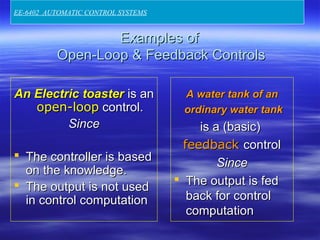
An Electric toasterAn Electric toaster is anis an
open-loopopen-loop control.control.
SinceSince
 The controller is basedThe controller is based
on the knowledge.on the knowledge.
 The output is not usedThe output is not used
in control computationin control computation
A water tank of anA water tank of an
ordinary water tankordinary water tank
is a (basic)is a (basic)
feedbackfeedback controlcontrol
SinceSince
 The output is fedThe output is fed
back for controlback for control
computationcomputation
EE-6402 AUTOMATIC CONTROL SYSTEMS
Pros & Cons of Open-Loop ControlPros & Cons of Open-Loop Control
 Generally simpler than closed-loop control,Generally simpler than closed-loop control,
 Does not require a sensor to measure the output,Does not require a sensor to measure the output,
 Does not, of itself, introduce stability problems;Does not, of itself, introduce stability problems;
BUTBUT
 Has lower performance than closed-loop to matchHas lower performance than closed-loop to match
the desired output wellthe desired output well..
EE-6402 AUTOMATIC CONTROL SYSTEMS
Problems with Feedback ControlProblems with Feedback Control
 More complex than open-loop controlMore complex than open-loop control
 May have steady state errorMay have steady state error
 Depends on accuracy with which you canDepends on accuracy with which you can
measure the outputmeasure the output
 May cause stability problemsMay cause stability problems
EE-6402 AUTOMATIC CONTROL SYSTEMS
Advantages of FeedbackAdvantages of Feedback
ControlControl
 System with well designed feedbackSystem with well designed feedback
control can respond to unforeseencontrol can respond to unforeseen
events.events.
 Eliminates need for human adjustmentEliminates need for human adjustment
of control variableof control variable
 Reduces human workloadReduces human workload
 Gives much better performance thanGives much better performance than
it is possible with open-loopit is possible with open-loop
EE-6402 AUTOMATIC CONTROL SYSTEMS
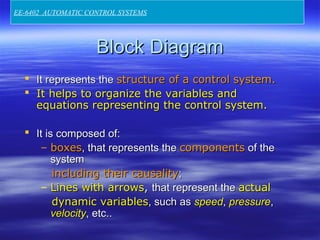
Block DiagramBlock Diagram
 It represents theIt represents the structure of a control system.structure of a control system.
 It helps to organize the variables andIt helps to organize the variables and
equations representing the control system.equations representing the control system.
 It is composed of:It is composed of:
– boxesboxes, that represents the, that represents the componentscomponents of theof the
systemsystem
including their causalityincluding their causality;;
– Lines with arrowsLines with arrows,, that represent thethat represent the actualactual
dynamic variablesdynamic variables, such as, such as speedspeed,, pressurepressure,,
velocityvelocity, etc.., etc..
EE-6402 AUTOMATIC CONTROL SYSTEMS
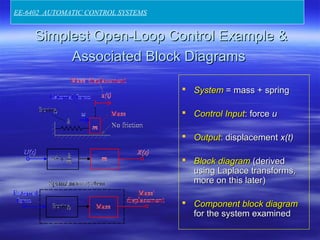
Simplest Open-Loop Control Example &Simplest Open-Loop Control Example &
Associated Block DiagramsAssociated Block Diagrams
 SystemSystem = mass + spring= mass + spring
 Control InputControl Input: force: force uu
 OutputOutput: displacement: displacement x(t)x(t)
 Block diagramBlock diagram (derived(derived
using Laplace transforms,using Laplace transforms,
more on this later)more on this later)
 ComponentComponent block diagramblock diagram
for the system examinedfor the system examined
EE-6402 AUTOMATIC CONTROL SYSTEMS
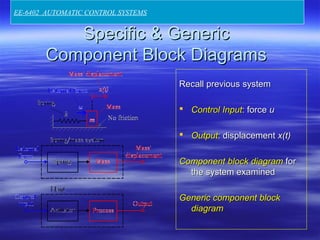
Specific & GenericSpecific & Generic
Component Block DiagramsComponent Block Diagrams
Recall previousRecall previous systemsystem
 Control InputControl Input: force: force uu
 OutputOutput: displacement: displacement x(t)x(t)
ComponentComponent block diagramblock diagram forfor
the system examinedthe system examined
Generic componentGeneric component blockblock
diagramdiagram
EE-6402 AUTOMATIC CONTROL SYSTEMS
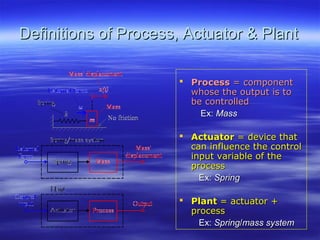
Definitions of Process, Actuator & PlantDefinitions of Process, Actuator & Plant
 ProcessProcess = component= component
whose the output is towhose the output is to
be controlledbe controlled
Ex:Ex: MassMass
 ActuatorActuator = device that= device that
can influence the controlcan influence the control
input variable of theinput variable of the
processprocess
Ex:Ex: SpringSpring
 PlantPlant = actuator += actuator +
processprocess
Ex:Ex: SpringSpring//mass systemmass system
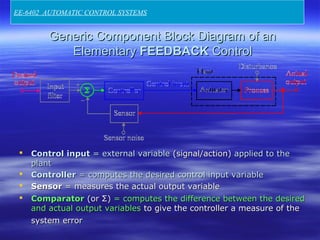
Generic Component Block Diagram of anGeneric Component Block Diagram of an
ElementaryElementary FEEDBACKFEEDBACK ControlControl
 Control inputControl input = external variable= external variable (signal/action)(signal/action) applied to theapplied to the
plantplant
 ControllerController = computes the desired control input variable= computes the desired control input variable
 SensorSensor = measures the actual output variable= measures the actual output variable
 ComparatorComparator (or(or ΣΣ)) = computes the difference between the desired= computes the difference between the desired
and actual output variablesand actual output variables to give the controller a measure of theto give the controller a measure of the
system errorsystem error
EE-6402 AUTOMATIC CONTROL SYSTEMS
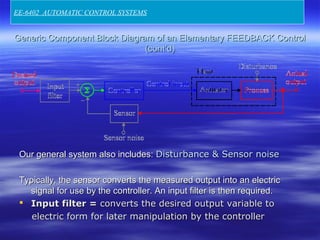
Generic Component Block Diagram of an Elementary FEEDBACK ControlGeneric Component Block Diagram of an Elementary FEEDBACK Control
(cont’d)(cont’d)
Our general system also includes:Our general system also includes: Disturbance & Sensor noiseDisturbance & Sensor noise
Typically, the sensor converts the measured output into an electricTypically, the sensor converts the measured output into an electric
signal for use by the controller. An input filter is then required.signal for use by the controller. An input filter is then required.
 Input filter =Input filter = converts the desired output variable toconverts the desired output variable to
electric form for later manipulation by the controllerelectric form for later manipulation by the controller
EE-6402 AUTOMATIC CONTROL SYSTEMS
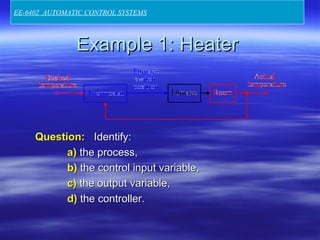
Example 1: HeaterExample 1: Heater
Question:Question: Identify:Identify:
a)a) the process,the process,
b)b) the control input variable,the control input variable,
c)c) the output variable,the output variable,
d)d) the controller.the controller.
EE-6402 AUTOMATIC CONTROL SYSTEMS
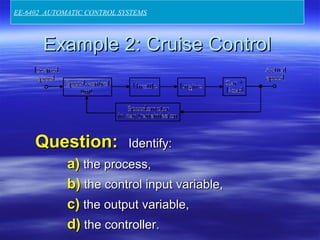
Example 2: Cruise ControlExample 2: Cruise Control
Question:Question: Identify:Identify:
a)a) the process,the process,
b)b) the control input variable,the control input variable,
c)c) the output variable,the output variable,
d)d) the controller.the controller.
EE-6402 AUTOMATIC CONTROL SYSTEMS
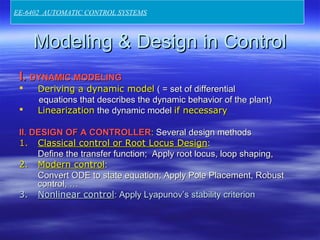
Modeling & Design in ControlModeling & Design in Control
I.I. DYNAMIC MODELINGDYNAMIC MODELING
 Deriving a dynamic modelDeriving a dynamic model ( = set of differential( = set of differential
equations that describes the dynamic behavior of the plant)equations that describes the dynamic behavior of the plant)
 LinearizationLinearization the dynamic modelthe dynamic model if necessaryif necessary
II. DESIGN OF A CONTROLLERII. DESIGN OF A CONTROLLER:: Several design methodsSeveral design methods
1.1. Classical control or Root Locus DesignClassical control or Root Locus Design::
Define the transfer function; Apply root locus, loop shaping,Define the transfer function; Apply root locus, loop shaping,
2.2. Modern controlModern control::
Convert ODE to state equation; Apply Pole Placement, RobustConvert ODE to state equation; Apply Pole Placement, Robust
control, …control, …
3.3. Nonlinear controlNonlinear control: Apply Lyapunov’s stability criterion: Apply Lyapunov’s stability criterion
EE-6402 AUTOMATIC CONTROL SYSTEMS
III. USE OF THE CONTROLLERIII. USE OF THE CONTROLLER
 Simulation of the controllerSimulation of the controller
 Integration of real-time control systemIntegration of real-time control system
 Interfacing the control computer to the plantInterfacing the control computer to the plant
 Gain tuning for best control performanceGain tuning for best control performance
EE-6402 AUTOMATIC CONTROL SYSTEMS
Overview of the Next LectureOverview of the Next Lecture
Deriving a dynamic model forDeriving a dynamic model for
mechanical systemsmechanical systems
EE-6402 AUTOMATIC CONTROL SYSTEMS
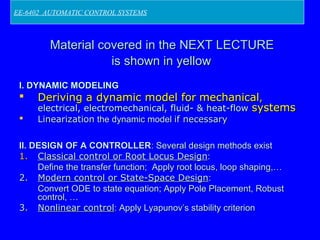
Material covered in the NEXT LECTUREMaterial covered in the NEXT LECTURE
is shown in yellowis shown in yellow
I. DYNAMIC MODELINGI. DYNAMIC MODELING
 Deriving a dynamic model forDeriving a dynamic model for mechanicalmechanical,,
electrical, electromechanical, fluid- & heat-flowelectrical, electromechanical, fluid- & heat-flow systemssystems
 LinearizationLinearization the dynamic modelthe dynamic model if necessaryif necessary
II. DESIGN OF A CONTROLLERII. DESIGN OF A CONTROLLER: Several design methods exist: Several design methods exist
1.1. Classical control or Root Locus DesignClassical control or Root Locus Design::
Define the transfer function; Apply root locus, loop shaping,…Define the transfer function; Apply root locus, loop shaping,…
2.2. Modern control or State-Space DesignModern control or State-Space Design::
Convert ODE to state equation; Apply Pole Placement, RobustConvert ODE to state equation; Apply Pole Placement, Robust
control, …control, …
3.3. Nonlinear controlNonlinear control: Apply Lyapunov’s stability criterion: Apply Lyapunov’s stability criterion
EE-6402 AUTOMATIC CONTROL SYSTEMS

Chapter 1 Automatic Controloverview

  • 1.
    Previous Chapter 1Index Next Section 1.3: Historical Periods of Control Theory is covered by slides: 5, [6], 7, 8, 9, 10 Home
  • 2.
  • 3.
  • 4.
    Chapter 1:Chapter 1: Overviewof ControlOverview of Control Definitions, Classification of controls,Definitions, Classification of controls, Block Diagram ComponentsBlock Diagram Components ofof Feedback Control,Feedback Control, ModelingModeling && DesignDesign in Control.in Control. EE-6402 AUTOMATIC CONTROL SYSTEMS
  • 5.
    TerminologyTerminology  ControlControl isa series of actions directed foris a series of actions directed for making a variable system adheres to amaking a variable system adheres to a reference valuereference value (that might be either(that might be either constant or variable).constant or variable).  TheThe desired reference valuedesired reference value whenwhen performing control is theperforming control is the desired outputdesired output variablevariable (that might deviate from actual(that might deviate from actual output)output)  ProcessProcess,, as it is used and understood byas it is used and understood by control engineers, means thecontrol engineers, means the componentcomponent to be controlledto be controlled EE-6402 AUTOMATIC CONTROL SYSTEMS
  • 6.
    Controls areControls areclassifiedclassified with respect to:with respect to:  technique involvedtechnique involved to perform control (to perform control (i.ei.e.. human/machineshuman/machines):): manual/automatic controlmanual/automatic control  Time dependence of output variableTime dependence of output variable ((i.ei.e.. constant/changingconstant/changing):): regulator/servo,regulator/servo, ((also known asalso known as regulatingregulating//tracking control)tracking control)  fundamental structurefundamental structure of the controlof the control ((i.ei.e. the. the information usedinformation used for computing the controlfor computing the control)):: Open-loop/feedback control,Open-loop/feedback control, ((also known asalso known as open-loop/closed-loop controlopen-loop/closed-loop control)) EE-6402 AUTOMATIC CONTROL SYSTEMS
  • 7.
    Manual/Automatic Controls -Manual/AutomaticControls - ExamplesExamples A system that involvesA system that involves::  aa person controlling a machineperson controlling a machine is calledis called manual controlmanual control.. ExEx: Driving a car: Driving a car  machines onlymachines only is called ais called a automaticautomatic controlcontrol.. ExEx: Central AC: Central AC EE-6402 AUTOMATIC CONTROL SYSTEMS
  • 8.
    Servo/Regulator Controls -Servo/RegulatorControls - ExamplesExamples AnAn automaticautomatic control system designed tocontrol system designed to::  follow a changing referencefollow a changing reference is calledis called tracking controltracking control or aor a servoservo.. ExEx: Remote control car: Remote control car  maintain an output fixedmaintain an output fixed ((regardless ofregardless of the disturbances present) is called athe disturbances present) is called a regulating controlregulating control or aor a regulatorregulator.. ExEx: Cruise control: Cruise control EE-6402 AUTOMATIC CONTROL SYSTEMS
  • 9.
    Open-Loop ControlOpen-Loop Control/Feedback control/Feedback control The structures are fundamentally different:The structures are fundamentally different:  In anIn an open-loop controlopen-loop control, the system, the system does NOTdoes NOT measure the actual output and there ismeasure the actual output and there is nono correctioncorrection to make that output conform toto make that output conform to the desired output.the desired output.  In aIn a closed loop controlclosed loop control the systemthe system includes a sensor to measure the outputincludes a sensor to measure the output andand uses feedbackuses feedback of the sensed valueof the sensed value toto influence the control input variable.influence the control input variable. EE-6402 AUTOMATIC CONTROL SYSTEMS
  • 10.
    Examples ofExamples of Open-Loop& Feedback ControlsOpen-Loop & Feedback Controls An Electric toasterAn Electric toaster is anis an open-loopopen-loop control.control. SinceSince  The controller is basedThe controller is based on the knowledge.on the knowledge.  The output is not usedThe output is not used in control computationin control computation A water tank of anA water tank of an ordinary water tankordinary water tank is a (basic)is a (basic) feedbackfeedback controlcontrol SinceSince  The output is fedThe output is fed back for controlback for control computationcomputation EE-6402 AUTOMATIC CONTROL SYSTEMS
  • 11.
    Pros & Consof Open-Loop ControlPros & Cons of Open-Loop Control  Generally simpler than closed-loop control,Generally simpler than closed-loop control,  Does not require a sensor to measure the output,Does not require a sensor to measure the output,  Does not, of itself, introduce stability problems;Does not, of itself, introduce stability problems; BUTBUT  Has lower performance than closed-loop to matchHas lower performance than closed-loop to match the desired output wellthe desired output well.. EE-6402 AUTOMATIC CONTROL SYSTEMS
  • 12.
    Problems with FeedbackControlProblems with Feedback Control  More complex than open-loop controlMore complex than open-loop control  May have steady state errorMay have steady state error  Depends on accuracy with which you canDepends on accuracy with which you can measure the outputmeasure the output  May cause stability problemsMay cause stability problems EE-6402 AUTOMATIC CONTROL SYSTEMS
  • 13.
    Advantages of FeedbackAdvantagesof Feedback ControlControl  System with well designed feedbackSystem with well designed feedback control can respond to unforeseencontrol can respond to unforeseen events.events.  Eliminates need for human adjustmentEliminates need for human adjustment of control variableof control variable  Reduces human workloadReduces human workload  Gives much better performance thanGives much better performance than it is possible with open-loopit is possible with open-loop EE-6402 AUTOMATIC CONTROL SYSTEMS
  • 14.
    Block DiagramBlock Diagram It represents theIt represents the structure of a control system.structure of a control system.  It helps to organize the variables andIt helps to organize the variables and equations representing the control system.equations representing the control system.  It is composed of:It is composed of: – boxesboxes, that represents the, that represents the componentscomponents of theof the systemsystem including their causalityincluding their causality;; – Lines with arrowsLines with arrows,, that represent thethat represent the actualactual dynamic variablesdynamic variables, such as, such as speedspeed,, pressurepressure,, velocityvelocity, etc.., etc.. EE-6402 AUTOMATIC CONTROL SYSTEMS
  • 15.
    Simplest Open-Loop ControlExample &Simplest Open-Loop Control Example & Associated Block DiagramsAssociated Block Diagrams  SystemSystem = mass + spring= mass + spring  Control InputControl Input: force: force uu  OutputOutput: displacement: displacement x(t)x(t)  Block diagramBlock diagram (derived(derived using Laplace transforms,using Laplace transforms, more on this later)more on this later)  ComponentComponent block diagramblock diagram for the system examinedfor the system examined EE-6402 AUTOMATIC CONTROL SYSTEMS
  • 16.
    Specific & GenericSpecific& Generic Component Block DiagramsComponent Block Diagrams Recall previousRecall previous systemsystem  Control InputControl Input: force: force uu  OutputOutput: displacement: displacement x(t)x(t) ComponentComponent block diagramblock diagram forfor the system examinedthe system examined Generic componentGeneric component blockblock diagramdiagram EE-6402 AUTOMATIC CONTROL SYSTEMS
  • 17.
    Definitions of Process,Actuator & PlantDefinitions of Process, Actuator & Plant  ProcessProcess = component= component whose the output is towhose the output is to be controlledbe controlled Ex:Ex: MassMass  ActuatorActuator = device that= device that can influence the controlcan influence the control input variable of theinput variable of the processprocess Ex:Ex: SpringSpring  PlantPlant = actuator += actuator + processprocess Ex:Ex: SpringSpring//mass systemmass system
  • 18.
    Generic Component BlockDiagram of anGeneric Component Block Diagram of an ElementaryElementary FEEDBACKFEEDBACK ControlControl  Control inputControl input = external variable= external variable (signal/action)(signal/action) applied to theapplied to the plantplant  ControllerController = computes the desired control input variable= computes the desired control input variable  SensorSensor = measures the actual output variable= measures the actual output variable  ComparatorComparator (or(or ΣΣ)) = computes the difference between the desired= computes the difference between the desired and actual output variablesand actual output variables to give the controller a measure of theto give the controller a measure of the system errorsystem error EE-6402 AUTOMATIC CONTROL SYSTEMS
  • 19.
    Generic Component BlockDiagram of an Elementary FEEDBACK ControlGeneric Component Block Diagram of an Elementary FEEDBACK Control (cont’d)(cont’d) Our general system also includes:Our general system also includes: Disturbance & Sensor noiseDisturbance & Sensor noise Typically, the sensor converts the measured output into an electricTypically, the sensor converts the measured output into an electric signal for use by the controller. An input filter is then required.signal for use by the controller. An input filter is then required.  Input filter =Input filter = converts the desired output variable toconverts the desired output variable to electric form for later manipulation by the controllerelectric form for later manipulation by the controller EE-6402 AUTOMATIC CONTROL SYSTEMS
  • 20.
    Example 1: HeaterExample1: Heater Question:Question: Identify:Identify: a)a) the process,the process, b)b) the control input variable,the control input variable, c)c) the output variable,the output variable, d)d) the controller.the controller. EE-6402 AUTOMATIC CONTROL SYSTEMS
  • 21.
    Example 2: CruiseControlExample 2: Cruise Control Question:Question: Identify:Identify: a)a) the process,the process, b)b) the control input variable,the control input variable, c)c) the output variable,the output variable, d)d) the controller.the controller. EE-6402 AUTOMATIC CONTROL SYSTEMS
  • 22.
    Modeling & Designin ControlModeling & Design in Control I.I. DYNAMIC MODELINGDYNAMIC MODELING  Deriving a dynamic modelDeriving a dynamic model ( = set of differential( = set of differential equations that describes the dynamic behavior of the plant)equations that describes the dynamic behavior of the plant)  LinearizationLinearization the dynamic modelthe dynamic model if necessaryif necessary II. DESIGN OF A CONTROLLERII. DESIGN OF A CONTROLLER:: Several design methodsSeveral design methods 1.1. Classical control or Root Locus DesignClassical control or Root Locus Design:: Define the transfer function; Apply root locus, loop shaping,Define the transfer function; Apply root locus, loop shaping, 2.2. Modern controlModern control:: Convert ODE to state equation; Apply Pole Placement, RobustConvert ODE to state equation; Apply Pole Placement, Robust control, …control, … 3.3. Nonlinear controlNonlinear control: Apply Lyapunov’s stability criterion: Apply Lyapunov’s stability criterion EE-6402 AUTOMATIC CONTROL SYSTEMS
  • 23.
    III. USE OFTHE CONTROLLERIII. USE OF THE CONTROLLER  Simulation of the controllerSimulation of the controller  Integration of real-time control systemIntegration of real-time control system  Interfacing the control computer to the plantInterfacing the control computer to the plant  Gain tuning for best control performanceGain tuning for best control performance EE-6402 AUTOMATIC CONTROL SYSTEMS
  • 24.
    Overview of theNext LectureOverview of the Next Lecture Deriving a dynamic model forDeriving a dynamic model for mechanical systemsmechanical systems EE-6402 AUTOMATIC CONTROL SYSTEMS
  • 25.
    Material covered inthe NEXT LECTUREMaterial covered in the NEXT LECTURE is shown in yellowis shown in yellow I. DYNAMIC MODELINGI. DYNAMIC MODELING  Deriving a dynamic model forDeriving a dynamic model for mechanicalmechanical,, electrical, electromechanical, fluid- & heat-flowelectrical, electromechanical, fluid- & heat-flow systemssystems  LinearizationLinearization the dynamic modelthe dynamic model if necessaryif necessary II. DESIGN OF A CONTROLLERII. DESIGN OF A CONTROLLER: Several design methods exist: Several design methods exist 1.1. Classical control or Root Locus DesignClassical control or Root Locus Design:: Define the transfer function; Apply root locus, loop shaping,…Define the transfer function; Apply root locus, loop shaping,… 2.2. Modern control or State-Space DesignModern control or State-Space Design:: Convert ODE to state equation; Apply Pole Placement, RobustConvert ODE to state equation; Apply Pole Placement, Robust control, …control, … 3.3. Nonlinear controlNonlinear control: Apply Lyapunov’s stability criterion: Apply Lyapunov’s stability criterion EE-6402 AUTOMATIC CONTROL SYSTEMS