 Definition and Representation
 Controllers and algorithms
 Transfer function and gain of a system
 Introduction to Digital Computer Control
Definition
A controller is a mechanism which seeks to minimize the difference
between actual value of a system (process variable) and desired value of the
system (set point).
A controller is a comparative device. It :
Receives an input signal from a measured process variable
Compares this value with that of a predetermined control point value (set
point)
Determines the appropriate amount of output signal required by the final
control element to provide corrective action within a control loop.
Electronic controller uses electrical signals and digital algorithms to
Working Principles
An electronic sensor (thermocouple, RTD or transmitter) installed at
the
measurement location continuously sends an input signal to the
controller.
At set intervals the controller compares this signal to a predefined
set point.
If the input signal deviates from the set point, the controller sends
a
corrective output signal to the control element.
Features of a Controller
An electronic controller is best suited for applications where large
load changes are encountered and/or fast response changes are
required.
Uses of Controllers
The important uses of the controllers are as follows:
Controllers improve the steady state accuracy by decreasing the
steady state error.
As the steady state accuracy improves, the stability also improves.
Controllers also help in reducing the unwanted offsets produced by
the system.
Controllers can control the maximum overshoot of the system.
Controllers can help in reducing the noise signals produced by the
system.
Controllers can help to speed up the slow response of an over
damped system.
Types of Controllers
There are two main types of controllers:
a. Continuous Controllers. b. Discontinuous Controllers.
In discontinuous controllers, the manipulated variable changes
between discrete values. Depending on how many different states the
manipulated variable can assume, a distinction is made between
two-position, three position and multi position controllers.
Compared to continuous controllers, discontinuous controllers
operate on very simple, switching final controlling elements.
In continuous controllers is the controlled variable (aka. manipulated
variable) can have any value within controller’s output range. In the
continuous controller theory, there are three basic modes.
Types of Controllers
a. Proportional Controller
The output (also called the actuating signal) is directly proportional
to the error signal.
To use a proportional controller in a system, there are two
conditions:
I. The deviation should not be large (There should be not be a
large deviation between the input and output).
II. The deviation should not be sudden.
Mathematical Represenstation
Output is directly proportional to error signal→
A(t) ∝ e(t)
or, A(t)=Kp*e(t)
Types of Controllers
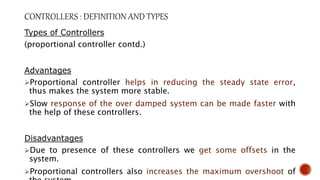
(proportional controller contd.)
Advantages
Proportional controller helps in reducing the steady state error,
thus makes the system more stable.
Slow response of the over damped system can be made faster with
the help of these controllers.
Disadvantages
Due to presence of these controllers we get some offsets in the
system.
Proportional controllers also increases the maximum overshoot of
Types of Controllers
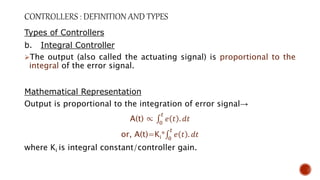
b. Integral Controller
The output (also called the actuating signal) is proportional to the
integral of the error signal.
Mathematical Representation
Output is proportional to the integration of error signal→
A(t) ∝ 0
𝑡
𝑒 𝑡 . 𝑑𝑡
or, A(t)=Ki* 0
𝑡
𝑒 𝑡 . 𝑑𝑡
where Ki is integral constant/controller gain.
Types of Controllers
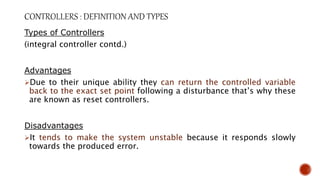
(integral controller contd.)
Advantages
Due to their unique ability they can return the controlled variable
back to the exact set point following a disturbance that’s why these
are known as reset controllers.
Disadvantages
It tends to make the system unstable because it responds slowly
towards the produced error.
Types of Controllers
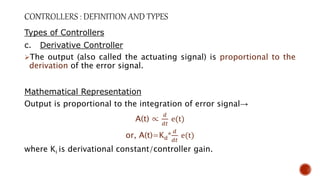
c. Derivative Controller
The output (also called the actuating signal) is proportional to the
derivation of the error signal.
Mathematical Representation
Output is proportional to the integration of error signal→
A(t) ∝
ⅆ
ⅆ𝑡
e(t)
or, A(t)=Kd*
ⅆ
ⅆ𝑡
e(t)
where Ki is derivational constant/controller gain.
Types of Controllers
(derivative controller contd.)
Advantages
The major advantage of derivative controller is that it improves the
transient response of the system.
Disadvantages
It never improves the steady state error.
It produces saturation effects and also amplifies the noise signals
produced in the system.
Types of Controllers
Combinational Controllers
The combination of these modes are used to control particular
system such that the process variable is equal to the set point (or as
close as can be got it). These three types of controllers can be
combined into new controllers:
i. Proportional and integral controllers (PI Controller)
A(t)=Ki* 0
𝑡
𝑒 𝑡 . 𝑑𝑡+Kp*e(t)
ii. Proportional and derivative controllers (PD Controller)
A(t)=Kd*
ⅆ
ⅆ𝑡
e(t)+Kp*e(t)
iii. Proportional integral derivative control (PID Controller)
A(t)=Ki* 0
𝑡
𝑒 𝑡 . 𝑑𝑡+ Kd*
ⅆ
ⅆ𝑡
e(t)+ Kp*e(t)
PID Controller Tuning
The process of setting the optimal gains for P, I and D to get an ideal response from a
control system is called tuning.
Closed Loop System
Ziegler-Nichols method
Modified Ziegler-Nichols
method
Tyreus-Luyben method
Damped oscillation method
Open Loop System
Open loop Ziegler-Nichols method
C-H-R method
Cohen and Coon method
Fertik method
Ciancone-Marline method
IMC method
Min. error criteria (IAE, ISE, ITAE)
method
Transfer Function
A transfer function represents the relationship between the output
signal of a control system and the input signal, for all possible input
values. If the input is represented by R(s) and the output is
represented by C(s), then the transfer function will be:
The transfer function of a control system is defined as the ratio of
the Laplace transform of the output variable to Laplace transform of
the input variable assuming all initial conditions to be zero.
(transfer function contd.)
Advantages
The output can be easily determined for any given input.
Complex differential and integral equations are transformed into
simple and easy algebraic equations.
Disadvantages
The key disadvantage of this analysis is that transfer functions can
be applied only on linear time invariant systems.
Gain
In a control loop, the controller gain is the strength of action a controller will take
at a particular point below or above the set point.
Process Gain
1. Model Parameter.
2. Describes important
aspects of a given
process’ dynamic
behavior.
3. Can be determined using
step test data.
Controller Gain
1. Tuning parameter.
2. Contributes to the PID
controller’s responsiveness to
disturbances.
3. Assigning a value requires both
specific knowledge of the PID
controller and the unique
objective for the control loop.

Introduction to control system 2

  • 1.
     Definition andRepresentation  Controllers and algorithms  Transfer function and gain of a system  Introduction to Digital Computer Control
  • 2.
    Definition A controller isa mechanism which seeks to minimize the difference between actual value of a system (process variable) and desired value of the system (set point). A controller is a comparative device. It : Receives an input signal from a measured process variable Compares this value with that of a predetermined control point value (set point) Determines the appropriate amount of output signal required by the final control element to provide corrective action within a control loop. Electronic controller uses electrical signals and digital algorithms to
  • 3.
    Working Principles An electronicsensor (thermocouple, RTD or transmitter) installed at the measurement location continuously sends an input signal to the controller. At set intervals the controller compares this signal to a predefined set point. If the input signal deviates from the set point, the controller sends a corrective output signal to the control element. Features of a Controller An electronic controller is best suited for applications where large load changes are encountered and/or fast response changes are required.
  • 4.
    Uses of Controllers Theimportant uses of the controllers are as follows: Controllers improve the steady state accuracy by decreasing the steady state error. As the steady state accuracy improves, the stability also improves. Controllers also help in reducing the unwanted offsets produced by the system. Controllers can control the maximum overshoot of the system. Controllers can help in reducing the noise signals produced by the system. Controllers can help to speed up the slow response of an over damped system.
  • 5.
    Types of Controllers Thereare two main types of controllers: a. Continuous Controllers. b. Discontinuous Controllers. In discontinuous controllers, the manipulated variable changes between discrete values. Depending on how many different states the manipulated variable can assume, a distinction is made between two-position, three position and multi position controllers. Compared to continuous controllers, discontinuous controllers operate on very simple, switching final controlling elements. In continuous controllers is the controlled variable (aka. manipulated variable) can have any value within controller’s output range. In the continuous controller theory, there are three basic modes.
  • 6.
    Types of Controllers a.Proportional Controller The output (also called the actuating signal) is directly proportional to the error signal. To use a proportional controller in a system, there are two conditions: I. The deviation should not be large (There should be not be a large deviation between the input and output). II. The deviation should not be sudden. Mathematical Represenstation Output is directly proportional to error signal→ A(t) ∝ e(t) or, A(t)=Kp*e(t)
  • 7.
    Types of Controllers (proportionalcontroller contd.) Advantages Proportional controller helps in reducing the steady state error, thus makes the system more stable. Slow response of the over damped system can be made faster with the help of these controllers. Disadvantages Due to presence of these controllers we get some offsets in the system. Proportional controllers also increases the maximum overshoot of
  • 8.
    Types of Controllers b.Integral Controller The output (also called the actuating signal) is proportional to the integral of the error signal. Mathematical Representation Output is proportional to the integration of error signal→ A(t) ∝ 0 𝑡 𝑒 𝑡 . 𝑑𝑡 or, A(t)=Ki* 0 𝑡 𝑒 𝑡 . 𝑑𝑡 where Ki is integral constant/controller gain.
  • 9.
    Types of Controllers (integralcontroller contd.) Advantages Due to their unique ability they can return the controlled variable back to the exact set point following a disturbance that’s why these are known as reset controllers. Disadvantages It tends to make the system unstable because it responds slowly towards the produced error.
  • 10.
    Types of Controllers c.Derivative Controller The output (also called the actuating signal) is proportional to the derivation of the error signal. Mathematical Representation Output is proportional to the integration of error signal→ A(t) ∝ ⅆ ⅆ𝑡 e(t) or, A(t)=Kd* ⅆ ⅆ𝑡 e(t) where Ki is derivational constant/controller gain.
  • 11.
    Types of Controllers (derivativecontroller contd.) Advantages The major advantage of derivative controller is that it improves the transient response of the system. Disadvantages It never improves the steady state error. It produces saturation effects and also amplifies the noise signals produced in the system.
  • 12.
    Types of Controllers CombinationalControllers The combination of these modes are used to control particular system such that the process variable is equal to the set point (or as close as can be got it). These three types of controllers can be combined into new controllers: i. Proportional and integral controllers (PI Controller) A(t)=Ki* 0 𝑡 𝑒 𝑡 . 𝑑𝑡+Kp*e(t) ii. Proportional and derivative controllers (PD Controller) A(t)=Kd* ⅆ ⅆ𝑡 e(t)+Kp*e(t) iii. Proportional integral derivative control (PID Controller) A(t)=Ki* 0 𝑡 𝑒 𝑡 . 𝑑𝑡+ Kd* ⅆ ⅆ𝑡 e(t)+ Kp*e(t)
  • 13.
    PID Controller Tuning Theprocess of setting the optimal gains for P, I and D to get an ideal response from a control system is called tuning. Closed Loop System Ziegler-Nichols method Modified Ziegler-Nichols method Tyreus-Luyben method Damped oscillation method Open Loop System Open loop Ziegler-Nichols method C-H-R method Cohen and Coon method Fertik method Ciancone-Marline method IMC method Min. error criteria (IAE, ISE, ITAE) method
  • 14.
    Transfer Function A transferfunction represents the relationship between the output signal of a control system and the input signal, for all possible input values. If the input is represented by R(s) and the output is represented by C(s), then the transfer function will be: The transfer function of a control system is defined as the ratio of the Laplace transform of the output variable to Laplace transform of the input variable assuming all initial conditions to be zero.
  • 15.
  • 16.
  • 17.
    Advantages The output canbe easily determined for any given input. Complex differential and integral equations are transformed into simple and easy algebraic equations. Disadvantages The key disadvantage of this analysis is that transfer functions can be applied only on linear time invariant systems.
  • 18.
    Gain In a controlloop, the controller gain is the strength of action a controller will take at a particular point below or above the set point. Process Gain 1. Model Parameter. 2. Describes important aspects of a given process’ dynamic behavior. 3. Can be determined using step test data. Controller Gain 1. Tuning parameter. 2. Contributes to the PID controller’s responsiveness to disturbances. 3. Assigning a value requires both specific knowledge of the PID controller and the unique objective for the control loop.