Animal Diversity I
Animal characteristics







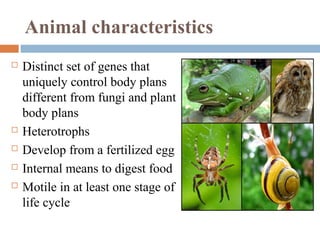
Distinct set of genes that
uniquely control body plans
different from fungi and plant
body plans
Heterotrophs
Develop from a fertilized egg
Internal means to digest food
Motile in at least one stage of
life cycle
Phylum Porifera
Sponges









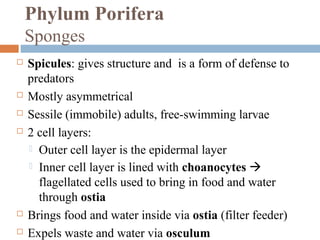
Spicules: gives structure and is a form of defense to
predators
Mostly asymmetrical
Sessile (immobile) adults, free-swimming larvae
2 cell layers:
 Outer cell layer is the epidermal layer
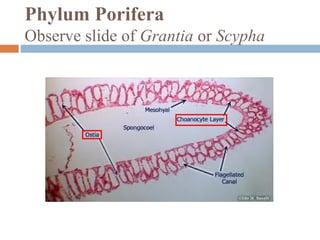
 Inner cell layer is lined with choanocytes 
flagellated cells used to bring in food and water
through ostia
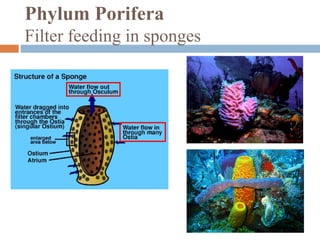
Brings food and water inside via ostia (filter feeder)
Expels waste and water via osculum
Phylum Porifera
Filter feeding in sponges
Phylum Porifera
Observe slide of Grantia or Scypha
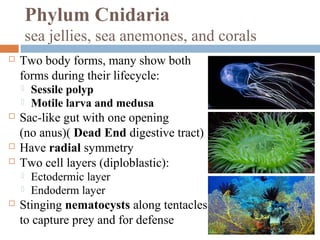
Phylum Cnidaria
sea jellies, sea anemones, and corals


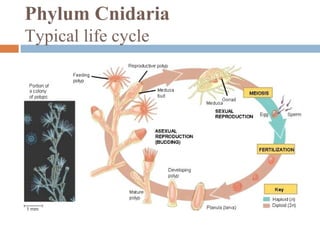
Two body forms, many show both
forms during their lifecycle:








Sac-like gut with one opening
(no anus)( Dead End digestive tract)
Have radial symmetry
Two cell layers (diploblastic):





Sessile polyp
Motile larva and medusa

Ectodermic layer
Endoderm layer

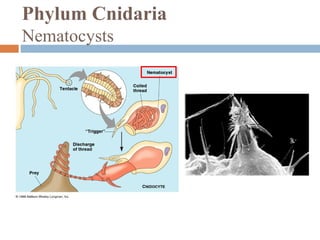
Stinging nematocysts along tentacles
to capture prey and for defense
Phylum Cnidaria
Nematocysts
Phylum Cnidaria
Typical life cycle
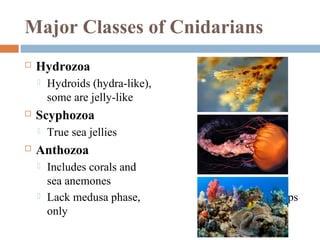
Major Classes of Cnidarians


Hydrozoa




Scyphozoa




Hydroids (hydra-like),
some are jelly-like
True sea jellies

Anthozoa




Includes corals and
sea anemones
Lack medusa phase,
only

polyps
Phylum Cnidaria
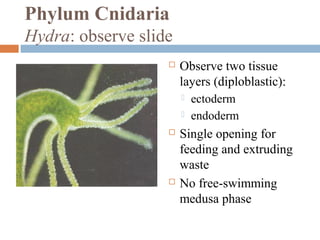
Hydra: observe slide


Observe two tissue
layers (diploblastic):







ectoderm
endoderm

Single opening for
feeding and extruding
waste
No free-swimming
medusa phase
Phylum Cnidaria
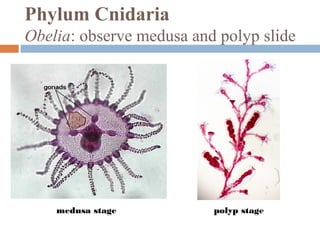
Obelia: observe medusa and polyp slide

medusa stage

polyp stage
LOPHOTROCHOZOA









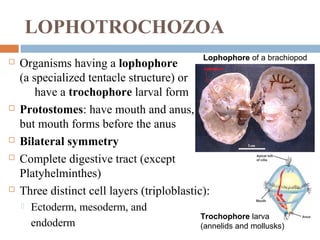
Lophophore of a brachiopod

Organisms having a lophophore
(a specialized tentacle structure) or
have a trochophore larval form
Protostomes: have mouth and anus,
but mouth forms before the anus
Bilateral symmetry
Complete digestive tract (except
Platyhelminthes)
Three distinct cell layers (triploblastic):


Ectoderm, mesoderm, and
endoderm

Trochophore larva
(annelids and mollusks)
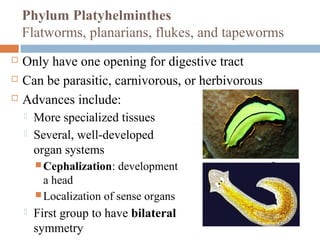
Phylum Platyhelminthes
Flatworms, planarians, flukes, and tapeworms




Only have one opening for digestive tract
Can be parasitic, carnivorous, or herbivorous
Advances include:



More specialized tissues
Several, well-developed
organ systems
 Cephalization:

development

a head
 Localization of sense organs


First group to have bilateral
symmetry

of
Phylum Platyhelminthes
Diversity within Platyhelminthess


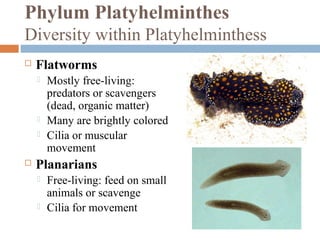
Flatworms







Mostly free-living:
predators or scavengers
(dead, organic matter)
Many are brightly colored
Cilia or muscular
movement

Planarians



Free-living: feed on small
animals or scavenge
Cilia for movement
Phylum Platyhelminthes
Diversity within Platyhelminthes


Flukes
 Parasitic in liver, lungs, bladder, or blood vessels
of vertebrates
 Primary

host for adult fluke: vertebrate
 Intermediate host for larvae: usually a snail


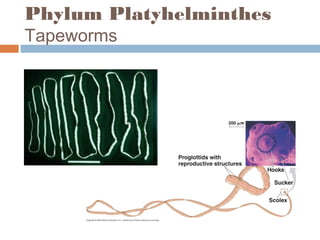
Tapeworms




Specialized parasites for life in intestine (predigested food)
Attach to host by scolex (suckers & hooks)
Phylum Platyhelminthes
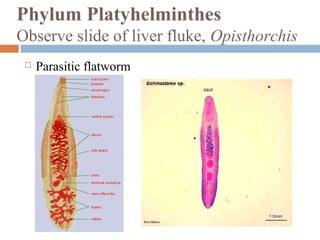
Observe slide of liver fluke, Opisthorchis


Parasitic flatworm
Phylum Platyhelminthes
Tapeworms
Phylum Annelida
segmented worms, marine worms, earthworms, leeches


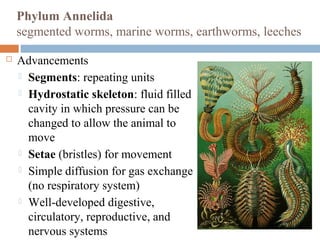
Advancements
 Segments: repeating units
 Hydrostatic skeleton: fluid filled
cavity in which pressure can be
changed to allow the animal to
move
 Setae (bristles) for movement
 Simple diffusion for gas exchange
(no respiratory system)
 Well-developed digestive,
circulatory, reproductive, and
nervous systems
Phylum Annelida
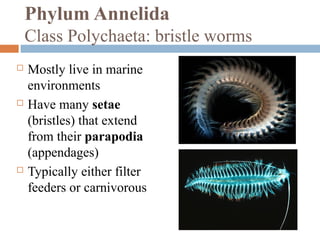
Class Polychaeta: bristle worms






Mostly live in marine
environments
Have many setae
(bristles) that extend
from their parapodia
(appendages)
Typically either filter
feeders or carnivorous
Phylum Annelida
Class Oligochaeta: earthworms










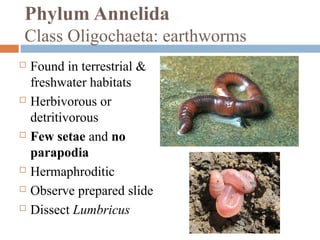
Found in terrestrial &
freshwater habitats
Herbivorous or
detritivorous
Few setae and no
parapodia
Hermaphroditic
Observe prepared slide
Dissect Lumbricus
Phylum Annelida
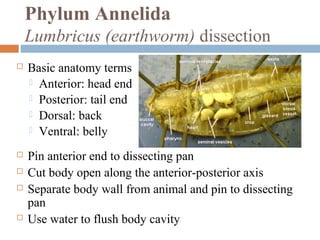
Lumbricus (earthworm) dissection


Basic anatomy terms
 Anterior: head end
 Posterior: tail end
 Dorsal: back
 Ventral: belly



Pin anterior end to dissecting pan
Cut body open along the anterior-posterior axis
Separate body wall from animal and pin to dissecting
pan
Use water to flush body cavity





Phylum Annelida
Class Hirudinea: leeches






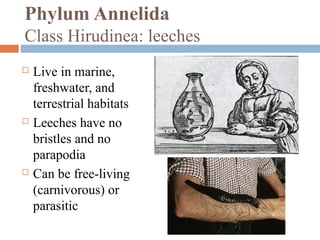
Live in marine,
freshwater, and
terrestrial habitats
Leeches have no
bristles and no
parapodia
Can be free-living
(carnivorous) or
parasitic
Phylum Mollusca
chitons, snails, slugs, clams, octopus, squid,
nautilus


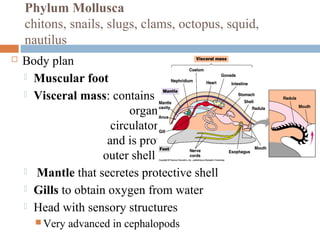
Body plan
 Muscular foot
 Visceral mass: contains
organs(digestive,
circulatory, reproductive)
and is protected by a hard
outer shell
 Mantle that secretes protective shell
 Gills to obtain oxygen from water
 Head with sensory structures
 Very

advanced in cephalopods
Phylum Mollusca
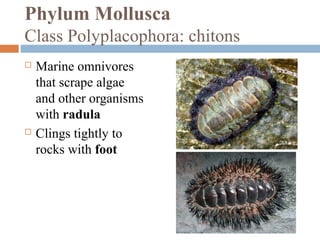
Class Polyplacophora: chitons




Marine omnivores
that scrape algae
and other organisms
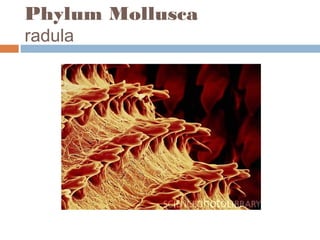
with radula
Clings tightly to
rocks with foot
Phylum Mollusca
radula
Phylum Mollusca
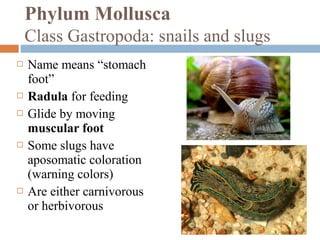
Class Gastropoda: snails and slugs









Name means “stomach
foot”
Radula for feeding
Glide by moving
muscular foot
Some slugs have
aposomatic coloration
(warning colors)
Are either carnivorous
or herbivorous
Phylum Mollusca
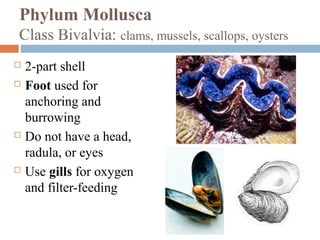
Class Bivalvia: clams, mussels, scallops, oysters







2-part shell
Foot used for
anchoring and
burrowing
Do not have a head,
radula, or eyes
Use gills for oxygen
and filter-feeding
Phylum Mollusca
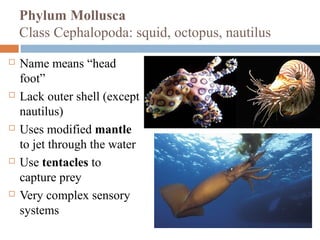
Class Cephalopoda: squid, octopus, nautilus










Name means “head
foot”
Lack outer shell (except
nautilus)
Uses modified mantle
to jet through the water
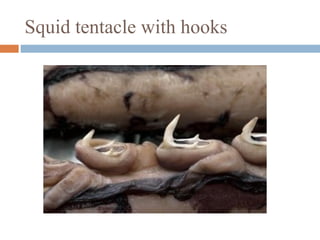
Use tentacles to
capture prey
Very complex sensory
systems
Squid tentacle with hooks
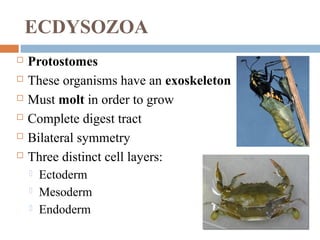
ECDYSOZOA







Protostomes
These organisms have an exoskeleton
Must molt in order to grow
Complete digest tract
Bilateral symmetry
Three distinct cell layers:




Ectoderm
Mesoderm
Endoderm
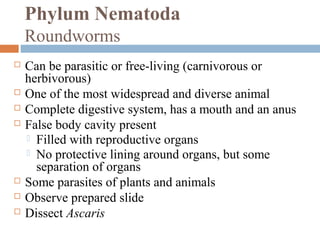
Phylum Nematoda
Roundworms










Can be parasitic or free-living (carnivorous or
herbivorous)
One of the most widespread and diverse animal
Complete digestive system, has a mouth and an anus
False body cavity present
 Filled with reproductive organs
 No protective lining around organs, but some
separation of organs
Some parasites of plants and animals
Observe prepared slide
Dissect Ascaris
Phylum Nematoda
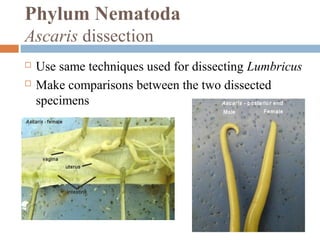
Ascaris dissection



Use same techniques used for dissecting Lumbricus
Make comparisons between the two dissected
specimens
Phylum Arthropoda
Chelicerates, myriapods, hexapods, and crustaceans


Arthropods united by having:
 Segmentation




Exoskeleton




Basic body plan:
head, thorax, abdomen
Made of chitin, molt to grow









Used for feeding,
movement, senses, and
reproduction

Spiders, mites, and ticks

Subphylum Myriapoda




Shrimp, lobsters,
barnacles, and relatives

Subphylum Chelicerata


Jointed paired appendages


Subphylum Crustacea

Millipedes and
centipedes

Subphylum Hexapoda


Insects and relatives
Phylum Arthropoda
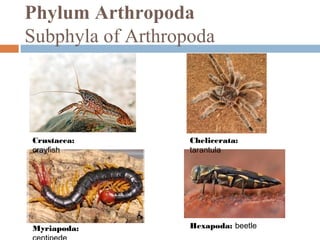
Subphyla of Arthropoda

Crustacea:
crayfish

Chelicerata:
tarantula

Myriapoda:

Hexapoda: beetle

Animal Diversity and Evolution

  • 1.
  • 2.
    Animal characteristics      Distinct setof genes that uniquely control body plans different from fungi and plant body plans Heterotrophs Develop from a fertilized egg Internal means to digest food Motile in at least one stage of life cycle
  • 3.
    Phylum Porifera Sponges       Spicules: givesstructure and is a form of defense to predators Mostly asymmetrical Sessile (immobile) adults, free-swimming larvae 2 cell layers:  Outer cell layer is the epidermal layer  Inner cell layer is lined with choanocytes  flagellated cells used to bring in food and water through ostia Brings food and water inside via ostia (filter feeder) Expels waste and water via osculum
  • 4.
  • 5.
    Phylum Porifera Observe slideof Grantia or Scypha
  • 6.
    Phylum Cnidaria sea jellies,sea anemones, and corals  Two body forms, many show both forms during their lifecycle:      Sac-like gut with one opening (no anus)( Dead End digestive tract) Have radial symmetry Two cell layers (diploblastic):    Sessile polyp Motile larva and medusa Ectodermic layer Endoderm layer Stinging nematocysts along tentacles to capture prey and for defense
  • 7.
  • 8.
  • 9.
    Major Classes ofCnidarians  Hydrozoa   Scyphozoa   Hydroids (hydra-like), some are jelly-like True sea jellies Anthozoa   Includes corals and sea anemones Lack medusa phase, only polyps
  • 10.
    Phylum Cnidaria Hydra: observeslide  Observe two tissue layers (diploblastic):     ectoderm endoderm Single opening for feeding and extruding waste No free-swimming medusa phase
  • 11.
    Phylum Cnidaria Obelia: observemedusa and polyp slide medusa stage polyp stage
  • 12.
    LOPHOTROCHOZOA      Lophophore of abrachiopod Organisms having a lophophore (a specialized tentacle structure) or have a trochophore larval form Protostomes: have mouth and anus, but mouth forms before the anus Bilateral symmetry Complete digestive tract (except Platyhelminthes) Three distinct cell layers (triploblastic):  Ectoderm, mesoderm, and endoderm Trochophore larva (annelids and mollusks)
  • 13.
    Phylum Platyhelminthes Flatworms, planarians,flukes, and tapeworms    Only have one opening for digestive tract Can be parasitic, carnivorous, or herbivorous Advances include:   More specialized tissues Several, well-developed organ systems  Cephalization: development a head  Localization of sense organs  First group to have bilateral symmetry of
  • 14.
    Phylum Platyhelminthes Diversity withinPlatyhelminthess  Flatworms     Mostly free-living: predators or scavengers (dead, organic matter) Many are brightly colored Cilia or muscular movement Planarians   Free-living: feed on small animals or scavenge Cilia for movement
  • 15.
    Phylum Platyhelminthes Diversity withinPlatyhelminthes  Flukes  Parasitic in liver, lungs, bladder, or blood vessels of vertebrates  Primary host for adult fluke: vertebrate  Intermediate host for larvae: usually a snail  Tapeworms   Specialized parasites for life in intestine (predigested food) Attach to host by scolex (suckers & hooks)
  • 16.
    Phylum Platyhelminthes Observe slideof liver fluke, Opisthorchis  Parasitic flatworm
  • 17.
  • 18.
    Phylum Annelida segmented worms,marine worms, earthworms, leeches  Advancements  Segments: repeating units  Hydrostatic skeleton: fluid filled cavity in which pressure can be changed to allow the animal to move  Setae (bristles) for movement  Simple diffusion for gas exchange (no respiratory system)  Well-developed digestive, circulatory, reproductive, and nervous systems
  • 19.
    Phylum Annelida Class Polychaeta:bristle worms    Mostly live in marine environments Have many setae (bristles) that extend from their parapodia (appendages) Typically either filter feeders or carnivorous
  • 20.
    Phylum Annelida Class Oligochaeta:earthworms       Found in terrestrial & freshwater habitats Herbivorous or detritivorous Few setae and no parapodia Hermaphroditic Observe prepared slide Dissect Lumbricus
  • 21.
    Phylum Annelida Lumbricus (earthworm)dissection  Basic anatomy terms  Anterior: head end  Posterior: tail end  Dorsal: back  Ventral: belly  Pin anterior end to dissecting pan Cut body open along the anterior-posterior axis Separate body wall from animal and pin to dissecting pan Use water to flush body cavity   
  • 22.
    Phylum Annelida Class Hirudinea:leeches    Live in marine, freshwater, and terrestrial habitats Leeches have no bristles and no parapodia Can be free-living (carnivorous) or parasitic
  • 23.
    Phylum Mollusca chitons, snails,slugs, clams, octopus, squid, nautilus  Body plan  Muscular foot  Visceral mass: contains organs(digestive, circulatory, reproductive) and is protected by a hard outer shell  Mantle that secretes protective shell  Gills to obtain oxygen from water  Head with sensory structures  Very advanced in cephalopods
  • 24.
    Phylum Mollusca Class Polyplacophora:chitons   Marine omnivores that scrape algae and other organisms with radula Clings tightly to rocks with foot
  • 25.
  • 26.
    Phylum Mollusca Class Gastropoda:snails and slugs      Name means “stomach foot” Radula for feeding Glide by moving muscular foot Some slugs have aposomatic coloration (warning colors) Are either carnivorous or herbivorous
  • 27.
    Phylum Mollusca Class Bivalvia:clams, mussels, scallops, oysters     2-part shell Foot used for anchoring and burrowing Do not have a head, radula, or eyes Use gills for oxygen and filter-feeding
  • 28.
    Phylum Mollusca Class Cephalopoda:squid, octopus, nautilus      Name means “head foot” Lack outer shell (except nautilus) Uses modified mantle to jet through the water Use tentacles to capture prey Very complex sensory systems
  • 29.
  • 30.
    ECDYSOZOA       Protostomes These organisms havean exoskeleton Must molt in order to grow Complete digest tract Bilateral symmetry Three distinct cell layers:    Ectoderm Mesoderm Endoderm
  • 31.
    Phylum Nematoda Roundworms        Can beparasitic or free-living (carnivorous or herbivorous) One of the most widespread and diverse animal Complete digestive system, has a mouth and an anus False body cavity present  Filled with reproductive organs  No protective lining around organs, but some separation of organs Some parasites of plants and animals Observe prepared slide Dissect Ascaris
  • 32.
    Phylum Nematoda Ascaris dissection   Usesame techniques used for dissecting Lumbricus Make comparisons between the two dissected specimens
  • 33.
    Phylum Arthropoda Chelicerates, myriapods,hexapods, and crustaceans  Arthropods united by having:  Segmentation   Exoskeleton   Basic body plan: head, thorax, abdomen Made of chitin, molt to grow     Used for feeding, movement, senses, and reproduction Spiders, mites, and ticks Subphylum Myriapoda   Shrimp, lobsters, barnacles, and relatives Subphylum Chelicerata  Jointed paired appendages  Subphylum Crustacea Millipedes and centipedes Subphylum Hexapoda  Insects and relatives
  • 34.
    Phylum Arthropoda Subphyla ofArthropoda Crustacea: crayfish Chelicerata: tarantula Myriapoda: Hexapoda: beetle