PHYLUM ARTHROPODA
Gr. Arthron, joint, + pous, podos, foot
Most numerous animals on earth (900,000 species)
Spiders, scorpions, ticks, mites, crustaceans, millipedes, centipedes, insects and
some smaller groups.
STRUCTURE AND ORGANIZATION
Segmented body, metameric body
Segments are specialized for a variety of purposes, forming functional groups (Tagmata)
 Head and thorax are two tagmata
 Head, thorax and abdomen
 Cephalothorax and abdomen
Triploblastic coelomates with well developed organ systems
No backbone
Cuticular exoskeleton (chitin and tanned protein)
ecdysis (or molting)
Skeletal support
• each somite bears a single pair of jointed
appendages
-sensory activities, food gathering and feeding,
reproduction and walking or swimming
Locomotion
with complete digestive system
Mouthparts are modified from appendages and adapted for different methods of feeding
exhibit all modes of feeding: carnivorous, herbivorous, scavengers, filter-feeding
Nutrition
Reproduction
• are dioecious and undergo internal fertilization
• may be oviparous or ovoviviparous
• life cycle involves metamorphosis which include molting process
or ecdysis (shedding of exoskeleton)
• Few species exhibit parthenogenesis
Respiration by body surface, gills, tracheae or book lungs
Open circulatory system
Poikilothermic
Respiration and Circulation
• excretory organs
– malpighian tubules
– excretory glands such as antennal, coxal, and maxillary glands
Excretion
Nervous System
• similar to annelid plan
• Dorsal ganglia connected to double ventral chain of ganglia
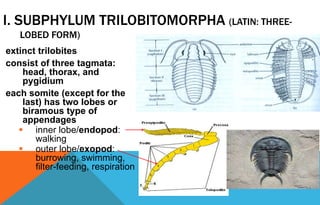
I. SUBPHYLUM TRILOBITOMORPHA (LATIN: THREE-
LOBED FORM)
extinct trilobites
consist of three tagmata:
head, thorax, and
pygidium
each somite (except for the
last) has two lobes or
biramous type of
appendages
 inner lobe/endopod:
walking
 outer lobe/exopod:
burrowing, swimming,
filter-feeding, respiration
II. SUBPHYLUM CHELICERATA (GREEK: CLAW)
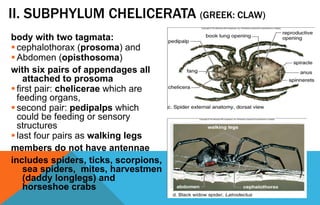
body with two tagmata:
 cephalothorax (prosoma) and
 Abdomen (opisthosoma)
with six pairs of appendages all
attached to prosoma
 first pair: chelicerae which are
feeding organs,
 second pair: pedipalps which
could be feeding or sensory
structures
 last four pairs as walking legs
members do not have antennae
includes spiders, ticks, scorpions,
sea spiders, mites, harvestmen
(daddy longlegs) and
horseshoe crabs
II. SUBPHYLUM CHELICERATA
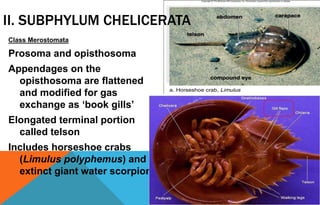
Class Merostomata
Prosoma and opisthosoma
Appendages on the
opisthosoma are flattened
and modified for gas
exchange as ‘book gills’
Elongated terminal portion
called telson
Includes horseshoe crabs
(Limulus polyphemus) and
extinct giant water scorpions
II. SUBPHYLUM
CHELICERATA
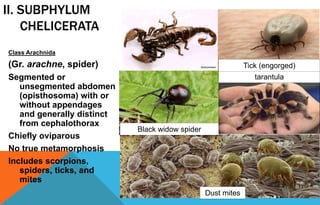
Class Arachnida
(Gr. arachne, spider)
Segmented or
unsegmented abdomen
(opisthosoma) with or
without appendages
and generally distinct
from cephalothorax
Chiefly oviparous
No true metamorphosis
Includes scorpions,
spiders, ticks, and
mites
Dust mites
Black widow spider
tarantula
Tick (engorged)
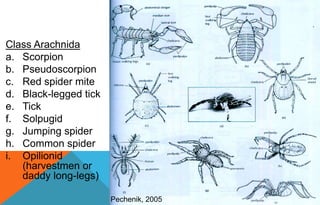
Class Arachnida
a. Scorpion
b. Pseudoscorpion
c. Red spider mite
d. Black-legged tick
e. Tick
f. Solpugid
g. Jumping spider
h. Common spider
i. Opilionid
(harvestmen or
daddy long-legs)
Pechenik, 2005
II. SUBPHYLUM CHELICERATA
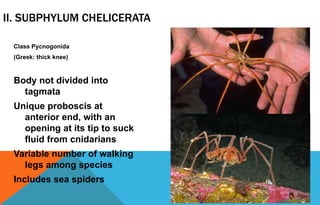
Class Pycnogonida
(Greek: thick knee)
Body not divided into
tagmata
Unique proboscis at
anterior end, with an
opening at its tip to suck
fluid from cnidarians
Variable number of walking
legs among species
Includes sea spiders
III. SUBPHYLUM CRUSTACEA (LATIN: A
CRUST)
mostly marine and few are terrestrial and freshwater
with carapace as their exoskeleton which is composed of chitin and
calcium carbonate
body is divided into cephalothorax and abdomen
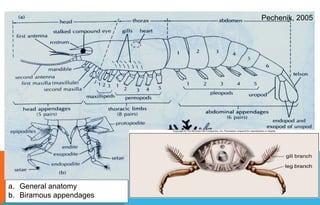
 Head bears 5 pairs of appendages
 2 pairs of antennae
 1 pair of mandibles
 2 pairs of maxillae
 Thorax
 3 pairs of maxillipeds
 5 pairs of pereopods (walking legs)
 Abdomen
 5 pairs of pleopods (swimming legs)
appendages are biramous (two-lobed)
use gills for respiration
Includes brachiopods, ostracods, isopods, amphipods, copepods,
a. General anatomy
b. Biramous appendages
Pechenik, 2005
III. SUBPHYLUM CRUSTACEA
Class Malacostraca
- isopods (pill bugs, sow bugs, woodlice),
amphipods (sand fleas), decapods (crabs, lobsters,
shrimps, hermit crabs), krills
Class Branchiopoda
- brine (fairy) shrimp, clam shrimp, water fleas
Class Ostracoda – the ostracods
Class Copepoda – the copepods
Class Cirripedia – the barnacles
III. SUBPHYLUM CRUSTACEA
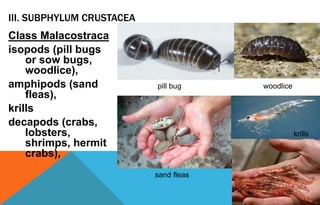
Class Malacostraca
isopods (pill bugs
or sow bugs,
woodlice),
amphipods (sand
fleas),
krills
decapods (crabs,
lobsters,
shrimps, hermit
crabs),
woodlicepill bug
sand fleas
krills
III. SUBPHYLUM CRUSTACEA
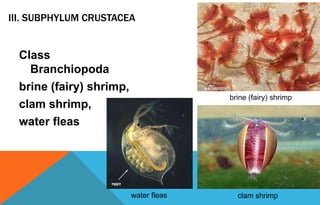
Class
Branchiopoda
brine (fairy) shrimp,
clam shrimp,
water fleas
brine (fairy) shrimp
clam shrimpwater fleas
III. SUBPHYLUM CRUSTACEA
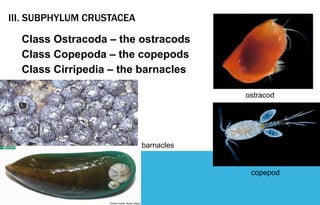
Class Ostracoda – the ostracods
Class Copepoda – the copepods
Class Cirripedia – the barnacles
ostracod
copepod
barnacles
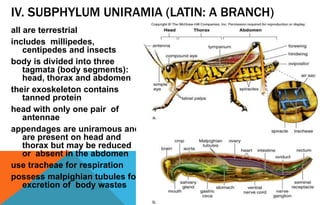
IV. SUBPHYLUM UNIRAMIA (LATIN: A BRANCH)
all are terrestrial
includes millipedes,
centipedes and insects
body is divided into three
tagmata (body segments):
head, thorax and abdomen
their exoskeleton contains
tanned protein
head with only one pair of
antennae
appendages are uniramous and
are present on head and
thorax but may be reduced
or absent in the abdomen
use tracheae for respiration
possess malpighian tubules for
excretion of body wastes
IV. Subphylum Uniramia
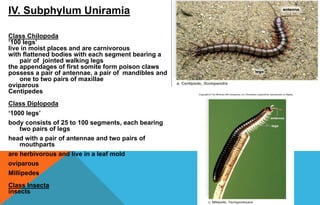
Class Chilopoda
‘100 legs’
live in moist places and are carnivorous
with flattened bodies with each segment bearing a
pair of jointed walking legs
the appendages of first somite form poison claws
possess a pair of antennae, a pair of mandibles and
one to two pairs of maxillae
oviparous
Centipedes
Class Diplopoda
‘1000 legs’
body consists of 25 to 100 segments, each bearing
two pairs of legs
head with a pair of antennae and two pairs of
mouthparts
are herbivorous and live in a leaf mold
oviparous
Millipedes
Class Insecta
insects
IV. Subphylum Uniramia
Class Insecta
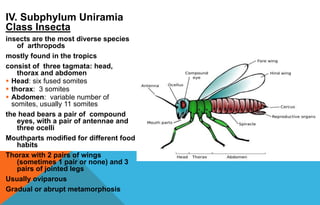
insects are the most diverse species
of arthropods
mostly found in the tropics
consist of three tagmata: head,
thorax and abdomen
 Head: six fused somites
 thorax: 3 somites
 Abdomen: variable number of
somites, usually 11 somites
the head bears a pair of compound
eyes, with a pair of antennae and
three ocelli
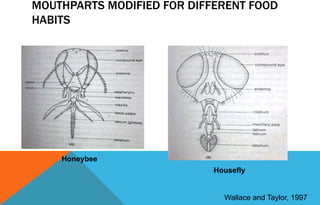
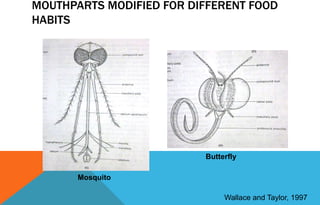
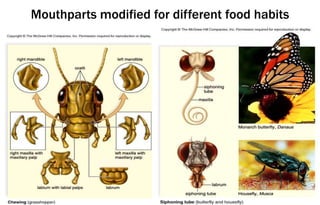
Mouthparts modified for different food
habits
Thorax with 2 pairs of wings
(sometimes 1 pair or none) and 3
pairs of jointed legs
Usually oviparous
Gradual or abrupt metamorphosis
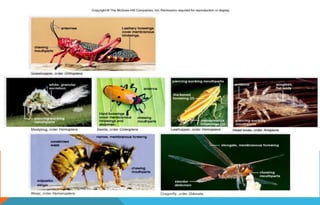
MOUTHPARTS MODIFIED FOR DIFFERENT FOOD
HABITS
Honeybee
Housefly
Wallace and Taylor, 1997
Mosquito
Butterfly
MOUTHPARTS MODIFIED FOR DIFFERENT FOOD
HABITS
Wallace and Taylor, 1997
Mouthparts modified for different food habits
IV. Subphylum Uniramia
Class Insecta
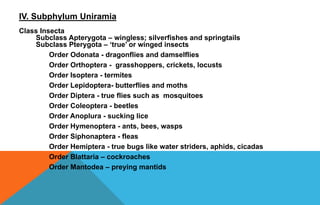
Subclass Apterygota – wingless; silverfishes and springtails
Subclass Pterygota – ‘true’ or winged insects
Order Odonata - dragonflies and damselflies
Order Orthoptera - grasshoppers, crickets, locusts
Order Isoptera - termites
Order Lepidoptera- butterflies and moths
Order Diptera - true flies such as mosquitoes
Order Coleoptera - beetles
Order Anoplura - sucking lice
Order Hymenoptera - ants, bees, wasps
Order Siphonaptera - fleas
Order Hemiptera - true bugs like water striders, aphids, cicadas
Order Blattaria – cockroaches
Order Mantodea – preying mantids
FIGURE 30.12
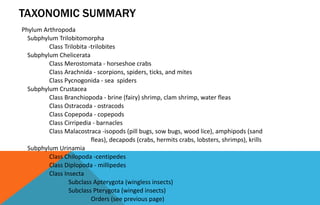
TAXONOMIC SUMMARY
Phylum Arthropoda
Subphylum Trilobitomorpha
Class Trilobita -trilobites
Subphylum Chelicerata
Class Merostomata - horseshoe crabs
Class Arachnida - scorpions, spiders, ticks, and mites
Class Pycnogonida - sea spiders
Subphylum Crustacea
Class Branchiopoda - brine (fairy) shrimp, clam shrimp, water fleas
Class Ostracoda - ostracods
Class Copepoda - copepods
Class Cirripedia - barnacles
Class Malacostraca -isopods (pill bugs, sow bugs, wood lice), amphipods (sand
fleas), decapods (crabs, hermits crabs, lobsters, shrimps), krills
Subphylum Urinamia
Class Chilopoda -centipedes
Class Diplopoda - millipedes
Class Insecta
Subclass Apterygota (wingless insects)
Subclass Pterygota (winged insects)
Orders (see previous page)

Activity 11 arthropods2

  • 2.
    PHYLUM ARTHROPODA Gr. Arthron,joint, + pous, podos, foot Most numerous animals on earth (900,000 species) Spiders, scorpions, ticks, mites, crustaceans, millipedes, centipedes, insects and some smaller groups.
  • 3.
    STRUCTURE AND ORGANIZATION Segmentedbody, metameric body Segments are specialized for a variety of purposes, forming functional groups (Tagmata)  Head and thorax are two tagmata  Head, thorax and abdomen  Cephalothorax and abdomen Triploblastic coelomates with well developed organ systems
  • 4.
    No backbone Cuticular exoskeleton(chitin and tanned protein) ecdysis (or molting) Skeletal support • each somite bears a single pair of jointed appendages -sensory activities, food gathering and feeding, reproduction and walking or swimming Locomotion
  • 5.
    with complete digestivesystem Mouthparts are modified from appendages and adapted for different methods of feeding exhibit all modes of feeding: carnivorous, herbivorous, scavengers, filter-feeding Nutrition Reproduction • are dioecious and undergo internal fertilization • may be oviparous or ovoviviparous • life cycle involves metamorphosis which include molting process or ecdysis (shedding of exoskeleton) • Few species exhibit parthenogenesis
  • 6.
    Respiration by bodysurface, gills, tracheae or book lungs Open circulatory system Poikilothermic Respiration and Circulation • excretory organs – malpighian tubules – excretory glands such as antennal, coxal, and maxillary glands Excretion Nervous System • similar to annelid plan • Dorsal ganglia connected to double ventral chain of ganglia
  • 7.
    I. SUBPHYLUM TRILOBITOMORPHA(LATIN: THREE- LOBED FORM) extinct trilobites consist of three tagmata: head, thorax, and pygidium each somite (except for the last) has two lobes or biramous type of appendages  inner lobe/endopod: walking  outer lobe/exopod: burrowing, swimming, filter-feeding, respiration
  • 8.
    II. SUBPHYLUM CHELICERATA(GREEK: CLAW) body with two tagmata:  cephalothorax (prosoma) and  Abdomen (opisthosoma) with six pairs of appendages all attached to prosoma  first pair: chelicerae which are feeding organs,  second pair: pedipalps which could be feeding or sensory structures  last four pairs as walking legs members do not have antennae includes spiders, ticks, scorpions, sea spiders, mites, harvestmen (daddy longlegs) and horseshoe crabs
  • 9.
    II. SUBPHYLUM CHELICERATA ClassMerostomata Prosoma and opisthosoma Appendages on the opisthosoma are flattened and modified for gas exchange as ‘book gills’ Elongated terminal portion called telson Includes horseshoe crabs (Limulus polyphemus) and extinct giant water scorpions
  • 10.
    II. SUBPHYLUM CHELICERATA Class Arachnida (Gr.arachne, spider) Segmented or unsegmented abdomen (opisthosoma) with or without appendages and generally distinct from cephalothorax Chiefly oviparous No true metamorphosis Includes scorpions, spiders, ticks, and mites Dust mites Black widow spider tarantula Tick (engorged)
  • 11.
    Class Arachnida a. Scorpion b.Pseudoscorpion c. Red spider mite d. Black-legged tick e. Tick f. Solpugid g. Jumping spider h. Common spider i. Opilionid (harvestmen or daddy long-legs) Pechenik, 2005
  • 12.
    II. SUBPHYLUM CHELICERATA ClassPycnogonida (Greek: thick knee) Body not divided into tagmata Unique proboscis at anterior end, with an opening at its tip to suck fluid from cnidarians Variable number of walking legs among species Includes sea spiders
  • 13.
    III. SUBPHYLUM CRUSTACEA(LATIN: A CRUST) mostly marine and few are terrestrial and freshwater with carapace as their exoskeleton which is composed of chitin and calcium carbonate body is divided into cephalothorax and abdomen  Head bears 5 pairs of appendages  2 pairs of antennae  1 pair of mandibles  2 pairs of maxillae  Thorax  3 pairs of maxillipeds  5 pairs of pereopods (walking legs)  Abdomen  5 pairs of pleopods (swimming legs) appendages are biramous (two-lobed) use gills for respiration Includes brachiopods, ostracods, isopods, amphipods, copepods,
  • 14.
    a. General anatomy b.Biramous appendages Pechenik, 2005
  • 15.
    III. SUBPHYLUM CRUSTACEA ClassMalacostraca - isopods (pill bugs, sow bugs, woodlice), amphipods (sand fleas), decapods (crabs, lobsters, shrimps, hermit crabs), krills Class Branchiopoda - brine (fairy) shrimp, clam shrimp, water fleas Class Ostracoda – the ostracods Class Copepoda – the copepods Class Cirripedia – the barnacles
  • 16.
    III. SUBPHYLUM CRUSTACEA ClassMalacostraca isopods (pill bugs or sow bugs, woodlice), amphipods (sand fleas), krills decapods (crabs, lobsters, shrimps, hermit crabs), woodlicepill bug sand fleas krills
  • 17.
    III. SUBPHYLUM CRUSTACEA Class Branchiopoda brine(fairy) shrimp, clam shrimp, water fleas brine (fairy) shrimp clam shrimpwater fleas
  • 18.
    III. SUBPHYLUM CRUSTACEA ClassOstracoda – the ostracods Class Copepoda – the copepods Class Cirripedia – the barnacles ostracod copepod barnacles
  • 19.
    IV. SUBPHYLUM UNIRAMIA(LATIN: A BRANCH) all are terrestrial includes millipedes, centipedes and insects body is divided into three tagmata (body segments): head, thorax and abdomen their exoskeleton contains tanned protein head with only one pair of antennae appendages are uniramous and are present on head and thorax but may be reduced or absent in the abdomen use tracheae for respiration possess malpighian tubules for excretion of body wastes
  • 20.
    IV. Subphylum Uniramia ClassChilopoda ‘100 legs’ live in moist places and are carnivorous with flattened bodies with each segment bearing a pair of jointed walking legs the appendages of first somite form poison claws possess a pair of antennae, a pair of mandibles and one to two pairs of maxillae oviparous Centipedes Class Diplopoda ‘1000 legs’ body consists of 25 to 100 segments, each bearing two pairs of legs head with a pair of antennae and two pairs of mouthparts are herbivorous and live in a leaf mold oviparous Millipedes Class Insecta insects
  • 21.
    IV. Subphylum Uniramia ClassInsecta insects are the most diverse species of arthropods mostly found in the tropics consist of three tagmata: head, thorax and abdomen  Head: six fused somites  thorax: 3 somites  Abdomen: variable number of somites, usually 11 somites the head bears a pair of compound eyes, with a pair of antennae and three ocelli Mouthparts modified for different food habits Thorax with 2 pairs of wings (sometimes 1 pair or none) and 3 pairs of jointed legs Usually oviparous Gradual or abrupt metamorphosis
  • 22.
    MOUTHPARTS MODIFIED FORDIFFERENT FOOD HABITS Honeybee Housefly Wallace and Taylor, 1997
  • 23.
    Mosquito Butterfly MOUTHPARTS MODIFIED FORDIFFERENT FOOD HABITS Wallace and Taylor, 1997
  • 24.
    Mouthparts modified fordifferent food habits
  • 25.
    IV. Subphylum Uniramia ClassInsecta Subclass Apterygota – wingless; silverfishes and springtails Subclass Pterygota – ‘true’ or winged insects Order Odonata - dragonflies and damselflies Order Orthoptera - grasshoppers, crickets, locusts Order Isoptera - termites Order Lepidoptera- butterflies and moths Order Diptera - true flies such as mosquitoes Order Coleoptera - beetles Order Anoplura - sucking lice Order Hymenoptera - ants, bees, wasps Order Siphonaptera - fleas Order Hemiptera - true bugs like water striders, aphids, cicadas Order Blattaria – cockroaches Order Mantodea – preying mantids
  • 26.
  • 27.
    TAXONOMIC SUMMARY Phylum Arthropoda SubphylumTrilobitomorpha Class Trilobita -trilobites Subphylum Chelicerata Class Merostomata - horseshoe crabs Class Arachnida - scorpions, spiders, ticks, and mites Class Pycnogonida - sea spiders Subphylum Crustacea Class Branchiopoda - brine (fairy) shrimp, clam shrimp, water fleas Class Ostracoda - ostracods Class Copepoda - copepods Class Cirripedia - barnacles Class Malacostraca -isopods (pill bugs, sow bugs, wood lice), amphipods (sand fleas), decapods (crabs, hermits crabs, lobsters, shrimps), krills Subphylum Urinamia Class Chilopoda -centipedes Class Diplopoda - millipedes Class Insecta Subclass Apterygota (wingless insects) Subclass Pterygota (winged insects) Orders (see previous page)

Editor's Notes

  • #6 Parthenogenesis -A form of reproduction in which an unfertilized egg develops into a new individual, occurring commonly among insects and certain other arthropods; virgin origin Most animal species that reproduce parthenogenetically also display a phase of sexual behaviour and sexual reproduction. In most cases, parthenogenetic reproduction occurs when environmental conditions are favourable and there is plenty of food that can sustain the generation of large numbers of individuals in a short period of time. When external conditions change and food supplies become less abundant, or when the environment becomes unpredictable, these species shift to a sexual mode of reproduction. Although sexual reproduction is considerably slower and generates fewer organisms, it gives rise to individuals containing variations in their genetic material. Some of these individuals might be at an advantage over their predecessors, because they might be more able to adapt to new conditions. In some species of insects, such as the aphids, parthenogenetic reproduction occurs in the spring and summer, when conditions are favourable for rapid population growth. As time goes by and conditions become less favourable, the parthenogenetically born individuals mate and lay fertilized eggs. These eggs hatch the following spring, when conditions are again favourable for another cycle of parthenogenetic reproduction. In some species of ants, bees, and wasps, the ability to reproduce both sexually and asexually is part of the mechanism establishing sexual differences. Usually, females develop from unfertilized eggs, containing only half of the genetic material of the mother, whereas males develop from fertilized eggs, containing the genetic contributions of both mother and father.
  • #7 Nervous system similar to annelid plan, with dorsal brain connected by a ring around the pharynx to a double nerve chain of ventral ganglia; fusion of ganglia in some species; well- developed sensory organs.