ORDER THYSANURA
(SILVER FISH)
Presented To: Dr. Shahzad Ali
Presented By: Mujahid Hussain
2019-mphil-1385
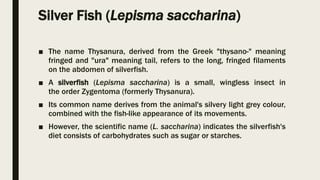
Silver Fish (Lepisma saccharina)
■ The name Thysanura, derived from the Greek "thysano-" meaning
fringed and "ura" meaning tail, refers to the long, fringed filaments
on the abdomen of silverfish.
■ A silverfish (Lepisma saccharina) is a small, wingless insect in
the order Zygentoma (formerly Thysanura).
■ Its common name derives from the animal's silvery light grey colour,
combined with the fish-like appearance of its movements.
■ However, the scientific name (L. saccharina) indicates the silverfish's
diet consists of carbohydrates such as sugar or starches.
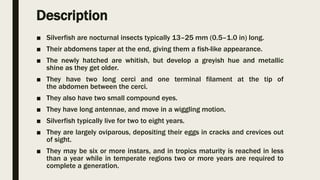
Description
■ Silverfish are nocturnal insects typically 13–25 mm (0.5–1.0 in) long.
■ Their abdomens taper at the end, giving them a fish-like appearance.
■ The newly hatched are whitish, but develop a greyish hue and metallic
shine as they get older.
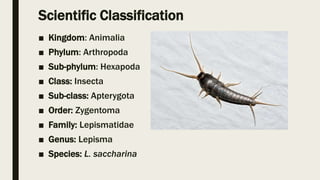
■ They have two long cerci and one terminal filament at the tip of
the abdomen between the cerci.
■ They also have two small compound eyes.
■ They have long antennae, and move in a wiggling motion.
■ Silverfish typically live for two to eight years.
■ They are largely oviparous, depositing their eggs in cracks and crevices out
of sight.
■ They may be six or more instars, and in tropics maturity is reached in less
than a year while in temperate regions two or more years are required to
complete a generation.
Scientific Classification
■ Kingdom: Animalia
■ Phylum: Arthropoda
■ Sub-phylum: Hexapoda
■ Class: Insecta
■ Sub-class: Apterygota
■ Order: Zygentoma
■ Family: Lepismatidae
■ Genus: Lepisma
■ Species: L. saccharina
Order Thysanura
(Thysanurans, Bristletails, Silver Fish Moths, Slickers)
Diagnostic Features
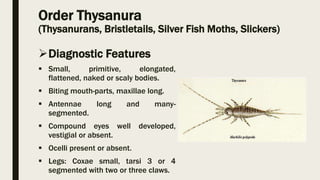
 Small, primitive, elongated,
flattened, naked or scaly bodies.
 Biting mouth-parts, maxillae long.
 Antennae long and many-
segmented.
 Compound eyes well developed,
vestigial or absent.
 Ocelli present or absent.
 Legs: Coxae small, tarsi 3 or 4
segmented with two or three claws.
Habit & Habitat
■ Almost world-wide in distribution. They are among the most primitive
of insects.
■ Usually white, grey, brown or otherwise pigmented to harmonize with
their immediate surroundings in the ground.
■ They are apterous in nature and entirely dependent upon crawling,
running and jumping.
■ The habitat of these insects are of quite variable in nature.
■ Majority of species adapt damp places under leaves, debris, bark, in
rotten wood, mosses, lichens, on stones, trunks of trees and nests of
ants and termite.
Cont…….
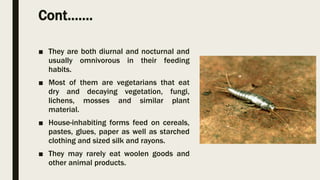
■ They are both diurnal and nocturnal and
usually omnivorous in their feeding
habits.
■ Most of them are vegetarians that eat
dry and decaying vegetation, fungi,
lichens, mosses and similar plant
material.
■ House-inhabiting forms feed on cereals,
pastes, glues, paper as well as starched
clothing and sized silk and rayons.
■ They may rarely eat woolen goods and
other animal products.
Morphology
■ The body seems to be naked but in fact they are usually somewhat
hairy or covered with overlapping metallic scales and look like
miniature dragons.
■ Head is wide and not condtricted behind, antennae 30 or more
segmented, compound eyes large and prominent or vestigial or
absent, ocelli are present in few forms.
■ Mouth parts: mandibles slender, entire or in two parts, incisors and
molar areas wide apart, maxillary palpi composed of 4 to 7
segments, labial palpi 3 segmented.
Cont…….
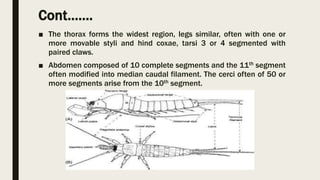
■ The thorax forms the widest region, legs similar, often with one or
more movable styli and hind coxae, tarsi 3 or 4 segmented with
paired claws.
■ Abdomen composed of 10 complete segments and the 11th segment
often modified into median caudal filament. The cerci often of 50 or
more segments arise from the 10th segment.
Reproduction
■ Before silverfish reproduce, they carry out a ritual involving three
phases, which may last over half an hour.
■ In the first phase, the male and female stand face to face, their
quivering antennae touching, then repeatedly back off and return to
this position.
■ In the second phase, the male runs away and the female chases him.
■ In the third phase, the male and female stand side by side and head
to tail, with the male vibrating his tail against the female.
■ Finally, the male lays a spermatophore, a sperm capsule covered
in gossamer, which the female takes into her body via
her ovipositor to fertilize her eggs.
Cont……
■ The female lays groups of fewer than 60 eggs at once, deposited in
small crevices. The eggs are oval-shaped, whitish, about 0.8 mm
(0.031 in) long, and take between two weeks and two months to
hatch.
■ A silverfish usually lays fewer than 100 eggs in her lifetime.
■ When the nymphs hatch, they are whitish in colour, and look like
smaller adults.
■ They may go through 17 to 66 moults in their lifetimes, sometimes
30 in a single year—many more than most insects.
Life Cycle
Economic Importance
■ Domestic species such as silverfish and firebrats may cause
extensive damage to household goods.
■ They often feed on wallpaper paste, bookbindings, and the starch
sizing of some textiles.
■ Cardboard and other paper products may also be damaged.
IPM for Order Thysanura
■ There are two methods for the control of silverfish.
1. Physical Control
2. Chemical Control
1. Physical Control
■ Dehumifying
■ Vaccuming
■ Removal of food
■ Trapping
■ Eliminating harborage sites
■ Drying store articles
2. Chemical Control
■ Diatomaceous earth
■ Borate-based insecticidal dust production
■ Silica aerogel
■ Residual insecticides
Order thysanura (silver fish)

Order thysanura (silver fish)

  • 1.
    ORDER THYSANURA (SILVER FISH) PresentedTo: Dr. Shahzad Ali Presented By: Mujahid Hussain 2019-mphil-1385
  • 2.
    Silver Fish (Lepismasaccharina) ■ The name Thysanura, derived from the Greek "thysano-" meaning fringed and "ura" meaning tail, refers to the long, fringed filaments on the abdomen of silverfish. ■ A silverfish (Lepisma saccharina) is a small, wingless insect in the order Zygentoma (formerly Thysanura). ■ Its common name derives from the animal's silvery light grey colour, combined with the fish-like appearance of its movements. ■ However, the scientific name (L. saccharina) indicates the silverfish's diet consists of carbohydrates such as sugar or starches.
  • 3.
    Description ■ Silverfish arenocturnal insects typically 13–25 mm (0.5–1.0 in) long. ■ Their abdomens taper at the end, giving them a fish-like appearance. ■ The newly hatched are whitish, but develop a greyish hue and metallic shine as they get older. ■ They have two long cerci and one terminal filament at the tip of the abdomen between the cerci. ■ They also have two small compound eyes. ■ They have long antennae, and move in a wiggling motion. ■ Silverfish typically live for two to eight years. ■ They are largely oviparous, depositing their eggs in cracks and crevices out of sight. ■ They may be six or more instars, and in tropics maturity is reached in less than a year while in temperate regions two or more years are required to complete a generation.
  • 4.
    Scientific Classification ■ Kingdom:Animalia ■ Phylum: Arthropoda ■ Sub-phylum: Hexapoda ■ Class: Insecta ■ Sub-class: Apterygota ■ Order: Zygentoma ■ Family: Lepismatidae ■ Genus: Lepisma ■ Species: L. saccharina
  • 5.
    Order Thysanura (Thysanurans, Bristletails,Silver Fish Moths, Slickers) Diagnostic Features  Small, primitive, elongated, flattened, naked or scaly bodies.  Biting mouth-parts, maxillae long.  Antennae long and many- segmented.  Compound eyes well developed, vestigial or absent.  Ocelli present or absent.  Legs: Coxae small, tarsi 3 or 4 segmented with two or three claws.
  • 6.
    Habit & Habitat ■Almost world-wide in distribution. They are among the most primitive of insects. ■ Usually white, grey, brown or otherwise pigmented to harmonize with their immediate surroundings in the ground. ■ They are apterous in nature and entirely dependent upon crawling, running and jumping. ■ The habitat of these insects are of quite variable in nature. ■ Majority of species adapt damp places under leaves, debris, bark, in rotten wood, mosses, lichens, on stones, trunks of trees and nests of ants and termite.
  • 7.
    Cont……. ■ They areboth diurnal and nocturnal and usually omnivorous in their feeding habits. ■ Most of them are vegetarians that eat dry and decaying vegetation, fungi, lichens, mosses and similar plant material. ■ House-inhabiting forms feed on cereals, pastes, glues, paper as well as starched clothing and sized silk and rayons. ■ They may rarely eat woolen goods and other animal products.
  • 8.
    Morphology ■ The bodyseems to be naked but in fact they are usually somewhat hairy or covered with overlapping metallic scales and look like miniature dragons. ■ Head is wide and not condtricted behind, antennae 30 or more segmented, compound eyes large and prominent or vestigial or absent, ocelli are present in few forms. ■ Mouth parts: mandibles slender, entire or in two parts, incisors and molar areas wide apart, maxillary palpi composed of 4 to 7 segments, labial palpi 3 segmented.
  • 9.
    Cont……. ■ The thoraxforms the widest region, legs similar, often with one or more movable styli and hind coxae, tarsi 3 or 4 segmented with paired claws. ■ Abdomen composed of 10 complete segments and the 11th segment often modified into median caudal filament. The cerci often of 50 or more segments arise from the 10th segment.
  • 10.
    Reproduction ■ Before silverfishreproduce, they carry out a ritual involving three phases, which may last over half an hour. ■ In the first phase, the male and female stand face to face, their quivering antennae touching, then repeatedly back off and return to this position. ■ In the second phase, the male runs away and the female chases him. ■ In the third phase, the male and female stand side by side and head to tail, with the male vibrating his tail against the female. ■ Finally, the male lays a spermatophore, a sperm capsule covered in gossamer, which the female takes into her body via her ovipositor to fertilize her eggs.
  • 11.
    Cont…… ■ The femalelays groups of fewer than 60 eggs at once, deposited in small crevices. The eggs are oval-shaped, whitish, about 0.8 mm (0.031 in) long, and take between two weeks and two months to hatch. ■ A silverfish usually lays fewer than 100 eggs in her lifetime. ■ When the nymphs hatch, they are whitish in colour, and look like smaller adults. ■ They may go through 17 to 66 moults in their lifetimes, sometimes 30 in a single year—many more than most insects.
  • 12.
  • 13.
    Economic Importance ■ Domesticspecies such as silverfish and firebrats may cause extensive damage to household goods. ■ They often feed on wallpaper paste, bookbindings, and the starch sizing of some textiles. ■ Cardboard and other paper products may also be damaged.
  • 14.
    IPM for OrderThysanura ■ There are two methods for the control of silverfish. 1. Physical Control 2. Chemical Control
  • 15.
    1. Physical Control ■Dehumifying ■ Vaccuming ■ Removal of food ■ Trapping ■ Eliminating harborage sites ■ Drying store articles
  • 16.
    2. Chemical Control ■Diatomaceous earth ■ Borate-based insecticidal dust production ■ Silica aerogel ■ Residual insecticides