Phylum- PORIFERA
Bollapalli Ashok Kumar
M.Sc. ,B.Ed., M.A(Lit)., CSIR-NET., (Ph.D)
LECTURER IN ZOOLOGY
KRK Govt Degree & PG College
ADDANKI-523201
Phone:9652929696,9441635264
Email: ashokkumarzoology@gmail.com
Porifera - Introduction
• Oldest animals which are not recognised ass
animals till 18th century
• Ellis (1765) identified the contractions of
osculum and entry of water into these animals
• Linnaeus, Lamark, Cuvier included these into
Zoophyta
• Grant(1836) gave recognition as Porifera.
Phylum - Porifera
• Basically marine, some fresh watered
• Biggest sponge – Spheciospongia vesparium-
3.5 yards length
• Very small sponge- Leucosolenia blanca – 0.11
inch length
• Poterion patere grows 4 yards height
• Sponges can live at 18500 yards depth
• Parazoology – study of sponges.
Porifera - General characters
• Multicellular
• Solitary / colonial , sedentary
• Vase like , cylindrical , tubular, cushion shaped
• Radially symmetrical except few asymmetric
• Different coloured- grey, light brown, bright
yellow, red , orange, pink/violet , black/white
• Diploblastic –Pinacoderm & Choanoderm
• Inbetween , a gelatinous non cellular mesoderm
with skeletal structures with free amoeboid cells
Porifera - General characters
• Canal system – ostia, spongeocoel, osculum
• Round flagellated collar cells/ choanocytes lines
radial chambers and involved in collection of
food, oxygen and water
• Skeleton is made of calcariuos or cilicious
spicules or spongin fibres or both which are
secreted by amoeboid cells
• Holozoic intracellular digestion
• Respiratory, excretory, locomotory appendages
are absent. Respiration by simple diffusion
Porifera - General characters
• Primitive type of nervous system- bipoolar or
multi polar cells formed into a network is
found in some sponges
• Hermophradites but cross fertilisation
• Asexual reproduction by budding or
gemmules
• Sexual reproduction by gametes formed from
amoebocytes
Porifera - General characters
• Holoblastic cleavage
• Development is indirect with Amphiblastula or
Parenchymula, a ciliated larva
• Primary germ layers of ectoderm and
endoderm which are not distinguishable
• Regeneration is too high
• Sponges are seen from arctic to temperate
regions
Porifera – Classification
• Classified on the basis of skeleton into three
classes. They are
1. Calcarea
2. Hexactinellida and
3. Demospongia
Class - Calcarea
• Small sized calcareous marine sponges
• Colonial or solitary. Body never exceeds 10cms
height
• Cylindrical or vase like
• Skeleton- calcareous spicules; Monaxon or
triaxon or tetraxon spicules
• No colour
• Canal system- ascanoid/syconoid/leuconoid type
• Posterior part has base andd anterior end has
osculum
Class- Calcarea
• Orders :
1. Hemocoela
2. Heterocoela
Examples : Leucosolenia, Clathrina ,Schypha ,
Grrantia , Leucila
Class- HEXACTINELLIDA
• Cylindrical body with radial symmetry
• Posterior end has base, in some sponges base is
provided with long spicules which are rooted
into soil and thus the animal is erect
• Skeleton is of triaxon, six rayed , siliceous spicules
• Skeleton is a trabicular net. The spaces in net are
lodged with syncytium.
• Carencyte, thesocyte, archeocyte and other
amoebocyte groups form syncytium
• The spaces are lodged with flagellated chambers
Class- HEXACTINELLIDA
• Exopinacoderm is not clear
• Asexual reproduction is by budding
• Development is indirect with sterioblastula
• Benthic marine forms
• Orders – hexasterophora , amphidiscophora
• Examples- Euplectella, Hyalonema,
Pheronema.
Class -DEMOSPONGIA
• Small to large sized, solitary or colonial forms
• Skeleton is absent or silicious spicules or spongin
fibres or both
• Silicious spicules monaxon or six rayed.
• Body shape is vase like, cup like or cushion like
• Leuconoid canal system assumed to be formed
from ragon type instead of asconoid type
• Choanocytes restricted to small round chambers
• Mostly marine few fresh watered
Class- DEMOSPONGIA
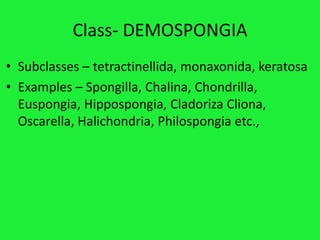
• Subclasses – tetractinellida, monaxonida, keratosa
• Examples – Spongilla, Chalina, Chondrilla,
Euspongia, Hippospongia, Cladoriza Cliona,
Oscarella, Halichondria, Philospongia etc.,
Porifera general characters

Porifera general characters

  • 1.
    Phylum- PORIFERA Bollapalli AshokKumar M.Sc. ,B.Ed., M.A(Lit)., CSIR-NET., (Ph.D) LECTURER IN ZOOLOGY KRK Govt Degree & PG College ADDANKI-523201 Phone:9652929696,9441635264 Email: ashokkumarzoology@gmail.com
  • 2.
    Porifera - Introduction •Oldest animals which are not recognised ass animals till 18th century • Ellis (1765) identified the contractions of osculum and entry of water into these animals • Linnaeus, Lamark, Cuvier included these into Zoophyta • Grant(1836) gave recognition as Porifera.
  • 3.
    Phylum - Porifera •Basically marine, some fresh watered • Biggest sponge – Spheciospongia vesparium- 3.5 yards length • Very small sponge- Leucosolenia blanca – 0.11 inch length • Poterion patere grows 4 yards height • Sponges can live at 18500 yards depth • Parazoology – study of sponges.
  • 4.
    Porifera - Generalcharacters • Multicellular • Solitary / colonial , sedentary • Vase like , cylindrical , tubular, cushion shaped • Radially symmetrical except few asymmetric • Different coloured- grey, light brown, bright yellow, red , orange, pink/violet , black/white • Diploblastic –Pinacoderm & Choanoderm • Inbetween , a gelatinous non cellular mesoderm with skeletal structures with free amoeboid cells
  • 5.
    Porifera - Generalcharacters • Canal system – ostia, spongeocoel, osculum • Round flagellated collar cells/ choanocytes lines radial chambers and involved in collection of food, oxygen and water • Skeleton is made of calcariuos or cilicious spicules or spongin fibres or both which are secreted by amoeboid cells • Holozoic intracellular digestion • Respiratory, excretory, locomotory appendages are absent. Respiration by simple diffusion
  • 6.
    Porifera - Generalcharacters • Primitive type of nervous system- bipoolar or multi polar cells formed into a network is found in some sponges • Hermophradites but cross fertilisation • Asexual reproduction by budding or gemmules • Sexual reproduction by gametes formed from amoebocytes
  • 7.
    Porifera - Generalcharacters • Holoblastic cleavage • Development is indirect with Amphiblastula or Parenchymula, a ciliated larva • Primary germ layers of ectoderm and endoderm which are not distinguishable • Regeneration is too high • Sponges are seen from arctic to temperate regions
  • 8.
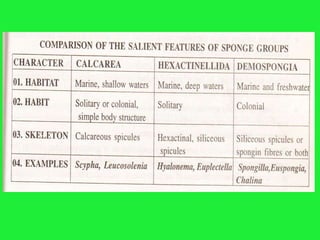
    Porifera – Classification •Classified on the basis of skeleton into three classes. They are 1. Calcarea 2. Hexactinellida and 3. Demospongia
  • 9.
    Class - Calcarea •Small sized calcareous marine sponges • Colonial or solitary. Body never exceeds 10cms height • Cylindrical or vase like • Skeleton- calcareous spicules; Monaxon or triaxon or tetraxon spicules • No colour • Canal system- ascanoid/syconoid/leuconoid type • Posterior part has base andd anterior end has osculum
  • 10.
    Class- Calcarea • Orders: 1. Hemocoela 2. Heterocoela Examples : Leucosolenia, Clathrina ,Schypha , Grrantia , Leucila
  • 11.
    Class- HEXACTINELLIDA • Cylindricalbody with radial symmetry • Posterior end has base, in some sponges base is provided with long spicules which are rooted into soil and thus the animal is erect • Skeleton is of triaxon, six rayed , siliceous spicules • Skeleton is a trabicular net. The spaces in net are lodged with syncytium. • Carencyte, thesocyte, archeocyte and other amoebocyte groups form syncytium • The spaces are lodged with flagellated chambers
  • 12.
    Class- HEXACTINELLIDA • Exopinacodermis not clear • Asexual reproduction is by budding • Development is indirect with sterioblastula • Benthic marine forms • Orders – hexasterophora , amphidiscophora • Examples- Euplectella, Hyalonema, Pheronema.
  • 13.
    Class -DEMOSPONGIA • Smallto large sized, solitary or colonial forms • Skeleton is absent or silicious spicules or spongin fibres or both • Silicious spicules monaxon or six rayed. • Body shape is vase like, cup like or cushion like • Leuconoid canal system assumed to be formed from ragon type instead of asconoid type • Choanocytes restricted to small round chambers • Mostly marine few fresh watered
  • 14.
    Class- DEMOSPONGIA • Subclasses– tetractinellida, monaxonida, keratosa • Examples – Spongilla, Chalina, Chondrilla, Euspongia, Hippospongia, Cladoriza Cliona, Oscarella, Halichondria, Philospongia etc.,