1
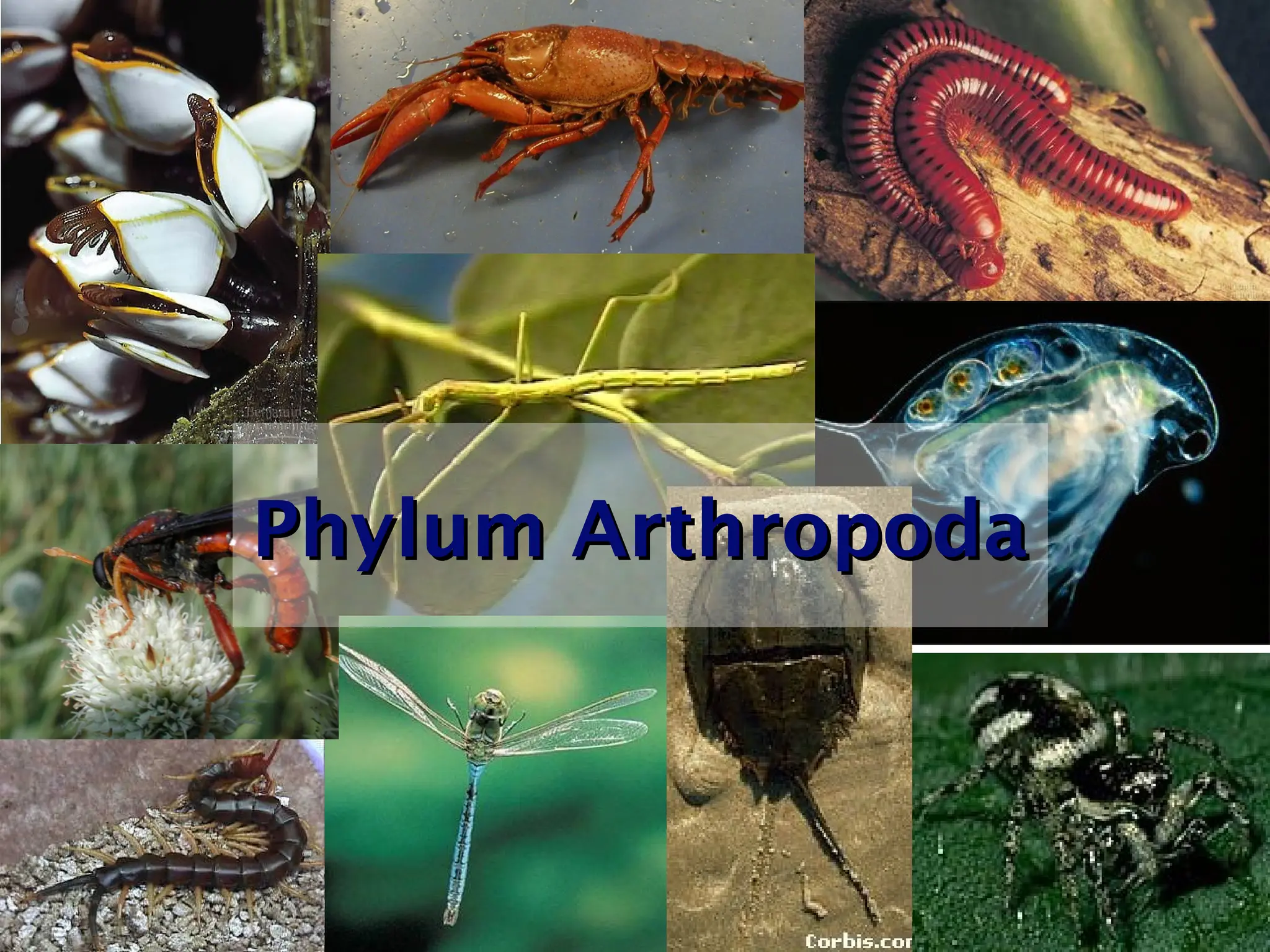
Phylum Arthropoda
Phylum Arthropoda
Phylum Arthropoda
Phylum Arthropoda
Several million species.
Hard exoskeleton.
3
Phylum Arthropoda
Phylum Arthropoda
• “jointed foot”
• Largest phylum
• 11,33,000
species till date
– 75% of all known
species
• Insects, spiders,
crustaceans,
millipedes,
scorpions, ticks,
etc.
4
Phylum Arthropoda (cont’d)
• Most successful phylum
– Ecologically diverse
– Present in all regions of
the earth
• Adapted to air, land,
freshwater, marine,
other organisms
Evolutionary Background
• The phylum includes largest no of animals
• Much earlier than human; first to dominate
the land
• Accessed all possible habitats, mountain
peaks to depths of the ocean
• Related to human life with different
aspects, thus having economic importance
• The earliest record of the study of arthro­
pods is available from the work of Aristotle
(384-322 B.C.) with crabs & related forms
5
• The present trend of studying Arthropoda began with the
work of Linnaeus (1707-1778), who created a group Insecta
aptera to include Crustaceans, Myriapods and Spiders
• The name Crustacea and Myriapoda were first introduced by
Cuvier (1769-1832) and Latreille (1825).
6
Evolutionary Background
• Lamarck (1744-1829) in his classification, included spiders,
mites, myriapods and silver fishes under Arachnida and
grouped prawns, lob­
sters, crabs and water fleas within
Crustacea
• It was Cuvier who first suggested to include these animals
and annelids under one large group, Articulata. Von Siebold
(1845) later separated the annelids and the rest were
included under Arthropoda 7
Evolutionary Background
8
Reasons for success
Reasons for success
1. Versatile exoskeleton
2. Efficient locomotion
3. Air piped directly to
cells (terrestrial)
4. Highly developed
sensory organs
5. Complex behavior
6. Metamorphosis
9
1. Exoskeleton
– External: not enveloped by living tissue
– Protection
– Secreted by underlying epidermis
• Waterproof barrier
• Chitin +/- calcium,
lipoproteins
• Modifications
– Can be site for muscle
attachment
– Energy stores- flying
– Sensory receptors
– Gas exchange
– bristles
10
1. Exoskeleton (cont’d)
– Soft and permeable or hard, impermeable
– Between segments of
body/appendages=
thin + flexible
– Must be shed (ecdysis=
molting) to allow growth
– Relatively heavy
• Limits size
11
2. Efficient locomotion
– Tagmatization, more specialized than annelids
• Regions= tagma/tagmata
• Jointed appendages
Crayfish mouthparts
Crushing food Food handling Drawing water into gills
Touch, taste, food handling
12
3. Air piped directly
to cells
– More efficient than
most other
invertebrates
• Most have efficient
tracheal system of
air tubes; some
breathe by gills
• Limits size
13
4. Highly developed sense organs
• Sight, touch, smell, hearing, balance, chemical
reception
Displacement of seta initiates
a nerve impulse in a receptor
cell at its base
Eyes convert light energy into
nerve impulses
14
5. Complex behavior patterns
• Complex, organized activities
• May be innate (unlearned) or learned
15
6. Limited intraspecific competition
– Many arthropods undergo metamorphosis
• meta= between/after; morphē= form; osis= state of
– Different stages (ie. larva, adult) have
different nutrition/habitats
 no competition
16
Do these questions now
• What is metamorphosis and why has it
contributed to arthropod success?
• What phylum is most closely related to
Phylum Arthropoda?
• Which of the following is not an arthropod?
– Beetle
– Spider
– Clam
– Millipede
– Caterpillar
– leech
– elephant
17
Other Characteristics of
Arthropods
Arthropods
• Bilateral, triploblastic, schizocoelous
• No septa
18
Arthropod Groups
Arthropod Groups
1. Subphylum Trilobita (Three lobed)
- extinct trilobites
2. Subphylum Chelicerata (Provided with chela)
– Class Arachnida (Spiders), horseshoe crabs,
ticks, mites, and some extinct groups
3. Subphylum Uniramia (Single branched)
– Class Hexapoda (insects)
4. Subphylum Crustacea
– crabs, lobsters, shrimps, barnacles
19
Subphylum Trilobita
Subphylum Trilobita
• tri= three; lobos= lobes
• Divided into 3 longitudinal
regions
• Extinct
• Oval, flattened
20
Subphylum Chelicerata
• Horseshoe crabs,
spiders, ticks, mites,
scorpions
23
Subphylum Chelicerata (cont’d)
• Cephalothorax (prosoma)
– Fused head and thoracic region
• Abdomen (opisthosoma)
– contains digestive,
reproductive, excretory, and
respiratory organs
24
Subphylum Chelicerata (cont’d)
• Appendages attached to cephalothorax
– Pair of chelicerae (clawlike feeding appendages)
– Pair of pedipalps (usually sensing or feeding)
– four pairs of legs (5 in horseshoe crabs)
25
Subphylum Chelicerata (cont’d)
• No antennae
• Most suck liquid food from prey
mite
Class Crustacea
E.g., crabs, lobsters
Almost all are aquatic.
Ca. 40,000 species.
Includes krill eaten by whales, and
daphnia, copepods, & amphipods in
Lake Erie, pill bugs, etc.
27
Class Arachnida
Class Arachnida
• Spiders, ticks, scorpions
• Most are predaceous
Scorpion
28
Class Arachnida (cont’d)
• Most are harmless/beneficial to humans
29
Class Arachnida (cont’d)
• Some spiders (ie. black widow, brown
recluse spider) give painful, dangerous bites
Black widow
Brown recluse
30
Class Arachnida (cont’d)
• Scorpion sting can be painful, dangerous
Scorpion
31
Class Arachnida (cont’d)
• Some ticks and mites spread disease, cause
irritation
Dust mite mite
32
Class Arachnida (cont’d)
• Lyme disease
– Caused by tick
tick
33
More on spiders……
More on spiders……
Order Araneae
Order Araneae
34
Spiders
Spiders
• cephalothorax and abdomen shows no
external segmentation
– tagma are joined by a narrow pedicel
35
Spiders (cont’d)
Spiders (cont’d)
• All predaceous
– Mostly insects
• Chelicerae have fangs
36
Prey capture among the spiders
• Some species are
cursorial predators
– stalk and ambush their
prey
– they usually have well-
developed eyes
Jumping spider
37
Prey capture among the spiders
(cont’d)
(cont’d)
• Some are web-building
spiders
– Eyes not as well
developed
– sensory hairs for
detecting vibrations
Grass spider
38
• Many spiders (and mites) producing silk
– Used for trapping prey, building nests, forming
egg cases
39
40
• silk glands that open to the exterior part
of the abdomen through spinnerets
spinnerets
41
Spiders (cont’d)
Spiders (cont’d)
• Many species have evolved poison glands
associated with the chelicerae
Black widow
Brown recluse
Classification (
Classification (Ruppert and Barnes (1994)
42
43
Urban legends
Urban legends
Debunked!
44
• MYTH: Daddy longlegs (Harvestmen) are
one of the most poisonous spiders but their
fangs are too short to bite humans: MYTH
(!!!!!!!)
• Daddy longlegs: Order Opilionid
• Spiders: Order Araneae
• One basic body
segment (no pedicel)
• Don’t produce silk
• No venom, fangs
daddy longlegs
45
Spiders: Class Araneae
Spider love…..
• Spiders, like most arthropods, are dioecious
• Mating habits
– Pheromones- chemicals that elicit behavioral
change
– Rituals- males pluck female’s web (pattern is
species-specific)
46
Spiders: Class Araneae
• Male builds small web, deposits sperm
– Collects sperm in cavities of pedipalps
– Pedipalps have ejaculatory duct + embolus
– inserts pedipalps into female genital opening
47
Spiders: Class Araneae
• Eggs laid in silk case
– Carried, attach to web, bury
Wolf spider preparing egg sac
48
A lycosid (wolf spider) preparing egg sac
M. C. Barnhart
49
M. C. Barnhart
50
M. C. Barnhart
51
M. C. Barnhart
52
Wolf spider parental care- after
the eggs hatch, the young ride on
mom for several days.
53
• Young spiders disperse by silk lines
(ballooning)
54
Brown recluse
• Violin-shaped stripe
on back
• Necrotoxin
– hemolytic
55
Loxosceles reclusa
• Necrosis of tissue
56
Day 3
57
Day 4
58
Day 5
59
Day 6
60
Day 9
61
Day 10
62
Crustaceans
Crustaceans
63
The Crustaceans
The Crustaceans
shrimp
crabs
lobsters
amphipods
euphausids
(krill)
amphipods
Daphnia
• Phylum Arthropoda
– Subphylum Crustacea
• crusta= shell
• Lobster, crayfish,
shrimp, crab, water
flea, barnacles
64
The Crustaceans (cont’d)
• Aquatic (mostly marine)
– a few terrestrial forms
• Major ecological and
economical importance.
shrimp
lobsters
euphausids
(krill)
amphipods
The Crustaceans
The Crustaceans
• Body divisible into 3 regions—head, thorax and abdomen.
• 2. Two pairs of antennae are a distin­
guishing feature among
crustaceans.
• 3. Other cephalic appendages are a pair of mandibles and
two pairs of max­
illae.
• 4. Thoracic and abdominal appendages are usually 8 pairs and
6 pairs, respec­
tively, variable in lower crustacea.
• 5. Appendages typically biramous ex­
cept of antennules.
• 6. Carapace covers all or part of the body.
• 7. Head bears a pair of compound eyes on movable jointed
stalk.
65
The Crustaceans
The Crustaceans
• 8. Respiration takes place either by gills or by the general surface
of the body when the exoskeleton is thin or by some of the limbs.
• 9. Vascular system consists of a contrac­
tile heart, arteries and
haemocoelomic spaces.
• 10. Excretory organs are the modification of coelomoducts may be
either antennal glands (green glands) or shell glands (maxillary
glands found in the second pair of maxillae).
• 11. Brain formed by the fusion of first four embryonic ganglia and
is con­
nected with ventral nerve cord by oesophageal connectives.
• 12. Sexes separate.
• 13. Distinct sexual dimorphism present.
• 14. Eggs usually centrolecithal, i.e., yolk present in the central
part of the egg, or may be telolecithal, i.e., yolk occu­
pies one-half
of the egg, or alecithal, i.e., without yolk.
• 15. Development includes a larval form, the nauplius, bearing a
single median eye and 3 pairs of appendages 66
67
• Biramous appendages (at least primitively)
– 2 main branches
68
• Only arthropods with 2 pairs of antennae
69
• Great specialization of appendages
– Mouthparts chewing, grinding, handling
70
– appendages strengthened for walking or
protection (chelipeds, pincer-like claws)
cheliped
walking legs
71
Do these questions now…
• List 3 differences between organisms of
Subphylum Celicerata and Subphylum
Crustacea
• List 4 organisms that are crustaceans
72
• Like other arthropods (+ unlike annelids),
coelom is highly reduced
• Major body cavity is hemocoel (contains
colorless blood)
73
Respiration
– gills (usually)
74
• Compound eye is typical of phylum
75
• Same Order, but different
families
• Lobsters are bigger
• Lobsters are marine; crayfish live
in freshwater creeks, ditches, or
lakes
What’s the difference between
a crayfish and a lobster?
crayfish lobster
76
Barnacles
Barnacles
“nothing more than a little shrimplike animal standing
on its head in a limestone house and kicking food
into its mouth”
-Louis Agassiz
77
Barnacles
Barnacles
• living and nonliving substrates
• most species secrete CaCO3 shell
• Head reduced, rudimentary abdomen
78
Krill
Krill
• Component of plankton
• Major food for whales
Class: Ostracoda
Class: Ostracoda
• Small crustaceans and commonly called seed-shrimps.
• 2. Mostly marine or freshwater, a few in terrestrial
habitats.
• 3. Body enclosed in a hinged bivalved carapace.
• 4. Trunk appendages never more than 2 pairs.
• 5. Mandible with a palp.
• 6. Both pairs of antennae modified for swimming.
• 7. Respiration usually cutaneous.
• 8. Eyes may or may not be present.
• Ex: Polycope, Philomedes, Cypridina
79
Class: Ostracoda
Class: Ostracoda
80
Philomedes
Cypridina
Polycope
Class: Copepoda
Class: Copepoda
• 1. Mostly small crustaceans.
• 2. Body with well-marked segments.
• 3. Trunk composed of a thorax bearing 5 pairs of biramous
appendages used for swimming.
• 4. Abdomen without appendages.
• 5. Presence of a pair of caudal styles.
• 6. Head-shield present but no carapace.
• 7. Single median nauplius eye present but paired compound eyes
absent.
• 8. Well-developed antennae may or may not be used for swimming.
• 9. Seventh segment of the body bears the reproductive apertures
• Ex: Calanus, Paracalanus, Cyclops, Monstrilla.
81
Class: Copepoda
Class: Copepoda
Cyclops
Monstrilla
Class:
Class: Branchiura
• 1. Fish ectoparasites.
• 2. Dorsoventrally flattened body with suctorial mouth.
• 3. Broad shield-like carapace covers the cephalothorax.
• 4. Small, un-segmented and bilobed ab­
domen.
• 5. Sessile compound eyes present.
• 6. Flagella present in the appendages of some body
segments.
• 7. 5 pairs thoracic appendages.
• 8. Fifth body segment bears the genital apertures.
• 9. Males have two testes but females possess a single ovary.
• 10. Commonly called fish lice.
• Ex: Argulus, Dolops
83
Class:
Class: Branchiura
84
Argulus
Dolops
Class: Cirripedia
Class: Cirripedia
• 1. All are marine.
• 2. Adults are sedenteric.
• 3. Body poorly segmented.
• 4. Six pairs biramous filamentous ap­
pendages present.
• 5. Abdomen almost absent, with only a pair of caudal style.
• 6. Body enclosed within a bivalve cara­
pace with calcareous
plates on it.
• 7. Adults without eyes and antennae.
• 8. Usually hermaphrodite.
• 9. Young passes through nauplius and cypris stage.
• 10. Commonly called barnacles.
• Ex: Balanus, Lepas, Sacculina
85
Class: Cirripedia
Class: Cirripedia
86
Balanus (Acorn barnacles)
Lepas
Sacculina
Class: Malacostraca
Class: Malacostraca
• 1. Body consists of 20-21 segments.
• 2. Thoracic and abdominal appendages distinct from one
another.
• 3. Carapace covers the head and at least some thoracic
segments.
• 4. Mandible with a palp.
• 5. Presence of compound eyes on stalk.
• 6. Antennule with two-many-jointed flagella.
• 7. Male and female gonopores on the bases of 8th and 6th
thoracic append­
ages.
• Ex: Coronida, Anaspides, Bathynella
87
Class: Malacostraca
Class: Malacostraca
88
Coronida
Anaspides
Bathynella
Sub Phylum: Uniramia
• 1. Un-branched appendages,
• 2. Mandibles un-jointed and without palp.
• 3. Presence of a single pair of antennae.
• 4. Gas exchange takes place with the help
of tracheal system.
• 5. Excretory organs are Malpighian tubules.
89
Class: Chilopoda
Class: Chilopoda
• Approx. 3000 known species; about 100 Indian species
• 1. Body usually dorsoventrally flattened.
• 2. First pair of trunk appendages modi­
fied as maxillipeds and work
as poi­
son claws.
• 3. Most of the trunk segments bear a single pair of uniramous
walking legs.
• 4. Number of legs varies from 15 to more than 100 pairs but no
form possesses even number of pairs.
• 5. Head bears a pair of antennae, a pair of mandibles and two
pairs of maxillae.
• 6. Segment in front of telson is called genital segment.
• 7. Usually genital segment bears a pair of gonopods, help in
reproduction.
• 8. Respiration takes place by trachea.
• 9. Excretion by a pair of Malpighian tubules.
• 10. Primarily carnivorous….Ex: Scutigera, Lithobius, Geophilus
Class: Chilopoda
Class: Chilopoda
91
Scutigera Lithobius
Geophilus
Class: Diplopoda
Class: Diplopoda
• Approx. 10,000 described species.
• 1. Elongated and segmented forms.
• 2. Trunk with a large number of leg- bearing segments.
• 3. First trunk segment (collum) is leg­
less and next three segments
with a single pair of legs in each segment and the rest doubled
segments (diplosegments) bear 2 pairs of legs in each segment.
• 4. Antennae 7 segmented.
• 5. Maxillae are united to form gnathochilarium.
• 6. Tracheae are mostly un-branched tubes.
• 7. Gonads unpaired but reproductive ducts are paired.
• 8. Gonopores on the second pair of legs.
• 9. Usually vegetarian and found usually beneath leaves, logs, bark
and stones.
• 10. They are commonly called Millipedes or thousandleggers
• 11. They are terrestrial and are mainly distributed in the tropics
• Ex: Polyxenus,Platydesmus,julus
Class: Diplopoda
Class: Diplopoda
93
Polyxenus
Platydesmus
Julus
Class: Hexapoda/Insecta
• Approx. 10,00,000 known species
• 1. Size varies from 250 pm—25 cm in length.
• 2. Body consists of three distinct tagmata
(regions)—head, thorax and abdomen.
• 3. Head is formed by the fusion of six segments
and its appendages are a single pair of antennae, a
pair of mandibles and two pairs of maxillae.
• 4. In adults, the thorax includes 3 seg­
ments—
prothorax, mesothorax and metathorax and each
segment bears one pair of walking legs. Hence,
called Hexapoda for the three pairs of legs.
• 5. In winged insects, the mesothorax and
metathorax bear a pair of wings in each segment.94
95
Class: Hexapoda/Insecta
• 6. A pair of compound eyes present.
• 7. Paried appendages absent in the adult abdomen.
• 8. Respiratory organs are in the form of tracheae
which extensively developed.
• 9. Chief excretory organs are the Mal­
pighian
tubules closely associated with alimentary caual.
• 10. Development usually pass through complicated
metamorphis but in some cases it may be direct.
It has two subclasses Apterygota and Pterygota.
96
Class: Hexapoda/Insecta
Lepisma
Anax
Zorotypus

Arthropods_complete classification types .ppt

  • 1.
  • 2.
    Phylum Arthropoda Phylum Arthropoda Severalmillion species. Hard exoskeleton.
  • 3.
    3 Phylum Arthropoda Phylum Arthropoda •“jointed foot” • Largest phylum • 11,33,000 species till date – 75% of all known species • Insects, spiders, crustaceans, millipedes, scorpions, ticks, etc.
  • 4.
    4 Phylum Arthropoda (cont’d) PhylumArthropoda (cont’d) • Most successful phylum – Ecologically diverse – Present in all regions of the earth • Adapted to air, land, freshwater, marine, other organisms
  • 5.
    Evolutionary Background Evolutionary Background •The phylum includes largest no of animals • Much earlier than human; first to dominate the land • Accessed all possible habitats, mountain peaks to depths of the ocean • Related to human life with different aspects, thus having economic importance • The earliest record of the study of arthro­ pods is available from the work of Aristotle (384-322 B.C.) with crabs & related forms 5
  • 6.
    • The presenttrend of studying Arthropoda began with the work of Linnaeus (1707-1778), who created a group Insecta aptera to include Crustaceans, Myriapods and Spiders • The name Crustacea and Myriapoda were first introduced by Cuvier (1769-1832) and Latreille (1825). 6 Evolutionary Background Evolutionary Background
  • 7.
    • Lamarck (1744-1829)in his classification, included spiders, mites, myriapods and silver fishes under Arachnida and grouped prawns, lob­ sters, crabs and water fleas within Crustacea • It was Cuvier who first suggested to include these animals and annelids under one large group, Articulata. Von Siebold (1845) later separated the annelids and the rest were included under Arthropoda 7 Evolutionary Background Evolutionary Background
  • 8.
    8 Reasons for success Reasonsfor success 1. Versatile exoskeleton 2. Efficient locomotion 3. Air piped directly to cells (terrestrial) 4. Highly developed sensory organs 5. Complex behavior 6. Metamorphosis
  • 9.
    9 1. Exoskeleton – External:not enveloped by living tissue – Protection – Secreted by underlying epidermis • Waterproof barrier • Chitin +/- calcium, lipoproteins • Modifications – Can be site for muscle attachment – Energy stores- flying – Sensory receptors – Gas exchange – bristles
  • 10.
    10 1. Exoskeleton (cont’d) –Soft and permeable or hard, impermeable – Between segments of body/appendages= thin + flexible – Must be shed (ecdysis= molting) to allow growth – Relatively heavy • Limits size
  • 11.
    11 2. Efficient locomotion –Tagmatization, more specialized than annelids • Regions= tagma/tagmata • Jointed appendages Crayfish mouthparts Crushing food Food handling Drawing water into gills Touch, taste, food handling
  • 12.
    12 3. Air pipeddirectly to cells – More efficient than most other invertebrates • Most have efficient tracheal system of air tubes; some breathe by gills • Limits size
  • 13.
    13 4. Highly developedsense organs • Sight, touch, smell, hearing, balance, chemical reception Displacement of seta initiates a nerve impulse in a receptor cell at its base Eyes convert light energy into nerve impulses
  • 14.
    14 5. Complex behaviorpatterns • Complex, organized activities • May be innate (unlearned) or learned
  • 15.
    15 6. Limited intraspecificcompetition – Many arthropods undergo metamorphosis • meta= between/after; morphē= form; osis= state of – Different stages (ie. larva, adult) have different nutrition/habitats  no competition
  • 16.
    16 Do these questionsnow Do these questions now • What is metamorphosis and why has it contributed to arthropod success? • What phylum is most closely related to Phylum Arthropoda? • Which of the following is not an arthropod? – Beetle – Spider – Clam – Millipede – Caterpillar – leech – elephant
  • 17.
    17 Other Characteristics of OtherCharacteristics of Arthropods Arthropods • Bilateral, triploblastic, schizocoelous • No septa
  • 18.
    18 Arthropod Groups Arthropod Groups 1.Subphylum Trilobita (Three lobed) - extinct trilobites 2. Subphylum Chelicerata (Provided with chela) – Class Arachnida (Spiders), horseshoe crabs, ticks, mites, and some extinct groups 3. Subphylum Uniramia (Single branched) – Class Hexapoda (insects) 4. Subphylum Crustacea – crabs, lobsters, shrimps, barnacles
  • 19.
    19 Subphylum Trilobita Subphylum Trilobita •tri= three; lobos= lobes • Divided into 3 longitudinal regions • Extinct • Oval, flattened
  • 20.
    20 Subphylum Chelicerata Subphylum Chelicerata •Horseshoe crabs, spiders, ticks, mites, scorpions
  • 23.
    23 Subphylum Chelicerata (cont’d) SubphylumChelicerata (cont’d) • Cephalothorax (prosoma) – Fused head and thoracic region • Abdomen (opisthosoma) – contains digestive, reproductive, excretory, and respiratory organs
  • 24.
    24 Subphylum Chelicerata (cont’d) SubphylumChelicerata (cont’d) • Appendages attached to cephalothorax – Pair of chelicerae (clawlike feeding appendages) – Pair of pedipalps (usually sensing or feeding) – four pairs of legs (5 in horseshoe crabs)
  • 25.
    25 Subphylum Chelicerata (cont’d) SubphylumChelicerata (cont’d) • No antennae • Most suck liquid food from prey mite
  • 26.
    Class Crustacea E.g., crabs,lobsters Almost all are aquatic. Ca. 40,000 species. Includes krill eaten by whales, and daphnia, copepods, & amphipods in Lake Erie, pill bugs, etc.
  • 27.
    27 Class Arachnida Class Arachnida •Spiders, ticks, scorpions • Most are predaceous Scorpion
  • 28.
    28 Class Arachnida (cont’d) ClassArachnida (cont’d) • Most are harmless/beneficial to humans
  • 29.
    29 Class Arachnida (cont’d) ClassArachnida (cont’d) • Some spiders (ie. black widow, brown recluse spider) give painful, dangerous bites Black widow Brown recluse
  • 30.
    30 Class Arachnida (cont’d) ClassArachnida (cont’d) • Scorpion sting can be painful, dangerous Scorpion
  • 31.
    31 Class Arachnida (cont’d) ClassArachnida (cont’d) • Some ticks and mites spread disease, cause irritation Dust mite mite
  • 32.
    32 Class Arachnida (cont’d) ClassArachnida (cont’d) • Lyme disease – Caused by tick tick
  • 33.
    33 More on spiders…… Moreon spiders…… Order Araneae Order Araneae
  • 34.
    34 Spiders Spiders • cephalothorax andabdomen shows no external segmentation – tagma are joined by a narrow pedicel
  • 35.
    35 Spiders (cont’d) Spiders (cont’d) •All predaceous – Mostly insects • Chelicerae have fangs
  • 36.
    36 Prey capture amongthe spiders Prey capture among the spiders • Some species are cursorial predators – stalk and ambush their prey – they usually have well- developed eyes Jumping spider
  • 37.
    37 Prey capture amongthe spiders Prey capture among the spiders (cont’d) (cont’d) • Some are web-building spiders – Eyes not as well developed – sensory hairs for detecting vibrations Grass spider
  • 38.
    38 • Many spiders(and mites) producing silk – Used for trapping prey, building nests, forming egg cases
  • 39.
  • 40.
    40 • silk glandsthat open to the exterior part of the abdomen through spinnerets spinnerets
  • 41.
    41 Spiders (cont’d) Spiders (cont’d) •Many species have evolved poison glands associated with the chelicerae Black widow Brown recluse
  • 42.
  • 43.
  • 44.
    44 • MYTH: Daddylonglegs (Harvestmen) are one of the most poisonous spiders but their fangs are too short to bite humans: MYTH (!!!!!!!) • Daddy longlegs: Order Opilionid • Spiders: Order Araneae • One basic body segment (no pedicel) • Don’t produce silk • No venom, fangs daddy longlegs
  • 45.
    45 Spiders: Class Araneae Spiders:Class Araneae Spider love….. • Spiders, like most arthropods, are dioecious • Mating habits – Pheromones- chemicals that elicit behavioral change – Rituals- males pluck female’s web (pattern is species-specific)
  • 46.
    46 Spiders: Class Araneae Spiders:Class Araneae • Male builds small web, deposits sperm – Collects sperm in cavities of pedipalps – Pedipalps have ejaculatory duct + embolus – inserts pedipalps into female genital opening
  • 47.
    47 Spiders: Class Araneae Spiders:Class Araneae • Eggs laid in silk case – Carried, attach to web, bury Wolf spider preparing egg sac
  • 48.
    48 A lycosid (wolfspider) preparing egg sac M. C. Barnhart
  • 49.
  • 50.
  • 51.
  • 52.
    52 Wolf spider parentalcare- after the eggs hatch, the young ride on mom for several days.
  • 53.
    53 • Young spidersdisperse by silk lines (ballooning)
  • 54.
    54 Brown recluse • Violin-shapedstripe on back • Necrotoxin – hemolytic
  • 55.
  • 56.
  • 57.
  • 58.
  • 59.
  • 60.
  • 61.
  • 62.
  • 63.
    63 The Crustaceans The Crustaceans shrimp crabs lobsters amphipods euphausids (krill) amphipods Daphnia •Phylum Arthropoda – Subphylum Crustacea • crusta= shell • Lobster, crayfish, shrimp, crab, water flea, barnacles
  • 64.
    64 The Crustaceans (cont’d) TheCrustaceans (cont’d) • Aquatic (mostly marine) – a few terrestrial forms • Major ecological and economical importance. shrimp lobsters euphausids (krill) amphipods
  • 65.
    The Crustaceans The Crustaceans •Body divisible into 3 regions—head, thorax and abdomen. • 2. Two pairs of antennae are a distin­ guishing feature among crustaceans. • 3. Other cephalic appendages are a pair of mandibles and two pairs of max­ illae. • 4. Thoracic and abdominal appendages are usually 8 pairs and 6 pairs, respec­ tively, variable in lower crustacea. • 5. Appendages typically biramous ex­ cept of antennules. • 6. Carapace covers all or part of the body. • 7. Head bears a pair of compound eyes on movable jointed stalk. 65
  • 66.
    The Crustaceans The Crustaceans •8. Respiration takes place either by gills or by the general surface of the body when the exoskeleton is thin or by some of the limbs. • 9. Vascular system consists of a contrac­ tile heart, arteries and haemocoelomic spaces. • 10. Excretory organs are the modification of coelomoducts may be either antennal glands (green glands) or shell glands (maxillary glands found in the second pair of maxillae). • 11. Brain formed by the fusion of first four embryonic ganglia and is con­ nected with ventral nerve cord by oesophageal connectives. • 12. Sexes separate. • 13. Distinct sexual dimorphism present. • 14. Eggs usually centrolecithal, i.e., yolk present in the central part of the egg, or may be telolecithal, i.e., yolk occu­ pies one-half of the egg, or alecithal, i.e., without yolk. • 15. Development includes a larval form, the nauplius, bearing a single median eye and 3 pairs of appendages 66
  • 67.
    67 • Biramous appendages(at least primitively) – 2 main branches
  • 68.
    68 • Only arthropodswith 2 pairs of antennae
  • 69.
    69 • Great specializationof appendages – Mouthparts chewing, grinding, handling
  • 70.
    70 – appendages strengthenedfor walking or protection (chelipeds, pincer-like claws) cheliped walking legs
  • 71.
    71 Do these questionsnow… Do these questions now… • List 3 differences between organisms of Subphylum Celicerata and Subphylum Crustacea • List 4 organisms that are crustaceans
  • 72.
    72 • Like otherarthropods (+ unlike annelids), coelom is highly reduced • Major body cavity is hemocoel (contains colorless blood)
  • 73.
  • 74.
    74 • Compound eyeis typical of phylum
  • 75.
    75 • Same Order,but different families • Lobsters are bigger • Lobsters are marine; crayfish live in freshwater creeks, ditches, or lakes What’s the difference between What’s the difference between a crayfish and a lobster? a crayfish and a lobster? crayfish lobster
  • 76.
    76 Barnacles Barnacles “nothing more thana little shrimplike animal standing on its head in a limestone house and kicking food into its mouth” -Louis Agassiz
  • 77.
    77 Barnacles Barnacles • living andnonliving substrates • most species secrete CaCO3 shell • Head reduced, rudimentary abdomen
  • 78.
    78 Krill Krill • Component ofplankton • Major food for whales
  • 79.
    Class: Ostracoda Class: Ostracoda •Small crustaceans and commonly called seed-shrimps. • 2. Mostly marine or freshwater, a few in terrestrial habitats. • 3. Body enclosed in a hinged bivalved carapace. • 4. Trunk appendages never more than 2 pairs. • 5. Mandible with a palp. • 6. Both pairs of antennae modified for swimming. • 7. Respiration usually cutaneous. • 8. Eyes may or may not be present. • Ex: Polycope, Philomedes, Cypridina 79
  • 80.
  • 81.
    Class: Copepoda Class: Copepoda •1. Mostly small crustaceans. • 2. Body with well-marked segments. • 3. Trunk composed of a thorax bearing 5 pairs of biramous appendages used for swimming. • 4. Abdomen without appendages. • 5. Presence of a pair of caudal styles. • 6. Head-shield present but no carapace. • 7. Single median nauplius eye present but paired compound eyes absent. • 8. Well-developed antennae may or may not be used for swimming. • 9. Seventh segment of the body bears the reproductive apertures • Ex: Calanus, Paracalanus, Cyclops, Monstrilla. 81
  • 82.
  • 83.
    Class: Class: Branchiura • 1.Fish ectoparasites. • 2. Dorsoventrally flattened body with suctorial mouth. • 3. Broad shield-like carapace covers the cephalothorax. • 4. Small, un-segmented and bilobed ab­ domen. • 5. Sessile compound eyes present. • 6. Flagella present in the appendages of some body segments. • 7. 5 pairs thoracic appendages. • 8. Fifth body segment bears the genital apertures. • 9. Males have two testes but females possess a single ovary. • 10. Commonly called fish lice. • Ex: Argulus, Dolops 83
  • 84.
  • 85.
    Class: Cirripedia Class: Cirripedia •1. All are marine. • 2. Adults are sedenteric. • 3. Body poorly segmented. • 4. Six pairs biramous filamentous ap­ pendages present. • 5. Abdomen almost absent, with only a pair of caudal style. • 6. Body enclosed within a bivalve cara­ pace with calcareous plates on it. • 7. Adults without eyes and antennae. • 8. Usually hermaphrodite. • 9. Young passes through nauplius and cypris stage. • 10. Commonly called barnacles. • Ex: Balanus, Lepas, Sacculina 85
  • 86.
    Class: Cirripedia Class: Cirripedia 86 Balanus(Acorn barnacles) Lepas Sacculina
  • 87.
    Class: Malacostraca Class: Malacostraca •1. Body consists of 20-21 segments. • 2. Thoracic and abdominal appendages distinct from one another. • 3. Carapace covers the head and at least some thoracic segments. • 4. Mandible with a palp. • 5. Presence of compound eyes on stalk. • 6. Antennule with two-many-jointed flagella. • 7. Male and female gonopores on the bases of 8th and 6th thoracic append­ ages. • Ex: Coronida, Anaspides, Bathynella 87
  • 88.
  • 89.
    Sub Phylum: Uniramia SubPhylum: Uniramia • 1. Un-branched appendages, • 2. Mandibles un-jointed and without palp. • 3. Presence of a single pair of antennae. • 4. Gas exchange takes place with the help of tracheal system. • 5. Excretory organs are Malpighian tubules. 89
  • 90.
    Class: Chilopoda Class: Chilopoda •Approx. 3000 known species; about 100 Indian species • 1. Body usually dorsoventrally flattened. • 2. First pair of trunk appendages modi­ fied as maxillipeds and work as poi­ son claws. • 3. Most of the trunk segments bear a single pair of uniramous walking legs. • 4. Number of legs varies from 15 to more than 100 pairs but no form possesses even number of pairs. • 5. Head bears a pair of antennae, a pair of mandibles and two pairs of maxillae. • 6. Segment in front of telson is called genital segment. • 7. Usually genital segment bears a pair of gonopods, help in reproduction. • 8. Respiration takes place by trachea. • 9. Excretion by a pair of Malpighian tubules. • 10. Primarily carnivorous….Ex: Scutigera, Lithobius, Geophilus
  • 91.
  • 92.
    Class: Diplopoda Class: Diplopoda •Approx. 10,000 described species. • 1. Elongated and segmented forms. • 2. Trunk with a large number of leg- bearing segments. • 3. First trunk segment (collum) is leg­ less and next three segments with a single pair of legs in each segment and the rest doubled segments (diplosegments) bear 2 pairs of legs in each segment. • 4. Antennae 7 segmented. • 5. Maxillae are united to form gnathochilarium. • 6. Tracheae are mostly un-branched tubes. • 7. Gonads unpaired but reproductive ducts are paired. • 8. Gonopores on the second pair of legs. • 9. Usually vegetarian and found usually beneath leaves, logs, bark and stones. • 10. They are commonly called Millipedes or thousandleggers • 11. They are terrestrial and are mainly distributed in the tropics • Ex: Polyxenus,Platydesmus,julus
  • 93.
  • 94.
    Class: Hexapoda/Insecta Class: Hexapoda/Insecta •Approx. 10,00,000 known species • 1. Size varies from 250 pm—25 cm in length. • 2. Body consists of three distinct tagmata (regions)—head, thorax and abdomen. • 3. Head is formed by the fusion of six segments and its appendages are a single pair of antennae, a pair of mandibles and two pairs of maxillae. • 4. In adults, the thorax includes 3 seg­ ments— prothorax, mesothorax and metathorax and each segment bears one pair of walking legs. Hence, called Hexapoda for the three pairs of legs. • 5. In winged insects, the mesothorax and metathorax bear a pair of wings in each segment.94
  • 95.
  • 96.
    Class: Hexapoda/Insecta Class: Hexapoda/Insecta •6. A pair of compound eyes present. • 7. Paried appendages absent in the adult abdomen. • 8. Respiratory organs are in the form of tracheae which extensively developed. • 9. Chief excretory organs are the Mal­ pighian tubules closely associated with alimentary caual. • 10. Development usually pass through complicated metamorphis but in some cases it may be direct. It has two subclasses Apterygota and Pterygota. 96
  • 97.

Editor's Notes

  • #10 Provides protection
  • #23 Opistho- behind
  • #78 Plankton- small organisms that drift in water