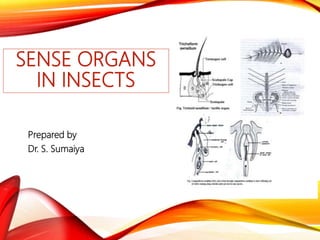
SENSE ORGANS
IN INSECTS
Prepared by
Dr. S. Sumaiya
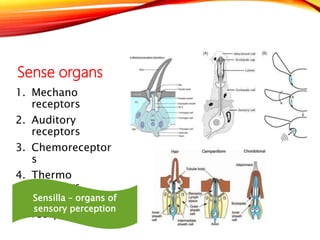
Sense organs
1. Mechano
receptors
2. Auditory
receptors
3. Chemoreceptor
s
4. Thermo
receptors
5. Photo
receptors
Sensilla – organs of
sensory perception
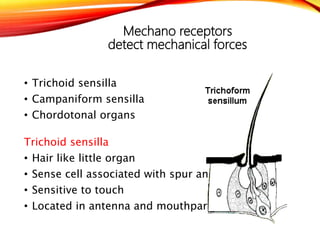
Mechano receptors
detect mechanical forces
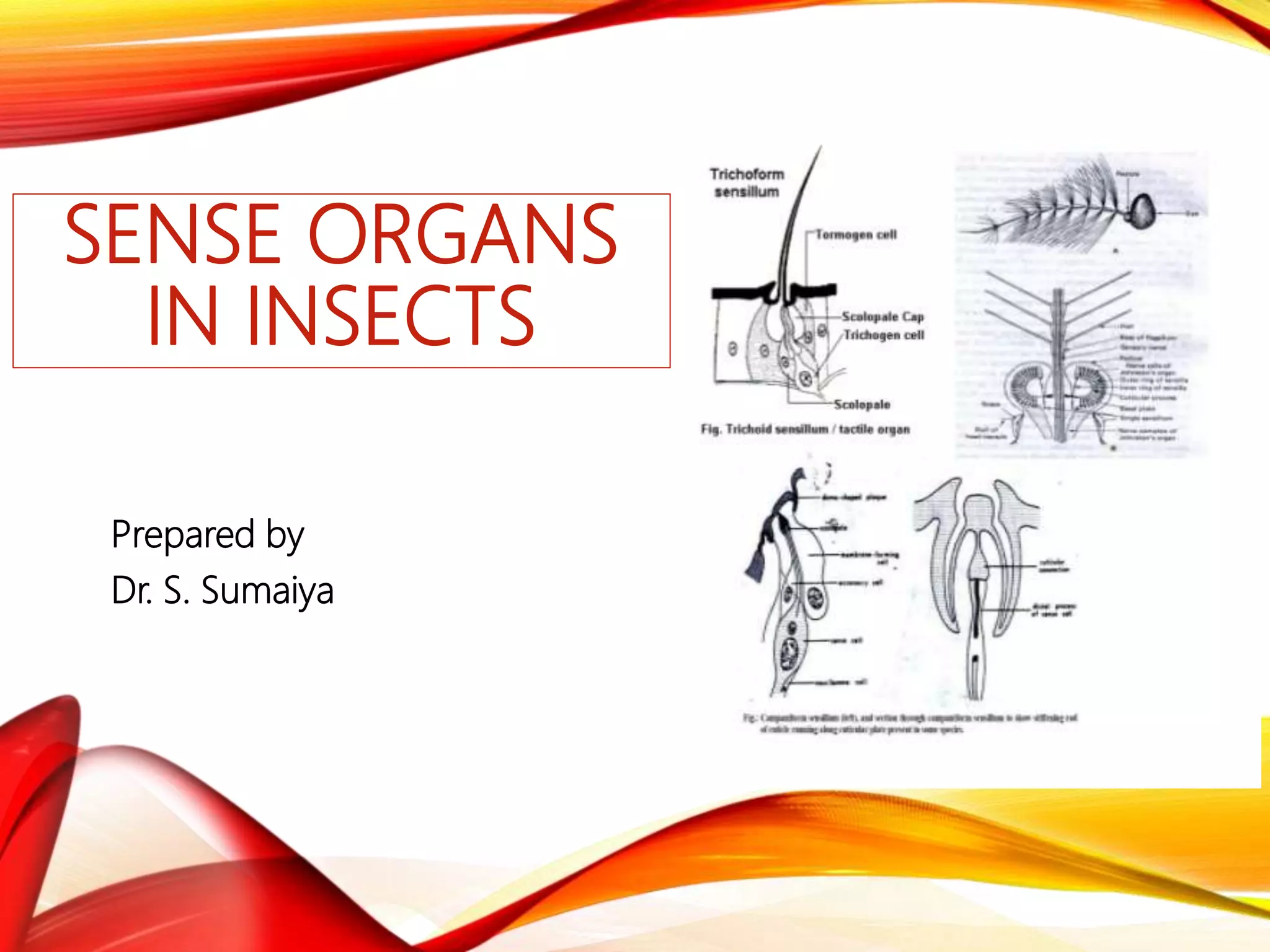
• Trichoid sensilla
• Campaniform sensilla
• Chordotonal organs
Trichoid sensilla
• Hair like little organ
• Sense cell associated with spur and seta
• Sensitive to touch
• Located in antenna and mouthparts
Mechano receptors
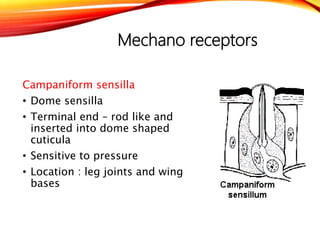
Campaniform sensilla
• Dome sensilla
• Terminal end – rod like and
inserted into dome shaped
cuticula
• Sensitive to pressure
• Location : leg joints and wing
bases
Mechano receptors
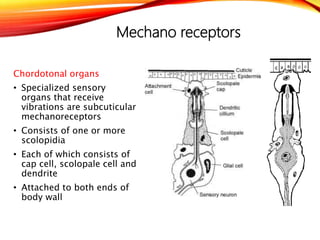
Chordotonal organs
• Specialized sensory
organs that receive
vibrations are subcuticular
mechanoreceptors
• Consists of one or more
scolopidia
• Each of which consists of
cap cell, scolopale cell and
dendrite
• Attached to both ends of
body wall
Chordotonal organs - Functions
• Proprioception
• positioning of body parts in relation to the gravity
• Sensitive to sound waves, vibration and pressure
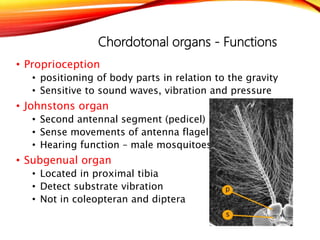
• Johnstons organ
• Second antennal segment (pedicel)
• Sense movements of antenna flagellum
• Hearing function – male mosquitoes
• Subgenual organ
• Located in proximal tibia
• Detect substrate vibration
• Not in coleopteran and diptera
Auditory receptors
• Tactile hairs: plumose antenna of male mosquito
• Tympanum: this is a membrane stretched across
tympanic cavity responds to sounds produced at some
distance, transmitted by air borne vibration.
Location Example
Between metathoracic
leg
Meta thorax
Mantids
Noctuid moths
Prothoracic legs Orthopterans
Abdomen Short horned
grasshopper
wings Moths and lace wings
Chemoreceptors
detect smell and taste
• Gustatory receptor – uniporous – detect chemicals
of solid and liquid form by contact
• Olfactory receptor – multiparous – located in
antenna – detect chemicals in vapour form at
distant by smell
• Each pore forms a chamber – pore kettle
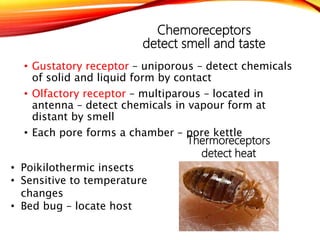
Thermoreceptors
detect heat
• Poikilothermic insects
• Sensitive to temperature
changes
• Bed bug – locate host
Photoreceptors
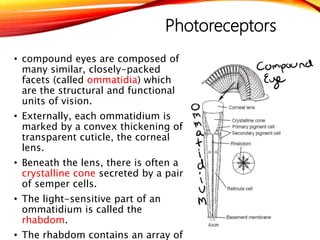
• compound eyes are composed of
many similar, closely-packed
facets (called ommatidia) which
are the structural and functional
units of vision.
• Externally, each ommatidium is
marked by a convex thickening of
transparent cuticle, the corneal
lens.
• Beneath the lens, there is often a
crystalline cone secreted by a pair
of semper cells.
• The light-sensitive part of an
ommatidium is called the
rhabdom.
• The rhabdom contains an array of
Types of ommatidia
i. Apposition type (light tight):
• Due to the presence of primary pigment cells light
cannot enter the adjacent cells.
• The mosaic image formed is very distinct.
• The image formed by the compound eye is of a series
of opposed points of light of different intensities.
• This functions well in diurnal insects.
ii. Super position type:
• Primary pigment cells are absent allowing light to pass
between adjacent ommatidia.
• Image formed in this way are indistinct, bright and
blurred.
• This type is seen in nocturnal and crepuscular insects.
Simple eyes
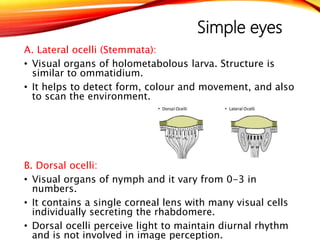
A. Lateral ocelli (Stemmata):
• Visual organs of holometabolous larva. Structure is
similar to ommatidium.
• It helps to detect form, colour and movement, and also
to scan the environment.
B. Dorsal ocelli:
• Visual organs of nymph and it vary from 0-3 in
numbers.
• It contains a single corneal lens with many visual cells
individually secreting the rhabdomere.
• Dorsal ocelli perceive light to maintain diurnal rhythm
and is not involved in image perception.

sense organs in insects

  • 1.
  • 2.
    Sense organs 1. Mechano receptors 2.Auditory receptors 3. Chemoreceptor s 4. Thermo receptors 5. Photo receptors Sensilla – organs of sensory perception
  • 3.
    Mechano receptors detect mechanicalforces • Trichoid sensilla • Campaniform sensilla • Chordotonal organs Trichoid sensilla • Hair like little organ • Sense cell associated with spur and seta • Sensitive to touch • Located in antenna and mouthparts
  • 4.
    Mechano receptors Campaniform sensilla •Dome sensilla • Terminal end – rod like and inserted into dome shaped cuticula • Sensitive to pressure • Location : leg joints and wing bases
  • 5.
    Mechano receptors Chordotonal organs •Specialized sensory organs that receive vibrations are subcuticular mechanoreceptors • Consists of one or more scolopidia • Each of which consists of cap cell, scolopale cell and dendrite • Attached to both ends of body wall
  • 6.
    Chordotonal organs -Functions • Proprioception • positioning of body parts in relation to the gravity • Sensitive to sound waves, vibration and pressure • Johnstons organ • Second antennal segment (pedicel) • Sense movements of antenna flagellum • Hearing function – male mosquitoes • Subgenual organ • Located in proximal tibia • Detect substrate vibration • Not in coleopteran and diptera
  • 7.
    Auditory receptors • Tactilehairs: plumose antenna of male mosquito • Tympanum: this is a membrane stretched across tympanic cavity responds to sounds produced at some distance, transmitted by air borne vibration. Location Example Between metathoracic leg Meta thorax Mantids Noctuid moths Prothoracic legs Orthopterans Abdomen Short horned grasshopper wings Moths and lace wings
  • 8.
    Chemoreceptors detect smell andtaste • Gustatory receptor – uniporous – detect chemicals of solid and liquid form by contact • Olfactory receptor – multiparous – located in antenna – detect chemicals in vapour form at distant by smell • Each pore forms a chamber – pore kettle Thermoreceptors detect heat • Poikilothermic insects • Sensitive to temperature changes • Bed bug – locate host
  • 9.
    Photoreceptors • compound eyesare composed of many similar, closely-packed facets (called ommatidia) which are the structural and functional units of vision. • Externally, each ommatidium is marked by a convex thickening of transparent cuticle, the corneal lens. • Beneath the lens, there is often a crystalline cone secreted by a pair of semper cells. • The light-sensitive part of an ommatidium is called the rhabdom. • The rhabdom contains an array of
  • 10.
    Types of ommatidia i.Apposition type (light tight): • Due to the presence of primary pigment cells light cannot enter the adjacent cells. • The mosaic image formed is very distinct. • The image formed by the compound eye is of a series of opposed points of light of different intensities. • This functions well in diurnal insects. ii. Super position type: • Primary pigment cells are absent allowing light to pass between adjacent ommatidia. • Image formed in this way are indistinct, bright and blurred. • This type is seen in nocturnal and crepuscular insects.
  • 11.
    Simple eyes A. Lateralocelli (Stemmata): • Visual organs of holometabolous larva. Structure is similar to ommatidium. • It helps to detect form, colour and movement, and also to scan the environment. B. Dorsal ocelli: • Visual organs of nymph and it vary from 0-3 in numbers. • It contains a single corneal lens with many visual cells individually secreting the rhabdomere. • Dorsal ocelli perceive light to maintain diurnal rhythm and is not involved in image perception.