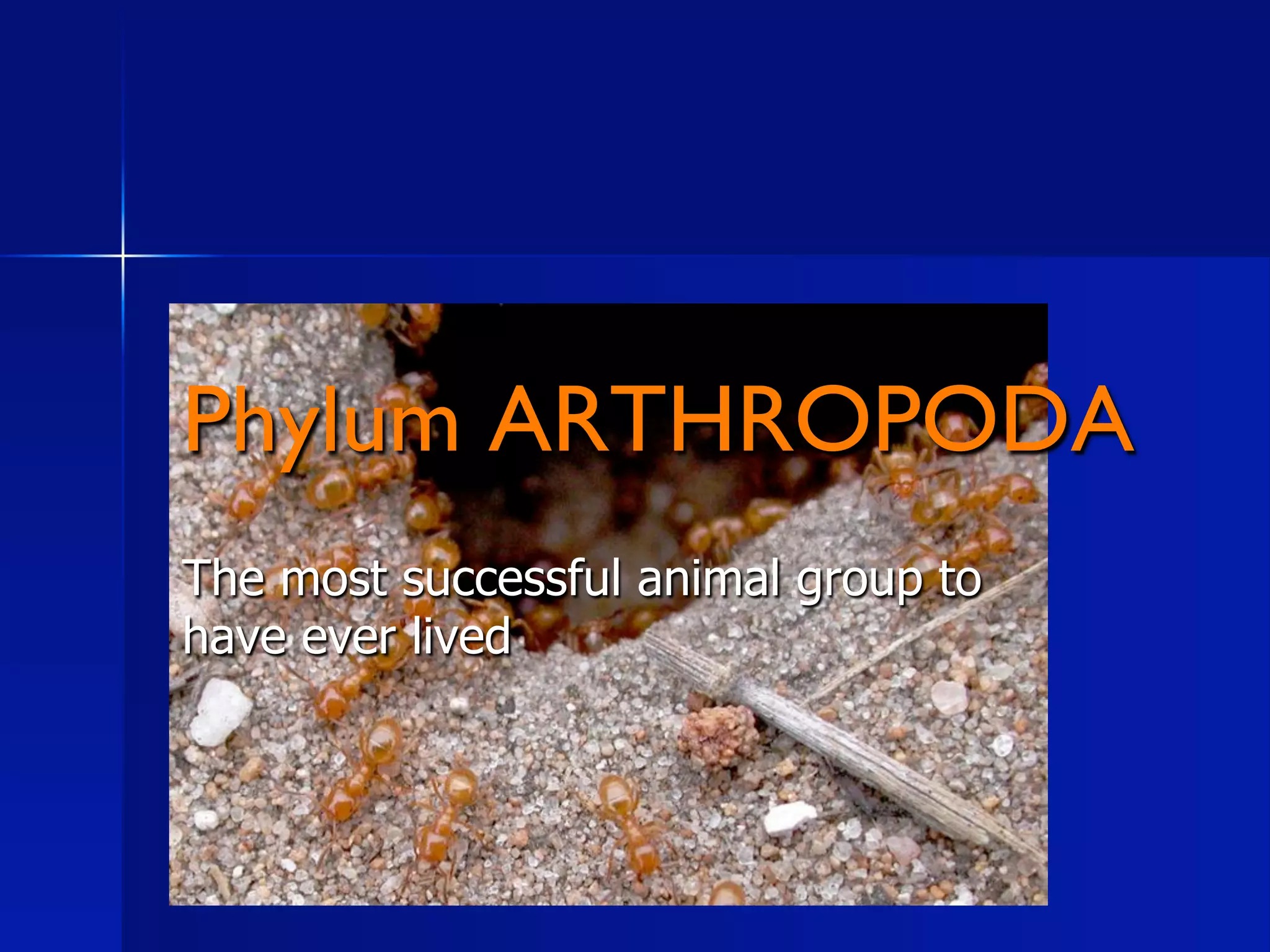
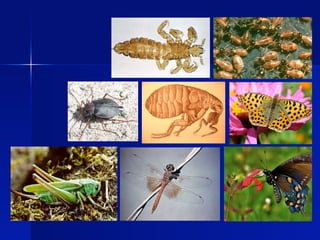
Phylum ARTHROPODA
The most successful animal group to
have ever lived
Phylum Arthropoda
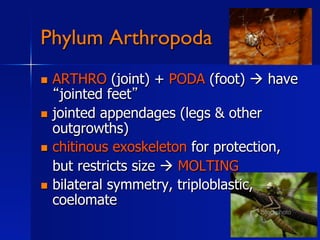
  ARTHRO (joint) + PODA (foot)  have
    jointed feet
  jointed appendages (legs & other
   outgrowths)
  chitinous exoskeleton for protection,
   but restricts size  MOLTING
  bilateral symmetry, triploblastic,
   coelomate
Phylum Arthropoda
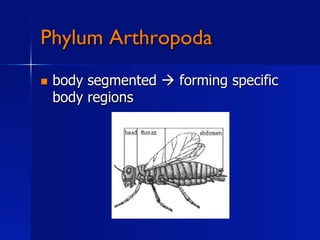
    body segmented  forming specific
     body regions
Structure and Function
  Feeding – complete digestive tract
  Internal transport – open circulatory
   system w/ dorsal heart
  Respiration – varied
  Excretion – varied
  Nervous system – brain + ventral nerve
      cord; sense organs (sight, smell,
      hearing, balance, taste, touch, etc.)
Structure and Function
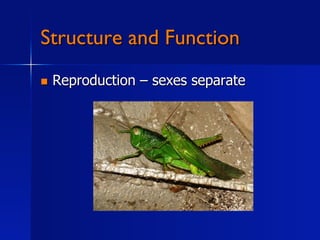
    Reproduction – sexes separate
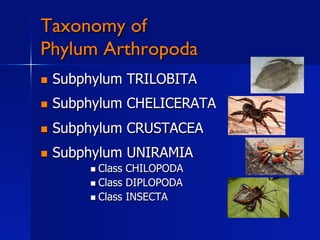
Taxonomy of
Phylum Arthropoda
    Subphylum TRILOBITA
    Subphylum CHELICERATA
    Subphylum CRUSTACEA
    Subphylum UNIRAMIA
           Class CHILOPODA
           Class DIPLOPODA
           Class INSECTA
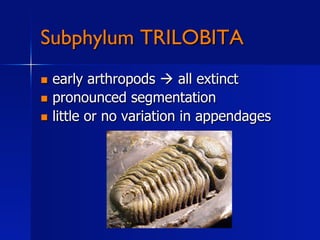
Subphylum TRILOBITA
  early arthropods  all extinct
  pronounced segmentation
  little or no variation in appendages
Subphylum CHELICERATA
  CHEILOS (lips) + CHEIR (arm)
  cepalothorax & abdomen
  no antennae
  6 pairs of appendages:
     chelicerae – claw-like, for feeding (pincers or
        fangs)
     pedipalps – sense chemicals, touch; for holding
        food, sperm transfer in males
     walking legs – 4 pairs
Subphylum CHELICERATA
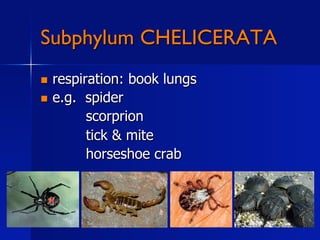
  respiration: book lungs
  e.g. spider
         scorprion
         tick & mite
         horseshoe crab
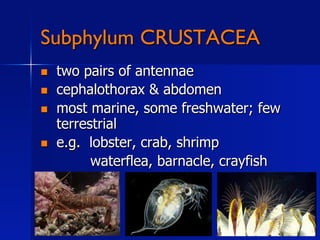
Subphylum CRUSTACEA
    two pairs of antennae
    cephalothorax & abdomen
    most marine, some freshwater; few
     terrestrial
    e.g. lobster, crab, shrimp
           waterflea, barnacle, crayfish
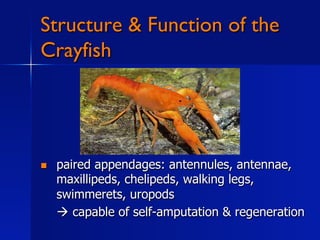
Structure & Function of the
Crayfish


    paired appendages: antennules, antennae,
     maxillipeds, chelipeds, walking legs,
     swimmerets, uropods
      capable of self-amputation & regeneration
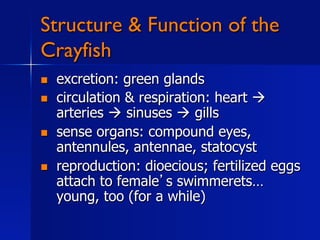
Structure & Function of the
Crayfish
    excretion: green glands
    circulation & respiration: heart 
     arteries  sinuses  gills
    sense organs: compound eyes,
     antennules, antennae, statocyst
    reproduction: dioecious; fertilized eggs
     attach to female s swimmerets…
     young, too (for a while)
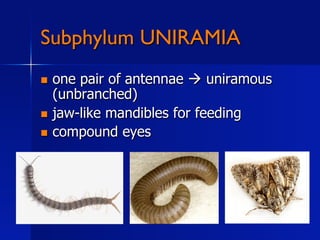
Subphylum UNIRAMIA
  one pair of antennae  uniramous
   (unbranched)
  jaw-like mandibles for feeding
  compound eyes
Subphylum UNIRAMIA
Class Chilopoda
  •  w/ head & worm-like body made up of
     similar segments
  •  segments have one pair of legs
  •  head w/ one pair of antennae & various
     mouthparts
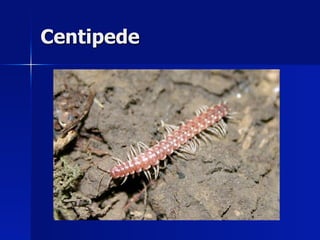
  •  e.g. centipede ( hundred legger )
Centipede
Subphylum UNIRAMIA
Class Diplodopa
  •  distinct head w/ worm like body
  •  two pairs of legs per segment
  •  head w/ one pair of antennae &
     mouthparts
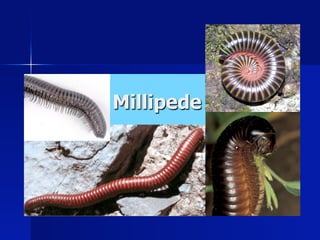
  •  e.g. millipede ( thousand legger )
Millipede
Subphylum UNIRAMIA
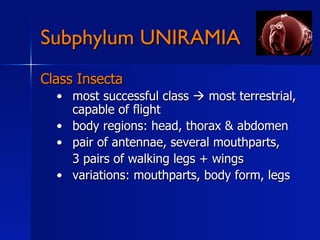
Class Insecta
  •  most successful class  most terrestrial,
     capable of flight
  •  body regions: head, thorax & abdomen
  •  pair of antennae, several mouthparts,
     3 pairs of walking legs + wings
  •  variations: mouthparts, body form, legs
Subphylum UNIRAMIA
 •  respiration: spiracles opening into
    tracheae
 •  excretion: malpighian tubules
 •  metamorphosis:
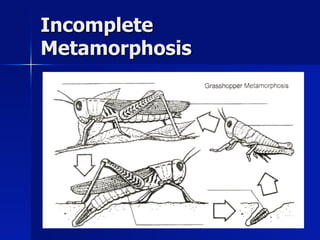
       incomplete (e.g. grasshopper, cockroach)
         egg  nymph  adult
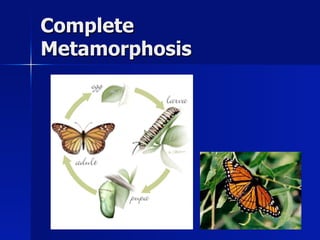
       complete (e.g. butterfly, bee, fly, beetle)
         egg  larva  pupa  adult
Incomplete
Metamorphosis
Complete
Metamorphosis
And the famousest of them all…

Arthropoda

  • 1.
    Phylum ARTHROPODA The mostsuccessful animal group to have ever lived
  • 2.
    Phylum Arthropoda   ARTHRO(joint) + PODA (foot)  have jointed feet   jointed appendages (legs & other outgrowths)   chitinous exoskeleton for protection, but restricts size  MOLTING   bilateral symmetry, triploblastic, coelomate
  • 3.
    Phylum Arthropoda   body segmented  forming specific body regions
  • 4.
    Structure and Function  Feeding – complete digestive tract   Internal transport – open circulatory system w/ dorsal heart   Respiration – varied   Excretion – varied   Nervous system – brain + ventral nerve cord; sense organs (sight, smell, hearing, balance, taste, touch, etc.)
  • 5.
    Structure and Function   Reproduction – sexes separate
  • 6.
    Taxonomy of Phylum Arthropoda   Subphylum TRILOBITA   Subphylum CHELICERATA   Subphylum CRUSTACEA   Subphylum UNIRAMIA   Class CHILOPODA   Class DIPLOPODA   Class INSECTA
  • 7.
    Subphylum TRILOBITA   earlyarthropods  all extinct   pronounced segmentation   little or no variation in appendages
  • 8.
    Subphylum CHELICERATA   CHEILOS(lips) + CHEIR (arm)   cepalothorax & abdomen   no antennae   6 pairs of appendages: chelicerae – claw-like, for feeding (pincers or fangs) pedipalps – sense chemicals, touch; for holding food, sperm transfer in males walking legs – 4 pairs
  • 9.
    Subphylum CHELICERATA   respiration:book lungs   e.g. spider scorprion tick & mite horseshoe crab
  • 10.
    Subphylum CRUSTACEA   two pairs of antennae   cephalothorax & abdomen   most marine, some freshwater; few terrestrial   e.g. lobster, crab, shrimp waterflea, barnacle, crayfish
  • 11.
    Structure & Functionof the Crayfish   paired appendages: antennules, antennae, maxillipeds, chelipeds, walking legs, swimmerets, uropods  capable of self-amputation & regeneration
  • 12.
    Structure & Functionof the Crayfish   excretion: green glands   circulation & respiration: heart  arteries  sinuses  gills   sense organs: compound eyes, antennules, antennae, statocyst   reproduction: dioecious; fertilized eggs attach to female s swimmerets… young, too (for a while)
  • 13.
    Subphylum UNIRAMIA   onepair of antennae  uniramous (unbranched)   jaw-like mandibles for feeding   compound eyes
  • 14.
    Subphylum UNIRAMIA Class Chilopoda •  w/ head & worm-like body made up of similar segments •  segments have one pair of legs •  head w/ one pair of antennae & various mouthparts •  e.g. centipede ( hundred legger )
  • 15.
  • 16.
    Subphylum UNIRAMIA Class Diplodopa •  distinct head w/ worm like body •  two pairs of legs per segment •  head w/ one pair of antennae & mouthparts •  e.g. millipede ( thousand legger )
  • 17.
  • 18.
    Subphylum UNIRAMIA Class Insecta •  most successful class  most terrestrial, capable of flight •  body regions: head, thorax & abdomen •  pair of antennae, several mouthparts, 3 pairs of walking legs + wings •  variations: mouthparts, body form, legs
  • 19.
    Subphylum UNIRAMIA • respiration: spiracles opening into tracheae •  excretion: malpighian tubules •  metamorphosis: incomplete (e.g. grasshopper, cockroach) egg  nymph  adult complete (e.g. butterfly, bee, fly, beetle) egg  larva  pupa  adult
  • 20.
  • 21.
  • 23.
    And the famousestof them all…