ARRHYTHMIA
Prep: Amen Ullah
Lecturer Surgical
12/25/2018 1studyforum911@hotmail.com
Arrhythmia
 Arrhythmia refers to irregular heartbeat or
disturbance in the rhythm of heart.
 In arrhythmia, heartbeat may be fast or slow
or there may be an extra beat or a missed
beat.
 It occurs in physiological and pathological
conditions.
12/25/2018 2studyforum911@hotmail.com
CLASSIFICATION
• In arrhythmia, SA node may or may not be the
pacemaker.
• If SA node is not the pacemaker, any other part of
the heart such as atrial muscle, AV node and
ventricular muscle becomes the pacemaker.
Accordingly, arrhythmia is classified into two types:
A. Normotopic arrhythmia
B. Ectopic arrhythmia
12/25/2018 3studyforum911@hotmail.com
Normotopic Arrhythmia
• Normotopic arrhythmia is the irregular
heartbeat, in which SA node is the pacemaker.
Normotopic arrhythmia is of three types:
1. Sinus arrhythmia
2. Sinus tachycardia
3. Sinus bradycardia.
12/25/2018 4studyforum911@hotmail.com
SINUS ARRHYTHMIA
 Sinus arrhythmia is a normal rhythmical increase and decrease in
heart rate, in relation to respiration. It is also called respiratory
sinus arrhythmia (RSA).
 Normal sinus rhythm means the normal heartbeat with SA node as
the pacemaker. Normal heart rate is 72 per minute.
 However, under physiological conditions, in a normal healthy
person, heart rate varies according to the phases of respiratory
cycle.
 Heart rate increases during inspiration and decreases during
expiration.
 ECG Changes
Only the duration of R-R interval varies rhythmically according to
phases of respiration.
 It is shortened during inspiration and prolonged during expiration
12/25/2018 5studyforum911@hotmail.com
Cause
 Sinus arrhythmia is due to fluctuation in the discharge of impulses
from SA node.
 During inspiration, the lungs are inflated and the intrathoracic
pressure
decreases.
 This increases the venous return.
 Inflation of lungs stimulates the stretch receptors of lungs, which
send impulses to vasodilator area (cardioinhibitory center) through
afferent fbers of vagus. It leads to
reflex inhibition of vasodilator area and reduction in vagal tone.
Because of these two factors, heart rate increases.
 Simultaneously, increased venous return initiates Bainbridge reflex
that causes increase in heart rate.
12/25/2018 6studyforum911@hotmail.com
Conti…
• During expiration, the lungs are deflated and
intrathoracic pressure increases.
• This decreases the venous return.
• During deflation of lungs, the stretch receptors are not
stimulated and vasodilator area is not inhibited.
• So, vagal tone increases, resulting in decreased heart
rate. Simultaneously, decreased venous return
abolishes Bainbridge reflex. It also decreases the heart
rate.
12/25/2018 7studyforum911@hotmail.com
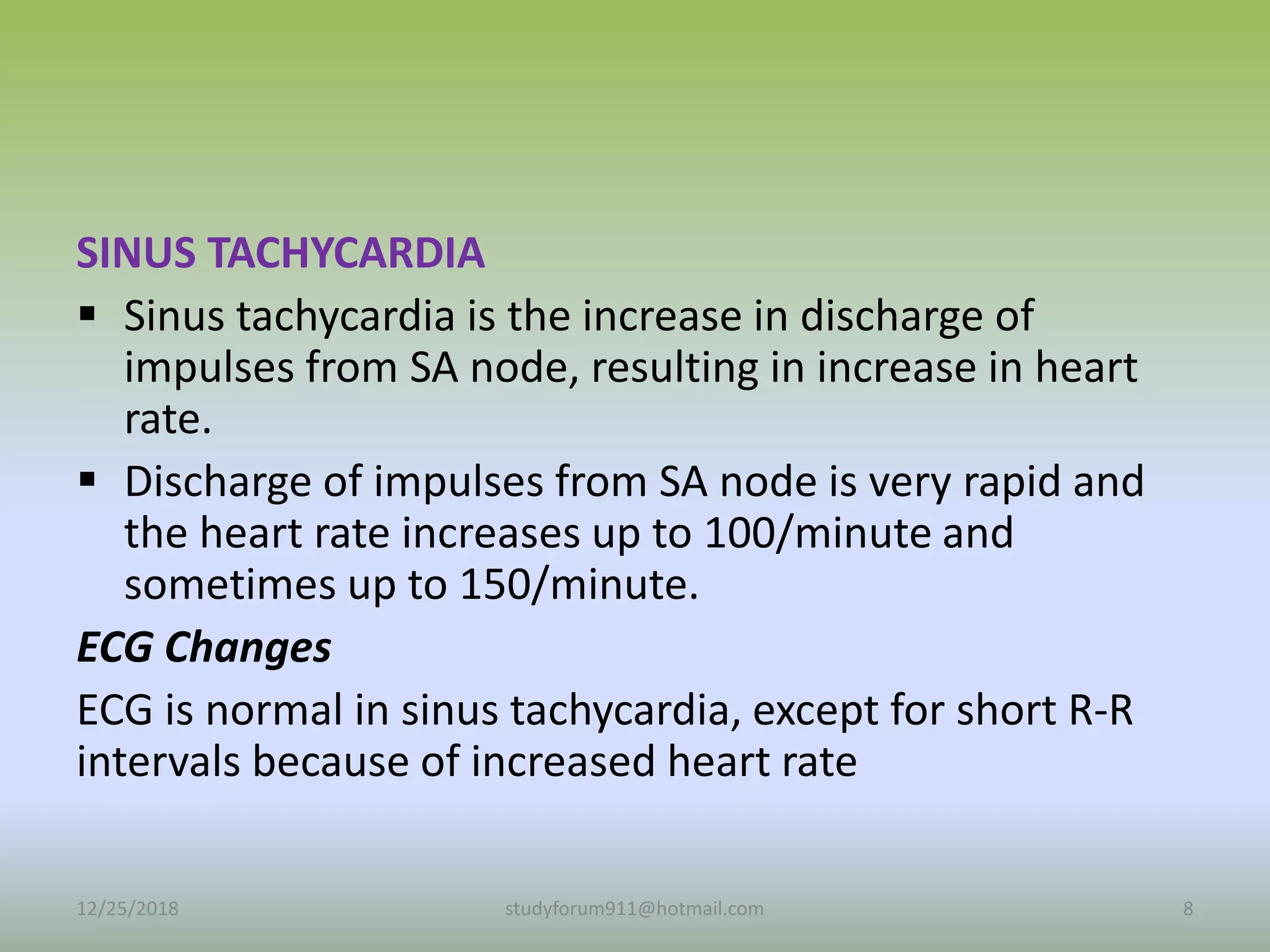
SINUS TACHYCARDIA
 Sinus tachycardia is the increase in discharge of
impulses from SA node, resulting in increase in heart
rate.
 Discharge of impulses from SA node is very rapid and
the heart rate increases up to 100/minute and
sometimes up to 150/minute.
ECG Changes
ECG is normal in sinus tachycardia, except for short R-R
intervals because of increased heart rate
12/25/2018 8studyforum911@hotmail.com
Sinus Arrhythmia
12/25/2018 9studyforum911@hotmail.com
Conditions when Sinus Tachycardia
Occurs
• Sinus tachycardia occurs in physiological as well as pathological
conditions.
Physiological conditions when tachycardia occurs
1. Exercise
2. Emotion
3. High altitude
4. Pregnancy.
Pathological conditions when tachycardia occurs
1. Fever
2. Anemia
3. Hyperthyroidism
4. Hypersecretion of catecholamines
5. Cardiomyopathy
6. Valvular heart disease
7. Hemorrhagic shock.
12/25/2018 10studyforum911@hotmail.com
• Features of Sinus Tachycardia
• 1. Palpitations (sensation of feeling the
heartbeat)
2. Dizziness
3. Fainting
4. Shortness of breath
5. Chest discomfort (angina).
12/25/2018 11studyforum911@hotmail.com
SINUS BRADYCARDIA
 Sinus bradycardia is the reduction in discharge of
impulses from SA node resulting in decrease in heart
rate.
 Heart rate is less than 60/minute.
ECG Changes
 ECG shows prolonged waves and prolonged R-R interval.
 Conditions when Sinus Bradycardia Occurs
Sinus bradycardia occurs in both physiological and
pathological conditions.
 It occurs during sleep.
 It is common in athletes due to the cardiovascular reflexes,
in response to increased force of contraction of heart
12/25/2018 12studyforum911@hotmail.com
• Physiological conditions when sinus bradycardia occurs
1. Sleep
2. Athletic heart.
Pathological conditions when sinus bradycardia occurs
1. Disease of SA node
2. Hypothermia
3. Hypothyroidism
4. Heart attack
5. Congenital heart disease
6. Degenerative process of aging
7. Obstructive jaundice
8. Increased intracranial pressure
9. Use of certain drugs like beta blockers, channel
blockers, digitalis and other antiarrhythmic drugs
10. Atherosclerosis. Bradycardia due to atherosclerosis
of carotid artery, at the region of carotid sinus is
called carotid sinus syndrome.
12/25/2018 13studyforum911@hotmail.com
Features of Sinus Bradycardia
1. Sick sinus syndrome
2. Fatigue
3. Weakness
4. Shortness of breath
5. Lack of concentration
6. Difficulty in exercising.
Sick sinus syndrome
Sick sinus syndrome is the common feature of sinus
bradycardia. It is the condition characterized by dizziness
and unconsciousness.
12/25/2018 14studyforum911@hotmail.com
ECTOPIC ARRHYTHMIA
• Ectopic arrhythmia is the abnormal heartbeat,
in which one of the structures of heart other
than SA node becomes the pacemaker.
• Impulses produced by these structures are
called ectopic foci.
12/25/2018 15studyforum911@hotmail.com
12/25/2018 16studyforum911@hotmail.com
HEART BLOCK
• Heart block is the blockage of impulses generated
by SA node in the conductive system.
• Because of the blockage, the impulses cannot
reach the cardiac musculature, resulting in
ectopic arrhythmia. Based on the area affected,
the heart block is classified into two
types.
1. Sinoatrial block
2. Atrioventricular block
12/25/2018 17studyforum911@hotmail.com
Sinoatrial Block – AV Nodal Rhythm
 Sinoatrial block is the failure of impulse transmission from SA node
to AV node. It is also called sinus block.
 During sinoatrial block, heart stops beating. Immediately, AV node
takes over the pacemaker function and produces the impulses.
 This leads to AV nodal (atrioventricular) rhythm.
 Sinoatrial block is due to the defect in internodal fbers and it occurs
suddenly.
 Initially, the heart stops for a while.
 Then after few seconds, the AV node becomes the pacemaker and
the heart starts beating with decreased rate of 40 to 60/minute.
Impulses may be discharged from any part of AV node, viz.
12/25/2018 18studyforum911@hotmail.com
Atrioventricular Block (AV Block)
 Atrioventricular block is the heart block in which the
impulses are not transmitted from atria (from AV
node) to ventricles because of defective conductive
system.
Atrioventricular block is of two categories:
1. Incomplete heart block
2. Complete heart block
12/25/2018 19studyforum911@hotmail.com
• Incomplete Heart Block
Incomplete heart block is the condition in which the
transmission of impulses from atria to ventricles is
slowed down and not blocked completely. Impulses
reach ventricles late.
Incomplete heart block is of four types:
i. First degree heart block
ii. Second degree heart block
iii. Wenckebach phenomenon
iv. Bundle branch block
12/25/2018 20studyforum911@hotmail.com
PAROXYSMAL TACHYCARDIA
 Paroxysmal tachycardia is the sudden attack of increased heart rate
due to ectopic foci arising from atria, AV node or ventricle. It is also
called BouveretHoffmann syndrome.
 Increase in heart rate due to ectopic foci arising from either atria or
AV node is called supraventricular tachycardia (SVT).
 Symptoms include palpitations, chest pain, rapid breathing and
dizziness.
Paroxysmal tachycardia is of three types:
1. Atrial paroxysmal tachycardia
2. AV nodal paroxysmal tachycardia
3. Ventricular paroxysmal tachycardia.
12/25/2018 21studyforum911@hotmail.com
Atrial Flutter
 Atrial flutter is an arrhythmia characterized by rapid ineffective atrial
contractions, caused by ectopic foci originating from atrial musculature.
 It is often associated with atrial paroxysmal tachycardia.
 Both the atria beat rapidly like the wings of a bird, hence the name atrial
flutter.
 Atrial rate is about 250 to 350/minute.
 Maximum number of impulses conducted by AV node is about 230 to 240
/minute.
 So, during atrial flutter, the second degree of heart block occurs. The ratio
between atrial beats and ventricular beats is 2 : 1 or sometimes 3 : 1.
 Atrial flutter is common in patients suffering from
cardiovascular diseases such as hypertension and coronary artery disease.
12/25/2018 22studyforum911@hotmail.com
Artificial Pacemaker
 Artificial pacemaker is a small electronic device that is surgically
implanted to regulate abnormal heartbeat.
 It contains a battery powered pulse generator, that produces
electrical impulses capable of stimulating the heart.
 This pacemaker is implanted under the skin over the chest of the
patient.
 Pulses generated by this device are transmitted to the heart
through electrodes.
 Electrodes connected to the device are inserted and passed
through a vein and positioned in the heart chambers.
 The device has a lithium battery that may last for 10 to 15 years.
 The outer casing of the pacemaker is usually made of titanium,
which is rarely rejected by body’s immune system.
12/25/2018 23studyforum911@hotmail.com
Thank You
12/25/2018 24studyforum911@hotmail.com

Arrythmia

  • 1.
    ARRHYTHMIA Prep: Amen Ullah LecturerSurgical 12/25/2018 1studyforum911@hotmail.com
  • 2.
    Arrhythmia  Arrhythmia refersto irregular heartbeat or disturbance in the rhythm of heart.  In arrhythmia, heartbeat may be fast or slow or there may be an extra beat or a missed beat.  It occurs in physiological and pathological conditions. 12/25/2018 2studyforum911@hotmail.com
  • 3.
    CLASSIFICATION • In arrhythmia,SA node may or may not be the pacemaker. • If SA node is not the pacemaker, any other part of the heart such as atrial muscle, AV node and ventricular muscle becomes the pacemaker. Accordingly, arrhythmia is classified into two types: A. Normotopic arrhythmia B. Ectopic arrhythmia 12/25/2018 3studyforum911@hotmail.com
  • 4.
    Normotopic Arrhythmia • Normotopicarrhythmia is the irregular heartbeat, in which SA node is the pacemaker. Normotopic arrhythmia is of three types: 1. Sinus arrhythmia 2. Sinus tachycardia 3. Sinus bradycardia. 12/25/2018 4studyforum911@hotmail.com
  • 5.
    SINUS ARRHYTHMIA  Sinusarrhythmia is a normal rhythmical increase and decrease in heart rate, in relation to respiration. It is also called respiratory sinus arrhythmia (RSA).  Normal sinus rhythm means the normal heartbeat with SA node as the pacemaker. Normal heart rate is 72 per minute.  However, under physiological conditions, in a normal healthy person, heart rate varies according to the phases of respiratory cycle.  Heart rate increases during inspiration and decreases during expiration.  ECG Changes Only the duration of R-R interval varies rhythmically according to phases of respiration.  It is shortened during inspiration and prolonged during expiration 12/25/2018 5studyforum911@hotmail.com
  • 6.
    Cause  Sinus arrhythmiais due to fluctuation in the discharge of impulses from SA node.  During inspiration, the lungs are inflated and the intrathoracic pressure decreases.  This increases the venous return.  Inflation of lungs stimulates the stretch receptors of lungs, which send impulses to vasodilator area (cardioinhibitory center) through afferent fbers of vagus. It leads to reflex inhibition of vasodilator area and reduction in vagal tone. Because of these two factors, heart rate increases.  Simultaneously, increased venous return initiates Bainbridge reflex that causes increase in heart rate. 12/25/2018 6studyforum911@hotmail.com
  • 7.
    Conti… • During expiration,the lungs are deflated and intrathoracic pressure increases. • This decreases the venous return. • During deflation of lungs, the stretch receptors are not stimulated and vasodilator area is not inhibited. • So, vagal tone increases, resulting in decreased heart rate. Simultaneously, decreased venous return abolishes Bainbridge reflex. It also decreases the heart rate. 12/25/2018 7studyforum911@hotmail.com
  • 8.
    SINUS TACHYCARDIA  Sinustachycardia is the increase in discharge of impulses from SA node, resulting in increase in heart rate.  Discharge of impulses from SA node is very rapid and the heart rate increases up to 100/minute and sometimes up to 150/minute. ECG Changes ECG is normal in sinus tachycardia, except for short R-R intervals because of increased heart rate 12/25/2018 8studyforum911@hotmail.com
  • 9.
  • 10.
    Conditions when SinusTachycardia Occurs • Sinus tachycardia occurs in physiological as well as pathological conditions. Physiological conditions when tachycardia occurs 1. Exercise 2. Emotion 3. High altitude 4. Pregnancy. Pathological conditions when tachycardia occurs 1. Fever 2. Anemia 3. Hyperthyroidism 4. Hypersecretion of catecholamines 5. Cardiomyopathy 6. Valvular heart disease 7. Hemorrhagic shock. 12/25/2018 10studyforum911@hotmail.com
  • 11.
    • Features ofSinus Tachycardia • 1. Palpitations (sensation of feeling the heartbeat) 2. Dizziness 3. Fainting 4. Shortness of breath 5. Chest discomfort (angina). 12/25/2018 11studyforum911@hotmail.com
  • 12.
    SINUS BRADYCARDIA  Sinusbradycardia is the reduction in discharge of impulses from SA node resulting in decrease in heart rate.  Heart rate is less than 60/minute. ECG Changes  ECG shows prolonged waves and prolonged R-R interval.  Conditions when Sinus Bradycardia Occurs Sinus bradycardia occurs in both physiological and pathological conditions.  It occurs during sleep.  It is common in athletes due to the cardiovascular reflexes, in response to increased force of contraction of heart 12/25/2018 12studyforum911@hotmail.com
  • 13.
    • Physiological conditionswhen sinus bradycardia occurs 1. Sleep 2. Athletic heart. Pathological conditions when sinus bradycardia occurs 1. Disease of SA node 2. Hypothermia 3. Hypothyroidism 4. Heart attack 5. Congenital heart disease 6. Degenerative process of aging 7. Obstructive jaundice 8. Increased intracranial pressure 9. Use of certain drugs like beta blockers, channel blockers, digitalis and other antiarrhythmic drugs 10. Atherosclerosis. Bradycardia due to atherosclerosis of carotid artery, at the region of carotid sinus is called carotid sinus syndrome. 12/25/2018 13studyforum911@hotmail.com
  • 14.
    Features of SinusBradycardia 1. Sick sinus syndrome 2. Fatigue 3. Weakness 4. Shortness of breath 5. Lack of concentration 6. Difficulty in exercising. Sick sinus syndrome Sick sinus syndrome is the common feature of sinus bradycardia. It is the condition characterized by dizziness and unconsciousness. 12/25/2018 14studyforum911@hotmail.com
  • 15.
    ECTOPIC ARRHYTHMIA • Ectopicarrhythmia is the abnormal heartbeat, in which one of the structures of heart other than SA node becomes the pacemaker. • Impulses produced by these structures are called ectopic foci. 12/25/2018 15studyforum911@hotmail.com
  • 16.
  • 17.
    HEART BLOCK • Heartblock is the blockage of impulses generated by SA node in the conductive system. • Because of the blockage, the impulses cannot reach the cardiac musculature, resulting in ectopic arrhythmia. Based on the area affected, the heart block is classified into two types. 1. Sinoatrial block 2. Atrioventricular block 12/25/2018 17studyforum911@hotmail.com
  • 18.
    Sinoatrial Block –AV Nodal Rhythm  Sinoatrial block is the failure of impulse transmission from SA node to AV node. It is also called sinus block.  During sinoatrial block, heart stops beating. Immediately, AV node takes over the pacemaker function and produces the impulses.  This leads to AV nodal (atrioventricular) rhythm.  Sinoatrial block is due to the defect in internodal fbers and it occurs suddenly.  Initially, the heart stops for a while.  Then after few seconds, the AV node becomes the pacemaker and the heart starts beating with decreased rate of 40 to 60/minute. Impulses may be discharged from any part of AV node, viz. 12/25/2018 18studyforum911@hotmail.com
  • 19.
    Atrioventricular Block (AVBlock)  Atrioventricular block is the heart block in which the impulses are not transmitted from atria (from AV node) to ventricles because of defective conductive system. Atrioventricular block is of two categories: 1. Incomplete heart block 2. Complete heart block 12/25/2018 19studyforum911@hotmail.com
  • 20.
    • Incomplete HeartBlock Incomplete heart block is the condition in which the transmission of impulses from atria to ventricles is slowed down and not blocked completely. Impulses reach ventricles late. Incomplete heart block is of four types: i. First degree heart block ii. Second degree heart block iii. Wenckebach phenomenon iv. Bundle branch block 12/25/2018 20studyforum911@hotmail.com
  • 21.
    PAROXYSMAL TACHYCARDIA  Paroxysmaltachycardia is the sudden attack of increased heart rate due to ectopic foci arising from atria, AV node or ventricle. It is also called BouveretHoffmann syndrome.  Increase in heart rate due to ectopic foci arising from either atria or AV node is called supraventricular tachycardia (SVT).  Symptoms include palpitations, chest pain, rapid breathing and dizziness. Paroxysmal tachycardia is of three types: 1. Atrial paroxysmal tachycardia 2. AV nodal paroxysmal tachycardia 3. Ventricular paroxysmal tachycardia. 12/25/2018 21studyforum911@hotmail.com
  • 22.
    Atrial Flutter  Atrialflutter is an arrhythmia characterized by rapid ineffective atrial contractions, caused by ectopic foci originating from atrial musculature.  It is often associated with atrial paroxysmal tachycardia.  Both the atria beat rapidly like the wings of a bird, hence the name atrial flutter.  Atrial rate is about 250 to 350/minute.  Maximum number of impulses conducted by AV node is about 230 to 240 /minute.  So, during atrial flutter, the second degree of heart block occurs. The ratio between atrial beats and ventricular beats is 2 : 1 or sometimes 3 : 1.  Atrial flutter is common in patients suffering from cardiovascular diseases such as hypertension and coronary artery disease. 12/25/2018 22studyforum911@hotmail.com
  • 23.
    Artificial Pacemaker  Artificialpacemaker is a small electronic device that is surgically implanted to regulate abnormal heartbeat.  It contains a battery powered pulse generator, that produces electrical impulses capable of stimulating the heart.  This pacemaker is implanted under the skin over the chest of the patient.  Pulses generated by this device are transmitted to the heart through electrodes.  Electrodes connected to the device are inserted and passed through a vein and positioned in the heart chambers.  The device has a lithium battery that may last for 10 to 15 years.  The outer casing of the pacemaker is usually made of titanium, which is rarely rejected by body’s immune system. 12/25/2018 23studyforum911@hotmail.com
  • 24.