


Prep: Amen Ullah
Lecturer Surgical
12/25/18 studyforum911@hotmail.com 1
Hemodynamics
 The branch of physiology dealing with the forces involved i
n the circulation of the blood. 
OR
 The study of the movements of the blood and the forces co
ncerned therein.
OR
 The study of movement of blood through circulatory 
system.
 cardiovascular system is Responsible for to pump the blood 
and to circulate it through different parts of the body.
 It is essential for the maintenance of pressure and other 
physical factors within the blood vessels.
12/25/18 studyforum911@hotmail.com 2
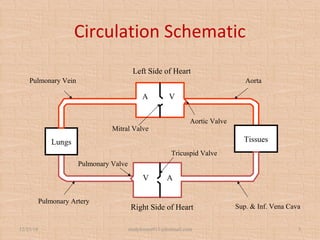
Circulation Schematic
 
Lungs Tissues
Left Side of Heart
Right Side of Heart
A V
V A
Pulmonary Vein
Pulmonary Artery
Aorta
Sup. & Inf. Vena Cava
Mitral Valve
Pulmonary Valve
Aortic Valve
Tricuspid Valve
12/25/18 studyforum911@hotmail.com 3
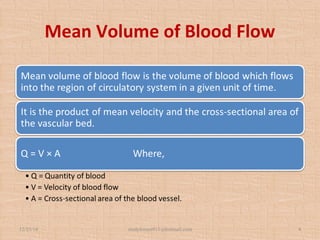
Mean Volume of Blood Flow
12/25/18 studyforum911@hotmail.com 4
Types of blood flow
• Blood flow through a blood vessel is of two
types:
• 1. Streamline or laminar flow
• 2. Turbulent flow.
12/25/18 studyforum911@hotmail.com 5
 1. Streamline Flow
 Streamline flow is a silent flow. Within the blood vessel, a
very thin layer of blood is in contact with the vessel wall.
 It does not move or moves very slowly.
 This type of flow does not produce any sound within the
vessel Streamline flow occurs only at velocities up to a critical
level.
OR
 Flow of a fluid in which its velocity at any point is constant or
varies in a regular manner. It can be represented by
streamlines.
12/25/18 studyforum911@hotmail.com 6
• 2. Turbulent Flow
• Turbulent flow is the noisy flow. When the
velocity of blood flow increases above critical
level, the flow becomes turbulent.
• Turbulent flow creates sounds.
12/25/18 studyforum911@hotmail.com 7
Factors determining volume
of blood flow
• Volume of blood flow is determined by fiv
factors:
– 1. Pressure gradient
– 2. Resistance to blood flow
– 3. Viscosity of blood
– 4. Diameter of blood vessels
– 5. Velocity of blood flow.
12/25/18 studyforum911@hotmail.com 8
• 1. Pressure
• Volume of blood flowing through any blood vessel is
directly proportional to the pressure gradient.
• Pressure gradient is the pressure difference between
the two ends of the blood vessel.
• Pressure gradient = P1 – P2
Where,
• P1 = Pressure at proximal end of the vessel
• P2 = Pressure at distal end of the vessel.
12/25/18 studyforum911@hotmail.com 9
2. Resistance to Blood Flow
•(Peripheral Resistance)
•Volume of blood flow is inversel proportional to the resistance.
Resistance is the friction, tension or hindrance, against which
the blood has to flow. Peripheral resistance means the
resistance offered to blood flow in peripheral blood vessels.
Though resistance exists in all the blood vessels to some extent,
it is remarkable in the peripheral vessels, particularly the
arterioles.
Determinants of peripheral resistance
•i. Radius of blood vessels
•ii. Pressure gradient
•iii. Viscosity of blood.
12/25/18 studyforum911@hotmail.com 10
3. Viscosity of Blood
•Volume of blood flow is inversely proportional to the viscosity
of blood. Viscosity is the friction of blood against the wall of the
blood vessel.
•Isaac Newton described viscosity as the internal friction or lack
of slipperiness. Viscosity influences the blood flow through
resistance.
Factors determining viscosity
•RBC count is the main factor which determines the viscosity of the blood.
•Another factor determining viscosity is plasma protein, mainly albumin.
•When hemoconcentration occurs as in case of burns or in polycythemia, the
viscosity increases and the velocity of blood flow decreases, so the volume of
blood reaching the organ is decreased.
12/25/18 studyforum911@hotmail.com 11
4. Diameter of Blood Vessels
•Volume of blood flow is directly proportional to the
diameter of the blood vessels.
•When the diameter of a segment of blood vessel is
considered, the aorta has the maximum diameter and
capillary has got the minimum diameter.
•But, in circulation, the diameter of the vessel is
considered in relation to the cross-sectional area
through which the blood flows
12/25/18 studyforum911@hotmail.com 12
5. Velocity of Blood Flow
•Volume of blood flow is directly proportional
to the velocity of blood flow.
•Velocity of blood flow is the rate at which blood
flows through a particular region.
12/25/18 studyforum911@hotmail.com 13
Velocity of Blood Flow
• Velocity of blood flow is the rate at which blood
flows through a particular region of the body.
• It mainly depends upon the diameter or cross-
sectional area of blood vessel.
• Velocity of blood flow is the rate at which blood
flows through a particular region of the body.
• It mainly depends upon the diameter or cross-
sectional area of blood vessel.
12/25/18 studyforum911@hotmail.com 14
FACTORS MAINTAINING VELOCITY
•Three factors are responsible for the
maintenance of the velocity of blood flow.
1. Cardiac output
2. Cross-sectional area of the blood vessel
3. Viscosity of the blood.
12/25/18 studyforum911@hotmail.com 15
Thank
You
12/25/18 studyforum911@hotmail.com 16

Hemodynamics, Circulation Schematic

  • 1.
    Prep: Amen Ullah LecturerSurgical 12/25/18 studyforum911@hotmail.com 1
  • 2.
    Hemodynamics  The branch of physiology dealing with the forces involved i n the circulation of the blood.  OR  The study of the movements of the blood and the forces co ncerned therein. OR The study of movement of blood through circulatory  system.  cardiovascular system is Responsible for to pump the blood  and to circulate it through different parts of the body.  It is essential for the maintenance of pressure and other  physical factors within the blood vessels. 12/25/18 studyforum911@hotmail.com 2
  • 3.
    Circulation Schematic   Lungs Tissues Left Sideof Heart Right Side of Heart A V V A Pulmonary Vein Pulmonary Artery Aorta Sup. & Inf. Vena Cava Mitral Valve Pulmonary Valve Aortic Valve Tricuspid Valve 12/25/18 studyforum911@hotmail.com 3
  • 4.
    Mean Volume ofBlood Flow 12/25/18 studyforum911@hotmail.com 4
  • 5.
    Types of bloodflow • Blood flow through a blood vessel is of two types: • 1. Streamline or laminar flow • 2. Turbulent flow. 12/25/18 studyforum911@hotmail.com 5
  • 6.
     1. StreamlineFlow  Streamline flow is a silent flow. Within the blood vessel, a very thin layer of blood is in contact with the vessel wall.  It does not move or moves very slowly.  This type of flow does not produce any sound within the vessel Streamline flow occurs only at velocities up to a critical level. OR  Flow of a fluid in which its velocity at any point is constant or varies in a regular manner. It can be represented by streamlines. 12/25/18 studyforum911@hotmail.com 6
  • 7.
    • 2. TurbulentFlow • Turbulent flow is the noisy flow. When the velocity of blood flow increases above critical level, the flow becomes turbulent. • Turbulent flow creates sounds. 12/25/18 studyforum911@hotmail.com 7
  • 8.
    Factors determining volume ofblood flow • Volume of blood flow is determined by fiv factors: – 1. Pressure gradient – 2. Resistance to blood flow – 3. Viscosity of blood – 4. Diameter of blood vessels – 5. Velocity of blood flow. 12/25/18 studyforum911@hotmail.com 8
  • 9.
    • 1. Pressure •Volume of blood flowing through any blood vessel is directly proportional to the pressure gradient. • Pressure gradient is the pressure difference between the two ends of the blood vessel. • Pressure gradient = P1 – P2 Where, • P1 = Pressure at proximal end of the vessel • P2 = Pressure at distal end of the vessel. 12/25/18 studyforum911@hotmail.com 9
  • 10.
    2. Resistance toBlood Flow •(Peripheral Resistance) •Volume of blood flow is inversel proportional to the resistance. Resistance is the friction, tension or hindrance, against which the blood has to flow. Peripheral resistance means the resistance offered to blood flow in peripheral blood vessels. Though resistance exists in all the blood vessels to some extent, it is remarkable in the peripheral vessels, particularly the arterioles. Determinants of peripheral resistance •i. Radius of blood vessels •ii. Pressure gradient •iii. Viscosity of blood. 12/25/18 studyforum911@hotmail.com 10
  • 11.
    3. Viscosity ofBlood •Volume of blood flow is inversely proportional to the viscosity of blood. Viscosity is the friction of blood against the wall of the blood vessel. •Isaac Newton described viscosity as the internal friction or lack of slipperiness. Viscosity influences the blood flow through resistance. Factors determining viscosity •RBC count is the main factor which determines the viscosity of the blood. •Another factor determining viscosity is plasma protein, mainly albumin. •When hemoconcentration occurs as in case of burns or in polycythemia, the viscosity increases and the velocity of blood flow decreases, so the volume of blood reaching the organ is decreased. 12/25/18 studyforum911@hotmail.com 11
  • 12.
    4. Diameter ofBlood Vessels •Volume of blood flow is directly proportional to the diameter of the blood vessels. •When the diameter of a segment of blood vessel is considered, the aorta has the maximum diameter and capillary has got the minimum diameter. •But, in circulation, the diameter of the vessel is considered in relation to the cross-sectional area through which the blood flows 12/25/18 studyforum911@hotmail.com 12
  • 13.
    5. Velocity ofBlood Flow •Volume of blood flow is directly proportional to the velocity of blood flow. •Velocity of blood flow is the rate at which blood flows through a particular region. 12/25/18 studyforum911@hotmail.com 13
  • 14.
    Velocity of BloodFlow • Velocity of blood flow is the rate at which blood flows through a particular region of the body. • It mainly depends upon the diameter or cross- sectional area of blood vessel. • Velocity of blood flow is the rate at which blood flows through a particular region of the body. • It mainly depends upon the diameter or cross- sectional area of blood vessel. 12/25/18 studyforum911@hotmail.com 14
  • 15.
    FACTORS MAINTAINING VELOCITY •Threefactors are responsible for the maintenance of the velocity of blood flow. 1. Cardiac output 2. Cross-sectional area of the blood vessel 3. Viscosity of the blood. 12/25/18 studyforum911@hotmail.com 15
  • 16.