Cell Mediated
Immunity
Prep: Amen Ullah
Lecturer Surgical
12/25/2018studyforum911@hotmail.com 1
CELL-MEDIATED IMMUNITY
 Cell-mediated immunity is defined as the immunity developed by cell-
mediated response.
 It is also called cellular immunity or T cell immunity.
 It involves several types of cells such as T lymphocytes, macrophages
and natural killer cells and hence the name cell mediated immunity.
 Cell-mediated immunity does not involve antibodies.
 Cellular immunity is the major defense mechanism against infections
by viruses, fungi and few bacteria like tubercle bacillus.
 It is also responsible for delayed allergic reactions and the rejection of
transplanted tissues.
12/25/2018studyforum911@hotmail.com 2
Conti…
 Cell-mediated immunity is offered by T lymphocytes and it starts
developing when T cells come in contact with the antigens.
 Usually, the invading microbial or non-microbial organisms carry
the antigenic materials.
 These antigenic materials are released from invading organisms
and are presented to the helper T cells by antigen-presenting
cells.
12/25/2018studyforum911@hotmail.com 3
ANTIGEN-PRESENTING CELLS
Types of Antigen-Presenting Cells
Antigen-presenting cells are of three types:
1. Macrophages
2. Dendritic cells
3. B lymphocytes.
 Among these cells, macrophages are the major antigen-
presenting cells.
12/25/2018studyforum911@hotmail.com 4
ANTIGEN-PRESENTING CELLS
1. Macrophages
 Macrophages are the large phagocytic cells, which digest the invading
organisms to release the antigen.
 The macrophages are present along with lymphocytes in almost all the
lymphoid tissues.
12/25/2018studyforum911@hotmail.com 5
Conti…
2. Dendritic Cells
 Dendritic cells are non phagocytic in nature.
 Based on the location, dendritic cells are classified into 3
categories:
a) Dendritic cells of spleen, which trap the antigen in blood.
b) Follicular dendritic cells in lymph nodes, which trap the antigen in the
lymph.
c) Langerhans dendritic cells in skin, which trap the organisms coming in
contact with body surface.
12/25/2018studyforum911@hotmail.com 6
Conti…
3. B Lymphocytes
 Recently, it is found that B lymphocytes also act as antigen-presenting cells.
 Thus, the B cells function as both antigen-presenting cells and antigen
receiving cells.
 However, B cells are the least efficient antigen presenting cells and need to
be activated by helper T cells.
12/25/2018studyforum911@hotmail.com 7
Role of Antigen-presenting Cells
 Invading foreign organisms are either engulfed by macro p hages through
phagocytosis or trapped by dendritic cells.
 Later, the antigen from these organisms is digested into small peptide
products.
 These antigenic peptide products move towards the surface of the antigen-
presenting cells and bind with human leukocyte anti gen (HLA).
 HLA is a genetic matter present in the molecule of class II major
histocompatiblility complex (MHC), which is situated on the surface of the
antigenpresenting cells.
 B-cells ingest the foreign bodies by means of pinocytosis. Role of B cells as
antigen-presenting cells in the body is not fully understood.
12/25/2018studyforum911@hotmail.com 8
MHC and HLA
 Major histocompatibility complex (MHC) is a large molecule present in the
short arm of chromosome 6.
 It is made up of a group of genes which are involved in immune system.
 It has more than 200 genes including HLA genes. HLA is made up of genes with
small molecules.
 It encodes antigen-presenting proteins on the cell surface.
 Though MHC molecules and HLA genes are distinct terms, both are used
interchangeably.
 Particularly in human, the MHC molecules are often referred as HLA
molecules.
12/25/2018studyforum911@hotmail.com 9
Conti…
 MHC molecules in human beings are divided into two types:
1) Class I MHC molecule: It is found on every cell in human body. It is
specifically responsible for presentation of endogenous antigens
(antigens produced intra-cellularly such as viral proteins and tumor
antigens) to cytotoxic T cells.
2) Class II MHC molecule: It is found on B cells, macrophages and other
antigen-presenting cells. It is responsible for presenting the
exogenous antigens (antigens of bacteria or viruses which are
engulfed by antigen-presenting cells) to helper T cells.
12/25/2018studyforum911@hotmail.com 10
Presentation of Antigen
 Antigen-presenting cells present their class II MHC
molecules together with antigen-bound HLA to the helper T cells.
 This activates the helper T cells through series of events
12/25/2018studyforum911@hotmail.com 11
Sequence of Events during Activation
of Helper T cells
1) Helper T cell recognizes the antigen displayed on the surface of the antigen-
presenting cell with the help of its own surface receptor protein called T cell
receptor.
2) Recognition of the antigen by the helper T cell initiates a complex interaction
between the helper T cell receptor and the antigen. This reaction activates
helper T cells.
3) At the same time, macrophages (the antigen-presenting cells) release
interleukin-1, which facilitates the activation and proliferation of helper T
cells.
4) Activated helper T cells proliferate and the proliferated cells enter the
circulation for further actions.
5) Simultaneously, the antigen which is bound to class II MHC molecules activates
the B cells also, resulting in the development of humoral immunity
12/25/2018studyforum911@hotmail.com 12
Sequence of Events during Activation of Helper T cells
12/25/2018studyforum911@hotmail.com 13
ROLE OF HELPER T CELLS
 activate all the other T cells and B cells. Normal, CD4 count in healthy
adults varies between 500 and 1500 per cubic millimeter of blood.
 Helper T cells are of two types:
1. Helper-1 (TH1) cells
2. Helper-2 (TH2) cells.
12/25/2018studyforum911@hotmail.com 14
Role of TH1 Cells
 TH1 cells are concerned with cellular immunity and secrete two substances:
 i. Interleukin-2, which activates the other T cells.
 ii. Gamma interferon, which stimulates the phagocytic activity of cytotoxic
cells, macrophages and natural killer (NK) cells.
Role of TH2 Cells
 TH2 cells are concerned with humoral immunity and secrete interleukin-4 and
interleukin-5, which are concerned with:
i. Activation of B cells.
ii. Proliferation of plasma cells.
iii. Production of antibodies by plasma cell.
12/25/2018studyforum911@hotmail.com 15
ROLE OF CYTOTOXIC T CELLS
 Cytotoxic T cells that are activated by helper T cells, circulate
through blood, lymph and lymphatic tissues and destroy the invading
organisms by attacking them directly.
12/25/2018studyforum911@hotmail.com 16
Mechanism of Action of Cytotoxic T Cells
1) Receptors situated on the outer membrane of cytotoxic T cells bind the
antigens or organisms tightly with cytotoxic T cells.
2) Then, the cytotoxic T cells enlarge and release cytotoxic substances like the
lysosomal enzymes.
3) These substances destroy the invading organisms.
4) Like this, each cytotoxic T cell can destroy a large number of microorganisms
one after another.
12/25/2018studyforum911@hotmail.com 17
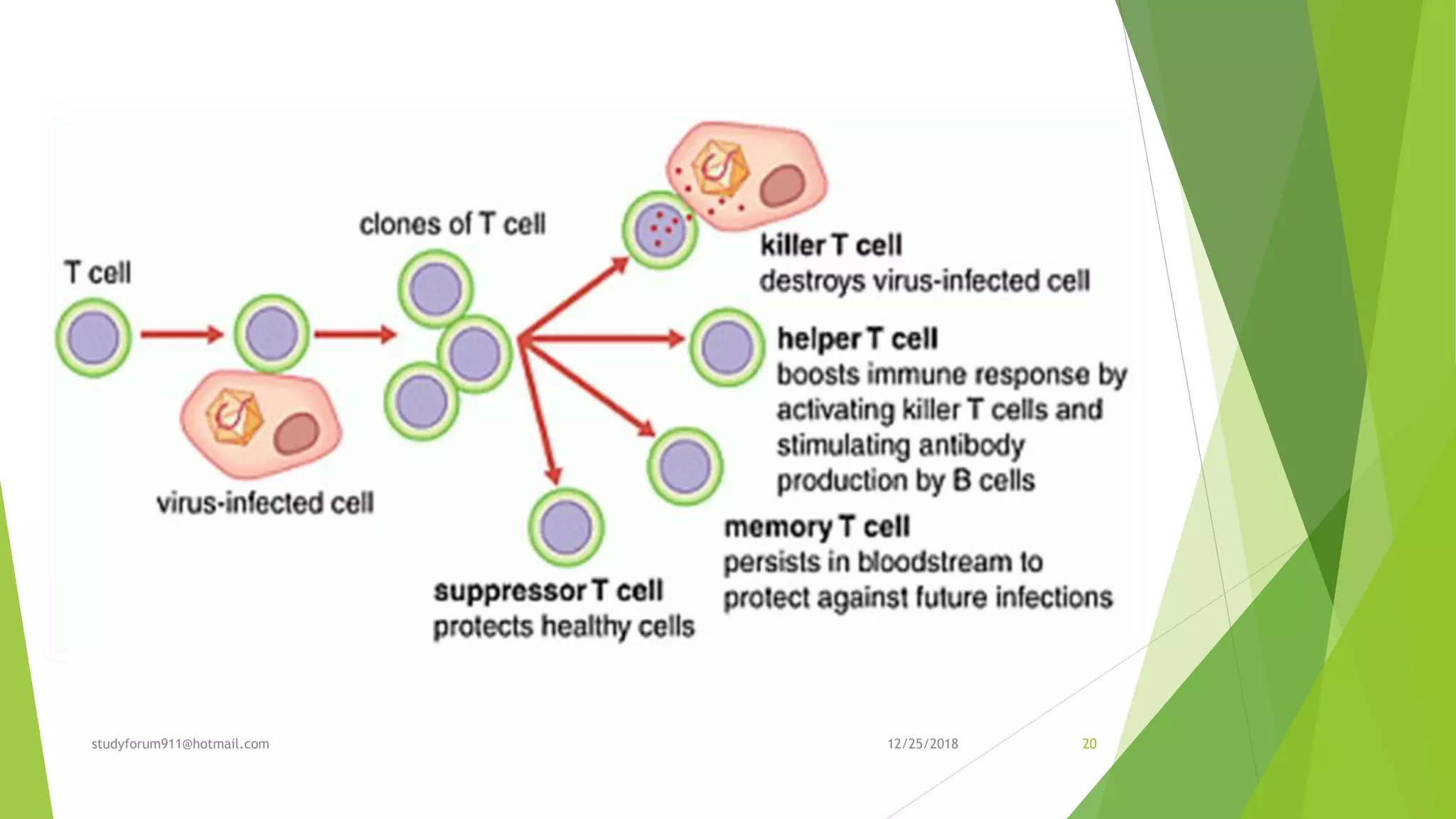
ROLE OF SUPPRESSOR T CELLS
 Suppressor T cells are also called regulatory T cells.
These T cells suppress the activities of the killer T cells.
 Thus, the suppressor T cells play an important role in preventing the
killer T cells from destroying the body’s own tissues along with
invaded organisms.
 Suppressor cells suppress the activities of helper T cells also.
12/25/2018studyforum911@hotmail.com 18
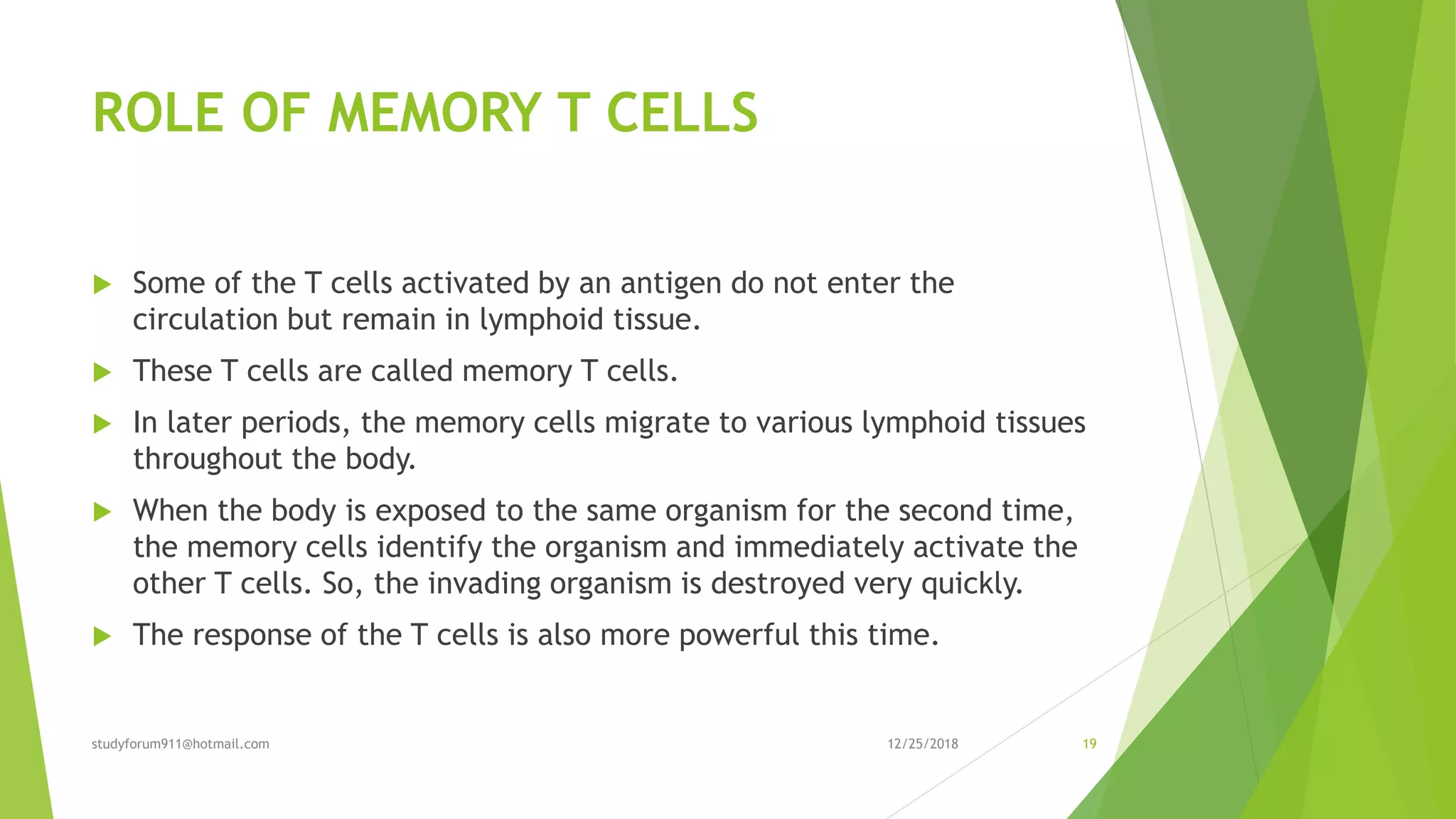
ROLE OF MEMORY T CELLS
 Some of the T cells activated by an antigen do not enter the
circulation but remain in lymphoid tissue.
 These T cells are called memory T cells.
 In later periods, the memory cells migrate to various lymphoid tissues
throughout the body.
 When the body is exposed to the same organism for the second time,
the memory cells identify the organism and immediately activate the
other T cells. So, the invading organism is destroyed very quickly.
 The response of the T cells is also more powerful this time.
12/25/2018studyforum911@hotmail.com 19
12/25/2018studyforum911@hotmail.com 20
12/25/2018studyforum911@hotmail.com 21

Cell mediated immunity

  • 1.
    Cell Mediated Immunity Prep: AmenUllah Lecturer Surgical 12/25/2018studyforum911@hotmail.com 1
  • 2.
    CELL-MEDIATED IMMUNITY  Cell-mediatedimmunity is defined as the immunity developed by cell- mediated response.  It is also called cellular immunity or T cell immunity.  It involves several types of cells such as T lymphocytes, macrophages and natural killer cells and hence the name cell mediated immunity.  Cell-mediated immunity does not involve antibodies.  Cellular immunity is the major defense mechanism against infections by viruses, fungi and few bacteria like tubercle bacillus.  It is also responsible for delayed allergic reactions and the rejection of transplanted tissues. 12/25/2018studyforum911@hotmail.com 2
  • 3.
    Conti…  Cell-mediated immunityis offered by T lymphocytes and it starts developing when T cells come in contact with the antigens.  Usually, the invading microbial or non-microbial organisms carry the antigenic materials.  These antigenic materials are released from invading organisms and are presented to the helper T cells by antigen-presenting cells. 12/25/2018studyforum911@hotmail.com 3
  • 4.
    ANTIGEN-PRESENTING CELLS Types ofAntigen-Presenting Cells Antigen-presenting cells are of three types: 1. Macrophages 2. Dendritic cells 3. B lymphocytes.  Among these cells, macrophages are the major antigen- presenting cells. 12/25/2018studyforum911@hotmail.com 4
  • 5.
    ANTIGEN-PRESENTING CELLS 1. Macrophages Macrophages are the large phagocytic cells, which digest the invading organisms to release the antigen.  The macrophages are present along with lymphocytes in almost all the lymphoid tissues. 12/25/2018studyforum911@hotmail.com 5
  • 6.
    Conti… 2. Dendritic Cells Dendritic cells are non phagocytic in nature.  Based on the location, dendritic cells are classified into 3 categories: a) Dendritic cells of spleen, which trap the antigen in blood. b) Follicular dendritic cells in lymph nodes, which trap the antigen in the lymph. c) Langerhans dendritic cells in skin, which trap the organisms coming in contact with body surface. 12/25/2018studyforum911@hotmail.com 6
  • 7.
    Conti… 3. B Lymphocytes Recently, it is found that B lymphocytes also act as antigen-presenting cells.  Thus, the B cells function as both antigen-presenting cells and antigen receiving cells.  However, B cells are the least efficient antigen presenting cells and need to be activated by helper T cells. 12/25/2018studyforum911@hotmail.com 7
  • 8.
    Role of Antigen-presentingCells  Invading foreign organisms are either engulfed by macro p hages through phagocytosis or trapped by dendritic cells.  Later, the antigen from these organisms is digested into small peptide products.  These antigenic peptide products move towards the surface of the antigen- presenting cells and bind with human leukocyte anti gen (HLA).  HLA is a genetic matter present in the molecule of class II major histocompatiblility complex (MHC), which is situated on the surface of the antigenpresenting cells.  B-cells ingest the foreign bodies by means of pinocytosis. Role of B cells as antigen-presenting cells in the body is not fully understood. 12/25/2018studyforum911@hotmail.com 8
  • 9.
    MHC and HLA Major histocompatibility complex (MHC) is a large molecule present in the short arm of chromosome 6.  It is made up of a group of genes which are involved in immune system.  It has more than 200 genes including HLA genes. HLA is made up of genes with small molecules.  It encodes antigen-presenting proteins on the cell surface.  Though MHC molecules and HLA genes are distinct terms, both are used interchangeably.  Particularly in human, the MHC molecules are often referred as HLA molecules. 12/25/2018studyforum911@hotmail.com 9
  • 10.
    Conti…  MHC moleculesin human beings are divided into two types: 1) Class I MHC molecule: It is found on every cell in human body. It is specifically responsible for presentation of endogenous antigens (antigens produced intra-cellularly such as viral proteins and tumor antigens) to cytotoxic T cells. 2) Class II MHC molecule: It is found on B cells, macrophages and other antigen-presenting cells. It is responsible for presenting the exogenous antigens (antigens of bacteria or viruses which are engulfed by antigen-presenting cells) to helper T cells. 12/25/2018studyforum911@hotmail.com 10
  • 11.
    Presentation of Antigen Antigen-presenting cells present their class II MHC molecules together with antigen-bound HLA to the helper T cells.  This activates the helper T cells through series of events 12/25/2018studyforum911@hotmail.com 11
  • 12.
    Sequence of Eventsduring Activation of Helper T cells 1) Helper T cell recognizes the antigen displayed on the surface of the antigen- presenting cell with the help of its own surface receptor protein called T cell receptor. 2) Recognition of the antigen by the helper T cell initiates a complex interaction between the helper T cell receptor and the antigen. This reaction activates helper T cells. 3) At the same time, macrophages (the antigen-presenting cells) release interleukin-1, which facilitates the activation and proliferation of helper T cells. 4) Activated helper T cells proliferate and the proliferated cells enter the circulation for further actions. 5) Simultaneously, the antigen which is bound to class II MHC molecules activates the B cells also, resulting in the development of humoral immunity 12/25/2018studyforum911@hotmail.com 12
  • 13.
    Sequence of Eventsduring Activation of Helper T cells 12/25/2018studyforum911@hotmail.com 13
  • 14.
    ROLE OF HELPERT CELLS  activate all the other T cells and B cells. Normal, CD4 count in healthy adults varies between 500 and 1500 per cubic millimeter of blood.  Helper T cells are of two types: 1. Helper-1 (TH1) cells 2. Helper-2 (TH2) cells. 12/25/2018studyforum911@hotmail.com 14
  • 15.
    Role of TH1Cells  TH1 cells are concerned with cellular immunity and secrete two substances:  i. Interleukin-2, which activates the other T cells.  ii. Gamma interferon, which stimulates the phagocytic activity of cytotoxic cells, macrophages and natural killer (NK) cells. Role of TH2 Cells  TH2 cells are concerned with humoral immunity and secrete interleukin-4 and interleukin-5, which are concerned with: i. Activation of B cells. ii. Proliferation of plasma cells. iii. Production of antibodies by plasma cell. 12/25/2018studyforum911@hotmail.com 15
  • 16.
    ROLE OF CYTOTOXICT CELLS  Cytotoxic T cells that are activated by helper T cells, circulate through blood, lymph and lymphatic tissues and destroy the invading organisms by attacking them directly. 12/25/2018studyforum911@hotmail.com 16
  • 17.
    Mechanism of Actionof Cytotoxic T Cells 1) Receptors situated on the outer membrane of cytotoxic T cells bind the antigens or organisms tightly with cytotoxic T cells. 2) Then, the cytotoxic T cells enlarge and release cytotoxic substances like the lysosomal enzymes. 3) These substances destroy the invading organisms. 4) Like this, each cytotoxic T cell can destroy a large number of microorganisms one after another. 12/25/2018studyforum911@hotmail.com 17
  • 18.
    ROLE OF SUPPRESSORT CELLS  Suppressor T cells are also called regulatory T cells. These T cells suppress the activities of the killer T cells.  Thus, the suppressor T cells play an important role in preventing the killer T cells from destroying the body’s own tissues along with invaded organisms.  Suppressor cells suppress the activities of helper T cells also. 12/25/2018studyforum911@hotmail.com 18
  • 19.
    ROLE OF MEMORYT CELLS  Some of the T cells activated by an antigen do not enter the circulation but remain in lymphoid tissue.  These T cells are called memory T cells.  In later periods, the memory cells migrate to various lymphoid tissues throughout the body.  When the body is exposed to the same organism for the second time, the memory cells identify the organism and immediately activate the other T cells. So, the invading organism is destroyed very quickly.  The response of the T cells is also more powerful this time. 12/25/2018studyforum911@hotmail.com 19
  • 20.
  • 21.