Heart Failure
Dr Arindam Pande,
MBBS (Hons), MD, DM, FESC, FACC (USA)
Consultant Cardiologist,
Academic Coordinator: DNB Cardiology and PGDCC Training
Apollo Gleneagles Hospital, Kolkata
www.healthprice.in
Heart
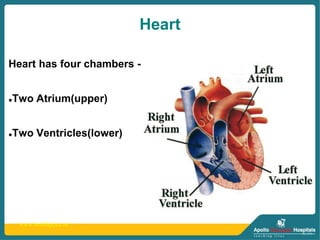
Heart has four chambers -
Two Atrium(upper)
Two Ventricles(lower)
www.healthprice.in
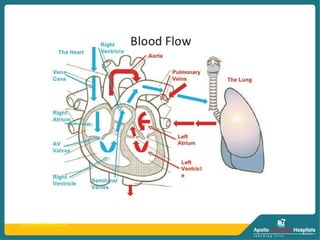
Atria – It collects blood from the body.
Ventricle- It supplies blood to the body
 Right Ventricle supplies blood to lungs
 Left Ventricle supplies blood into the
system for circulation
www.healthprice.in
• In medical terms heart failure is defined as the
condition when heart is unable to pump enough
blood required for normal body functions.
• Human body needs sufficient amount of oxygen
which is supplied by heart through blood. Heart
failure is a serious condition and needs
immediate medical care.
What is Heart Failure?
Congestive Heart Failure
Congestion of pulmonary or systemic
circulation (backward failure)
Reduced output to body tissues (forward
failure)
7
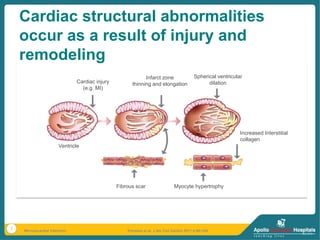
Cardiac structural abnormalities
occur as a result of injury and
remodeling
MI=myocardial infarction Konstam et al. J Am Coll Cardiol 2011;4:98–108
Cardiac injury
(e.g. MI)
Infarct zone
thinning and elongation
Spherical ventricular
dilation
Fibrous scar Myocyte hypertrophy
Increased Interstitial
collagen
Ventricle
LV=left ventricular
McMurray. N Engl J Med 2010;362:228–38; Francis et al. Ann Intern Med 1984;101:370–7; Krum, Abraham. Lancet 2009;373:941–55
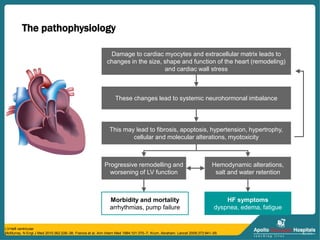
The pathophysiology of chronic HF
HF symptoms
dyspnea, edema, fatigue
Progressive remodelling and
worsening of LV function
Morbidity and mortality
arrhythmias, pump failure
Hemodynamic alterations,
salt and water retention
These changes lead to systemic neurohormonal imbalance
Damage to cardiac myocytes and extracellular matrix leads to
changes in the size, shape and function of the heart (remodeling)
and cardiac wall stress
This may lead to fibrosis, apoptosis, hypertension, hypertrophy,
cellular and molecular alterations, myotoxicity
Congestive Heart Failure
Left sided
Right sided
Biventricular
Left-Sided Heart Failure
• Left ventricle fails as effective pump
• Left ventricle cannot eject blood delivered
from right heart through pulmonary
circulation
• Blood backs up into pulmonary circulation
Left-Sided Heart Failure
• Increase pressure in pulmonary capillaries
forces blood serum out of capillaries into
interstitial spaces and alveoli
• Increase respiratory work and decrease gas
exchange occur
Left-Sided Heart Failure
• Common causes
• ACUTE MI
• especially if involves left ventricle
• Chronic hypertension
• Dysrhythmias
• especially tachydysrhythmias
Left-Sided Heart Failure
Pulmonary
Signs/Symptoms
Left Heart Failure Symptoms
• Dyspnea on exertion
• Paroxysmal nocturnal dyspnea
• Orthopnea
• Fatigue, generalized weakness
Left Heart Failure Signs
• Anxiety, confusion, restlessness
• Persistent cough
• Pink, frothy sputum
• Tachycardia
• Tachypnea
• Noisy, labored breathing
• Rales, wheezing (“cardiac asthma”)
• Cyanosis (late)
• Third heart sound (S3)
Right-sided Heart Failure
• Right ventricle fails as effective pump
• Right ventricle cannot eject blood returning
through vena cavae
• Blood backs up into systemic circulation
Right Heart Failure
• Increased pressure in systemic capillaries
forces fluid out of capillaries into interstitial
spaces
• Tissue edema occurs
Right Heart Failure Causes
Most Common Cause:
Left sided Heart Failure
Right Heart Failure Causes
• Others
• Chronic pulmonary hypertension (Idiopathic)
• COPD (cor pulmonale)
• Congenital Heart Disease
• Pulmonary embolism
• Right ventricular infarction
Right-Sided Heart Failure
Systemic
Signs/Symptoms
Right Heart Failure
Signs/Symptoms
• Tachycardia
• Jugular vein distension
• Pedal, pre-tibial, sacral edema
• Hepatomegaly
• Splenomegaly
Classic Triad of Right Ventricular Failure:
JVD, Hypotension, Clear Lungs
Right Heart Failure
Signs/Symptoms
• Anasarca (generalized edema)
• Fluid accumulation in body cavities
• Ascites
• Pleural effusion
• Pericardial effusion
Management of Heart Failure
Goals of Management
• Improve oxygenation, ventilation
• Decrease venous return to heart
• Decrease cardiac work, O2 demand
• Improve cardiac output by
• Reducing afterload
• Increasing myocardial contractility
Management
• Sit patient up, dangle feet
• Do not lay flat
• Oxygen by non-rebreather mask
• Consider positive pressure ventilation
Management
• Consider intubation if:
• O2 saturation cannot be kept >90% on 100% O2
• PaO2 cannot be kept >60 torr on 100 % O2
• Patient displays signs of worsening cerebral hypoxia
• PaCO2 progressively increases
• Patient becoming exhausted
Management
• Monitor ECG
• Hypoxia, increased heart wall tension leads to
dysrhythmias
• IV NS TKO via microdrip or lock
• Limit Fluids
• If RVF only, fluid challenges to  preload
Drug management in acute setings
• Nitroglycerin
• Furosemide (Lasix®) -
• Morphine Sulfate
• Dobutamine, Noradrenaline
• Bronchodilators (beta agonists)
• Digitalis
Long Term CHF Management
• Fluid minimization
• Diuretics (+ Potassium if non-potassium sparing)
• Diet restrictions
• Increase contractility
• Digitalis
• Blood pressure control
• ACE Inhibitors
• Betablockers
• ARNI
• Ivabradin
• Coronary artery perfusion
• Nitroglycerin
 If medication or other means fail to improve the
condition, left ventricular assist devices and / or
heart transplantation is opted.
 For patients in cardiogenic shock, ECMO
(extracorporeal membrane oxygenator) therapy
is given to stabilize the condition temporarily.
THANKS
31

Heart failure: Basic Cocepts

  • 1.
    Heart Failure Dr ArindamPande, MBBS (Hons), MD, DM, FESC, FACC (USA) Consultant Cardiologist, Academic Coordinator: DNB Cardiology and PGDCC Training Apollo Gleneagles Hospital, Kolkata
  • 2.
    www.healthprice.in Heart Heart has fourchambers - Two Atrium(upper) Two Ventricles(lower)
  • 3.
    www.healthprice.in Atria – Itcollects blood from the body. Ventricle- It supplies blood to the body  Right Ventricle supplies blood to lungs  Left Ventricle supplies blood into the system for circulation
  • 4.
  • 5.
    • In medicalterms heart failure is defined as the condition when heart is unable to pump enough blood required for normal body functions. • Human body needs sufficient amount of oxygen which is supplied by heart through blood. Heart failure is a serious condition and needs immediate medical care. What is Heart Failure?
  • 6.
    Congestive Heart Failure Congestionof pulmonary or systemic circulation (backward failure) Reduced output to body tissues (forward failure)
  • 7.
    7 Cardiac structural abnormalities occuras a result of injury and remodeling MI=myocardial infarction Konstam et al. J Am Coll Cardiol 2011;4:98–108 Cardiac injury (e.g. MI) Infarct zone thinning and elongation Spherical ventricular dilation Fibrous scar Myocyte hypertrophy Increased Interstitial collagen Ventricle
  • 8.
    LV=left ventricular McMurray. NEngl J Med 2010;362:228–38; Francis et al. Ann Intern Med 1984;101:370–7; Krum, Abraham. Lancet 2009;373:941–55 The pathophysiology of chronic HF HF symptoms dyspnea, edema, fatigue Progressive remodelling and worsening of LV function Morbidity and mortality arrhythmias, pump failure Hemodynamic alterations, salt and water retention These changes lead to systemic neurohormonal imbalance Damage to cardiac myocytes and extracellular matrix leads to changes in the size, shape and function of the heart (remodeling) and cardiac wall stress This may lead to fibrosis, apoptosis, hypertension, hypertrophy, cellular and molecular alterations, myotoxicity
  • 9.
    Congestive Heart Failure Leftsided Right sided Biventricular
  • 10.
    Left-Sided Heart Failure •Left ventricle fails as effective pump • Left ventricle cannot eject blood delivered from right heart through pulmonary circulation • Blood backs up into pulmonary circulation
  • 11.
    Left-Sided Heart Failure •Increase pressure in pulmonary capillaries forces blood serum out of capillaries into interstitial spaces and alveoli • Increase respiratory work and decrease gas exchange occur
  • 12.
    Left-Sided Heart Failure •Common causes • ACUTE MI • especially if involves left ventricle • Chronic hypertension • Dysrhythmias • especially tachydysrhythmias
  • 13.
  • 14.
    Left Heart FailureSymptoms • Dyspnea on exertion • Paroxysmal nocturnal dyspnea • Orthopnea • Fatigue, generalized weakness
  • 15.
    Left Heart FailureSigns • Anxiety, confusion, restlessness • Persistent cough • Pink, frothy sputum • Tachycardia • Tachypnea • Noisy, labored breathing • Rales, wheezing (“cardiac asthma”) • Cyanosis (late) • Third heart sound (S3)
  • 16.
    Right-sided Heart Failure •Right ventricle fails as effective pump • Right ventricle cannot eject blood returning through vena cavae • Blood backs up into systemic circulation
  • 17.
    Right Heart Failure •Increased pressure in systemic capillaries forces fluid out of capillaries into interstitial spaces • Tissue edema occurs
  • 18.
    Right Heart FailureCauses Most Common Cause: Left sided Heart Failure
  • 19.
    Right Heart FailureCauses • Others • Chronic pulmonary hypertension (Idiopathic) • COPD (cor pulmonale) • Congenital Heart Disease • Pulmonary embolism • Right ventricular infarction
  • 20.
  • 21.
    Right Heart Failure Signs/Symptoms •Tachycardia • Jugular vein distension • Pedal, pre-tibial, sacral edema • Hepatomegaly • Splenomegaly Classic Triad of Right Ventricular Failure: JVD, Hypotension, Clear Lungs
  • 22.
    Right Heart Failure Signs/Symptoms •Anasarca (generalized edema) • Fluid accumulation in body cavities • Ascites • Pleural effusion • Pericardial effusion
  • 23.
  • 24.
    Goals of Management •Improve oxygenation, ventilation • Decrease venous return to heart • Decrease cardiac work, O2 demand • Improve cardiac output by • Reducing afterload • Increasing myocardial contractility
  • 25.
    Management • Sit patientup, dangle feet • Do not lay flat • Oxygen by non-rebreather mask • Consider positive pressure ventilation
  • 26.
    Management • Consider intubationif: • O2 saturation cannot be kept >90% on 100% O2 • PaO2 cannot be kept >60 torr on 100 % O2 • Patient displays signs of worsening cerebral hypoxia • PaCO2 progressively increases • Patient becoming exhausted
  • 27.
    Management • Monitor ECG •Hypoxia, increased heart wall tension leads to dysrhythmias • IV NS TKO via microdrip or lock • Limit Fluids • If RVF only, fluid challenges to  preload
  • 28.
    Drug management inacute setings • Nitroglycerin • Furosemide (Lasix®) - • Morphine Sulfate • Dobutamine, Noradrenaline • Bronchodilators (beta agonists) • Digitalis
  • 29.
    Long Term CHFManagement • Fluid minimization • Diuretics (+ Potassium if non-potassium sparing) • Diet restrictions • Increase contractility • Digitalis • Blood pressure control • ACE Inhibitors • Betablockers • ARNI • Ivabradin • Coronary artery perfusion • Nitroglycerin
  • 30.
     If medicationor other means fail to improve the condition, left ventricular assist devices and / or heart transplantation is opted.  For patients in cardiogenic shock, ECMO (extracorporeal membrane oxygenator) therapy is given to stabilize the condition temporarily.
  • 31.