CONGESTIVE HEART FAILURE
RAHIL DALAL
DEFINITION
• Congestive Heart Failure is a clinical
syndrome in which the heart is unable to
pump sufficient blood to meet the
metabolic requirements of the body, or
can do so only at an elevated filling
pressure
EPIDEMIOLOGY
• HF is a burgeoning problem worldwide, with more than
20 million people affected.
• The overall prevalence of HF in the adult population in
developed countries is 2%.
• HF prevalence follows an exponential pattern, rising
with age, and affects 6–10% of people over age 65.
• Although the relative incidence of HF is lower in
women than in men, women constitute at least one-
half the cases of HF because of their longer life
expectancy
• Although HF once was thought to arise primarily in the
setting of a depressed left ventricular (LV) ejection
fraction (EF), epidemiologic studies have shown that
approximately one-half of patients who develop HF
have a normal or preserved EF (EF 40–50%).
• Accordingly, HF patients are now broadly categorized
into one of two groups: (1) HF with a depressed EF
(commonly referred to as systolic failure) or (2) HF with
a preserved EF (commonly referred to as diastolic
failure).
CLASSIFICATION
Heart failure
Low-output
versus High-
output
Low-output:
metabolic
demands are
normal but
heart is unable
to meet them
High-output:
metabolic
demands are
increased and
the heart is
unable to meet
them
Left-sided, Right-sided
and Biventricular
Left-sided:
when blood is
not adequately
pumped from
the left
ventricle
Right-sided:
when blood is
not pumped
adequately
from right
ventricle
Biventricular
(Left + Right)
• However, both the above classifications are
outdated and not used clinically. They are used only
academically for better understanding
• The classification currently used clinically is that of
systolic-failure versus diastolic-failure which was
explained in epidemiology.
• Apart from this, it is also classified as acute /
chronic failure.
ETIOLOGY
• Heart failure can result from any disorder that
affects the ability of the heart to contract (systolic
function) and/or relax (diastolic dysfunction)
• Common causes are given in the table below
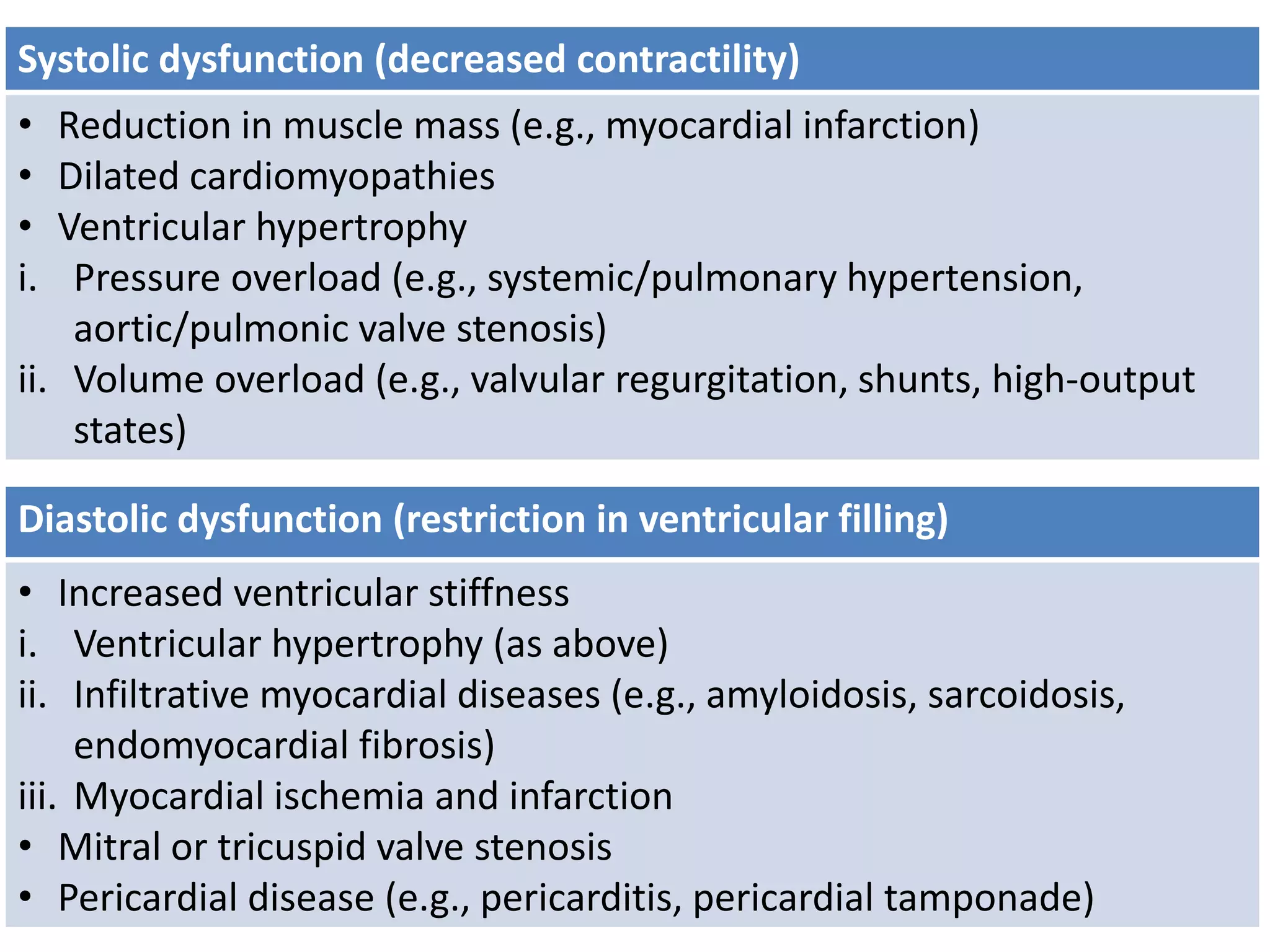
Systolic dysfunction (decreased contractility)
• Reduction in muscle mass (e.g., myocardial infarction)
• Dilated cardiomyopathies
• Ventricular hypertrophy
i. Pressure overload (e.g., systemic/pulmonary hypertension,
aortic/pulmonic valve stenosis)
ii. Volume overload (e.g., valvular regurgitation, shunts, high-output
states)
Diastolic dysfunction (restriction in ventricular filling)
• Increased ventricular stiffness
i. Ventricular hypertrophy (as above)
ii. Infiltrative myocardial diseases (e.g., amyloidosis, sarcoidosis,
endomyocardial fibrosis)
iii. Myocardial ischemia and infarction
• Mitral or tricuspid valve stenosis
• Pericardial disease (e.g., pericarditis, pericardial tamponade)
PATHOPHYSIOLOGY
Normal Cardiac Performance
• To understand the pathophysiologic processes in
heart failure, a basic understanding of normal
cardiac function is necessary.
• Cardiac output (CO) is defined as the volume of
blood ejected per unit time (L/min) and is the
product of heart rate (HR) and stroke volume (SV):
CO = HR × SV
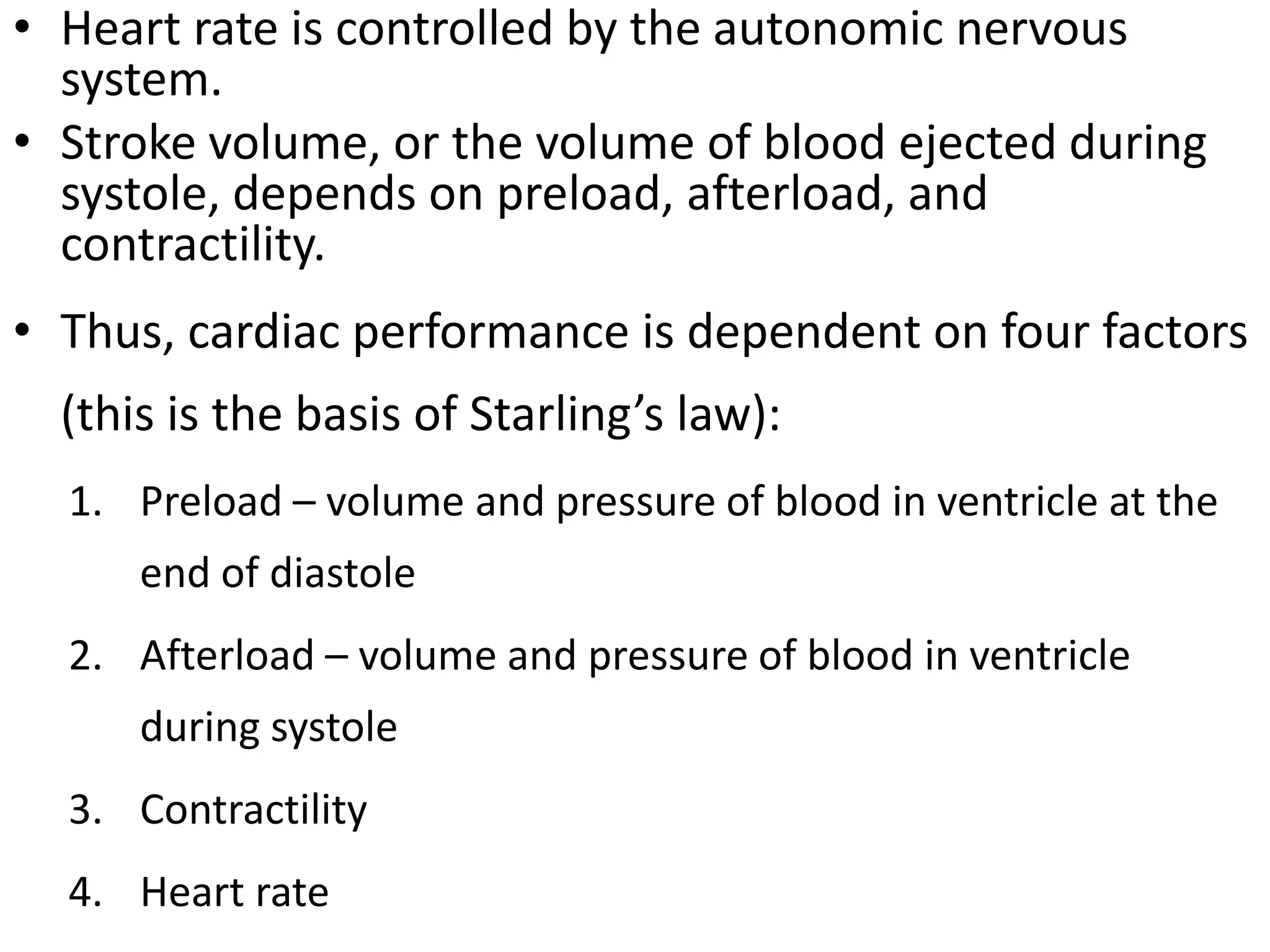
• Heart rate is controlled by the autonomic nervous
system.
• Stroke volume, or the volume of blood ejected during
systole, depends on preload, afterload, and
contractility.
• Thus, cardiac performance is dependent on four factors
(this is the basis of Starling’s law):
1. Preload – volume and pressure of blood in ventricle at the
end of diastole
2. Afterload – volume and pressure of blood in ventricle
during systole
3. Contractility
4. Heart rate
Compensatory mechanisms
• Heart failure is a progressive disorder initiated by an event
that impairs the ability of the heart to contract and/or relax.
• The index event may have an acute onset, as with myocardial
infarction, or the onset may be slow, as with long-standing
hypertension.
• Regardless of the index event, the decrease in the heart’s
pumping capacity results in the heart having to rely on
compensatory responses to maintain an adequate cardiac
output.
• The compensatory mechanisms include:
1. Tachycardia and increased contractility through
Sympathetic stimulation
2. Increased preload due to decreased sodium and
water retention because of activation of RAAS,
which is activated by decreased renal perfusion
3. Vasoconstriction and increased afterload-
vasoconstriction occurs due to a number of
neurohormones like NE, angiotensin 2, endothelin-
1 and vasopressin. Vasoconstriction increases
peripheral vascular resistence and hence further
decreases cardiac output
4. Ventricular hypertrophy and remodelling
CLINICAL PRESENTATION
General
• Patient presentation may range from asymptomatic
to cardiogenic shock
• The clinical picture depends on the nature of the
underlying heart disease, the type of heart failure
that it has evoked, and the neurohumoral changes
that have developed
Symptoms
• Dyspnea, particularly on
exertion
• Orthopnea
• Paroxysmal nocturnal
dyspnea
• Exercise intolerance
• Tachypnea
• Cough
• Fatigue
• Nocturia
• Hemoptysis
• Abdominal pain
• Anorexia
• Nausea
• Bloating
• Poor appetite, early satiety
• Ascites
• Mental status changes
Signs
• Pulmonary rales
• Pulmonary edema
• S3 gallop
• Cool extremities
• Pleural effusion
• Cheyne-Stokes respiration
• Tachycardia
• Narrow pulse pressure
• Cardiomegaly
• Peripheral edema
• Jugular venous distension
• Hepatojugular reflux
• •Hepatomegaly
INVESTIGATIONS
Blood tests
• Blood gas analysis – to assess respiratory gas
exchange
• Serum creatinine and urea – to assess renal
function
• Serum alanine- and aspartate-aminotransferase
plus other liver function tests – increased due to
hepatic congestion
• Complete blood count (CBC) – to investigate
possibility of anaemia and if heart failure is due to it
• Thyroid function tests to investigate possibility of
thyrotoxicosis
• Brain natriuretic peptide (BNP) – elevated in heart
failure ( >100 pg/mL) and is a marker of risk; it is
useful in the investigation of patients with
breathlessness or peripheral oedema.
• Neopterin levels increase and are biomarkers of
cardiovascular remodelling
Electrocardiogram
• A routine 12-lead ECG is recommended. The major
importance of the ECG is to assess cardiac rhythm
and determine the presence of LV hypertrophy or a
prior MI (presence or absence of Q waves) as well
as to determine QRS width to ascertain whether the
patient may benefit from resynchronization therapy
(see below). A normal ECG virtually excludes LV
systolic dysfunction
Echocardiogram
• Non-invasive cardiac imaging is essential for the
diagnosis, evaluation, and management of HF. The
most useful test is the two-dimensional (2-D)
echocardiogram/Doppler, which can provide a
semiquantitative assessment of LV size and function
as well as the presence or absence of valvular
and/or regional wall motion abnormalities
(indicative of a prior MI).
• Echocardiogram assesses left ventricle size, valve
function, pericardial effusion, wall motion
abnormalities, and ejection fraction
• Although the history, physical examination, and
laboratory tests can provide important clues to the
underlying cause of heart failure, the
echocardiogram is the single most useful test in the
evaluation of a patient with heart failure
• Echocardiography is very useful and should be
considered in all patients with heart failure in order
to:
determine the aetiology
detect hitherto unsuspected valvular heart disease,
such as occult mitral stenosis, and other conditions that
may be amenable to specific remedies
identify patients who will benefit from long-term
therapy with drugs, such as ACE inhibitors (see below).
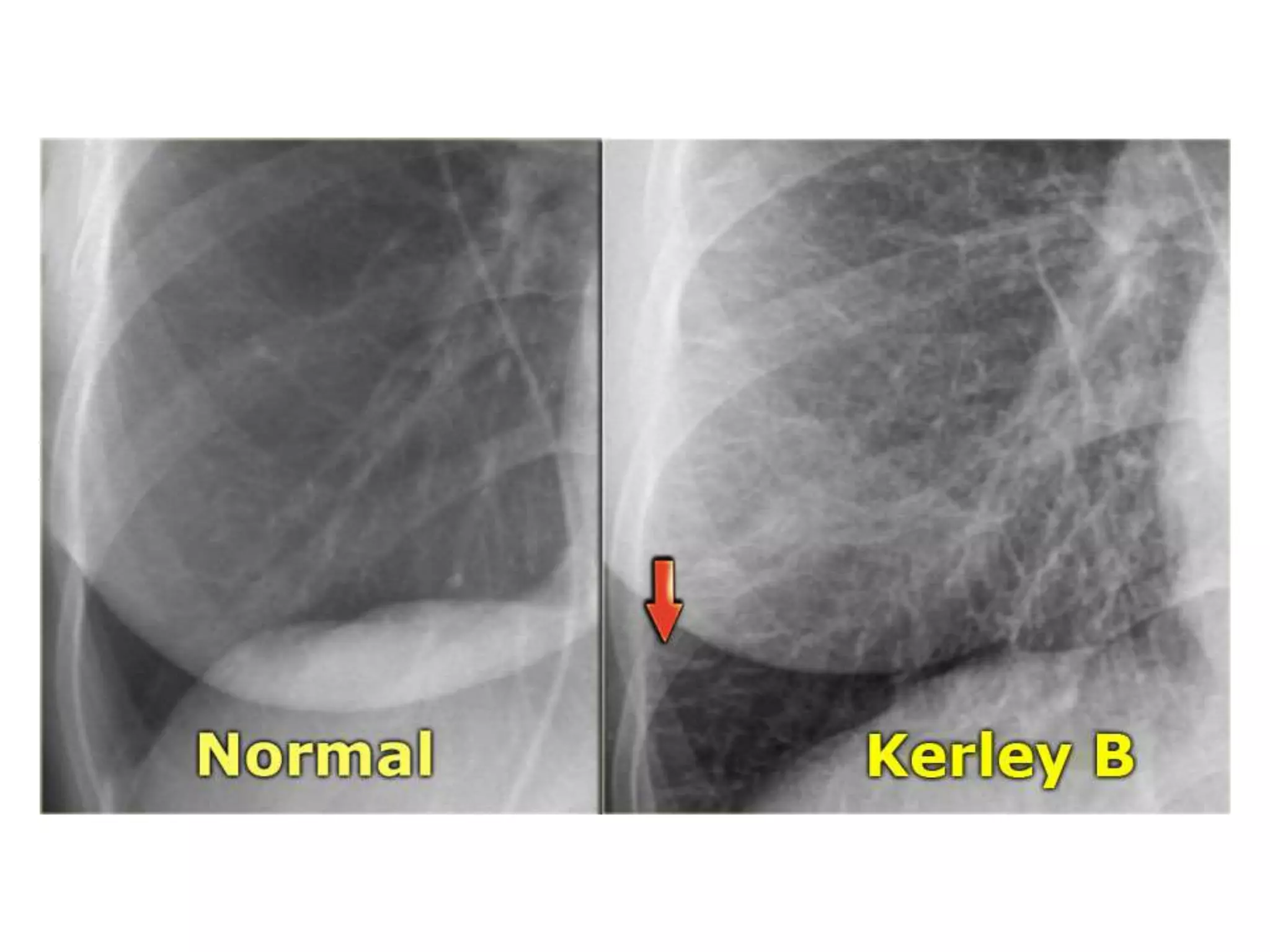
Chest radiography
• A chest x-ray provides useful information about
cardiac size and shape, as well as the state of the
pulmonary vasculature (for edema), and may
identify non-cardiac causes of the patient's
symptoms
TREATMENT
Goals of therapy
• Relieve or reduce symptoms
• Delay progression of the disease
• Decrease hospitalization
• Mainly decrease preload and afterload
Although these goals are still important, identification
of risk factors for heart failure development and
recognition of its progressive nature have led to
increased emphasis on preventing the development of
this disorder.
• With this in mind, the American College of
Cardiology/American Heart Association (ACC/AHA)
guidelines for the evaluation and management of
chronic heart failure use a staging system that
recognizes not only the evolution and progression
of the disorder, but also emphasizes risk factor
modification and preventive treatment strategies.
• The New York Heart Association (NYHA) system is
primarily intended to classify symptomatic heart
failure according to the clinician’s subjective
evaluation and does not recognize preventive
measures or the progression of the disorder.
Non-pharmacologic therapy
Pharmacologic therapy

Congestive heart failure

  • 1.
  • 3.
  • 4.
    • Congestive HeartFailure is a clinical syndrome in which the heart is unable to pump sufficient blood to meet the metabolic requirements of the body, or can do so only at an elevated filling pressure
  • 5.
  • 6.
    • HF isa burgeoning problem worldwide, with more than 20 million people affected. • The overall prevalence of HF in the adult population in developed countries is 2%. • HF prevalence follows an exponential pattern, rising with age, and affects 6–10% of people over age 65. • Although the relative incidence of HF is lower in women than in men, women constitute at least one- half the cases of HF because of their longer life expectancy
  • 7.
    • Although HFonce was thought to arise primarily in the setting of a depressed left ventricular (LV) ejection fraction (EF), epidemiologic studies have shown that approximately one-half of patients who develop HF have a normal or preserved EF (EF 40–50%). • Accordingly, HF patients are now broadly categorized into one of two groups: (1) HF with a depressed EF (commonly referred to as systolic failure) or (2) HF with a preserved EF (commonly referred to as diastolic failure).
  • 8.
  • 9.
    Heart failure Low-output versus High- output Low-output: metabolic demandsare normal but heart is unable to meet them High-output: metabolic demands are increased and the heart is unable to meet them Left-sided, Right-sided and Biventricular Left-sided: when blood is not adequately pumped from the left ventricle Right-sided: when blood is not pumped adequately from right ventricle Biventricular (Left + Right)
  • 10.
    • However, boththe above classifications are outdated and not used clinically. They are used only academically for better understanding • The classification currently used clinically is that of systolic-failure versus diastolic-failure which was explained in epidemiology. • Apart from this, it is also classified as acute / chronic failure.
  • 11.
  • 12.
    • Heart failurecan result from any disorder that affects the ability of the heart to contract (systolic function) and/or relax (diastolic dysfunction) • Common causes are given in the table below
  • 13.
    Systolic dysfunction (decreasedcontractility) • Reduction in muscle mass (e.g., myocardial infarction) • Dilated cardiomyopathies • Ventricular hypertrophy i. Pressure overload (e.g., systemic/pulmonary hypertension, aortic/pulmonic valve stenosis) ii. Volume overload (e.g., valvular regurgitation, shunts, high-output states) Diastolic dysfunction (restriction in ventricular filling) • Increased ventricular stiffness i. Ventricular hypertrophy (as above) ii. Infiltrative myocardial diseases (e.g., amyloidosis, sarcoidosis, endomyocardial fibrosis) iii. Myocardial ischemia and infarction • Mitral or tricuspid valve stenosis • Pericardial disease (e.g., pericarditis, pericardial tamponade)
  • 14.
  • 15.
    Normal Cardiac Performance •To understand the pathophysiologic processes in heart failure, a basic understanding of normal cardiac function is necessary. • Cardiac output (CO) is defined as the volume of blood ejected per unit time (L/min) and is the product of heart rate (HR) and stroke volume (SV): CO = HR × SV
  • 16.
    • Heart rateis controlled by the autonomic nervous system. • Stroke volume, or the volume of blood ejected during systole, depends on preload, afterload, and contractility. • Thus, cardiac performance is dependent on four factors (this is the basis of Starling’s law): 1. Preload – volume and pressure of blood in ventricle at the end of diastole 2. Afterload – volume and pressure of blood in ventricle during systole 3. Contractility 4. Heart rate
  • 18.
    Compensatory mechanisms • Heartfailure is a progressive disorder initiated by an event that impairs the ability of the heart to contract and/or relax. • The index event may have an acute onset, as with myocardial infarction, or the onset may be slow, as with long-standing hypertension. • Regardless of the index event, the decrease in the heart’s pumping capacity results in the heart having to rely on compensatory responses to maintain an adequate cardiac output.
  • 19.
    • The compensatorymechanisms include: 1. Tachycardia and increased contractility through Sympathetic stimulation 2. Increased preload due to decreased sodium and water retention because of activation of RAAS, which is activated by decreased renal perfusion 3. Vasoconstriction and increased afterload- vasoconstriction occurs due to a number of neurohormones like NE, angiotensin 2, endothelin- 1 and vasopressin. Vasoconstriction increases peripheral vascular resistence and hence further decreases cardiac output 4. Ventricular hypertrophy and remodelling
  • 26.
  • 27.
    General • Patient presentationmay range from asymptomatic to cardiogenic shock • The clinical picture depends on the nature of the underlying heart disease, the type of heart failure that it has evoked, and the neurohumoral changes that have developed
  • 28.
    Symptoms • Dyspnea, particularlyon exertion • Orthopnea • Paroxysmal nocturnal dyspnea • Exercise intolerance • Tachypnea • Cough • Fatigue • Nocturia • Hemoptysis • Abdominal pain • Anorexia • Nausea • Bloating • Poor appetite, early satiety • Ascites • Mental status changes
  • 29.
    Signs • Pulmonary rales •Pulmonary edema • S3 gallop • Cool extremities • Pleural effusion • Cheyne-Stokes respiration • Tachycardia • Narrow pulse pressure • Cardiomegaly • Peripheral edema • Jugular venous distension • Hepatojugular reflux • •Hepatomegaly
  • 30.
  • 31.
    Blood tests • Bloodgas analysis – to assess respiratory gas exchange • Serum creatinine and urea – to assess renal function • Serum alanine- and aspartate-aminotransferase plus other liver function tests – increased due to hepatic congestion
  • 32.
    • Complete bloodcount (CBC) – to investigate possibility of anaemia and if heart failure is due to it • Thyroid function tests to investigate possibility of thyrotoxicosis • Brain natriuretic peptide (BNP) – elevated in heart failure ( >100 pg/mL) and is a marker of risk; it is useful in the investigation of patients with breathlessness or peripheral oedema.
  • 33.
    • Neopterin levelsincrease and are biomarkers of cardiovascular remodelling
  • 34.
    Electrocardiogram • A routine12-lead ECG is recommended. The major importance of the ECG is to assess cardiac rhythm and determine the presence of LV hypertrophy or a prior MI (presence or absence of Q waves) as well as to determine QRS width to ascertain whether the patient may benefit from resynchronization therapy (see below). A normal ECG virtually excludes LV systolic dysfunction
  • 35.
    Echocardiogram • Non-invasive cardiacimaging is essential for the diagnosis, evaluation, and management of HF. The most useful test is the two-dimensional (2-D) echocardiogram/Doppler, which can provide a semiquantitative assessment of LV size and function as well as the presence or absence of valvular and/or regional wall motion abnormalities (indicative of a prior MI).
  • 36.
    • Echocardiogram assessesleft ventricle size, valve function, pericardial effusion, wall motion abnormalities, and ejection fraction • Although the history, physical examination, and laboratory tests can provide important clues to the underlying cause of heart failure, the echocardiogram is the single most useful test in the evaluation of a patient with heart failure
  • 37.
    • Echocardiography isvery useful and should be considered in all patients with heart failure in order to: determine the aetiology detect hitherto unsuspected valvular heart disease, such as occult mitral stenosis, and other conditions that may be amenable to specific remedies identify patients who will benefit from long-term therapy with drugs, such as ACE inhibitors (see below).
  • 38.
    Chest radiography • Achest x-ray provides useful information about cardiac size and shape, as well as the state of the pulmonary vasculature (for edema), and may identify non-cardiac causes of the patient's symptoms
  • 41.
  • 42.
    Goals of therapy •Relieve or reduce symptoms • Delay progression of the disease • Decrease hospitalization • Mainly decrease preload and afterload Although these goals are still important, identification of risk factors for heart failure development and recognition of its progressive nature have led to increased emphasis on preventing the development of this disorder.
  • 43.
    • With thisin mind, the American College of Cardiology/American Heart Association (ACC/AHA) guidelines for the evaluation and management of chronic heart failure use a staging system that recognizes not only the evolution and progression of the disorder, but also emphasizes risk factor modification and preventive treatment strategies.
  • 44.
    • The NewYork Heart Association (NYHA) system is primarily intended to classify symptomatic heart failure according to the clinician’s subjective evaluation and does not recognize preventive measures or the progression of the disorder.
  • 47.
  • 48.