Antacids
Presented by
Dr. Jasmine Chaudhary
Associate Professor
MMCP, MM(DU), Mullana
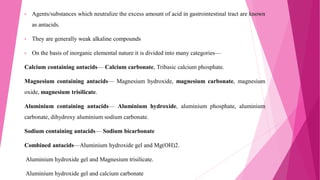
• Agents/substances which neutralize the excess amount of acid in gastrointestinal tract are known
as antacids.
• They are generally weak alkaline compounds
• On the basis of inorganic elemental nature it is divided into many categories—
Calcium containing antacids— Calcium carbonate, Tribasic calcium phosphate.
Magnesium containing antacids— Magnesium hydroxide, magnesium carbonate, magnesium
oxide, magnesium trisilicate.
Aluminium containing antacids— Aluminium hydroxide, aluminium phosphate, aluminium
carbonate, dihydroxy aluminium sodium carbonate.
Sodium containing antacids— Sodium bicarbonate
Combined antacids—Aluminium hydroxide gel and Mg(OH)2.
Aluminium hydroxide gel and Magnesium trisilicate.
Aluminium hydroxide gel and calcium carbonate
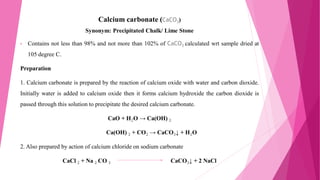
Calcium carbonate (CaCO3)
Synonym: Precipitated Chalk/ Lime Stone
• Contains not less than 98% and not more than 102% of CaCO3 calculated wrt sample dried at
105 degree C.
Preparation
1. Calcium carbonate is prepared by the reaction of calcium oxide with water and carbon dioxide.
Initially water is added to calcium oxide then it forms calcium hydroxide the carbon dioxide is
passed through this solution to precipitate the desired calcium carbonate.
CaO + H2O → Ca(OH) 2
Ca(OH) 2 + CO2 → CaCO3↓ + H2O
2. Also prepared by action of calcium chloride on sodium carbonate
CaCl 2 + Na 2 CO 3 CaCO3↓ + 2 NaCl
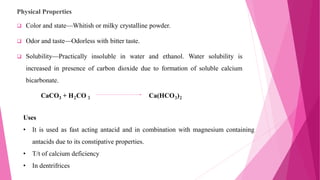
Physical Properties
 Color and state—Whitish or milky crystalline powder.
 Odor and taste—Odorless with bitter taste.
 Solubility—Practically insoluble in water and ethanol. Water solubility is
increased in presence of carbon dioxide due to formation of soluble calcium
bicarbonate.
CaCO3 + H2CO 3 Ca(HCO3)2
Uses
• It is used as fast acting antacid and in combination with magnesium containing
antacids due to its constipative properties.
• T/t of calcium deficiency
• In dentrifrices
Assay
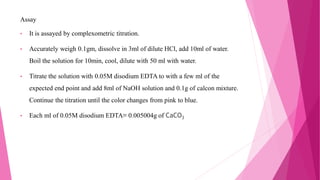
• It is assayed by complexometric titration.
• Accurately weigh 0.1gm, dissolve in 3ml of dilute HCl, add 10ml of water.
Boil the solution for 10min, cool, dilute with 50 ml with water.
• Titrate the solution with 0.05M disodium EDTA to with a few ml of the
expected end point and add 8ml of NaOH solution and 0.1g of calcon mixture.
Continue the titration until the color changes from pink to blue.
• Each ml of 0.05M disodium EDTA≡ 0.005004g of CaCO3
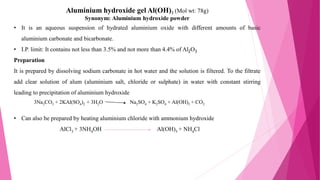
Aluminium hydroxide gel Al(OH)3 (Mol wt: 78g)
Synonym: Aluminium hydroxide powder
• It is an aqueous suspension of hydrated aluminium oxide with different amounts of basic
aluminium carbonate and bicarbonate.
• I.P. limit: It contains not less than 3.5% and not more than 4.4% of Al2O3
Preparation
It is prepared by dissolving sodium carbonate in hot water and the solution is filtered. To the filtrate
add clear solution of alum (aluminium salt, chloride or sulphate) in water with constant stirring
leading to precipitation of aluminium hydroxide
• Can also be prepared by heating aluminium chloride with ammonium hydroxide
AlCl3 + 3NH4OH Al(OH)3 + NH4Cl
3Na2CO3 + 2KAl(SO4)2 + 3H2O Na2SO4 + K2SO4 + Al(OH)3 + CO2
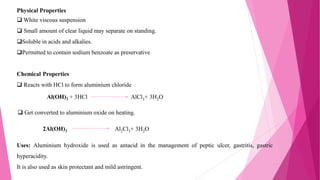
Physical Properties
 White viscous suspension
 Small amount of clear liquid may separate on standing.
Soluble in acids and alkalies.
Permitted to contain sodium benzoate as preservative
Chemical Properties
 Reacts with HCl to form aluminium chloride
Al(OH)3 + 3HCl AlCl3+ 3H2O
Uses: Aluminium hydroxide is used as antacid in the management of peptic ulcer, gastritis, gastric
hyperacidity.
It is also used as skin protectant and mild astringent.
 Get converted to aluminium oxide on heating.
2Al(OH)3 Al2Cl3+ 3H2O
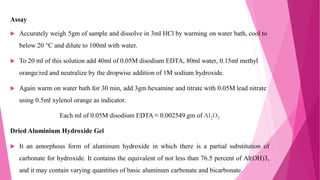
Assay
 Accurately weigh 5gm of sample and dissolve in 3ml HCl by warming on water bath, cool to
below 20 °C and dilute to 100ml with water.
 To 20 ml of this solution add 40ml of 0.05M disodium EDTA, 80ml water, 0.15ml methyl
orange/red and neutralize by the dropwise addition of 1M sodium hydroxide.
 Again warm on water bath for 30 min, add 3gm hexamine and titrate with 0.05M lead nitrate
using 0.5ml xylenol orange as indicator.
Each ml of 0.05M disodium EDTA ≡ 0.002549 gm of Al2O3
Dried Aluminium Hydroxide Gel
 It an amorphous form of aluminum hydroxide in which there is a partial substitution of
carbonate for hydroxide. It contains the equivalent of not less than 76.5 percent of Al(OH)3,
and it may contain varying quantities of basic aluminum carbonate and bicarbonate.
Magnesium Trisilicate
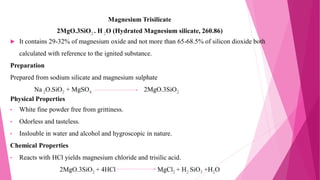
2MgO.3SiO2 . H 2O (Hydrated Magnesium silicate, 260.86)
 It contains 29-32% of magnesium oxide and not more than 65-68.5% of silicon dioxide both
calculated with reference to the ignited substance.
Preparation
Prepared from sodium silicate and magnesium sulphate
Na 2O.SiO2 + MgSO4 2MgO.3SiO2
Physical Properties
• White fine powder free from grittiness.
• Odorless and tasteless.
• Inslouble in water and alcohol and hygroscopic in nature.
Chemical Properties
• Reacts with HCl yields magnesium chloride and trisilic acid.
2MgO.3SiO2 + 4HCl MgCl2 + H2 SiO3 +H2O
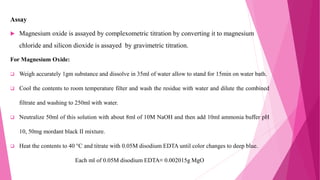
Assay
 Magnesium oxide is assayed by complexometric titration by converting it to magnesium
chloride and silicon dioxide is assayed by gravimetric titration.
For Magnesium Oxide:
 Weigh accurately 1gm substance and dissolve in 35ml of water allow to stand for 15min on water bath.
 Cool the contents to room temperature filter and wash the residue with water and dilute the combined
filtrate and washing to 250ml with water.
 Neutralize 50ml of this solution with about 8ml of 10M NaOH and then add 10ml ammonia buffer pH
10, 50mg mordant black II mixture.
 Heat the contents to 40 °C and titrate with 0.05M disodium EDTA until color changes to deep blue.
Each ml of 0.05M disodium EDTA≡ 0.002015g MgO
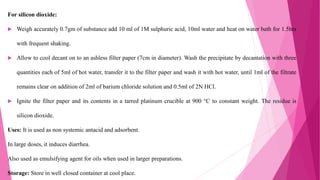
For silicon dioxide:
 Weigh accurately 0.7gm of substance add 10 ml of 1M sulphuric acid, 10ml water and heat on water bath for 1.5hrs
with frequent shaking.
 Allow to cool decant on to an ashless filter paper (7cm in diameter). Wash the precipitate by decantation with three
quantities each of 5ml of hot water, transfer it to the filter paper and wash it with hot water, until 1ml of the filtrate
remains clear on addition of 2ml of barium chloride solution and 0.5ml of 2N HCl.
 Ignite the filter paper and its contents in a tarred platinum crucible at 900 °C to constant weight. The residue is
silicon dioxide.
Uses: It is used as non systemic antacid and adsorbent.
In large doses, it induces diarrhea.
Also used as emulsifying agent for oils when used in larger preparations.
Storage: Store in well closed container at cool place.
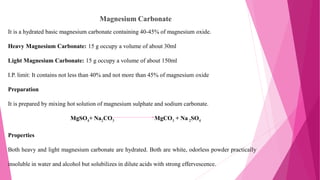
Magnesium Carbonate
It is a hydrated basic magnesium carbonate containing 40-45% of magnesium oxide.
Heavy Magnesium Carbonate: 15 g occupy a volume of about 30ml
Light Magnesium Carbonate: 15 g occupy a volume of about 150ml
I.P. limit: It contains not less than 40% and not more than 45% of magnesium oxide
Preparation
It is prepared by mixing hot solution of magnesium sulphate and sodium carbonate.
MgSO4+ Na2CO3 MgCO3 + Na 2SO4
Properties
Both heavy and light magnesium carbonate are hydrated. Both are white, odorless powder practically
insoluble in water and alcohol but solubilizes in dilute acids with strong effervescence.
Chemical Properties
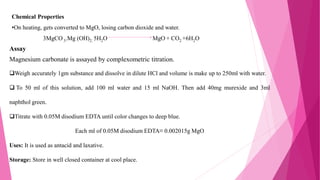
•On heating, gets converted to MgO, losing carbon dioxide and water.
3MgCO 3.Mg (OH)2. 5H2O MgO + CO2 +6H2O
Assay
Magnesium carbonate is assayed by complexometric titration.
Weigh accurately 1gm substance and dissolve in dilute HCl and volume is make up to 250ml with water.
 To 50 ml of this solution, add 100 ml water and 15 ml NaOH. Then add 40mg murexide and 3ml
naphthol green.
Titrate with 0.05M disodium EDTA until color changes to deep blue.
Each ml of 0.05M disodium EDTA≡ 0.002015g MgO
Uses: It is used as antacid and laxative.
Storage: Store in well closed container at cool place.
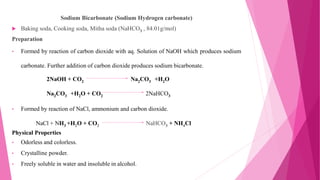
Sodium Bicarbonate (Sodium Hydrogen carbonate)
 Baking soda, Cooking soda, Mitha soda (NaHCO3 , 84.01g/mol)
Preparation
• Formed by reaction of carbon dioxide with aq. Solution of NaOH which produces sodium
carbonate. Further addition of carbon dioxide produces sodium bicarbonate.
• Formed by reaction of NaCl, ammonium and carbon dioxide.
NaCl + NH3 +H2O + CO2 NaHCO3 + NH4Cl
Physical Properties
• Odorless and colorless.
• Crystalline powder.
• Freely soluble in water and insoluble in alcohol.
2NaOH + CO2 Na2CO3 +H2O
Na2CO3 +H2O + CO2 2NaHCO3
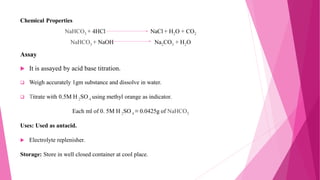
Chemical Properties
NaHCO3 + 4HCl NaCl + H2O + CO2
NaHCO3 + NaOH Na2CO3 + H2O
Assay
 It is assayed by acid base titration.
 Weigh accurately 1gm substance and dissolve in water.
 Titrate with 0.5M H 2SO 4 using methyl orange as indicator.
Each ml of 0. 5M H 2SO 4 ≡ 0.0425g of NaHCO3
Uses: Used as antacid.
 Electrolyte replenisher.
Storage: Store in well closed container at cool place.
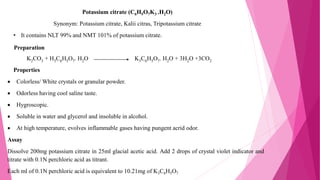
Potassium citrate (C6H5O7K3 .H2O)
Synonym: Potassium citrate, Kalii citras, Tripotassium citrate
• It contains NLT 99% and NMT 101% of potassium citrate.
Preparation
K2CO3 + H3C6H5O7. H2O K3C6H5O7. H2O + 3H2O +3CO2
Properties
 Colorless/ White crystals or granular powder.
 Odorless having cool saline taste.
 Hygroscopic.
 Soluble in water and glycerol and insoluble in alcohol.
 At high temperature, evolves inflammable gases having pungent acrid odor.
Assay
Dissolve 200mg potassium citrate in 25ml glacial acetic acid. Add 2 drops of crystal violet indicator and
titrate with 0.1N perchloric acid as titrant.
Each ml of 0.1N perchloric acid is equivalent to 10.21mg of K3C6H5O7
Uses
 Diuretic, expectorant and diaphoretic.
 Laxative & Alkalinising agent
 Anticoagulant
Magaldrate: It is combination preparation.
• Composed of aluminium hydroxide and magnesium hydroxide.
• Contains equivalent of 28-39% MgO and 17-25% of Al2O3.
• White, colorless, crystalline powder.
• Insoluble in water and alcohol but soluble in dilute mineral acids.
Bismuth carbonate [(BiO2)2(CO3)]2. H2O
Basic carbonate, which upon ignition yield NLT 90% and NMT 92% of Bi2O3 calculated with
reference to substance dried at 105°C for 3 hours.
Preparation
4Bi(NO3)3 + 6Na2CO3 + H2O [(BiO2)2(CO3)]2. H2O + NaNO3 + CO2
Properties
 White or pale yellowish white powder
 Odorless and tasteless.
 Stable in air but slowly affected by light.
 Insoluble in alcohol and water
Assay
It is assayed by gravimetric method. Accurately weighed amount is ignited in tarred crucible to
constant weight and then weight is analyte is calculated using gravimetric factor.
Use
 Mild antacid
 Adsorbant and Anti-diarrheal

Antacids.pdf

  • 1.
    Antacids Presented by Dr. JasmineChaudhary Associate Professor MMCP, MM(DU), Mullana
  • 2.
    • Agents/substances whichneutralize the excess amount of acid in gastrointestinal tract are known as antacids. • They are generally weak alkaline compounds • On the basis of inorganic elemental nature it is divided into many categories— Calcium containing antacids— Calcium carbonate, Tribasic calcium phosphate. Magnesium containing antacids— Magnesium hydroxide, magnesium carbonate, magnesium oxide, magnesium trisilicate. Aluminium containing antacids— Aluminium hydroxide, aluminium phosphate, aluminium carbonate, dihydroxy aluminium sodium carbonate. Sodium containing antacids— Sodium bicarbonate Combined antacids—Aluminium hydroxide gel and Mg(OH)2. Aluminium hydroxide gel and Magnesium trisilicate. Aluminium hydroxide gel and calcium carbonate
  • 3.
    Calcium carbonate (CaCO3) Synonym:Precipitated Chalk/ Lime Stone • Contains not less than 98% and not more than 102% of CaCO3 calculated wrt sample dried at 105 degree C. Preparation 1. Calcium carbonate is prepared by the reaction of calcium oxide with water and carbon dioxide. Initially water is added to calcium oxide then it forms calcium hydroxide the carbon dioxide is passed through this solution to precipitate the desired calcium carbonate. CaO + H2O → Ca(OH) 2 Ca(OH) 2 + CO2 → CaCO3↓ + H2O 2. Also prepared by action of calcium chloride on sodium carbonate CaCl 2 + Na 2 CO 3 CaCO3↓ + 2 NaCl
  • 4.
    Physical Properties  Colorand state—Whitish or milky crystalline powder.  Odor and taste—Odorless with bitter taste.  Solubility—Practically insoluble in water and ethanol. Water solubility is increased in presence of carbon dioxide due to formation of soluble calcium bicarbonate. CaCO3 + H2CO 3 Ca(HCO3)2 Uses • It is used as fast acting antacid and in combination with magnesium containing antacids due to its constipative properties. • T/t of calcium deficiency • In dentrifrices
  • 5.
    Assay • It isassayed by complexometric titration. • Accurately weigh 0.1gm, dissolve in 3ml of dilute HCl, add 10ml of water. Boil the solution for 10min, cool, dilute with 50 ml with water. • Titrate the solution with 0.05M disodium EDTA to with a few ml of the expected end point and add 8ml of NaOH solution and 0.1g of calcon mixture. Continue the titration until the color changes from pink to blue. • Each ml of 0.05M disodium EDTA≡ 0.005004g of CaCO3
  • 6.
    Aluminium hydroxide gelAl(OH)3 (Mol wt: 78g) Synonym: Aluminium hydroxide powder • It is an aqueous suspension of hydrated aluminium oxide with different amounts of basic aluminium carbonate and bicarbonate. • I.P. limit: It contains not less than 3.5% and not more than 4.4% of Al2O3 Preparation It is prepared by dissolving sodium carbonate in hot water and the solution is filtered. To the filtrate add clear solution of alum (aluminium salt, chloride or sulphate) in water with constant stirring leading to precipitation of aluminium hydroxide • Can also be prepared by heating aluminium chloride with ammonium hydroxide AlCl3 + 3NH4OH Al(OH)3 + NH4Cl 3Na2CO3 + 2KAl(SO4)2 + 3H2O Na2SO4 + K2SO4 + Al(OH)3 + CO2
  • 7.
    Physical Properties  Whiteviscous suspension  Small amount of clear liquid may separate on standing. Soluble in acids and alkalies. Permitted to contain sodium benzoate as preservative Chemical Properties  Reacts with HCl to form aluminium chloride Al(OH)3 + 3HCl AlCl3+ 3H2O Uses: Aluminium hydroxide is used as antacid in the management of peptic ulcer, gastritis, gastric hyperacidity. It is also used as skin protectant and mild astringent.  Get converted to aluminium oxide on heating. 2Al(OH)3 Al2Cl3+ 3H2O
  • 8.
    Assay  Accurately weigh5gm of sample and dissolve in 3ml HCl by warming on water bath, cool to below 20 °C and dilute to 100ml with water.  To 20 ml of this solution add 40ml of 0.05M disodium EDTA, 80ml water, 0.15ml methyl orange/red and neutralize by the dropwise addition of 1M sodium hydroxide.  Again warm on water bath for 30 min, add 3gm hexamine and titrate with 0.05M lead nitrate using 0.5ml xylenol orange as indicator. Each ml of 0.05M disodium EDTA ≡ 0.002549 gm of Al2O3 Dried Aluminium Hydroxide Gel  It an amorphous form of aluminum hydroxide in which there is a partial substitution of carbonate for hydroxide. It contains the equivalent of not less than 76.5 percent of Al(OH)3, and it may contain varying quantities of basic aluminum carbonate and bicarbonate.
  • 9.
    Magnesium Trisilicate 2MgO.3SiO2 .H 2O (Hydrated Magnesium silicate, 260.86)  It contains 29-32% of magnesium oxide and not more than 65-68.5% of silicon dioxide both calculated with reference to the ignited substance. Preparation Prepared from sodium silicate and magnesium sulphate Na 2O.SiO2 + MgSO4 2MgO.3SiO2 Physical Properties • White fine powder free from grittiness. • Odorless and tasteless. • Inslouble in water and alcohol and hygroscopic in nature. Chemical Properties • Reacts with HCl yields magnesium chloride and trisilic acid. 2MgO.3SiO2 + 4HCl MgCl2 + H2 SiO3 +H2O
  • 10.
    Assay  Magnesium oxideis assayed by complexometric titration by converting it to magnesium chloride and silicon dioxide is assayed by gravimetric titration. For Magnesium Oxide:  Weigh accurately 1gm substance and dissolve in 35ml of water allow to stand for 15min on water bath.  Cool the contents to room temperature filter and wash the residue with water and dilute the combined filtrate and washing to 250ml with water.  Neutralize 50ml of this solution with about 8ml of 10M NaOH and then add 10ml ammonia buffer pH 10, 50mg mordant black II mixture.  Heat the contents to 40 °C and titrate with 0.05M disodium EDTA until color changes to deep blue. Each ml of 0.05M disodium EDTA≡ 0.002015g MgO
  • 11.
    For silicon dioxide: Weigh accurately 0.7gm of substance add 10 ml of 1M sulphuric acid, 10ml water and heat on water bath for 1.5hrs with frequent shaking.  Allow to cool decant on to an ashless filter paper (7cm in diameter). Wash the precipitate by decantation with three quantities each of 5ml of hot water, transfer it to the filter paper and wash it with hot water, until 1ml of the filtrate remains clear on addition of 2ml of barium chloride solution and 0.5ml of 2N HCl.  Ignite the filter paper and its contents in a tarred platinum crucible at 900 °C to constant weight. The residue is silicon dioxide. Uses: It is used as non systemic antacid and adsorbent. In large doses, it induces diarrhea. Also used as emulsifying agent for oils when used in larger preparations. Storage: Store in well closed container at cool place.
  • 12.
    Magnesium Carbonate It isa hydrated basic magnesium carbonate containing 40-45% of magnesium oxide. Heavy Magnesium Carbonate: 15 g occupy a volume of about 30ml Light Magnesium Carbonate: 15 g occupy a volume of about 150ml I.P. limit: It contains not less than 40% and not more than 45% of magnesium oxide Preparation It is prepared by mixing hot solution of magnesium sulphate and sodium carbonate. MgSO4+ Na2CO3 MgCO3 + Na 2SO4 Properties Both heavy and light magnesium carbonate are hydrated. Both are white, odorless powder practically insoluble in water and alcohol but solubilizes in dilute acids with strong effervescence.
  • 13.
    Chemical Properties •On heating,gets converted to MgO, losing carbon dioxide and water. 3MgCO 3.Mg (OH)2. 5H2O MgO + CO2 +6H2O Assay Magnesium carbonate is assayed by complexometric titration. Weigh accurately 1gm substance and dissolve in dilute HCl and volume is make up to 250ml with water.  To 50 ml of this solution, add 100 ml water and 15 ml NaOH. Then add 40mg murexide and 3ml naphthol green. Titrate with 0.05M disodium EDTA until color changes to deep blue. Each ml of 0.05M disodium EDTA≡ 0.002015g MgO Uses: It is used as antacid and laxative. Storage: Store in well closed container at cool place.
  • 14.
    Sodium Bicarbonate (SodiumHydrogen carbonate)  Baking soda, Cooking soda, Mitha soda (NaHCO3 , 84.01g/mol) Preparation • Formed by reaction of carbon dioxide with aq. Solution of NaOH which produces sodium carbonate. Further addition of carbon dioxide produces sodium bicarbonate. • Formed by reaction of NaCl, ammonium and carbon dioxide. NaCl + NH3 +H2O + CO2 NaHCO3 + NH4Cl Physical Properties • Odorless and colorless. • Crystalline powder. • Freely soluble in water and insoluble in alcohol. 2NaOH + CO2 Na2CO3 +H2O Na2CO3 +H2O + CO2 2NaHCO3
  • 15.
    Chemical Properties NaHCO3 +4HCl NaCl + H2O + CO2 NaHCO3 + NaOH Na2CO3 + H2O Assay  It is assayed by acid base titration.  Weigh accurately 1gm substance and dissolve in water.  Titrate with 0.5M H 2SO 4 using methyl orange as indicator. Each ml of 0. 5M H 2SO 4 ≡ 0.0425g of NaHCO3 Uses: Used as antacid.  Electrolyte replenisher. Storage: Store in well closed container at cool place.
  • 16.
    Potassium citrate (C6H5O7K3.H2O) Synonym: Potassium citrate, Kalii citras, Tripotassium citrate • It contains NLT 99% and NMT 101% of potassium citrate. Preparation K2CO3 + H3C6H5O7. H2O K3C6H5O7. H2O + 3H2O +3CO2 Properties  Colorless/ White crystals or granular powder.  Odorless having cool saline taste.  Hygroscopic.  Soluble in water and glycerol and insoluble in alcohol.  At high temperature, evolves inflammable gases having pungent acrid odor. Assay Dissolve 200mg potassium citrate in 25ml glacial acetic acid. Add 2 drops of crystal violet indicator and titrate with 0.1N perchloric acid as titrant. Each ml of 0.1N perchloric acid is equivalent to 10.21mg of K3C6H5O7
  • 17.
    Uses  Diuretic, expectorantand diaphoretic.  Laxative & Alkalinising agent  Anticoagulant Magaldrate: It is combination preparation. • Composed of aluminium hydroxide and magnesium hydroxide. • Contains equivalent of 28-39% MgO and 17-25% of Al2O3. • White, colorless, crystalline powder. • Insoluble in water and alcohol but soluble in dilute mineral acids.
  • 18.
    Bismuth carbonate [(BiO2)2(CO3)]2.H2O Basic carbonate, which upon ignition yield NLT 90% and NMT 92% of Bi2O3 calculated with reference to substance dried at 105°C for 3 hours. Preparation 4Bi(NO3)3 + 6Na2CO3 + H2O [(BiO2)2(CO3)]2. H2O + NaNO3 + CO2 Properties  White or pale yellowish white powder  Odorless and tasteless.  Stable in air but slowly affected by light.  Insoluble in alcohol and water Assay It is assayed by gravimetric method. Accurately weighed amount is ignited in tarred crucible to constant weight and then weight is analyte is calculated using gravimetric factor. Use  Mild antacid  Adsorbant and Anti-diarrheal