Antihyperlipidemic drugs
Dr. Jasmine Chaudhary
Associate Professor
MMCP
Introduction
Drugs used to treat hyperlipidemia.
Also known as lipid lowering drugs or hypolipidemic.
Hyperlipidemia is an increase in lipids which are a group of fats or fat
like substances in the blood (due to abnormality in lipid metabolism.
Cholesterol and the triglycerides are two lipids in the blood. Elevation of
one or both of these lipids is seen in hyperlipidemia. So accordingly
classified as
• Hyperlipoproteinemia(Increased concentrations of lipoproteins)/
• Hypercholesterolemic (high concentration of cholesterol)/
• Hypertriglyceridemia (high concentration of triglyceride)
 Serum cholesterol levels above 240 mg/dL and triglyceride
levels above 150 mg/dL are associated with atherosclerosis.
 Atherosclerosis is a disorder in which lipid deposits accumulate
on the lining of blood vessels, eventually producing
degenerative changes and obstruction of blood flow.
Atherosclerosis is considered to be a major contributor in the
development of heart disease.
Lipids are water insoluble whereas blood and other body fluids
are watery so they need a special transport which is carried
through protein and this complex is called lipoprotein and the
protein moiety of a lipoprotein is called apolipoprotein which
allow fats to move through the water inside and outside cells.
There are different types of lipoproteins which differ
from each other w.r. t to size, density and relative
proportion of triglycerides and cholesterol
 Chylomicrons (CM).
•Very Low Density Lipoprotein (VLDL).
•Low Density Lipoprotein (LDL).
•Intermediate Density Lipoprotein (IDL).
•High Density Lipoprotein (HDL)
 HDL stands for high-density lipoproteins. It is called the
"good" cholesterol because it carries cholesterol from
other parts of your body back to liver. Liver then
removes the cholesterol from body.
 LDL stands for low-density lipoproteins. It is called the
"bad" cholesterol because a high LDL level leads to a
buildup of cholesterol in arteries.
Causes
• Lifestyle habits (not exercising, and smoking)
• Obesity, diabetes, kidney disease, pregnancy, and an
under active thyroid gland.
• Inherit hyperlipidemia
Classification of
Antihyperlipidemic Drugs
• HMG-CoA-reductase Inhibitor: e.g. Lovastatin, Simvastatin,
Pravastatin
• Fibric acid derivatives: e.g. Clofibrate, Fenofibrate, Ciprofibrate,
Benzafibrate, Gemfibrozil
• Bile-acid sequestrants: e.g. Cholestyramine, Colestipol
• Inhibition of LDL oxidation: e.g. Probucol
• Cholestrol absorption inhibitor: Ezetimibe
• Miscellaneous Agents: e.g. Nicotinic acid, Neomycin, β-Sitosterol,
Acipimox, Metformin, Dextrothyroxine.
HMG CoA-reductase Inhibitors:
Most effective and best tolerated drugs
These drugs bring about specific, reversible and competitive
blockage of HMG-CoA reductase (3-Hydroxy-3-methyl-glutaryl-
CoA reductase), the enzyme that catalyzes the conversion of HMG-
CoA to mevanolate. This reaction is the rate-determining step in the
synthetic pathway of cholesterol leading to decreased hepatic
cholesterol synthesis.
HMG-CoA reductase
HMG-CoA Mevalonic acid Cholesterol
There are two classes of statins:
• Natural Statins:Lovastatin, Compactin, Pravastatin, Simvastatin
• Synthetic Statins: Atorvastatin, Fluvastatin
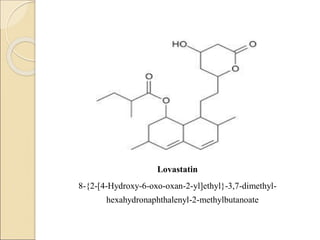
Lovastatin
8-{2-[4-Hydroxy-6-oxo-oxan-2-yl]ethyl}-3,7-dimethyl-
hexahydronaphthalenyl-2-methylbutanoate
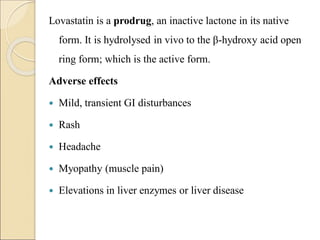
Lovastatin is a prodrug, an inactive lactone in its native
form. It is hydrolysed in vivo to the β-hydroxy acid open
ring form; which is the active form.
Adverse effects
 Mild, transient GI disturbances
 Rash
 Headache
 Myopathy (muscle pain)
 Elevations in liver enzymes or liver disease
Fibric acid derivatives
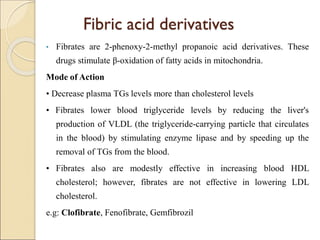
• Fibrates are 2-phenoxy-2-methyl propanoic acid derivatives. These
drugs stimulate β-oxidation of fatty acids in mitochondria.
Mode of Action
• Decrease plasma TGs levels more than cholesterol levels
• Fibrates lower blood triglyceride levels by reducing the liver's
production of VLDL (the triglyceride-carrying particle that circulates
in the blood) by stimulating enzyme lipase and by speeding up the
removal of TGs from the blood.
• Fibrates also are modestly effective in increasing blood HDL
cholesterol; however, fibrates are not effective in lowering LDL
cholesterol.
e.g: Clofibrate, Fenofibrate, Gemfibrozil
Adverse effects
• Abdominal discomfort, diarrhea, nausea
• Blurred vision, headache
• Increased risk of gallstones
• Malignancy
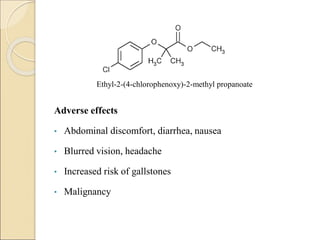
Ethyl-2-(4-chlorophenoxy)-2-methyl propanoate
Bile acid Sequesterents
 Also called Bile acid–binding resins and ion-exchange resins. E.g.
cholestyramine and colestipol.
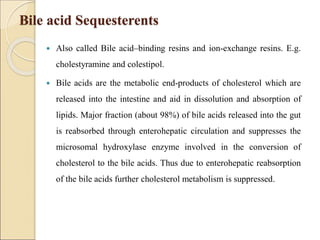
 Bile acids are the metabolic end-products of cholesterol which are
released into the intestine and aid in dissolution and absorption of
lipids. Major fraction (about 98%) of bile acids released into the gut
is reabsorbed through enterohepatic circulation and suppresses the
microsomal hydroxylase enzyme involved in the conversion of
cholesterol to the bile acids. Thus due to enterohepatic reabsorption
of the bile acids further cholesterol metabolism is suppressed.
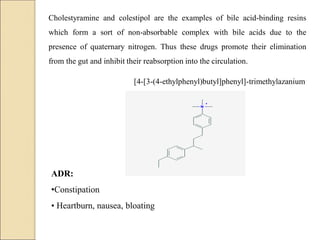
Cholestyramine and colestipol are the examples of bile acid-binding resins
which form a sort of non-absorbable complex with bile acids due to the
presence of quaternary nitrogen. Thus these drugs promote their elimination
from the gut and inhibit their reabsorption into the circulation.
ADR:
•Constipation
• Heartburn, nausea, bloating
[4-[3-(4-ethylphenyl)butyl]phenyl]-trimethylazanium
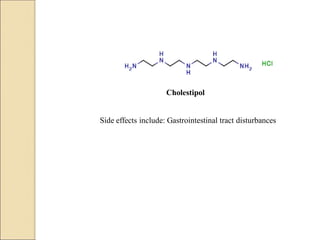
Cholestipol
Side effects include: Gastrointestinal tract disturbances
Inhibition of LDL oxidation:
The antioxidant effects of agents of this group inhibit the oxidation of
LDL, thereby, preventing its uptake by macrophages. This may help
prevent development of atherosclerosis. E.g Probucol
Cholestrol absorption inhibitor: Ezetimibe
It is a drug that lowers plasma cholesterol levels by decreasing
cholesterol absorption in the intestine.
Miscellaneous
Niacin (A water soluble vitamin of the B family)
• Increases activity of lipase, which breaks down lipids
• Reduces the metabolism of cholesterol and triglycerides
Adverse effects
• Flushing (due to histamine release)
• Pruritus
• GI distress
 β – Sitotsterol: It is a plant sterol.
Due to the structural similarity with cholesterol, this agent
impedes the absorption of dietary cholesterol and produces a
moderate reduction in cholesterol level. Its low efficacy and
high cost decrease its popularity as lipid lowering agent.