PT 103 PHARMACEUTICAL INORGANIC
CHEMISTRY(THEORY)
KUNAL DATTA
UNIT III : Gastrointestinal Agents
Cathartics
Cathartics
• Laxatives, purgatives, or cathartics are the drugs
that loosen stools and increase bowel movements.
• They are used to treat or prevent Constipation.
• Constipation is the infrequent or difficult
evacuation of the faeces.
To ease defecation in patients
To relieve acute constipation Or
To clear bowels before surgery
To remove solid material from intestinal
tract
Uses of Cathartics
Types of Cathartics
Laxative or aperient: Milder action, elimination of
soft but formed stools. Onset of action: 12-72 hours.
Purgative: Purgative are moderate laxative. Onset of
action: 6-8 hours.
Cathartic: Stronger action resulting in more fluid
evacuation. Onset of action: 0.5-3 hours (oral), 2-15
minutes (rectal)
 Bulk forming: Dietary fibre: Isapgol (Plantago),
Methylcellulose
 Stool softener: Docusates (DOSS), Liquid paraffin
 Stimulant purgatives: Senna, Sodium picosulfate,
Castor oil
 Osmotic purgatives [Saline (Osmotic) Cathartics]:
Magnesium salts: sulfate, hydroxide; Sodium salts:
sulfate, phosphate; Sod. Pot. tartarate; Lactulose
Classification of Cathartics
Some Commonly Used Cathartics
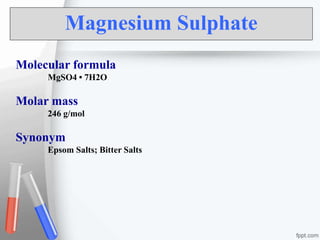
Magnesium Sulphate
Molecular formula
MgSO4 • 7H2O
Molar mass
246 g/mol
Synonym
Epsom Salts; Bitter Salts
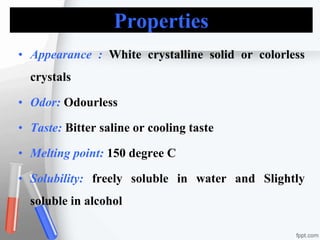
Properties
• Appearance : White crystalline solid or colorless
crystals
• Odor: Odourless
• Taste: Bitter saline or cooling taste
• Melting point: 150 degree C
• Solubility: freely soluble in water and Slightly
soluble in alcohol
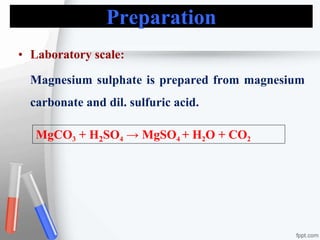
Preparation
• Laboratory scale:
Magnesium sulphate is prepared from magnesium
carbonate and dil. sulfuric acid.
MgCO3 + H2SO4 → MgSO4 + H2O + CO2
Preparation
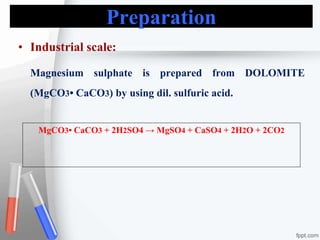
• Industrial scale:
Magnesium sulphate is prepared from DOLOMITE
(MgCO3• CaCO3) by using dil. sulfuric acid.
MgCO3• CaCO3 + 2H2SO4 → MgSO4 + CaSO4 + 2H2O + 2CO2
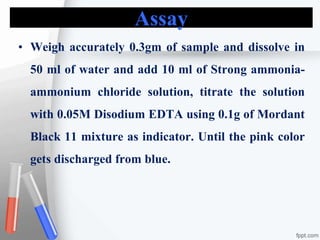
Assay
• Weigh accurately 0.3gm of sample and dissolve in
50 ml of water and add 10 ml of Strong ammonia-
ammonium chloride solution, titrate the solution
with 0.05M Disodium EDTA using 0.1g of Mordant
Black 11 mixture as indicator. Until the pink color
gets discharged from blue.
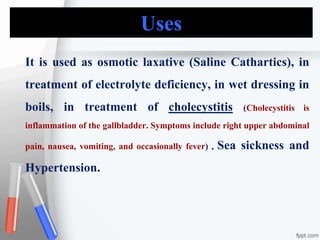
Uses
It is used as osmotic laxative (Saline Cathartics), in
treatment of electrolyte deficiency, in wet dressing in
boils, in treatment of cholecystitis (Cholecystitis is
inflammation of the gallbladder. Symptoms include right upper abdominal
pain, nausea, vomiting, and occasionally fever) , Sea sickness and
Hypertension.
Storage
• Store in air tight container.
Dose
• 10-15g/day
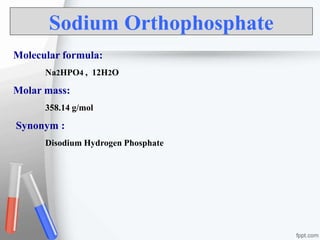
Sodium Orthophosphate
Molecular formula:
Na2HPO4 , 12H2O
Molar mass:
358.14 g/mol
Synonym :
Disodium Hydrogen Phosphate
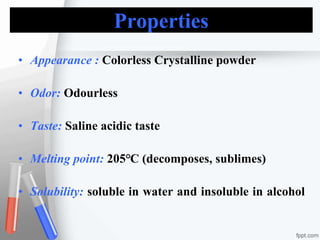
Properties
• Appearance : Colorless Crystalline powder
• Odor: Odourless
• Taste: Saline acidic taste
• Melting point: 205℃ (decomposes, sublimes)
• Solubility: soluble in water and insoluble in alcohol
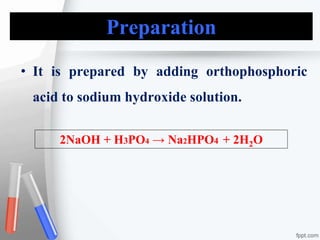
Preparation
2NaOH + H3PO4 → Na2HPO4 + 2H2O
• It is prepared by adding orthophosphoric
acid to sodium hydroxide solution.
Assay
• Weigh accurately 6 gm of sample and dissolve in
100 ml of water titrate the solution with 0.5 N
H2SO4 using Bromocresol as indicator.
Uses
 Saline Laxative
 Cathartic and buffering agent.
 Urinary Acidifier
Storage
• Store in well-closed containers.
Dose
• 2 to 16g .
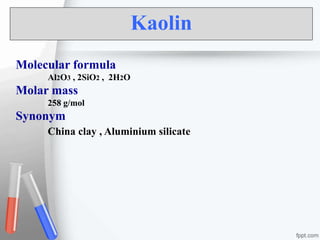
Kaolin
Molecular formula
Al2O3 , 2SiO2 , 2H2O
Molar mass
258 g/mol
Synonym
China clay , Aluminium silicate
Physical Properties
• Appearance : Slightly plastic like and white in color
• Odor: Odourless
• Taste: Clay like taste
• Solubility: Insoluble in water and alcohol
Chemical Properties
• On Heating kaolin losses water molecule.
• It is decomposed by boiling with Conc. H2SO4.
Preparation
It is Hydrated aluminium silicate , prepared when
the rock is mined, executed , the impurities was
washed with the flow of water and then powdered.
Uses
 Kaolin is used as an antidiarrhoeal and
increase the bulk of faeces.
 It has been also used in the treatment of
chronic ulcerative colitis.
Dose
• 15 to 75 gm in three divided dose
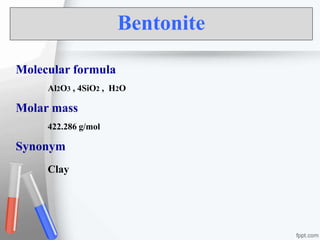
Bentonite
Molecular formula
Al2O3 , 4SiO2 , H2O
Molar mass
422.286 g/mol
Synonym
Clay
Physical Properties
• It is a very fine odourless , cream colored clay and
is formed from volcanic ash and water.
• It has absorptive properties.
• It has excellent plasticity and lubricity properties.
• It has binding properties and dry sealing
properties.
• It is insoluble in water but soluble in organic
solvents.
Uses
 It is used as Cathartics due to its amazing absorption
properties.
 It can remove toxin materials and chemicals
 It helps to detoxify the digestive system
 It is helpful in removing the internal parasites from
digestive system.
 Its supports in boosting immune system.
 It can be used as an antioxidant.
 As a Pharmaceutical aid it is also used as a binder and
suspending agents.
THANK YOU

Gastrointestinal agents _ Cathartics.ppt

  • 1.
    PT 103 PHARMACEUTICALINORGANIC CHEMISTRY(THEORY) KUNAL DATTA UNIT III : Gastrointestinal Agents Cathartics
  • 2.
  • 3.
    • Laxatives, purgatives,or cathartics are the drugs that loosen stools and increase bowel movements. • They are used to treat or prevent Constipation. • Constipation is the infrequent or difficult evacuation of the faeces.
  • 4.
    To ease defecationin patients To relieve acute constipation Or To clear bowels before surgery To remove solid material from intestinal tract Uses of Cathartics
  • 5.
    Types of Cathartics Laxativeor aperient: Milder action, elimination of soft but formed stools. Onset of action: 12-72 hours. Purgative: Purgative are moderate laxative. Onset of action: 6-8 hours. Cathartic: Stronger action resulting in more fluid evacuation. Onset of action: 0.5-3 hours (oral), 2-15 minutes (rectal)
  • 6.
     Bulk forming:Dietary fibre: Isapgol (Plantago), Methylcellulose  Stool softener: Docusates (DOSS), Liquid paraffin  Stimulant purgatives: Senna, Sodium picosulfate, Castor oil  Osmotic purgatives [Saline (Osmotic) Cathartics]: Magnesium salts: sulfate, hydroxide; Sodium salts: sulfate, phosphate; Sod. Pot. tartarate; Lactulose Classification of Cathartics
  • 7.
  • 8.
    Magnesium Sulphate Molecular formula MgSO4• 7H2O Molar mass 246 g/mol Synonym Epsom Salts; Bitter Salts
  • 9.
    Properties • Appearance :White crystalline solid or colorless crystals • Odor: Odourless • Taste: Bitter saline or cooling taste • Melting point: 150 degree C • Solubility: freely soluble in water and Slightly soluble in alcohol
  • 10.
    Preparation • Laboratory scale: Magnesiumsulphate is prepared from magnesium carbonate and dil. sulfuric acid. MgCO3 + H2SO4 → MgSO4 + H2O + CO2
  • 11.
    Preparation • Industrial scale: Magnesiumsulphate is prepared from DOLOMITE (MgCO3• CaCO3) by using dil. sulfuric acid. MgCO3• CaCO3 + 2H2SO4 → MgSO4 + CaSO4 + 2H2O + 2CO2
  • 12.
    Assay • Weigh accurately0.3gm of sample and dissolve in 50 ml of water and add 10 ml of Strong ammonia- ammonium chloride solution, titrate the solution with 0.05M Disodium EDTA using 0.1g of Mordant Black 11 mixture as indicator. Until the pink color gets discharged from blue.
  • 13.
    Uses It is usedas osmotic laxative (Saline Cathartics), in treatment of electrolyte deficiency, in wet dressing in boils, in treatment of cholecystitis (Cholecystitis is inflammation of the gallbladder. Symptoms include right upper abdominal pain, nausea, vomiting, and occasionally fever) , Sea sickness and Hypertension.
  • 14.
    Storage • Store inair tight container.
  • 15.
  • 16.
    Sodium Orthophosphate Molecular formula: Na2HPO4, 12H2O Molar mass: 358.14 g/mol Synonym : Disodium Hydrogen Phosphate
  • 17.
    Properties • Appearance :Colorless Crystalline powder • Odor: Odourless • Taste: Saline acidic taste • Melting point: 205℃ (decomposes, sublimes) • Solubility: soluble in water and insoluble in alcohol
  • 18.
    Preparation 2NaOH + H3PO4→ Na2HPO4 + 2H2O • It is prepared by adding orthophosphoric acid to sodium hydroxide solution.
  • 19.
    Assay • Weigh accurately6 gm of sample and dissolve in 100 ml of water titrate the solution with 0.5 N H2SO4 using Bromocresol as indicator.
  • 20.
    Uses  Saline Laxative Cathartic and buffering agent.  Urinary Acidifier
  • 21.
    Storage • Store inwell-closed containers.
  • 22.
  • 23.
    Kaolin Molecular formula Al2O3 ,2SiO2 , 2H2O Molar mass 258 g/mol Synonym China clay , Aluminium silicate
  • 24.
    Physical Properties • Appearance: Slightly plastic like and white in color • Odor: Odourless • Taste: Clay like taste • Solubility: Insoluble in water and alcohol
  • 25.
    Chemical Properties • OnHeating kaolin losses water molecule. • It is decomposed by boiling with Conc. H2SO4.
  • 26.
    Preparation It is Hydratedaluminium silicate , prepared when the rock is mined, executed , the impurities was washed with the flow of water and then powdered.
  • 27.
    Uses  Kaolin isused as an antidiarrhoeal and increase the bulk of faeces.  It has been also used in the treatment of chronic ulcerative colitis.
  • 28.
    Dose • 15 to75 gm in three divided dose
  • 29.
    Bentonite Molecular formula Al2O3 ,4SiO2 , H2O Molar mass 422.286 g/mol Synonym Clay
  • 30.
    Physical Properties • Itis a very fine odourless , cream colored clay and is formed from volcanic ash and water. • It has absorptive properties. • It has excellent plasticity and lubricity properties. • It has binding properties and dry sealing properties. • It is insoluble in water but soluble in organic solvents.
  • 31.
    Uses  It isused as Cathartics due to its amazing absorption properties.  It can remove toxin materials and chemicals  It helps to detoxify the digestive system  It is helpful in removing the internal parasites from digestive system.  Its supports in boosting immune system.  It can be used as an antioxidant.  As a Pharmaceutical aid it is also used as a binder and suspending agents.
  • 32.