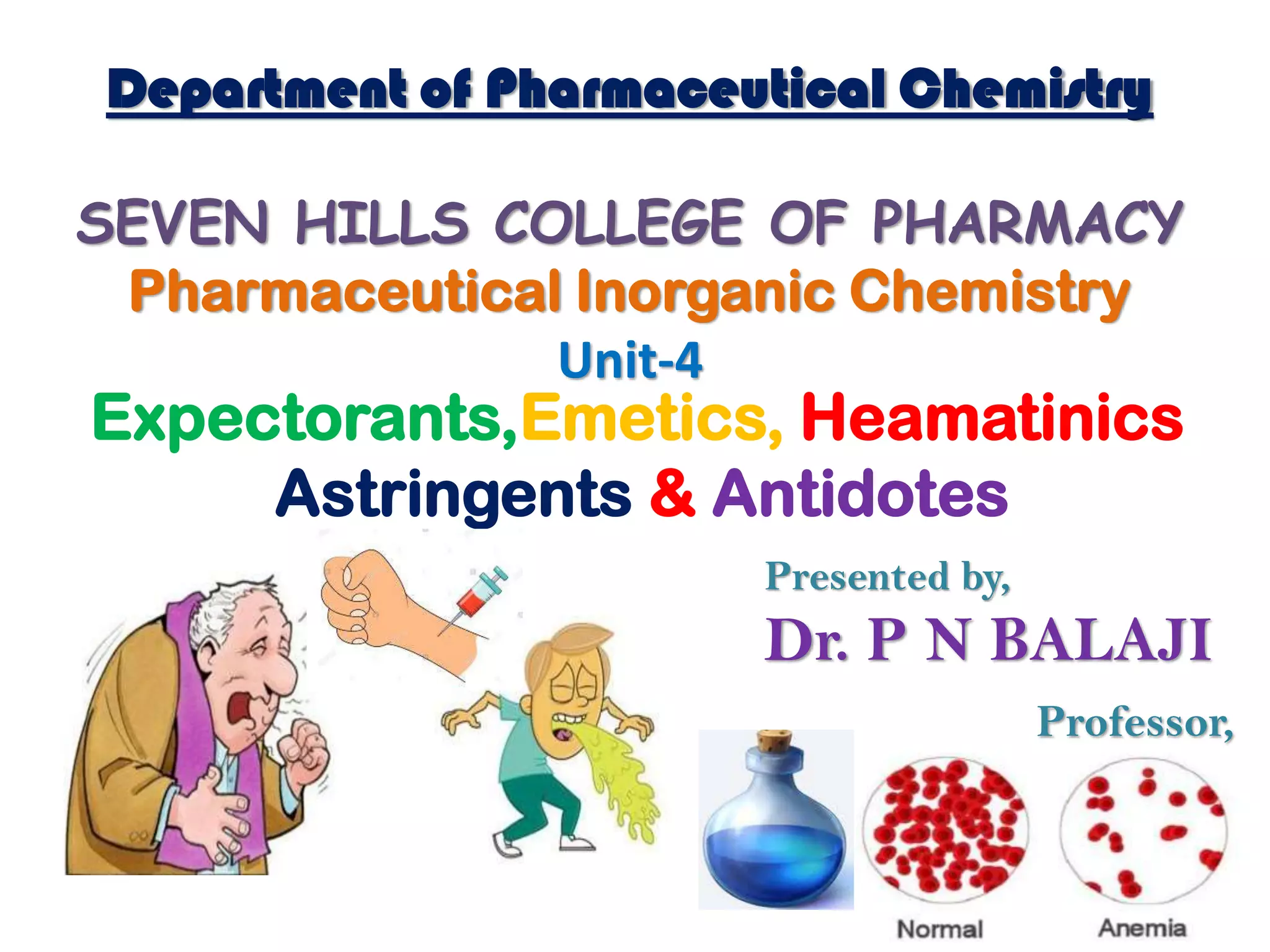
Department of Pharmaceutical Chemistry
SEVEN HILLS COLLEGE OF PHARMACY
Pharmaceutical Inorganic Chemistry
Unit-4
Presented by,
Dr. P N BALAJI
Professor,
Expectorants,Emetics, Heamatinics
Astringents & Antidotes
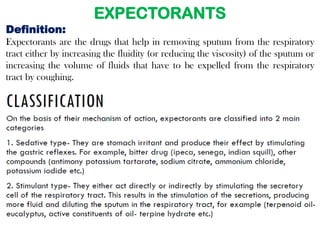
EXPECTORANTS
Definition:
Expectorants are the drugs that help in removing sputum from the respiratory
tract either by increasing the fluidity (or reducing the viscosity) of the sputum or
increasing the volume of fluids that have to be expelled from the respiratory
tract by coughing.
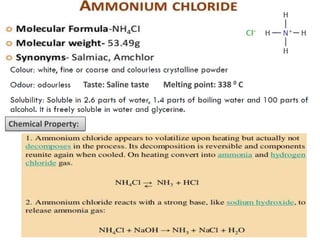
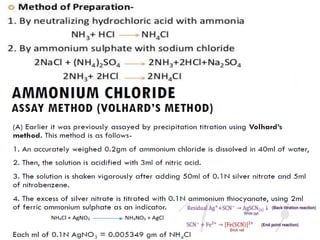
Taste: Saline taste
Chemical Property:
Melting point: 338 0 C
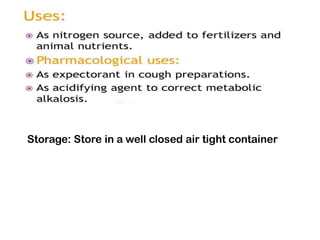
Storage: Store in a well closed air tight container
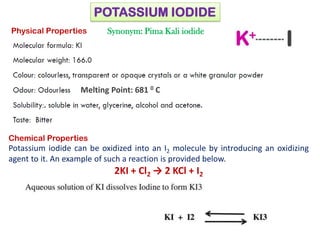
POTASSIUM IODIDE
Melting Point: 681 0 C
Chemical Properties
Potassium iodide can be oxidized into an I2 molecule by introducing an oxidizing
agent to it. An example of such a reaction is provided below.
2KI + Cl2 → 2 KCl + I2
Physical Properties Synonym: Pima Kali iodide
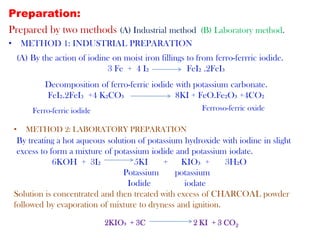
Preparation:
Prepared by two methods (A) Industrial method (B) Laboratory method.
• METHOD 1: INDUSTRIAL PREPARATION
(A) By the action of iodine on moist iron fillings to from ferro-ferrric iodide.
3 Fe + 4 I₂ FeI₂ .2FeI₃
Decomposition of ferro-ferric iodide with potassium carbonate.
FeI₂.2FeI₃ +4 K₂CO₃ 8KI + FeO.Fe₂O₃ +4CO₂
Ferroso-ferric oxide
Ferro-ferric iodide
• METHOD 2: LABORATORY PREPARATION
By treating a hot aqueous solution of potassium hydroxide with iodine in slight
excess to form a mixture of potassium iodide and potassium iodate.
6KOH + 3I₂ 5KI + KIO₃ + 3H₂O
Potassium potassium
Iodide iodate
Solution is concentrated and then treated with excess of CHARCOAL powder
followed by evaporation of mixture to dryness and ignition.
2KIO₃ + 3C 2 KI + 3 CO2
USES:
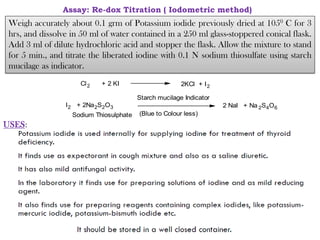
Assay: Re-dox Titration ( Iodometric method)
Ca(OCl) 2 + 2 CH3COOH Ca(CH 3COO)2 + Cl2 + 2H2O
Chlorinated lime Acetic acid Calcium acetate Chlorine
Cl2 + 2 KI 2KCl + I2
I2 + 2Na2S2O3 2 NaI + Na 2S4O6
Starch mucilage Indicator
(Blue to Colour less)
Sodium Thiosulphate
Weigh accurately about 0.1 grm of Potassium iodide previously dried at 1050 C for 3
hrs, and dissolve in 50 ml of water contained in a 250 ml glass-stoppered conical flask.
Add 3 ml of dilute hydrochloric acid and stopper the flask. Allow the mixture to stand
for 5 min., and titrate the liberated iodine with 0.1 N sodium thiosulfate using starch
mucilage as indicator.
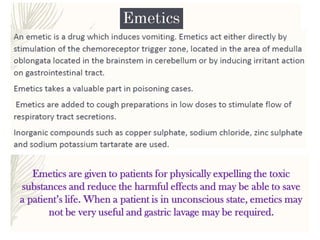
Emetics are given to patients for physically expelling the toxic
substances and reduce the harmful effects and may be able to save
a patient’s life. When a patient is in unconscious state, emetics may
not be very useful and gastric lavage may be required.
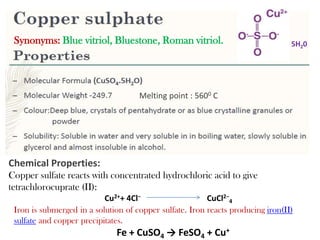
5H20
Melting point : 5600 C
Chemical Properties:
Copper sulfate reacts with concentrated hydrochloric acid to give
tetrachlorocuprate (II):
Cu2++ 4Cl− CuCl2−
4
Iron is submerged in a solution of copper sulfate. Iron reacts producing iron(II)
sulfate and copper precipitates.
Fe + CuSO4 → FeSO4 + Cu+
Synonyms: Blue vitriol, Bluestone, Roman vitriol.
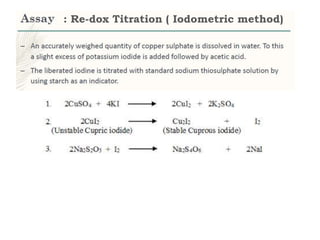
: Re-dox Titration ( Iodometric method)
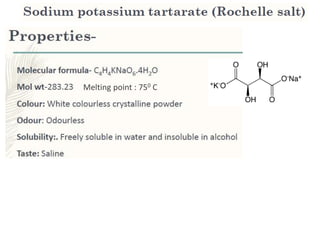
Melting point : 750 C
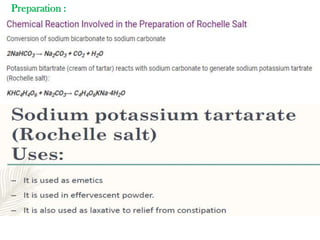
Preparation :
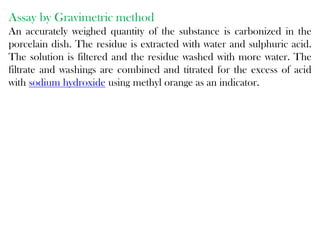
Assay by Gravimetric method
An accurately weighed quantity of the substance is carbonized in the
porcelain dish. The residue is extracted with water and sulphuric acid.
The solution is filtered and the residue washed with more water. The
filtrate and washings are combined and titrated for the excess of acid
with sodium hydroxide using methyl orange as an indicator.
Chemical character:
C12H24FeO14
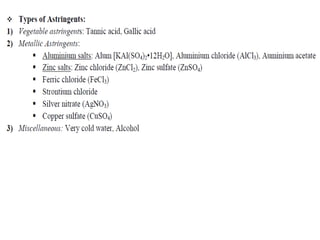
Astringents
,Constrict the blood vessels to stop bleeding.
The word "astringent" derives from Latin “adstringere”, meaning "to bind
fast".
Chemical Properties
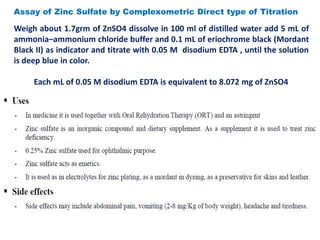
Assay of Zinc Sulfate by Complexometric Direct type of Titration
Weigh about 1.7grm of ZnSO4 dissolve in 100 ml of distilled water add 5 mL of
ammonia–ammonium chloride buffer and 0.1 mL of eriochrome black (Mordant
Black II) as indicator and titrate with 0.05 M disodium EDTA , until the solution
is deep blue in color.
Each mL of 0.05 M disodium EDTA is equivalent to 8.072 mg of ZnSO4
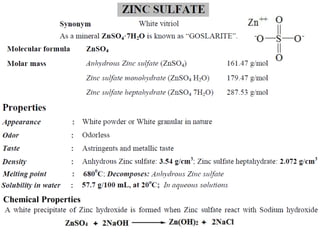
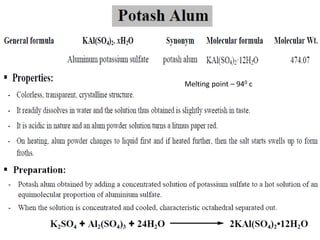
Melting point – 940 c
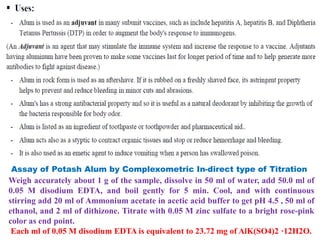
Assay of Potash Alum by Complexometric In-direct type of Titration
Weigh accurately about 1 g of the sample, dissolve in 50 ml of water, add 50.0 ml of
0.05 M disodium EDTA, and boil gently for 5 min. Cool, and with continuous
stirring add 20 ml of Ammonium acetate in acetic acid buffer to get pH 4.5 , 50 ml of
ethanol, and 2 ml of dithizone. Titrate with 0.05 M zinc sulfate to a bright rose-pink
color as end point.
Each ml of 0.05 M disodium EDTA is equivalent to 23.72 mg of AlK(SO4)2 ·12H2O.
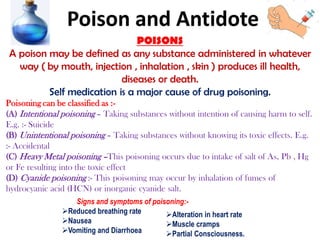
POISONS
A poison may be defined as any substance administered in whatever
way ( by mouth, injection , inhalation , skin ) produces ill health,
diseases or death.
Self medication is a major cause of drug poisoning.
Poisoning can be classified as :-
(A) Intentional poisoning – Taking substances without intention of causing harm to self.
E.g. :- Suicide
(B) Unintentional poisoning – Taking substances without knowing its toxic effects. E.g.
:- Accidental
(C) Heavy Metal poisoning –This poisoning occurs due to intake of salt of As, Pb , Hg
or Fe resulting into the toxic effect
(D) Cyanide poisoning :- This poisoning may occur by inhalation of fumes of
hydrocyanic acid (HCN) or inorganic cyanide salt.
Signs and symptoms of poisoning:-
Reduced breathing rate
Nausea
Vomiting and Diarrhoea
Alteration in heart rate
Muscle cramps
Partial Consciousness.
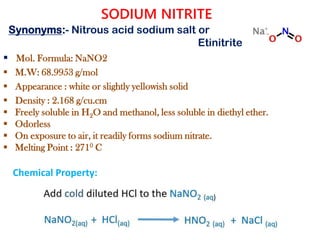
SODIUM NITRITE
 Mol. Formula: NaNO2
 M.W: 68.9953 g/mol
 Appearance : white or slightly yellowish solid
 Density : 2.168 g/cu.cm
 Freely soluble in H2O and methanol, less soluble in diethyl ether.
 Odorless
 On exposure to air, it readily forms sodium nitrate.
 Melting Point : 2710 C
Chemical Property:
Synonyms:- Nitrous acid sodium salt or
Etinitrite
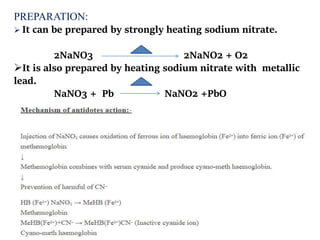
PREPARATION:
 It can be prepared by strongly heating sodium nitrate.
2NaNO3 2NaNO2 + O2
It is also prepared by heating sodium nitrate with metallic
lead.
NaNO3 + Pb NaNO2 +PbO
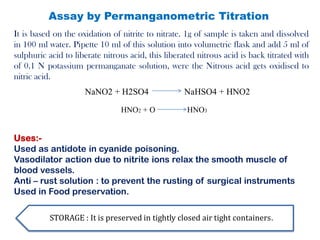
Assay by Permanganometric Titration
Uses:-
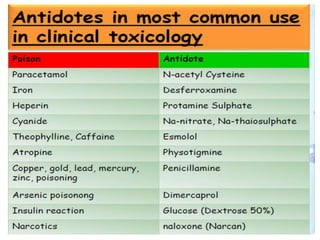
Used as antidote in cyanide poisoning.
Vasodilator action due to nitrite ions relax the smooth muscle of
blood vessels.
Anti – rust solution : to prevent the rusting of surgical instruments
Used in Food preservation.
STORAGE : It is preserved in tightly closed air tight containers.
It is based on the oxidation of nitrite to nitrate. 1g of sample is taken and dissolved
in 100 ml water. Pipette 10 ml of this solution into volumetric flask and add 5 ml of
sulphuric acid to liberate nitrous acid, this liberated nitrous acid is back titrated with
of 0.1 N potassium permanganate solution, were the Nitrous acid gets oxidised to
nitric acid.
NaNO2 + H2SO4 NaHSO4 + HNO2
HNO2 + O HNO3
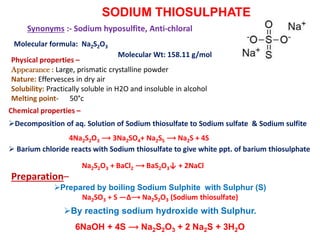
SODIUM THIOSULPHATE
Molecular formula: Na2S2O3
Synonyms :- Sodium hyposulfite, Anti-chloral
Physical properties –
Appearance : Large, prismatic crystalline powder
Nature: Effervesces in dry air
Solubility: Practically soluble in H2O and insoluble in alcohol
Melting point- 50°c
Chemical properties –
Decomposition of aq. Solution of Sodium thiosulfate to Sodium sulfate & Sodium sulfite
4Na2S2O3 ⟶ 3Na2SO4+ Na2S5 ⟶ Na2S + 4S
 Barium chloride reacts with Sodium thiosulfate to give white ppt. of barium thiosulphate
Na2S2O3 + BaCl2 ⟶ BaS2O3↓ + 2NaCl
Molecular Wt: 158.11 g/mol
Preparation–
Prepared by boiling Sodium Sulphite with Sulphur (S)
Na2SO3 + S —∆⟶ Na2S2O3 (Sodium thiosulfate)
By reacting sodium hydroxide with Sulphur.
6NaOH + 4S ⟶ Na2S2O3 + 2 Na2S + 3H2O
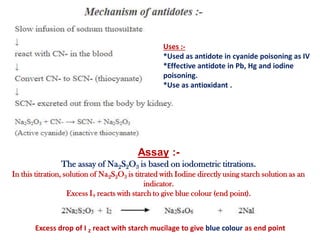
Assay :-
The assay of Na2S2O3 is based on iodometric titrations.
In this titration, solution of Na2S2O3 is titrated with Iodine directly using starch solution as an
indicator.
Excess I2 reacts with starch to give blue colour (end point).
Excess drop of I 2 react with starch mucilage to give blue colour as end point
Uses :-
*Used as antidote in cyanide poisoning as IV
*Effective antidote in Pb, Hg and iodine
poisoning.
*Use as antioxidant .
Properties:-
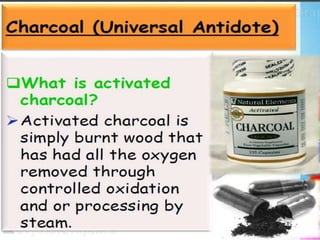
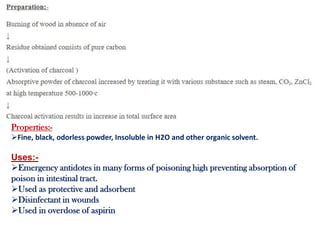
Fine, black, odorless powder, Insoluble in H2O and other organic solvent.
Uses:-
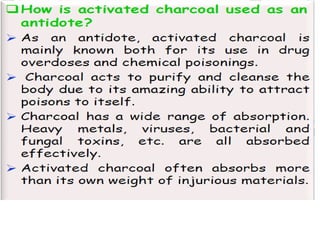
Emergency antidotes in many forms of poisoning high preventing absorption of
poison in intestinal tract.
Used as protective and adsorbent
Disinfectant in wounds
Used in overdose of aspirin
Misselaneous agents.pdf

Misselaneous agents.pdf

  • 1.
    Department of PharmaceuticalChemistry SEVEN HILLS COLLEGE OF PHARMACY Pharmaceutical Inorganic Chemistry Unit-4 Presented by, Dr. P N BALAJI Professor, Expectorants,Emetics, Heamatinics Astringents & Antidotes
  • 2.
    EXPECTORANTS Definition: Expectorants are thedrugs that help in removing sputum from the respiratory tract either by increasing the fluidity (or reducing the viscosity) of the sputum or increasing the volume of fluids that have to be expelled from the respiratory tract by coughing.
  • 3.
    Taste: Saline taste ChemicalProperty: Melting point: 338 0 C
  • 5.
    Storage: Store ina well closed air tight container
  • 6.
    POTASSIUM IODIDE Melting Point:681 0 C Chemical Properties Potassium iodide can be oxidized into an I2 molecule by introducing an oxidizing agent to it. An example of such a reaction is provided below. 2KI + Cl2 → 2 KCl + I2 Physical Properties Synonym: Pima Kali iodide
  • 7.
    Preparation: Prepared by twomethods (A) Industrial method (B) Laboratory method. • METHOD 1: INDUSTRIAL PREPARATION (A) By the action of iodine on moist iron fillings to from ferro-ferrric iodide. 3 Fe + 4 I₂ FeI₂ .2FeI₃ Decomposition of ferro-ferric iodide with potassium carbonate. FeI₂.2FeI₃ +4 K₂CO₃ 8KI + FeO.Fe₂O₃ +4CO₂ Ferroso-ferric oxide Ferro-ferric iodide • METHOD 2: LABORATORY PREPARATION By treating a hot aqueous solution of potassium hydroxide with iodine in slight excess to form a mixture of potassium iodide and potassium iodate. 6KOH + 3I₂ 5KI + KIO₃ + 3H₂O Potassium potassium Iodide iodate Solution is concentrated and then treated with excess of CHARCOAL powder followed by evaporation of mixture to dryness and ignition. 2KIO₃ + 3C 2 KI + 3 CO2
  • 8.
    USES: Assay: Re-dox Titration( Iodometric method) Ca(OCl) 2 + 2 CH3COOH Ca(CH 3COO)2 + Cl2 + 2H2O Chlorinated lime Acetic acid Calcium acetate Chlorine Cl2 + 2 KI 2KCl + I2 I2 + 2Na2S2O3 2 NaI + Na 2S4O6 Starch mucilage Indicator (Blue to Colour less) Sodium Thiosulphate Weigh accurately about 0.1 grm of Potassium iodide previously dried at 1050 C for 3 hrs, and dissolve in 50 ml of water contained in a 250 ml glass-stoppered conical flask. Add 3 ml of dilute hydrochloric acid and stopper the flask. Allow the mixture to stand for 5 min., and titrate the liberated iodine with 0.1 N sodium thiosulfate using starch mucilage as indicator.
  • 9.
    Emetics are givento patients for physically expelling the toxic substances and reduce the harmful effects and may be able to save a patient’s life. When a patient is in unconscious state, emetics may not be very useful and gastric lavage may be required.
  • 10.
    5H20 Melting point :5600 C Chemical Properties: Copper sulfate reacts with concentrated hydrochloric acid to give tetrachlorocuprate (II): Cu2++ 4Cl− CuCl2− 4 Iron is submerged in a solution of copper sulfate. Iron reacts producing iron(II) sulfate and copper precipitates. Fe + CuSO4 → FeSO4 + Cu+ Synonyms: Blue vitriol, Bluestone, Roman vitriol.
  • 12.
    : Re-dox Titration( Iodometric method)
  • 13.
  • 14.
  • 15.
    Assay by Gravimetricmethod An accurately weighed quantity of the substance is carbonized in the porcelain dish. The residue is extracted with water and sulphuric acid. The solution is filtered and the residue washed with more water. The filtrate and washings are combined and titrated for the excess of acid with sodium hydroxide using methyl orange as an indicator.
  • 19.
  • 21.
  • 23.
    Astringents ,Constrict the bloodvessels to stop bleeding. The word "astringent" derives from Latin “adstringere”, meaning "to bind fast".
  • 25.
  • 27.
    Assay of ZincSulfate by Complexometric Direct type of Titration Weigh about 1.7grm of ZnSO4 dissolve in 100 ml of distilled water add 5 mL of ammonia–ammonium chloride buffer and 0.1 mL of eriochrome black (Mordant Black II) as indicator and titrate with 0.05 M disodium EDTA , until the solution is deep blue in color. Each mL of 0.05 M disodium EDTA is equivalent to 8.072 mg of ZnSO4
  • 28.
  • 29.
    Assay of PotashAlum by Complexometric In-direct type of Titration Weigh accurately about 1 g of the sample, dissolve in 50 ml of water, add 50.0 ml of 0.05 M disodium EDTA, and boil gently for 5 min. Cool, and with continuous stirring add 20 ml of Ammonium acetate in acetic acid buffer to get pH 4.5 , 50 ml of ethanol, and 2 ml of dithizone. Titrate with 0.05 M zinc sulfate to a bright rose-pink color as end point. Each ml of 0.05 M disodium EDTA is equivalent to 23.72 mg of AlK(SO4)2 ·12H2O.
  • 30.
    POISONS A poison maybe defined as any substance administered in whatever way ( by mouth, injection , inhalation , skin ) produces ill health, diseases or death. Self medication is a major cause of drug poisoning. Poisoning can be classified as :- (A) Intentional poisoning – Taking substances without intention of causing harm to self. E.g. :- Suicide (B) Unintentional poisoning – Taking substances without knowing its toxic effects. E.g. :- Accidental (C) Heavy Metal poisoning –This poisoning occurs due to intake of salt of As, Pb , Hg or Fe resulting into the toxic effect (D) Cyanide poisoning :- This poisoning may occur by inhalation of fumes of hydrocyanic acid (HCN) or inorganic cyanide salt. Signs and symptoms of poisoning:- Reduced breathing rate Nausea Vomiting and Diarrhoea Alteration in heart rate Muscle cramps Partial Consciousness.
  • 38.
    SODIUM NITRITE  Mol.Formula: NaNO2  M.W: 68.9953 g/mol  Appearance : white or slightly yellowish solid  Density : 2.168 g/cu.cm  Freely soluble in H2O and methanol, less soluble in diethyl ether.  Odorless  On exposure to air, it readily forms sodium nitrate.  Melting Point : 2710 C Chemical Property: Synonyms:- Nitrous acid sodium salt or Etinitrite
  • 39.
    PREPARATION:  It canbe prepared by strongly heating sodium nitrate. 2NaNO3 2NaNO2 + O2 It is also prepared by heating sodium nitrate with metallic lead. NaNO3 + Pb NaNO2 +PbO
  • 40.
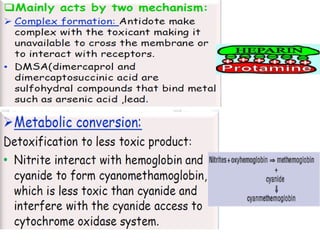
    Assay by PermanganometricTitration Uses:- Used as antidote in cyanide poisoning. Vasodilator action due to nitrite ions relax the smooth muscle of blood vessels. Anti – rust solution : to prevent the rusting of surgical instruments Used in Food preservation. STORAGE : It is preserved in tightly closed air tight containers. It is based on the oxidation of nitrite to nitrate. 1g of sample is taken and dissolved in 100 ml water. Pipette 10 ml of this solution into volumetric flask and add 5 ml of sulphuric acid to liberate nitrous acid, this liberated nitrous acid is back titrated with of 0.1 N potassium permanganate solution, were the Nitrous acid gets oxidised to nitric acid. NaNO2 + H2SO4 NaHSO4 + HNO2 HNO2 + O HNO3
  • 41.
    SODIUM THIOSULPHATE Molecular formula:Na2S2O3 Synonyms :- Sodium hyposulfite, Anti-chloral Physical properties – Appearance : Large, prismatic crystalline powder Nature: Effervesces in dry air Solubility: Practically soluble in H2O and insoluble in alcohol Melting point- 50°c Chemical properties – Decomposition of aq. Solution of Sodium thiosulfate to Sodium sulfate & Sodium sulfite 4Na2S2O3 ⟶ 3Na2SO4+ Na2S5 ⟶ Na2S + 4S  Barium chloride reacts with Sodium thiosulfate to give white ppt. of barium thiosulphate Na2S2O3 + BaCl2 ⟶ BaS2O3↓ + 2NaCl Molecular Wt: 158.11 g/mol Preparation– Prepared by boiling Sodium Sulphite with Sulphur (S) Na2SO3 + S —∆⟶ Na2S2O3 (Sodium thiosulfate) By reacting sodium hydroxide with Sulphur. 6NaOH + 4S ⟶ Na2S2O3 + 2 Na2S + 3H2O
  • 42.
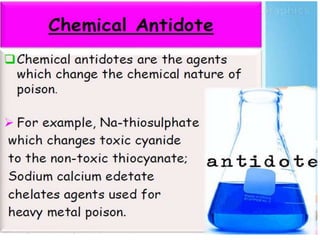
    Assay :- The assayof Na2S2O3 is based on iodometric titrations. In this titration, solution of Na2S2O3 is titrated with Iodine directly using starch solution as an indicator. Excess I2 reacts with starch to give blue colour (end point). Excess drop of I 2 react with starch mucilage to give blue colour as end point Uses :- *Used as antidote in cyanide poisoning as IV *Effective antidote in Pb, Hg and iodine poisoning. *Use as antioxidant .
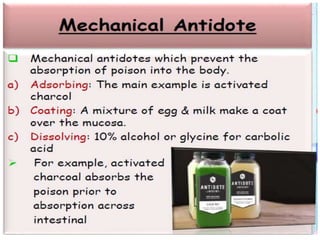
  • 45.
    Properties:- Fine, black, odorlesspowder, Insoluble in H2O and other organic solvent. Uses:- Emergency antidotes in many forms of poisoning high preventing absorption of poison in intestinal tract. Used as protective and adsorbent Disinfectant in wounds Used in overdose of aspirin