MEANING ?
These are the drugs which are usually alkaline
substances and used for neutralising excess acid
in the stomach of patients Suffering from hyper-
chlorhydria (hyperacidity).
IDEAL REQUIREMENTS
The ideal requirements of an antacid are as follows:
1. It should be insoluble in water and has fine particle form.
2. It should not be absorbable or cause systemic alkalosis.
3. It should be able to exert its effect gradually and over a long period of time.
4. It should not be a laxative or cause constipation.
5. It should not cause any side effects.
6. It should be stable and readily available.
7. The reaction between antacid and gastric hydrochloric acid should not
produce large volume of gas.
8. The antacid should buffer in the pH range 4 to 6.
9. The antacid should probably inhibit pepsin, the proteolytic enzyme.
COMBINATION OF ANTACIDS
It is well known that no antacid is available in the market which satisfies the
requirement an ideal antacid.
However, many preparations which are having combination of antacids are
being marketed.
The idea behind such combination is to counteract the constipation action of
calcium and aluminium containing antacids with laxative effect of magnesium
containing antacid.
Sometimes the combination antacid preparation is having one with rapid onset
of action with an antacid with a longer duration of action.
In another type, the antacids are combined with simethicone type of compounds
which are having anti-flatulent (agents used for prevention of excessive
intestinal gas) action as they are anti foaming agents and cause dispersion of
gases.
Few such combinations are reported to be official in B.P.
COMBINATION PREPARATIONS
(1) Compound magnesium trisilicate oral powder: It is having magnesium
trisilicate, chalk powder, sodium bicarbonate and heavy magnesium
carbonate each 250 mg.
(2) Magnesium trisilicate mixture: It is a suspension having 5 per cent w/w of
each of magnesium trisilicate, light magnesium carbonate and sodium
carbonate in a suitable vehicle with a peppermint flavour
(3) Compound magnesium trisilicate tablets: It is having in each 250 mg of
magnesium trisilicate and 120 mg of dried aluminium hydroxide gel.
Peppermint is added as a flavour.
SODIUM BICARBONATE
Formula :NaHCO3 Molecular Weight : 58.82 g/mol
It contains or less than 99 per cent and not more than the equivalent of 100.5 per cent
NaHCO3
Preparation: On a small scale, it is prepared by passing CO2, gas through a solution of
sodium hydroxide. The solution is concentrated to get the product
2NAOH + CO2 → Na2CO3 + H2O
Na2CO3 + H20 + CO2 2NaHCO3
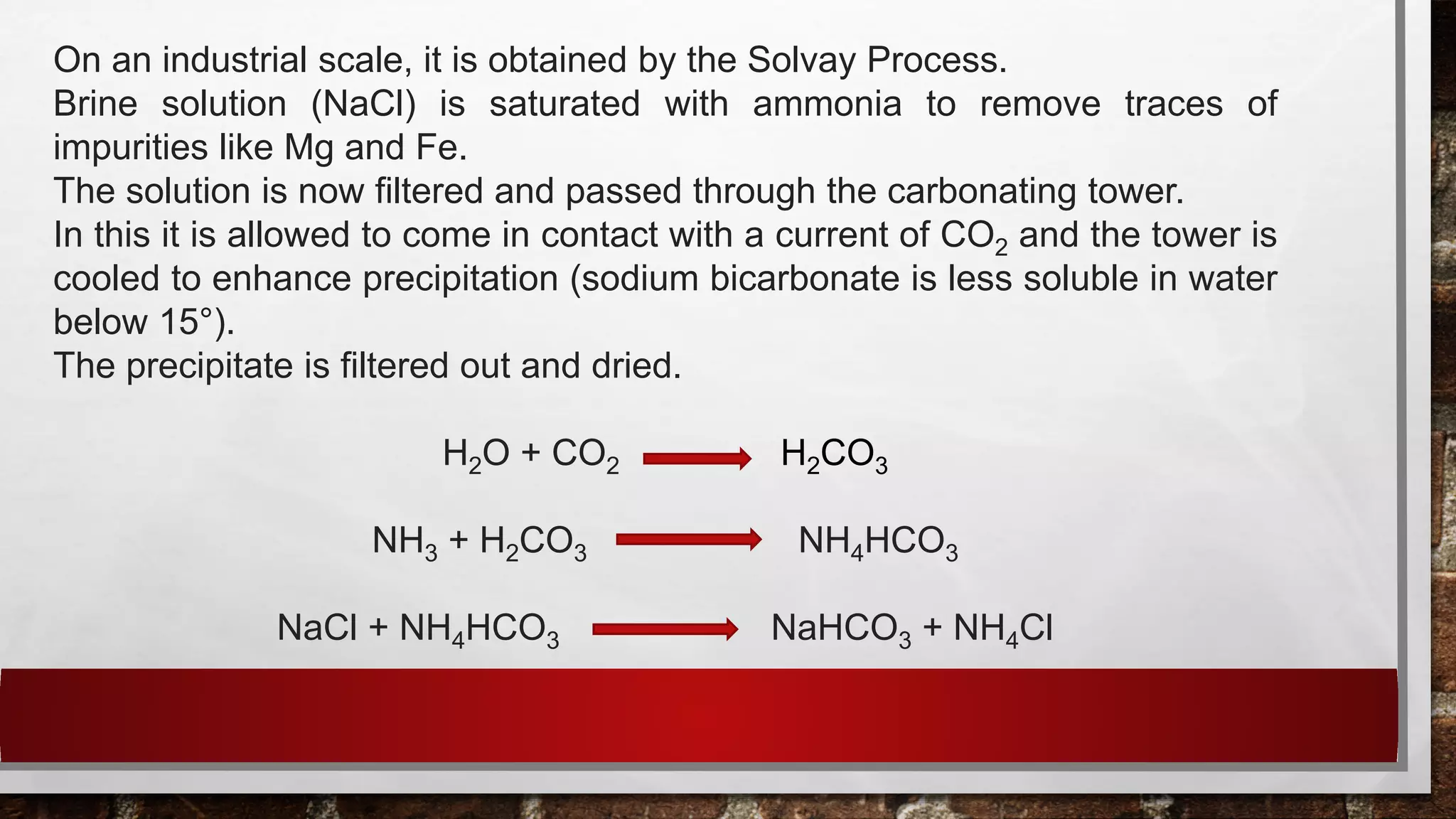
On an industrial scale, it is obtained by the Solvay Process.
Brine solution (NaCl) is saturated with ammonia to remove traces of
impurities like Mg and Fe.
The solution is now filtered and passed through the carbonating tower.
In this it is allowed to come in contact with a current of CO2 and the tower is
cooled to enhance precipitation (sodium bicarbonate is less soluble in water
below 15°).
The precipitate is filtered out and dried.
H2O + CO2 H2CO3
NH3 + H2CO3 NH4HCO3
NaCl + NH4HCO3 NaHCO3 + NH4Cl
Properties: It occurs in white crystalline or amorphous powder having a
saline taste.
It is freely soluble in water but practically insoluble in alcohol.
Assay: 1gm is weighed accurately & dissolved in 20ml of water.
It is than titrated with 0.5N Sulphuric acid using methyl orange as indicator.
Each ml of 0.5N H2SO4 = 0.042 gm of NaHCO3
Uses : Acid neutralizing substance.
It is a antacid.
Used in Preparation of Buffer solutions.
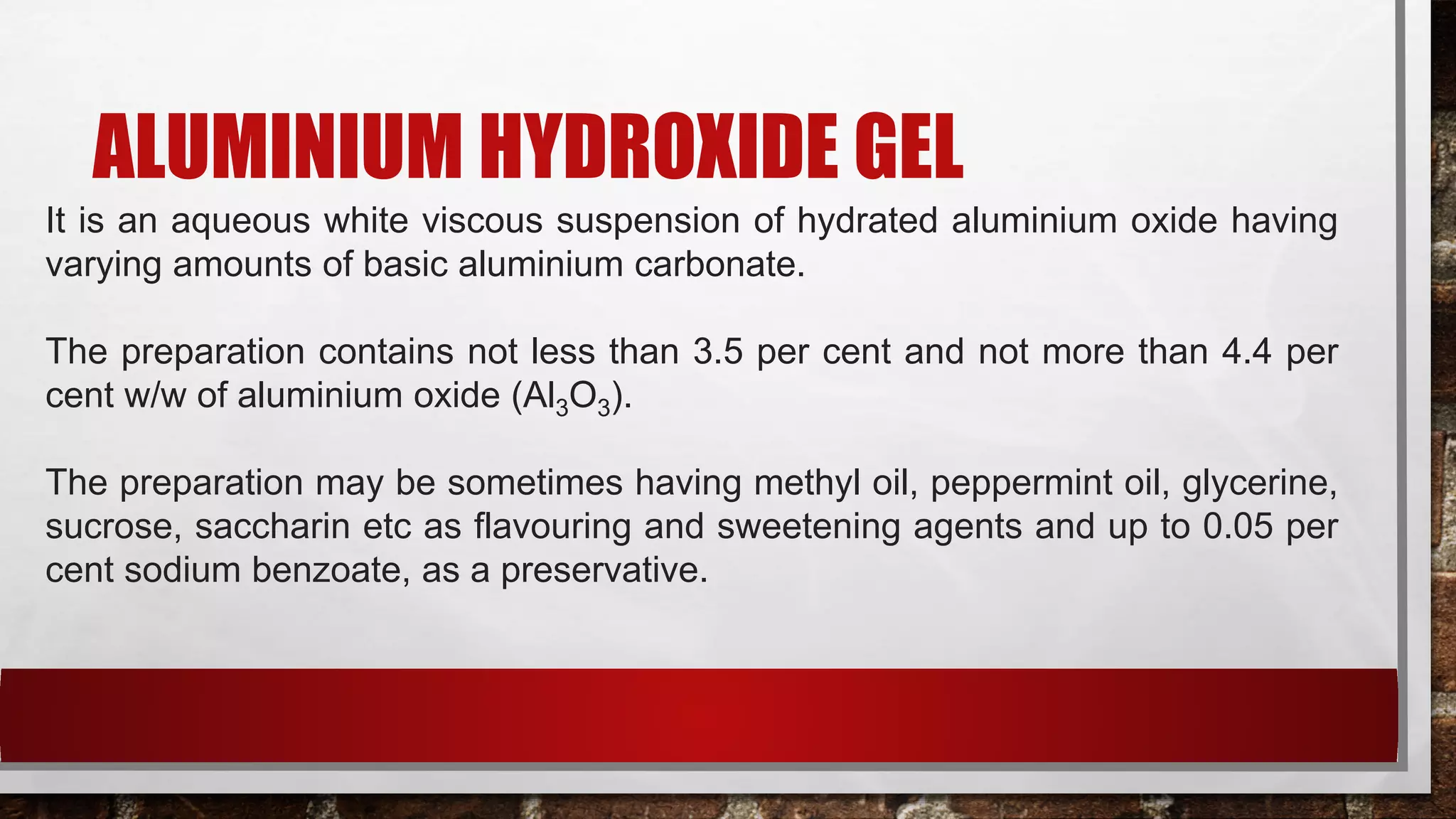
ALUMINIUM HYDROXIDE GEL
It is an aqueous white viscous suspension of hydrated aluminium oxide having
varying amounts of basic aluminium carbonate.
The preparation contains not less than 3.5 per cent and not more than 4.4 per
cent w/w of aluminium oxide (Al3O3).
The preparation may be sometimes having methyl oil, peppermint oil, glycerine,
sucrose, saccharin etc as flavouring and sweetening agents and up to 0.05 per
cent sodium benzoate, as a preservative.
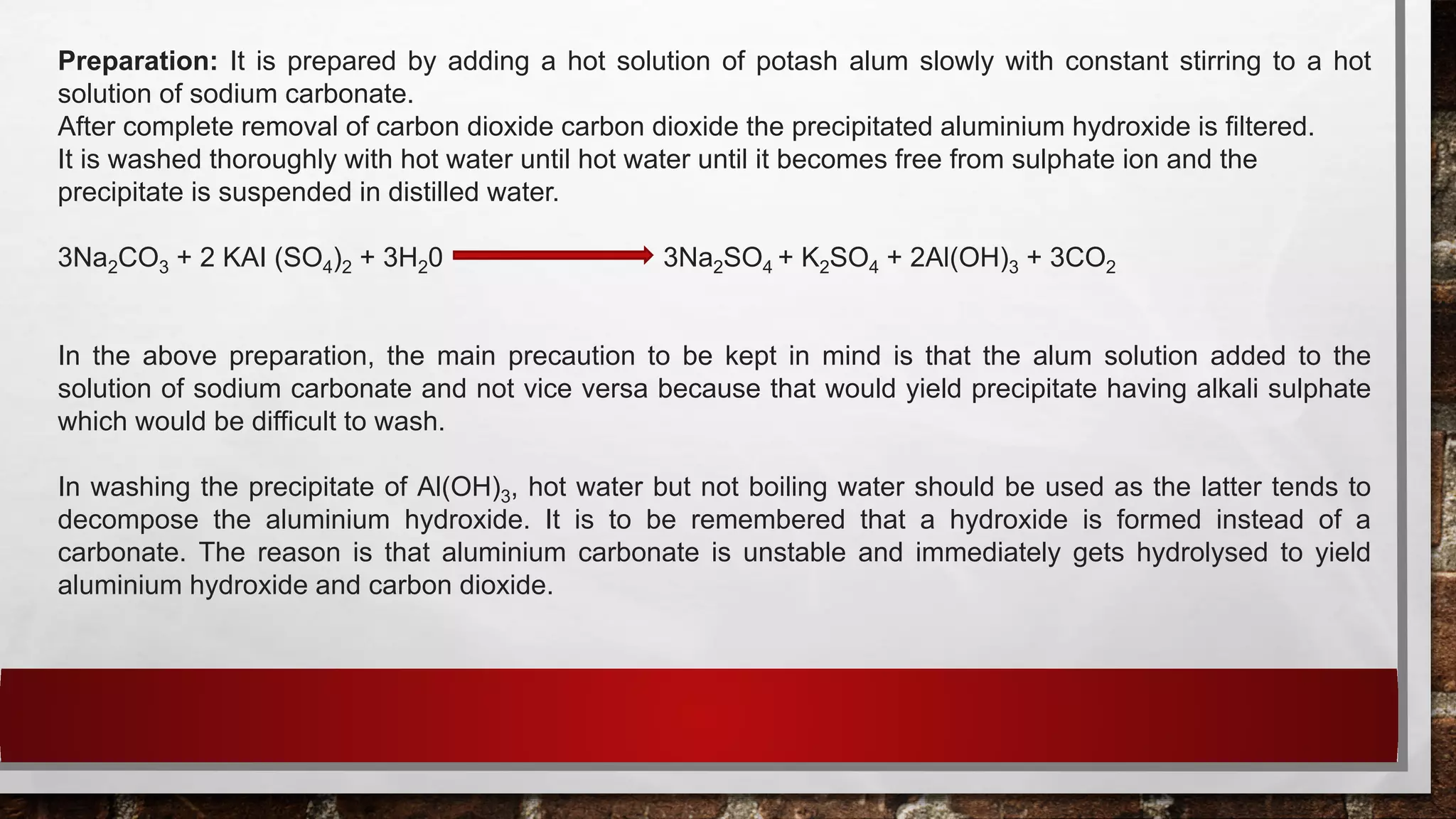
Preparation: It is prepared by adding a hot solution of potash alum slowly with constant stirring to a hot
solution of sodium carbonate.
After complete removal of carbon dioxide carbon dioxide the precipitated aluminium hydroxide is filtered.
It is washed thoroughly with hot water until hot water until it becomes free from sulphate ion and the
precipitate is suspended in distilled water.
3Na2CO3 + 2 KAI (SO4)2 + 3H20 3Na2SO4 + K2SO4 + 2Al(OH)3 + 3CO2
In the above preparation, the main precaution to be kept in mind is that the alum solution added to the
solution of sodium carbonate and not vice versa because that would yield precipitate having alkali sulphate
which would be difficult to wash.
In washing the precipitate of Al(OH)3, hot water but not boiling water should be used as the latter tends to
decompose the aluminium hydroxide. It is to be remembered that a hydroxide is formed instead of a
carbonate. The reason is that aluminium carbonate is unstable and immediately gets hydrolysed to yield
aluminium hydroxide and carbon dioxide.
Properties: It is a white viscous suspension. A clear liquid gets
separated when it is kept standing for some time.
Aluminium hydroxide gel gives astringent aluminium chloride
when it reacts with gastric hydrochloric acid. This results into
nausea, vomiting and constipation.
Use : good slow acting antacid.
Used in treatment of hyperchlorhydria.
MAGNESIUM HYDROXIDE
Formula : Mg(OH)2 Mol. Wt.: 58.32 g/mol
Preparation: It is also prepared by treating sea water or other natural brines with
sufficient calcium hydroxide to precipitate magnesium as magnesium hydroxide,
then washing and drying the precipitate.
MgO + H20 Mg(OH)2
MgSO4 + 2NaOH Mg(OH)2 + Na2SO4
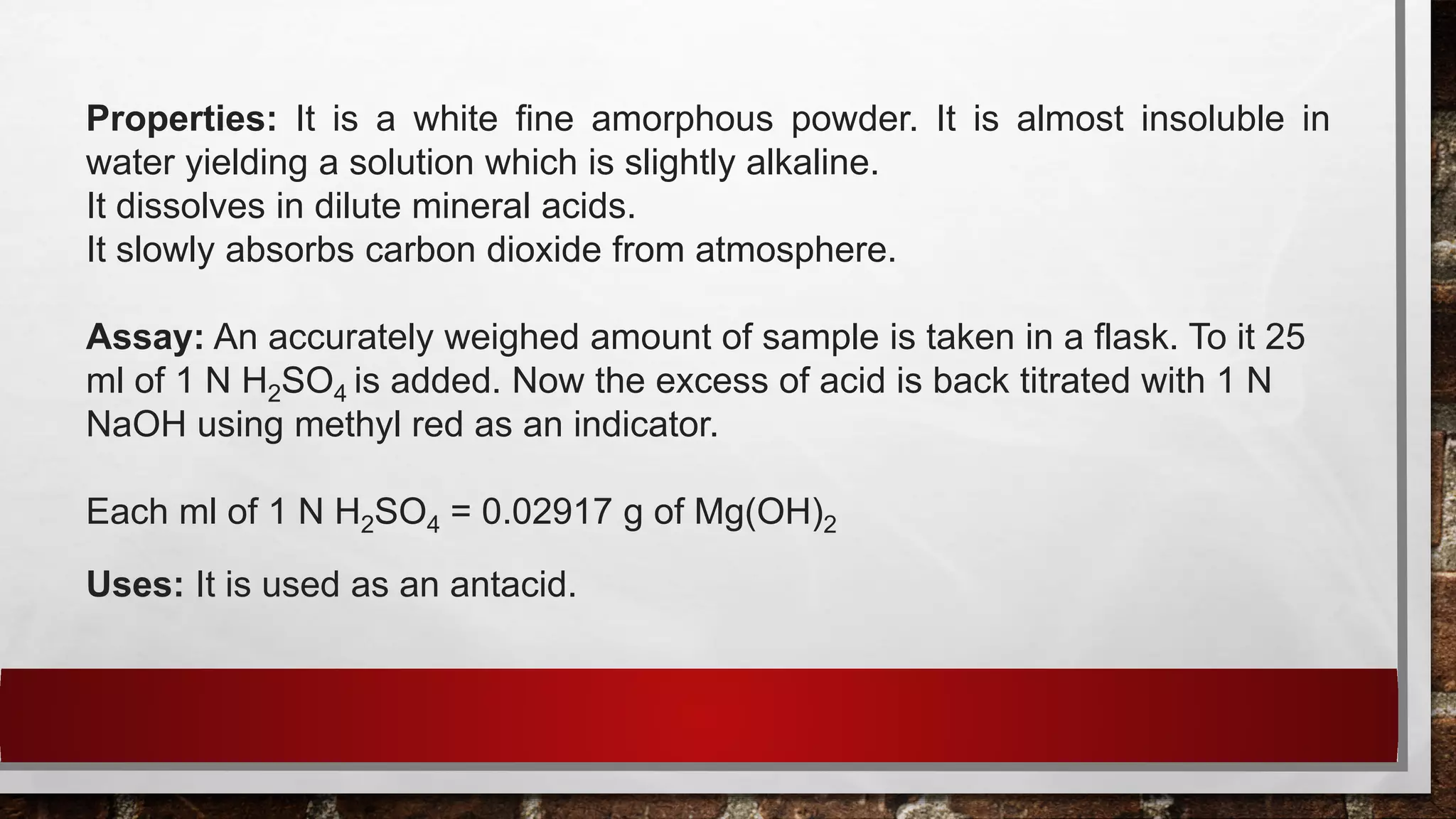
Properties: It is a white fine amorphous powder. It is almost insoluble in
water yielding a solution which is slightly alkaline.
It dissolves in dilute mineral acids.
It slowly absorbs carbon dioxide from atmosphere.
Assay: An accurately weighed amount of sample is taken in a flask. To it 25
ml of 1 N H2SO4 is added. Now the excess of acid is back titrated with 1 N
NaOH using methyl red as an indicator.
Each ml of 1 N H2SO4 = 0.02917 g of Mg(OH)2
Uses: It is used as an antacid.

Antacids

  • 2.
    MEANING ? These arethe drugs which are usually alkaline substances and used for neutralising excess acid in the stomach of patients Suffering from hyper- chlorhydria (hyperacidity).
  • 3.
    IDEAL REQUIREMENTS The idealrequirements of an antacid are as follows: 1. It should be insoluble in water and has fine particle form. 2. It should not be absorbable or cause systemic alkalosis. 3. It should be able to exert its effect gradually and over a long period of time. 4. It should not be a laxative or cause constipation. 5. It should not cause any side effects. 6. It should be stable and readily available. 7. The reaction between antacid and gastric hydrochloric acid should not produce large volume of gas. 8. The antacid should buffer in the pH range 4 to 6. 9. The antacid should probably inhibit pepsin, the proteolytic enzyme.
  • 4.
    COMBINATION OF ANTACIDS Itis well known that no antacid is available in the market which satisfies the requirement an ideal antacid. However, many preparations which are having combination of antacids are being marketed. The idea behind such combination is to counteract the constipation action of calcium and aluminium containing antacids with laxative effect of magnesium containing antacid.
  • 5.
    Sometimes the combinationantacid preparation is having one with rapid onset of action with an antacid with a longer duration of action. In another type, the antacids are combined with simethicone type of compounds which are having anti-flatulent (agents used for prevention of excessive intestinal gas) action as they are anti foaming agents and cause dispersion of gases. Few such combinations are reported to be official in B.P.
  • 6.
    COMBINATION PREPARATIONS (1) Compoundmagnesium trisilicate oral powder: It is having magnesium trisilicate, chalk powder, sodium bicarbonate and heavy magnesium carbonate each 250 mg. (2) Magnesium trisilicate mixture: It is a suspension having 5 per cent w/w of each of magnesium trisilicate, light magnesium carbonate and sodium carbonate in a suitable vehicle with a peppermint flavour (3) Compound magnesium trisilicate tablets: It is having in each 250 mg of magnesium trisilicate and 120 mg of dried aluminium hydroxide gel. Peppermint is added as a flavour.
  • 7.
    SODIUM BICARBONATE Formula :NaHCO3Molecular Weight : 58.82 g/mol It contains or less than 99 per cent and not more than the equivalent of 100.5 per cent NaHCO3 Preparation: On a small scale, it is prepared by passing CO2, gas through a solution of sodium hydroxide. The solution is concentrated to get the product 2NAOH + CO2 → Na2CO3 + H2O Na2CO3 + H20 + CO2 2NaHCO3
  • 8.
    On an industrialscale, it is obtained by the Solvay Process. Brine solution (NaCl) is saturated with ammonia to remove traces of impurities like Mg and Fe. The solution is now filtered and passed through the carbonating tower. In this it is allowed to come in contact with a current of CO2 and the tower is cooled to enhance precipitation (sodium bicarbonate is less soluble in water below 15°). The precipitate is filtered out and dried. H2O + CO2 H2CO3 NH3 + H2CO3 NH4HCO3 NaCl + NH4HCO3 NaHCO3 + NH4Cl
  • 9.
    Properties: It occursin white crystalline or amorphous powder having a saline taste. It is freely soluble in water but practically insoluble in alcohol. Assay: 1gm is weighed accurately & dissolved in 20ml of water. It is than titrated with 0.5N Sulphuric acid using methyl orange as indicator. Each ml of 0.5N H2SO4 = 0.042 gm of NaHCO3 Uses : Acid neutralizing substance. It is a antacid. Used in Preparation of Buffer solutions.
  • 10.
    ALUMINIUM HYDROXIDE GEL Itis an aqueous white viscous suspension of hydrated aluminium oxide having varying amounts of basic aluminium carbonate. The preparation contains not less than 3.5 per cent and not more than 4.4 per cent w/w of aluminium oxide (Al3O3). The preparation may be sometimes having methyl oil, peppermint oil, glycerine, sucrose, saccharin etc as flavouring and sweetening agents and up to 0.05 per cent sodium benzoate, as a preservative.
  • 11.
    Preparation: It isprepared by adding a hot solution of potash alum slowly with constant stirring to a hot solution of sodium carbonate. After complete removal of carbon dioxide carbon dioxide the precipitated aluminium hydroxide is filtered. It is washed thoroughly with hot water until hot water until it becomes free from sulphate ion and the precipitate is suspended in distilled water. 3Na2CO3 + 2 KAI (SO4)2 + 3H20 3Na2SO4 + K2SO4 + 2Al(OH)3 + 3CO2 In the above preparation, the main precaution to be kept in mind is that the alum solution added to the solution of sodium carbonate and not vice versa because that would yield precipitate having alkali sulphate which would be difficult to wash. In washing the precipitate of Al(OH)3, hot water but not boiling water should be used as the latter tends to decompose the aluminium hydroxide. It is to be remembered that a hydroxide is formed instead of a carbonate. The reason is that aluminium carbonate is unstable and immediately gets hydrolysed to yield aluminium hydroxide and carbon dioxide.
  • 12.
    Properties: It isa white viscous suspension. A clear liquid gets separated when it is kept standing for some time. Aluminium hydroxide gel gives astringent aluminium chloride when it reacts with gastric hydrochloric acid. This results into nausea, vomiting and constipation. Use : good slow acting antacid. Used in treatment of hyperchlorhydria.
  • 13.
    MAGNESIUM HYDROXIDE Formula :Mg(OH)2 Mol. Wt.: 58.32 g/mol Preparation: It is also prepared by treating sea water or other natural brines with sufficient calcium hydroxide to precipitate magnesium as magnesium hydroxide, then washing and drying the precipitate. MgO + H20 Mg(OH)2 MgSO4 + 2NaOH Mg(OH)2 + Na2SO4
  • 14.
    Properties: It isa white fine amorphous powder. It is almost insoluble in water yielding a solution which is slightly alkaline. It dissolves in dilute mineral acids. It slowly absorbs carbon dioxide from atmosphere. Assay: An accurately weighed amount of sample is taken in a flask. To it 25 ml of 1 N H2SO4 is added. Now the excess of acid is back titrated with 1 N NaOH using methyl red as an indicator. Each ml of 1 N H2SO4 = 0.02917 g of Mg(OH)2 Uses: It is used as an antacid.