ACIDIFYING REAGENTS OR ACIDIFIERS
G. Nikitha, M.Pharmacy
Assistant Professor
Department of Pharmaceutical Chemistry
Sree Dattha Institute of Pharmacy
Hyderabad
Subject Name: Pharmaceutical Inorganic Chemistry
Year: Pharm-D Ist year
CONTENTS
 Introduction
 Dilute Hydrochloric acid
 Ammonium chloride
 Reference
INTRODUCTION
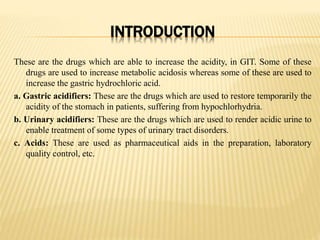
These are the drugs which are able to increase the acidity, in GIT. Some of these
drugs are used to increase metabolic acidosis whereas some of these are used to
increase the gastric hydrochloric acid.
a. Gastric acidifiers: These are the drugs which are used to restore temporarily the
acidity of the stomach in patients, suffering from hypochlorhydria.
b. Urinary acidifiers: These are the drugs which are used to render acidic urine to
enable treatment of some types of urinary tract disorders.
c. Acids: These are used as pharmaceutical aids in the preparation, laboratory
quality control, etc.
DILUTE HYDROCHLORIC ACID
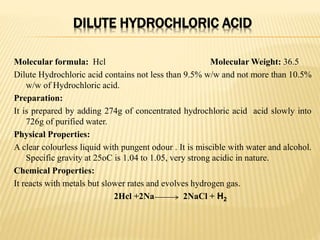
Molecular formula: Hcl Molecular Weight: 36.5
Dilute Hydrochloric acid contains not less than 9.5% w/w and not more than 10.5%
w/w of Hydrochloric acid.
Preparation:
It is prepared by adding 274g of concentrated hydrochloric acid acid slowly into
726g of purified water.
Physical Properties:
A clear colourless liquid with pungent odour . It is miscible with water and alcohol.
Specific gravity at 25oC is 1.04 to 1.05, very strong acidic in nature.
Chemical Properties:
It reacts with metals but slower rates and evolves hydrogen gas.
2Hcl +2Na 2NaCl + H2
Test for identification:
1. After neutralization it gives reactions which are characteristic of chloride.
2. When it is added to KMno4solution, chloride gas is liberated.
Test for purity:
It has to be tested for As, heavy metals, sulphate, sulphide, free chloride, bromide
and iodide and residue on ignition.
Bromide and iodide:
5ml of Hcl is dilute with 10ml of water. To it 1ml of chloroform and solution of
chlorinated lime are added drop by drop with constant shaking. The chloroform
layer should not become brown or violet.
Sulphide:
1ml of Hcl is dilute with 10ml of water. To it 5 drops of barium chloride solution
and 0.5ml of 0.001N iodine are added with shaking. The chloroform layer
should not became violet with in one minute.
Assay:
An accurate amount about 4g of Hcl is transferred to a stoppered flask which is
having 40ml of water. Now the solution is titrated with 1N sodium hydroxide
using methyl orange as indicator.
NaoH+Hcl Nacl+H2O
Each ml of 1N NaOH ≡ 0.03646 g of Hcl
Storage:
It should be stored in well closed containers of glass or other material at
temperature not exceeding 30oC.
Uses:
It is used as an acidifier.
AMMONIUM CHLORIDE
Molecular formula: NH4Cl Molecular Weight: 53.49
It is having not less than 99.5% of NH4Cl which is calculated which refernce to
substance dried over silica gel for four hours
Preparation:
1. It is prepared by neutralizing ammonia with Hcl. The solution is evaporated till
crystalline mass of ammonium chloride is obtained.
NH3+Hcl NH4Cl
The crude salt is purified either by crystallization or sublimation.
2. Ammonium chloride is also produced by heating ammonium sulphate with
sodium chloride.
Properties:
It is white, fine crystalline powder. It is odourless. It is having a saline taste. It is
slightly hygroscopic in nature. It is freely soluble in glycerine.
Test for identity:
It gives reaction which are characteristic of ammonium salts and chlorides.
Test for purity:
It is tested for Heavy metals, loss on drying arsenic etc.
Loss on drying:
Moisture can be determined by drying the substance over silica gel in a dessicator
for nearly 4 hours at ordinary temperature. So that there occur no loss of
ammonium chloride by volatisation.
Assay:
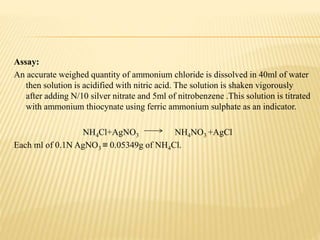
An accurate weighed quantity of ammonium chloride is dissolved in 40ml of water
then solution is acidified with nitric acid. The solution is shaken vigorously
after adding N/10 silver nitrate and 5ml of nitrobenzene .This solution is titrated
with ammonium thiocynate using ferric ammonium sulphate as an indicator.
NH4Cl+AgNO3 NH4NO3 +AgCl
Each ml of 0.1N AgNO3 ≡ 0.05349g of NH4Cl.
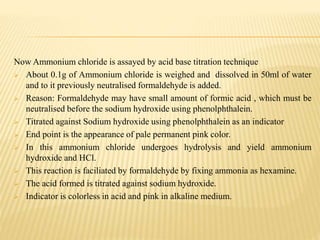
Now Ammonium chloride is assayed by acid base titration technique
 About 0.1g of Ammonium chloride is weighed and dissolved in 50ml of water
and to it previously neutralised formaldehyde is added.
 Reason: Formaldehyde may have small amount of formic acid , which must be
neutralised before the sodium hydroxide using phenolphthalein.
 Titrated against Sodium hydroxide using phenolphthalein as an indicator
 End point is the appearance of pale permanent pink color.
 In this ammonium chloride undergoes hydrolysis and yield ammonium
hydroxide and HCl.
 This reaction is faciliated by formaldehyde by fixing ammonia as hexamine.
 The acid formed is titrated against sodium hydroxide.
 Indicator is colorless in acid and pink in alkaline medium.
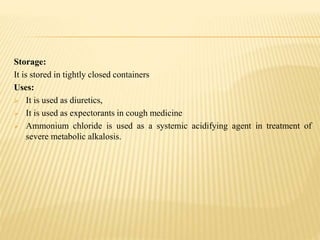
Storage:
It is stored in tightly closed containers
Uses:
 It is used as diuretics,
 It is used as expectorants in cough medicine
 Ammonium chloride is used as a systemic acidifying agent in treatment of
severe metabolic alkalosis.
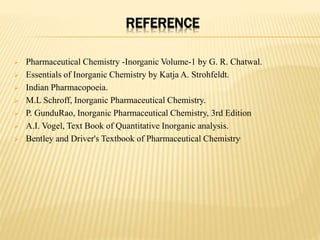
REFERENCE
 Pharmaceutical Chemistry -Inorganic Volume-1 by G. R. Chatwal.
 Essentials of Inorganic Chemistry by Katja A. Strohfeldt.
 Indian Pharmacopoeia.
 M.L Schroff, Inorganic Pharmaceutical Chemistry.
 P. GunduRao, Inorganic Pharmaceutical Chemistry, 3rd Edition
 A.I. Vogel, Text Book of Quantitative Inorganic analysis.
 Bentley and Driver's Textbook of Pharmaceutical Chemistry.
THANK YOU