Limit test for chlorides
Mahakal Institute of Pharmaceutical Studies,
Ujjain
Behind Air strip, Datana, Dewas road, Ujjain
Given by
Alok Sharma
Asst. Professor
Pharmaceutical
chemistry
Presentation on
Introduction
Limit tests are quantitative or semi-quantitative tests
designed to identify and control small quantities of impurity,
which are likely to be present in the substance. The quantity
of any one impurity in an official substance is often small, and
consequently the visible reaction response to any test for that
impurity is also small. The design of individual tests is
therefore important if errors are to be avoided in the hands of
different operators.
Specificity of the test
Any test used as a limit test must, of necessity, give some form
of selective reaction with the trace impurity. Many tests used for
the detection of inorganic impurities in official inorganic
chemicals are based upon the separations involved in inorganic
qualitative analysis.
Sensitivity of the test
The degree of sensitivity required in a limit test varies
enormously according to the standard of purity demanded by
the monograph. The sensitivity of most tests is dependent
upon a number of variable factors concentration of the
solute, precipitating reagent, duration of the reaction,
temperature, and the nature and concentration of other
substances unavoidably present in solution.
Comparison methods:
Tests of this type require a standard containing a definite
amount of impurity, to be set up at the same time and under the
same conditions as the test experiment. In this way the extent
of the reaction is readily determined by direct comparison of
the test solution with a standard of known concentration. E.g.
limit test of chlorides and sulphate e.t.c
Method use for Limit tests
Limit test for chlorides
Principle
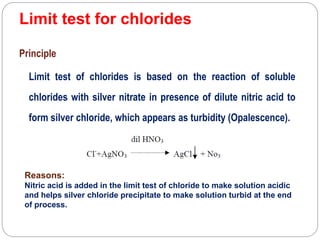
Limit test of chlorides is based on the reaction of soluble
chlorides with silver nitrate in presence of dilute nitric acid to
form silver chloride, which appears as turbidity (Opalescence).
Reasons:
Nitric acid is added in the limit test of chloride to make solution acidic
and helps silver chloride precipitate to make solution turbid at the end
of process.
Apparatus & chemicals
Apparatus Required
a) Nessler cylinders
b) Glass rod
c) Stand
Chemicals Required
a) Dilute Nitric acid (10%)
b) Silver nitrate (5%)
c) Sodium chloride
Nessler Cylinder
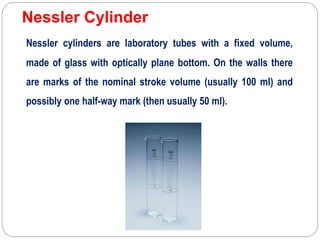
Nessler cylinders are laboratory tubes with a fixed volume,
made of glass with optically plane bottom. On the walls there
are marks of the nominal stroke volume (usually 100 ml) and
possibly one half-way mark (then usually 50 ml).
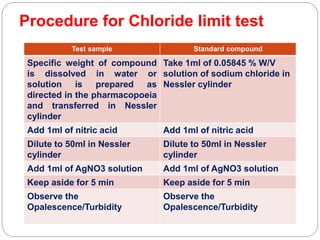
Procedure for Chloride limit test
Test sample Standard compound
Specific weight of compound
is dissolved in water or
solution is prepared as
directed in the pharmacopoeia
and transferred in Nessler
cylinder
Take 1ml of 0.05845 % W/V
solution of sodium chloride in
Nessler cylinder
Add 1ml of nitric acid Add 1ml of nitric acid
Dilute to 50ml in Nessler
cylinder
Dilute to 50ml in Nessler
cylinder
Add 1ml of AgNO3 solution Add 1ml of AgNO3 solution
Keep aside for 5 min Keep aside for 5 min
Observe the
Opalescence/Turbidity
Observe the
Opalescence/Turbidity
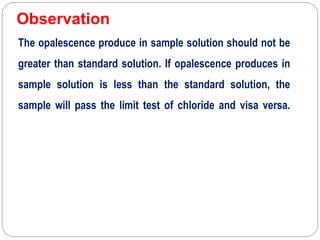
Observation
The opalescence produce in sample solution should not be
greater than standard solution. If opalescence produces in
sample solution is less than the standard solution, the
sample will pass the limit test of chloride and visa versa.
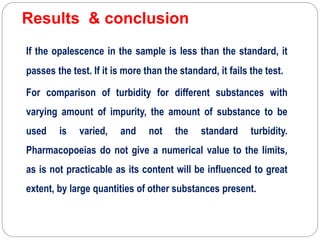
Results & conclusion
If the opalescence in the sample is less than the standard, it
passes the test. If it is more than the standard, it fails the test.
For comparison of turbidity for different substances with
varying amount of impurity, the amount of substance to be
used is varied, and not the standard turbidity.
Pharmacopoeias do not give a numerical value to the limits,
as is not practicable as its content will be influenced to great
extent, by large quantities of other substances present.

Limit test for chlorides alok sharma

  • 1.
    Limit test forchlorides Mahakal Institute of Pharmaceutical Studies, Ujjain Behind Air strip, Datana, Dewas road, Ujjain Given by Alok Sharma Asst. Professor Pharmaceutical chemistry Presentation on
  • 2.
    Introduction Limit tests arequantitative or semi-quantitative tests designed to identify and control small quantities of impurity, which are likely to be present in the substance. The quantity of any one impurity in an official substance is often small, and consequently the visible reaction response to any test for that impurity is also small. The design of individual tests is therefore important if errors are to be avoided in the hands of different operators.
  • 3.
    Specificity of thetest Any test used as a limit test must, of necessity, give some form of selective reaction with the trace impurity. Many tests used for the detection of inorganic impurities in official inorganic chemicals are based upon the separations involved in inorganic qualitative analysis.
  • 4.
    Sensitivity of thetest The degree of sensitivity required in a limit test varies enormously according to the standard of purity demanded by the monograph. The sensitivity of most tests is dependent upon a number of variable factors concentration of the solute, precipitating reagent, duration of the reaction, temperature, and the nature and concentration of other substances unavoidably present in solution.
  • 5.
    Comparison methods: Tests ofthis type require a standard containing a definite amount of impurity, to be set up at the same time and under the same conditions as the test experiment. In this way the extent of the reaction is readily determined by direct comparison of the test solution with a standard of known concentration. E.g. limit test of chlorides and sulphate e.t.c Method use for Limit tests
  • 6.
    Limit test forchlorides Principle Limit test of chlorides is based on the reaction of soluble chlorides with silver nitrate in presence of dilute nitric acid to form silver chloride, which appears as turbidity (Opalescence). Reasons: Nitric acid is added in the limit test of chloride to make solution acidic and helps silver chloride precipitate to make solution turbid at the end of process.
  • 7.
    Apparatus & chemicals ApparatusRequired a) Nessler cylinders b) Glass rod c) Stand Chemicals Required a) Dilute Nitric acid (10%) b) Silver nitrate (5%) c) Sodium chloride
  • 8.
    Nessler Cylinder Nessler cylindersare laboratory tubes with a fixed volume, made of glass with optically plane bottom. On the walls there are marks of the nominal stroke volume (usually 100 ml) and possibly one half-way mark (then usually 50 ml).
  • 9.
    Procedure for Chloridelimit test Test sample Standard compound Specific weight of compound is dissolved in water or solution is prepared as directed in the pharmacopoeia and transferred in Nessler cylinder Take 1ml of 0.05845 % W/V solution of sodium chloride in Nessler cylinder Add 1ml of nitric acid Add 1ml of nitric acid Dilute to 50ml in Nessler cylinder Dilute to 50ml in Nessler cylinder Add 1ml of AgNO3 solution Add 1ml of AgNO3 solution Keep aside for 5 min Keep aside for 5 min Observe the Opalescence/Turbidity Observe the Opalescence/Turbidity
  • 10.
    Observation The opalescence producein sample solution should not be greater than standard solution. If opalescence produces in sample solution is less than the standard solution, the sample will pass the limit test of chloride and visa versa.
  • 11.
    Results & conclusion Ifthe opalescence in the sample is less than the standard, it passes the test. If it is more than the standard, it fails the test. For comparison of turbidity for different substances with varying amount of impurity, the amount of substance to be used is varied, and not the standard turbidity. Pharmacopoeias do not give a numerical value to the limits, as is not practicable as its content will be influenced to great extent, by large quantities of other substances present.