MAJOR INTRA &
EXTRACELLULAR
ELECTROLYTES
MS. KRUTIKA HIRALAL PARDESHI
ASSISTANT PROFESSOR, MSGCOPER, NASHIK.
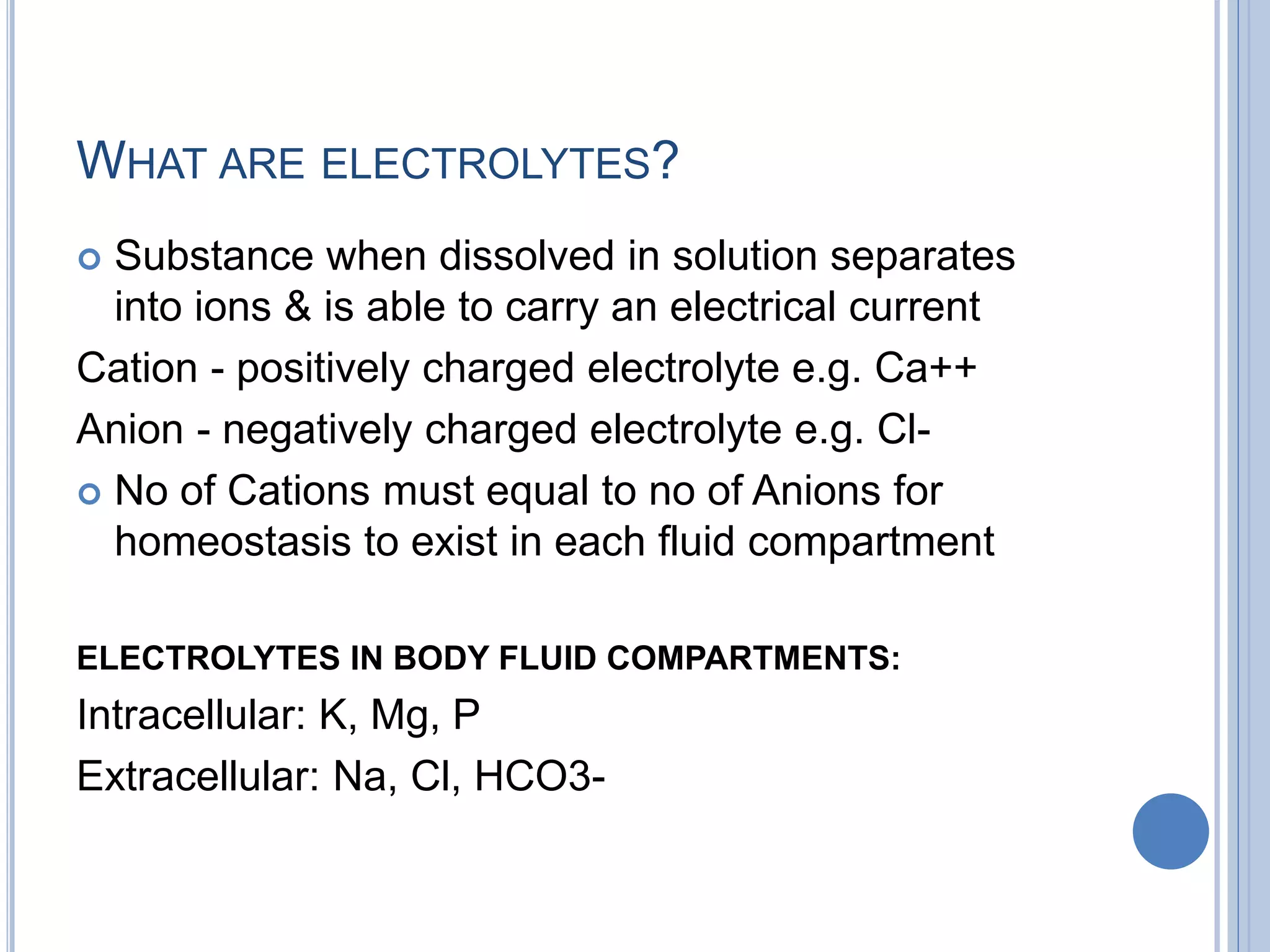
WHAT ARE ELECTROLYTES?
 Substance when dissolved in solution separates
into ions & is able to carry an electrical current
Cation - positively charged electrolyte e.g. Ca++
Anion - negatively charged electrolyte e.g. Cl-
 No of Cations must equal to no of Anions for
homeostasis to exist in each fluid compartment
ELECTROLYTES IN BODY FLUID COMPARTMENTS:
Intracellular: K, Mg, P
Extracellular: Na, Cl, HCO3-
 Various organic and inorganic compounds are present in body
fluids and concentration of them is maintained in such a way
that body cell and tissue have same environment
(homeostasis)
 To maintain this internal homeostasis, there are regulatory
mechanisms that control pH, ionic balances, osmotic balances
etc.
 There are a large number of products under the general
heading of replacement therapy which can be used by the
physician when the body itself is unable to correct an
electrolyte imbalance due to a change in the composition of its
fluids.
 These products include electrolytes, acids and bases, blood
products, carbohydrates, amino acids and proteins.
 The electrolyte concentration will vary with a particular fluid
compartment.
The three compartments are :
1. intracellular fluid (45-50% of body weight)
2. interstitial fluid (12- 15% of body weight)
3. plasma or vascular fluid (4-5% of body weight)
 The term ‘extracellular fluid’ includes both interstitial and vascular
fluids.
 These three compartments are separated from each other by
membranes that are permeable to water and many organic and
inorganic solutes.
 They are nearly impermeable to macromolecules such as proteins
and are selectively permeable to certain ions such as Na+, K+,
Mg2+
THE SOLUTION IN EACH COMPARTMENT IS IONICALLY BALANCED
INORGANIC IONS PRESENT IN BODY FLUID
ANIONIC CATIONIC
HCO3- Sodium
Cl- Potassium
SO4- Calcium
HPO4- Magnesium
 Electrolytes are express in terms of mEq/L i.e.
Miliequivalent per Litre rather than weight/volume
(w/v).
 Equivalent weight is obtained by dividing the atomic
or molecular weight by the valence.
 mEq/L= mg of substance /litre
 Equivalent weight
 Equivalent weight= Molecular weight
 Valency
MAJOR CATION PRESENT IN BODY
1. SODIUM
- Location- extracelluler compartment as a salt.
- Normal level- 136-142 mEq/L
- Functions- 1. absorb and excreted by cells
- 2. along with chloride maintain osmotic
balance of all fluid.
Condition Hyponatremia Hypernatremia
Low level of Na+ High level of Na+
Reason Extreme urine loss,
diarrhea, kidney
damage, vomiting,
excessive sweating
Dehydration.
High sodium intact
Symptoms Muscular weakness,
headache,
respiratory
depression.
Intense thirst, fatigue
Treatment Electrolyte
replacement
Low sodium diet,
diuretics.
2. POTASSIUM
- Location- intracelluler fluid.
- Normal level- 3.0-5.0 mEq/L
- Functions- 1. contraction of muscles. (Cardiac)
- 2. along with chloride maintain osmotic
balance of all fluid.
- 3. nerve impulse transmission.
Condition Hypokalemia
Decrease K+ level in body
Reasons Lower absorption, urine
loss, Heart disease
Kidney damage, cardiac
disease, CNS
depression
Symptoms Mental confusion.
Muscle weakness.
MAJOR ANION PRESENT IN BODY
1. CHLORIDE
- Location- Nearly found in all body fluids. 66% of ion
content in plasma is chloride ions.
- Normal level- 50 mEq/Kg
- Functions- 1. absorb and excreted by cells
(maintain charge in body fluid)
- 2. along with sodium maintain osmotic
balance of all fluid.
- 3. in formation of gastric acid.
Condition Hypochloremia Hyperchloremia
Decrease calcium
level in body
Increase calcium
level in body
Reason 1. Metabolic
acidosis
2. Vomiting
3. Lack of
reabsorption
Excess loss of
bicarbonate ions and
dehydration
Symptoms Alkalosis and muscle
spasm
ELECTROLYTE USED IN
REPLACEMENT THERAPY
 Sodium chloride and its preparations
 Potassium chloride and its preparations
SODIUM CHLORIDE
 Moleculer formula- NaCl
 Molecular weight- 58.54
METHOD OF PREPARATION
 Sodium Chloride (NaCl) can be obtained from natural
source as well as it can also be prepared in laboratory.
 Naturally It can be obtained from Rock salt strata & Sea
water. But from these sources it can be obtained in
impure form. The pure form of salt can be obtained by
the filtration process & finally the dried form can be
collected by evaporation process.
 It can also be prepared in laboratory in small scale by
the acid- base reaction. In which strong acid (HCl)
reacts with strong base (NaOH) & finally it gives Sodium
Chloride.
 It is white, anhydrous crystalline solid.
 Odourless but having salty taste.
 It is soluble in water but insoluble in alcohol.
 Its 0.9% Solution is Isotonic (That means having
same Osmotic pressure) to blood.
PHYSICAL PROPERTIES
CHEMICAL PROPERTIES
 When react with permanganate it liberate chorine
gas.
 It reacts with Silver nitrate and forms white
precipitates of Silver chloride.
NaCl + AgNO3 AgCl + NaNO2
USES
 It is used as electrolyte replenisher.
 Its 0.9% solution is isotonic (having same osmotic
pressure) as blood.
 It is also used as taste enhancer in the preparation
of dishes.
 It is also used in Wet dressings & irrigation of body
cavities.
OFFICIAL PREPARATION OF SODIUM
CHLORIDE
1. Sodium chloride injection I.P
2. Sodium chloride hypertonic injection I.P
3. Sodium chloride eye lotion B.P
4. Sodium chloride solution B.P
5. Sodium chloride & Dextrose injection I.P
6. Sodium chloride & Mannitol injection I.P
7. Sodium chloride tablets U.S.P
SODIUM CHLORIDE INJECTION I.P
 It is sterile isotonic solution of NaCl in water for
injection.
 I.P.- 0.85-0.95% w/v (150 milimoles of sodium
chloride ions per litre)
 B.P.- 95-105% w/v
 When it is required as diluent for other
pharmacopoeial injctions, 0.9% w/v solution of NaCl
is used.
SODIUM CHLORIDE HYPERTONIC INJECTION
I.P
 It is sterile isotonic solution of NaCl in water for
injection contain not less than 1. 52% and not more
than 1.68% w/v of sodium chloride.
 (270 milimoles of sodium chloride ions per litre)
 no antimicrobial ions are present.
 Sodium chloride eye lotion B.P
0.85-0.95% w/v of NaCl
 Sodium chloride solution B.P
0.9% w/v solution
Normal saline solution
If sterile- it is completely free from micro organisms.
SODIUM CHLORIDE & DEXTROSE INJECTION I.P
Concentration of Dextrose Concentration of Sodium chloride
5 % w/v 0.11, 0.18, 0.20, 0.225, 0.30, 0.33 %
2.5, 5, 10% 0.45%
2.5, 5, 10 , 25 % w/v 0.9%
Sterile solution of sodium chloride and dextrose.
SODIUM CHLORIDE & MANNITOL INJECTION
U.S.P
 Sterile solution of sodium chloride and mannitol.
Concentration of Mannitol
Concentration of Sodium
chloride
5-10% 0.3%
15-20% 0.45%
SODIUM CHLORIDE TABLETS I.P
 95-105% w/v of stated amount
 Strength available- 180,300,500mg
POTASSIUM CHLORIDE
 Molecular formula- KCl
 Molecular weight- 74.55
 Synonym- potassium muriate, potash muriate
METHOD OF PREPARATION
 It can be commonly obtained by mining its
 minerals, followed by extraction.
 It is also extracted from brine (salt water).
 It can also be prepared in the laboratory in small
scales by reacting potassium hydroxide (KOH) with
hydrochloric acid (HCl).
KOH + HCl → KCl + H2O
PROPERTIES
 Physical properties-
 It is white crystalline powder, odourless & strong
saline taste.
 Like Sodium Chloride it is freely soluble in Water, &
insoluble in alcohols.
 Chemical properties-
 Another important reaction of KCl is used to
produce metallic potassium, by reducing KCl with
metallic sodium at 850 °C.
KCl + Na → NaCl + K
USES
 It is used as electrolytes replenisher.
 pH buffers
 Preparation of fertilizers, explosives, potassium
metal and potassium hydroxide.
 In treatment of hypokalemia (potassium deficiency
disorder)
 Used in treatment of digitalis poisoning
 Used in treatment of myasthenia gravis
OFFICIAL PREPARATION OF POTASSIUM
CHLORIDE
 Potassium chloride and glucose IV infusion B.P.
injection I.P
 Potassium chloride & Sodium chloride I.V Infusion
I.P/ Injection
 Potassium chloride & Dextrose(Glucose) I.V
infusion I.P

Major inta extra cellualr electrolyte.

  • 1.
    MAJOR INTRA & EXTRACELLULAR ELECTROLYTES MS.KRUTIKA HIRALAL PARDESHI ASSISTANT PROFESSOR, MSGCOPER, NASHIK.
  • 2.
    WHAT ARE ELECTROLYTES? Substance when dissolved in solution separates into ions & is able to carry an electrical current Cation - positively charged electrolyte e.g. Ca++ Anion - negatively charged electrolyte e.g. Cl-  No of Cations must equal to no of Anions for homeostasis to exist in each fluid compartment ELECTROLYTES IN BODY FLUID COMPARTMENTS: Intracellular: K, Mg, P Extracellular: Na, Cl, HCO3-
  • 3.
     Various organicand inorganic compounds are present in body fluids and concentration of them is maintained in such a way that body cell and tissue have same environment (homeostasis)  To maintain this internal homeostasis, there are regulatory mechanisms that control pH, ionic balances, osmotic balances etc.  There are a large number of products under the general heading of replacement therapy which can be used by the physician when the body itself is unable to correct an electrolyte imbalance due to a change in the composition of its fluids.  These products include electrolytes, acids and bases, blood products, carbohydrates, amino acids and proteins.
  • 4.
     The electrolyteconcentration will vary with a particular fluid compartment. The three compartments are : 1. intracellular fluid (45-50% of body weight) 2. interstitial fluid (12- 15% of body weight) 3. plasma or vascular fluid (4-5% of body weight)  The term ‘extracellular fluid’ includes both interstitial and vascular fluids.  These three compartments are separated from each other by membranes that are permeable to water and many organic and inorganic solutes.  They are nearly impermeable to macromolecules such as proteins and are selectively permeable to certain ions such as Na+, K+, Mg2+
  • 6.
    THE SOLUTION INEACH COMPARTMENT IS IONICALLY BALANCED
  • 7.
    INORGANIC IONS PRESENTIN BODY FLUID ANIONIC CATIONIC HCO3- Sodium Cl- Potassium SO4- Calcium HPO4- Magnesium
  • 8.
     Electrolytes areexpress in terms of mEq/L i.e. Miliequivalent per Litre rather than weight/volume (w/v).  Equivalent weight is obtained by dividing the atomic or molecular weight by the valence.  mEq/L= mg of substance /litre  Equivalent weight  Equivalent weight= Molecular weight  Valency
  • 9.
  • 10.
    1. SODIUM - Location-extracelluler compartment as a salt. - Normal level- 136-142 mEq/L - Functions- 1. absorb and excreted by cells - 2. along with chloride maintain osmotic balance of all fluid.
  • 11.
    Condition Hyponatremia Hypernatremia Lowlevel of Na+ High level of Na+ Reason Extreme urine loss, diarrhea, kidney damage, vomiting, excessive sweating Dehydration. High sodium intact Symptoms Muscular weakness, headache, respiratory depression. Intense thirst, fatigue Treatment Electrolyte replacement Low sodium diet, diuretics.
  • 12.
    2. POTASSIUM - Location-intracelluler fluid. - Normal level- 3.0-5.0 mEq/L - Functions- 1. contraction of muscles. (Cardiac) - 2. along with chloride maintain osmotic balance of all fluid. - 3. nerve impulse transmission.
  • 13.
    Condition Hypokalemia Decrease K+level in body Reasons Lower absorption, urine loss, Heart disease Kidney damage, cardiac disease, CNS depression Symptoms Mental confusion. Muscle weakness.
  • 14.
  • 15.
    1. CHLORIDE - Location-Nearly found in all body fluids. 66% of ion content in plasma is chloride ions. - Normal level- 50 mEq/Kg - Functions- 1. absorb and excreted by cells (maintain charge in body fluid) - 2. along with sodium maintain osmotic balance of all fluid. - 3. in formation of gastric acid.
  • 16.
    Condition Hypochloremia Hyperchloremia Decreasecalcium level in body Increase calcium level in body Reason 1. Metabolic acidosis 2. Vomiting 3. Lack of reabsorption Excess loss of bicarbonate ions and dehydration Symptoms Alkalosis and muscle spasm
  • 17.
    ELECTROLYTE USED IN REPLACEMENTTHERAPY  Sodium chloride and its preparations  Potassium chloride and its preparations
  • 18.
    SODIUM CHLORIDE  Moleculerformula- NaCl  Molecular weight- 58.54
  • 19.
    METHOD OF PREPARATION Sodium Chloride (NaCl) can be obtained from natural source as well as it can also be prepared in laboratory.  Naturally It can be obtained from Rock salt strata & Sea water. But from these sources it can be obtained in impure form. The pure form of salt can be obtained by the filtration process & finally the dried form can be collected by evaporation process.  It can also be prepared in laboratory in small scale by the acid- base reaction. In which strong acid (HCl) reacts with strong base (NaOH) & finally it gives Sodium Chloride.
  • 20.
     It iswhite, anhydrous crystalline solid.  Odourless but having salty taste.  It is soluble in water but insoluble in alcohol.  Its 0.9% Solution is Isotonic (That means having same Osmotic pressure) to blood. PHYSICAL PROPERTIES
  • 21.
    CHEMICAL PROPERTIES  Whenreact with permanganate it liberate chorine gas.  It reacts with Silver nitrate and forms white precipitates of Silver chloride. NaCl + AgNO3 AgCl + NaNO2
  • 22.
    USES  It isused as electrolyte replenisher.  Its 0.9% solution is isotonic (having same osmotic pressure) as blood.  It is also used as taste enhancer in the preparation of dishes.  It is also used in Wet dressings & irrigation of body cavities.
  • 23.
    OFFICIAL PREPARATION OFSODIUM CHLORIDE 1. Sodium chloride injection I.P 2. Sodium chloride hypertonic injection I.P 3. Sodium chloride eye lotion B.P 4. Sodium chloride solution B.P 5. Sodium chloride & Dextrose injection I.P 6. Sodium chloride & Mannitol injection I.P 7. Sodium chloride tablets U.S.P
  • 24.
    SODIUM CHLORIDE INJECTIONI.P  It is sterile isotonic solution of NaCl in water for injection.  I.P.- 0.85-0.95% w/v (150 milimoles of sodium chloride ions per litre)  B.P.- 95-105% w/v  When it is required as diluent for other pharmacopoeial injctions, 0.9% w/v solution of NaCl is used.
  • 25.
    SODIUM CHLORIDE HYPERTONICINJECTION I.P  It is sterile isotonic solution of NaCl in water for injection contain not less than 1. 52% and not more than 1.68% w/v of sodium chloride.  (270 milimoles of sodium chloride ions per litre)  no antimicrobial ions are present.
  • 26.
     Sodium chlorideeye lotion B.P 0.85-0.95% w/v of NaCl  Sodium chloride solution B.P 0.9% w/v solution Normal saline solution If sterile- it is completely free from micro organisms.
  • 27.
    SODIUM CHLORIDE &DEXTROSE INJECTION I.P Concentration of Dextrose Concentration of Sodium chloride 5 % w/v 0.11, 0.18, 0.20, 0.225, 0.30, 0.33 % 2.5, 5, 10% 0.45% 2.5, 5, 10 , 25 % w/v 0.9% Sterile solution of sodium chloride and dextrose.
  • 28.
    SODIUM CHLORIDE &MANNITOL INJECTION U.S.P  Sterile solution of sodium chloride and mannitol. Concentration of Mannitol Concentration of Sodium chloride 5-10% 0.3% 15-20% 0.45%
  • 29.
    SODIUM CHLORIDE TABLETSI.P  95-105% w/v of stated amount  Strength available- 180,300,500mg
  • 30.
    POTASSIUM CHLORIDE  Molecularformula- KCl  Molecular weight- 74.55  Synonym- potassium muriate, potash muriate
  • 31.
    METHOD OF PREPARATION It can be commonly obtained by mining its  minerals, followed by extraction.  It is also extracted from brine (salt water).  It can also be prepared in the laboratory in small scales by reacting potassium hydroxide (KOH) with hydrochloric acid (HCl). KOH + HCl → KCl + H2O
  • 32.
    PROPERTIES  Physical properties- It is white crystalline powder, odourless & strong saline taste.  Like Sodium Chloride it is freely soluble in Water, & insoluble in alcohols.  Chemical properties-  Another important reaction of KCl is used to produce metallic potassium, by reducing KCl with metallic sodium at 850 °C. KCl + Na → NaCl + K
  • 33.
    USES  It isused as electrolytes replenisher.  pH buffers  Preparation of fertilizers, explosives, potassium metal and potassium hydroxide.  In treatment of hypokalemia (potassium deficiency disorder)  Used in treatment of digitalis poisoning  Used in treatment of myasthenia gravis
  • 34.
    OFFICIAL PREPARATION OFPOTASSIUM CHLORIDE  Potassium chloride and glucose IV infusion B.P. injection I.P  Potassium chloride & Sodium chloride I.V Infusion I.P/ Injection  Potassium chloride & Dextrose(Glucose) I.V infusion I.P