Dr. Jasmine Chaudhary
Associate Professor
MMCP
jasmine.jain@mmumullana.o
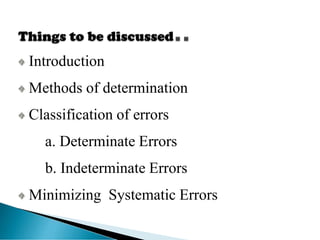
Introduction
Methods of determination
Classification of errors
a. Determinate Errors
b. Indeterminate Errors
Minimizing Systematic Errors
Error is the difference between the true (standard/reference)
value and the measured (observed) value.
Error = Measured value- True value
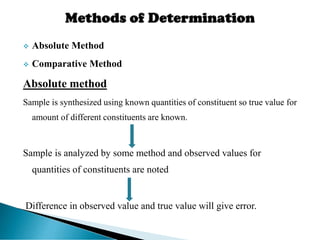
 Absolute Method
 Comparative Method
Absolute method
Sample is synthesized using known quantities of constituent so true value for
amount of different constituents are known.
Sample is analyzed by some method and observed values for
quantities of constituents are noted
Difference in observed value and true value will give error.
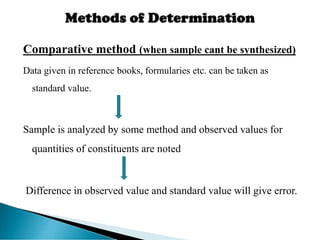
Comparative method (when sample cant be synthesized)
Data given in reference books, formularies etc. can be taken as
standard value.
Sample is analyzed by some method and observed values for
quantities of constituents are noted
Difference in observed value and standard value will give error.
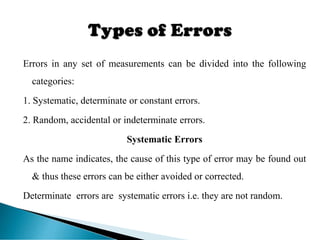
Errors in any set of measurements can be divided into the following
categories:
1. Systematic, determinate or constant errors.
2. Random, accidental or indeterminate errors.
Systematic Errors
As the name indicates, the cause of this type of error may be found out
& thus these errors can be either avoided or corrected.
Determinate errors are systematic errors i.e. they are not random.
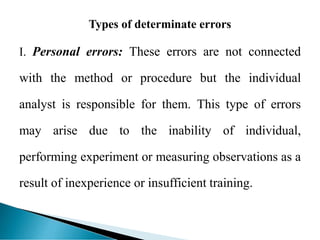
Types of determinate errors
I. Personal errors: These errors are not connected
with the method or procedure but the individual
analyst is responsible for them. This type of errors
may arise due to the inability of individual,
performing experiment or measuring observations as a
result of inexperience or insufficient training.
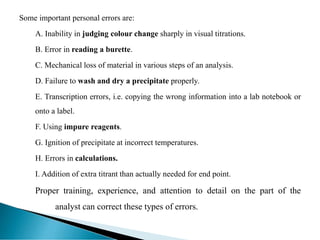
Some important personal errors are:
A. Inability in judging colour change sharply in visual titrations.
B. Error in reading a burette.
C. Mechanical loss of material in various steps of an analysis.
D. Failure to wash and dry a precipitate properly.
E. Transcription errors, i.e. copying the wrong information into a lab notebook or
onto a label.
F. Using impure reagents.
G. Ignition of precipitate at incorrect temperatures.
H. Errors in calculations.
I. Addition of extra titrant than actually needed for end point.
Proper training, experience, and attention to detail on the part of the
analyst can correct these types of errors.
Instruments and reagent errors: These errors may be due to using
faulty constructed instruments, apparatus or impure reagents. E.g.
A. Balance arms of unequal lengths.
B. Uncalibrated or improperly calibrated weights.
C. Incorrectly graduated burettes/ pipettes so instead of measuring 10
ml; 9.8 or 10.2 ml is taken.
D. Attack of foreign materials upon glasswares.
E. Impure reagents.
These errors can be avoided by
• using calibrated weights, glasswares and pure reagents.
• following a systematic procedure to check the instrument
settings and operation before use. Such procedures are called std.
operating procedures (SOPs).
Methodic errors (Error of Method): These are the most serious
types of errors encountered in chemical analysis. Some examples involving
methodic errors are:
A. Solubility of precipitate in medium and in wash liquid.
B. Decomposition or volatilization of weighing forms of precipitates on
ignition or heating.
C. Hygroscopicity of the weighing forms of the precipitates.
D. Co-precipitation and Post-precipitation
E. Failure of a reaction to achieve completion.
F. Occurrence of side reactions.
G. Loss of analyte during sample preparation by volatilization or precipitation.
These errors can be eliminated or reduced to a small magnitude by
employing the proper technique.
Additive Errors
This type of error is independent of the amount of the constituent present in
the determination and is constant in a series of determination. e.g.,
 0.1 ml extra titrant has to be added to see color change clearly at end point
so error is 0.1 ml. Now if std value is 10 ml, observed value will be 10.1
ml.
If sample is doubled, std. value is 20 ml and observed value will be 20.1 ml
due to end point error (0.1 ml) so error remains same even sample is
doubled.
 loss in weight of a crucible adds error to the weight of precipitate ignited in
it.
Proportional errors
Magnitude of proportional error depends upon the quantity of the constituent/
sample. e.g.,
Impurity present in a standard substance gives a wrong value for the
normality of a standard solution e.g in case of NaOH.
As10 ml of 0.1N HCl can be titrated with 10 ml of 0.1 N NaOH (std. value)
but as NaOH is impure so due to impurity, observed value can let be 10.2
ml so error is 10.2-10= 0.2 ml
Now, if 20 ml of 0.1N HCl has to be titrated then 20 ml of 0.1 N NaOH
should be used but observed value is 20.4 ml so error is 20.4- 20 = 0.4 ml.
Thus, doubling of sample, doubled the error.
Inderteminate error
Indeterminate errors can not be pin- pointed to any specific well defined
reasons.
They are random in nature & take place in several successive
measurements performed by the same analyst under the same conditions
and identical experimental parameters.
These errors are accidental and analyst has no control over them.
e.g.
 Vibration in balance while handling it.
 Accidental loss of material during analysis.
 Variation in temperature.
 Variation in weighing due to air pressure
Other examples are the limitations of reading balances, vibrations
caused to the building by heavy vehicular- trafficking , which are
beyond anyone's control.
For e.g. A balance that is capable of measuring only to 0.001 g can not
distinguish between two samples with masses of 1.0151 & 1.0149
g.
MINIMIZATION OF ERRORS
The determinate error may be minimized by using following methods:
1. Running a blank determination: Errors arising from the introduction of
impurities through the reagents and vessels are accomplished by running a
blank. Such a procedure involves going through all the analysis, using the
same solvent and reagent in the same quantities, but omitting the unknown
component. Thus, in making a blank, sample is omitted; otherwise the details
of the procedure are followed exactly as far as possible.
2. Calibration of apparatus and application of corrections: All instruments,
such as burettes, pipettes, weights, measuring flasks, etc. must be properly
calibrated and the appropriate corrections must be applied to the original
measurements.
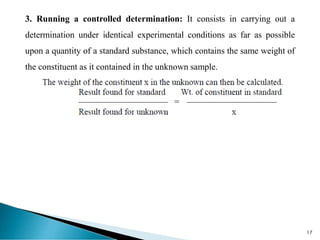
3. Running a controlled determination: It consists in carrying out a
determination under identical experimental conditions as far as possible
upon a quantity of a standard substance, which contains the same weight of
the constituent as it contained in the unknown sample.
17
4. Use of independent method of analysis: Determination is made by some
other method and both results are compared. e.g. strength of HCl may be
determined by two methods :
i. Titrating it with a standard solution of a strong base.
ii. Precipitation with AgNO3 and weighing as AgCl.
If the results obtained by the two methods are in good agreement, it may be
said that the values are correct within small limits of errors.
 Verma RM. Analytical Chemistry (Theory and Practice), 3rd
Edition, 2016, CBS Publishers, 19-24

Errors in Pharmaceutical analysis.pdf

  • 1.
    Dr. Jasmine Chaudhary AssociateProfessor MMCP jasmine.jain@mmumullana.o
  • 2.
    Introduction Methods of determination Classificationof errors a. Determinate Errors b. Indeterminate Errors Minimizing Systematic Errors
  • 3.
    Error is thedifference between the true (standard/reference) value and the measured (observed) value. Error = Measured value- True value
  • 4.
     Absolute Method Comparative Method Absolute method Sample is synthesized using known quantities of constituent so true value for amount of different constituents are known. Sample is analyzed by some method and observed values for quantities of constituents are noted Difference in observed value and true value will give error.
  • 5.
    Comparative method (whensample cant be synthesized) Data given in reference books, formularies etc. can be taken as standard value. Sample is analyzed by some method and observed values for quantities of constituents are noted Difference in observed value and standard value will give error.
  • 6.
    Errors in anyset of measurements can be divided into the following categories: 1. Systematic, determinate or constant errors. 2. Random, accidental or indeterminate errors. Systematic Errors As the name indicates, the cause of this type of error may be found out & thus these errors can be either avoided or corrected. Determinate errors are systematic errors i.e. they are not random.
  • 7.
    Types of determinateerrors I. Personal errors: These errors are not connected with the method or procedure but the individual analyst is responsible for them. This type of errors may arise due to the inability of individual, performing experiment or measuring observations as a result of inexperience or insufficient training.
  • 8.
    Some important personalerrors are: A. Inability in judging colour change sharply in visual titrations. B. Error in reading a burette. C. Mechanical loss of material in various steps of an analysis. D. Failure to wash and dry a precipitate properly. E. Transcription errors, i.e. copying the wrong information into a lab notebook or onto a label. F. Using impure reagents. G. Ignition of precipitate at incorrect temperatures. H. Errors in calculations. I. Addition of extra titrant than actually needed for end point. Proper training, experience, and attention to detail on the part of the analyst can correct these types of errors.
  • 9.
    Instruments and reagenterrors: These errors may be due to using faulty constructed instruments, apparatus or impure reagents. E.g. A. Balance arms of unequal lengths. B. Uncalibrated or improperly calibrated weights. C. Incorrectly graduated burettes/ pipettes so instead of measuring 10 ml; 9.8 or 10.2 ml is taken. D. Attack of foreign materials upon glasswares. E. Impure reagents.
  • 10.
    These errors canbe avoided by • using calibrated weights, glasswares and pure reagents. • following a systematic procedure to check the instrument settings and operation before use. Such procedures are called std. operating procedures (SOPs).
  • 11.
    Methodic errors (Errorof Method): These are the most serious types of errors encountered in chemical analysis. Some examples involving methodic errors are: A. Solubility of precipitate in medium and in wash liquid. B. Decomposition or volatilization of weighing forms of precipitates on ignition or heating. C. Hygroscopicity of the weighing forms of the precipitates. D. Co-precipitation and Post-precipitation E. Failure of a reaction to achieve completion. F. Occurrence of side reactions. G. Loss of analyte during sample preparation by volatilization or precipitation. These errors can be eliminated or reduced to a small magnitude by employing the proper technique.
  • 12.
    Additive Errors This typeof error is independent of the amount of the constituent present in the determination and is constant in a series of determination. e.g.,  0.1 ml extra titrant has to be added to see color change clearly at end point so error is 0.1 ml. Now if std value is 10 ml, observed value will be 10.1 ml. If sample is doubled, std. value is 20 ml and observed value will be 20.1 ml due to end point error (0.1 ml) so error remains same even sample is doubled.  loss in weight of a crucible adds error to the weight of precipitate ignited in it.
  • 13.
    Proportional errors Magnitude ofproportional error depends upon the quantity of the constituent/ sample. e.g., Impurity present in a standard substance gives a wrong value for the normality of a standard solution e.g in case of NaOH. As10 ml of 0.1N HCl can be titrated with 10 ml of 0.1 N NaOH (std. value) but as NaOH is impure so due to impurity, observed value can let be 10.2 ml so error is 10.2-10= 0.2 ml Now, if 20 ml of 0.1N HCl has to be titrated then 20 ml of 0.1 N NaOH should be used but observed value is 20.4 ml so error is 20.4- 20 = 0.4 ml. Thus, doubling of sample, doubled the error.
  • 14.
    Inderteminate error Indeterminate errorscan not be pin- pointed to any specific well defined reasons. They are random in nature & take place in several successive measurements performed by the same analyst under the same conditions and identical experimental parameters. These errors are accidental and analyst has no control over them. e.g.  Vibration in balance while handling it.  Accidental loss of material during analysis.  Variation in temperature.  Variation in weighing due to air pressure
  • 15.
    Other examples arethe limitations of reading balances, vibrations caused to the building by heavy vehicular- trafficking , which are beyond anyone's control. For e.g. A balance that is capable of measuring only to 0.001 g can not distinguish between two samples with masses of 1.0151 & 1.0149 g.
  • 16.
    MINIMIZATION OF ERRORS Thedeterminate error may be minimized by using following methods: 1. Running a blank determination: Errors arising from the introduction of impurities through the reagents and vessels are accomplished by running a blank. Such a procedure involves going through all the analysis, using the same solvent and reagent in the same quantities, but omitting the unknown component. Thus, in making a blank, sample is omitted; otherwise the details of the procedure are followed exactly as far as possible. 2. Calibration of apparatus and application of corrections: All instruments, such as burettes, pipettes, weights, measuring flasks, etc. must be properly calibrated and the appropriate corrections must be applied to the original measurements.
  • 17.
    3. Running acontrolled determination: It consists in carrying out a determination under identical experimental conditions as far as possible upon a quantity of a standard substance, which contains the same weight of the constituent as it contained in the unknown sample. 17
  • 18.
    4. Use ofindependent method of analysis: Determination is made by some other method and both results are compared. e.g. strength of HCl may be determined by two methods : i. Titrating it with a standard solution of a strong base. ii. Precipitation with AgNO3 and weighing as AgCl. If the results obtained by the two methods are in good agreement, it may be said that the values are correct within small limits of errors.
  • 19.
     Verma RM.Analytical Chemistry (Theory and Practice), 3rd Edition, 2016, CBS Publishers, 19-24