DEPARTMENT OF PHARMACY
NAGPUR COLLEGE OF PHARMACY,
WANADONGRI ,NAGPUR
Author: Dr Sanjana N Gaikwad
Department :Pharmaceutics
Subject: Inorganic Chemistry
Nagpur college of Pharmacy, Wanadongri ,Nagpur
EMETICS
• To understand the medicinal and pharmaceutical
importance
• To know about pharmaceutical compounds and
their uses as emetics
PURPOSE
1. What are Emetics
2. Assay
3. Properties
LEARNING OBJECTIVES
EMETICS
• Emetics are derived from word emesis which mean
vomiting
• Vomiting is forceful expulsion of contents present in
stomach through mouth sometimes through nose
• Emetics are the drugs which give rise to forced emesis
by which the contents of the stomach get expelled
through the oral cavity.
• They are very important in cases ofPoisoning.
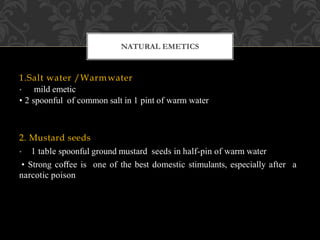
1.Salt water /Warmwater
• mild emetic
• 2 spoonful of common salt in 1 pint of warm water
2. Mustard seeds
• 1 table spoonful ground mustard seeds in half-pin of warm water
• Strong coffee is one of the best domestic stimulants, especially after a
narcotic poison
NATURAL EMETICS
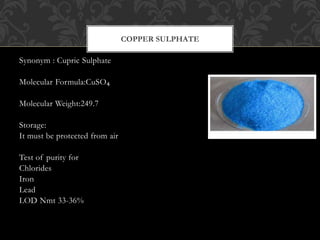
Synonym : Cupric Sulphate
Molecular Formula:CuSO₄
Molecular Weight:249.7
Storage:
It must be protected from air
Test of purity for
Chlorides
Iron
Lead
LOD Nmt 33-36%
COPPER SULPHATE
Emetic in large doses Chemical antidote for Phosphorus poisoning
Astringent and fungicidal
Copper Deficiency
Ingredient in Benedicts and Fehlings solution
Preparation of absolute alcohol
Herbicide , algaecide
Electroplating
USES
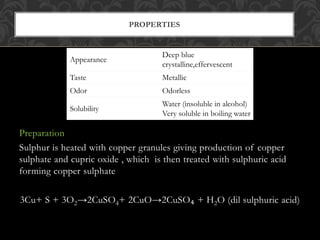
Preparation
Sulphur is heated with copper granules giving production of copper
sulphate and cupric oxide , which is then treated with sulphuric acid
forming copper sulphate
3Cu+ S + 3O2→2CuSO4+ 2CuO→2CuSO₄ + H2O (dil sulphuric acid)
PROPERTIES
Appearance
Deep blue
crystalline,effervescent
Taste Metallic
Odor Odorless
Solubility
Water (insoluble in alcohol)
Very soluble in boiling water
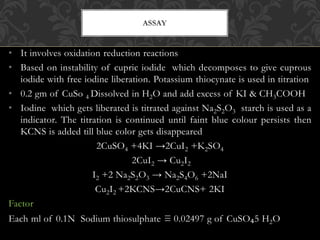
• It involves oxidation reduction reactions
• Based on instability of cupric iodide which decomposes to give cuprous
iodide with free iodine liberation. Potassium thiocynate is used in titration
• 0.2 gm of CuSo 4 Dissolved in H2O and add excess of KI & CH3COOH
• Iodine which gets liberated is titrated against Na2S2O3 starch is used as a
indicator. The titration is continued until faint blue colour persists then
KCNS is added till blue color gets disappeared
2CuSO4 +4KI →2CuI2 +K2SO4
2CuI2 → Cu2I2
I2 +2 Na2S2O3 → Na2S4O6 +2NaI
Cu2I2 +2KCNS→2CuCNS+ 2KI
Factor
Each ml of 0.1N Sodium thiosulphate ≡ 0.02497 g of CuSO₄5 H2O
ASSAY
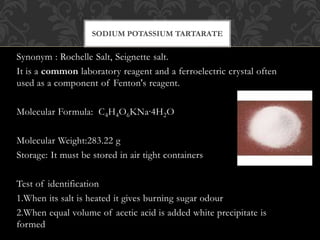
Synonym : Rochelle Salt, Seignette salt.
It is a common laboratory reagent and a ferroelectric crystal often
used as a component of Fenton's reagent.
Molecular Formula: C4H4O6KNa·4H2O
Molecular Weight:283.22 g
Storage: It must be stored in air tight containers
Test of identification
1.When its salt is heated it gives burning sugar odour
2.When equal volume of acetic acid is added white precipitate is
formed
SODIUM POTASSIUM TARTARATE
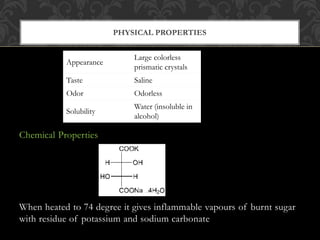
Chemical Properties
When heated to 74 degree it gives inflammable vapours of burnt sugar
with residue of potassium and sodium carbonate
PHYSICAL PROPERTIES
Appearance
Large colorless
prismatic crystals
Taste Saline
Odor Odorless
Solubility
Water (insoluble in
alcohol)
It is an ingredient of Fehling's solution
Emetic,Saline cathartic
Mild laxative
Diuretic
Alkaliser
Food additive
Breaking emulsions
USES
PREPARATION
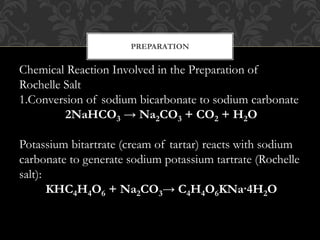
Chemical Reaction Involved in the Preparation of
Rochelle Salt
1.Conversion of sodium bicarbonate to sodium carbonate
2NaHCO3 → Na2CO3 + CO2 + H2O
Potassium bitartrate (cream of tartar) reacts with sodium
carbonate to generate sodium potassium tartrate (Rochelle
salt):
KHC4H4O6 + Na2CO3→ C4H4O6KNa·4H2O
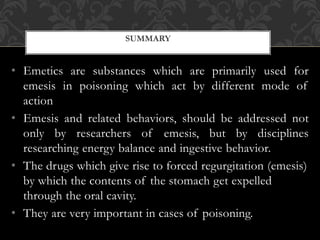
• Emetics are substances which are primarily used for
emesis in poisoning which act by different mode of
action
• Emesis and related behaviors, should be addressed not
only by researchers of emesis, but by disciplines
researching energy balance and ingestive behavior.
• The drugs which give rise to forced regurgitation (emesis)
by which the contents of the stomach get expelled
through the oral cavity.
• They are very important in cases of poisoning.
SUMMARY
1. G.R Chatwal:Pharmaceutical Chemistry Inorganic,
himalaya publishing house Vol 1
2. P. Gundu Rao, Inorganic Pharmaceutical
Chemistry, 3rd Edition
3. M.L Schroff, Inorganic Pharmaceutical Chemistry
BIBLIOGRAPHY
1. What are emetics ?
2. Give assay of copper sulphate?
3. Give properties and uses of Sodium Potassium
Tartarate.
QUESTIONS?

Emetics

  • 1.
    DEPARTMENT OF PHARMACY NAGPURCOLLEGE OF PHARMACY, WANADONGRI ,NAGPUR
  • 2.
    Author: Dr SanjanaN Gaikwad Department :Pharmaceutics Subject: Inorganic Chemistry Nagpur college of Pharmacy, Wanadongri ,Nagpur EMETICS
  • 3.
    • To understandthe medicinal and pharmaceutical importance • To know about pharmaceutical compounds and their uses as emetics PURPOSE
  • 4.
    1. What areEmetics 2. Assay 3. Properties LEARNING OBJECTIVES
  • 5.
    EMETICS • Emetics arederived from word emesis which mean vomiting • Vomiting is forceful expulsion of contents present in stomach through mouth sometimes through nose • Emetics are the drugs which give rise to forced emesis by which the contents of the stomach get expelled through the oral cavity. • They are very important in cases ofPoisoning.
  • 6.
    1.Salt water /Warmwater •mild emetic • 2 spoonful of common salt in 1 pint of warm water 2. Mustard seeds • 1 table spoonful ground mustard seeds in half-pin of warm water • Strong coffee is one of the best domestic stimulants, especially after a narcotic poison NATURAL EMETICS
  • 7.
    Synonym : CupricSulphate Molecular Formula:CuSO₄ Molecular Weight:249.7 Storage: It must be protected from air Test of purity for Chlorides Iron Lead LOD Nmt 33-36% COPPER SULPHATE
  • 8.
    Emetic in largedoses Chemical antidote for Phosphorus poisoning Astringent and fungicidal Copper Deficiency Ingredient in Benedicts and Fehlings solution Preparation of absolute alcohol Herbicide , algaecide Electroplating USES
  • 9.
    Preparation Sulphur is heatedwith copper granules giving production of copper sulphate and cupric oxide , which is then treated with sulphuric acid forming copper sulphate 3Cu+ S + 3O2→2CuSO4+ 2CuO→2CuSO₄ + H2O (dil sulphuric acid) PROPERTIES Appearance Deep blue crystalline,effervescent Taste Metallic Odor Odorless Solubility Water (insoluble in alcohol) Very soluble in boiling water
  • 10.
    • It involvesoxidation reduction reactions • Based on instability of cupric iodide which decomposes to give cuprous iodide with free iodine liberation. Potassium thiocynate is used in titration • 0.2 gm of CuSo 4 Dissolved in H2O and add excess of KI & CH3COOH • Iodine which gets liberated is titrated against Na2S2O3 starch is used as a indicator. The titration is continued until faint blue colour persists then KCNS is added till blue color gets disappeared 2CuSO4 +4KI →2CuI2 +K2SO4 2CuI2 → Cu2I2 I2 +2 Na2S2O3 → Na2S4O6 +2NaI Cu2I2 +2KCNS→2CuCNS+ 2KI Factor Each ml of 0.1N Sodium thiosulphate ≡ 0.02497 g of CuSO₄5 H2O ASSAY
  • 11.
    Synonym : RochelleSalt, Seignette salt. It is a common laboratory reagent and a ferroelectric crystal often used as a component of Fenton's reagent. Molecular Formula: C4H4O6KNa·4H2O Molecular Weight:283.22 g Storage: It must be stored in air tight containers Test of identification 1.When its salt is heated it gives burning sugar odour 2.When equal volume of acetic acid is added white precipitate is formed SODIUM POTASSIUM TARTARATE
  • 12.
    Chemical Properties When heatedto 74 degree it gives inflammable vapours of burnt sugar with residue of potassium and sodium carbonate PHYSICAL PROPERTIES Appearance Large colorless prismatic crystals Taste Saline Odor Odorless Solubility Water (insoluble in alcohol)
  • 13.
    It is aningredient of Fehling's solution Emetic,Saline cathartic Mild laxative Diuretic Alkaliser Food additive Breaking emulsions USES
  • 14.
    PREPARATION Chemical Reaction Involvedin the Preparation of Rochelle Salt 1.Conversion of sodium bicarbonate to sodium carbonate 2NaHCO3 → Na2CO3 + CO2 + H2O Potassium bitartrate (cream of tartar) reacts with sodium carbonate to generate sodium potassium tartrate (Rochelle salt): KHC4H4O6 + Na2CO3→ C4H4O6KNa·4H2O
  • 15.
    • Emetics aresubstances which are primarily used for emesis in poisoning which act by different mode of action • Emesis and related behaviors, should be addressed not only by researchers of emesis, but by disciplines researching energy balance and ingestive behavior. • The drugs which give rise to forced regurgitation (emesis) by which the contents of the stomach get expelled through the oral cavity. • They are very important in cases of poisoning. SUMMARY
  • 16.
    1. G.R Chatwal:PharmaceuticalChemistry Inorganic, himalaya publishing house Vol 1 2. P. Gundu Rao, Inorganic Pharmaceutical Chemistry, 3rd Edition 3. M.L Schroff, Inorganic Pharmaceutical Chemistry BIBLIOGRAPHY
  • 17.
    1. What areemetics ? 2. Give assay of copper sulphate? 3. Give properties and uses of Sodium Potassium Tartarate. QUESTIONS?