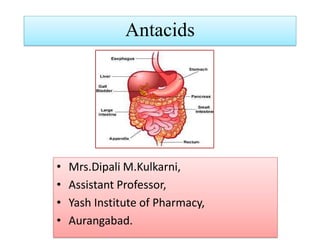
Antacids
• Mrs.Dipali M.Kulkarni,
• Assistant Professor,
• Yash Institute of Pharmacy,
• Aurangabad.
Gastrointestinal agent
combinations of antacids,
Sodium Bicarbonate*,
Aluminum hydroxide gel,
Magnesium hydroxide mixture
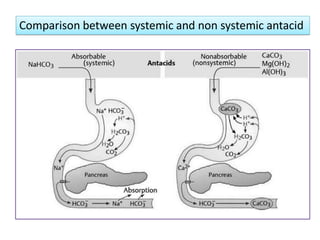
Comparison between systemic and non systemic antacid
COMBINATIONS OF ANTACIDS
Three complications .
• exert an action on bowel. For example some
• eg. Magnesium hydroxide - mild laxative
• e.g. aluminum hydroxide -constipating
2. Cation -eg.sodium bicarbonate- absorbed, causes systemic alkalosis
.Alkalinity of body fluids is abnormally high
Eg. Calcium ions may produce hupercalcaemia (abnormally high
concentration of calcium in blood).
3. Magnesium, Aluminum -precipitates phosphate in GIT , depletion of
phosphorus.
Affect absorption of antichlolinergics, antibiotics.
These drugs may be adsorbed by antacids.
Alter pH of gut gastric contents .Absorption of weak acids- decreases ;
basic drugs- Increases.
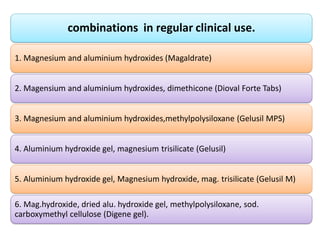
combinations in regular clinical use.
1. Magnesium and aluminium hydroxides (Magaldrate)
2. Magensium and aluminium hydroxides, dimethicone (Dioval Forte Tabs)
3. Magnesium and aluminium hydroxides,methylpolysiloxane (Gelusil MPS)
4. Aluminium hydroxide gel, magnesium trisilicate (Gelusil)
5. Aluminium hydroxide gel, Magnesium hydroxide, mag. trisilicate (Gelusil M)
6. Mag.hydroxide, dried alu. hydroxide gel, methylpolysiloxane, sod.
carboxymethyl cellulose (Digene gel).
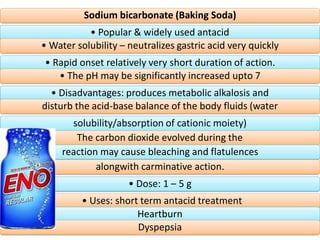
Sodium bicarbonate (Baking Soda)
• Popular & widely used antacid
• Water solubility – neutralizes gastric acid very quickly
• Rapid onset relatively very short duration of action.
• The pH may be significantly increased upto 7
• Disadvantages: produces metabolic alkalosis and
disturb the acid-base balance of the body fluids (water
solubility/absorption of cationic moiety)
The carbon dioxide evolved during the
reaction may cause bleaching and flatulences
alongwith carminative action.
• Dose: 1 – 5 g
• Uses: short term antacid treatment
Heartburn
Dyspepsia
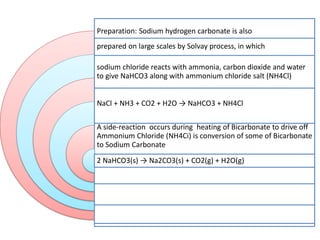
Preparation: Sodium hydrogen carbonate is also
prepared on large scales by Solvay process, in which
sodium chloride reacts with ammonia, carbon dioxide and water
to give NaHCO3 along with ammonium chloride salt (NH4Cl)
NaCl + NH3 + CO2 + H2O → NaHCO3 + NH4Cl
A side-reaction occurs during heating of Bicarbonate to drive off
Ammonium Chloride (NH4Ci) is conversion of some of Bicarbonate
to Sodium Carbonate
(Na2CO3)
2 NaHCO3(s) → Na2CO3(s) + CO2(g) + H2O(g)
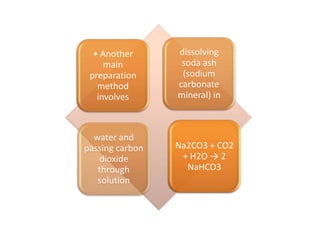
Na2CO3 + CO2
+ H2O → 2
NaHCO3
• Another
main
preparation
method
involves
dissolving
soda ash
(sodium
carbonate
mineral) in
water and
passing carbon
dioxide
through
solution
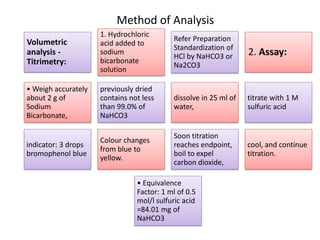
Volumetric
analysis -
Titrimetry:
1. Hydrochloric
acid added to
sodium
bicarbonate
solution
Refer Preparation
Standardization of
HCl by NaHCO3 or
Na2CO3
2. Assay:
• Weigh accurately
about 2 g of
Sodium
Bicarbonate,
previously dried
contains not less
than 99.0% of
NaHCO3
dissolve in 25 ml of
water,
titrate with 1 M
sulfuric acid
indicator: 3 drops
bromophenol blue
Colour changes
from blue to
yellow.
Soon titration
reaches endpoint,
boil to expel
carbon dioxide,
cool, and continue
titration.
• Equivalence
Factor: 1 ml of 0.5
mol/l sulfuric acid
=84.01 mg of
NaHCO3
Method of Analysis
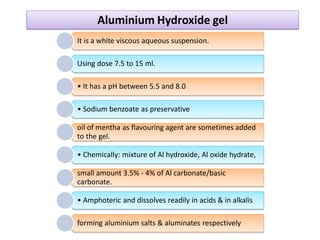
It is a white viscous aqueous suspension.
Using dose 7.5 to 15 ml.
• It has a pH between 5.5 and 8.0
• Sodium benzoate as preservative
oil of mentha as flavouring agent are sometimes added
to the gel.
• Chemically: mixture of Al hydroxide, Al oxide hydrate,
small amount 3.5% - 4% of Al carbonate/basic
carbonate.
• Amphoteric and dissolves readily in acids & in alkalis
forming aluminium salts & aluminates respectively
Aluminium Hydroxide gel
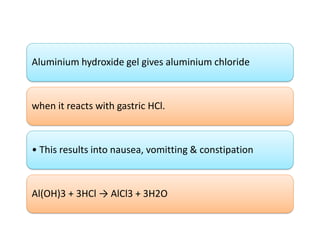
Aluminium hydroxide gel gives aluminium chloride
when it reacts with gastric HCl.
• This results into nausea, vomitting & constipation
Al(OH)3 + 3HCl → AlCl3 + 3H2O
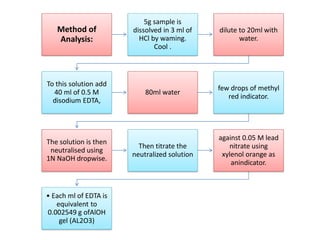
Method of
Analysis:
5g sample is
dissolved in 3 ml of
HCl by waming.
Cool .
dilute to 20ml with
water.
To this solution add
40 ml of 0.5 M
disodium EDTA,
80ml water
few drops of methyl
red indicator.
The solution is then
neutralised using
1N NaOH dropwise.
Then titrate the
neutralized solution
against 0.05 M lead
nitrate using
xylenol orange as
anindicator.
• Each ml of EDTA is
equivalent to
0.002549 g ofAlOH
gel (AL2O3)
Chemically magnesium hydroxide is (Mg(OH)2)
• Also called as magnesium hydroxide mixture or cream of magnesia
• It is a bulky white powder insoluble in water and alcohol.
• It is soluble in dilute acids like dil HCl
• It neutralizes gastric acid by giving away Mg cations and Hydroxide ions
• Usually given in combination with AlOH or Ca antacids
• Mg(OH)2 → Mg 2+ + 2OH- → 2H3O+ → 4H2O
Milk of magnesia
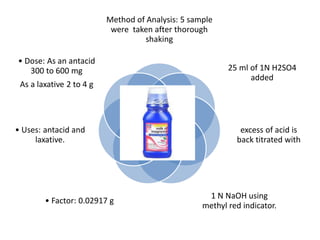
Method of Analysis: 5 sample
were taken after thorough
shaking
25 ml of 1N H2SO4
added
excess of acid is
back titrated with
1 N NaOH using
methyl red indicator.
• Factor: 0.02917 g
• Uses: antacid and
laxative.
• Dose: As an antacid
300 to 600 mg
As a laxative 2 to 4 g
Antacid

Antacid

  • 1.
    Antacids • Mrs.Dipali M.Kulkarni, •Assistant Professor, • Yash Institute of Pharmacy, • Aurangabad.
  • 2.
    Gastrointestinal agent combinations ofantacids, Sodium Bicarbonate*, Aluminum hydroxide gel, Magnesium hydroxide mixture
  • 3.
    Comparison between systemicand non systemic antacid
  • 4.
    COMBINATIONS OF ANTACIDS Threecomplications . • exert an action on bowel. For example some • eg. Magnesium hydroxide - mild laxative • e.g. aluminum hydroxide -constipating 2. Cation -eg.sodium bicarbonate- absorbed, causes systemic alkalosis .Alkalinity of body fluids is abnormally high Eg. Calcium ions may produce hupercalcaemia (abnormally high concentration of calcium in blood). 3. Magnesium, Aluminum -precipitates phosphate in GIT , depletion of phosphorus. Affect absorption of antichlolinergics, antibiotics. These drugs may be adsorbed by antacids. Alter pH of gut gastric contents .Absorption of weak acids- decreases ; basic drugs- Increases.
  • 5.
    combinations in regularclinical use. 1. Magnesium and aluminium hydroxides (Magaldrate) 2. Magensium and aluminium hydroxides, dimethicone (Dioval Forte Tabs) 3. Magnesium and aluminium hydroxides,methylpolysiloxane (Gelusil MPS) 4. Aluminium hydroxide gel, magnesium trisilicate (Gelusil) 5. Aluminium hydroxide gel, Magnesium hydroxide, mag. trisilicate (Gelusil M) 6. Mag.hydroxide, dried alu. hydroxide gel, methylpolysiloxane, sod. carboxymethyl cellulose (Digene gel).
  • 6.
    Sodium bicarbonate (BakingSoda) • Popular & widely used antacid • Water solubility – neutralizes gastric acid very quickly • Rapid onset relatively very short duration of action. • The pH may be significantly increased upto 7 • Disadvantages: produces metabolic alkalosis and disturb the acid-base balance of the body fluids (water solubility/absorption of cationic moiety) The carbon dioxide evolved during the reaction may cause bleaching and flatulences alongwith carminative action. • Dose: 1 – 5 g • Uses: short term antacid treatment Heartburn Dyspepsia
  • 7.
    Preparation: Sodium hydrogencarbonate is also prepared on large scales by Solvay process, in which sodium chloride reacts with ammonia, carbon dioxide and water to give NaHCO3 along with ammonium chloride salt (NH4Cl) NaCl + NH3 + CO2 + H2O → NaHCO3 + NH4Cl A side-reaction occurs during heating of Bicarbonate to drive off Ammonium Chloride (NH4Ci) is conversion of some of Bicarbonate to Sodium Carbonate (Na2CO3) 2 NaHCO3(s) → Na2CO3(s) + CO2(g) + H2O(g)
  • 8.
    Na2CO3 + CO2 +H2O → 2 NaHCO3 • Another main preparation method involves dissolving soda ash (sodium carbonate mineral) in water and passing carbon dioxide through solution
  • 9.
    Volumetric analysis - Titrimetry: 1. Hydrochloric acidadded to sodium bicarbonate solution Refer Preparation Standardization of HCl by NaHCO3 or Na2CO3 2. Assay: • Weigh accurately about 2 g of Sodium Bicarbonate, previously dried contains not less than 99.0% of NaHCO3 dissolve in 25 ml of water, titrate with 1 M sulfuric acid indicator: 3 drops bromophenol blue Colour changes from blue to yellow. Soon titration reaches endpoint, boil to expel carbon dioxide, cool, and continue titration. • Equivalence Factor: 1 ml of 0.5 mol/l sulfuric acid =84.01 mg of NaHCO3 Method of Analysis
  • 10.
    It is awhite viscous aqueous suspension. Using dose 7.5 to 15 ml. • It has a pH between 5.5 and 8.0 • Sodium benzoate as preservative oil of mentha as flavouring agent are sometimes added to the gel. • Chemically: mixture of Al hydroxide, Al oxide hydrate, small amount 3.5% - 4% of Al carbonate/basic carbonate. • Amphoteric and dissolves readily in acids & in alkalis forming aluminium salts & aluminates respectively Aluminium Hydroxide gel
  • 11.
    Aluminium hydroxide gelgives aluminium chloride when it reacts with gastric HCl. • This results into nausea, vomitting & constipation Al(OH)3 + 3HCl → AlCl3 + 3H2O
  • 12.
    Method of Analysis: 5g sampleis dissolved in 3 ml of HCl by waming. Cool . dilute to 20ml with water. To this solution add 40 ml of 0.5 M disodium EDTA, 80ml water few drops of methyl red indicator. The solution is then neutralised using 1N NaOH dropwise. Then titrate the neutralized solution against 0.05 M lead nitrate using xylenol orange as anindicator. • Each ml of EDTA is equivalent to 0.002549 g ofAlOH gel (AL2O3)
  • 13.
    Chemically magnesium hydroxideis (Mg(OH)2) • Also called as magnesium hydroxide mixture or cream of magnesia • It is a bulky white powder insoluble in water and alcohol. • It is soluble in dilute acids like dil HCl • It neutralizes gastric acid by giving away Mg cations and Hydroxide ions • Usually given in combination with AlOH or Ca antacids • Mg(OH)2 → Mg 2+ + 2OH- → 2H3O+ → 4H2O Milk of magnesia
  • 14.
    Method of Analysis:5 sample were taken after thorough shaking 25 ml of 1N H2SO4 added excess of acid is back titrated with 1 N NaOH using methyl red indicator. • Factor: 0.02917 g • Uses: antacid and laxative. • Dose: As an antacid 300 to 600 mg As a laxative 2 to 4 g