Female Sex Hormone
Oestrogen
Dr. Jasmine Chaudhary
Associate Prof., MMCP
MM(DU), Mullana
Introduction
 Hormones secreted by ductless/ endocrine glands in minute
amounts and exert important functions on other tissues.
 3 main sex hormones are
 Androgens (Male sex hormone)
 Oestrogens (Female sex hormone)
 Progestins/ Progesterone (Corpus Luteum hormone)
 These hormones are produced in gonads i.e. mainly testis in male
and ovary in females and their secretion is under the control of 3
hormones:
a) FSH b) LH/ICSH c) Prolactin/Leutropin
Lecture by Dr. Jasmine Chaudhary
Functions
 Regulation of ovulation in women and spermatogenesis in
male.
 Development of secondary sex characters in both.
 Stimulation and growth of mammary gland.
 Maintainence of endometrium to prepare reproductive tract for
fertilization and implanatation.
 Growth and development of bones in both.
Lecture by Dr. Jasmine Chaudhary
Estrogens
 Female sex hormone which are produced mainly in the
follicles present in ovary and their secretion is controlled by
FSH released from anterior pituatory.
 Also secreted in placenta, testis, liver, skeletal muscles and
hair follicles.
 Main precursor is cholesterol which get converted to
androstenedione which then form estradiol or estrone by the
action of enzyme aromatase
 These are derivatives of esrtrane having C-18 skeleton.
Lecture by Dr. Jasmine Chaudhary
Physiological Functions
• Development of female reproductive tract and stimulate
ovulation.
• Development of female secondary sex characters i.e.
distribution of body fat to produce female body contour,
growth of axillary and pubic hair, feminine voice.
• Stimulation of proliferative phase of endometrium (Initial
growth of endometrium during menstrual cycle)
• Vasodilation and Cardioprotection
• Maintain integrity of skeleton in reproductive age (Growth of
uterus during puberty)
Lecture by Dr. Jasmine Chaudhary
Mode of Action
Bind to estrogen receptor in target organ
Oesrogen receptor complex
Enters nucleus
mRNA synthesis
Protein synthesis
Lecture by Dr. Jasmine Chaudhary
Classification
 Natural estrogens/ Human estrogens: Estrone, Estradiol,
Estriol
 Semi-synthetic estrogens: Mestranol, Ethinyl estradiol
 Synthetic estrogens: Diethyl stilbestrol, Benzesterol,
Dienestrol
Lecture by Dr. Jasmine Chaudhary
Natural estrogens
 Secreted by the ovary.
 Synthesized in the graafian follicle, corpus luteum and placenta
from cholesterol.
Estradiol Estrone Estriol
Drawbacks
Inactive orally
Rapid metabolism in liver
Have short duration of action
Lecture by Dr. Jasmine Chaudhary
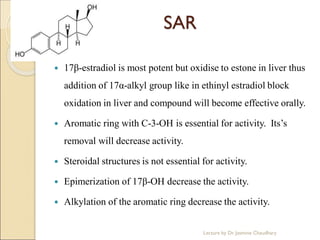
SAR
 17β-estradiol is most potent but oxidise to estone in liver thus
addition of 17α-alkyl group like in ethinyl estradiol block
oxidation in liver and compound will become effective orally.
 Aromatic ring with C-3-OH is essential for activity. Its’s
removal will decrease activity.
 Steroidal structures is not essential for activity.
 Epimerization of 17β-OH decrease the activity.
 Alkylation of the aromatic ring decrease the activity.
Lecture by Dr. Jasmine Chaudhary
 The group between the two hydroxyl must be hydrophobic.
 Unsaturation of ring B decreases the activity.
 17a- and 16 position when modified enhance the activity.
 Phenolic ring A is principle structural feature responsible for
binding to receptor.
 The 17 beta-hydroxyl with constant distance from 3-OH is
essential for activity.
Lecture by Dr. Jasmine Chaudhary
Biosynthesis of Estrogens
Lecture by Dr. Jasmine Chaudhary
Uses
 In menstrual disorders like amenorrhea, dysmennorrhea
 In infertility (Anovulation)
 Replacement therapy in estrogen deficient patients.
 In abnormal uterine bleeding.
 Dermatological disorders (Acne vulgare)
 In contraception (along with progestogen)
 In treatment of breast cancer and various genital problems.
Lecture by Dr. Jasmine Chaudhary
Side effects
 Nausea and vomiting
 Headache
 Weight gain
 Salt and water retention so increased BP.
 Anorexia
 Migraine and hypertension.
Lecture by Dr. Jasmine Chaudhary
Diethyl stibesterol (DES)
•Also known as stilbestrol
•Synthetic and nonsteroidal estrogen which differs from
natural estrogen estradiol in various ways.
• Compared to estradiol, DES has
improved bioavailability when taken by mouth,
More resistant to metabolism,
Shows relatively increased effects in certain parts of the body
like the liver and uterus.
These differences result in DES having an increased risk
of blood clots, cardiovascular issues, and certain other adverse
effects.
Lecture by Dr. Jasmine Chaudhary

Estrogen.pdf

  • 1.
    Female Sex Hormone Oestrogen Dr.Jasmine Chaudhary Associate Prof., MMCP MM(DU), Mullana
  • 2.
    Introduction  Hormones secretedby ductless/ endocrine glands in minute amounts and exert important functions on other tissues.  3 main sex hormones are  Androgens (Male sex hormone)  Oestrogens (Female sex hormone)  Progestins/ Progesterone (Corpus Luteum hormone)  These hormones are produced in gonads i.e. mainly testis in male and ovary in females and their secretion is under the control of 3 hormones: a) FSH b) LH/ICSH c) Prolactin/Leutropin Lecture by Dr. Jasmine Chaudhary
  • 3.
    Functions  Regulation ofovulation in women and spermatogenesis in male.  Development of secondary sex characters in both.  Stimulation and growth of mammary gland.  Maintainence of endometrium to prepare reproductive tract for fertilization and implanatation.  Growth and development of bones in both. Lecture by Dr. Jasmine Chaudhary
  • 4.
    Estrogens  Female sexhormone which are produced mainly in the follicles present in ovary and their secretion is controlled by FSH released from anterior pituatory.  Also secreted in placenta, testis, liver, skeletal muscles and hair follicles.  Main precursor is cholesterol which get converted to androstenedione which then form estradiol or estrone by the action of enzyme aromatase  These are derivatives of esrtrane having C-18 skeleton. Lecture by Dr. Jasmine Chaudhary
  • 5.
    Physiological Functions • Developmentof female reproductive tract and stimulate ovulation. • Development of female secondary sex characters i.e. distribution of body fat to produce female body contour, growth of axillary and pubic hair, feminine voice. • Stimulation of proliferative phase of endometrium (Initial growth of endometrium during menstrual cycle) • Vasodilation and Cardioprotection • Maintain integrity of skeleton in reproductive age (Growth of uterus during puberty) Lecture by Dr. Jasmine Chaudhary
  • 6.
    Mode of Action Bindto estrogen receptor in target organ Oesrogen receptor complex Enters nucleus mRNA synthesis Protein synthesis Lecture by Dr. Jasmine Chaudhary
  • 7.
    Classification  Natural estrogens/Human estrogens: Estrone, Estradiol, Estriol  Semi-synthetic estrogens: Mestranol, Ethinyl estradiol  Synthetic estrogens: Diethyl stilbestrol, Benzesterol, Dienestrol Lecture by Dr. Jasmine Chaudhary
  • 8.
    Natural estrogens  Secretedby the ovary.  Synthesized in the graafian follicle, corpus luteum and placenta from cholesterol. Estradiol Estrone Estriol Drawbacks Inactive orally Rapid metabolism in liver Have short duration of action Lecture by Dr. Jasmine Chaudhary
  • 9.
    SAR  17β-estradiol ismost potent but oxidise to estone in liver thus addition of 17α-alkyl group like in ethinyl estradiol block oxidation in liver and compound will become effective orally.  Aromatic ring with C-3-OH is essential for activity. Its’s removal will decrease activity.  Steroidal structures is not essential for activity.  Epimerization of 17β-OH decrease the activity.  Alkylation of the aromatic ring decrease the activity. Lecture by Dr. Jasmine Chaudhary
  • 10.
     The groupbetween the two hydroxyl must be hydrophobic.  Unsaturation of ring B decreases the activity.  17a- and 16 position when modified enhance the activity.  Phenolic ring A is principle structural feature responsible for binding to receptor.  The 17 beta-hydroxyl with constant distance from 3-OH is essential for activity. Lecture by Dr. Jasmine Chaudhary
  • 11.
    Biosynthesis of Estrogens Lectureby Dr. Jasmine Chaudhary
  • 12.
    Uses  In menstrualdisorders like amenorrhea, dysmennorrhea  In infertility (Anovulation)  Replacement therapy in estrogen deficient patients.  In abnormal uterine bleeding.  Dermatological disorders (Acne vulgare)  In contraception (along with progestogen)  In treatment of breast cancer and various genital problems. Lecture by Dr. Jasmine Chaudhary
  • 13.
    Side effects  Nauseaand vomiting  Headache  Weight gain  Salt and water retention so increased BP.  Anorexia  Migraine and hypertension. Lecture by Dr. Jasmine Chaudhary
  • 14.
    Diethyl stibesterol (DES) •Alsoknown as stilbestrol •Synthetic and nonsteroidal estrogen which differs from natural estrogen estradiol in various ways. • Compared to estradiol, DES has improved bioavailability when taken by mouth, More resistant to metabolism, Shows relatively increased effects in certain parts of the body like the liver and uterus. These differences result in DES having an increased risk of blood clots, cardiovascular issues, and certain other adverse effects. Lecture by Dr. Jasmine Chaudhary
  • 15.
    Lecture by Dr.Jasmine Chaudhary