Oral Hypoglycemic
Agents
By
Dr. Jasmine Chaudhary
Associate Prof.
MMCP
Oral hypoglycemic agents
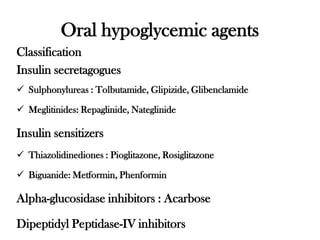
Classification
Insulin secretagogues
 Sulphonylureas : Tolbutamide, Glipizide, Glibenclamide
 Meglitinides: Repaglinide, Nateglinide
Insulin sensitizers
 Thiazolidinediones : Pioglitazone, Rosiglitazone
 Biguanide: Metformin, Phenformin
Alpha-glucosidase inhibitors : Acarbose
Dipeptidyl Peptidase-IV inhibitors
Insulin secretagogues
• Called because they promote insulin release from the β cells of
pancreas.
• Useful in the treatment of patients who have Type 2 diabetes but
who cannot be managed by diet alone.
• Best response to OHA is seen in one who develops diabetes after
age 40 and has had diabetes less than 5 years.
• Patients with long-standing disease may require a combination of
hypoglycemic drugs with or without insulin to control their
hyperglycemia.
• Oral hypoglycemic agents should NOT be given to patients with
Type 1 diabetes.
• Sulfonylureas
• First generation: Tolbutamide, Chlorpropamide
• Second generation: Glipizide, Glimepiride
• Third generation: Glyclazipe
First generation sulfonylureas are excreted mainly through urine
and are less potent than 2nd generation while 2nd generation are
mainly excreted through biliary excretion and are more potent
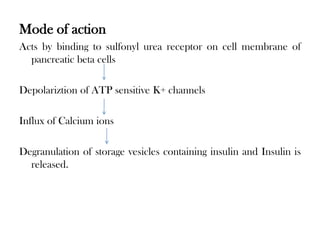
Mode of action
Acts by binding to sulfonyl urea receptor on cell membrane of
pancreatic beta cells
Depolariztion of ATP sensitive K+ channels
Influx of Calcium ions
Degranulation of storage vesicles containing insulin and Insulin is
released.
SAR
R’
• R’ Must be lipophilic and should have an aromatic ring next to the sulfoxide
group
•Should have a substitutent at the para position.
•Methyl, amino, acetyl, chloro, bromo, and trifluorometyl enhance
hypoglycemic activity.
• The larger, more complex, para substituents comprise the 2nd generation
which are more potent.
•R’ also governs duration of action e.g Tolbutamide is having short DOA
than chlorpropamide.
R’’
• R’’ should also be lipophilic. For maximum activity, R’’ should be
between 3-6 C atom chain. It can also be replaced by heteroaromatic
or aromatic group.
3. Benzene ring is essential for activity.
4. Sulfonyl group and R’ should be p-to each other.
1-butyl-3-(4-methylphenyl)sulfonylurea/ Tolbutamide
Chlorpropamide
1-cyclohexyl-3-(4-[2-{5-methyl pyrazine carboxamide} ethyl] phenyl)sulfonyl urea
1-(4-methylcyclohexyl)-3-(4-[2-{3-ethyl-4-methyl-2-oxo) pyrrolidine carboxamide}
ethyl] phenyl)sulfonyl urea
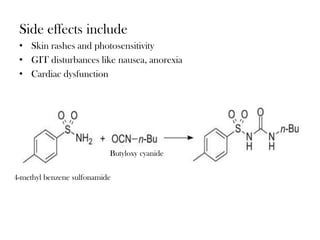
Side effects include
• Skin rashes and photosensitivity
• GIT disturbances like nausea, anorexia
• Cardiac dysfunction
4-methyl benzene sulfonamide
Butyloxy cyanide
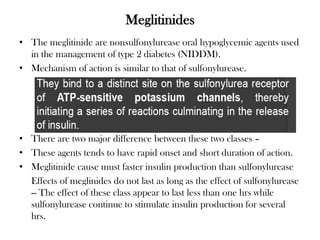
Meglitinides
• The meglitinide are nonsulfonylurease oral hypoglycemic agents used
in the management of type 2 diabetes (NIDDM).
• Mechanism of action is similar to that of sulfonylurease.
• There are two major difference between these two classes –
• These agents tends to have rapid onset and short duration of action.
• Meglitinide cause must faster insulin production than sulfonylurease
Effects of meglinides do not last as long as the effect of sulfonylurease
-- The effect of these class appear to last less than one hrs while
sulfonylurease continue to stimulate insulin production for several
hrs.
• In contrast to the sulfonylureas, the meglitinides have a rapid
onset and a short duration of action. They are are categorized
as postprandial glucose regulators. As a result meglitinide
should be taken 5 to 10 mins before meal. These are the drugs
which normalize meal time excursions.(Premeal therapy to
control post prandial hyperglycemia)
• There is less risk of hypoglycemia due to short duration of
action.
Adverse Effects:
• Incidence of hypoglycemia is lower than that of the
sulfonylureas.
• Weight gain is less of a problem with the meglitinides than with
the sulfonylureas.
2-ethoxy-4-(2-[3-methyl-1-[2-piperidyl)phenyl]
butyl ]amino-2-oxoethyl benzoic acid
3-phenyl-2-[4-(1-methylethyl)cyclohexylcarbonyl) aminopropanoic
acid
Insulin sensitizers
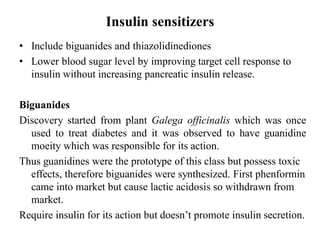
• Include biguanides and thiazolidinediones
• Lower blood sugar level by improving target cell response to
insulin without increasing pancreatic insulin release.
Biguanides
Discovery started from plant Galega officinalis which was once
used to treat diabetes and it was observed to have guanidine
moeity which was responsible for its action.
Thus guanidines were the prototype of this class but possess toxic
effects, therefore biguanides were synthesized. First phenformin
came into market but cause lactic acidosis so withdrawn from
market.
Require insulin for its action but doesn’t promote insulin secretion.
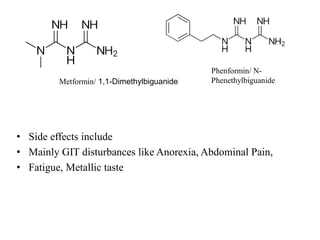
• Side effects include
• Mainly GIT disturbances like Anorexia, Abdominal Pain,
• Fatigue, Metallic taste
Metformin/ 1,1-Dimethylbiguanide
Phenformin/ N-
Phenethylbiguanide
Thiazolidinediones
• Also known as glitazones.
• Troglitazone was the first drug approved of this class but later found
to cause hepatotoxicity so withdrawn from market.
• The other two drugs belonging to this class is Pioglitazone and
Rosiglitazone.
MOA
Selective agonist of PPAR-γ receptor which is involved in
transcription of genes involved in control of glucose and
lipid metabolism in muscle, adipose tissue and liver. So, it
reduces insulin resistance by stimulating GLUT-4
expression.
Pioglitazone/ 5-(4-(2-(4-ethylpyridin-2-yl)ethoxy) benzyl) thiazolidine-2,4-dione
Rosiglitazone/
5-[[4-[2-[N-methyl(pyridin-2-yl)amino]ethoxy]phenyl]methyl]-1,3-thiazolidine-2,4-dione
Side effects include Fluid retention, Weight gain, Hypoglycemia, Respiratory Tract Infection
Alpha glucosidase inhibitors
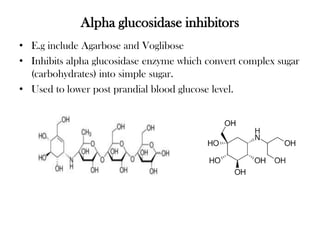
• E.g include Agarbose and Voglibose
• Inhibits alpha glucosidase enzyme which convert complex sugar
(carbohydrates) into simple sugar.
• Used to lower post prandial blood glucose level.
Dipeptidyl Peptidase-IV (DPP-IV) inhibitors
• Sitagliptin, Vildagliptin, Saxagliptin
• Selective and reversible competitive inhibitor of DPP-4 enzyme
and potentiate secretion of insulin in beta cells and suppress
glucagon release by alpha cells of Islets of Langerhans of
pancreas.

Oral Hypoglycemic Agent (1).pdf

  • 1.
    Oral Hypoglycemic Agents By Dr. JasmineChaudhary Associate Prof. MMCP
  • 2.
    Oral hypoglycemic agents Classification Insulinsecretagogues  Sulphonylureas : Tolbutamide, Glipizide, Glibenclamide  Meglitinides: Repaglinide, Nateglinide Insulin sensitizers  Thiazolidinediones : Pioglitazone, Rosiglitazone  Biguanide: Metformin, Phenformin Alpha-glucosidase inhibitors : Acarbose Dipeptidyl Peptidase-IV inhibitors
  • 3.
    Insulin secretagogues • Calledbecause they promote insulin release from the β cells of pancreas. • Useful in the treatment of patients who have Type 2 diabetes but who cannot be managed by diet alone. • Best response to OHA is seen in one who develops diabetes after age 40 and has had diabetes less than 5 years. • Patients with long-standing disease may require a combination of hypoglycemic drugs with or without insulin to control their hyperglycemia. • Oral hypoglycemic agents should NOT be given to patients with Type 1 diabetes.
  • 4.
    • Sulfonylureas • Firstgeneration: Tolbutamide, Chlorpropamide • Second generation: Glipizide, Glimepiride • Third generation: Glyclazipe First generation sulfonylureas are excreted mainly through urine and are less potent than 2nd generation while 2nd generation are mainly excreted through biliary excretion and are more potent
  • 5.
    Mode of action Actsby binding to sulfonyl urea receptor on cell membrane of pancreatic beta cells Depolariztion of ATP sensitive K+ channels Influx of Calcium ions Degranulation of storage vesicles containing insulin and Insulin is released.
  • 6.
    SAR R’ • R’ Mustbe lipophilic and should have an aromatic ring next to the sulfoxide group •Should have a substitutent at the para position. •Methyl, amino, acetyl, chloro, bromo, and trifluorometyl enhance hypoglycemic activity. • The larger, more complex, para substituents comprise the 2nd generation which are more potent. •R’ also governs duration of action e.g Tolbutamide is having short DOA than chlorpropamide.
  • 7.
    R’’ • R’’ shouldalso be lipophilic. For maximum activity, R’’ should be between 3-6 C atom chain. It can also be replaced by heteroaromatic or aromatic group. 3. Benzene ring is essential for activity. 4. Sulfonyl group and R’ should be p-to each other.
  • 8.
  • 9.
    1-cyclohexyl-3-(4-[2-{5-methyl pyrazine carboxamide}ethyl] phenyl)sulfonyl urea 1-(4-methylcyclohexyl)-3-(4-[2-{3-ethyl-4-methyl-2-oxo) pyrrolidine carboxamide} ethyl] phenyl)sulfonyl urea
  • 10.
    Side effects include •Skin rashes and photosensitivity • GIT disturbances like nausea, anorexia • Cardiac dysfunction 4-methyl benzene sulfonamide Butyloxy cyanide
  • 11.
    Meglitinides • The meglitinideare nonsulfonylurease oral hypoglycemic agents used in the management of type 2 diabetes (NIDDM). • Mechanism of action is similar to that of sulfonylurease. • There are two major difference between these two classes – • These agents tends to have rapid onset and short duration of action. • Meglitinide cause must faster insulin production than sulfonylurease Effects of meglinides do not last as long as the effect of sulfonylurease -- The effect of these class appear to last less than one hrs while sulfonylurease continue to stimulate insulin production for several hrs.
  • 12.
    • In contrastto the sulfonylureas, the meglitinides have a rapid onset and a short duration of action. They are are categorized as postprandial glucose regulators. As a result meglitinide should be taken 5 to 10 mins before meal. These are the drugs which normalize meal time excursions.(Premeal therapy to control post prandial hyperglycemia) • There is less risk of hypoglycemia due to short duration of action.
  • 13.
    Adverse Effects: • Incidenceof hypoglycemia is lower than that of the sulfonylureas. • Weight gain is less of a problem with the meglitinides than with the sulfonylureas.
  • 14.
    2-ethoxy-4-(2-[3-methyl-1-[2-piperidyl)phenyl] butyl ]amino-2-oxoethyl benzoicacid 3-phenyl-2-[4-(1-methylethyl)cyclohexylcarbonyl) aminopropanoic acid
  • 15.
    Insulin sensitizers • Includebiguanides and thiazolidinediones • Lower blood sugar level by improving target cell response to insulin without increasing pancreatic insulin release. Biguanides Discovery started from plant Galega officinalis which was once used to treat diabetes and it was observed to have guanidine moeity which was responsible for its action. Thus guanidines were the prototype of this class but possess toxic effects, therefore biguanides were synthesized. First phenformin came into market but cause lactic acidosis so withdrawn from market. Require insulin for its action but doesn’t promote insulin secretion.
  • 16.
    • Side effectsinclude • Mainly GIT disturbances like Anorexia, Abdominal Pain, • Fatigue, Metallic taste Metformin/ 1,1-Dimethylbiguanide Phenformin/ N- Phenethylbiguanide
  • 17.
    Thiazolidinediones • Also knownas glitazones. • Troglitazone was the first drug approved of this class but later found to cause hepatotoxicity so withdrawn from market. • The other two drugs belonging to this class is Pioglitazone and Rosiglitazone. MOA Selective agonist of PPAR-γ receptor which is involved in transcription of genes involved in control of glucose and lipid metabolism in muscle, adipose tissue and liver. So, it reduces insulin resistance by stimulating GLUT-4 expression.
  • 18.
    Pioglitazone/ 5-(4-(2-(4-ethylpyridin-2-yl)ethoxy) benzyl)thiazolidine-2,4-dione Rosiglitazone/ 5-[[4-[2-[N-methyl(pyridin-2-yl)amino]ethoxy]phenyl]methyl]-1,3-thiazolidine-2,4-dione Side effects include Fluid retention, Weight gain, Hypoglycemia, Respiratory Tract Infection
  • 19.
    Alpha glucosidase inhibitors •E.g include Agarbose and Voglibose • Inhibits alpha glucosidase enzyme which convert complex sugar (carbohydrates) into simple sugar. • Used to lower post prandial blood glucose level.
  • 20.
    Dipeptidyl Peptidase-IV (DPP-IV)inhibitors • Sitagliptin, Vildagliptin, Saxagliptin • Selective and reversible competitive inhibitor of DPP-4 enzyme and potentiate secretion of insulin in beta cells and suppress glucagon release by alpha cells of Islets of Langerhans of pancreas.