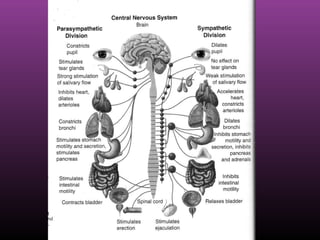
AUTONOMICAUTONOMIC
NERVOUS SYSTEMNERVOUS SYSTEM
Prof. Vajira WeerasingheProf. Vajira Weerasinghe
Dept of PhysiologyDept of Physiology
4
Autonomic nervous systemAutonomic nervous system
The autonomic nervous system is theThe autonomic nervous system is the
subdivision of the peripheral nervoussubdivision of the peripheral nervous
system that regulates body activities thatsystem that regulates body activities that
are generally not under conscious controlare generally not under conscious control
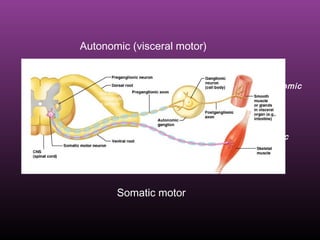
Autonomic (visceral motor)
autonomic
somatic
this dorsal
root ganglion
is sensory
Somatic motor
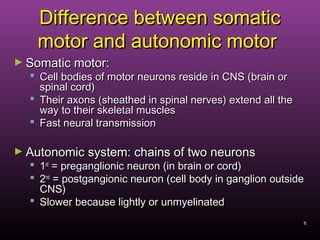
Difference between somaticDifference between somatic
motor and autonomic motormotor and autonomic motor
► Somatic motor:Somatic motor:
 Cell bodies of motor neurons reside in CNS (brain orCell bodies of motor neurons reside in CNS (brain or
spinal cord)spinal cord)
 Their axons (sheathed in spinal nerves) extend all theTheir axons (sheathed in spinal nerves) extend all the
way to their skeletal musclesway to their skeletal muscles
 Fast neural transmissionFast neural transmission
► Autonomic system: chains of two neuronsAutonomic system: chains of two neurons
 11stst
= preganglionic neuron (in brain or cord)= preganglionic neuron (in brain or cord)
 22ndnd
= postgangionic neuron (cell body in ganglion outside= postgangionic neuron (cell body in ganglion outside
CNS)CNS)
 Slower because lightly or unmyelinatedSlower because lightly or unmyelinated
6
7
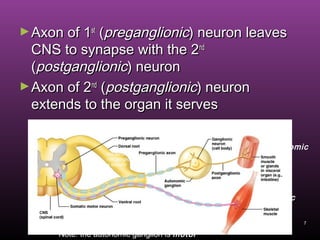
►Axon of 1Axon of 1stst
((preganglionicpreganglionic) neuron leaves) neuron leaves
CNS to synapse with the 2CNS to synapse with the 2ndnd
((postganglionicpostganglionic) neuron) neuron
►Axon of 2Axon of 2ndnd
((postganglionicpostganglionic) neuron) neuron
extends to the organ it servesextends to the organ it serves
Diagram contrasts somatic (lower) and autonomic:
autonomic
somatic
Note: the autonomic ganglion is motor
this dorsal
root ganglion
is sensory
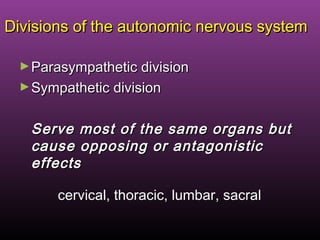
Divisions of the autonomic nervous systemDivisions of the autonomic nervous system
►Parasympathetic divisionParasympathetic division
►Sympathetic divisionSympathetic division
Serve most of the same organs butServe most of the same organs but
cause opposing or antagonisticcause opposing or antagonistic
effectseffects
cervical, thoracic, lumbar, sacral
9
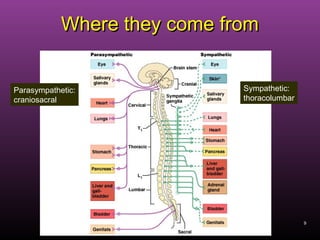
Where they come fromWhere they come from
Parasympathetic:
craniosacral
Sympathetic:
thoracolumbar
10
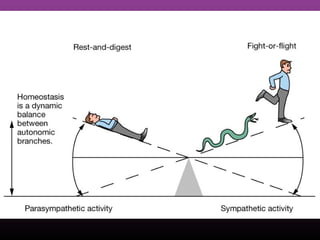
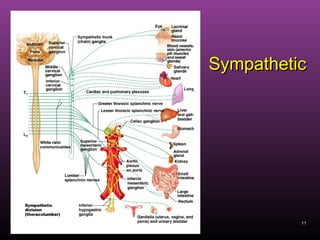
Sympathetic nervous systemSympathetic nervous system
“fight or flight”“fight or flight”
► Also calledAlso called thoracolumbarthoracolumbar system: all its neuronssystem: all its neurons
are in lateral horn of gray matter from T1-L2are in lateral horn of gray matter from T1-L2
► Lead to every part of the body (unlike parasymp.)Lead to every part of the body (unlike parasymp.)
 Easy to remember that when nervous, you sweat; whenEasy to remember that when nervous, you sweat; when
afraid, hair stands on end; when excited blood pressureafraid, hair stands on end; when excited blood pressure
rises (vasoconstriction): these sympathetic onlyrises (vasoconstriction): these sympathetic only
 Also causes: dry mouth, pupils to dilate, increased heartAlso causes: dry mouth, pupils to dilate, increased heart
& respiratory rates to increase O2 to skeletal muscles,& respiratory rates to increase O2 to skeletal muscles,
and liver to release glucoseand liver to release glucose
► NorepinephrineNorepinephrine (noradrenaline) is(noradrenaline) is
neurotransmitter released by most postganglionicneurotransmitter released by most postganglionic
fibers (acetylcholine in preganglionic): “adrenergic”fibers (acetylcholine in preganglionic): “adrenergic”
11
SympatheticSympathetic
12
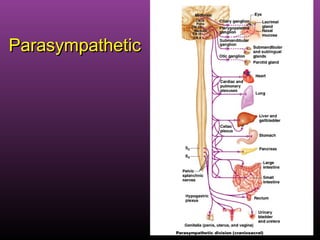
Parasympathetic nervous systemParasympathetic nervous system
“rest & digest”“rest & digest”
►Also called theAlso called the craniosacralcraniosacral systemsystem
because all its preganglionic neurons arebecause all its preganglionic neurons are
in the brain stem or sacral levels of thein the brain stem or sacral levels of the
spinal cordspinal cord
 Cranial nerves III,VII, IX and XCranial nerves III,VII, IX and X
 In lateral horn of gray matter from S2-S4In lateral horn of gray matter from S2-S4
►Only innervate internal organs (not skin)Only innervate internal organs (not skin)
►AcetylcholineAcetylcholine is neurotransmitter at endis neurotransmitter at end
organ as well as at preganglionic synapse:organ as well as at preganglionic synapse:
“cholinergic”“cholinergic”
13
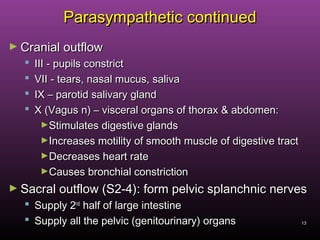
Parasympathetic continuedParasympathetic continued
► Cranial outflowCranial outflow
 III - pupils constrictIII - pupils constrict
 VII - tears, nasal mucus, salivaVII - tears, nasal mucus, saliva
 IX – parotid salivary glandIX – parotid salivary gland
 X (Vagus n) – visceral organs of thorax & abdomen:X (Vagus n) – visceral organs of thorax & abdomen:
►Stimulates digestive glandsStimulates digestive glands
►Increases motility of smooth muscle of digestive tractIncreases motility of smooth muscle of digestive tract
►Decreases heart rateDecreases heart rate
►Causes bronchial constrictionCauses bronchial constriction
► Sacral outflow (S2-4): form pelvic splanchnic nervesSacral outflow (S2-4): form pelvic splanchnic nerves
 Supply 2Supply 2ndnd
half of large intestinehalf of large intestine
 Supply all the pelvic (genitourinary) organsSupply all the pelvic (genitourinary) organs
14
ParasympatheticParasympathetic
NeurotransmittersNeurotransmitters
►Somatic = all motor neurons release ACHSomatic = all motor neurons release ACH
which is always stimulatorywhich is always stimulatory
►Visceral = ACH & norepinephrineVisceral = ACH & norepinephrine
 AllAll prepreganglionicganglionic fibers release ACHfibers release ACH
 AllAll postpostganglionicganglionic PsNSPsNS fibers release ACHfibers release ACH
 Most postganglionic SNS fibers releaseMost postganglionic SNS fibers release
norepinorepi
 Can be stimulatory or inhibitory basedCan be stimulatory or inhibitory based
on receptor typeson receptor types
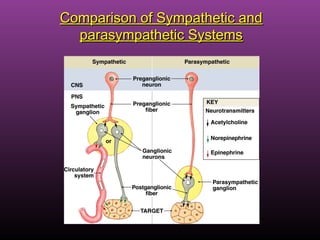
Comparison of Sympathetic andComparison of Sympathetic and
parasympathetic Systemsparasympathetic Systems
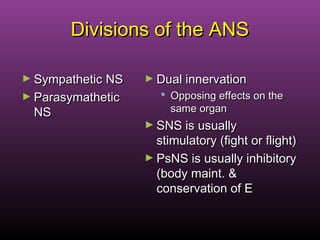
Divisions of the ANSDivisions of the ANS
► Sympathetic NSSympathetic NS
► ParasymatheticParasymathetic
NSNS
► Dual innervationDual innervation
 Opposing effects on theOpposing effects on the
same organsame organ
► SNS is usuallySNS is usually
stimulatory (fight or flight)stimulatory (fight or flight)
► PsNS is usually inhibitoryPsNS is usually inhibitory
(body maint. &(body maint. &
conservation of Econservation of E
Sympathetic nervousSympathetic nervous
systemsystem
► The sympathetic division is theThe sympathetic division is the “fight-or-flight”“fight-or-flight” systemsystem
► InvolvesInvolves EE activities – exercise, excitement, emergency,activities – exercise, excitement, emergency,
and embarrassmentand embarrassment
► Non-essential activities are dampened (GI/urinary)Non-essential activities are dampened (GI/urinary)
► Promotes adjustments during exercise – blood flow toPromotes adjustments during exercise – blood flow to
organs is reduced, flow to muscles is increasedorgans is reduced, flow to muscles is increased
► Its activity is illustrated by a person who is threatenedIts activity is illustrated by a person who is threatened
 Heart rate increases, and breathing is rapid and deepHeart rate increases, and breathing is rapid and deep
 The skin is cold and sweaty, and the pupils dilateThe skin is cold and sweaty, and the pupils dilate
 Bronchioles dilate…increasing ventilation, delivering more oxygenBronchioles dilate…increasing ventilation, delivering more oxygen
to cellsto cells
 Constriction of visceral & cutaneous bv’s (blood is shunted toConstriction of visceral & cutaneous bv’s (blood is shunted to
skeletal mm)skeletal mm)
 Liver releases more glucose into blood to provide more readilyLiver releases more glucose into blood to provide more readily
avail. Eavail. E
 Targets adipocytes for lipolysisTargets adipocytes for lipolysis
Parasympathetic nervous systemParasympathetic nervous system
► Salivation, Lacrimation, Urination, Digestion,Salivation, Lacrimation, Urination, Digestion,
DefecationDefecation
► Most active in non-stressful situationsMost active in non-stressful situations
► Concerned with keeping body energy use lowConcerned with keeping body energy use low
► Lenses of eyes accommodated for near visionLenses of eyes accommodated for near vision
► Its activity is illustrated in a person who relaxesIts activity is illustrated in a person who relaxes
after a mealafter a meal
 Blood pressure, heart rate, and respiratory rates areBlood pressure, heart rate, and respiratory rates are
lowlow
 Gastrointestinal tract activity is highGastrointestinal tract activity is high
 The skin is warm and the pupils are constrictedThe skin is warm and the pupils are constricted
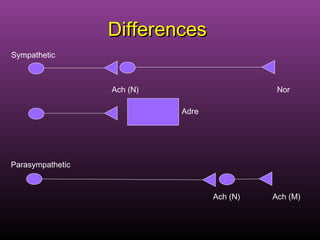
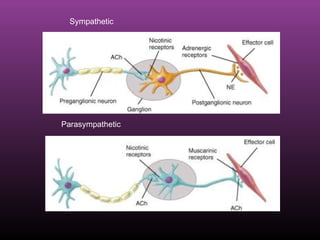
DifferencesDifferences
Ach (N)
Ach (N) Ach (M)
Nor
Sympathetic
Parasympathetic
Adre
Neurotransmitters and ReceptorsNeurotransmitters and Receptors
► Acetylcholine (ACh) and norepinephrine (NE) are theAcetylcholine (ACh) and norepinephrine (NE) are the
two major neurotransmitters of the ANStwo major neurotransmitters of the ANS
► ACh is released by all preganglionic axons and allACh is released by all preganglionic axons and all
parasympathetic postganglionic axonsparasympathetic postganglionic axons
► Cholinergic fibersCholinergic fibers – ACh-releasing fibers– ACh-releasing fibers
► Adrenergic fibersAdrenergic fibers – sympathetic postganglionic– sympathetic postganglionic
axons that release NEaxons that release NE
► Neurotransmitter effects can be excitatory or inhibitoryNeurotransmitter effects can be excitatory or inhibitory
depending upon the receptor typedepending upon the receptor type
Cholinergic ReceptorsCholinergic Receptors
►The two types of receptors that bindThe two types of receptors that bind
ACh areACh are nicotinicnicotinic andand muscarinicmuscarinic
►These are named after drugs that bindThese are named after drugs that bind
to them and mimic ACh effectsto them and mimic ACh effects
Nicotinic Receptors (cholinergic)Nicotinic Receptors (cholinergic)
►Nicotinic receptors are found on:Nicotinic receptors are found on:
 Motor end plates (somatic targets)Motor end plates (somatic targets)
 All ganglionic neurons of both sympatheticAll ganglionic neurons of both sympathetic
and parasympathetic divisionsand parasympathetic divisions
 The hormone-producing cells of theThe hormone-producing cells of the
adrenal medullaadrenal medulla
►The effect of ACh binding to nicotinicThe effect of ACh binding to nicotinic
receptors isreceptors is always stimulatoryalways stimulatory
Muscarinic ReceptorsMuscarinic Receptors
(cholinergic)(cholinergic)
►Muscarinic receptors occur on all effectorMuscarinic receptors occur on all effector
cells stimulated by postganglioniccells stimulated by postganglionic
cholinergic fiberscholinergic fibers
►The effect of ACh binding:The effect of ACh binding:
 Can be either inhibitory or excitatoryCan be either inhibitory or excitatory
 Depends on the receptor typeDepends on the receptor type of theof the
target organtarget organ
Adrenergic ReceptorsAdrenergic Receptors
► The two types of adrenergic receptors are alphaThe two types of adrenergic receptors are alpha
and betaand beta
► Each type has two or three subclassesEach type has two or three subclasses
((αα11,, αα22,, ββ11,, ββ22 ,, ββ33))
► Effects of NE binding to:Effects of NE binding to:
 αα receptors is generally stimulatoryreceptors is generally stimulatory
 ββ receptors is generally inhibitoryreceptors is generally inhibitory
► A notable exception – NE binding toA notable exception – NE binding to ββ receptors ofreceptors of
the heart is stimulatorythe heart is stimulatory
Adrenergic ReceptorsAdrenergic Receptors
►Norepinephrine produces its effects byNorepinephrine produces its effects by
combining with adrenergic receptorscombining with adrenergic receptors
 AlphaAlpha
 BetaBeta
Adrenergic ReceptorsAdrenergic Receptors
►Found in:Found in:
 CardiovascularCardiovascular
 EndocrineEndocrine
 GastrointestinalGastrointestinal
 GenitourinaryGenitourinary
 RespiratoryRespiratory
 OcularOcular
Alpha ReceptorsAlpha Receptors
►Alpha 1: adrenergic receptors located onAlpha 1: adrenergic receptors located on
postsynaptic effector cells.postsynaptic effector cells.
 Smooth muscles of blood vessels: ConstrictionSmooth muscles of blood vessels: Constriction
►Arteriolar constrictionArteriolar constriction
 Bladder sphincterBladder sphincter
 PenisPenis
 UterusUterus
 Pupillary muscles of irisPupillary muscles of iris
Alpha 2Alpha 2
►Same as the Alpha 1 but are located in theSame as the Alpha 1 but are located in the
presynaptic nerve terminals.presynaptic nerve terminals.
Adrenergic ReceptorAdrenergic Receptor
►Beta 1Beta 1
►CardiovascularCardiovascular
 Cardiac muscle: increased contractilityCardiac muscle: increased contractility
increased force of contractionincreased force of contraction
 Atrioventricular node: increased heart rateAtrioventricular node: increased heart rate
 Sinoatrial node: increase in heart rateSinoatrial node: increase in heart rate
►EndocrineEndocrine
 PancreasPancreas
Beta 1 DrugsBeta 1 Drugs
►Predominately works on vascular smoothPredominately works on vascular smooth
muscle of the heart.muscle of the heart.
Adrenergic ReceptorAdrenergic Receptor
►Beta 2Beta 2
►CardiovascularCardiovascular
 Dilation of blood vesselsDilation of blood vessels
►EndocrineEndocrine
►Uterine relaxationUterine relaxation
►Respiratory: dilation of bronchial musclesRespiratory: dilation of bronchial muscles
HeartHeart
►Direct stimulation of receptorsDirect stimulation of receptors
 Alpha 1 –Alpha 1 –
►Vasoconstriction of blood vessels which increasesVasoconstriction of blood vessels which increases
blood pressureblood pressure
►Pressor or vasopressor effect to maintain bloodPressor or vasopressor effect to maintain blood
pressurepressure
 Beta 1Beta 1
►Increased force of myocardial contractionIncreased force of myocardial contraction
►Increased speed of electrical conduction in the heart.Increased speed of electrical conduction in the heart.
Sympathetic vs parasympatheticSympathetic vs parasympathetic
►Distribution on different organsDistribution on different organs
►Actions on different organsActions on different organs
►Drugs acting on receptorsDrugs acting on receptors
►Reflexes in different systemsReflexes in different systems
Sympathetic vs parasympatheticSympathetic vs parasympathetic
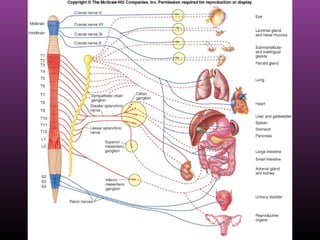
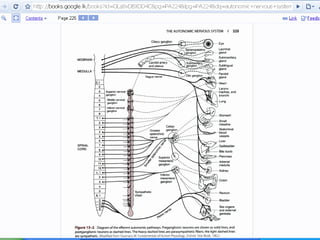
►Distribution on different organsDistribution on different organs
Fig. 9.6Fig. 9.6
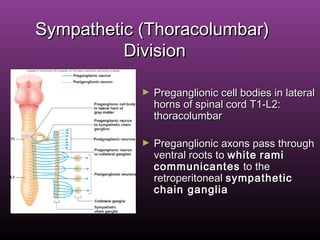
Sympathetic (Thoracolumbar)Sympathetic (Thoracolumbar)
DivisionDivision
► Preganglionic cell bodies in lateralPreganglionic cell bodies in lateral
horns of spinal cord T1-L2:horns of spinal cord T1-L2:
thoracolumbarthoracolumbar
► Preganglionic axons pass throughPreganglionic axons pass through
ventral roots toventral roots to whitewhite ramirami
communicantescommunicantes to theto the
retroperitonealretroperitoneal sympatheticsympathetic
chain gangliachain ganglia
Parasympathetic (Craniosacral)Parasympathetic (Craniosacral)
DivisionDivision
► Preganglionic cell bodies inPreganglionic cell bodies in
nuclei of brainstem or lateralnuclei of brainstem or lateral
parts of spinal cord gray matterparts of spinal cord gray matter
from S2-S4from S2-S4
 Preganglionic axons fromPreganglionic axons from
brain pass to terminalbrain pass to terminal
ganglia through cranialganglia through cranial
nerves III, VII, IX and Xnerves III, VII, IX and X
 Preganglionic axons fromPreganglionic axons from
sacral region pass throughsacral region pass through
pelvic nervespelvic nerves to terminalto terminal
gangliaganglia
► Terminal gangliaTerminal ganglia locatedlocated
near organ innervated ornear organ innervated or
embedded in wall of organembedded in wall of organ
Sympathetic vs parasympatheticSympathetic vs parasympathetic
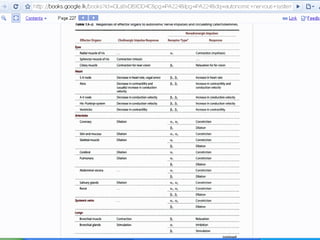
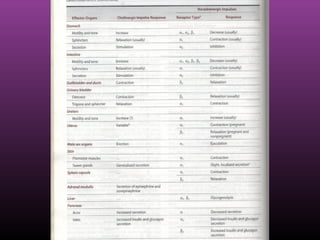
►Actions on different organsActions on different organs
Sympathetic vs parasympatheticSympathetic vs parasympathetic
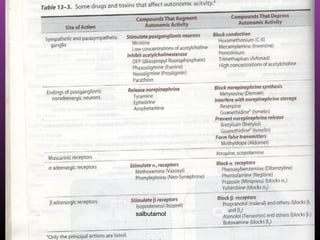
►Drugs acting on receptorsDrugs acting on receptors
Parasympathetic
Sympathetic
salbutamol
Sympathetic vs parasympatheticSympathetic vs parasympathetic
►Reflexes in different systemsReflexes in different systems
ANS reflexesANS reflexes
► CVS:CVS:
 baroreceptor reflexbaroreceptor reflex
 Control of heart rateControl of heart rate
 chemoreceptor reflexchemoreceptor reflex
► GIT:GIT:
 GIT secretions and motilityGIT secretions and motility
► Other:Other:
 Urinary bladder controlUrinary bladder control
 Sexual reflexesSexual reflexes
 SweatingSweating
 Other visceral reflexesOther visceral reflexes
ExceptionException
––
adrenal medullaadrenal medulla
52
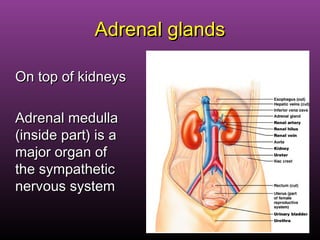
Adrenal glandsAdrenal glands
On top of kidneysOn top of kidneys
Adrenal medullaAdrenal medulla
(inside part) is a(inside part) is a
major organ ofmajor organ of
the sympatheticthe sympathetic
nervous systemnervous system
53
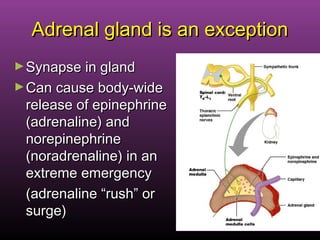
Adrenal gland is an exceptionAdrenal gland is an exception
►Synapse in glandSynapse in gland
►Can cause body-wideCan cause body-wide
release of epinephrinerelease of epinephrine
(adrenaline) and(adrenaline) and
norepinephrinenorepinephrine
(noradrenaline) in an(noradrenaline) in an
extreme emergencyextreme emergency
(adrenaline “rush” or(adrenaline “rush” or
surge)surge)
InnervationInnervation
Ach
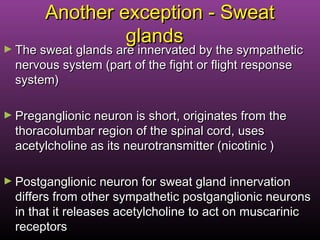
Another exception - SweatAnother exception - Sweat
glandsglands
► The sweat glands are innervated by the sympatheticThe sweat glands are innervated by the sympathetic
nervous system (part of the fight or flight responsenervous system (part of the fight or flight response
system)system)
► Preganglionic neuron is short, originates from thePreganglionic neuron is short, originates from the
thoracolumbar region of the spinal cord, usesthoracolumbar region of the spinal cord, uses
acetylcholine as its neurotransmitter (nicotinic )acetylcholine as its neurotransmitter (nicotinic )
► Postganglionic neuron for sweat gland innervationPostganglionic neuron for sweat gland innervation
differs from other sympathetic postganglionic neuronsdiffers from other sympathetic postganglionic neurons
in that it releases acetylcholine to act on muscarinicin that it releases acetylcholine to act on muscarinic
receptorsreceptors
Another exception – skeletalAnother exception – skeletal
muscle blood vesselsmuscle blood vessels
►These are also innervated by sympatheticThese are also innervated by sympathetic
cholinergic fibrescholinergic fibres
58
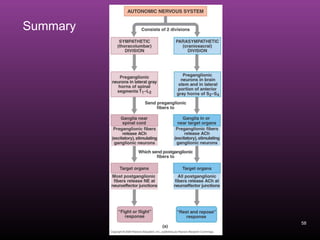
Summary

Ans

  • 1.
    AUTONOMICAUTONOMIC NERVOUS SYSTEMNERVOUS SYSTEM Prof.Vajira WeerasingheProf. Vajira Weerasinghe Dept of PhysiologyDept of Physiology
  • 4.
    4 Autonomic nervous systemAutonomicnervous system The autonomic nervous system is theThe autonomic nervous system is the subdivision of the peripheral nervoussubdivision of the peripheral nervous system that regulates body activities thatsystem that regulates body activities that are generally not under conscious controlare generally not under conscious control
  • 5.
    Autonomic (visceral motor) autonomic somatic thisdorsal root ganglion is sensory Somatic motor
  • 6.
    Difference between somaticDifferencebetween somatic motor and autonomic motormotor and autonomic motor ► Somatic motor:Somatic motor:  Cell bodies of motor neurons reside in CNS (brain orCell bodies of motor neurons reside in CNS (brain or spinal cord)spinal cord)  Their axons (sheathed in spinal nerves) extend all theTheir axons (sheathed in spinal nerves) extend all the way to their skeletal musclesway to their skeletal muscles  Fast neural transmissionFast neural transmission ► Autonomic system: chains of two neuronsAutonomic system: chains of two neurons  11stst = preganglionic neuron (in brain or cord)= preganglionic neuron (in brain or cord)  22ndnd = postgangionic neuron (cell body in ganglion outside= postgangionic neuron (cell body in ganglion outside CNS)CNS)  Slower because lightly or unmyelinatedSlower because lightly or unmyelinated 6
  • 7.
    7 ►Axon of 1Axonof 1stst ((preganglionicpreganglionic) neuron leaves) neuron leaves CNS to synapse with the 2CNS to synapse with the 2ndnd ((postganglionicpostganglionic) neuron) neuron ►Axon of 2Axon of 2ndnd ((postganglionicpostganglionic) neuron) neuron extends to the organ it servesextends to the organ it serves Diagram contrasts somatic (lower) and autonomic: autonomic somatic Note: the autonomic ganglion is motor this dorsal root ganglion is sensory
  • 8.
    Divisions of theautonomic nervous systemDivisions of the autonomic nervous system ►Parasympathetic divisionParasympathetic division ►Sympathetic divisionSympathetic division Serve most of the same organs butServe most of the same organs but cause opposing or antagonisticcause opposing or antagonistic effectseffects cervical, thoracic, lumbar, sacral
  • 9.
    9 Where they comefromWhere they come from Parasympathetic: craniosacral Sympathetic: thoracolumbar
  • 10.
    10 Sympathetic nervous systemSympatheticnervous system “fight or flight”“fight or flight” ► Also calledAlso called thoracolumbarthoracolumbar system: all its neuronssystem: all its neurons are in lateral horn of gray matter from T1-L2are in lateral horn of gray matter from T1-L2 ► Lead to every part of the body (unlike parasymp.)Lead to every part of the body (unlike parasymp.)  Easy to remember that when nervous, you sweat; whenEasy to remember that when nervous, you sweat; when afraid, hair stands on end; when excited blood pressureafraid, hair stands on end; when excited blood pressure rises (vasoconstriction): these sympathetic onlyrises (vasoconstriction): these sympathetic only  Also causes: dry mouth, pupils to dilate, increased heartAlso causes: dry mouth, pupils to dilate, increased heart & respiratory rates to increase O2 to skeletal muscles,& respiratory rates to increase O2 to skeletal muscles, and liver to release glucoseand liver to release glucose ► NorepinephrineNorepinephrine (noradrenaline) is(noradrenaline) is neurotransmitter released by most postganglionicneurotransmitter released by most postganglionic fibers (acetylcholine in preganglionic): “adrenergic”fibers (acetylcholine in preganglionic): “adrenergic”
  • 11.
  • 12.
    12 Parasympathetic nervous systemParasympatheticnervous system “rest & digest”“rest & digest” ►Also called theAlso called the craniosacralcraniosacral systemsystem because all its preganglionic neurons arebecause all its preganglionic neurons are in the brain stem or sacral levels of thein the brain stem or sacral levels of the spinal cordspinal cord  Cranial nerves III,VII, IX and XCranial nerves III,VII, IX and X  In lateral horn of gray matter from S2-S4In lateral horn of gray matter from S2-S4 ►Only innervate internal organs (not skin)Only innervate internal organs (not skin) ►AcetylcholineAcetylcholine is neurotransmitter at endis neurotransmitter at end organ as well as at preganglionic synapse:organ as well as at preganglionic synapse: “cholinergic”“cholinergic”
  • 13.
    13 Parasympathetic continuedParasympathetic continued ►Cranial outflowCranial outflow  III - pupils constrictIII - pupils constrict  VII - tears, nasal mucus, salivaVII - tears, nasal mucus, saliva  IX – parotid salivary glandIX – parotid salivary gland  X (Vagus n) – visceral organs of thorax & abdomen:X (Vagus n) – visceral organs of thorax & abdomen: ►Stimulates digestive glandsStimulates digestive glands ►Increases motility of smooth muscle of digestive tractIncreases motility of smooth muscle of digestive tract ►Decreases heart rateDecreases heart rate ►Causes bronchial constrictionCauses bronchial constriction ► Sacral outflow (S2-4): form pelvic splanchnic nervesSacral outflow (S2-4): form pelvic splanchnic nerves  Supply 2Supply 2ndnd half of large intestinehalf of large intestine  Supply all the pelvic (genitourinary) organsSupply all the pelvic (genitourinary) organs
  • 14.
  • 15.
    NeurotransmittersNeurotransmitters ►Somatic = allmotor neurons release ACHSomatic = all motor neurons release ACH which is always stimulatorywhich is always stimulatory ►Visceral = ACH & norepinephrineVisceral = ACH & norepinephrine  AllAll prepreganglionicganglionic fibers release ACHfibers release ACH  AllAll postpostganglionicganglionic PsNSPsNS fibers release ACHfibers release ACH  Most postganglionic SNS fibers releaseMost postganglionic SNS fibers release norepinorepi  Can be stimulatory or inhibitory basedCan be stimulatory or inhibitory based on receptor typeson receptor types
  • 16.
    Comparison of SympatheticandComparison of Sympathetic and parasympathetic Systemsparasympathetic Systems
  • 17.
    Divisions of theANSDivisions of the ANS ► Sympathetic NSSympathetic NS ► ParasymatheticParasymathetic NSNS ► Dual innervationDual innervation  Opposing effects on theOpposing effects on the same organsame organ ► SNS is usuallySNS is usually stimulatory (fight or flight)stimulatory (fight or flight) ► PsNS is usually inhibitoryPsNS is usually inhibitory (body maint. &(body maint. & conservation of Econservation of E
  • 18.
    Sympathetic nervousSympathetic nervous systemsystem ►The sympathetic division is theThe sympathetic division is the “fight-or-flight”“fight-or-flight” systemsystem ► InvolvesInvolves EE activities – exercise, excitement, emergency,activities – exercise, excitement, emergency, and embarrassmentand embarrassment ► Non-essential activities are dampened (GI/urinary)Non-essential activities are dampened (GI/urinary) ► Promotes adjustments during exercise – blood flow toPromotes adjustments during exercise – blood flow to organs is reduced, flow to muscles is increasedorgans is reduced, flow to muscles is increased ► Its activity is illustrated by a person who is threatenedIts activity is illustrated by a person who is threatened  Heart rate increases, and breathing is rapid and deepHeart rate increases, and breathing is rapid and deep  The skin is cold and sweaty, and the pupils dilateThe skin is cold and sweaty, and the pupils dilate  Bronchioles dilate…increasing ventilation, delivering more oxygenBronchioles dilate…increasing ventilation, delivering more oxygen to cellsto cells  Constriction of visceral & cutaneous bv’s (blood is shunted toConstriction of visceral & cutaneous bv’s (blood is shunted to skeletal mm)skeletal mm)  Liver releases more glucose into blood to provide more readilyLiver releases more glucose into blood to provide more readily avail. Eavail. E  Targets adipocytes for lipolysisTargets adipocytes for lipolysis
  • 19.
    Parasympathetic nervous systemParasympatheticnervous system ► Salivation, Lacrimation, Urination, Digestion,Salivation, Lacrimation, Urination, Digestion, DefecationDefecation ► Most active in non-stressful situationsMost active in non-stressful situations ► Concerned with keeping body energy use lowConcerned with keeping body energy use low ► Lenses of eyes accommodated for near visionLenses of eyes accommodated for near vision ► Its activity is illustrated in a person who relaxesIts activity is illustrated in a person who relaxes after a mealafter a meal  Blood pressure, heart rate, and respiratory rates areBlood pressure, heart rate, and respiratory rates are lowlow  Gastrointestinal tract activity is highGastrointestinal tract activity is high  The skin is warm and the pupils are constrictedThe skin is warm and the pupils are constricted
  • 20.
    DifferencesDifferences Ach (N) Ach (N)Ach (M) Nor Sympathetic Parasympathetic Adre
  • 21.
    Neurotransmitters and ReceptorsNeurotransmittersand Receptors ► Acetylcholine (ACh) and norepinephrine (NE) are theAcetylcholine (ACh) and norepinephrine (NE) are the two major neurotransmitters of the ANStwo major neurotransmitters of the ANS ► ACh is released by all preganglionic axons and allACh is released by all preganglionic axons and all parasympathetic postganglionic axonsparasympathetic postganglionic axons ► Cholinergic fibersCholinergic fibers – ACh-releasing fibers– ACh-releasing fibers ► Adrenergic fibersAdrenergic fibers – sympathetic postganglionic– sympathetic postganglionic axons that release NEaxons that release NE ► Neurotransmitter effects can be excitatory or inhibitoryNeurotransmitter effects can be excitatory or inhibitory depending upon the receptor typedepending upon the receptor type
  • 22.
    Cholinergic ReceptorsCholinergic Receptors ►Thetwo types of receptors that bindThe two types of receptors that bind ACh areACh are nicotinicnicotinic andand muscarinicmuscarinic ►These are named after drugs that bindThese are named after drugs that bind to them and mimic ACh effectsto them and mimic ACh effects
  • 23.
    Nicotinic Receptors (cholinergic)NicotinicReceptors (cholinergic) ►Nicotinic receptors are found on:Nicotinic receptors are found on:  Motor end plates (somatic targets)Motor end plates (somatic targets)  All ganglionic neurons of both sympatheticAll ganglionic neurons of both sympathetic and parasympathetic divisionsand parasympathetic divisions  The hormone-producing cells of theThe hormone-producing cells of the adrenal medullaadrenal medulla ►The effect of ACh binding to nicotinicThe effect of ACh binding to nicotinic receptors isreceptors is always stimulatoryalways stimulatory
  • 24.
    Muscarinic ReceptorsMuscarinic Receptors (cholinergic)(cholinergic) ►Muscarinicreceptors occur on all effectorMuscarinic receptors occur on all effector cells stimulated by postganglioniccells stimulated by postganglionic cholinergic fiberscholinergic fibers ►The effect of ACh binding:The effect of ACh binding:  Can be either inhibitory or excitatoryCan be either inhibitory or excitatory  Depends on the receptor typeDepends on the receptor type of theof the target organtarget organ
  • 25.
    Adrenergic ReceptorsAdrenergic Receptors ►The two types of adrenergic receptors are alphaThe two types of adrenergic receptors are alpha and betaand beta ► Each type has two or three subclassesEach type has two or three subclasses ((αα11,, αα22,, ββ11,, ββ22 ,, ββ33)) ► Effects of NE binding to:Effects of NE binding to:  αα receptors is generally stimulatoryreceptors is generally stimulatory  ββ receptors is generally inhibitoryreceptors is generally inhibitory ► A notable exception – NE binding toA notable exception – NE binding to ββ receptors ofreceptors of the heart is stimulatorythe heart is stimulatory
  • 26.
    Adrenergic ReceptorsAdrenergic Receptors ►Norepinephrineproduces its effects byNorepinephrine produces its effects by combining with adrenergic receptorscombining with adrenergic receptors  AlphaAlpha  BetaBeta
  • 27.
    Adrenergic ReceptorsAdrenergic Receptors ►Foundin:Found in:  CardiovascularCardiovascular  EndocrineEndocrine  GastrointestinalGastrointestinal  GenitourinaryGenitourinary  RespiratoryRespiratory  OcularOcular
  • 28.
    Alpha ReceptorsAlpha Receptors ►Alpha1: adrenergic receptors located onAlpha 1: adrenergic receptors located on postsynaptic effector cells.postsynaptic effector cells.  Smooth muscles of blood vessels: ConstrictionSmooth muscles of blood vessels: Constriction ►Arteriolar constrictionArteriolar constriction  Bladder sphincterBladder sphincter  PenisPenis  UterusUterus  Pupillary muscles of irisPupillary muscles of iris
  • 29.
    Alpha 2Alpha 2 ►Sameas the Alpha 1 but are located in theSame as the Alpha 1 but are located in the presynaptic nerve terminals.presynaptic nerve terminals.
  • 30.
    Adrenergic ReceptorAdrenergic Receptor ►Beta1Beta 1 ►CardiovascularCardiovascular  Cardiac muscle: increased contractilityCardiac muscle: increased contractility increased force of contractionincreased force of contraction  Atrioventricular node: increased heart rateAtrioventricular node: increased heart rate  Sinoatrial node: increase in heart rateSinoatrial node: increase in heart rate ►EndocrineEndocrine  PancreasPancreas
  • 31.
    Beta 1 DrugsBeta1 Drugs ►Predominately works on vascular smoothPredominately works on vascular smooth muscle of the heart.muscle of the heart.
  • 32.
    Adrenergic ReceptorAdrenergic Receptor ►Beta2Beta 2 ►CardiovascularCardiovascular  Dilation of blood vesselsDilation of blood vessels ►EndocrineEndocrine ►Uterine relaxationUterine relaxation ►Respiratory: dilation of bronchial musclesRespiratory: dilation of bronchial muscles
  • 33.
    HeartHeart ►Direct stimulation ofreceptorsDirect stimulation of receptors  Alpha 1 –Alpha 1 – ►Vasoconstriction of blood vessels which increasesVasoconstriction of blood vessels which increases blood pressureblood pressure ►Pressor or vasopressor effect to maintain bloodPressor or vasopressor effect to maintain blood pressurepressure  Beta 1Beta 1 ►Increased force of myocardial contractionIncreased force of myocardial contraction ►Increased speed of electrical conduction in the heart.Increased speed of electrical conduction in the heart.
  • 34.
    Sympathetic vs parasympatheticSympatheticvs parasympathetic ►Distribution on different organsDistribution on different organs ►Actions on different organsActions on different organs ►Drugs acting on receptorsDrugs acting on receptors ►Reflexes in different systemsReflexes in different systems
  • 35.
    Sympathetic vs parasympatheticSympatheticvs parasympathetic ►Distribution on different organsDistribution on different organs
  • 36.
  • 37.
    Sympathetic (Thoracolumbar)Sympathetic (Thoracolumbar) DivisionDivision ►Preganglionic cell bodies in lateralPreganglionic cell bodies in lateral horns of spinal cord T1-L2:horns of spinal cord T1-L2: thoracolumbarthoracolumbar ► Preganglionic axons pass throughPreganglionic axons pass through ventral roots toventral roots to whitewhite ramirami communicantescommunicantes to theto the retroperitonealretroperitoneal sympatheticsympathetic chain gangliachain ganglia
  • 38.
    Parasympathetic (Craniosacral)Parasympathetic (Craniosacral) DivisionDivision ►Preganglionic cell bodies inPreganglionic cell bodies in nuclei of brainstem or lateralnuclei of brainstem or lateral parts of spinal cord gray matterparts of spinal cord gray matter from S2-S4from S2-S4  Preganglionic axons fromPreganglionic axons from brain pass to terminalbrain pass to terminal ganglia through cranialganglia through cranial nerves III, VII, IX and Xnerves III, VII, IX and X  Preganglionic axons fromPreganglionic axons from sacral region pass throughsacral region pass through pelvic nervespelvic nerves to terminalto terminal gangliaganglia ► Terminal gangliaTerminal ganglia locatedlocated near organ innervated ornear organ innervated or embedded in wall of organembedded in wall of organ
  • 41.
    Sympathetic vs parasympatheticSympatheticvs parasympathetic ►Actions on different organsActions on different organs
  • 43.
    Sympathetic vs parasympatheticSympatheticvs parasympathetic ►Drugs acting on receptorsDrugs acting on receptors
  • 44.
  • 48.
  • 49.
    Sympathetic vs parasympatheticSympatheticvs parasympathetic ►Reflexes in different systemsReflexes in different systems
  • 50.
    ANS reflexesANS reflexes ►CVS:CVS:  baroreceptor reflexbaroreceptor reflex  Control of heart rateControl of heart rate  chemoreceptor reflexchemoreceptor reflex ► GIT:GIT:  GIT secretions and motilityGIT secretions and motility ► Other:Other:  Urinary bladder controlUrinary bladder control  Sexual reflexesSexual reflexes  SweatingSweating  Other visceral reflexesOther visceral reflexes
  • 51.
  • 52.
    52 Adrenal glandsAdrenal glands Ontop of kidneysOn top of kidneys Adrenal medullaAdrenal medulla (inside part) is a(inside part) is a major organ ofmajor organ of the sympatheticthe sympathetic nervous systemnervous system
  • 53.
    53 Adrenal gland isan exceptionAdrenal gland is an exception ►Synapse in glandSynapse in gland ►Can cause body-wideCan cause body-wide release of epinephrinerelease of epinephrine (adrenaline) and(adrenaline) and norepinephrinenorepinephrine (noradrenaline) in an(noradrenaline) in an extreme emergencyextreme emergency (adrenaline “rush” or(adrenaline “rush” or surge)surge)
  • 54.
  • 55.
    Another exception -SweatAnother exception - Sweat glandsglands ► The sweat glands are innervated by the sympatheticThe sweat glands are innervated by the sympathetic nervous system (part of the fight or flight responsenervous system (part of the fight or flight response system)system) ► Preganglionic neuron is short, originates from thePreganglionic neuron is short, originates from the thoracolumbar region of the spinal cord, usesthoracolumbar region of the spinal cord, uses acetylcholine as its neurotransmitter (nicotinic )acetylcholine as its neurotransmitter (nicotinic ) ► Postganglionic neuron for sweat gland innervationPostganglionic neuron for sweat gland innervation differs from other sympathetic postganglionic neuronsdiffers from other sympathetic postganglionic neurons in that it releases acetylcholine to act on muscarinicin that it releases acetylcholine to act on muscarinic receptorsreceptors
  • 57.
    Another exception –skeletalAnother exception – skeletal muscle blood vesselsmuscle blood vessels ►These are also innervated by sympatheticThese are also innervated by sympathetic cholinergic fibrescholinergic fibres
  • 58.