
Units and Measurements
& Basic Statistics
Prof Vajira Weerasinghe
Professor of Physiology
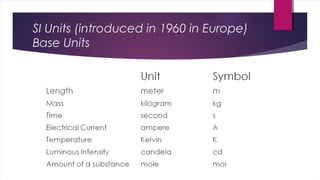
SI Units (introduced in 1960 in Europe)
Base Units
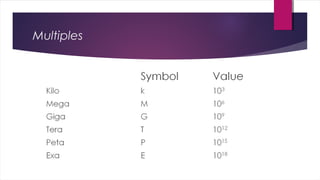
Multiples
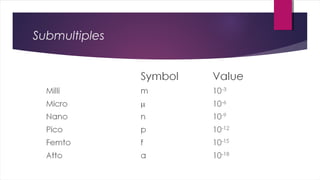
Submultiples
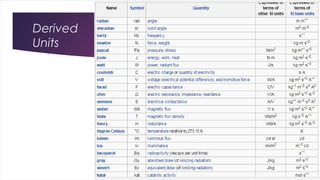
Derived
Units
Rules
 Prefix attached to one unit: mg/l preferred to ug/ml
 Both formats acceptable: mg/l or mg l-1
 Ampere x second is written as A.s
 No space between prefix and unit : ms is millisecond
Length, area and volume
 Angstrom = 10-10
m
 Micron = 10-6
m
 Derived units
 Area = m2
 Volume = m3
= 1000 l
1 ml = 1 cm3
1 dl = 100 ml
Frequency, Velocity and
Acceleration
 Frequency is how often a periodic event occurs
 Hertz (Hz) or s-1
 Velocity is the distance per time:
ms-1
 Acceleration is the change of velocity
ms-2
 Negative value refers to deceleration
Force and Pressure
 Force is the acceleration times mass
kg ms-2
which is called 1 Newton (N)
 1 dyne = 10-5
N
 Pressure is force exerted on an area or Nm-2
 Unit is Pascal (Pa)
 1 mmHg = 0.133 Pa
 1 cmH2O = 98 Pa
 1 bar = 100 kPa
Work, Energy, Heat and Power
 Work is the force times distance (N x m)
 Unit joule (J)
 Energy and Unit have the same unit, the joule
 1 calorie = 4.185 J
 1 kilocalorie = 4.185 kJ
 Power is the work per time: J x s-1
= watt (W)
Mass, Quantity and Concentration
 Unit of mass is kg
 Quantity of a substance is the molecular weight expressed in grams or
gram molecular weight or mole
 Ions are expressed as equivalents (eq)
 Another derived unit is osmoles or Osmol
 Osmolarity of a solution is the concentration of osmotically active particles
 Unit = osml-1
 Osmolality is measured as osmkg-1
 Mass of a molecule or an atom is expressed as Dalton
 1 Dalton = 1.66 x 10⁻²⁷
kg
 Concentration refers to
 Mass per volume gl-1
 g/dl or g/100 ml which is same as g%
Examples
 Blood pressure = 120/80 mmHg
 Pulse rate = 70 beats per min
 Red cell count = 5 million mm-3
or microlitre (10-6
l)
 Haemoglobin = 15 g/dl
 Mean Corpuscular Volume = 88 fl (femtolitre)
 Mean Corpuscular Haemoglobin = 30 pg (picograms)
 Fasting glucose = 100 mg/dl
 Total Cholesterol = 150 mg/dl
 Red cell count = mm-3

Units and measurements & basic statistics

  • 1.
    Units and Measurements &Basic Statistics Prof Vajira Weerasinghe Professor of Physiology
  • 2.
    SI Units (introducedin 1960 in Europe) Base Units
  • 3.
  • 4.
  • 5.
  • 6.
    Rules  Prefix attachedto one unit: mg/l preferred to ug/ml  Both formats acceptable: mg/l or mg l-1  Ampere x second is written as A.s  No space between prefix and unit : ms is millisecond
  • 7.
    Length, area andvolume  Angstrom = 10-10 m  Micron = 10-6 m  Derived units  Area = m2  Volume = m3 = 1000 l 1 ml = 1 cm3 1 dl = 100 ml
  • 8.
    Frequency, Velocity and Acceleration Frequency is how often a periodic event occurs  Hertz (Hz) or s-1  Velocity is the distance per time: ms-1  Acceleration is the change of velocity ms-2  Negative value refers to deceleration
  • 9.
    Force and Pressure Force is the acceleration times mass kg ms-2 which is called 1 Newton (N)  1 dyne = 10-5 N  Pressure is force exerted on an area or Nm-2  Unit is Pascal (Pa)  1 mmHg = 0.133 Pa  1 cmH2O = 98 Pa  1 bar = 100 kPa
  • 10.
    Work, Energy, Heatand Power  Work is the force times distance (N x m)  Unit joule (J)  Energy and Unit have the same unit, the joule  1 calorie = 4.185 J  1 kilocalorie = 4.185 kJ  Power is the work per time: J x s-1 = watt (W)
  • 11.
    Mass, Quantity andConcentration  Unit of mass is kg  Quantity of a substance is the molecular weight expressed in grams or gram molecular weight or mole  Ions are expressed as equivalents (eq)  Another derived unit is osmoles or Osmol  Osmolarity of a solution is the concentration of osmotically active particles  Unit = osml-1  Osmolality is measured as osmkg-1  Mass of a molecule or an atom is expressed as Dalton  1 Dalton = 1.66 x 10⁻²⁷ kg  Concentration refers to  Mass per volume gl-1  g/dl or g/100 ml which is same as g%
  • 12.
    Examples  Blood pressure= 120/80 mmHg  Pulse rate = 70 beats per min  Red cell count = 5 million mm-3 or microlitre (10-6 l)  Haemoglobin = 15 g/dl  Mean Corpuscular Volume = 88 fl (femtolitre)  Mean Corpuscular Haemoglobin = 30 pg (picograms)  Fasting glucose = 100 mg/dl  Total Cholesterol = 150 mg/dl  Red cell count = mm-3