Third Ventricle
dr himanshu soni
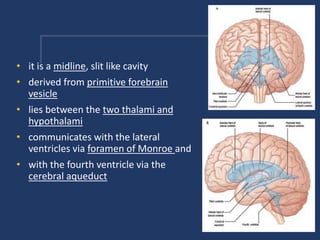
• it is a midline, slit like cavity
• derived from primitive forebrain
vesicle
• lies between the two thalami and

hypothalami
• communicates with the lateral

ventricles via foramen of Monroe and
• with the fourth ventricle via the
cerebral aqueduct
relations
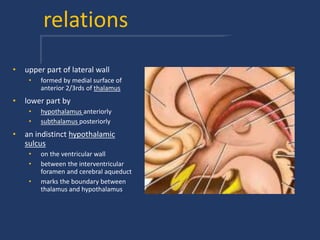
• upper part of lateral wall
• formed by medial surface of
anterior 2/3rds of thalamus
• lower part by
• hypothalamus anteriorly
• subthalamus posteriorly
• an indistinct hypothalamic
sulcus
• on the ventricular wall
• between the interventricular
foramen and cerebral aqueduct
• marks the boundary between
thalamus and hypothalamus
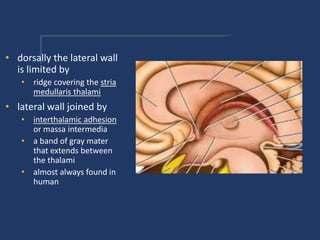
• dorsally the lateral wall
is limited by
• ridge covering the stria
medullaris thalami
• lateral wall joined by
• interthalamic adhesion
or massa intermedia
• a band of gray mater
that extends between
the thalami
• almost always found in
human
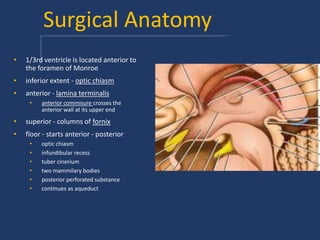
Surgical Anatomy
• 1/3rd ventricle is located anterior to
the foramen of Monroe
• inferior extent - optic chiasm
• anterior - lamina terminalis
• anterior commisure crosses the
anterior wall at its upper end
• superior - columns of fornix
• floor - starts anterior - posterior
• optic chiasm
• infundibular recess
• tuber cinerium
• two mammilary bodies
• posterior perforated substance
• continues as aqueduct
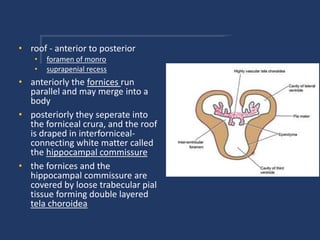
• roof - anterior to posterior
• foramen of monro
• suprapenial recess
• anteriorly the fornices run
parallel and may merge into a
body
• posteriorly they seperate into
the forniceal crura, and the roof
is draped in interforniceal-
connecting white matter called
the hippocampal commissure
• the fornices and the
hippocampal commissure are
covered by loose trabecular pial
tissue forming double layered
tela choroidea
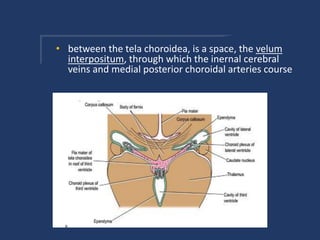
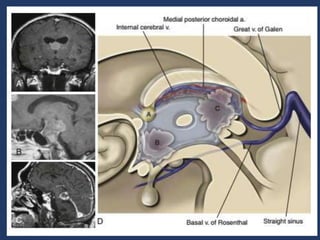
• between the tela choroidea, is a space, the velum
interpositum, through which the inernal cerebral
veins and medial posterior choroidal arteries course
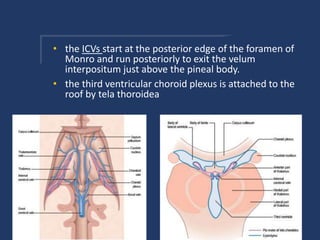
• the ICVs start at the posterior edge of the foramen of
Monro and run posteriorly to exit the velum
interpositum just above the pineal body.
• the third ventricular choroid plexus is attached to the
roof by tela thoroidea
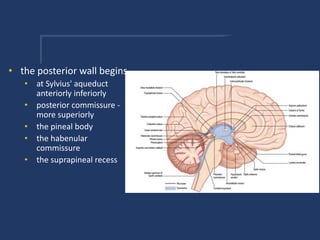
• the posterior wall begins
• at Sylvius' aqueduct
anteriorly inferiorly
• posterior commissure -
more superiorly
• the pineal body
• the habenular
commissure
• the suprapineal recess
RADIOLOGY
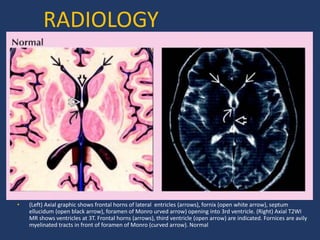
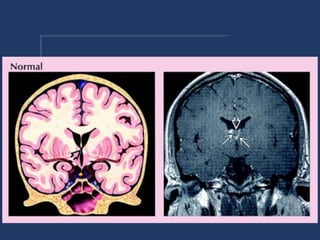
• (Left) Axial graphic shows frontal horns of lateral entricles (arrows), fornix (open white arrow), septum
ellucidum (open black arrow), foramen of Monro urved arrow) opening into 3rd ventricle. (Right) Axial T2WI
MR shows ventricles at 3T. Frontal horns (arrows), third ventricle (open arrow) are indicated. Fornices are avily
myelinated tracts in front of foramen of Monro (curved arrow). Normal
CAVUM VELUM INTERPOSITUM
• cystic dilatation of cistern of Velum
interpositum
• k/a - cavum velum interpositum,
cavum velum triangulare, cyst of the
velum interpositum
• located
• midline between the lateral ventricles
• below the fornices
• above the tela chorodea of 3rd ventricle
• contains internal cerebral veins
• shape - triangular
• apex - foramen of monro
• base - quadrigeminal cistern
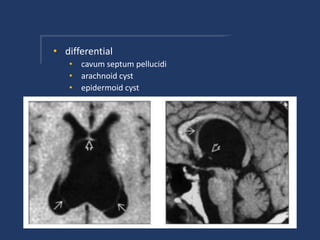
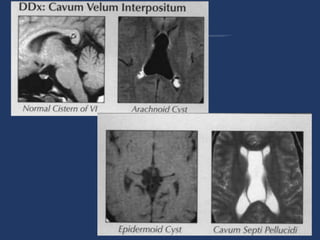
• differential
• cavum septum pellucidi
• arachnoid cyst
• epidermoid cyst
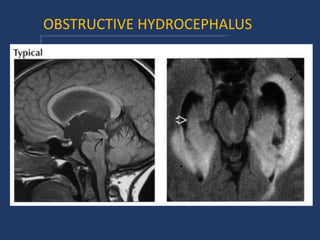
OBSTRUCTIVE HYDROCEPHALUS
Aqueductal stenosis
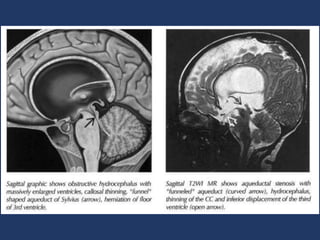
• Best diagnostic clue
• Funnel-shaped aqueduct of Sylvius
• "Ballooned" ventricles (lateral, third) and foramina of
Monroe proximal to obstruction
• Normal fourth ventricle and foramina (Luschka, Magendie)
distal to obstruction
• Interstitial edema with indistinct ("blurred") ventricular
margins (absent if AS "arrested")
• Location:
• Stenosis at cerebral aqueduct, either at level of the
superior colliculi or at intercollicular sulcus
• Size:
• Normal mean cross-sectional area of the aqueduct at birth
is 0.2 to 1.8 mm2
• Morphology
• Typically funnel-shaped aqueduct of Sylvius
• May see "aqueductal forking" or branching of aqueduct
into channels
• Aqueductal forking often accompanied by fusion of
quadrigeminal bodies, third nerve nuclei or tectal beaking
MR Findings
• TlWI
o Lateral ventricles enlarged
o Corpus callosum (CC) thinned, stretched
upward
o Fornix, internal cerebral veins, 3rd ventricle
floor displaced downward
• T2WI
o "Fingers" of CSF-like hyperintensity extend
outwards from ventricles into brain (including CC)
o Interstitial edema most striking around
ventricular
horns
o Disturbed/turbulent CSF flow in ventricles
o Absent aqueductal "flow void" common
SURGICAL OPTIONS
• anterior third ventricle
• trans foraminal approach
• interforniceal approach
• lateral subfrontal approach
• pterional approach
• endoscopic approaches
• Posterior third ventricle
• transcallosal transvelum interpositum
approach
• infratentorial supracerebellar approach
• occipital transtentorial approach
thank you
Third ventricle
Third ventricle
Third ventricle
Third ventricle
Third ventricle
Third ventricle
Third ventricle
Third ventricle
Third ventricle
Third ventricle
Third ventricle
Third ventricle
Third ventricle
Third ventricle
Third ventricle
Third ventricle
Third ventricle
Third ventricle
Third ventricle
Third ventricle
Third ventricle
Third ventricle

Third ventricle

  • 1.
  • 2.
    • it isa midline, slit like cavity • derived from primitive forebrain vesicle • lies between the two thalami and hypothalami • communicates with the lateral ventricles via foramen of Monroe and • with the fourth ventricle via the cerebral aqueduct
  • 3.
    relations • upper partof lateral wall • formed by medial surface of anterior 2/3rds of thalamus • lower part by • hypothalamus anteriorly • subthalamus posteriorly • an indistinct hypothalamic sulcus • on the ventricular wall • between the interventricular foramen and cerebral aqueduct • marks the boundary between thalamus and hypothalamus
  • 4.
    • dorsally thelateral wall is limited by • ridge covering the stria medullaris thalami • lateral wall joined by • interthalamic adhesion or massa intermedia • a band of gray mater that extends between the thalami • almost always found in human
  • 5.
    Surgical Anatomy • 1/3rdventricle is located anterior to the foramen of Monroe • inferior extent - optic chiasm • anterior - lamina terminalis • anterior commisure crosses the anterior wall at its upper end • superior - columns of fornix • floor - starts anterior - posterior • optic chiasm • infundibular recess • tuber cinerium • two mammilary bodies • posterior perforated substance • continues as aqueduct
  • 6.
    • roof -anterior to posterior • foramen of monro • suprapenial recess • anteriorly the fornices run parallel and may merge into a body • posteriorly they seperate into the forniceal crura, and the roof is draped in interforniceal- connecting white matter called the hippocampal commissure • the fornices and the hippocampal commissure are covered by loose trabecular pial tissue forming double layered tela choroidea
  • 7.
    • between thetela choroidea, is a space, the velum interpositum, through which the inernal cerebral veins and medial posterior choroidal arteries course
  • 8.
    • the ICVsstart at the posterior edge of the foramen of Monro and run posteriorly to exit the velum interpositum just above the pineal body. • the third ventricular choroid plexus is attached to the roof by tela thoroidea
  • 9.
    • the posteriorwall begins • at Sylvius' aqueduct anteriorly inferiorly • posterior commissure - more superiorly • the pineal body • the habenular commissure • the suprapineal recess
  • 10.
    RADIOLOGY • (Left) Axialgraphic shows frontal horns of lateral entricles (arrows), fornix (open white arrow), septum ellucidum (open black arrow), foramen of Monro urved arrow) opening into 3rd ventricle. (Right) Axial T2WI MR shows ventricles at 3T. Frontal horns (arrows), third ventricle (open arrow) are indicated. Fornices are avily myelinated tracts in front of foramen of Monro (curved arrow). Normal
  • 13.
    CAVUM VELUM INTERPOSITUM •cystic dilatation of cistern of Velum interpositum • k/a - cavum velum interpositum, cavum velum triangulare, cyst of the velum interpositum • located • midline between the lateral ventricles • below the fornices • above the tela chorodea of 3rd ventricle • contains internal cerebral veins • shape - triangular • apex - foramen of monro • base - quadrigeminal cistern
  • 14.
    • differential • cavumseptum pellucidi • arachnoid cyst • epidermoid cyst
  • 16.
  • 17.
    Aqueductal stenosis • Bestdiagnostic clue • Funnel-shaped aqueduct of Sylvius • "Ballooned" ventricles (lateral, third) and foramina of Monroe proximal to obstruction • Normal fourth ventricle and foramina (Luschka, Magendie) distal to obstruction • Interstitial edema with indistinct ("blurred") ventricular margins (absent if AS "arrested") • Location: • Stenosis at cerebral aqueduct, either at level of the superior colliculi or at intercollicular sulcus • Size: • Normal mean cross-sectional area of the aqueduct at birth is 0.2 to 1.8 mm2 • Morphology • Typically funnel-shaped aqueduct of Sylvius • May see "aqueductal forking" or branching of aqueduct into channels • Aqueductal forking often accompanied by fusion of quadrigeminal bodies, third nerve nuclei or tectal beaking
  • 19.
    MR Findings • TlWI oLateral ventricles enlarged o Corpus callosum (CC) thinned, stretched upward o Fornix, internal cerebral veins, 3rd ventricle floor displaced downward • T2WI o "Fingers" of CSF-like hyperintensity extend outwards from ventricles into brain (including CC) o Interstitial edema most striking around ventricular horns o Disturbed/turbulent CSF flow in ventricles o Absent aqueductal "flow void" common
  • 20.
    SURGICAL OPTIONS • anteriorthird ventricle • trans foraminal approach • interforniceal approach • lateral subfrontal approach • pterional approach • endoscopic approaches • Posterior third ventricle • transcallosal transvelum interpositum approach • infratentorial supracerebellar approach • occipital transtentorial approach
  • 22.