1Prof .Dr. Rashid Mahmood
Movements of small & large intestine
A 35 year old female was operated for acute appendicitis. She was
advised not to take anything by mouth till further advice by the
surgeon. Six hours after surgery she inquired the doctor on duty that
whether she can now start taking orally or not. The doctor examined
her bowl sounds. He could not listen the bowl sounds and advised
her to wait for another few hours.
•What is the name of this condition?
•Why does the motility of intestine decrease after abdominal
surgery?
•How the condition can be relieved if the movements of small
intestine do not recur in more than 10 hours?
2Prof .Dr. Rashid Mahmood
Objectives
Goal /Aim
• By the end of this session the student should be able to describe the
mechanism, types and functions of the motility of small and large
intestine.
Specific objectives
By the end of this session the student should be able to
• Enlist the types of movements of small and large intestine
• Define the factors that control motility of small and large intestine
• Describe how chyme is transported from pylorus to anus
• Distinguish between Segmentation and Haustrations
• Explain Function and Feedback control of Ileocecal valve and
Ileocecal sphincter
3Prof .Dr. Rashid Mahmood
Lesson contents
• Movements of Small Intestine
• Mixing (Segmentation Contractions)
• Progression of segmentation contractions
• Peristalsis (Propulsive Movements)
• Movements of Muscularis Mucosa
• Contraction of villi
• Control of Peristalsis of Small Intestine
• Ileocecal valve and Ileocecal sphincter
• Function
• Feedback control
• Emptying at Ileocecal valve
• Movements of Colon
• Mixing Movements (Haustrations)
• Propulsive Movements (Mass Movements)
4Prof .Dr. Rashid Mahmood
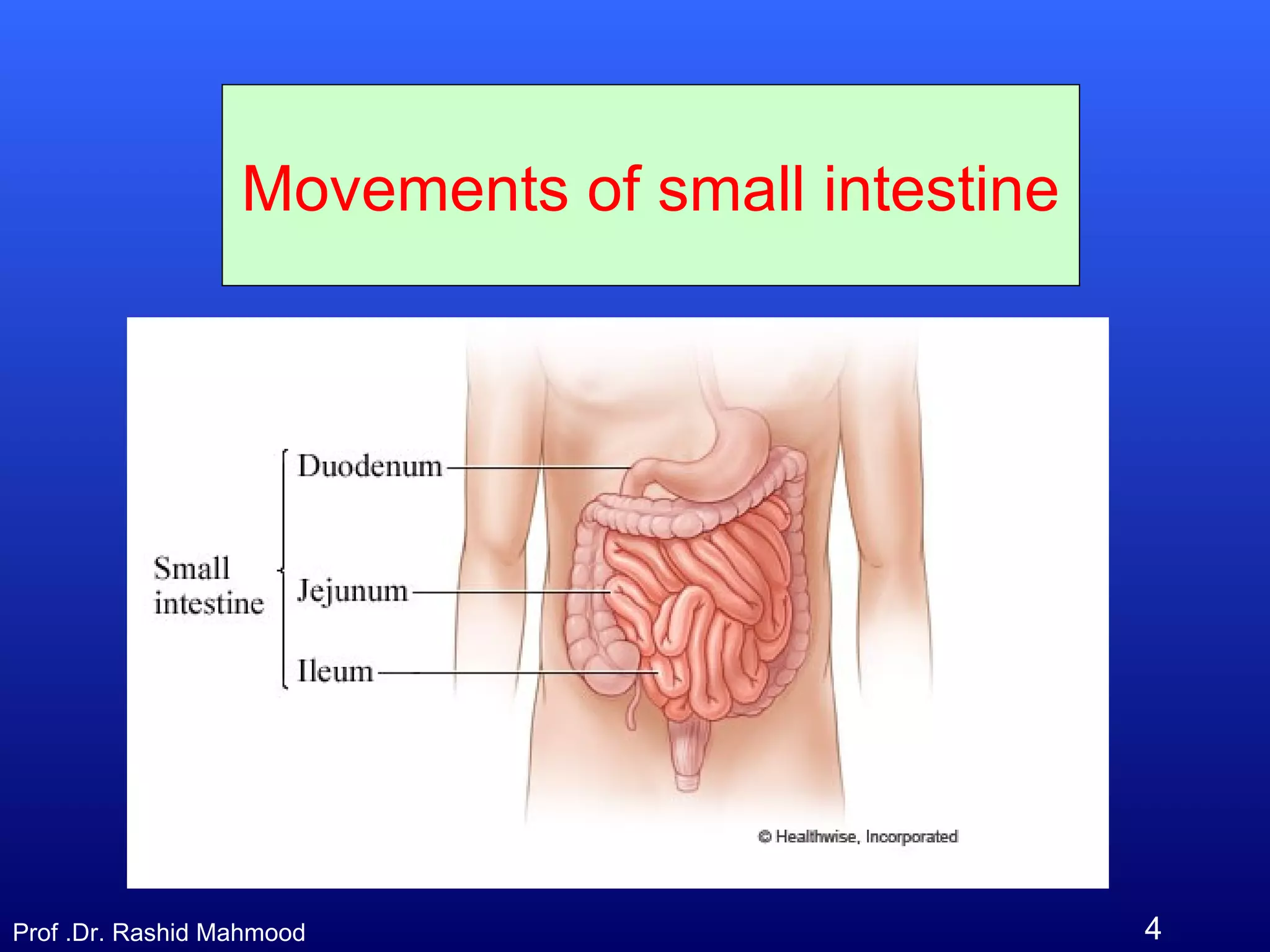
Movements of small intestine
5Prof .Dr. Rashid Mahmood
Movements of Small Intestine
1. Mixing (Segmentation Contractions)
2. Propulsive (Peristalsis)
Overlap
1. Movements of Muscularis Mucosa
Folds
↑ surface area
1. Contraction of villi
“milk” the villi
↑ lymph flow
6Prof .Dr. Rashid Mahmood
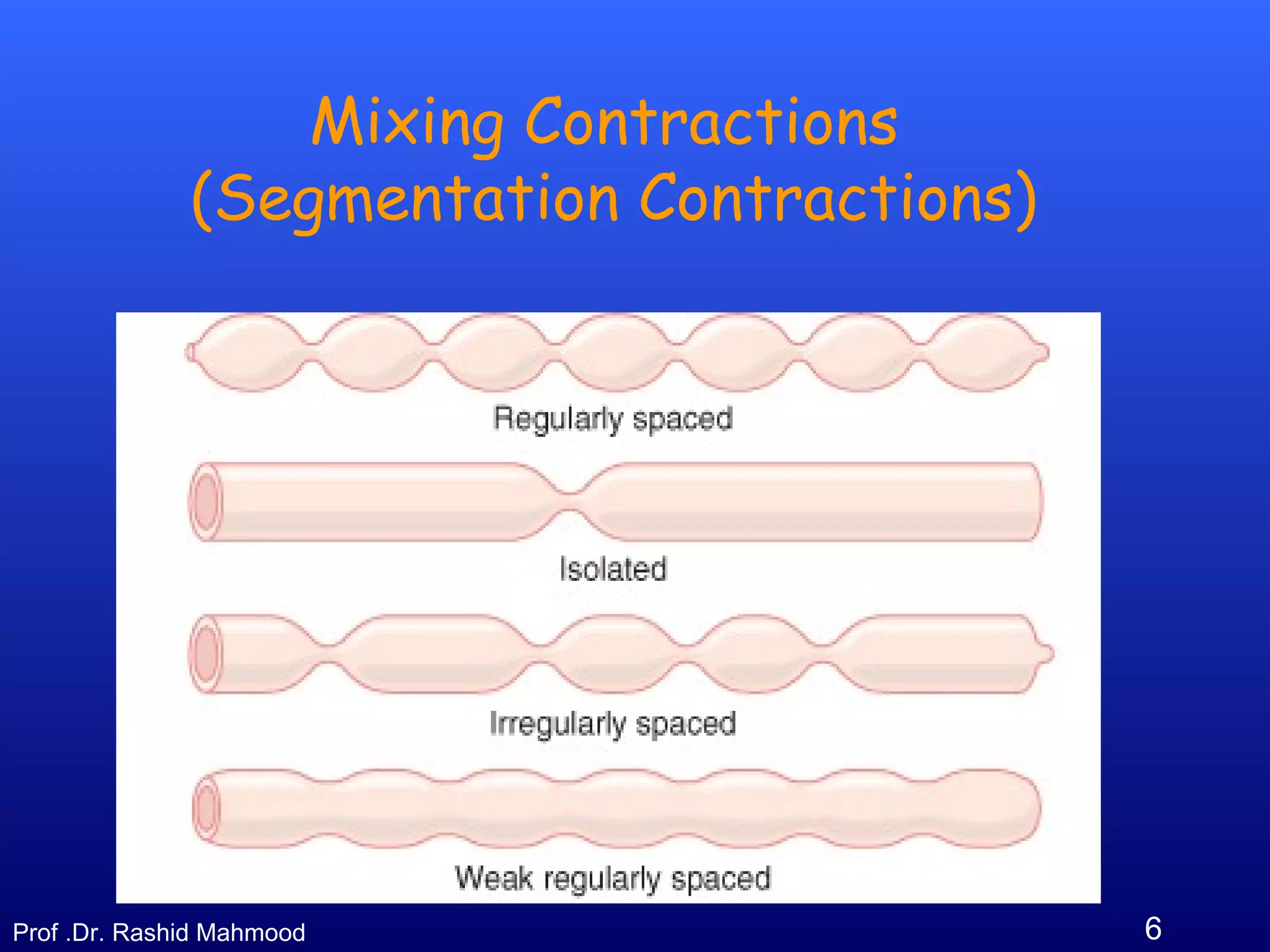
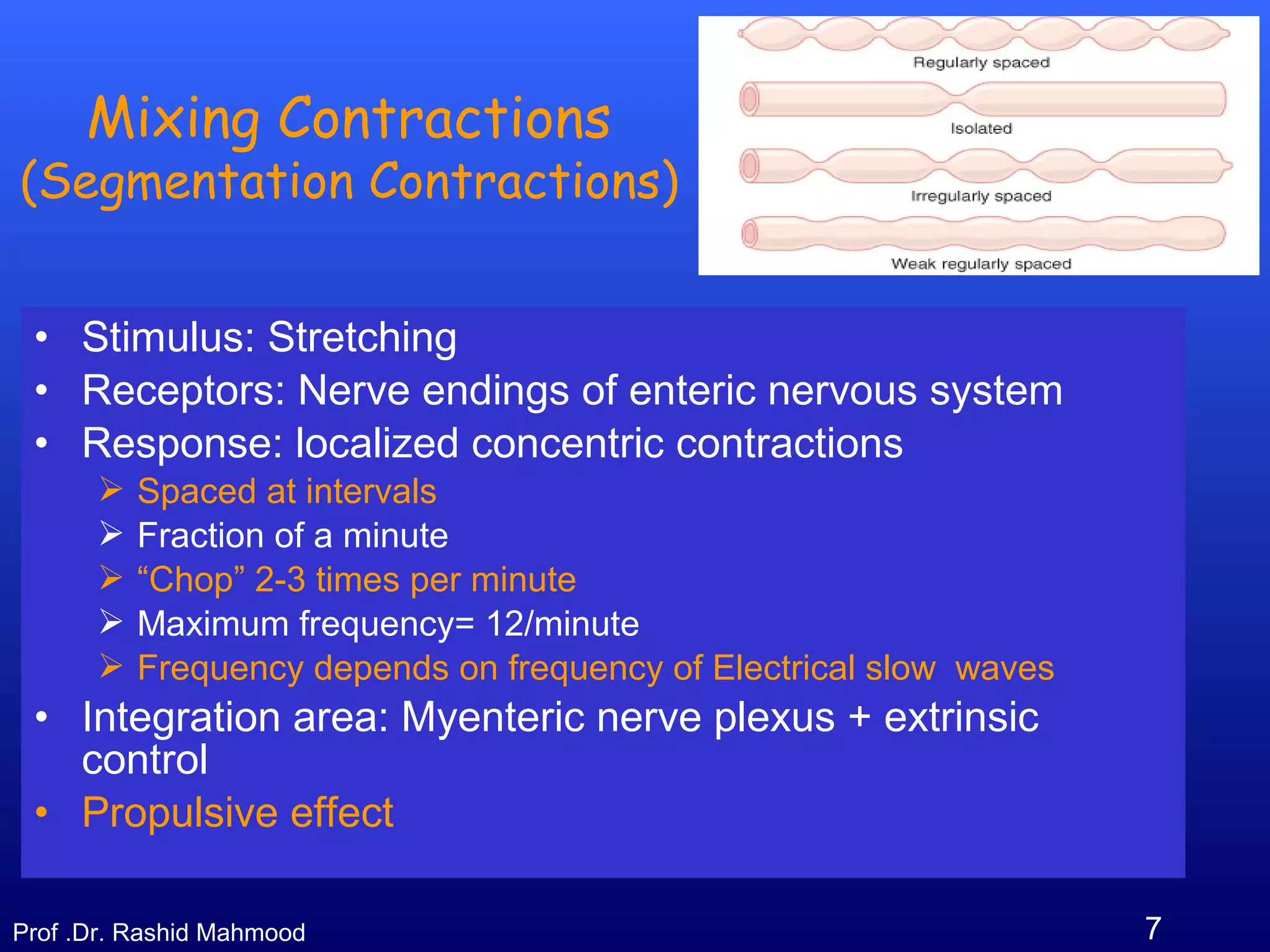
Mixing Contractions
(Segmentation Contractions)
7Prof .Dr. Rashid Mahmood
Mixing Contractions
(Segmentation Contractions)
• Stimulus: Stretching
• Receptors: Nerve endings of enteric nervous system
• Response: localized concentric contractions
 Spaced at intervals
 Fraction of a minute
 “Chop” 2-3 times per minute
 Maximum frequency= 12/minute
 Frequency depends on frequency of Electrical slow waves
• Integration area: Myenteric nerve plexus + extrinsic
control
• Propulsive effect
8Prof .Dr. Rashid Mahmood
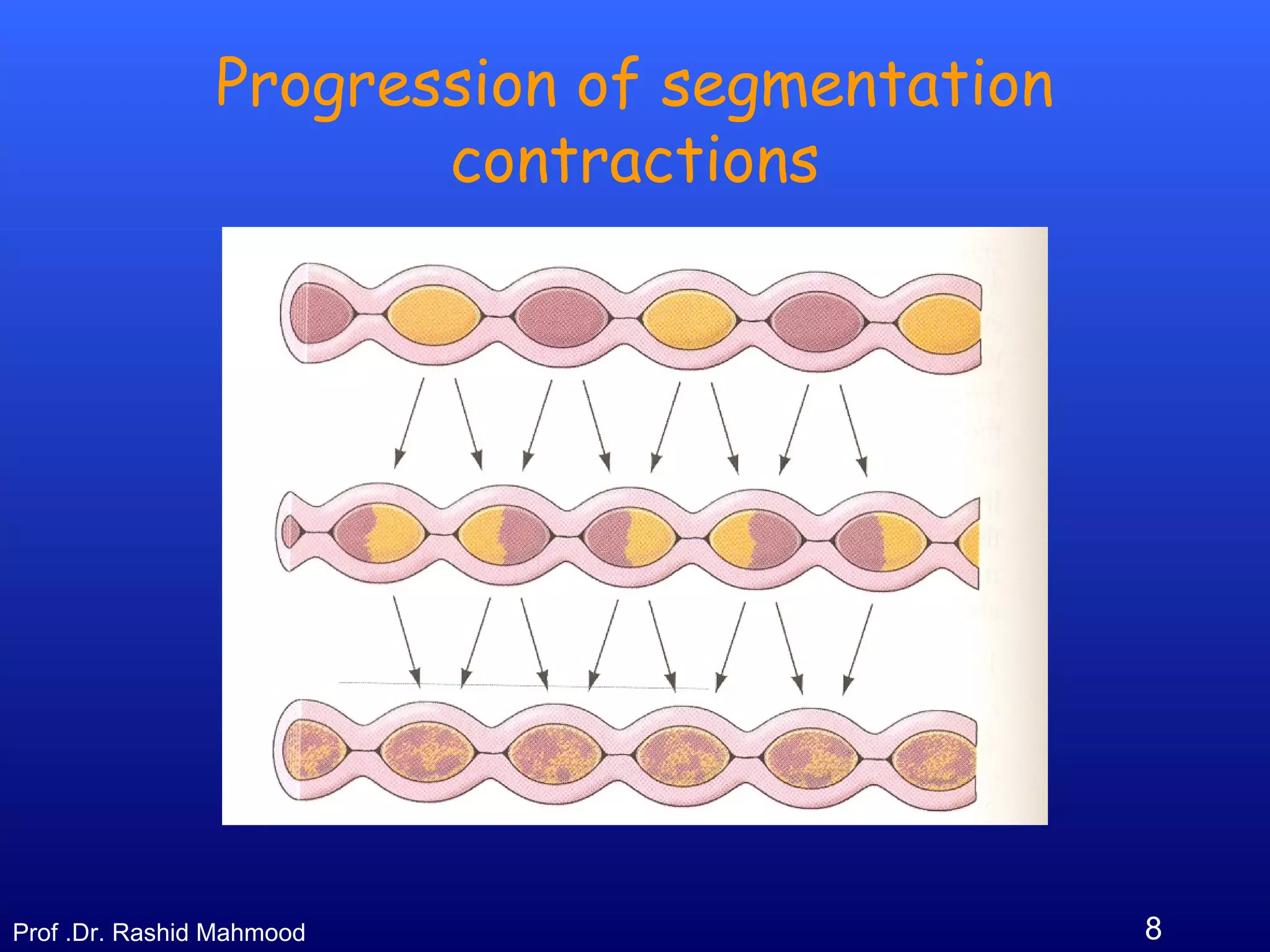
Progression of segmentation
contractions
9Prof .Dr. Rashid Mahmood
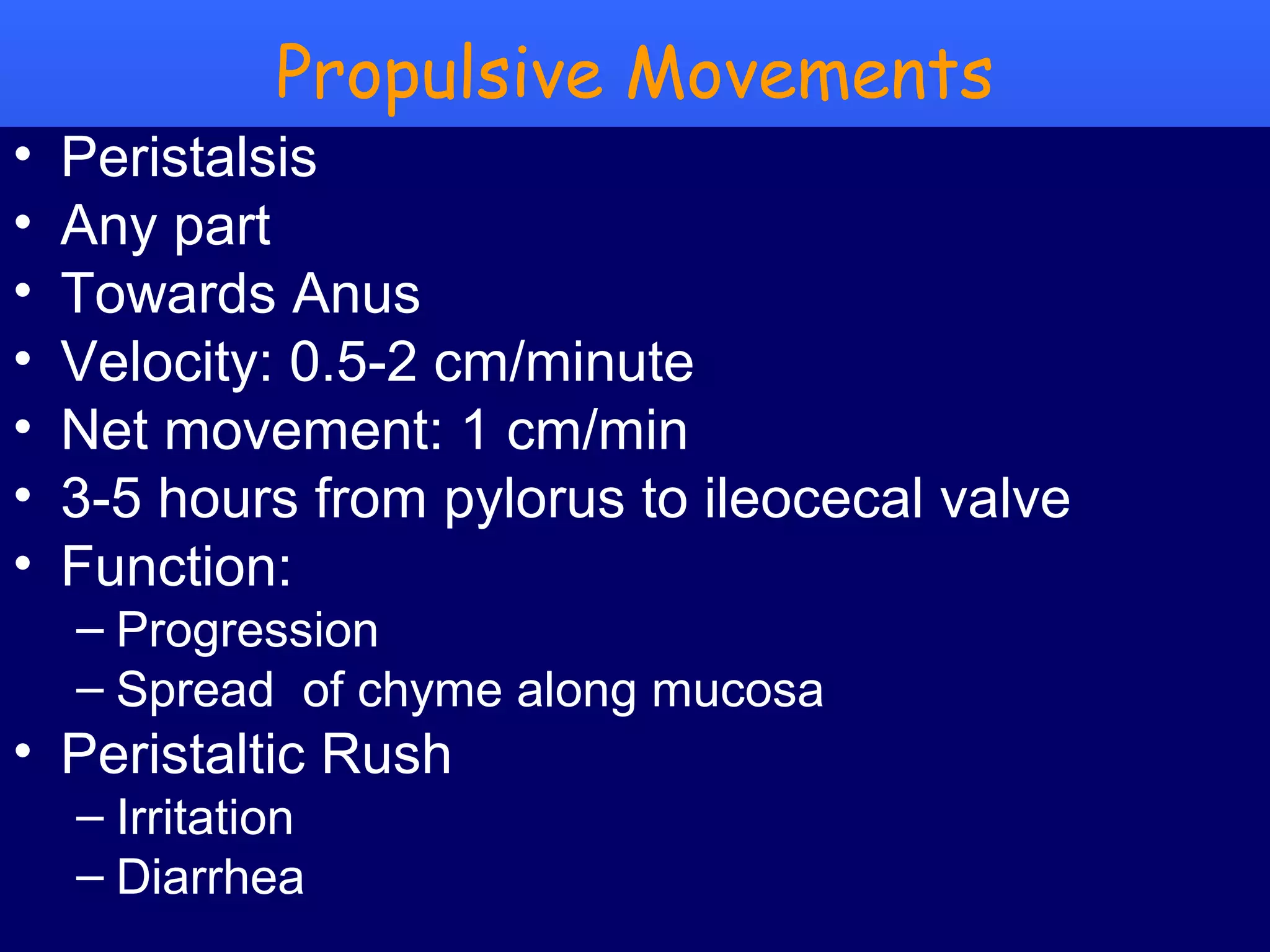
Propulsive Movements
• Peristalsis
• Any part
• Towards Anus
• Velocity: 0.5-2 cm/minute
• Net movement: 1 cm/min
• 3-5 hours from pylorus to ileocecal valve
• Function:
– Progression
– Spread of chyme along mucosa
• Peristaltic Rush
– Irritation
– Diarrhea
10Prof .Dr. Rashid Mahmood
Assessment Question 1
• List the different types of movements in
small Intestine.
11Prof .Dr. Rashid Mahmood
Control of Peristalsis of Small
Intestine
1. Nervous Factors
2. Hormonal Factors
12Prof .Dr. Rashid Mahmood
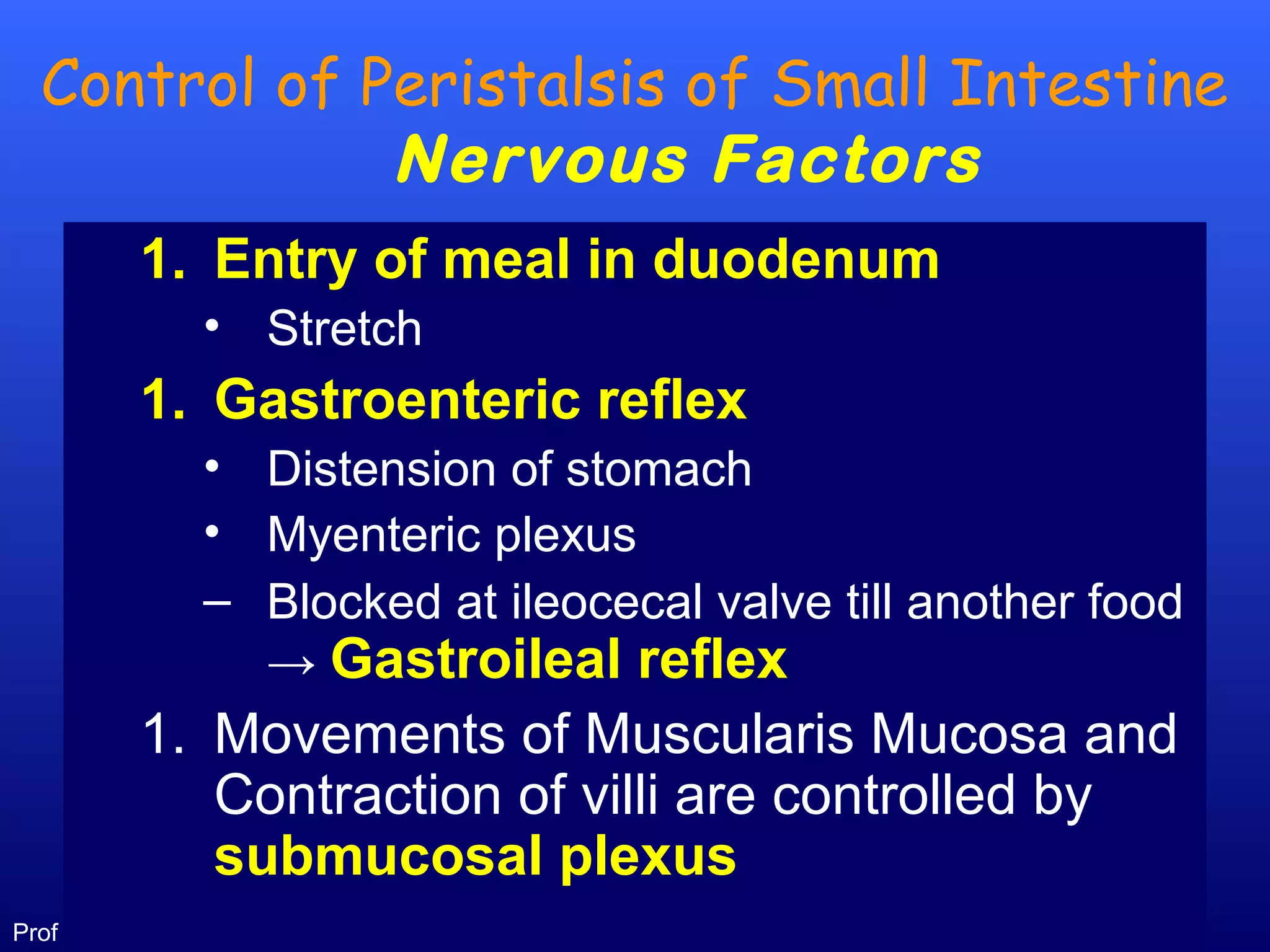
Control of Peristalsis of Small Intestine
Nervous Factors
1. Entry of meal in duodenum
• Stretch
1. Gastroenteric reflex
• Distension of stomach
• Myenteric plexus
– Blocked at ileocecal valve till another food
→ Gastroileal reflex
1. Movements of Muscularis Mucosa and
Contraction of villi are controlled by
submucosal plexus
13Prof .Dr. Rashid Mahmood
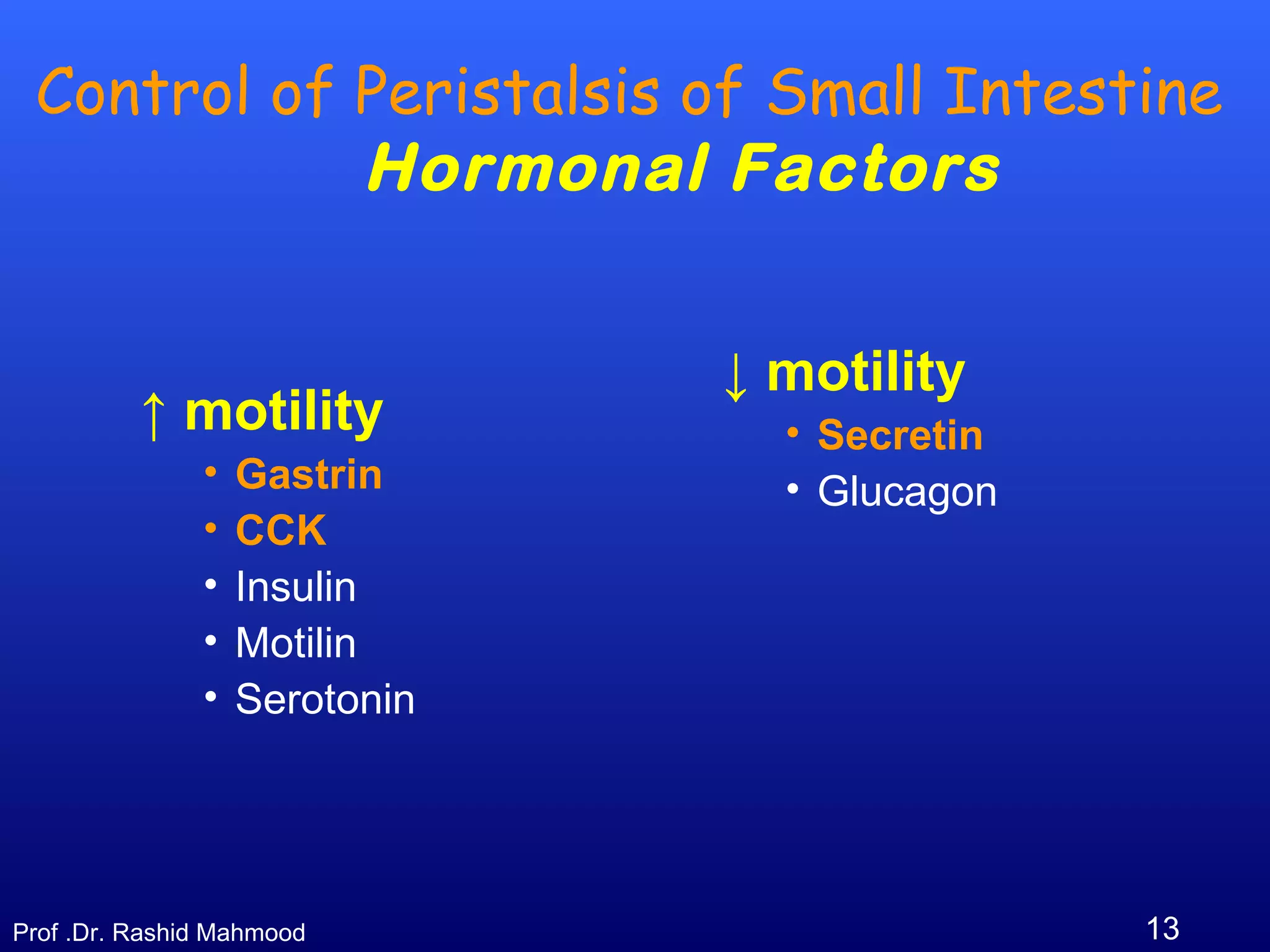
Control of Peristalsis of Small Intestine
Hormonal Factors
↑ motility
• Gastrin
• CCK
• Insulin
• Motilin
• Serotonin
↓ motility
• Secretin
• Glucagon
14Prof .Dr. Rashid Mahmood
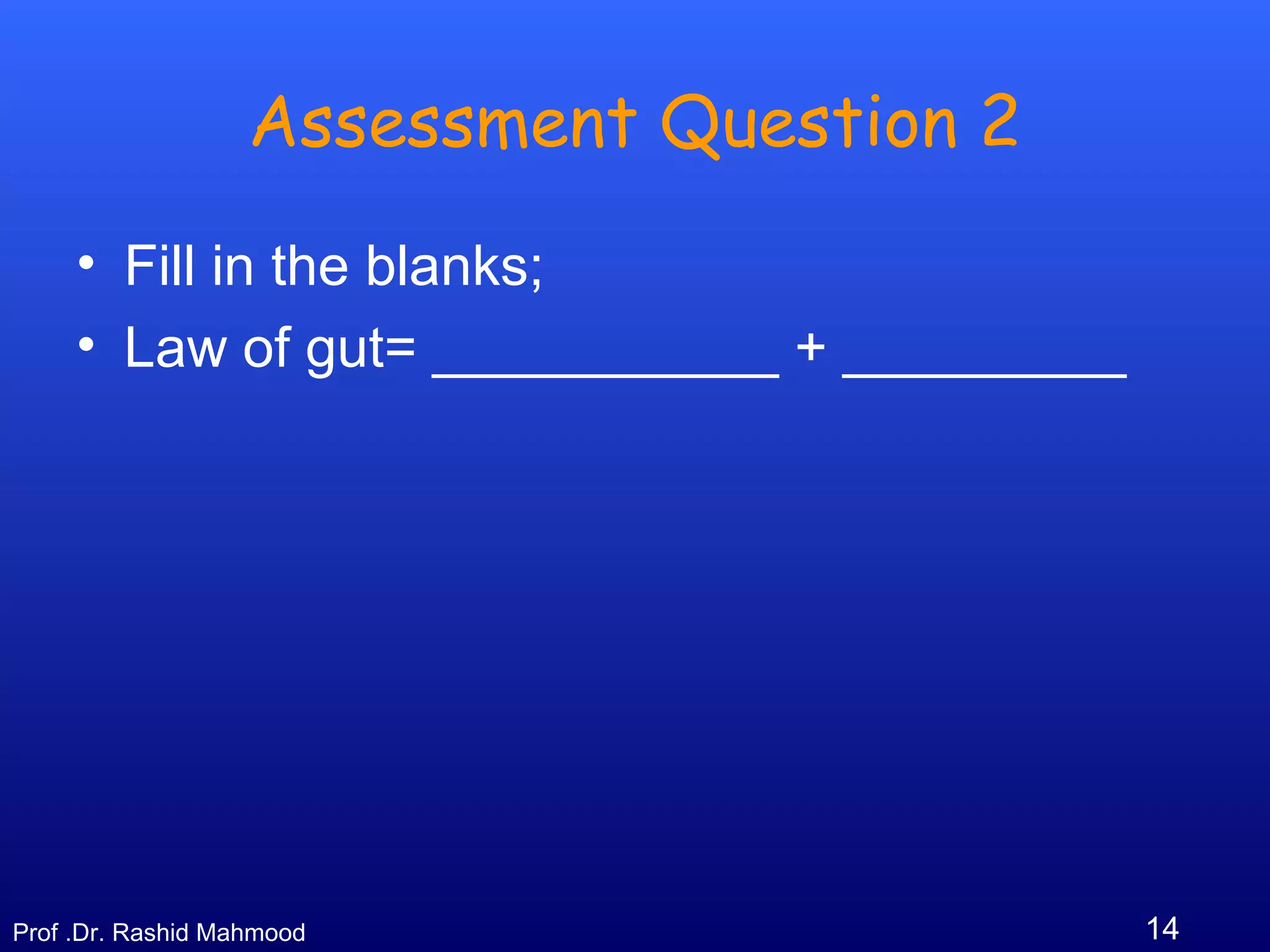
Assessment Question 2
• Fill in the blanks;
• Law of gut= ___________ + _________
15Prof .Dr. Rashid Mahmood
Next: Ileocecal valve
16Prof .Dr. Rashid Mahmood
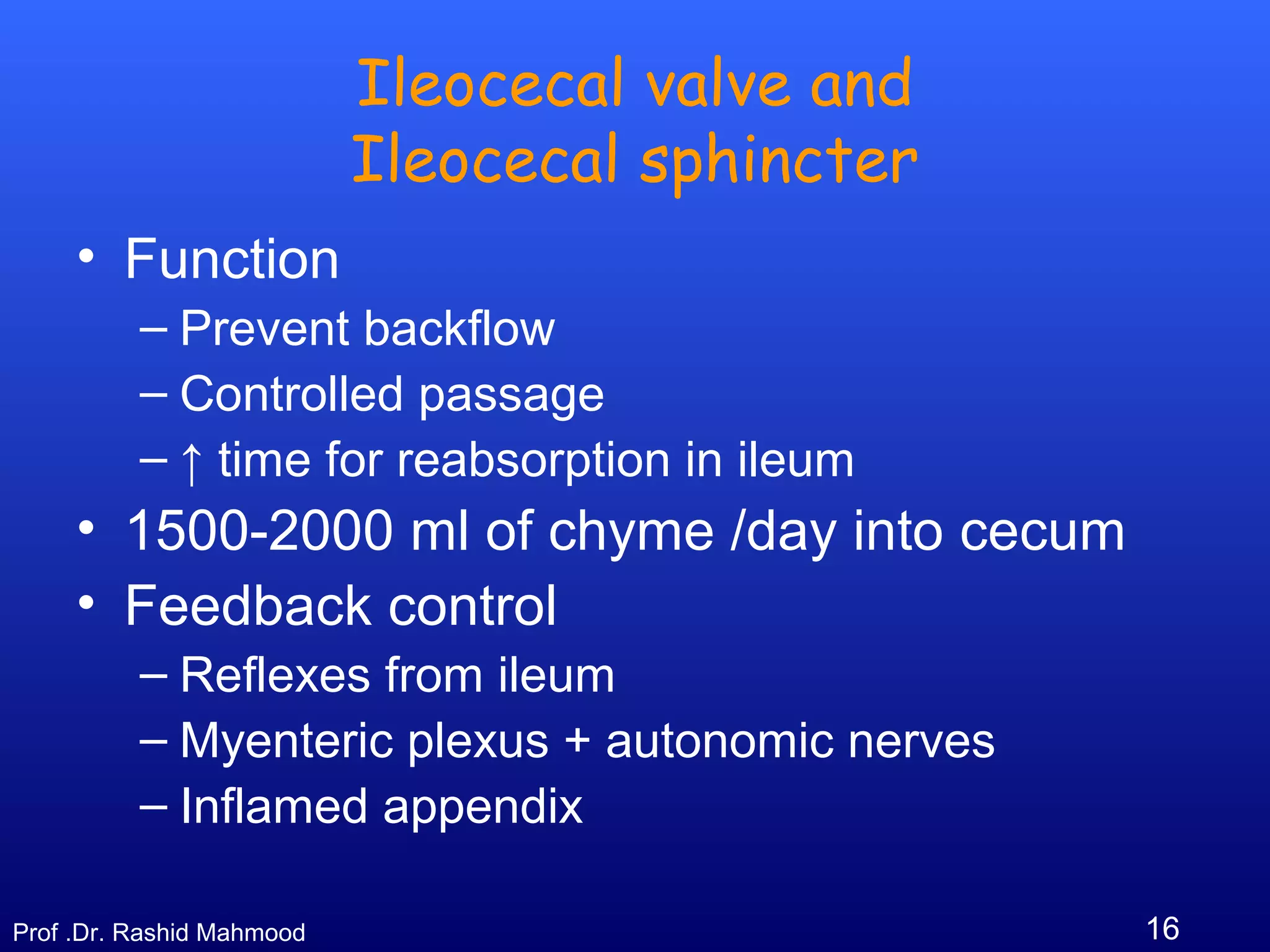
Ileocecal valve and
Ileocecal sphincter
• Function
– Prevent backflow
– Controlled passage
– ↑ time for reabsorption in ileum
• 1500-2000 ml of chyme /day into cecum
• Feedback control
– Reflexes from ileum
– Myenteric plexus + autonomic nerves
– Inflamed appendix
17Prof .Dr. Rashid Mahmood
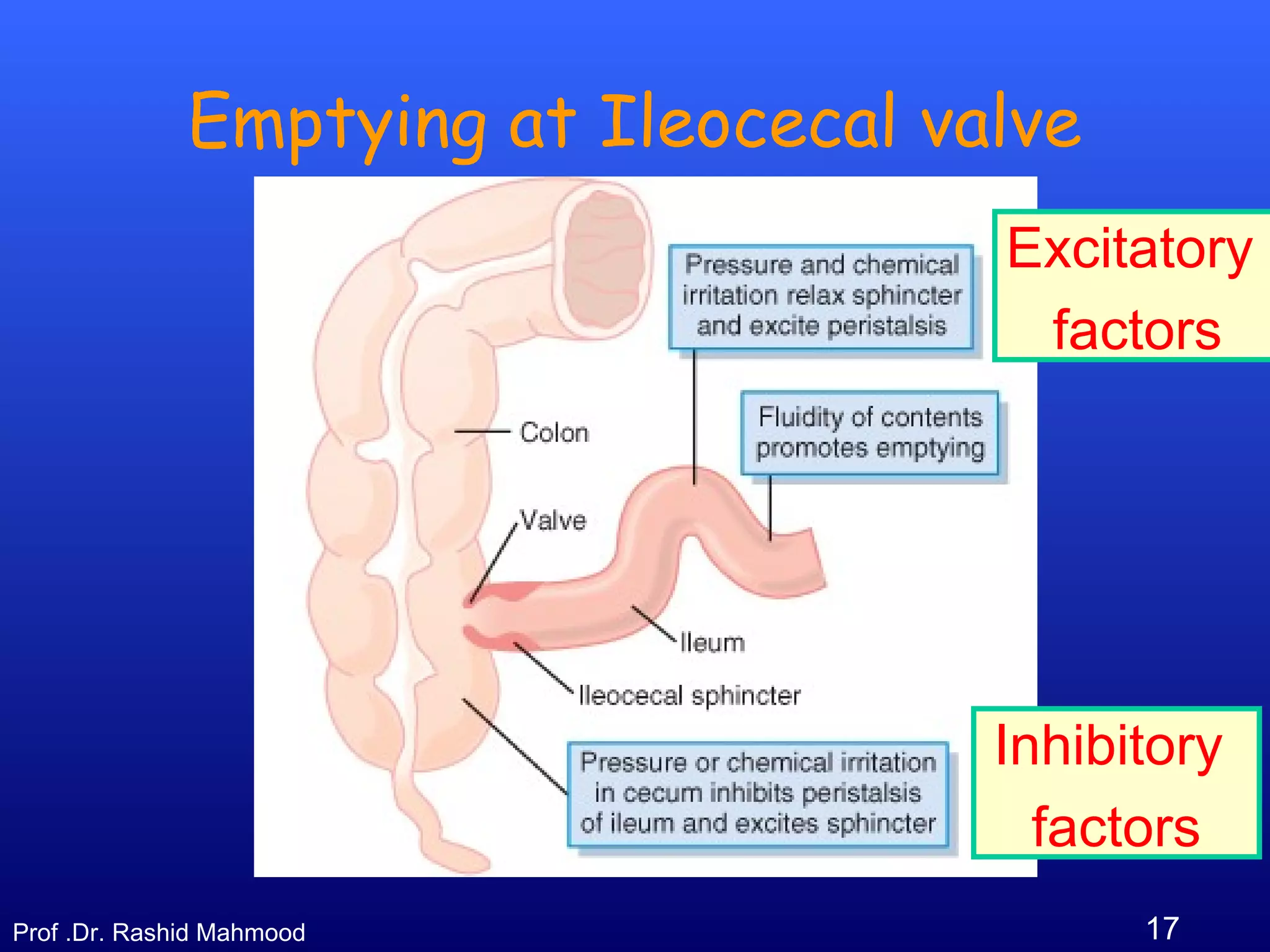
Emptying at Ileocecal valve
Excitatory
factors
Inhibitory
factors
18Prof .Dr. Rashid Mahmood
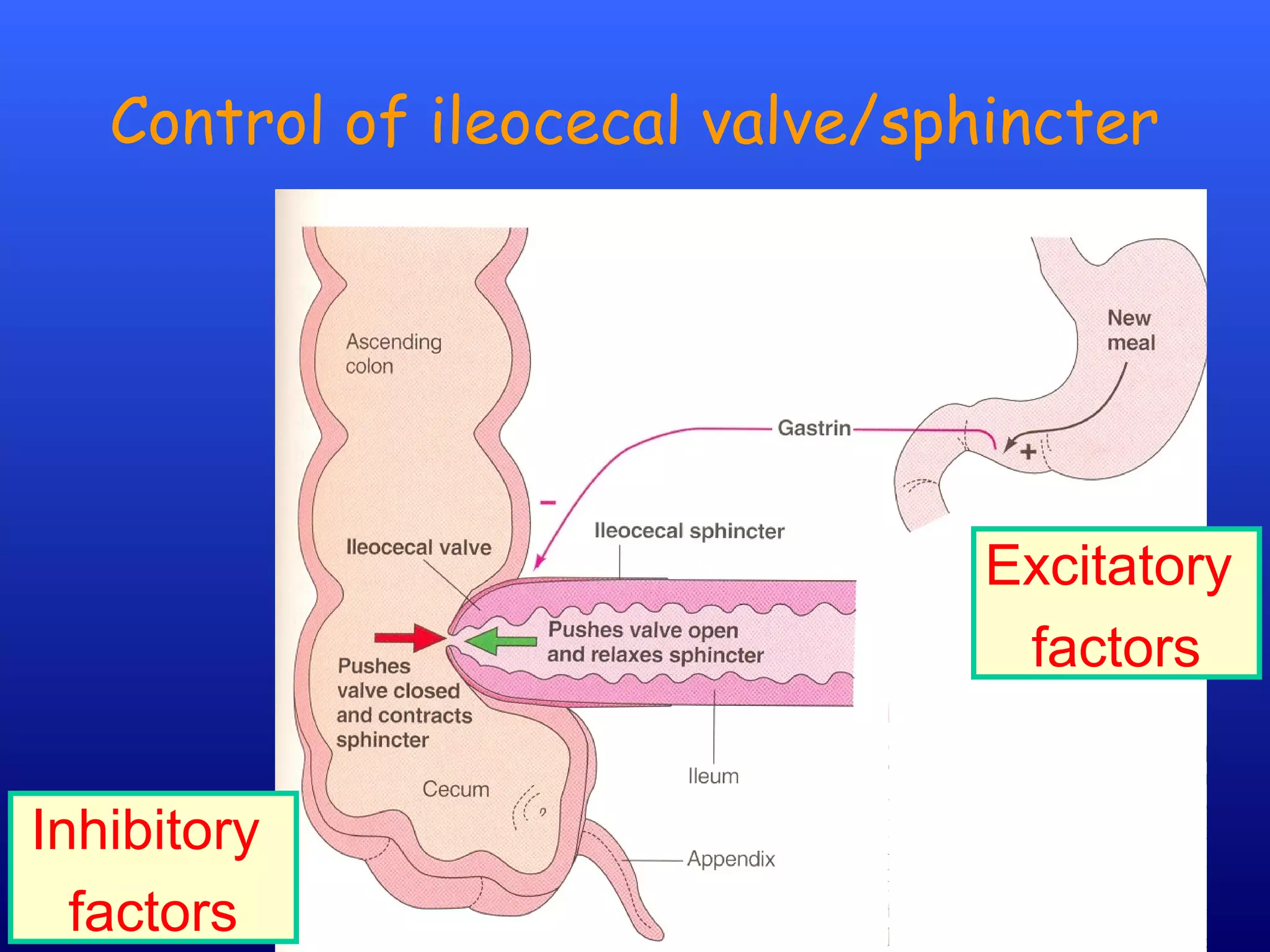
Control of ileocecal valve/sphincter
Excitatory
factors
Inhibitory
factors
19Prof .Dr. Rashid Mahmood
Assessment Question 3
• List the factors that increase emptying at
Ileo-cecal valve.
20Prof .Dr. Rashid Mahmood
Next: movements of large intestine
21Prof .Dr. Rashid Mahmood
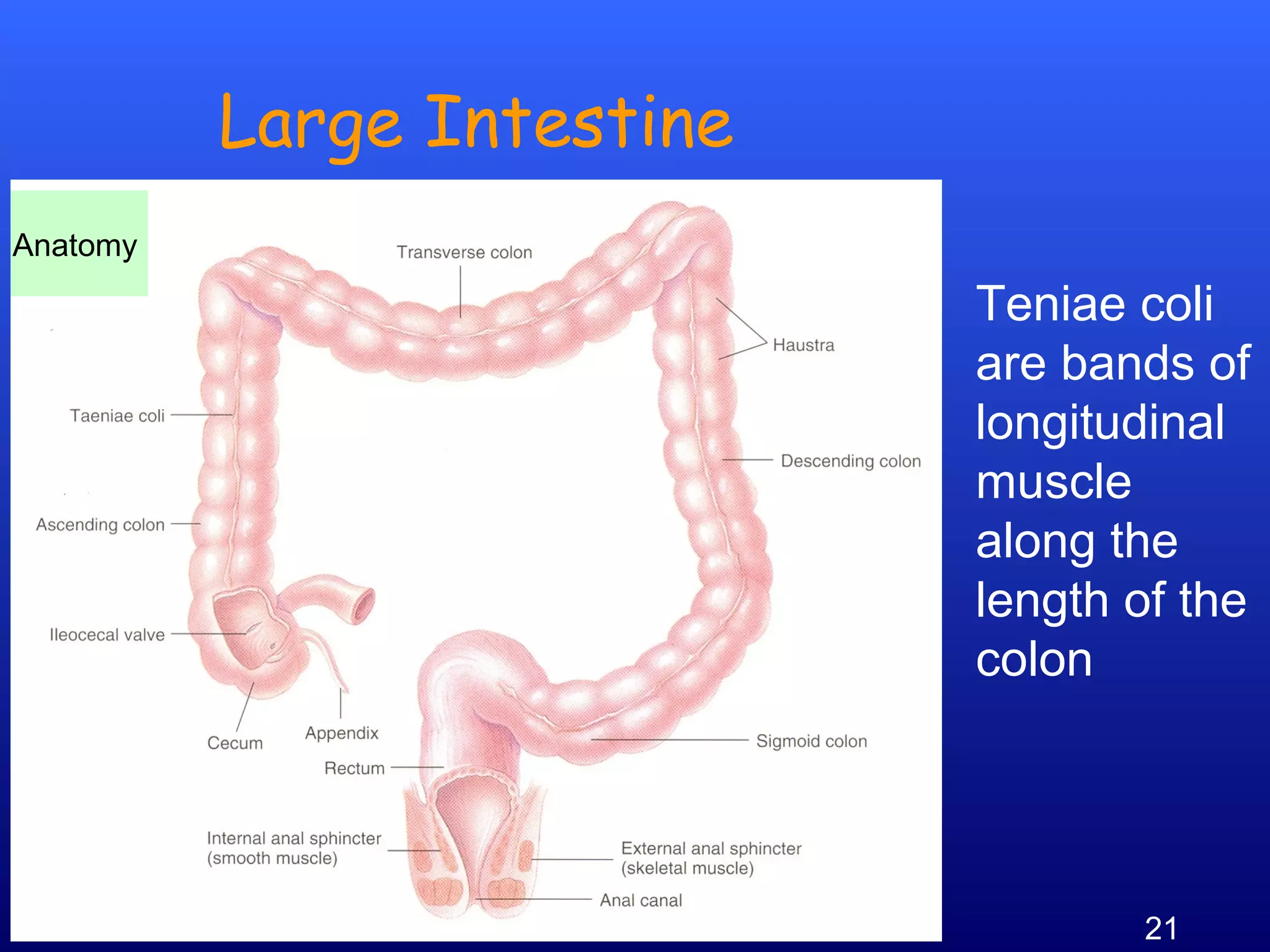
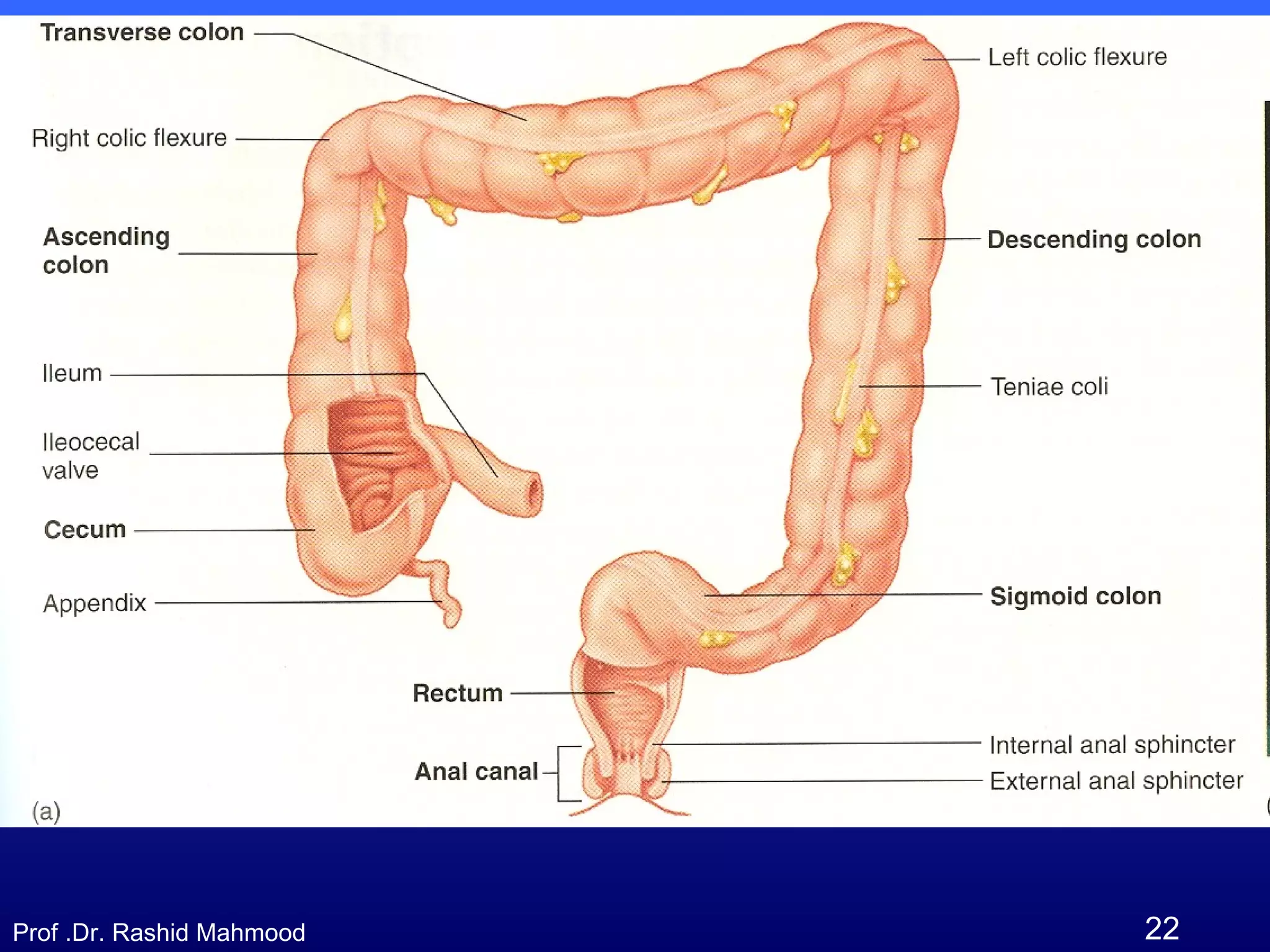
Large Intestine
Anatomy
Teniae coli
are bands of
longitudinal
muscle
along the
length of the
colon
22Prof .Dr. Rashid Mahmood
23Prof .Dr. Rashid Mahmood
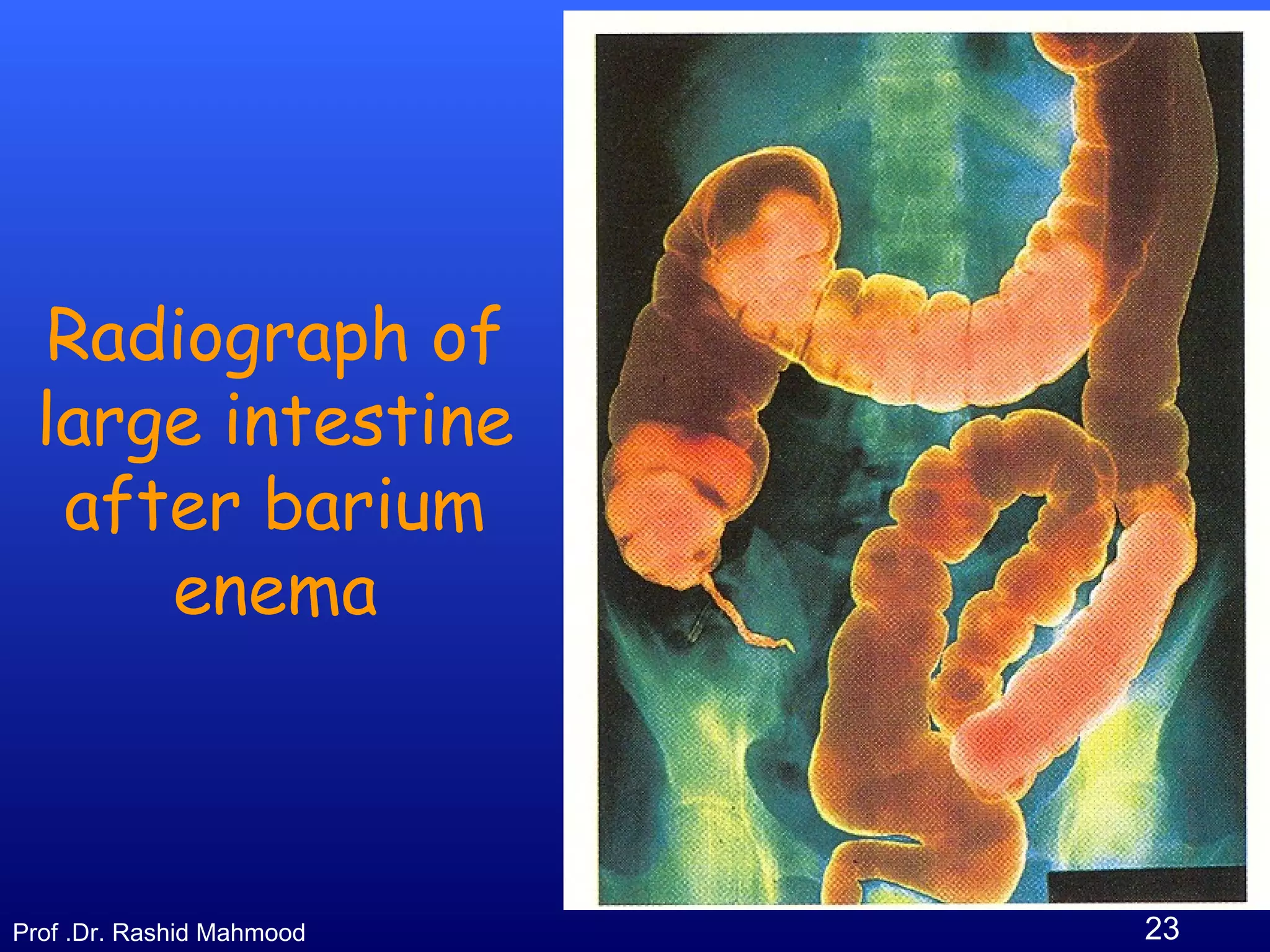
Radiograph of
large intestine
after barium
enema
24Prof .Dr. Rashid Mahmood
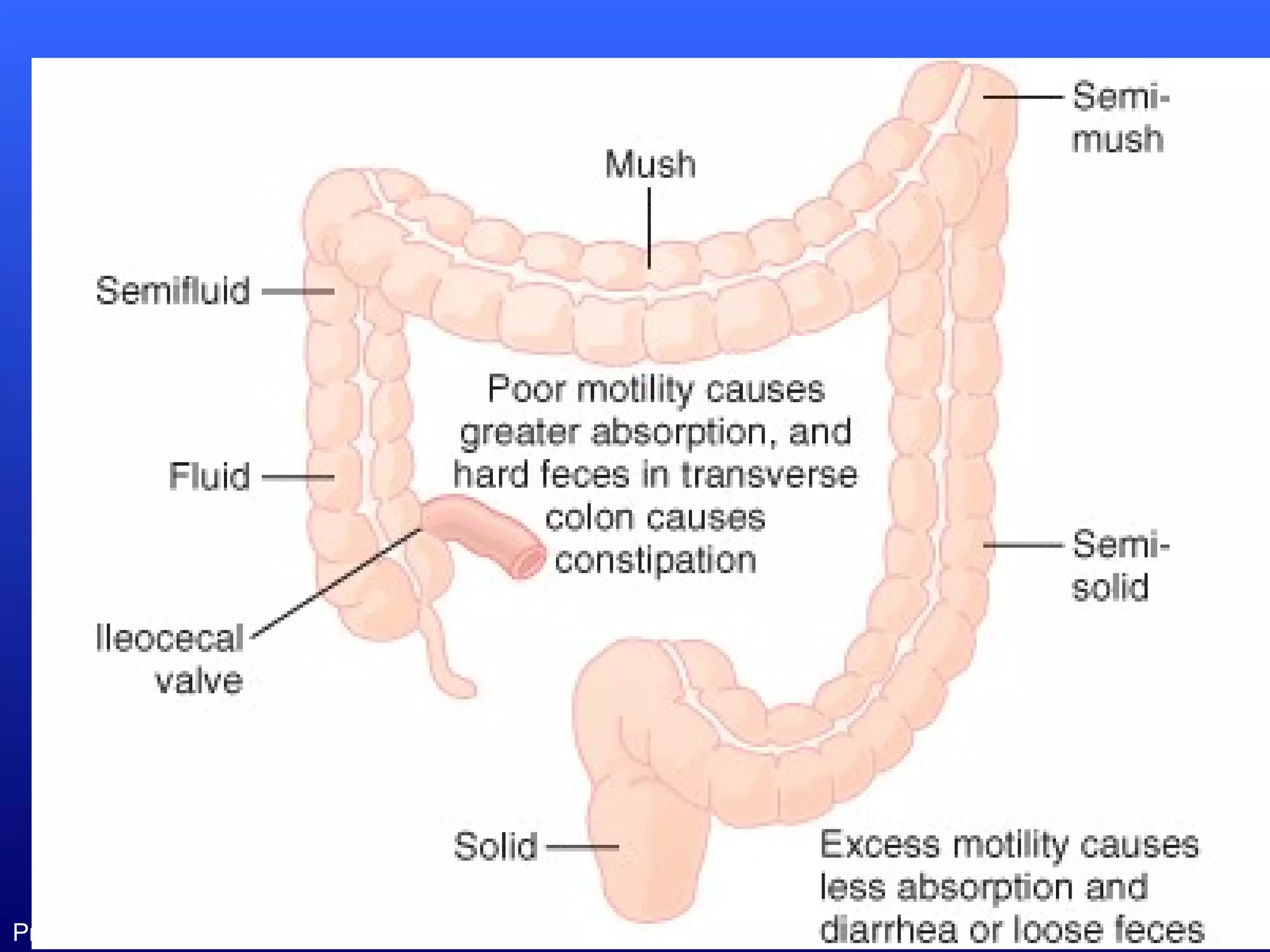
Movements of Colon
• Mixing Movements (Haustrations)
– Proximal half
• Propulsive Movements (Mass
Movements)
– Distal half
• Functions of colon:
– Absorption
– Storage of fecal matter
25Prof .Dr. Rashid Mahmood
26Prof .Dr. Rashid Mahmood
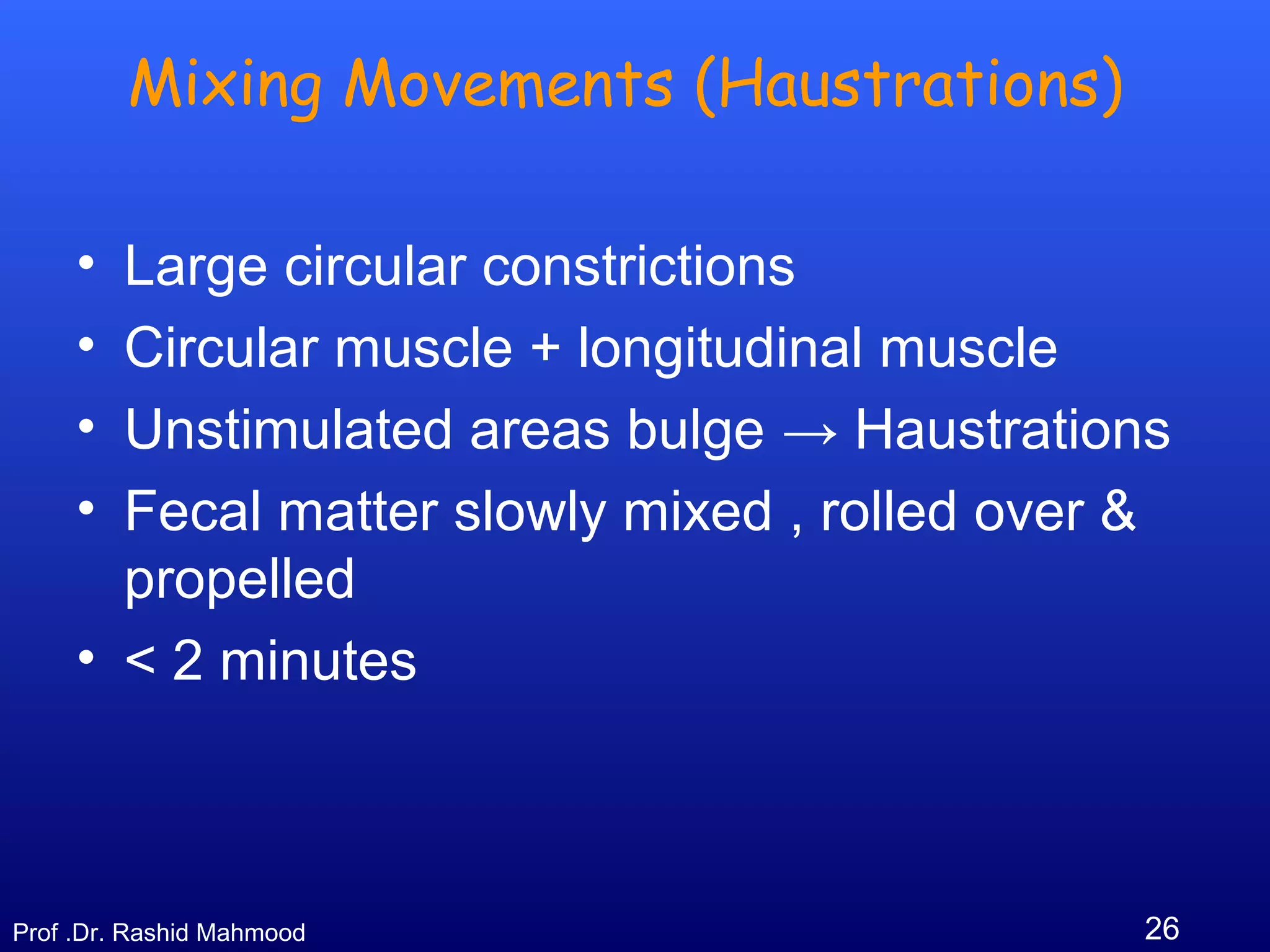
Mixing Movements (Haustrations)
• Large circular constrictions
• Circular muscle + longitudinal muscle
• Unstimulated areas bulge → Haustrations
• Fecal matter slowly mixed , rolled over &
propelled
• < 2 minutes
27Prof .Dr. Rashid Mahmood
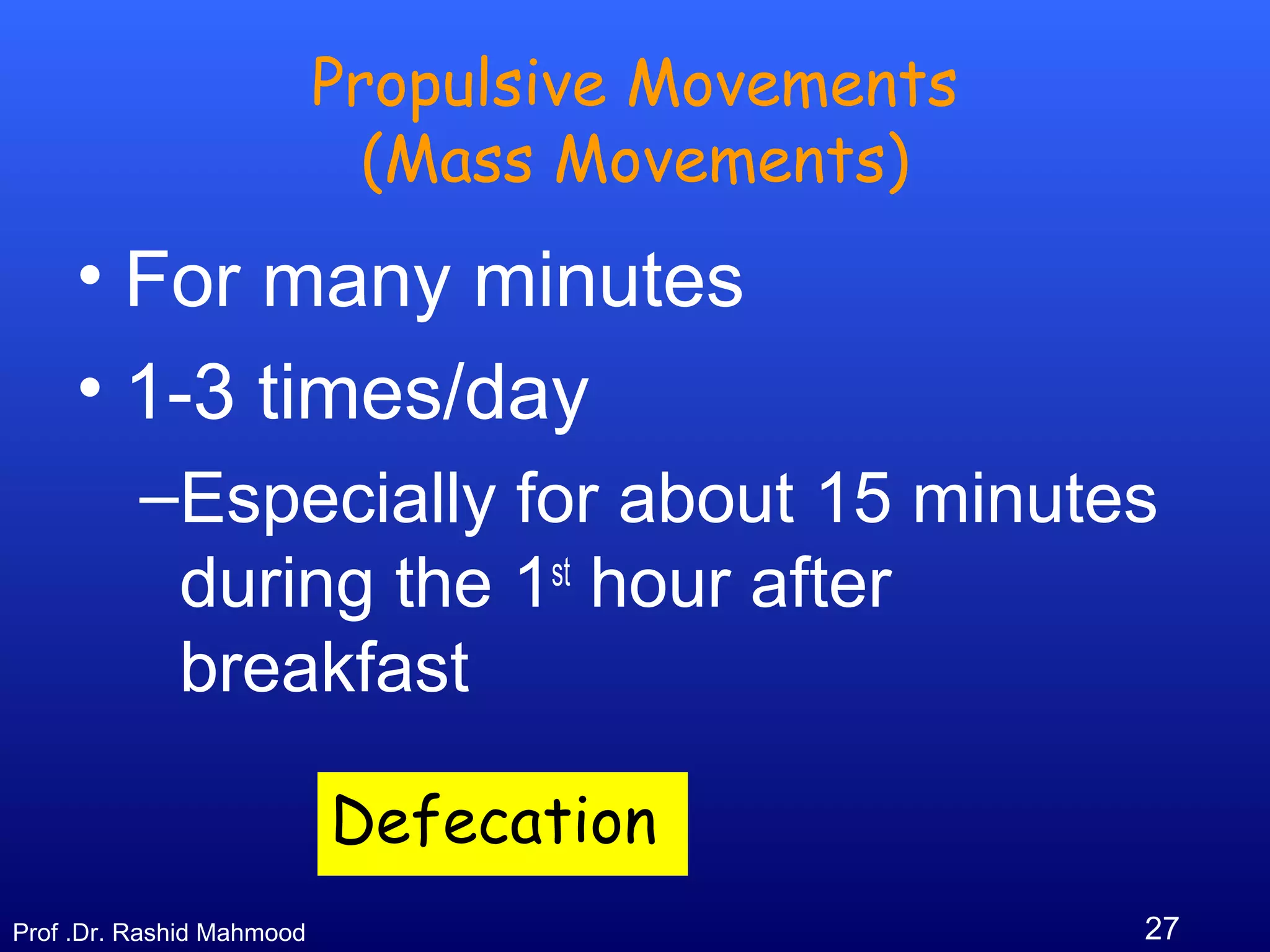
Propulsive Movements
(Mass Movements)
• For many minutes
• 1-3 times/day
–Especially for about 15 minutes
during the 1st
hour after
breakfast
Defecation
28Prof .Dr. Rashid Mahmood
Assessment Question 4
• Distinguish between Segmentation and
Haustrations
29Prof .Dr. Rashid Mahmood
Summary
• Movements of Small Intestine are of TWO Types: Mixing (Segmentation)
Contractions and Propulsive (Peristalsis)
• Nervous Factors that Control of Peristalsis of Small Intestine include
Gastroenteric reflex, Gastroileal reflex & some other reflexes
• These reflexes are controlled by Myenteric plexus, and also by Autonomic
nervous system
• Hormones that increase the motility of Small Intestine include Gastrin
and CCK, while Secretin decreases the motility of Small Intestine
• Ileocecal valve prevents backflow of chyme from cecum to ileum
• Ileocecal sphincter allows controlled emptying at Ileocecal valve
• Feedback control of Ileocecal sphincter is by Reflexes from ileum, stomach
and cecum
• Movements of Colon are also of TWO types: Mixing Movements
(Haustrations), and Propulsive Movements (Mass Movements)
30Prof .Dr. Rashid Mahmood
Learning Resources
1. Guyton and Hall (Text book of physiology), 13th
Edition
2. Ganong (Text book of physiology), 24th Edition
3. Berne & Levy Principles of Physiology (Koeppen
BM), 6th Edition
4. Human Physiology Stuart Ira Fox, 13th Edition
5. Human Physiology : from cells to system Lauralee
Sherwood, 9th Edition
6. Internet
31Prof .Dr. Rashid Mahmood
Next topic
• Pancreatic secretion: Regulation & phases
• Prior knowledge required for next lecture
– Physiological Anatomy of Pancreas
– Composition of Pancreatic secretions
– Hormones of GIT
– Autonomic control of GIT

Movements of small and large intestine

  • 1.
    1Prof .Dr. RashidMahmood Movements of small & large intestine A 35 year old female was operated for acute appendicitis. She was advised not to take anything by mouth till further advice by the surgeon. Six hours after surgery she inquired the doctor on duty that whether she can now start taking orally or not. The doctor examined her bowl sounds. He could not listen the bowl sounds and advised her to wait for another few hours. •What is the name of this condition? •Why does the motility of intestine decrease after abdominal surgery? •How the condition can be relieved if the movements of small intestine do not recur in more than 10 hours?
  • 2.
    2Prof .Dr. RashidMahmood Objectives Goal /Aim • By the end of this session the student should be able to describe the mechanism, types and functions of the motility of small and large intestine. Specific objectives By the end of this session the student should be able to • Enlist the types of movements of small and large intestine • Define the factors that control motility of small and large intestine • Describe how chyme is transported from pylorus to anus • Distinguish between Segmentation and Haustrations • Explain Function and Feedback control of Ileocecal valve and Ileocecal sphincter
  • 3.
    3Prof .Dr. RashidMahmood Lesson contents • Movements of Small Intestine • Mixing (Segmentation Contractions) • Progression of segmentation contractions • Peristalsis (Propulsive Movements) • Movements of Muscularis Mucosa • Contraction of villi • Control of Peristalsis of Small Intestine • Ileocecal valve and Ileocecal sphincter • Function • Feedback control • Emptying at Ileocecal valve • Movements of Colon • Mixing Movements (Haustrations) • Propulsive Movements (Mass Movements)
  • 4.
    4Prof .Dr. RashidMahmood Movements of small intestine
  • 5.
    5Prof .Dr. RashidMahmood Movements of Small Intestine 1. Mixing (Segmentation Contractions) 2. Propulsive (Peristalsis) Overlap 1. Movements of Muscularis Mucosa Folds ↑ surface area 1. Contraction of villi “milk” the villi ↑ lymph flow
  • 6.
    6Prof .Dr. RashidMahmood Mixing Contractions (Segmentation Contractions)
  • 7.
    7Prof .Dr. RashidMahmood Mixing Contractions (Segmentation Contractions) • Stimulus: Stretching • Receptors: Nerve endings of enteric nervous system • Response: localized concentric contractions  Spaced at intervals  Fraction of a minute  “Chop” 2-3 times per minute  Maximum frequency= 12/minute  Frequency depends on frequency of Electrical slow waves • Integration area: Myenteric nerve plexus + extrinsic control • Propulsive effect
  • 8.
    8Prof .Dr. RashidMahmood Progression of segmentation contractions
  • 9.
    9Prof .Dr. RashidMahmood Propulsive Movements • Peristalsis • Any part • Towards Anus • Velocity: 0.5-2 cm/minute • Net movement: 1 cm/min • 3-5 hours from pylorus to ileocecal valve • Function: – Progression – Spread of chyme along mucosa • Peristaltic Rush – Irritation – Diarrhea
  • 10.
    10Prof .Dr. RashidMahmood Assessment Question 1 • List the different types of movements in small Intestine.
  • 11.
    11Prof .Dr. RashidMahmood Control of Peristalsis of Small Intestine 1. Nervous Factors 2. Hormonal Factors
  • 12.
    12Prof .Dr. RashidMahmood Control of Peristalsis of Small Intestine Nervous Factors 1. Entry of meal in duodenum • Stretch 1. Gastroenteric reflex • Distension of stomach • Myenteric plexus – Blocked at ileocecal valve till another food → Gastroileal reflex 1. Movements of Muscularis Mucosa and Contraction of villi are controlled by submucosal plexus
  • 13.
    13Prof .Dr. RashidMahmood Control of Peristalsis of Small Intestine Hormonal Factors ↑ motility • Gastrin • CCK • Insulin • Motilin • Serotonin ↓ motility • Secretin • Glucagon
  • 14.
    14Prof .Dr. RashidMahmood Assessment Question 2 • Fill in the blanks; • Law of gut= ___________ + _________
  • 15.
    15Prof .Dr. RashidMahmood Next: Ileocecal valve
  • 16.
    16Prof .Dr. RashidMahmood Ileocecal valve and Ileocecal sphincter • Function – Prevent backflow – Controlled passage – ↑ time for reabsorption in ileum • 1500-2000 ml of chyme /day into cecum • Feedback control – Reflexes from ileum – Myenteric plexus + autonomic nerves – Inflamed appendix
  • 17.
    17Prof .Dr. RashidMahmood Emptying at Ileocecal valve Excitatory factors Inhibitory factors
  • 18.
    18Prof .Dr. RashidMahmood Control of ileocecal valve/sphincter Excitatory factors Inhibitory factors
  • 19.
    19Prof .Dr. RashidMahmood Assessment Question 3 • List the factors that increase emptying at Ileo-cecal valve.
  • 20.
    20Prof .Dr. RashidMahmood Next: movements of large intestine
  • 21.
    21Prof .Dr. RashidMahmood Large Intestine Anatomy Teniae coli are bands of longitudinal muscle along the length of the colon
  • 22.
  • 23.
    23Prof .Dr. RashidMahmood Radiograph of large intestine after barium enema
  • 24.
    24Prof .Dr. RashidMahmood Movements of Colon • Mixing Movements (Haustrations) – Proximal half • Propulsive Movements (Mass Movements) – Distal half • Functions of colon: – Absorption – Storage of fecal matter
  • 25.
  • 26.
    26Prof .Dr. RashidMahmood Mixing Movements (Haustrations) • Large circular constrictions • Circular muscle + longitudinal muscle • Unstimulated areas bulge → Haustrations • Fecal matter slowly mixed , rolled over & propelled • < 2 minutes
  • 27.
    27Prof .Dr. RashidMahmood Propulsive Movements (Mass Movements) • For many minutes • 1-3 times/day –Especially for about 15 minutes during the 1st hour after breakfast Defecation
  • 28.
    28Prof .Dr. RashidMahmood Assessment Question 4 • Distinguish between Segmentation and Haustrations
  • 29.
    29Prof .Dr. RashidMahmood Summary • Movements of Small Intestine are of TWO Types: Mixing (Segmentation) Contractions and Propulsive (Peristalsis) • Nervous Factors that Control of Peristalsis of Small Intestine include Gastroenteric reflex, Gastroileal reflex & some other reflexes • These reflexes are controlled by Myenteric plexus, and also by Autonomic nervous system • Hormones that increase the motility of Small Intestine include Gastrin and CCK, while Secretin decreases the motility of Small Intestine • Ileocecal valve prevents backflow of chyme from cecum to ileum • Ileocecal sphincter allows controlled emptying at Ileocecal valve • Feedback control of Ileocecal sphincter is by Reflexes from ileum, stomach and cecum • Movements of Colon are also of TWO types: Mixing Movements (Haustrations), and Propulsive Movements (Mass Movements)
  • 30.
    30Prof .Dr. RashidMahmood Learning Resources 1. Guyton and Hall (Text book of physiology), 13th Edition 2. Ganong (Text book of physiology), 24th Edition 3. Berne & Levy Principles of Physiology (Koeppen BM), 6th Edition 4. Human Physiology Stuart Ira Fox, 13th Edition 5. Human Physiology : from cells to system Lauralee Sherwood, 9th Edition 6. Internet
  • 31.
    31Prof .Dr. RashidMahmood Next topic • Pancreatic secretion: Regulation & phases • Prior knowledge required for next lecture – Physiological Anatomy of Pancreas – Composition of Pancreatic secretions – Hormones of GIT – Autonomic control of GIT

Editor's Notes

  • #2 Paralytic Ileus (Adynamic Ileus) When the intestines are traumatized, there is a direct inhibition of smooth muscle. It is due in part to activation of opioid receptors. When the peritoneum is irritated, reflex inhibition occurs due to increased discharge of noradrenergic fibers in the splanchnic nerves. By passing a tube the nose down to the small intestine and aspirating the fluid and gas until peristalsis returns.
  • #11 1. Mixing (Segmentation Contractions) 2. Propulsive (Peristalsis) 3. Movements of Muscularis Mucosa 4. Contraction of villi
  • #15 Myenteric Reflex (Peristaltic reflex) = anal direction of movement of peristalsis According to Bayliss and Starling: “If cerebral reflexes be excluded, excitation at any point of the gut excites contraction above, inhibition below. This is the Law of the Intestine Myenteric Reflex (Peristaltic reflex) = anal direction of movement of peristalsis  instead of (=) , (+) should be written in the note of assessment 2.
  • #20 Pressure (Distension ) at terminal Ileum Chemical irritation of terminal Ileum Gastrin Gastro-ileal reflex
  • #29 Segmentation are mixing contractions of small intestine Fraction of a minute “Chop” 2-3 times per minute Maximum frequency= 12/minute Haustrations are mixing contractions of large intestine Large circular constrictions Fecal matter slowly mixed , rolled over &amp; propelled &amp;lt; 2 minutes