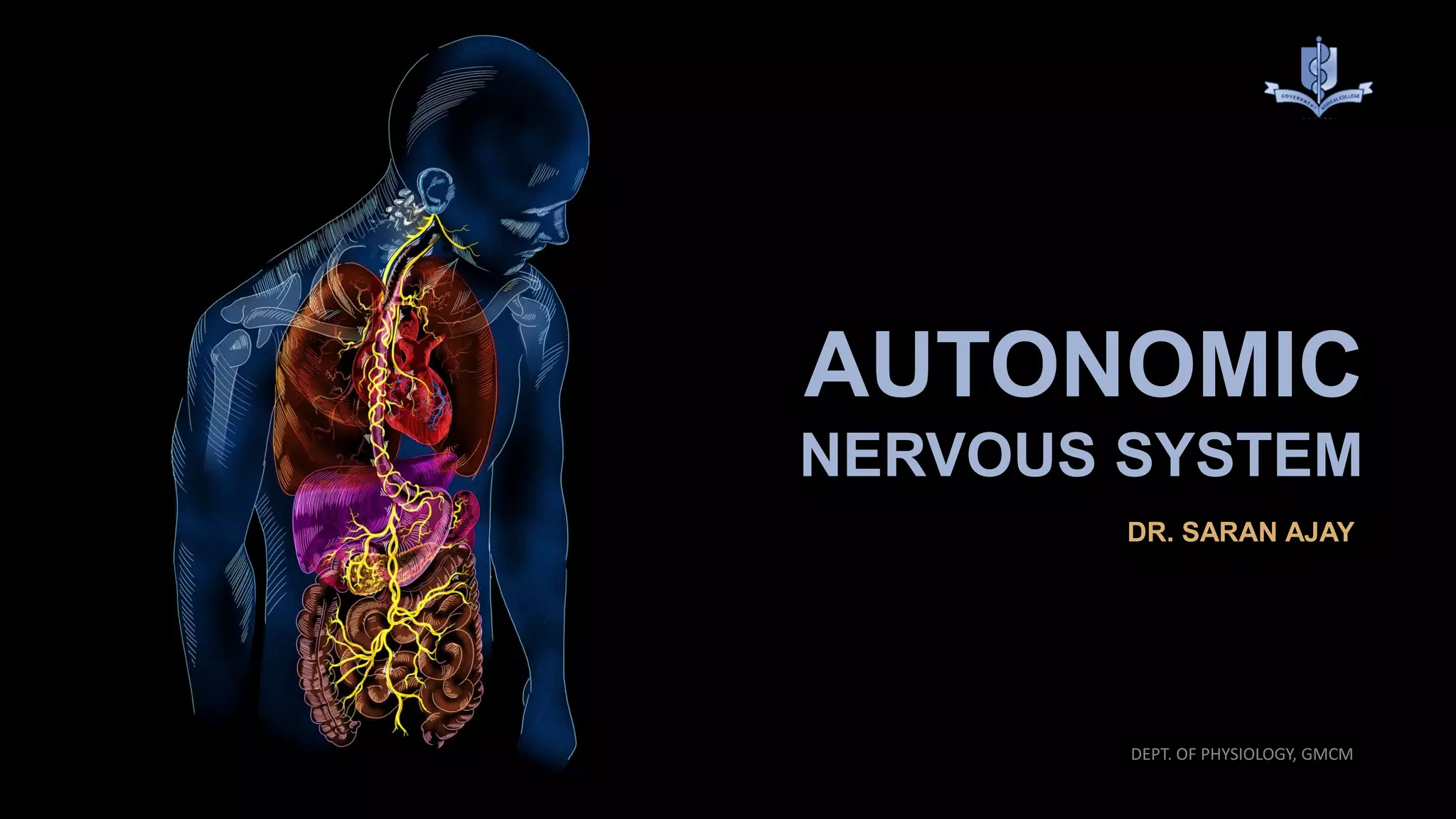
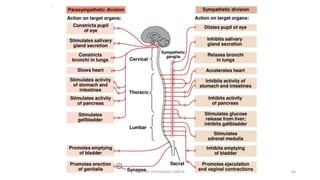
AUTONOMIC
NERVOUS SYSTEM
DR. SARAN AJAY
DEPT. OF PHYSIOLOGY, GMCM
3
DEPT. OF PHYSIOLOGY, GMCM 4
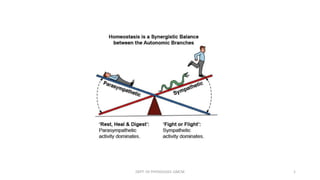
Complementary, my dear Watson!
DEPT. OF PHYSIOLOGY, GMCM 1
Autonomic system makes involuntary fine tuning
adjustments to your body according to the signals your
CNS is picking up.
DEPT. OF PHYSIOLOGY, GMCM 6
DEPT. OF PHYSIOLOGY, GMCM 7
Specific Learning Objectives
• Introduction to ANS
• General Organisation of ANS
• Sympathetic System
• Parasympathetic System
• Neurotransmitters and Receptors in ANS
• Responses of various organs to autonomic nerve impulses
• Drugs acting on ANS
• Applied Physiology
• Summary
DEPT. OF PHYSIOLOGY, GMCM
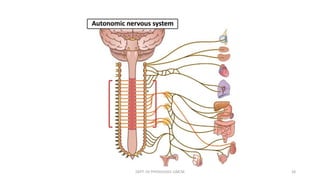
Autonomic Nervous System
• Controls visceral functions.
• Maintains homeostasis.
• Rapidity and Intensity
Autonomic (adj) /ɔːtəˈnɒmɪk/
self governing, functionally independent
DEPT. OF PHYSIOLOGY, GMCM 8
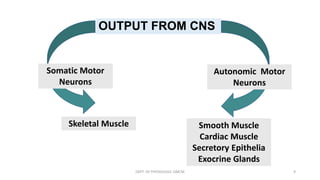
OUTPUT FROM CNS
Somatic Motor
Neurons
Skeletal Muscle
Autonomic Motor
Neurons
Smooth Muscle
Cardiac Muscle
Secretory Epithelia
Exocrine Glands
DEPT. OF PHYSIOLOGY, GMCM 9
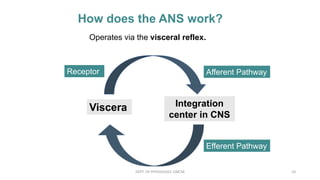
How does the ANS work?
Operates via the visceral reflex.
Viscera Integration
center in CNS
Receptor Afferent Pathway
Efferent Pathway
DEPT. OF PHYSIOLOGY, GMCM 10
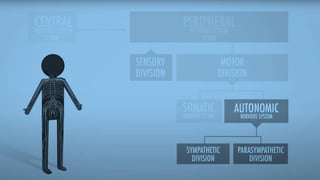
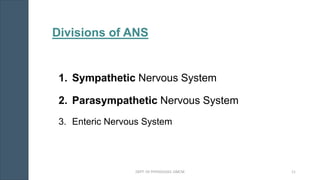
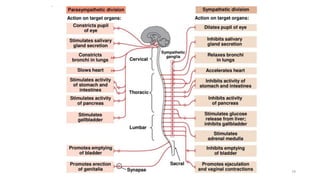
Divisions of ANS
1. Sympathetic Nervous System
2. Parasympathetic Nervous System
3. Enteric Nervous System
DEPT. OF PHYSIOLOGY, GMCM 11
DEPT. OF PHYSIOLOGY, GMCM 12
Specific Learning Objectives
• Introduction to ANS
• General Organisation of ANS
• Sympathetic System
• Parasympathetic System
• Neurotransmitters and Receptors in ANS
• Responses of various organs to autonomic nerve impulses
• Drugs acting on ANS
• Applied Physiology
• Summary
DEPT. OF PHYSIOLOGY, GMCM
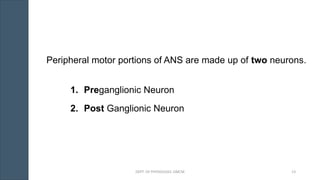
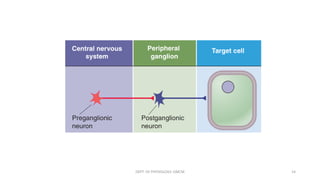
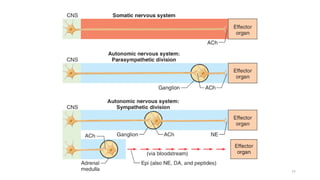
Peripheral motor portions of ANS are made up of two neurons.
1. Preganglionic Neuron
2. Post Ganglionic Neuron
DEPT. OF PHYSIOLOGY, GMCM 13
DEPT. OF PHYSIOLOGY, GMCM 14
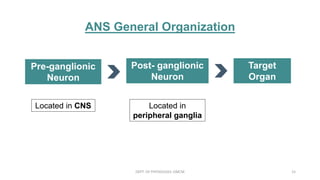
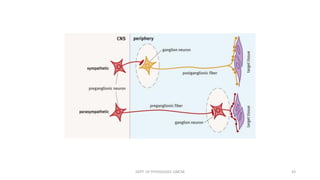
ANS General Organization
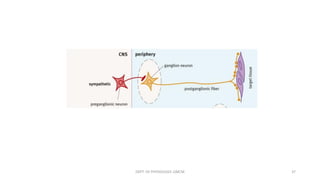
Pre-ganglionic
Neuron
Post- ganglionic
Neuron
Target
Organ
Located in CNS Located in
peripheral ganglia
DEPT. OF PHYSIOLOGY, GMCM 15
Sympathetic and Parasympathetic system innervate target
tissues by two synapse pathway.
DEPT. OF PHYSIOLOGY, GMCM 16
DEPT. OF PHYSIOLOGY, GMCM 17
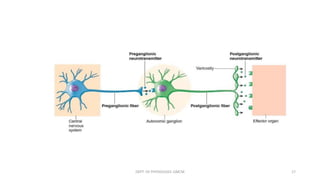
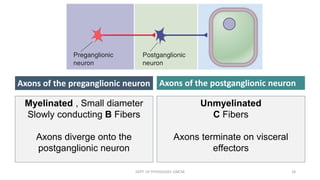
Axons of the preganglionic neuron Axons of the postganglionic neuron
Myelinated , Small diameter
Slowly conducting B Fibers
Axons diverge onto the
postganglionic neuron
Unmyelinated
C Fibers
Axons terminate on visceral
effectors
DEPT. OF PHYSIOLOGY, GMCM 18
DEPT. OF PHYSIOLOGY, GMCM 19
Specific Learning Objectives
• Introduction to ANS
• General Organisation of ANS
• Sympathetic System
• Parasympathetic System
• Neurotransmitters and Receptors in ANS
• Responses of various organs to autonomic nerve impulses
• Drugs acting on ANS
• Applied Physiology
• Summary
DEPT. OF PHYSIOLOGY, GMCM
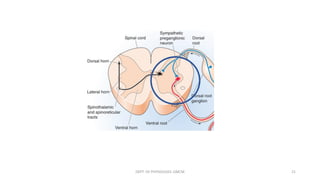
Sympathetic Nervous System
• Cell bodies of the preganglionic neurons are in the
spinal cord.
• Intermediolateral column/ lateral horn
DEPT. OF PHYSIOLOGY, GMCM 20
DEPT. OF PHYSIOLOGY, GMCM 21
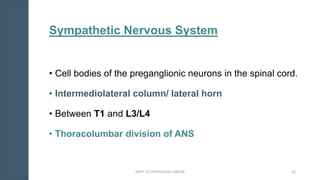
Sympathetic Nervous System
• Cell bodies of the preganglionic neurons in the spinal cord.
• Intermediolateral column/ lateral horn
• Between T1 and L3/L4
• Thoracolumbar division of ANS
DEPT. OF PHYSIOLOGY, GMCM 22
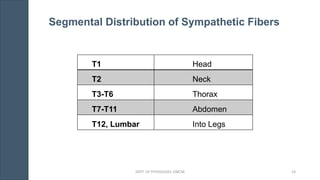
Segmental Distribution of Sympathetic Fibers
T1 Head
T2 Neck
T3-T6 Thorax
T7-T11 Abdomen
T12, Lumbar Into Legs
DEPT. OF PHYSIOLOGY, GMCM 23
24
Sensory
afferent
Prevertebral
Ganglion
25
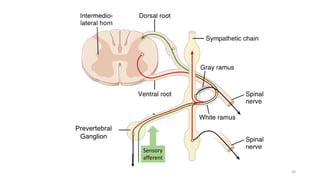
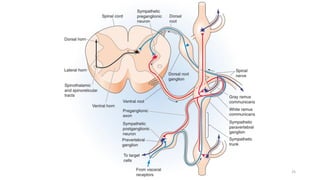
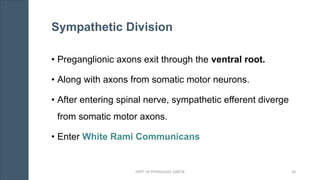
Sympathetic Division
• Preganglionic axons exit through the ventral root.
• Along with axons from somatic motor neurons.
• After entering spinal nerve, sympathetic efferent diverge
from somatic motor axons.
• Enter White Rami Communicans
DEPT. OF PHYSIOLOGY, GMCM 26
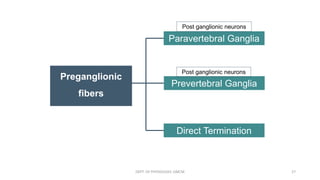
Preganglionic
fibers
Paravertebral Ganglia
Prevertebral Ganglia
Direct Termination
Post ganglionic neurons
DEPT. OF PHYSIOLOGY, GMCM 27
DEPT. OF PHYSIOLOGY, GMCM 28
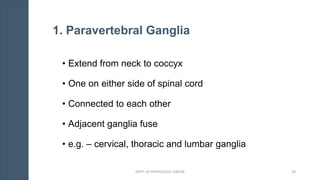
1. Paravertebral Ganglia
• Extend from neck to coccyx
• One on either side of spinal cord
• Connected to each other
• Adjacent ganglia fuse
• e.g. – cervical, thoracic and lumbar ganglia
DEPT. OF PHYSIOLOGY, GMCM 29
In paravertebral ganglia, axons of preganglionic neurons
1. Synapse within same segmental paravertebral ganglia
2. Synapse within neighboring paravertebral ganglia
DEPT. OF PHYSIOLOGY, GMCM 30
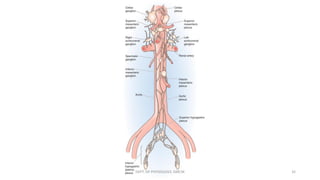
2. Prevertebral Ganglia
• Lies in front of aorta and its major branches
DEPT. OF PHYSIOLOGY, GMCM 31
DEPT. OF PHYSIOLOGY, GMCM 32
2. Prevertebral Ganglia
• Lies in front of aorta and its major branches
3. Terminate directly
• On effector organ – adrenal gland
• Postganglionic cell are secretory
DEPT. OF PHYSIOLOGY, GMCM 33
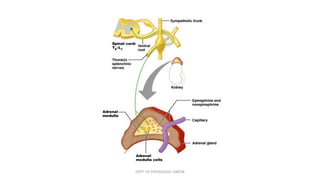
• Preganglionic sympathetic fibers without synapsing reach
adrenal medulla.
• The preganglionic fibres end on the secretory cells in
adrenal medulla
• The cells in adrenal medulla is postganglionic neurons
that lost their axon to become secretory cells.
DEPT. OF PHYSIOLOGY, GMCM 34
DEPT. OF PHYSIOLOGY, GMCM
Axons of post ganglionic neurons leave the chain ganglia
• Re-enter spinal nerve via gray rami communicans
• Distributed to effectors in areas supplied by spinal nerves
• To smooth muscles, sweat glands
• Enter thoracic cavity
• Terminate on visceral organs
• Fibers from prevertebral ganglia terminate in visceral targets
1
2
3
DEPT. OF PHYSIOLOGY, GMCM 36
DEPT. OF PHYSIOLOGY, GMCM 37
DEPT. OF PHYSIOLOGY, GMCM 38
Specific Learning Objectives
• Introduction to ANS
• General Organisation of ANS
• Sympathetic System
• Parasympathetic System
• Neurotransmitters and Receptors in ANS
• Responses of various organs to autonomic nerve impulses
• Drugs acting on ANS
• Applied Physiology
• Summary
DEPT. OF PHYSIOLOGY, GMCM
Parasympathetic Nervous System
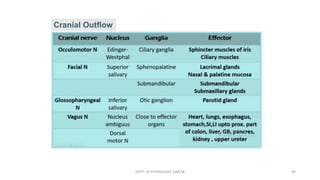
• Preganglionic Neurons are located in
1. Cranial Nerve Nuclei III, VII, IX and X
2. IML of the sacral spinal cord
• Craniosacral outflow
DEPT. OF PHYSIOLOGY, GMCM 39
Cranial Outflow
DEPT. OF PHYSIOLOGY, GMCM 40
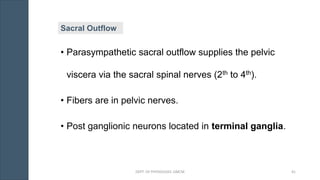
• Parasympathetic sacral outflow supplies the pelvic
viscera via the sacral spinal nerves (2th to 4th).
• Fibers are in pelvic nerves.
• Post ganglionic neurons located in terminal ganglia.
Sacral Outflow
DEPT. OF PHYSIOLOGY, GMCM 41
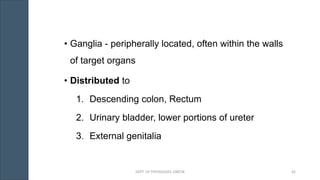
• Ganglia - peripherally located, often within the walls
of target organs
• Distributed to
1. Descending colon, Rectum
2. Urinary bladder, lower portions of ureter
3. External genitalia
DEPT. OF PHYSIOLOGY, GMCM 42
DEPT. OF PHYSIOLOGY, GMCM 43
DEPT. OF PHYSIOLOGY, GMCM 44
Specific Learning Objectives
• Introduction to ANS
• General Organisation of ANS
• Sympathetic System
• Parasympathetic System
• Neurotransmitters and Receptors in ANS
• Responses of various organs to autonomic nerve impulses
• Drugs acting on ANS
• Applied Physiology
• Summary
DEPT. OF PHYSIOLOGY, GMCM
DEPT. OF PHYSIOLOGY, GMCM 45
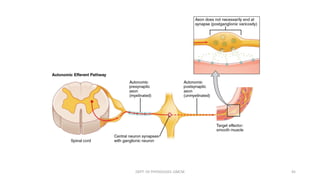
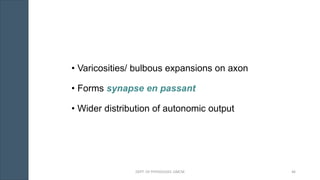
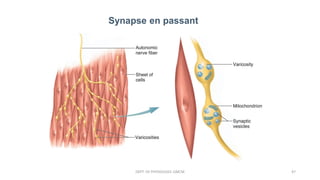
• Varicosities/ bulbous expansions on axon
• Forms synapse en passant
• Wider distribution of autonomic output
DEPT. OF PHYSIOLOGY, GMCM 46
Synapse en passant
DEPT. OF PHYSIOLOGY, GMCM 47
Neurotransmitters and Receptors in ANS
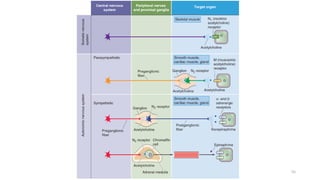
• The principal transmitters are Acetylcholine (Ach) and
Norepinephrine (NE).
DEPT. OF PHYSIOLOGY, GMCM 48
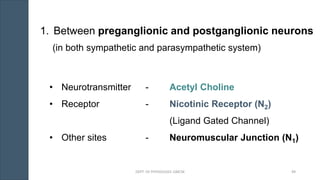
1. Between preganglionic and postganglionic neurons
(in both sympathetic and parasympathetic system)
• Neurotransmitter - Acetyl Choline
• Receptor - Nicotinic Receptor (N2)
(Ligand Gated Channel)
• Other sites - Neuromuscular Junction (N1)
DEPT. OF PHYSIOLOGY, GMCM 49
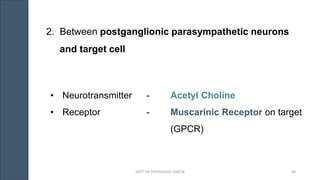
2. Between postganglionic parasympathetic neurons
and target cell
• Neurotransmitter - Acetyl Choline
• Receptor - Muscarinic Receptor on target
(GPCR)
DEPT. OF PHYSIOLOGY, GMCM 50
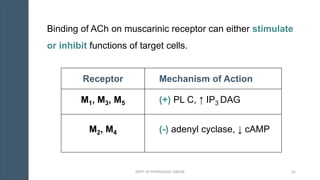
Binding of ACh on muscarinic receptor can either stimulate
or inhibit functions of target cells.
Receptor Mechanism of Action
M1, M3, M5 (+) PL C, ↑ IP3 DAG
M2, M4 (-) adenyl cyclase, ↓ cAMP
DEPT. OF PHYSIOLOGY, GMCM 51
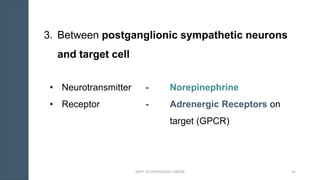
3. Between postganglionic sympathetic neurons
and target cell
• Neurotransmitter - Norepinephrine
• Receptor - Adrenergic Receptors on
target (GPCR)
DEPT. OF PHYSIOLOGY, GMCM 52
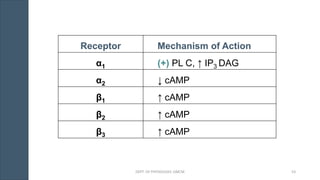
Receptor Mechanism of Action
α1 (+) PL C, ↑ IP3 DAG
α2 ↓ cAMP
β1 ↑ cAMP
β2 ↑ cAMP
β3 ↑ cAMP
DEPT. OF PHYSIOLOGY, GMCM 53
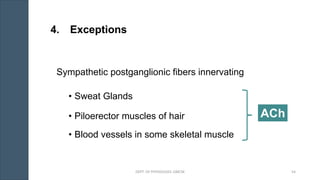
4. Exceptions
Sympathetic postganglionic fibers innervating
• Sweat Glands
• Piloerector muscles of hair
• Blood vessels in some skeletal muscle
ACh
DEPT. OF PHYSIOLOGY, GMCM 54
55
DEPT. OF PHYSIOLOGY, GMCM 56
Specific Learning Objectives
• Introduction to ANS
• General Organisation of ANS
• Sympathetic System
• Parasympathetic System
• Neurotransmitters and Receptors in ANS
• Responses of various organs to autonomic nerve impulses
• Drugs acting on ANS
• Applied Physiology
• Summary
DEPT. OF PHYSIOLOGY, GMCM
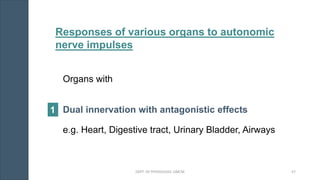
Organs with
Dual innervation with antagonistic effects
e.g. Heart, Digestive tract, Urinary Bladder, Airways
Responses of various organs to autonomic
nerve impulses
1
DEPT. OF PHYSIOLOGY, GMCM 57
Complementary Sympathetic and Parasympathetic
Action
e.g. Salivary glands
2 Divisions act synergistically/ in cooperative manner
e.g. Control of pupil diameter, control of sexual function
2
3
DEPT. OF PHYSIOLOGY, GMCM 58
Organs innervated by only one division
e.g. Adrenal gland, most blood vessels, piloerector
muscles in skin, sweat glands – only sympathetic
supply
Lacrimal muscle, ciliary muscle and sublingual
salivary glands – only parasympathetic supply
4
DEPT. OF PHYSIOLOGY, GMCM 59
Sympathetic output can be
1. Selective for a specific target organ
2. Massive and non specific (fight or flight response)
Sympathetic Response
DEPT. OF PHYSIOLOGY, GMCM 60
Fight or Flight Response
• Walter B Cannon
• Fear, Stress etc. → massive output + PS activity ceases
• ↑ HR, BP, pupil dilation etc.
• Mechanism of survival
• Catabolic NS
DEPT. OF PHYSIOLOGY, GMCM 61
• Concerned with vegetative aspects of day to day living.
• Anabolic NS
Parasympathetic Response
DEPT. OF PHYSIOLOGY, GMCM 62
DEPT. OF PHYSIOLOGY, GMCM 63
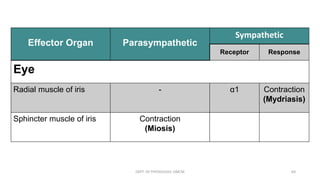
Effector Organ Parasympathetic
Sympathetic
Receptor Response
Eye
Radial muscle of iris - α1 Contraction
(Mydriasis)
Sphincter muscle of iris Contraction
(Miosis)
DEPT. OF PHYSIOLOGY, GMCM 64
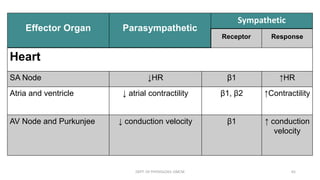
Effector Organ Parasympathetic
Sympathetic
Receptor Response
Heart
SA Node ↓HR β1 ↑HR
Atria and ventricle ↓ atrial contractility β1, β2 ↑Contractility
AV Node and Purkunjee ↓ conduction velocity β1 ↑ conduction
velocity
DEPT. OF PHYSIOLOGY, GMCM 65
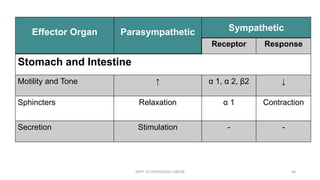
Effector Organ Parasympathetic Sympathetic
Receptor Response
Stomach and Intestine
Motility and Tone ↑ α 1, α 2, β2 ↓
Sphincters Relaxation α 1 Contraction
Secretion Stimulation - -
DEPT. OF PHYSIOLOGY, GMCM 66
Effector Organ Parasympathetic
Sympathetic
Receptor Response
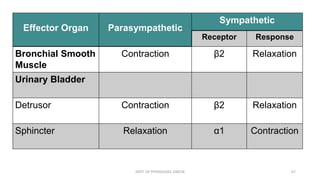
Bronchial Smooth
Muscle
Contraction β2 Relaxation
Urinary Bladder
Detrusor Contraction β2 Relaxation
Sphincter Relaxation α1 Contraction
DEPT. OF PHYSIOLOGY, GMCM 67
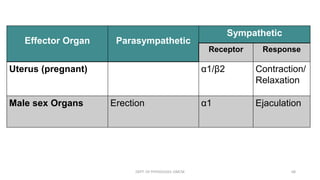
Effector Organ Parasympathetic
Sympathetic
Receptor Response
Uterus (pregnant) α1/β2 Contraction/
Relaxation
Male sex Organs Erection α1 Ejaculation
DEPT. OF PHYSIOLOGY, GMCM 68
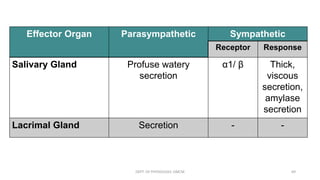
Effector Organ Parasympathetic Sympathetic
Receptor Response
Salivary Gland Profuse watery
secretion
α1/ β Thick,
viscous
secretion,
amylase
secretion
Lacrimal Gland Secretion - -
DEPT. OF PHYSIOLOGY, GMCM 69
DEPT. OF PHYSIOLOGY, GMCM 70
Specific Learning Objectives
• Introduction to ANS
• General Organisation of ANS
• Sympathetic System
• Parasympathetic System
• Neurotransmitters and Receptors in ANS
• Responses of various organs to autonomic nerve impulses
• Drugs acting on ANS
• Applied Physiology
• Summary
DEPT. OF PHYSIOLOGY, GMCM
1. Sympathomimetic drugs
• Stimulate specific adrenergic receptors
• e.g. Phenylephrine, Isoproterenol, Albuterol
Drugs acting on ANS
DEPT. OF PHYSIOLOGY, GMCM 71
2. Parasympathomimetic drugs
• e.g. Pilocarpine, Methacholine
DEPT. OF PHYSIOLOGY, GMCM 72
DEPT. OF PHYSIOLOGY, GMCM 73
Specific Learning Objectives
• Introduction to ANS
• General Organisation of ANS
• Sympathetic System
• Parasympathetic System
• Neurotransmitters and Receptors in ANS
• Responses of various organs to autonomic nerve impulses
• Drugs acting on ANS
• Applied Physiology
• Summary
DEPT. OF PHYSIOLOGY, GMCM
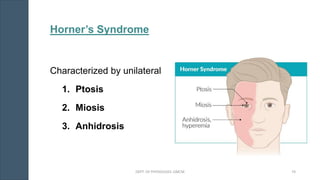
Horner’s Syndrome
Characterized by unilateral
1. Ptosis
2. Miosis
3. Anhidrosis
DEPT. OF PHYSIOLOGY, GMCM 74
• Loss of sympathetic innervation on one side of the face
• Causes
1. Malignancy of cervical Lymph Nodes
2. Pancoast Tumor
DEPT. OF PHYSIOLOGY, GMCM 75
DEPT. OF PHYSIOLOGY, GMCM 76
Specific Learning Objectives
• Introduction to ANS
• General Organisation of ANS
• Sympathetic System
• Parasympathetic System
• Neurotransmitters and Receptors in ANS
• Responses of various organs to autonomic nerve impulses
• Drugs acting on ANS
• Applied Physiology
• Summary
DEPT. OF PHYSIOLOGY, GMCM
77
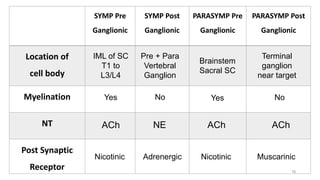
SYMP Pre
Ganglionic
SYMP Post
Ganglionic
PARASYMP Pre
Ganglionic
PARASYMP Post
Ganglionic
Location of
cell body
Myelination
NT
Post Synaptic
Receptor
IML of SC
T1 to
L3/L4
Pre + Para
Vertebral
Ganglion
Brainstem
Sacral SC
Terminal
ganglion
near target
Yes Yes
No No
ACh ACh ACh
NE
Nicotinic Nicotinic
Adrenergic Muscarinic
78
79
saran.adhoc@gmail.com
DEPT. OF PHYSIOLOGY, GMCM 80

Autonomic Nervous System

  • 1.
    AUTONOMIC NERVOUS SYSTEM DR. SARANAJAY DEPT. OF PHYSIOLOGY, GMCM
  • 2.
  • 3.
    DEPT. OF PHYSIOLOGY,GMCM 4 Complementary, my dear Watson!
  • 4.
  • 5.
    Autonomic system makesinvoluntary fine tuning adjustments to your body according to the signals your CNS is picking up. DEPT. OF PHYSIOLOGY, GMCM 6
  • 6.
    DEPT. OF PHYSIOLOGY,GMCM 7 Specific Learning Objectives • Introduction to ANS • General Organisation of ANS • Sympathetic System • Parasympathetic System • Neurotransmitters and Receptors in ANS • Responses of various organs to autonomic nerve impulses • Drugs acting on ANS • Applied Physiology • Summary DEPT. OF PHYSIOLOGY, GMCM
  • 7.
    Autonomic Nervous System •Controls visceral functions. • Maintains homeostasis. • Rapidity and Intensity Autonomic (adj) /ɔːtəˈnɒmɪk/ self governing, functionally independent DEPT. OF PHYSIOLOGY, GMCM 8
  • 8.
    OUTPUT FROM CNS SomaticMotor Neurons Skeletal Muscle Autonomic Motor Neurons Smooth Muscle Cardiac Muscle Secretory Epithelia Exocrine Glands DEPT. OF PHYSIOLOGY, GMCM 9
  • 9.
    How does theANS work? Operates via the visceral reflex. Viscera Integration center in CNS Receptor Afferent Pathway Efferent Pathway DEPT. OF PHYSIOLOGY, GMCM 10
  • 10.
    Divisions of ANS 1.Sympathetic Nervous System 2. Parasympathetic Nervous System 3. Enteric Nervous System DEPT. OF PHYSIOLOGY, GMCM 11
  • 11.
    DEPT. OF PHYSIOLOGY,GMCM 12 Specific Learning Objectives • Introduction to ANS • General Organisation of ANS • Sympathetic System • Parasympathetic System • Neurotransmitters and Receptors in ANS • Responses of various organs to autonomic nerve impulses • Drugs acting on ANS • Applied Physiology • Summary DEPT. OF PHYSIOLOGY, GMCM
  • 12.
    Peripheral motor portionsof ANS are made up of two neurons. 1. Preganglionic Neuron 2. Post Ganglionic Neuron DEPT. OF PHYSIOLOGY, GMCM 13
  • 13.
  • 14.
    ANS General Organization Pre-ganglionic Neuron Post-ganglionic Neuron Target Organ Located in CNS Located in peripheral ganglia DEPT. OF PHYSIOLOGY, GMCM 15
  • 15.
    Sympathetic and Parasympatheticsystem innervate target tissues by two synapse pathway. DEPT. OF PHYSIOLOGY, GMCM 16
  • 16.
  • 17.
    Axons of thepreganglionic neuron Axons of the postganglionic neuron Myelinated , Small diameter Slowly conducting B Fibers Axons diverge onto the postganglionic neuron Unmyelinated C Fibers Axons terminate on visceral effectors DEPT. OF PHYSIOLOGY, GMCM 18
  • 18.
    DEPT. OF PHYSIOLOGY,GMCM 19 Specific Learning Objectives • Introduction to ANS • General Organisation of ANS • Sympathetic System • Parasympathetic System • Neurotransmitters and Receptors in ANS • Responses of various organs to autonomic nerve impulses • Drugs acting on ANS • Applied Physiology • Summary DEPT. OF PHYSIOLOGY, GMCM
  • 19.
    Sympathetic Nervous System •Cell bodies of the preganglionic neurons are in the spinal cord. • Intermediolateral column/ lateral horn DEPT. OF PHYSIOLOGY, GMCM 20
  • 20.
  • 21.
    Sympathetic Nervous System •Cell bodies of the preganglionic neurons in the spinal cord. • Intermediolateral column/ lateral horn • Between T1 and L3/L4 • Thoracolumbar division of ANS DEPT. OF PHYSIOLOGY, GMCM 22
  • 22.
    Segmental Distribution ofSympathetic Fibers T1 Head T2 Neck T3-T6 Thorax T7-T11 Abdomen T12, Lumbar Into Legs DEPT. OF PHYSIOLOGY, GMCM 23
  • 23.
  • 24.
  • 25.
    Sympathetic Division • Preganglionicaxons exit through the ventral root. • Along with axons from somatic motor neurons. • After entering spinal nerve, sympathetic efferent diverge from somatic motor axons. • Enter White Rami Communicans DEPT. OF PHYSIOLOGY, GMCM 26
  • 26.
    Preganglionic fibers Paravertebral Ganglia Prevertebral Ganglia DirectTermination Post ganglionic neurons Post ganglionic neurons DEPT. OF PHYSIOLOGY, GMCM 27
  • 27.
  • 28.
    1. Paravertebral Ganglia •Extend from neck to coccyx • One on either side of spinal cord • Connected to each other • Adjacent ganglia fuse • e.g. – cervical, thoracic and lumbar ganglia DEPT. OF PHYSIOLOGY, GMCM 29
  • 29.
    In paravertebral ganglia,axons of preganglionic neurons 1. Synapse within same segmental paravertebral ganglia 2. Synapse within neighboring paravertebral ganglia DEPT. OF PHYSIOLOGY, GMCM 30
  • 30.
    2. Prevertebral Ganglia •Lies in front of aorta and its major branches DEPT. OF PHYSIOLOGY, GMCM 31
  • 31.
  • 32.
    2. Prevertebral Ganglia •Lies in front of aorta and its major branches 3. Terminate directly • On effector organ – adrenal gland • Postganglionic cell are secretory DEPT. OF PHYSIOLOGY, GMCM 33
  • 33.
    • Preganglionic sympatheticfibers without synapsing reach adrenal medulla. • The preganglionic fibres end on the secretory cells in adrenal medulla • The cells in adrenal medulla is postganglionic neurons that lost their axon to become secretory cells. DEPT. OF PHYSIOLOGY, GMCM 34
  • 34.
  • 35.
    Axons of postganglionic neurons leave the chain ganglia • Re-enter spinal nerve via gray rami communicans • Distributed to effectors in areas supplied by spinal nerves • To smooth muscles, sweat glands • Enter thoracic cavity • Terminate on visceral organs • Fibers from prevertebral ganglia terminate in visceral targets 1 2 3 DEPT. OF PHYSIOLOGY, GMCM 36
  • 36.
  • 37.
    DEPT. OF PHYSIOLOGY,GMCM 38 Specific Learning Objectives • Introduction to ANS • General Organisation of ANS • Sympathetic System • Parasympathetic System • Neurotransmitters and Receptors in ANS • Responses of various organs to autonomic nerve impulses • Drugs acting on ANS • Applied Physiology • Summary DEPT. OF PHYSIOLOGY, GMCM
  • 38.
    Parasympathetic Nervous System •Preganglionic Neurons are located in 1. Cranial Nerve Nuclei III, VII, IX and X 2. IML of the sacral spinal cord • Craniosacral outflow DEPT. OF PHYSIOLOGY, GMCM 39
  • 39.
    Cranial Outflow DEPT. OFPHYSIOLOGY, GMCM 40
  • 40.
    • Parasympathetic sacraloutflow supplies the pelvic viscera via the sacral spinal nerves (2th to 4th). • Fibers are in pelvic nerves. • Post ganglionic neurons located in terminal ganglia. Sacral Outflow DEPT. OF PHYSIOLOGY, GMCM 41
  • 41.
    • Ganglia -peripherally located, often within the walls of target organs • Distributed to 1. Descending colon, Rectum 2. Urinary bladder, lower portions of ureter 3. External genitalia DEPT. OF PHYSIOLOGY, GMCM 42
  • 42.
  • 43.
    DEPT. OF PHYSIOLOGY,GMCM 44 Specific Learning Objectives • Introduction to ANS • General Organisation of ANS • Sympathetic System • Parasympathetic System • Neurotransmitters and Receptors in ANS • Responses of various organs to autonomic nerve impulses • Drugs acting on ANS • Applied Physiology • Summary DEPT. OF PHYSIOLOGY, GMCM
  • 44.
  • 45.
    • Varicosities/ bulbousexpansions on axon • Forms synapse en passant • Wider distribution of autonomic output DEPT. OF PHYSIOLOGY, GMCM 46
  • 46.
    Synapse en passant DEPT.OF PHYSIOLOGY, GMCM 47
  • 47.
    Neurotransmitters and Receptorsin ANS • The principal transmitters are Acetylcholine (Ach) and Norepinephrine (NE). DEPT. OF PHYSIOLOGY, GMCM 48
  • 48.
    1. Between preganglionicand postganglionic neurons (in both sympathetic and parasympathetic system) • Neurotransmitter - Acetyl Choline • Receptor - Nicotinic Receptor (N2) (Ligand Gated Channel) • Other sites - Neuromuscular Junction (N1) DEPT. OF PHYSIOLOGY, GMCM 49
  • 49.
    2. Between postganglionicparasympathetic neurons and target cell • Neurotransmitter - Acetyl Choline • Receptor - Muscarinic Receptor on target (GPCR) DEPT. OF PHYSIOLOGY, GMCM 50
  • 50.
    Binding of AChon muscarinic receptor can either stimulate or inhibit functions of target cells. Receptor Mechanism of Action M1, M3, M5 (+) PL C, ↑ IP3 DAG M2, M4 (-) adenyl cyclase, ↓ cAMP DEPT. OF PHYSIOLOGY, GMCM 51
  • 51.
    3. Between postganglionicsympathetic neurons and target cell • Neurotransmitter - Norepinephrine • Receptor - Adrenergic Receptors on target (GPCR) DEPT. OF PHYSIOLOGY, GMCM 52
  • 52.
    Receptor Mechanism ofAction α1 (+) PL C, ↑ IP3 DAG α2 ↓ cAMP β1 ↑ cAMP β2 ↑ cAMP β3 ↑ cAMP DEPT. OF PHYSIOLOGY, GMCM 53
  • 53.
    4. Exceptions Sympathetic postganglionicfibers innervating • Sweat Glands • Piloerector muscles of hair • Blood vessels in some skeletal muscle ACh DEPT. OF PHYSIOLOGY, GMCM 54
  • 54.
  • 55.
    DEPT. OF PHYSIOLOGY,GMCM 56 Specific Learning Objectives • Introduction to ANS • General Organisation of ANS • Sympathetic System • Parasympathetic System • Neurotransmitters and Receptors in ANS • Responses of various organs to autonomic nerve impulses • Drugs acting on ANS • Applied Physiology • Summary DEPT. OF PHYSIOLOGY, GMCM
  • 56.
    Organs with Dual innervationwith antagonistic effects e.g. Heart, Digestive tract, Urinary Bladder, Airways Responses of various organs to autonomic nerve impulses 1 DEPT. OF PHYSIOLOGY, GMCM 57
  • 57.
    Complementary Sympathetic andParasympathetic Action e.g. Salivary glands 2 Divisions act synergistically/ in cooperative manner e.g. Control of pupil diameter, control of sexual function 2 3 DEPT. OF PHYSIOLOGY, GMCM 58
  • 58.
    Organs innervated byonly one division e.g. Adrenal gland, most blood vessels, piloerector muscles in skin, sweat glands – only sympathetic supply Lacrimal muscle, ciliary muscle and sublingual salivary glands – only parasympathetic supply 4 DEPT. OF PHYSIOLOGY, GMCM 59
  • 59.
    Sympathetic output canbe 1. Selective for a specific target organ 2. Massive and non specific (fight or flight response) Sympathetic Response DEPT. OF PHYSIOLOGY, GMCM 60
  • 60.
    Fight or FlightResponse • Walter B Cannon • Fear, Stress etc. → massive output + PS activity ceases • ↑ HR, BP, pupil dilation etc. • Mechanism of survival • Catabolic NS DEPT. OF PHYSIOLOGY, GMCM 61
  • 61.
    • Concerned withvegetative aspects of day to day living. • Anabolic NS Parasympathetic Response DEPT. OF PHYSIOLOGY, GMCM 62
  • 62.
  • 63.
    Effector Organ Parasympathetic Sympathetic ReceptorResponse Eye Radial muscle of iris - α1 Contraction (Mydriasis) Sphincter muscle of iris Contraction (Miosis) DEPT. OF PHYSIOLOGY, GMCM 64
  • 64.
    Effector Organ Parasympathetic Sympathetic ReceptorResponse Heart SA Node ↓HR β1 ↑HR Atria and ventricle ↓ atrial contractility β1, β2 ↑Contractility AV Node and Purkunjee ↓ conduction velocity β1 ↑ conduction velocity DEPT. OF PHYSIOLOGY, GMCM 65
  • 65.
    Effector Organ ParasympatheticSympathetic Receptor Response Stomach and Intestine Motility and Tone ↑ α 1, α 2, β2 ↓ Sphincters Relaxation α 1 Contraction Secretion Stimulation - - DEPT. OF PHYSIOLOGY, GMCM 66
  • 66.
    Effector Organ Parasympathetic Sympathetic ReceptorResponse Bronchial Smooth Muscle Contraction β2 Relaxation Urinary Bladder Detrusor Contraction β2 Relaxation Sphincter Relaxation α1 Contraction DEPT. OF PHYSIOLOGY, GMCM 67
  • 67.
    Effector Organ Parasympathetic Sympathetic ReceptorResponse Uterus (pregnant) α1/β2 Contraction/ Relaxation Male sex Organs Erection α1 Ejaculation DEPT. OF PHYSIOLOGY, GMCM 68
  • 68.
    Effector Organ ParasympatheticSympathetic Receptor Response Salivary Gland Profuse watery secretion α1/ β Thick, viscous secretion, amylase secretion Lacrimal Gland Secretion - - DEPT. OF PHYSIOLOGY, GMCM 69
  • 69.
    DEPT. OF PHYSIOLOGY,GMCM 70 Specific Learning Objectives • Introduction to ANS • General Organisation of ANS • Sympathetic System • Parasympathetic System • Neurotransmitters and Receptors in ANS • Responses of various organs to autonomic nerve impulses • Drugs acting on ANS • Applied Physiology • Summary DEPT. OF PHYSIOLOGY, GMCM
  • 70.
    1. Sympathomimetic drugs •Stimulate specific adrenergic receptors • e.g. Phenylephrine, Isoproterenol, Albuterol Drugs acting on ANS DEPT. OF PHYSIOLOGY, GMCM 71
  • 71.
    2. Parasympathomimetic drugs •e.g. Pilocarpine, Methacholine DEPT. OF PHYSIOLOGY, GMCM 72
  • 72.
    DEPT. OF PHYSIOLOGY,GMCM 73 Specific Learning Objectives • Introduction to ANS • General Organisation of ANS • Sympathetic System • Parasympathetic System • Neurotransmitters and Receptors in ANS • Responses of various organs to autonomic nerve impulses • Drugs acting on ANS • Applied Physiology • Summary DEPT. OF PHYSIOLOGY, GMCM
  • 73.
    Horner’s Syndrome Characterized byunilateral 1. Ptosis 2. Miosis 3. Anhidrosis DEPT. OF PHYSIOLOGY, GMCM 74
  • 74.
    • Loss ofsympathetic innervation on one side of the face • Causes 1. Malignancy of cervical Lymph Nodes 2. Pancoast Tumor DEPT. OF PHYSIOLOGY, GMCM 75
  • 75.
    DEPT. OF PHYSIOLOGY,GMCM 76 Specific Learning Objectives • Introduction to ANS • General Organisation of ANS • Sympathetic System • Parasympathetic System • Neurotransmitters and Receptors in ANS • Responses of various organs to autonomic nerve impulses • Drugs acting on ANS • Applied Physiology • Summary DEPT. OF PHYSIOLOGY, GMCM
  • 76.
  • 77.
    SYMP Pre Ganglionic SYMP Post Ganglionic PARASYMPPre Ganglionic PARASYMP Post Ganglionic Location of cell body Myelination NT Post Synaptic Receptor IML of SC T1 to L3/L4 Pre + Para Vertebral Ganglion Brainstem Sacral SC Terminal ganglion near target Yes Yes No No ACh ACh ACh NE Nicotinic Nicotinic Adrenergic Muscarinic 78
  • 78.
  • 79.