Warm-Up
1. Based on what you know about Latin root words,
what do you think these terms refer to?
 Sarcomere
 Sarcoplasm
 Myofibril
 Epimysium
 Perimysium
 Endomysium
1. What structure connects muscle to bone?
Warm-Up
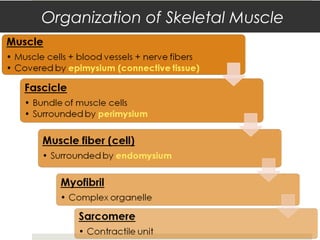
1. What is the organization of a skeletal muscle from
the largest to the smallest structures?
2. Draw and label the parts of a sarcomere. Be sure to
include the thick & thin filaments, I band, A band,
and Z lines.
Warm-Up
1. Describe what happens at the neuromuscular
junction.
2. How would a drug that blocks acetylcholine (ACh)
release affect muscle contraction?
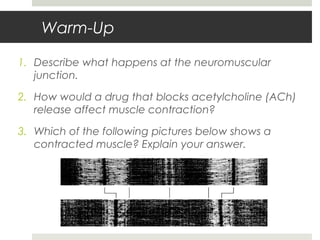
3. Which of the following pictures below shows a
contracted muscle? Explain your answer.
Warm-Up
Put the following events in muscle contraction in order:
A. Calcium binds to troponin  changes shape  myosin
binding sites exposed on actin
B. Myosin head pivots and pulls actin filament toward M
line
C. ATP attaches to myosin and cross-bridge detaches
D. Action potential travels down sarcolemma along T-
Tubules
E. Myosin cross-bridge forms with actin
F. Calcium is released from sarcoplasmic reticulum (SR)
Warm-Up
1. Jay is competing in a chin-up competition. What
types of muscle contractions are occurring in his
biceps muscles:
a) immediately after he grabs the bar?
b) as his body begins to move upward toward the bar?
c) when his body begins to approach the mat?
2. When a suicide victim was found, the coroner was
unable to remove the drug vial from his hand.
Explain.
Muscles & Muscle Tissue
Chapter 9
Muscles
 “muscle” = myo- or mys-
 sarco- = “flesh” - also refers to muscles
Main Functions of Muscles
1. Produce movement
2. Maintain posture & body position
3. Stabilize joints
4. Generate heat
Additional: protect organs, valves, dilate
pupils, raise hairs
Types of Muscle Tissue
 Skeletal: voluntary, striated, multinucleated
 Cardiac: (heart) striated, involuntary
 Smooth: visceral (lines hollow organs),
nonstriated, involuntary
Special Characteristics
 Excitability – can receive and respond to
stimuli
 Contractility – can shorten forcibly
 Extensibility – can be stretched or extended
 Elasticity – can recoil and resume resting
length after being stretched
Gross Anatomy of Skeletal Muscle
 1 muscle = 1 organ
 Each muscle served by a nerve, artery, & vein (1+)
 Rich blood supply – need energy & O2
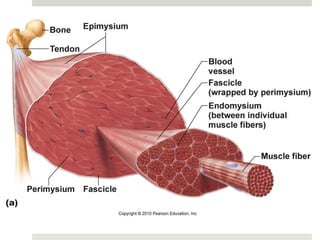
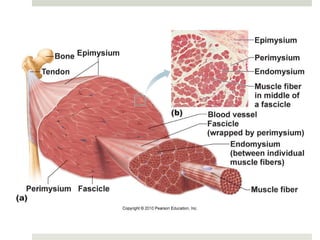
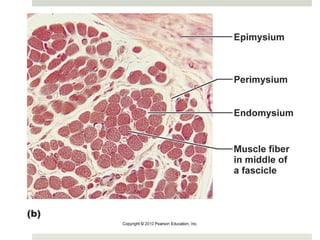
 Connective tissue sheaths: wraps each cell and
reinforce whole muscle
 Attachment: (1) directly to bone, (2) by tendons or
aponeuroses to bone, cartilage, or other muscles
Organization of Skeletal Muscle
Gross Anatomy of Skeletal Muscle
Video Clip
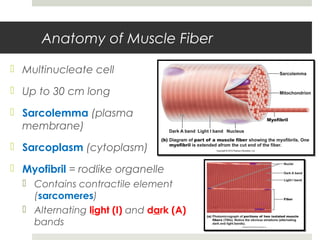
Anatomy of Muscle Fiber
 Multinucleate cell
 Up to 30 cm long
 Sarcolemma (plasma
membrane)
 Sarcoplasm (cytoplasm)
 Myofibril = rodlike organelle
 Contains contractile element
(sarcomeres)
 Alternating light (I) and dark (A)
bands
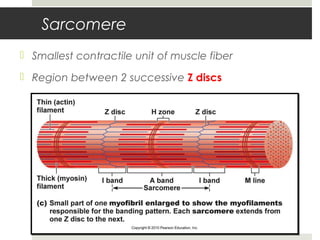
Sarcomere
 Smallest contractile unit of muscle fiber
 Region between 2 successive Z discs
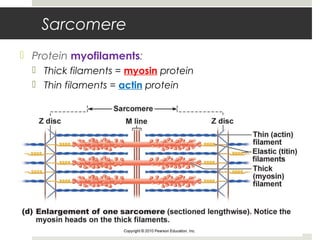
Sarcomere
 Protein myofilaments:
 Thick filaments = myosin protein
 Thin filaments = actin protein
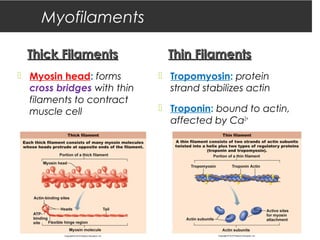
Myofilaments
Thick FilamentsThick Filaments
 Myosin head: forms
cross bridges with thin
filaments to contract
muscle cell
Thin FilamentsThin Filaments
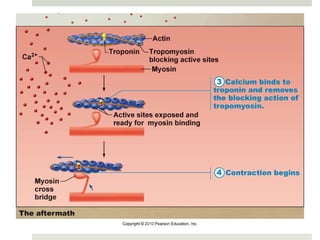
 Tropomyosin: protein
strand stabilizes actin
 Troponin: bound to actin,
affected by Ca2+
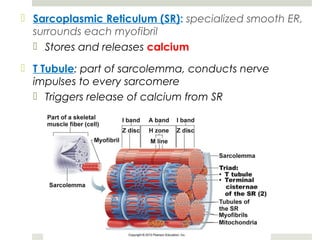
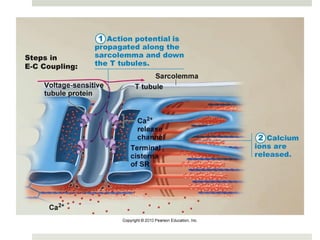
 Sarcoplasmic Reticulum (SR): specialized smooth ER,
surrounds each myofibril
 Stores and releases calcium
 T Tubule: part of sarcolemma, conducts nerve
impulses to every sarcomere
 Triggers release of calcium from SR
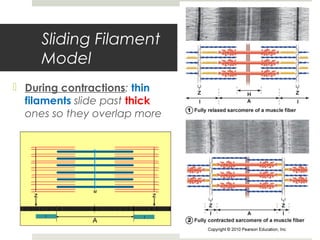
Sliding Filament
Model
 During contractions: thin
filaments slide past thick
ones so they overlap more
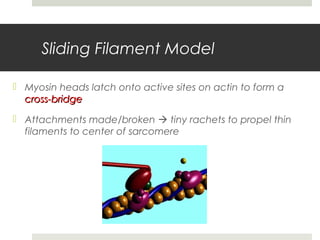
Sliding Filament Model
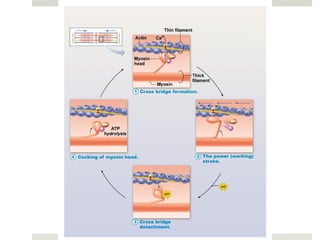
 Myosin heads latch onto active sites on actin to form a
cross-bridgecross-bridge
 Attachments made/broken  tiny rachets to propel thin
filaments to center of sarcomere
Skeletal Muscle Structure
Video Clip
Basic Muscle Contraction
1. Stimulation by nerve impulse
2. Generate and send electrical current (actionaction
potentialpotential) along sarcolemma
3. Rise in calcium ion levels to trigger contraction
Nerve Impulse
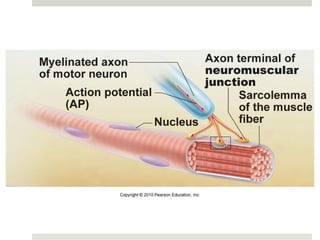
 1 nerve cell (motor neuronmotor neuron) stimulates a few or
hundreds of muscle cells
 Motor unit = 1 neuron + muscle cells stimulated
 Axon: extension of neuron
 Axon terminal: end of axon
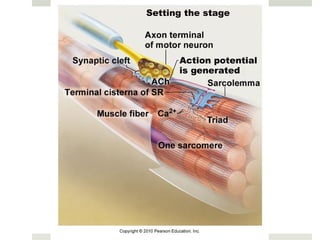
 Neuromuscular junction (NMJ): where axon terminal
meets muscle fiber
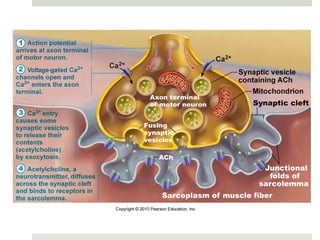
 Synpatic cleft: space between neuron & muscle fiber
 Acetylcholine (ACh): neurotransmitter
Excitation of Muscle Cell
1. Action potential travels down axon and arrives at
neuromuscular junction
2. Release of acetylcholine (ACh)acetylcholine (ACh) into synaptic cleft
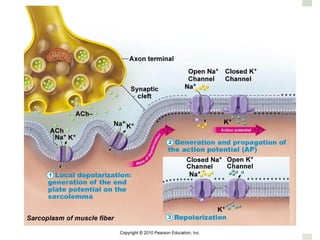
3. ACh diffuses across cleft & attaches to ACh receptors
on sarcolemma of muscle fiber
4. Rush of sodium (Nasodium (Na++
)) into sarcoplasm produces action
potential in sarcolemma
5. ACh broken down
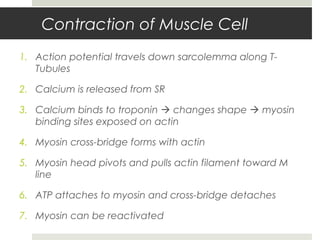
Contraction of Muscle Cell
1. Action potential travels down sarcolemma along T-
Tubules
2. Calcium is released from SR
3. Calcium binds to troponin  changes shape  myosin
binding sites exposed on actin
4. Myosin cross-bridge forms with actin
5. Myosin head pivots and pulls actin filament toward M
line
6. ATP attaches to myosin and cross-bridge detaches
7. Myosin can be reactivated
Action Potentials and Muscle
Contraction
Video Clip
Neuromuscular Junction
Video Clip
Homeostatic Imbalances
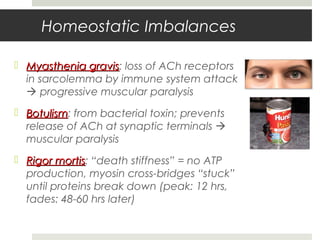
 Myasthenia gravisMyasthenia gravis: loss of ACh receptors
in sarcolemma by immune system attack
 progressive muscular paralysis
 BotulismBotulism: from bacterial toxin; prevents
release of ACh at synaptic terminals 
muscular paralysis
 Rigor mortisRigor mortis: “death stiffness” = no ATP
production, myosin cross-bridges “stuck”
until proteins break down (peak: 12 hrs,
fades: 48-60 hrs later)
Muscle Responses
 TwitchesTwitches (single, brief, jerky contractions) =
problem
 Healthy muscle = smooth contraction
 Graded muscle responsesGraded muscle responses: different degrees
of muscle shortening
Greater force by:
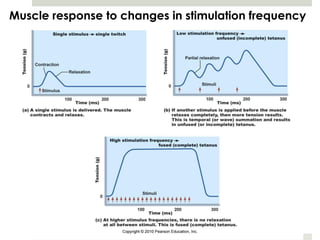
1. Increase frequencyfrequency of muscle stimulation
 Contractions are summed (max tension =
complete tetanuscomplete tetanus)
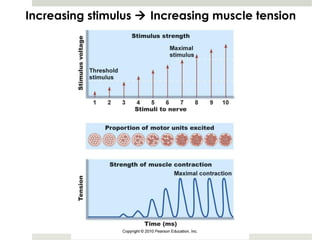
1. Increase # muscle cells# muscle cells being stimulated
Muscle response to changes in stimulation frequency
Increasing stimulus  Increasing muscle tension
Energy
 ATPATP = only energy source for muscles
 Regenerated by:
1.1. Creatine phosphate (CP)Creatine phosphate (CP): transfers energy to
ATP
2.2. Aerobic respirationAerobic respiration: complete glucose
breakdown with O2 present
3.3. Lactic acid fermentationLactic acid fermentation: glucose breakdown
without O2
 Muscle fatigueMuscle fatigue: lack of O2, ATP supply low, lactic
acid accumulates, soreness  muscle contracts
more weakly until it stops
Creatine Phosphate Supplements
 Muscle cells store phosphocreatine (Pcr) for sprinting and
explosive exercise
 Forms/usesForms/uses: powders, tablets, energy bars, drink mixes
 Supplements can enhance sprint performanceenhance sprint performance and lean musclelean muscle
massmass (no evidence to aid endurance performance)
 Side effectsSide effects: weight gain, anxiety, diarrhea, fatigue, headache,
kidney problems, nausea, vomiting, rash
 No recommended for peopleNo recommended for people with diabetes, kidney or liver
problems
 CautionCaution: Drink lots of water to avoid dehydration
 Effects of long-term usageEffects of long-term usage: unknown
Types of Contractions
Isotonic
 “same tension”
 Muscle length changes
 Concentric: shortens
 Eccentric: lengthens
 Eg. bicep curl, bend
knee, smiling
Isometric
 “same length”
 Muscle length stays same
 Tension increases
 Moving against heavy
load or immovable
object
 Eg. lifting heavy weights
Isotonic Contractions
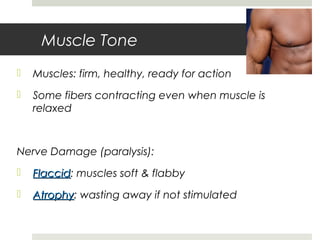
Muscle Tone
 Muscles: firm, healthy, ready for action
 Some fibers contracting even when muscle is
relaxed
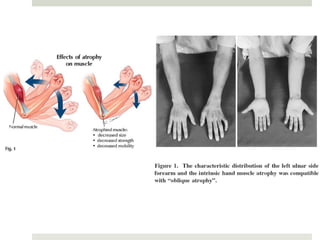
Nerve Damage (paralysis):
 FlaccidFlaccid: muscles soft & flabby
 AtrophyAtrophy: wasting away if not stimulated
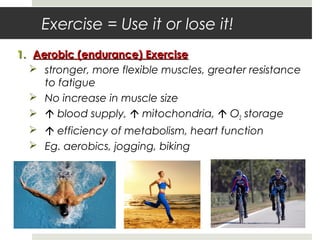
Exercise = Use it or lose it!
1.1. Aerobic (endurance) ExerciseAerobic (endurance) Exercise
 stronger, more flexible muscles, greater resistance
to fatigue
 No increase in muscle size
  blood supply,  mitochondria,  O2 storage
  efficiency of metabolism, heart function
 Eg. aerobics, jogging, biking
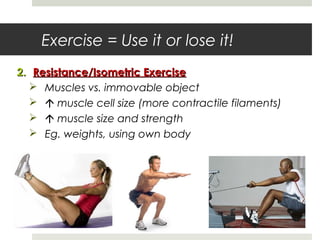
Exercise = Use it or lose it!
2.2. Resistance/Isometric ExerciseResistance/Isometric Exercise
 Muscles vs. immovable object
  muscle cell size (more contractile filaments)
  muscle size and strength
 Eg. weights, using own body
Muscle Cramps
 Sudden or involuntary contraction of muscles
 Causes: long periods of exercise or physical labor,
medications, dehydration, muscle strain,
nerve/kidney/thyroid disorders
 Medical Condition: Inadequate blood supply, nerve
compression, mineral depletion (Ca, K, Mg)
 Treatment: stretching exercises, muscle relaxant,
hydration, Vitamin B supplements, apply cold/heat
Health & Fitness
 Forcing a muscle to work hard promotes
strength & endurance
 Heavy workout day  1-2 days of rest or light
workout for muscle recovery
 Overuse injuries – muscle or joint pain
 Best program: alternate aerobic & anaerobic
activities
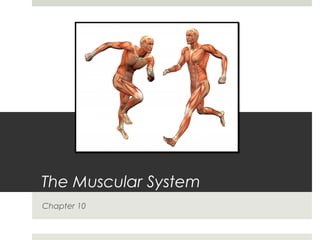
The Muscular System
Chapter 10
Five Golden Rules of Skeletal Muscle
Activity
1. All muscles cross at least one joint (+ a few
exceptions).
2. The bulk of muscle lies proximal to the joint crossed.
3. All muscles have at least 2 attachments: origin +
insertion
4. Muscle can only pull; they never push.
5. During contraction, the muscle insertion moves
toward origin.
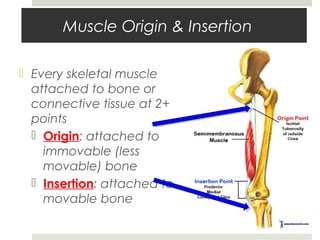
Muscle Origin & Insertion
 Every skeletal muscle
attached to bone or
connective tissue at 2+
points
 Origin: attached to
immovable (less
movable) bone
 Insertion: attached to
movable bone
Naming Skeletal Muscles
1. Location (associated with bone; temporalis)
2. Shape (deltoid = triangle, trapezius = trapezoid)
3. Relative size (maximus, minimus, longus)
4. Direction of muscle fibers (rectus = straight,
transversus, oblique)
5. Number of origins (biceps, triceps, quadriceps)
6. Location of attachments (sternocleidomastoid =
sternum & clavicle origins, mastoid insertion)
7. Action of muscle(flexor, extensor, adductor)
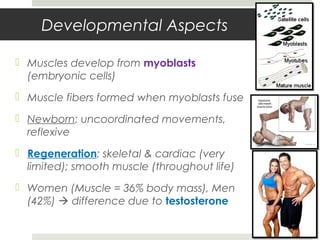
Developmental Aspects
 Muscles develop from myoblasts
(embryonic cells)
 Muscle fibers formed when myoblasts fuse
 Newborn: uncoordinated movements,
reflexive
 Regeneration: skeletal & cardiac (very
limited); smooth muscle (throughout life)
 Women (Muscle = 36% body mass), Men
(42%)  difference due to testosterone
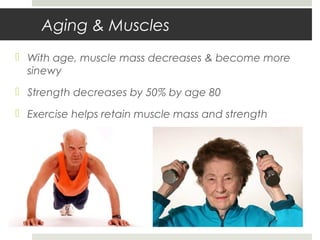
Aging & Muscles
 With age, muscle mass decreases & become more
sinewy
 Strength decreases by 50% by age 80
 Exercise helps retain muscle mass and strength
Homeostatic Imbalances
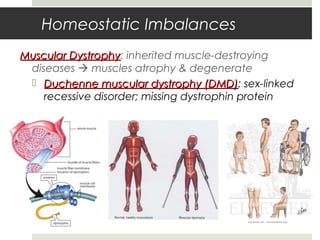
Muscular DystrophyMuscular Dystrophy: inherited muscle-destroying
diseases  muscles atrophy & degenerate
 Duchenne muscular dystrophy (DMD)Duchenne muscular dystrophy (DMD): sex-linked
recessive disorder; missing dystrophin protein

Anatomy & Physiology Lecture Notes - Muscles & muscle tissue

  • 1.
    Warm-Up 1. Based onwhat you know about Latin root words, what do you think these terms refer to?  Sarcomere  Sarcoplasm  Myofibril  Epimysium  Perimysium  Endomysium 1. What structure connects muscle to bone?
  • 2.
    Warm-Up 1. What isthe organization of a skeletal muscle from the largest to the smallest structures? 2. Draw and label the parts of a sarcomere. Be sure to include the thick & thin filaments, I band, A band, and Z lines.
  • 3.
    Warm-Up 1. Describe whathappens at the neuromuscular junction. 2. How would a drug that blocks acetylcholine (ACh) release affect muscle contraction? 3. Which of the following pictures below shows a contracted muscle? Explain your answer.
  • 4.
    Warm-Up Put the followingevents in muscle contraction in order: A. Calcium binds to troponin  changes shape  myosin binding sites exposed on actin B. Myosin head pivots and pulls actin filament toward M line C. ATP attaches to myosin and cross-bridge detaches D. Action potential travels down sarcolemma along T- Tubules E. Myosin cross-bridge forms with actin F. Calcium is released from sarcoplasmic reticulum (SR)
  • 5.
    Warm-Up 1. Jay iscompeting in a chin-up competition. What types of muscle contractions are occurring in his biceps muscles: a) immediately after he grabs the bar? b) as his body begins to move upward toward the bar? c) when his body begins to approach the mat? 2. When a suicide victim was found, the coroner was unable to remove the drug vial from his hand. Explain.
  • 6.
    Muscles & MuscleTissue Chapter 9
  • 7.
    Muscles  “muscle” =myo- or mys-  sarco- = “flesh” - also refers to muscles
  • 8.
    Main Functions ofMuscles 1. Produce movement 2. Maintain posture & body position 3. Stabilize joints 4. Generate heat Additional: protect organs, valves, dilate pupils, raise hairs
  • 9.
    Types of MuscleTissue  Skeletal: voluntary, striated, multinucleated  Cardiac: (heart) striated, involuntary  Smooth: visceral (lines hollow organs), nonstriated, involuntary
  • 10.
    Special Characteristics  Excitability– can receive and respond to stimuli  Contractility – can shorten forcibly  Extensibility – can be stretched or extended  Elasticity – can recoil and resume resting length after being stretched
  • 11.
    Gross Anatomy ofSkeletal Muscle  1 muscle = 1 organ  Each muscle served by a nerve, artery, & vein (1+)  Rich blood supply – need energy & O2  Connective tissue sheaths: wraps each cell and reinforce whole muscle  Attachment: (1) directly to bone, (2) by tendons or aponeuroses to bone, cartilage, or other muscles
  • 13.
  • 16.
    Gross Anatomy ofSkeletal Muscle Video Clip
  • 17.
    Anatomy of MuscleFiber  Multinucleate cell  Up to 30 cm long  Sarcolemma (plasma membrane)  Sarcoplasm (cytoplasm)  Myofibril = rodlike organelle  Contains contractile element (sarcomeres)  Alternating light (I) and dark (A) bands
  • 18.
    Sarcomere  Smallest contractileunit of muscle fiber  Region between 2 successive Z discs
  • 19.
    Sarcomere  Protein myofilaments: Thick filaments = myosin protein  Thin filaments = actin protein
  • 20.
    Myofilaments Thick FilamentsThick Filaments Myosin head: forms cross bridges with thin filaments to contract muscle cell Thin FilamentsThin Filaments  Tropomyosin: protein strand stabilizes actin  Troponin: bound to actin, affected by Ca2+
  • 21.
     Sarcoplasmic Reticulum(SR): specialized smooth ER, surrounds each myofibril  Stores and releases calcium  T Tubule: part of sarcolemma, conducts nerve impulses to every sarcomere  Triggers release of calcium from SR
  • 22.
    Sliding Filament Model  Duringcontractions: thin filaments slide past thick ones so they overlap more
  • 23.
    Sliding Filament Model Myosin heads latch onto active sites on actin to form a cross-bridgecross-bridge  Attachments made/broken  tiny rachets to propel thin filaments to center of sarcomere
  • 24.
  • 25.
    Basic Muscle Contraction 1.Stimulation by nerve impulse 2. Generate and send electrical current (actionaction potentialpotential) along sarcolemma 3. Rise in calcium ion levels to trigger contraction
  • 26.
    Nerve Impulse  1nerve cell (motor neuronmotor neuron) stimulates a few or hundreds of muscle cells  Motor unit = 1 neuron + muscle cells stimulated  Axon: extension of neuron  Axon terminal: end of axon  Neuromuscular junction (NMJ): where axon terminal meets muscle fiber  Synpatic cleft: space between neuron & muscle fiber  Acetylcholine (ACh): neurotransmitter
  • 27.
    Excitation of MuscleCell 1. Action potential travels down axon and arrives at neuromuscular junction 2. Release of acetylcholine (ACh)acetylcholine (ACh) into synaptic cleft 3. ACh diffuses across cleft & attaches to ACh receptors on sarcolemma of muscle fiber 4. Rush of sodium (Nasodium (Na++ )) into sarcoplasm produces action potential in sarcolemma 5. ACh broken down
  • 34.
    Contraction of MuscleCell 1. Action potential travels down sarcolemma along T- Tubules 2. Calcium is released from SR 3. Calcium binds to troponin  changes shape  myosin binding sites exposed on actin 4. Myosin cross-bridge forms with actin 5. Myosin head pivots and pulls actin filament toward M line 6. ATP attaches to myosin and cross-bridge detaches 7. Myosin can be reactivated
  • 36.
    Action Potentials andMuscle Contraction Video Clip
  • 37.
  • 38.
    Homeostatic Imbalances  MyastheniagravisMyasthenia gravis: loss of ACh receptors in sarcolemma by immune system attack  progressive muscular paralysis  BotulismBotulism: from bacterial toxin; prevents release of ACh at synaptic terminals  muscular paralysis  Rigor mortisRigor mortis: “death stiffness” = no ATP production, myosin cross-bridges “stuck” until proteins break down (peak: 12 hrs, fades: 48-60 hrs later)
  • 39.
    Muscle Responses  TwitchesTwitches(single, brief, jerky contractions) = problem  Healthy muscle = smooth contraction  Graded muscle responsesGraded muscle responses: different degrees of muscle shortening Greater force by: 1. Increase frequencyfrequency of muscle stimulation  Contractions are summed (max tension = complete tetanuscomplete tetanus) 1. Increase # muscle cells# muscle cells being stimulated
  • 40.
    Muscle response tochanges in stimulation frequency
  • 41.
    Increasing stimulus Increasing muscle tension
  • 42.
    Energy  ATPATP =only energy source for muscles  Regenerated by: 1.1. Creatine phosphate (CP)Creatine phosphate (CP): transfers energy to ATP 2.2. Aerobic respirationAerobic respiration: complete glucose breakdown with O2 present 3.3. Lactic acid fermentationLactic acid fermentation: glucose breakdown without O2  Muscle fatigueMuscle fatigue: lack of O2, ATP supply low, lactic acid accumulates, soreness  muscle contracts more weakly until it stops
  • 43.
    Creatine Phosphate Supplements Muscle cells store phosphocreatine (Pcr) for sprinting and explosive exercise  Forms/usesForms/uses: powders, tablets, energy bars, drink mixes  Supplements can enhance sprint performanceenhance sprint performance and lean musclelean muscle massmass (no evidence to aid endurance performance)  Side effectsSide effects: weight gain, anxiety, diarrhea, fatigue, headache, kidney problems, nausea, vomiting, rash  No recommended for peopleNo recommended for people with diabetes, kidney or liver problems  CautionCaution: Drink lots of water to avoid dehydration  Effects of long-term usageEffects of long-term usage: unknown
  • 44.
    Types of Contractions Isotonic “same tension”  Muscle length changes  Concentric: shortens  Eccentric: lengthens  Eg. bicep curl, bend knee, smiling Isometric  “same length”  Muscle length stays same  Tension increases  Moving against heavy load or immovable object  Eg. lifting heavy weights
  • 45.
  • 46.
    Muscle Tone  Muscles:firm, healthy, ready for action  Some fibers contracting even when muscle is relaxed Nerve Damage (paralysis):  FlaccidFlaccid: muscles soft & flabby  AtrophyAtrophy: wasting away if not stimulated
  • 48.
    Exercise = Useit or lose it! 1.1. Aerobic (endurance) ExerciseAerobic (endurance) Exercise  stronger, more flexible muscles, greater resistance to fatigue  No increase in muscle size   blood supply,  mitochondria,  O2 storage   efficiency of metabolism, heart function  Eg. aerobics, jogging, biking
  • 49.
    Exercise = Useit or lose it! 2.2. Resistance/Isometric ExerciseResistance/Isometric Exercise  Muscles vs. immovable object   muscle cell size (more contractile filaments)   muscle size and strength  Eg. weights, using own body
  • 50.
    Muscle Cramps  Suddenor involuntary contraction of muscles  Causes: long periods of exercise or physical labor, medications, dehydration, muscle strain, nerve/kidney/thyroid disorders  Medical Condition: Inadequate blood supply, nerve compression, mineral depletion (Ca, K, Mg)  Treatment: stretching exercises, muscle relaxant, hydration, Vitamin B supplements, apply cold/heat
  • 51.
    Health & Fitness Forcing a muscle to work hard promotes strength & endurance  Heavy workout day  1-2 days of rest or light workout for muscle recovery  Overuse injuries – muscle or joint pain  Best program: alternate aerobic & anaerobic activities
  • 52.
  • 53.
    Five Golden Rulesof Skeletal Muscle Activity 1. All muscles cross at least one joint (+ a few exceptions). 2. The bulk of muscle lies proximal to the joint crossed. 3. All muscles have at least 2 attachments: origin + insertion 4. Muscle can only pull; they never push. 5. During contraction, the muscle insertion moves toward origin.
  • 54.
    Muscle Origin &Insertion  Every skeletal muscle attached to bone or connective tissue at 2+ points  Origin: attached to immovable (less movable) bone  Insertion: attached to movable bone
  • 55.
    Naming Skeletal Muscles 1.Location (associated with bone; temporalis) 2. Shape (deltoid = triangle, trapezius = trapezoid) 3. Relative size (maximus, minimus, longus) 4. Direction of muscle fibers (rectus = straight, transversus, oblique) 5. Number of origins (biceps, triceps, quadriceps) 6. Location of attachments (sternocleidomastoid = sternum & clavicle origins, mastoid insertion) 7. Action of muscle(flexor, extensor, adductor)
  • 56.
    Developmental Aspects  Musclesdevelop from myoblasts (embryonic cells)  Muscle fibers formed when myoblasts fuse  Newborn: uncoordinated movements, reflexive  Regeneration: skeletal & cardiac (very limited); smooth muscle (throughout life)  Women (Muscle = 36% body mass), Men (42%)  difference due to testosterone
  • 57.
    Aging & Muscles With age, muscle mass decreases & become more sinewy  Strength decreases by 50% by age 80  Exercise helps retain muscle mass and strength
  • 58.
    Homeostatic Imbalances Muscular DystrophyMuscularDystrophy: inherited muscle-destroying diseases  muscles atrophy & degenerate  Duchenne muscular dystrophy (DMD)Duchenne muscular dystrophy (DMD): sex-linked recessive disorder; missing dystrophin protein