Warm-Up
1. What is a tissue?
2. The study of tissues is called ______.
3. What are the 4 main types of tissues? (See
the intro to Chapter 4 in textbook)
Warm-Up
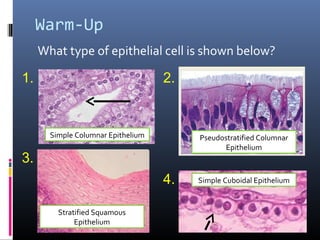
What type of epithelial cell is shown below?
1. 2.
3.
4.
Simple Columnar Epithelium
Stratified Squamous
Epithelium
Pseudostratified Columnar
Epithelium
Simple Cuboidal Epithelium
Chapter 4
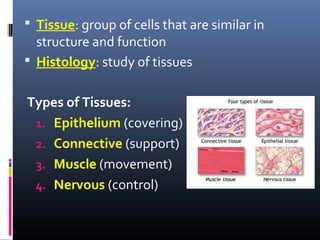
 Tissue: group of cells that are similar in
structure and function
 Histology: study of tissues
Types of Tissues:
1. Epithelium (covering)
2. Connective (support)
3. Muscle (movement)
4. Nervous (control)
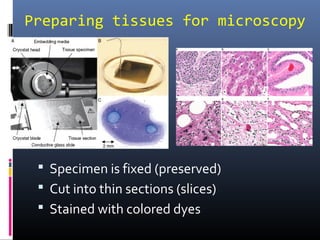
Preparing tissues for microscopy
 Specimen is fixed (preserved)
 Cut into thin sections (slices)
 Stained with colored dyes
Part I: Epithelial Tissue
Epithelial Tissue
 “epithe” = laid on, covering
 Structure:
1. Covering and lining epithelium
2. Glandular epithelium
 Function:
 Protection
 Absorption
 Filtration
 Secretion
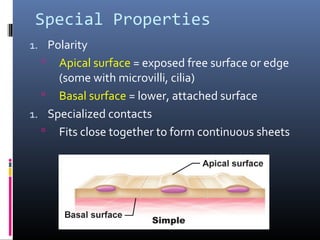
Special Properties
1. Polarity
 Apical surface = exposed free surface or edge
(some with microvilli, cilia)
 Basal surface = lower, attached surface
1. Specialized contacts
 Fits close together to form continuous sheets
Special Properties
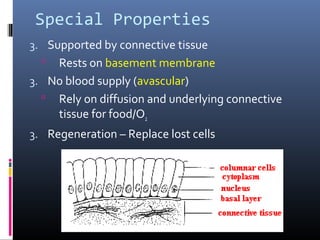
3. Supported by connective tissue
 Rests on basement membrane
3. No blood supply (avascular)
 Rely on diffusion and underlying connective
tissue for food/O2
3. Regeneration – Replace lost cells
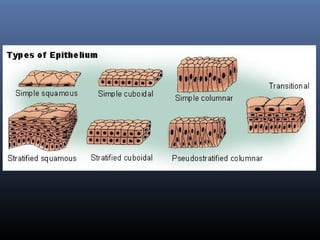
Classification
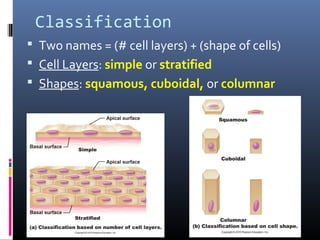
 Two names = (# cell layers) + (shape of cells)
 Cell Layers: simple or stratified
 Shapes: squamous, cuboidal, or columnar
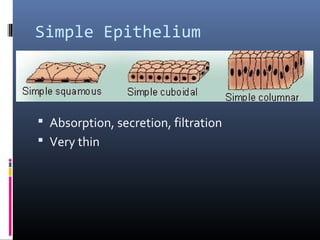
Simple Epithelium
 Absorption, secretion, filtration
 Very thin
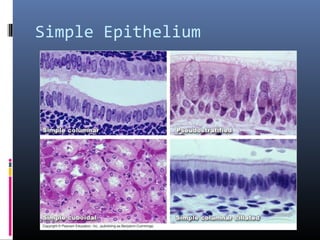
Simple Epithelium
Simple Epithelium
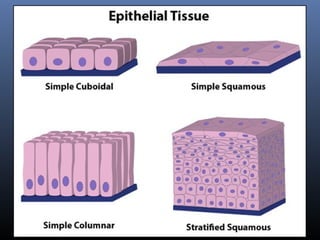
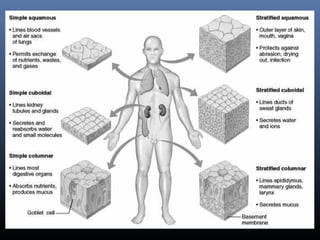
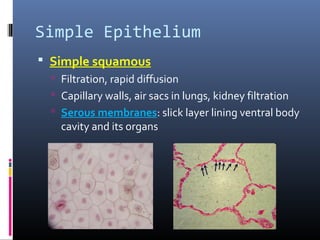
 Simple squamous
 Filtration, rapid diffusion
 Capillary walls, air sacs in lungs, kidney filtration
 Serous membranes: slick layer lining ventral body
cavity and its organs
Simple Epithelium
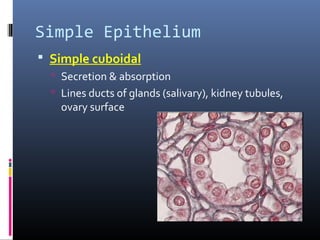
 Simple cuboidal
 Secretion & absorption
 Lines ducts of glands (salivary), kidney tubules,
ovary surface
Simple Epithelium
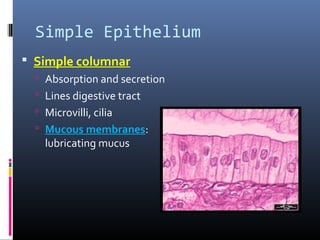
 Simple columnar
 Absorption and secretion
 Lines digestive tract
 Microvilli, cilia
 Mucous membranes:
lubricating mucus
Simple Epithelium
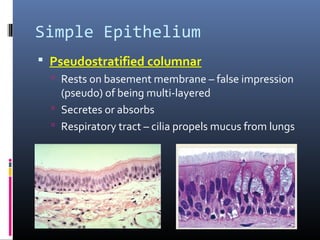
 Pseudostratified columnar
 Rests on basement membrane – false impression
(pseudo) of being multi-layered
 Secretes or absorbs
 Respiratory tract – cilia propels mucus from lungs
Stratified Epithelium
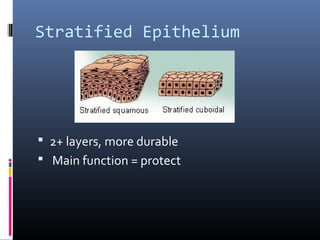
 2+ layers, more durable
 Main function = protect
Stratified Epithelium
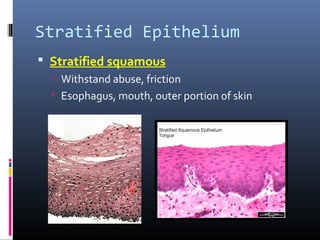
 Stratified squamous
 Withstand abuse, friction
 Esophagus, mouth, outer portion of skin
Stratified Epithelium
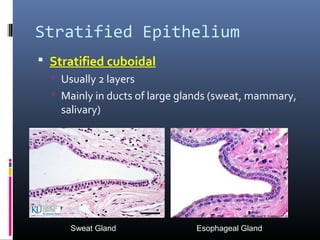
 Stratified cuboidal
 Usually 2 layers
 Mainly in ducts of large glands (sweat, mammary,
salivary)
Sweat Gland Esophageal Gland
Stratified Epithelium
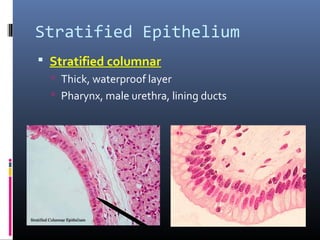
 Stratified columnar
 Thick, waterproof layer
 Pharynx, male urethra, lining ducts
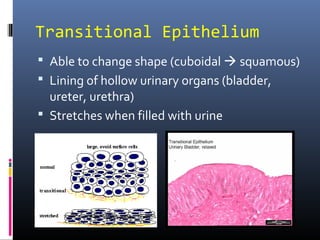
Transitional Epithelium
 Able to change shape (cuboidal  squamous)
 Lining of hollow urinary organs (bladder,
ureter, urethra)
 Stretches when filled with urine
Glandular Epithelium
 Gland: make and secrete a particular product
 2 Types:
 Endocrine gland: produce hormones secreted
into tissue fluid or bloodstream
 Exocrine gland: secrete products into ducts 
onto body surfaces or body cavities
 Eg. mucous, sweat, oil, saliva, bile
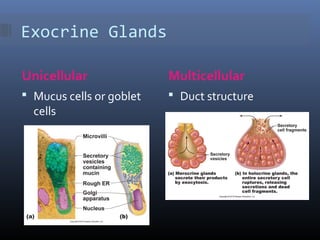
Exocrine Glands
Unicellular Multicellular
 Mucus cells or goblet
cells
 Duct structure

Anatomy & Physiology Lecture Notes - Ch. 4 tissues - epithelium

  • 1.
    Warm-Up 1. What isa tissue? 2. The study of tissues is called ______. 3. What are the 4 main types of tissues? (See the intro to Chapter 4 in textbook)
  • 2.
    Warm-Up What type ofepithelial cell is shown below? 1. 2. 3. 4. Simple Columnar Epithelium Stratified Squamous Epithelium Pseudostratified Columnar Epithelium Simple Cuboidal Epithelium
  • 3.
  • 4.
     Tissue: groupof cells that are similar in structure and function  Histology: study of tissues Types of Tissues: 1. Epithelium (covering) 2. Connective (support) 3. Muscle (movement) 4. Nervous (control)
  • 5.
    Preparing tissues formicroscopy  Specimen is fixed (preserved)  Cut into thin sections (slices)  Stained with colored dyes
  • 6.
  • 7.
    Epithelial Tissue  “epithe”= laid on, covering  Structure: 1. Covering and lining epithelium 2. Glandular epithelium  Function:  Protection  Absorption  Filtration  Secretion
  • 8.
    Special Properties 1. Polarity Apical surface = exposed free surface or edge (some with microvilli, cilia)  Basal surface = lower, attached surface 1. Specialized contacts  Fits close together to form continuous sheets
  • 9.
    Special Properties 3. Supportedby connective tissue  Rests on basement membrane 3. No blood supply (avascular)  Rely on diffusion and underlying connective tissue for food/O2 3. Regeneration – Replace lost cells
  • 10.
    Classification  Two names= (# cell layers) + (shape of cells)  Cell Layers: simple or stratified  Shapes: squamous, cuboidal, or columnar
  • 14.
    Simple Epithelium  Absorption,secretion, filtration  Very thin
  • 15.
  • 16.
    Simple Epithelium  Simplesquamous  Filtration, rapid diffusion  Capillary walls, air sacs in lungs, kidney filtration  Serous membranes: slick layer lining ventral body cavity and its organs
  • 17.
    Simple Epithelium  Simplecuboidal  Secretion & absorption  Lines ducts of glands (salivary), kidney tubules, ovary surface
  • 18.
    Simple Epithelium  Simplecolumnar  Absorption and secretion  Lines digestive tract  Microvilli, cilia  Mucous membranes: lubricating mucus
  • 19.
    Simple Epithelium  Pseudostratifiedcolumnar  Rests on basement membrane – false impression (pseudo) of being multi-layered  Secretes or absorbs  Respiratory tract – cilia propels mucus from lungs
  • 20.
    Stratified Epithelium  2+layers, more durable  Main function = protect
  • 21.
    Stratified Epithelium  Stratifiedsquamous  Withstand abuse, friction  Esophagus, mouth, outer portion of skin
  • 22.
    Stratified Epithelium  Stratifiedcuboidal  Usually 2 layers  Mainly in ducts of large glands (sweat, mammary, salivary) Sweat Gland Esophageal Gland
  • 23.
    Stratified Epithelium  Stratifiedcolumnar  Thick, waterproof layer  Pharynx, male urethra, lining ducts
  • 24.
    Transitional Epithelium  Ableto change shape (cuboidal  squamous)  Lining of hollow urinary organs (bladder, ureter, urethra)  Stretches when filled with urine
  • 25.
    Glandular Epithelium  Gland:make and secrete a particular product  2 Types:  Endocrine gland: produce hormones secreted into tissue fluid or bloodstream  Exocrine gland: secrete products into ducts  onto body surfaces or body cavities  Eg. mucous, sweat, oil, saliva, bile
  • 26.
    Exocrine Glands Unicellular Multicellular Mucus cells or goblet cells  Duct structure