Complete Muscle
Histology
By- Dr. Armaan SinghBy- Dr. Armaan Singh
Functions of muscle tissueFunctions of muscle tissue
 Movement
 Maintenance of
posture
 Joint stabilization
 Heat generation
Special functional characteristics of muscle
 Contractility
 Only one action: to shorten
 Shortening generates pulling force
 Excitability
 Nerve fibers cause electrical impulse to travel
 Extensibility
 Stretch with contraction of an opposing muscle
 Elasticity
 Recoils passively after being stretched
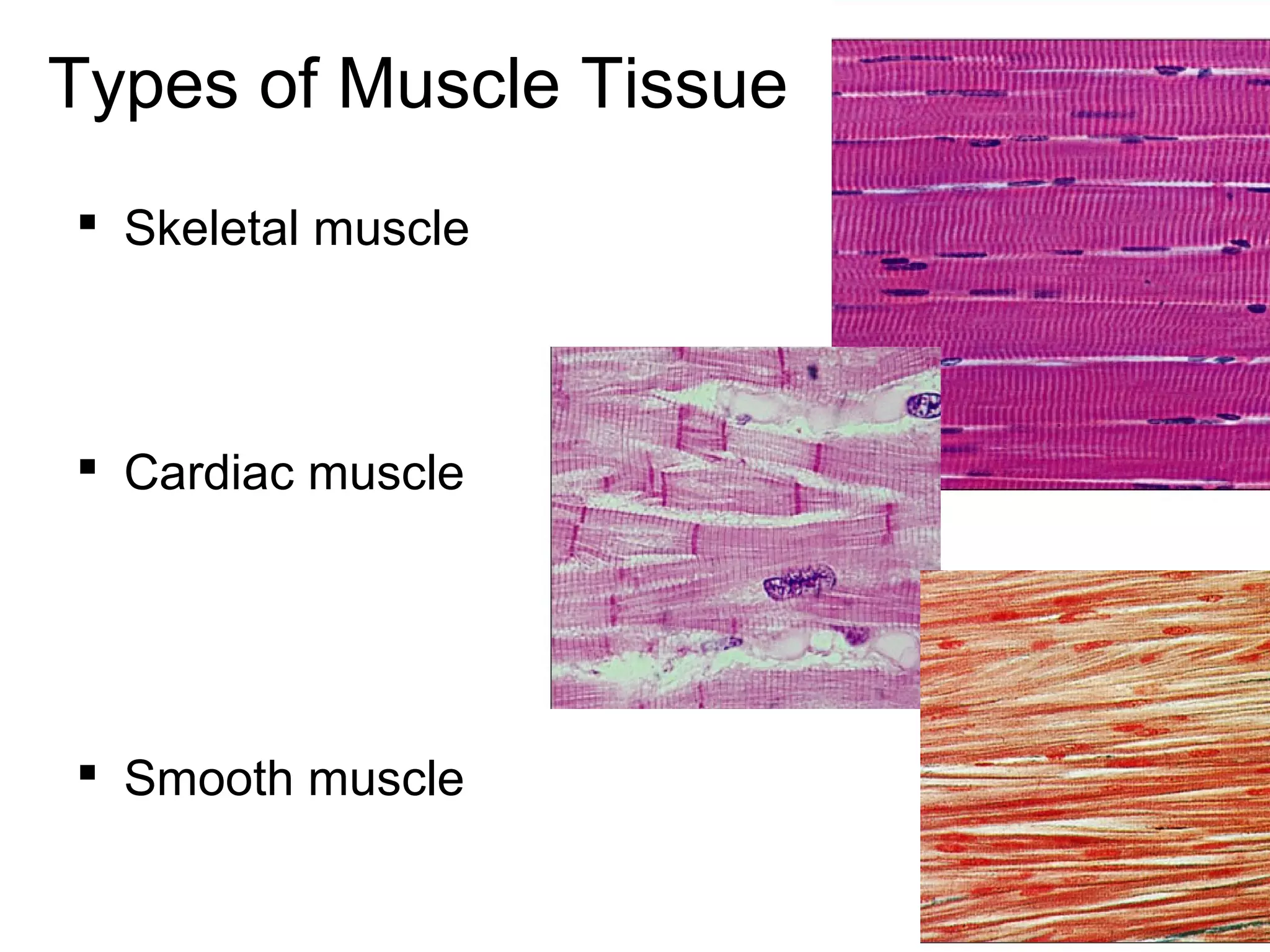
Types of Muscle Tissue
 Skeletal muscle
 Cardiac muscle
 Smooth muscle
Types of Muscle Tissue
Skeletal
•Attach to and move skeleton
•40% of body weight
•Fibers = multinucleate cells (embryonic cells fuse)
•Cells with obvious striations
•Contractions are voluntary
Cardiac: only in the wall of
the heart
•Cells are striated
•Contractions are
involuntary (not voluntary)
Smooth: walls of hollow organs
•Lack striations
•Contractions are involuntary (not voluntary)
Similarities…
 Their cells are called fibers because they
are elongated
 Contraction depends on myofilaments
 Actin
 Myosin
 Plasma membrane is called sarcolemma
 Sarcos = flesh
 Lemma = sheath
Skeletal muscle
Epimysium:
surrounds
whole muscle
Perimysium
is around
fascicle
Endomysium is around each
muscle fiber
Skeletal
Muscle
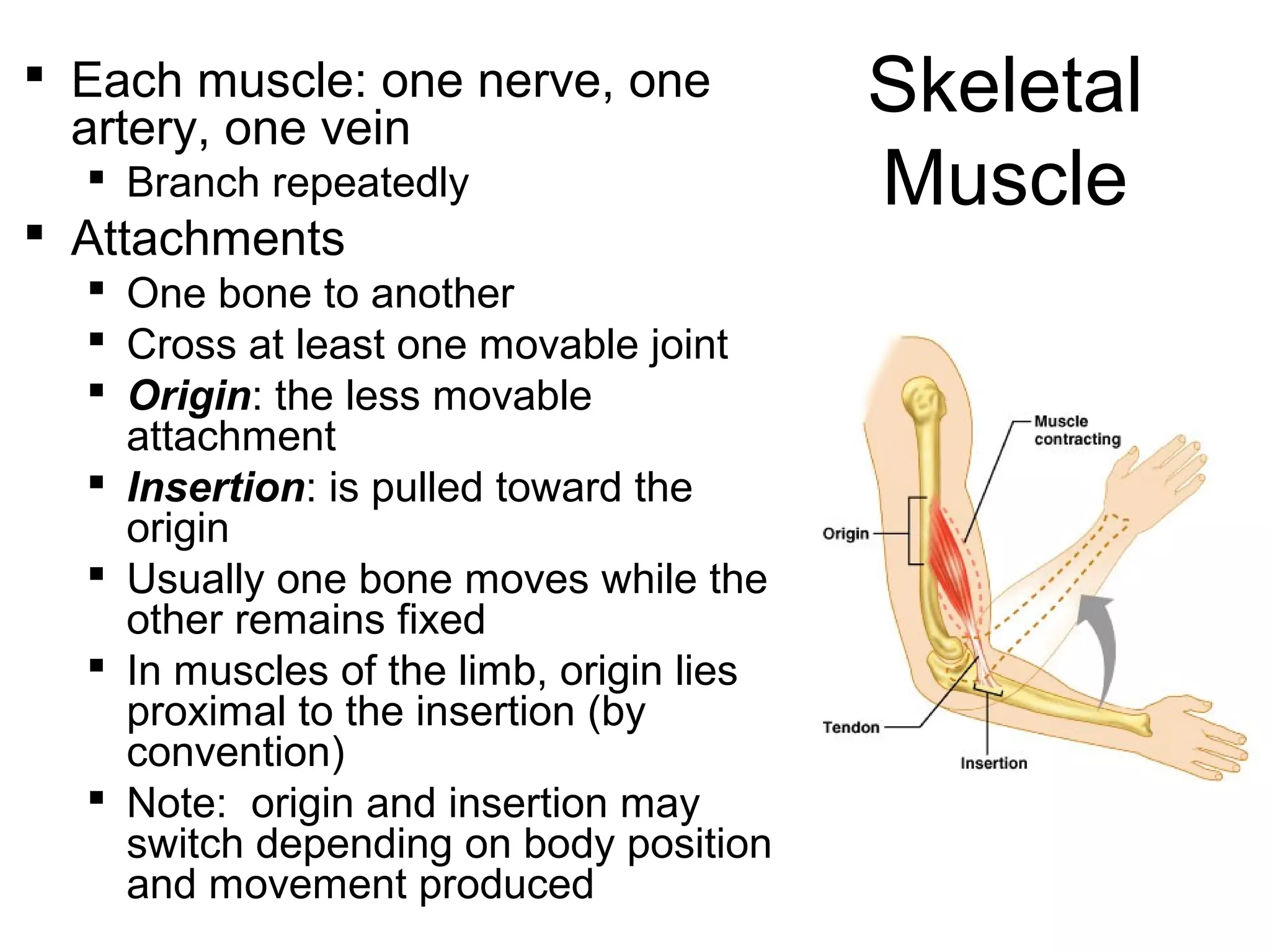
 Each muscle: one nerve, one
artery, one vein
 Branch repeatedly
 Attachments
 One bone to another
 Cross at least one movable joint
 Origin: the less movable
attachment
 Insertion: is pulled toward the
origin
 Usually one bone moves while the
other remains fixed
 In muscles of the limb, origin lies
proximal to the insertion (by
convention)
 Note: origin and insertion may
switch depending on body position
and movement produced
Attachments continued
 Many muscles span two or more joints
 Called biarticular or multijoint muscles
 Cause movements at two joints
 Direct or “fleshy” attachments
 Attachments so short that muscle appears to attach
directly to bone
 Indirect: connective tissue extends well beyond
the muscle (more common)
 Tendon: cordlike (most muscles have tendons)
 Aponeurosis: flat sheet
 Raised bone markings where tendons meet bones
 Tubercles, trochanters, crests, etc.
Some sites showing animations
of muscle contraction
 http://entochem.tamu.edu/MuscleStrucContrac
 http://www.brookscole.com/chemistry_d/templ
Skeletal
muscle
 Fibers (each is one
cell) have striations
 Myofibrils are
organelles of the
cell: these are made
up of filaments
 Sarcomere
 Basic unit of
contraction
 Myofibrils are long
rows of repeating
sarcomeres
 Boundaries: Z discs
(or lines)
This big
cylinder is a
fiber: 1 cell -an organelle
Myofibrils
 Made of three types of filaments (or
myofilaments):
 Thick (myosin)
 Thin (actin)
 Elastic (titin)
______actin
_____________myosin
titin_____
Sliding Filament Model
__relaxed sarcomere__ _partly contracted_
fully contracted
“A” band constant
because it is
caused by myosin,
which doesn’t
change length
Sarcomere shortens
because actin pulled
towards its middle
by myosin cross
bridges
Titin resists overstretching
Another pic
EM (electron
microscope): parts
of 2 myofibrils
Labeled and unlabeled
 Sarcoplasmic reticulum is smooth ER
 Tubules surround myofibrils
 Cross-channels called “terminal cisternae”
 Store Ca++ and release when muscle stimulated to contract
 To thin filaments triggering sliding filament mechanism of contraction
 T tubules are continuous with sarcolemma, therefore whole muscle
(deep parts as well) contracts simultaneously
Neuromuscular
Junction
Motor neurons innervate muscle
fibers
Motor end plate is where they
meet
Neurotransmitters are released
by nerve signal: this initiates
calcium ion release and muscle
contraction
Motor Unit: a motor neuron and all the muscle fibers it innervates (these all
contract together)
•Average is 150, but range is four to several hundred muscle fibers in a motor unit
•The finer the movement, the fewer muscle fibers /motor unit
•The fibers are spread throughout the muscle, so stimulation of a single motor unit
causes a weak contraction of the entire muscle
Types of skeletal muscle fibers
 Fast, slow and intermediate
 Whether or not they predominantly use oxygen to
produce ATP (the energy molecule used in muscle
contraction)
 Oxidative – aerobic (use oxygen)
 Glycolytic – make ATP by glycolysis (break down of sugars
without oxygen=anaerobic)
 Fast fibers: “white fibers” – large, predominantly
anaerobic, fatigue rapidly (rely on glycogen reserves);
most of the skeletal muscle fibers are fast
 Slow fibers: “red fibers” – half the diameter, 3X slower,
but can continue contracting; aerobic, more
mitochondria, myoglobin
 Intermediate: in between
 A skeletal muscle contracts when its motor
units are stimulated
 Amount of tension depends on
1. the frequency of stimulation
2. the number of motor units involved
 Single, momentary contraction is called a
muscle twitch
 All or none principle: each muscle fiber either
contracts completely or not at all
 Amount of force: depends on how many motor
units are activated
 Muscle tone
 Even at rest, some motor units are active: tense the
muscle even though not causing movement: “resting
tone”
 Muscle hypertrophy
 Weight training (repeated intense workouts): increases diameter and
strength of “fast” muscle fibers by increasing production of
 Mitochondria
 Actin and myosin protein
 Myofilaments containing these contractile proteins
 The myofibril organelles these myofilaments form
 Fibers enlarge (hypertrophy) as number and size of myofibrils
increase
[Muscle fibers (=muscle cells) don’t increase in number but increase
in diameter producing large muscles]
 Endurance training (aerobic): doesn’t produce hypertrophy
 Muscle atrophy: loss of tone and mass from lack of
stimulation
 Muscle becomes smaller and weaker
Note on terminology: in general, increased size is hypertrophy; increased number
of cells is hyperplasia
Cardiac muscle
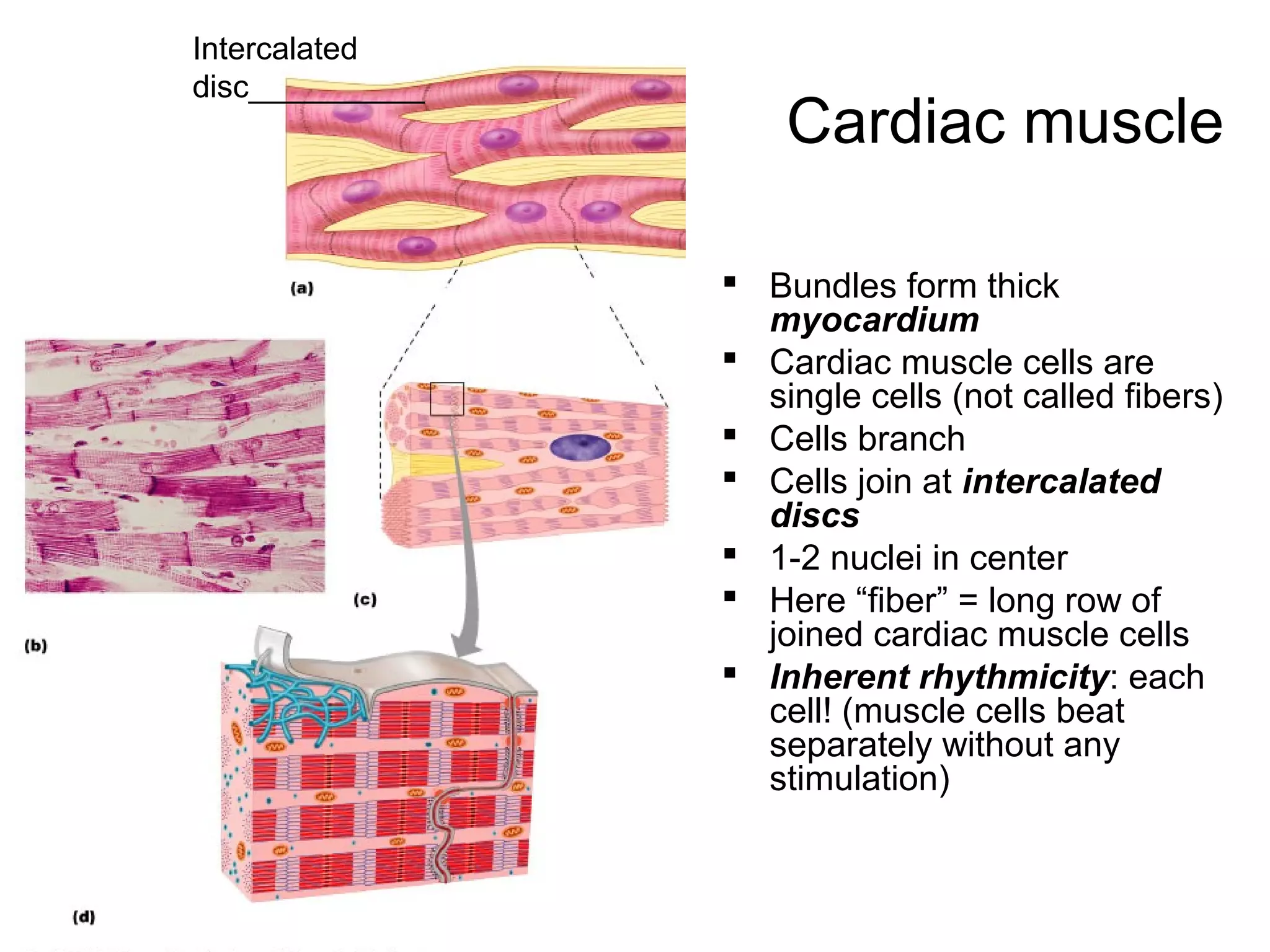
 Bundles form thick
myocardium
 Cardiac muscle cells are
single cells (not called fibers)
 Cells branch
 Cells join at intercalated
discs
 1-2 nuclei in center
 Here “fiber” = long row of
joined cardiac muscle cells
 Inherent rhythmicity: each
cell! (muscle cells beat
separately without any
stimulation)
Intercalated
disc__________
Smooth muscle
•Muscles are spindle-shaped cells
•One central nucleus
•Grouped into sheets: often running
perpendicular to each other
•Peristalsis
•No striations (no sarcomeres)
•Contractions are slow, sustained and
resistant to fatigue
•Does not always require a nervous signal:
can be stimulated by stretching or hormones
6 major locations:
1. inside the eye 2. walls of vessels 3. respiratory tubes
4. digestive tubes 5. urinary organs 6. reproductive organs
This is included because troponins are measured clinically in
heart attacks…but be careful because the colors are opposite
Calcium attaches to troponin/
tropomyosin; they roll away,
exposing the active site on actin.

Muscle histology by dr. armaan singh

  • 1.
    Complete Muscle Histology By- Dr.Armaan SinghBy- Dr. Armaan Singh
  • 2.
    Functions of muscletissueFunctions of muscle tissue  Movement  Maintenance of posture  Joint stabilization  Heat generation
  • 3.
    Special functional characteristicsof muscle  Contractility  Only one action: to shorten  Shortening generates pulling force  Excitability  Nerve fibers cause electrical impulse to travel  Extensibility  Stretch with contraction of an opposing muscle  Elasticity  Recoils passively after being stretched
  • 4.
    Types of MuscleTissue  Skeletal muscle  Cardiac muscle  Smooth muscle
  • 5.
    Types of MuscleTissue Skeletal •Attach to and move skeleton •40% of body weight •Fibers = multinucleate cells (embryonic cells fuse) •Cells with obvious striations •Contractions are voluntary Cardiac: only in the wall of the heart •Cells are striated •Contractions are involuntary (not voluntary) Smooth: walls of hollow organs •Lack striations •Contractions are involuntary (not voluntary)
  • 6.
    Similarities…  Their cellsare called fibers because they are elongated  Contraction depends on myofilaments  Actin  Myosin  Plasma membrane is called sarcolemma  Sarcos = flesh  Lemma = sheath
  • 7.
    Skeletal muscle Epimysium: surrounds whole muscle Perimysium isaround fascicle Endomysium is around each muscle fiber
  • 8.
    Skeletal Muscle  Each muscle:one nerve, one artery, one vein  Branch repeatedly  Attachments  One bone to another  Cross at least one movable joint  Origin: the less movable attachment  Insertion: is pulled toward the origin  Usually one bone moves while the other remains fixed  In muscles of the limb, origin lies proximal to the insertion (by convention)  Note: origin and insertion may switch depending on body position and movement produced
  • 9.
    Attachments continued  Manymuscles span two or more joints  Called biarticular or multijoint muscles  Cause movements at two joints  Direct or “fleshy” attachments  Attachments so short that muscle appears to attach directly to bone  Indirect: connective tissue extends well beyond the muscle (more common)  Tendon: cordlike (most muscles have tendons)  Aponeurosis: flat sheet  Raised bone markings where tendons meet bones  Tubercles, trochanters, crests, etc.
  • 10.
    Some sites showinganimations of muscle contraction  http://entochem.tamu.edu/MuscleStrucContrac  http://www.brookscole.com/chemistry_d/templ
  • 11.
    Skeletal muscle  Fibers (eachis one cell) have striations  Myofibrils are organelles of the cell: these are made up of filaments  Sarcomere  Basic unit of contraction  Myofibrils are long rows of repeating sarcomeres  Boundaries: Z discs (or lines) This big cylinder is a fiber: 1 cell -an organelle
  • 12.
    Myofibrils  Made ofthree types of filaments (or myofilaments):  Thick (myosin)  Thin (actin)  Elastic (titin) ______actin _____________myosin titin_____
  • 13.
    Sliding Filament Model __relaxedsarcomere__ _partly contracted_ fully contracted “A” band constant because it is caused by myosin, which doesn’t change length Sarcomere shortens because actin pulled towards its middle by myosin cross bridges Titin resists overstretching
  • 14.
  • 15.
    EM (electron microscope): parts of2 myofibrils Labeled and unlabeled
  • 16.
     Sarcoplasmic reticulumis smooth ER  Tubules surround myofibrils  Cross-channels called “terminal cisternae”  Store Ca++ and release when muscle stimulated to contract  To thin filaments triggering sliding filament mechanism of contraction  T tubules are continuous with sarcolemma, therefore whole muscle (deep parts as well) contracts simultaneously
  • 17.
    Neuromuscular Junction Motor neurons innervatemuscle fibers Motor end plate is where they meet Neurotransmitters are released by nerve signal: this initiates calcium ion release and muscle contraction Motor Unit: a motor neuron and all the muscle fibers it innervates (these all contract together) •Average is 150, but range is four to several hundred muscle fibers in a motor unit •The finer the movement, the fewer muscle fibers /motor unit •The fibers are spread throughout the muscle, so stimulation of a single motor unit causes a weak contraction of the entire muscle
  • 20.
    Types of skeletalmuscle fibers  Fast, slow and intermediate  Whether or not they predominantly use oxygen to produce ATP (the energy molecule used in muscle contraction)  Oxidative – aerobic (use oxygen)  Glycolytic – make ATP by glycolysis (break down of sugars without oxygen=anaerobic)  Fast fibers: “white fibers” – large, predominantly anaerobic, fatigue rapidly (rely on glycogen reserves); most of the skeletal muscle fibers are fast  Slow fibers: “red fibers” – half the diameter, 3X slower, but can continue contracting; aerobic, more mitochondria, myoglobin  Intermediate: in between
  • 21.
     A skeletalmuscle contracts when its motor units are stimulated  Amount of tension depends on 1. the frequency of stimulation 2. the number of motor units involved  Single, momentary contraction is called a muscle twitch  All or none principle: each muscle fiber either contracts completely or not at all  Amount of force: depends on how many motor units are activated  Muscle tone  Even at rest, some motor units are active: tense the muscle even though not causing movement: “resting tone”
  • 22.
     Muscle hypertrophy Weight training (repeated intense workouts): increases diameter and strength of “fast” muscle fibers by increasing production of  Mitochondria  Actin and myosin protein  Myofilaments containing these contractile proteins  The myofibril organelles these myofilaments form  Fibers enlarge (hypertrophy) as number and size of myofibrils increase [Muscle fibers (=muscle cells) don’t increase in number but increase in diameter producing large muscles]  Endurance training (aerobic): doesn’t produce hypertrophy  Muscle atrophy: loss of tone and mass from lack of stimulation  Muscle becomes smaller and weaker Note on terminology: in general, increased size is hypertrophy; increased number of cells is hyperplasia
  • 23.
    Cardiac muscle  Bundlesform thick myocardium  Cardiac muscle cells are single cells (not called fibers)  Cells branch  Cells join at intercalated discs  1-2 nuclei in center  Here “fiber” = long row of joined cardiac muscle cells  Inherent rhythmicity: each cell! (muscle cells beat separately without any stimulation) Intercalated disc__________
  • 24.
    Smooth muscle •Muscles arespindle-shaped cells •One central nucleus •Grouped into sheets: often running perpendicular to each other •Peristalsis •No striations (no sarcomeres) •Contractions are slow, sustained and resistant to fatigue •Does not always require a nervous signal: can be stimulated by stretching or hormones 6 major locations: 1. inside the eye 2. walls of vessels 3. respiratory tubes 4. digestive tubes 5. urinary organs 6. reproductive organs
  • 25.
    This is includedbecause troponins are measured clinically in heart attacks…but be careful because the colors are opposite Calcium attaches to troponin/ tropomyosin; they roll away, exposing the active site on actin.