Muscular System
Chapter 7
The Muscular System
 Muscles are responsible for all types of
body movement – they contract or
shorten and are the machine of the body
 Three basic muscle types are found in the
body
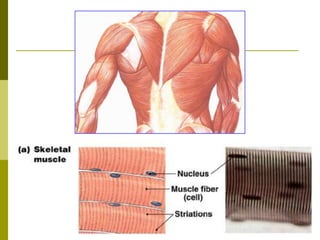
 Skeletal muscle
 Cardiac muscle
 Smooth muscle
Function of Muscles
 1. Support the
body
 2. Allow for
movement by
making bones and
other body parts
move
 3. Maintain
constant body
temperature
 4. Assist in
movement of
cardiovascular
veins and lymph
 5. Protect internal
organs and
stabilize joints
Organization of Skeletal Muscle
Muscle
belly
Fascicle:
a bundle of
muscle fibers
Muscle
Fiber:
muscle cell
Sarcomere:
units of
myofibrils
responsible for
the striated
appearance
Myofibrils:
structures
that make
up a muscle
fiber
Myofilament:
protein
filaments that
make up a
sarcomere
Myosin:
thick
filaments
Actin: thin
filaments
Coverings of a Skeletal Muscle
 Skeletal muscles are
organs
 They contain muscle
fibers, nerves, and blood
vessels
 Connective tissue
membranes separate each
muscle structure
 Fascia – layer of fibrous
tissue that separates
muscles from each other
and from the skin
Coverings from largest to smallest
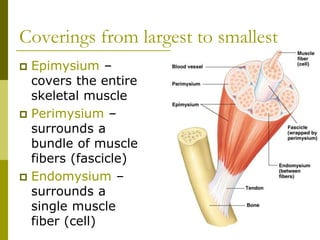
 Epimysium –
covers the entire
skeletal muscle
 Perimysium –
surrounds a
bundle of muscle
fibers (fascicle)
 Endomysium –
surrounds a
single muscle
fiber (cell)
Skeletal Muscle Attachments
 Epimysium blends into a connective tissue
attachment
 Tendon – cord-like structure
 Sites of muscle attachment
 Bones
 Cartilages
 Connective tissue coverings
Microscopic Anatomy of Muscle Fiber
(muscle cell)
 Cells are multinucleate
 Nuclei are just beneath the membrane
 Sarcolemma – specialized plasma
membrane
 Sarcoplasmic reticulum – specialized
smooth endoplasmic reticulum involved in
muscle contraction
 Myofibril
 Bundles of myofilaments
 Myofibrils are aligned to give distinct bands
 Light band = “I band”
 Dark band = “A band”
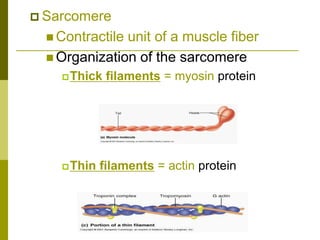
 Sarcomere
 Contractile unit of a muscle fiber
 Organization of the sarcomere
Thick filaments = myosin protein
Thin filaments = actin protein
 Myosin and actin
overlap somewhat
in the sarcomere
 Myosin filaments
have heads
(extensions) that
can ‘grab’ onto
actin forming a
crossbridge
 Skeletal muscles
must be
stimulated by a
nerve (motor
neuron) to
contract
Physiology of Muscle Contraction
 Step 1: Nerve releases a neurotransmitter
(acetylcholine)
Transmission of Nerve Impulse to
Muscle
 Step 2: Neurotransmitter causes the
muscle cell membrane gates to open
 Step 3: Ions (Na+ & K+) exchange places
causing the sarcoplasmic reticulum to
release Ca2+
 Step 4: This release of Ca+ starts the
muscle contraction as the actin filaments
slide past the myosin filaments
The Sliding Filament Theory of Muscle
Contraction
 Sliding Filament Model - a muscle
contracts when the thin filament in the
muscle fiber slides over the thick filament
 Activated by ATP and calcium (Ca+) ions
The Sliding Filament Theory of
Muscle Contraction
 1) An influx of Ca2+ causes thick myosin
filaments to form crossbridges with the
thin actin filament by exposing the binding
site on actin
The Sliding Filament Theory of Muscle
Contraction
 2) The crossbridges change shape as it pulls
on filaments which slides towards the center
of the sacromere in the power stroke
 The distance between the Z line decreases,
shortening the muscle.
 3) The crossbridges detach from the
actin filament when ATP bonds to
myosin head.
The Sliding Filament Theory
 4) The myosin head gets ready to bond to
actin again using ATP energy
 The cycle is repeated on another site of actin
filament using the stored ATP energy
Muscle Contraction
 Physiology of Muscle Contraction
Contraction of a Skeletal Muscle
 Muscle fiber contraction is “all or none”
 Within a skeletal muscle, not all fibers
may be stimulated during the same
interval
 Different combinations of muscle fiber
contractions may give differing responses
 Graded responses – different degrees of
skeletal muscle shortening
 Rapid stimulus = constant contraction or
tetanus
 Muscle force depends upon the
number of fibers stimulated
 More fibers contracting results in
greater muscle tension
 Muscles can continue to contract
unless they run out of ATP or
Ca2+
 One molecule of ATP supplies
enough energy for one actin and
myosin cross-bridge
Energy for Muscle Contraction
 Muscles use stored ATP for energy
 Bonds of ATP are broken to release energy
 Only 4-6 seconds worth of ATP is stored by
muscles
 Three ways for muscle to make energy (ATP)
ATP production
for Muscle
Contraction
Creatine
Phosphate
Cellular
Respiration
Fermentation
(Anaerobic
Respiration)
1. Creatine Phosphate
 Creatine phosphate is a high-energy
compound and is the fastest way to
make ATP available for muscles
 Used for activities lasting < 15
seconds
 Anaerobic (no oxygen needed)
 Reaction:
 Creatine phosphate + ADP ↔ creatine +
ATP
 Creatine phosphate is made when a
muscle is at rest
2. Cellular Respiration
 Mitochondria use glucose
molecules to make ATP in
the presence of oxygen
 Provides most of a muscle’s
ATP
 Aerobic (needs oxygen)
 Used for activities lasting
hours
 Reaction
 C6H12O6 + 6O2  6CO2 +
6H2O + ATP energy
 1 glucose = 36 ATP
3. Anaerobic Respiration/
Fermentation
 Reaction that breaks down
glucose without oxygen
 Used for activities lasting
30 – 60 seconds
 Anaerobic (no oxygen)
 Reaction
 Glucose  pyruvic acid + 2
ATP  lactic acid
 Lactic acid is also
produced and causes pain
in the muscle
 Heavy breathing after exercise is a sign of
oxygen deficiency
 A marathon runner is exhausted after crossing
the finish line because they have depleted not
only their oxygen but their glucose as well
 It takes up to two days to replace all of the
glucose in the muscles and glycogen in the liver
Muscles and Body Movements
 Movement is
attained due to a
muscle moving an
attached bone
 Muscles are attached
to at least two points
 Insertion –
attachment to a
moveable bone
 Origin – attachment
to an immovable
bone
Types of Ordinary Body Movements
 Flexion –
decreases angle of
joint and brings
two bones closer
together
 Extension-
increases angle of
joint
 Rotation- movement of a
bone in longitudinal axis,
shaking head “no”
 Abduction – moving
away from the midline
 Adduction - moving
toward the midline
 Circumduction - cone-
shaped movement,
proximal end doesn’t
move, while distal end
moves in a circle.
Types of Muscles
 Muscles work in opposing pairs
 Ex. Biceps (flexion of arm) and Triceps
(extension of arm)
 Prime mover – muscle that does most of
the work
 Synergist – muscle that helps a prime mover
in a movement
 Antagonist – muscle that opposes or
reverses a prime mover
Naming of Skeletal Muscles
 Direction of muscle fibers
 Example: rectus (straight), orbicularis (circular)
 Relative size of the muscle
 Example: maximus (largest), minimus
(smallest), longus (long), brevis (short)
 Location of the muscle
 Example: pectoralis (chest), external (outside),
frontalis (frontal)
 Number of origins
 Example: triceps (three heads)
 Location of the muscles origin and
insertion
 Example: sterno (on the sternum)
 Shape of the muscle
 Example: deltoid (triangular)
 Action of the muscle
 Example: flexor and extensor (flexes or
extends a bone)
Affects of Aging on Muscles
1. Muscles that are not used are replaced by
connective tissue then by fat
2. With age comes degeneration of
mitochondria due to exposure to oxygen
and free radicals
3. Changes in the nervous system and
endocrine system also effect structure and
function of muscles
4. Muscles become weaker as we age but
exercise can stimulate muscle build-up
 She is 86 years young and a body builder.
 He is 80, and the oldest Iron man triathlon
participant.
(1.2 mile swim, a 56-mile bike and a 13.1 mile
run = 70.3 miles.)
Disorders relating to the Muscular
System
 Muscular Dystrophy: inherited, muscle
enlarge due to increased fat and
connective tissue, but fibers degenerate
and atrophy
 Duchenne MD: lacking a protein to
maintain the sarcolemma
 Myasthemia Gravis: progressive
weakness due to a shortage of
acetylcholine receptors
Sprain verses Strain
 Strain – overstretching of
a muscle near a joint
 Sprain – twisting of a joint
leading to swelling and
injury to ligaments,
tendons, blood vessels and
nerves
Myalgia and Tendinitis
 Myalgia –
inflammation of
muscle tissue
(arthritis on previous
slide)
 Tendinitis –
inflammation of the
tendon due to strain
of repeated activity

muscle.ppt

  • 1.
  • 2.
    The Muscular System Muscles are responsible for all types of body movement – they contract or shorten and are the machine of the body  Three basic muscle types are found in the body  Skeletal muscle  Cardiac muscle  Smooth muscle
  • 4.
    Function of Muscles 1. Support the body  2. Allow for movement by making bones and other body parts move  3. Maintain constant body temperature
  • 5.
     4. Assistin movement of cardiovascular veins and lymph  5. Protect internal organs and stabilize joints
  • 6.
    Organization of SkeletalMuscle Muscle belly Fascicle: a bundle of muscle fibers Muscle Fiber: muscle cell Sarcomere: units of myofibrils responsible for the striated appearance Myofibrils: structures that make up a muscle fiber Myofilament: protein filaments that make up a sarcomere Myosin: thick filaments Actin: thin filaments
  • 9.
    Coverings of aSkeletal Muscle  Skeletal muscles are organs  They contain muscle fibers, nerves, and blood vessels  Connective tissue membranes separate each muscle structure  Fascia – layer of fibrous tissue that separates muscles from each other and from the skin
  • 10.
    Coverings from largestto smallest  Epimysium – covers the entire skeletal muscle  Perimysium – surrounds a bundle of muscle fibers (fascicle)  Endomysium – surrounds a single muscle fiber (cell)
  • 11.
    Skeletal Muscle Attachments Epimysium blends into a connective tissue attachment  Tendon – cord-like structure  Sites of muscle attachment  Bones  Cartilages  Connective tissue coverings
  • 12.
    Microscopic Anatomy ofMuscle Fiber (muscle cell)  Cells are multinucleate  Nuclei are just beneath the membrane
  • 13.
     Sarcolemma –specialized plasma membrane  Sarcoplasmic reticulum – specialized smooth endoplasmic reticulum involved in muscle contraction
  • 14.
     Myofibril  Bundlesof myofilaments  Myofibrils are aligned to give distinct bands  Light band = “I band”  Dark band = “A band”
  • 15.
     Sarcomere  Contractileunit of a muscle fiber  Organization of the sarcomere Thick filaments = myosin protein Thin filaments = actin protein
  • 16.
     Myosin andactin overlap somewhat in the sarcomere  Myosin filaments have heads (extensions) that can ‘grab’ onto actin forming a crossbridge
  • 18.
     Skeletal muscles mustbe stimulated by a nerve (motor neuron) to contract Physiology of Muscle Contraction
  • 19.
     Step 1:Nerve releases a neurotransmitter (acetylcholine) Transmission of Nerve Impulse to Muscle
  • 20.
     Step 2:Neurotransmitter causes the muscle cell membrane gates to open  Step 3: Ions (Na+ & K+) exchange places causing the sarcoplasmic reticulum to release Ca2+  Step 4: This release of Ca+ starts the muscle contraction as the actin filaments slide past the myosin filaments
  • 21.
    The Sliding FilamentTheory of Muscle Contraction  Sliding Filament Model - a muscle contracts when the thin filament in the muscle fiber slides over the thick filament  Activated by ATP and calcium (Ca+) ions
  • 22.
    The Sliding FilamentTheory of Muscle Contraction  1) An influx of Ca2+ causes thick myosin filaments to form crossbridges with the thin actin filament by exposing the binding site on actin
  • 23.
    The Sliding FilamentTheory of Muscle Contraction  2) The crossbridges change shape as it pulls on filaments which slides towards the center of the sacromere in the power stroke  The distance between the Z line decreases, shortening the muscle.
  • 24.
     3) Thecrossbridges detach from the actin filament when ATP bonds to myosin head.
  • 25.
    The Sliding FilamentTheory  4) The myosin head gets ready to bond to actin again using ATP energy  The cycle is repeated on another site of actin filament using the stored ATP energy
  • 28.
    Muscle Contraction  Physiologyof Muscle Contraction
  • 29.
    Contraction of aSkeletal Muscle  Muscle fiber contraction is “all or none”  Within a skeletal muscle, not all fibers may be stimulated during the same interval  Different combinations of muscle fiber contractions may give differing responses  Graded responses – different degrees of skeletal muscle shortening  Rapid stimulus = constant contraction or tetanus
  • 30.
     Muscle forcedepends upon the number of fibers stimulated  More fibers contracting results in greater muscle tension  Muscles can continue to contract unless they run out of ATP or Ca2+  One molecule of ATP supplies enough energy for one actin and myosin cross-bridge
  • 31.
    Energy for MuscleContraction  Muscles use stored ATP for energy  Bonds of ATP are broken to release energy  Only 4-6 seconds worth of ATP is stored by muscles  Three ways for muscle to make energy (ATP) ATP production for Muscle Contraction Creatine Phosphate Cellular Respiration Fermentation (Anaerobic Respiration)
  • 32.
    1. Creatine Phosphate Creatine phosphate is a high-energy compound and is the fastest way to make ATP available for muscles  Used for activities lasting < 15 seconds  Anaerobic (no oxygen needed)  Reaction:  Creatine phosphate + ADP ↔ creatine + ATP  Creatine phosphate is made when a muscle is at rest
  • 33.
    2. Cellular Respiration Mitochondria use glucose molecules to make ATP in the presence of oxygen  Provides most of a muscle’s ATP  Aerobic (needs oxygen)  Used for activities lasting hours  Reaction  C6H12O6 + 6O2  6CO2 + 6H2O + ATP energy  1 glucose = 36 ATP
  • 34.
    3. Anaerobic Respiration/ Fermentation Reaction that breaks down glucose without oxygen  Used for activities lasting 30 – 60 seconds  Anaerobic (no oxygen)  Reaction  Glucose  pyruvic acid + 2 ATP  lactic acid  Lactic acid is also produced and causes pain in the muscle
  • 35.
     Heavy breathingafter exercise is a sign of oxygen deficiency  A marathon runner is exhausted after crossing the finish line because they have depleted not only their oxygen but their glucose as well  It takes up to two days to replace all of the glucose in the muscles and glycogen in the liver
  • 36.
    Muscles and BodyMovements  Movement is attained due to a muscle moving an attached bone  Muscles are attached to at least two points  Insertion – attachment to a moveable bone  Origin – attachment to an immovable bone
  • 37.
    Types of OrdinaryBody Movements  Flexion – decreases angle of joint and brings two bones closer together  Extension- increases angle of joint
  • 38.
     Rotation- movementof a bone in longitudinal axis, shaking head “no”  Abduction – moving away from the midline  Adduction - moving toward the midline  Circumduction - cone- shaped movement, proximal end doesn’t move, while distal end moves in a circle.
  • 39.
    Types of Muscles Muscles work in opposing pairs  Ex. Biceps (flexion of arm) and Triceps (extension of arm)  Prime mover – muscle that does most of the work  Synergist – muscle that helps a prime mover in a movement  Antagonist – muscle that opposes or reverses a prime mover
  • 40.
    Naming of SkeletalMuscles  Direction of muscle fibers  Example: rectus (straight), orbicularis (circular)  Relative size of the muscle  Example: maximus (largest), minimus (smallest), longus (long), brevis (short)  Location of the muscle  Example: pectoralis (chest), external (outside), frontalis (frontal)  Number of origins  Example: triceps (three heads)
  • 41.
     Location ofthe muscles origin and insertion  Example: sterno (on the sternum)  Shape of the muscle  Example: deltoid (triangular)  Action of the muscle  Example: flexor and extensor (flexes or extends a bone)
  • 42.
    Affects of Agingon Muscles 1. Muscles that are not used are replaced by connective tissue then by fat 2. With age comes degeneration of mitochondria due to exposure to oxygen and free radicals 3. Changes in the nervous system and endocrine system also effect structure and function of muscles 4. Muscles become weaker as we age but exercise can stimulate muscle build-up
  • 43.
     She is86 years young and a body builder.  He is 80, and the oldest Iron man triathlon participant. (1.2 mile swim, a 56-mile bike and a 13.1 mile run = 70.3 miles.)
  • 44.
    Disorders relating tothe Muscular System  Muscular Dystrophy: inherited, muscle enlarge due to increased fat and connective tissue, but fibers degenerate and atrophy  Duchenne MD: lacking a protein to maintain the sarcolemma  Myasthemia Gravis: progressive weakness due to a shortage of acetylcholine receptors
  • 45.
    Sprain verses Strain Strain – overstretching of a muscle near a joint  Sprain – twisting of a joint leading to swelling and injury to ligaments, tendons, blood vessels and nerves
  • 46.
    Myalgia and Tendinitis Myalgia – inflammation of muscle tissue (arthritis on previous slide)  Tendinitis – inflammation of the tendon due to strain of repeated activity