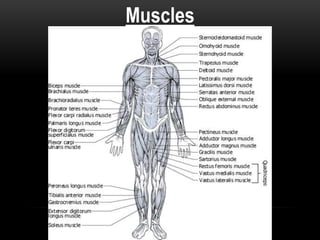
MUSCLE
Dr. Seyed Morteza Mahmoudi,
MBBS
MUSCULAR SYSTEM
For the students of Gulf Medical University, Ajman, PharmD
LECTURE 21

Dr. Seyed Morteza Mahmoudi, MBBS
Gulf Medical University, Ajman
LEARNING OBJECTIVE

• Define muscle
• Understand the gross and
microscopic structure of
muscle
• What are the various
classifications of muscles?
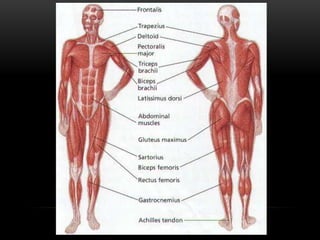
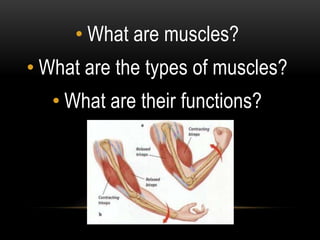
• What are muscles?
• What are the types of muscles?
• What are their functions?
• There are approximately 639 skeletal muscles in the
human body.
Functions of skeletal muscle
1. Movement:
2. Support and posture maintain a constant state of slight
contraction – muscle tonus.
3. Heat production: The contraction of skeletal muscle
involves the production of energy, the by-product of which is
heat.
Functions
•Prime movers- chief muscle for primary movement
•Antagonists-opposing action of prime mover
•Fixators (increase tone but not movement) eg
shoulder girdle to trunk muscles for deltoid to act.

•Synergists –acting on intermediate joints to prevent
unwanted movements eg.. Flexor and extensors of carpus
on wrist to facilitate efficient movement of digits.
Visceral muscles are smooth and without banding.
They have short fibres and single cell nuclei.
These are involuntary muscles

Sites
•Walls of blood vessels and viscera (organs in the abdominal cavity).
•Sphincter & dilator pupillae

•Orbitalis muscle in orbit and Muller’s muscle in upper eyelid
•Dartos muscle in scrotum

•Arrector pilorum of hair follicle.
•Myoepithelial cells in glands
A muscle has 2 attachments
•Origin- the attachment that moves
the least
•Insertion- the attachment that
moves the most
•Belly- fleshy part of a muscle
•Tendon- end of a muscle that is
attached to bones, cartilage or
ligaments
•Aponeuroses- a flattened tendon
•Raphe- interdigitation of tendinous
ends of a flat muscle
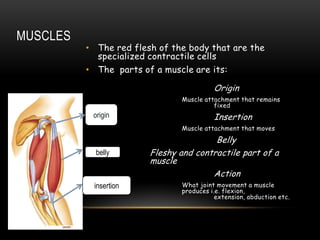
MUSCLES

• The red flesh of the body that are the
specialized contractile cells
• The parts of a muscle are its:
Origin
Muscle attachment that remains
fixed

origin

Insertion
Muscle attachment that moves

belly

insertion

Belly
Fleshy and contractile part of a
muscle
Action
What joint movement a muscle
produces i.e. flexion,
extension, abduction etc.
•

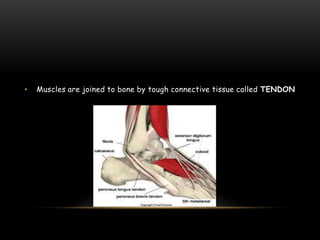
Muscles are joined to bone by tough connective tissue called TENDON
CLASSIFIED

i)Voluntary muscle-under one’s control
and Involuntary muscles-not under
willful control
ii)Striated muscle-appears striated
under microscope;
Smooth/unstriated- appears
unstriped/unstriated

iii)Somatic muscle- makes up the body
wall and limbs.Visceral musclesmuscular component of hallow organs
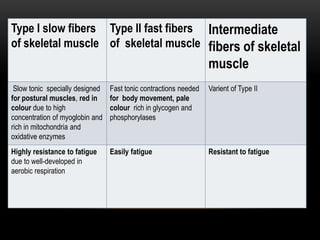
Type I slow fibers Type II fast fibers Intermediate
of skeletal muscle of skeletal muscle fibers of skeletal

muscle
Slow tonic specially designed
for postural muscles, red in
colour due to high
concentration of myoglobin and
rich in mitochondria and
oxidative enzymes

Fast tonic contractions needed
for body movement, pale
colour rich in glycogen and
phosphorylases

Varient of Type II

Highly resistance to fatigue
due to well-developed in
aerobic respiration

Easily fatigue

Resistant to fatigue
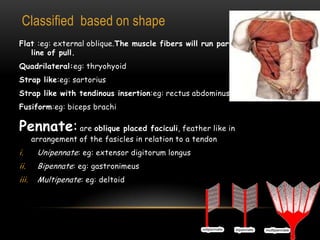
Classified based on shape
Flat :eg: external oblique.The muscle fibers will run paralle to the
line of pull.
Quadrilateral:eg: thryohyoid

Strap like:eg: sartorius
Strap like with tendinous insertion:eg: rectus abdominus
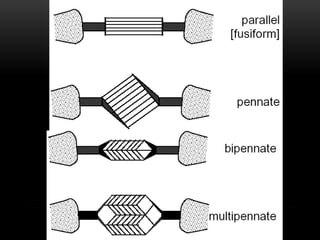
Fusiform:eg: biceps brachi

Pennate: are oblique placed faciculi, feather like in
arrangement of the fasicles in relation to a tendon

i.

Unipennate: eg: extensor digitorum longus

ii.

Bipennate: eg: gastronimeus

iii.

Multipenate : eg: deltoid
•

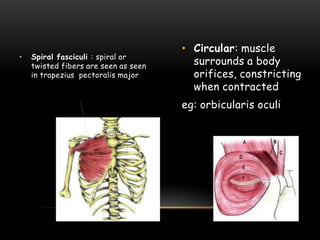
Spiral fasciculi : spiral or
twisted fibers are seen as seen
in trapezius pectoralis major

• Circular: muscle
surrounds a body
orifices, constricting
when contracted
eg: orbicularis oculi
Classified based on movement
Prime mover: A muscle that is
chiefly responsible for a
particular movement
Antagonist: A muscle that opposes
the action of a prime mover
Synergist: A muscle that prevents
unwanted movements in an
intermediate joint where the
another muscle crosses that
joint. To prevent unwanted
movements and stabilizes the
intermediate joints.
Fixator: A muscle that contracts
isometrically, to stabilize the
origin of the prime mover so
that it can act efficiently

Concentric action: the
muscle length shortens
to produce a movement
Isometric action :the
muscle length remains
constant on producing a
movement
Excentric action: the
muscle lengthens when
active
Range of contraction
• Active
insufficiency:
normally muscles
contract 40%of its
fully stretched
state. This
limitation in the
range affects all
muscles that act on
several joints
simultaneously, thus
unable to shorten to
produce full range

•

Passive insufficiency: the
opposing muscle unable to
stretch beyond a certain length
to allow full range of movement
is Passive insufficiency.
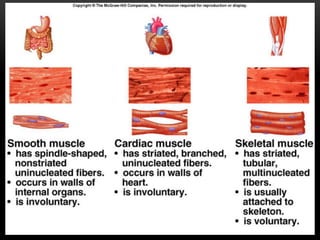
Muscles
Types

Muscles

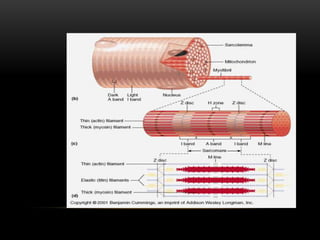
Skeletal muscles are striated (have distinct bands) made up of
fibres (long cells). – 30cm!!!!

The cells are multinucleated (many cell nuclei) and contract and relax
quickly.
These are voluntary muscles attached to the skeleton that help to
move the bones.
There are nearly 700 skeletal muscles spread all over the body.
Ends attached to bones, cartilage or ligaments by tendons,
aponeuroses
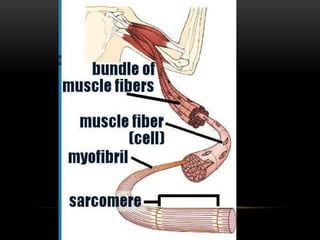
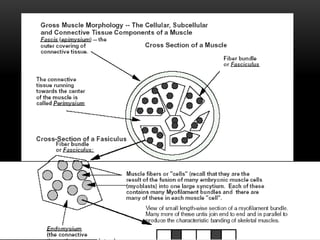
Structure of a muscle
Properties of skeletal muscle
1. Extensibility – the ability of muscle tissue to lengthen when
contracting
2. Elasticity – the ability of muscle tissue to return to its normal
resting length after being stretched, allowing repeated contractions
3. Contractility – the capacity of a muscle to contract or shorten
forcibly when stimulated by nerves or hormones (excitability).

4. Controlled by nerve stimuli.

5. Will atrophy (waste) –inadequate blood supply
6. Will hypertrophy -overworked
•Raphe is between 2 flat muscles serving as an
attachment
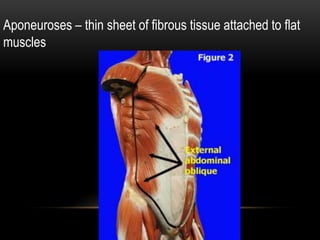
Aponeuroses – thin sheet of fibrous tissue attached to flat
muscles
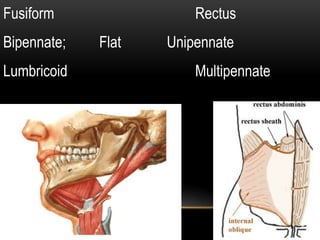
Different forms
Rhomboid
Strap muscles
Fusiform
Bipennate;

Lumbricoid

Rectus
Flat

Unipennate

Multipennate
Introduction to Anatomy (Muscular System)

Introduction to Anatomy (Muscular System)

  • 1.
  • 2.
    MUSCULAR SYSTEM For thestudents of Gulf Medical University, Ajman, PharmD LECTURE 21 Dr. Seyed Morteza Mahmoudi, MBBS Gulf Medical University, Ajman
  • 3.
    LEARNING OBJECTIVE • Definemuscle • Understand the gross and microscopic structure of muscle • What are the various classifications of muscles?
  • 5.
    • What aremuscles? • What are the types of muscles? • What are their functions?
  • 8.
    • There areapproximately 639 skeletal muscles in the human body.
  • 9.
    Functions of skeletalmuscle 1. Movement: 2. Support and posture maintain a constant state of slight contraction – muscle tonus. 3. Heat production: The contraction of skeletal muscle involves the production of energy, the by-product of which is heat.
  • 10.
    Functions •Prime movers- chiefmuscle for primary movement •Antagonists-opposing action of prime mover •Fixators (increase tone but not movement) eg shoulder girdle to trunk muscles for deltoid to act. •Synergists –acting on intermediate joints to prevent unwanted movements eg.. Flexor and extensors of carpus on wrist to facilitate efficient movement of digits.
  • 11.
    Visceral muscles aresmooth and without banding. They have short fibres and single cell nuclei. These are involuntary muscles Sites •Walls of blood vessels and viscera (organs in the abdominal cavity). •Sphincter & dilator pupillae •Orbitalis muscle in orbit and Muller’s muscle in upper eyelid •Dartos muscle in scrotum •Arrector pilorum of hair follicle. •Myoepithelial cells in glands
  • 12.
    A muscle has2 attachments •Origin- the attachment that moves the least •Insertion- the attachment that moves the most •Belly- fleshy part of a muscle •Tendon- end of a muscle that is attached to bones, cartilage or ligaments •Aponeuroses- a flattened tendon •Raphe- interdigitation of tendinous ends of a flat muscle
  • 14.
    MUSCLES • The redflesh of the body that are the specialized contractile cells • The parts of a muscle are its: Origin Muscle attachment that remains fixed origin Insertion Muscle attachment that moves belly insertion Belly Fleshy and contractile part of a muscle Action What joint movement a muscle produces i.e. flexion, extension, abduction etc.
  • 15.
    • Muscles are joinedto bone by tough connective tissue called TENDON
  • 16.
    CLASSIFIED i)Voluntary muscle-under one’scontrol and Involuntary muscles-not under willful control ii)Striated muscle-appears striated under microscope; Smooth/unstriated- appears unstriped/unstriated iii)Somatic muscle- makes up the body wall and limbs.Visceral musclesmuscular component of hallow organs
  • 18.
    Type I slowfibers Type II fast fibers Intermediate of skeletal muscle of skeletal muscle fibers of skeletal muscle Slow tonic specially designed for postural muscles, red in colour due to high concentration of myoglobin and rich in mitochondria and oxidative enzymes Fast tonic contractions needed for body movement, pale colour rich in glycogen and phosphorylases Varient of Type II Highly resistance to fatigue due to well-developed in aerobic respiration Easily fatigue Resistant to fatigue
  • 19.
    Classified based onshape Flat :eg: external oblique.The muscle fibers will run paralle to the line of pull. Quadrilateral:eg: thryohyoid Strap like:eg: sartorius Strap like with tendinous insertion:eg: rectus abdominus Fusiform:eg: biceps brachi Pennate: are oblique placed faciculi, feather like in arrangement of the fasicles in relation to a tendon i. Unipennate: eg: extensor digitorum longus ii. Bipennate: eg: gastronimeus iii. Multipenate : eg: deltoid
  • 20.
    • Spiral fasciculi :spiral or twisted fibers are seen as seen in trapezius pectoralis major • Circular: muscle surrounds a body orifices, constricting when contracted eg: orbicularis oculi
  • 21.
    Classified based onmovement Prime mover: A muscle that is chiefly responsible for a particular movement Antagonist: A muscle that opposes the action of a prime mover Synergist: A muscle that prevents unwanted movements in an intermediate joint where the another muscle crosses that joint. To prevent unwanted movements and stabilizes the intermediate joints. Fixator: A muscle that contracts isometrically, to stabilize the origin of the prime mover so that it can act efficiently Concentric action: the muscle length shortens to produce a movement Isometric action :the muscle length remains constant on producing a movement Excentric action: the muscle lengthens when active
  • 22.
    Range of contraction •Active insufficiency: normally muscles contract 40%of its fully stretched state. This limitation in the range affects all muscles that act on several joints simultaneously, thus unable to shorten to produce full range • Passive insufficiency: the opposing muscle unable to stretch beyond a certain length to allow full range of movement is Passive insufficiency.
  • 25.
  • 26.
    Types Muscles Skeletal muscles arestriated (have distinct bands) made up of fibres (long cells). – 30cm!!!! The cells are multinucleated (many cell nuclei) and contract and relax quickly. These are voluntary muscles attached to the skeleton that help to move the bones. There are nearly 700 skeletal muscles spread all over the body. Ends attached to bones, cartilage or ligaments by tendons, aponeuroses
  • 27.
  • 30.
    Properties of skeletalmuscle 1. Extensibility – the ability of muscle tissue to lengthen when contracting 2. Elasticity – the ability of muscle tissue to return to its normal resting length after being stretched, allowing repeated contractions 3. Contractility – the capacity of a muscle to contract or shorten forcibly when stimulated by nerves or hormones (excitability). 4. Controlled by nerve stimuli. 5. Will atrophy (waste) –inadequate blood supply 6. Will hypertrophy -overworked
  • 31.
    •Raphe is between2 flat muscles serving as an attachment
  • 32.
    Aponeuroses – thinsheet of fibrous tissue attached to flat muscles
  • 33.
  • 34.
  • 35.