Chapter 11:

Alkanes

K. Dunlap

Chem 104
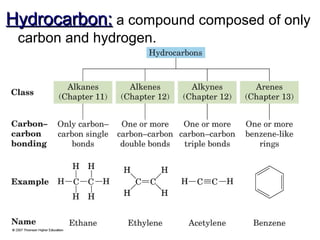
Hydrocarbon: a compound composed of only
carbon and hydrogen.
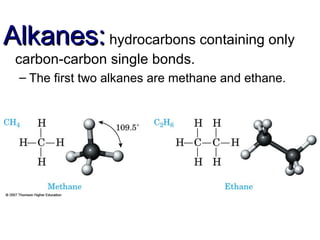
Alkanes: hydrocarbons containing only
carbon-carbon single bonds.

– The first two alkanes are methane and ethane.
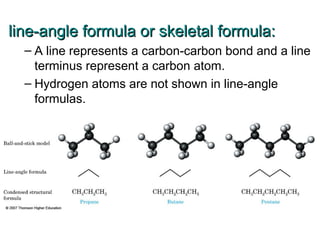
line-angle formula or skeletal formula:
– A line represents a carbon-carbon bond and a line
terminus represent a carbon atom.
– Hydrogen atoms are not shown in line-angle
formulas.
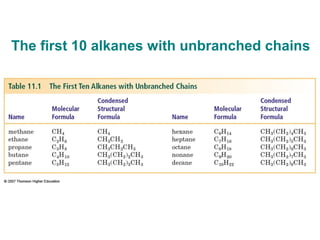
The first 10 alkanes with unbranched chains
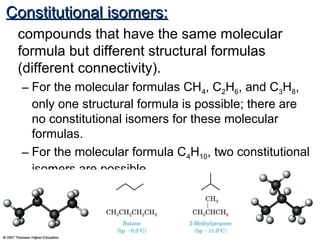
Constitutional isomers:
compounds that have the same molecular
formula but different structural formulas
(different connectivity).
– For the molecular formulas CH4, C2H6, and C3H8,
only one structural formula is possible; there are
no constitutional isomers for these molecular
formulas.
– For the molecular formula C4H10, two constitutional
isomers are possible.
Constitutional isomers
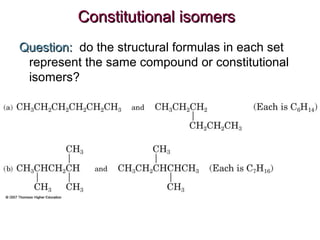
Question: do the structural formulas in each set
represent the same compound or constitutional
isomers?
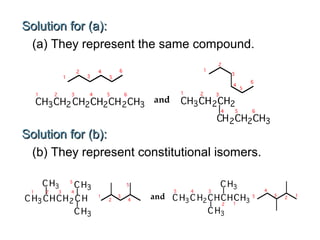
Solution for (a):
(a) They represent the same compound.

Solution for (b):
(b) They represent constitutional isomers.
Constitutional isomers
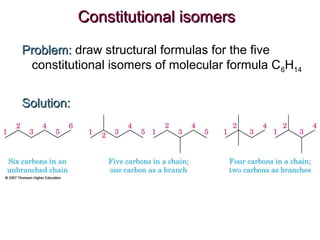
Problem: draw structural formulas for the five
constitutional isomers of molecular formula C 6H14
Solution:
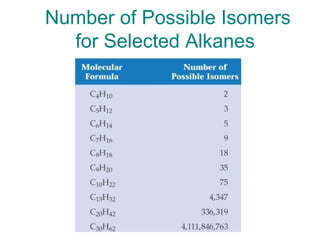
Number of Possible Isomers
for Selected Alkanes
Naming Alkanes
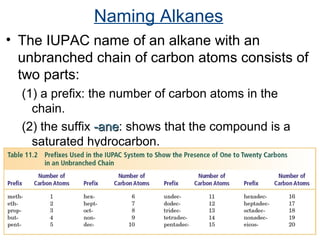
• The IUPAC name of an alkane with an
unbranched chain of carbon atoms consists of
two parts:
(1) a prefix: the number of carbon atoms in the
chain.
(2) the suffix -ane: shows that the compound is a
-ane
saturated hydrocarbon.
Naming Alkanes
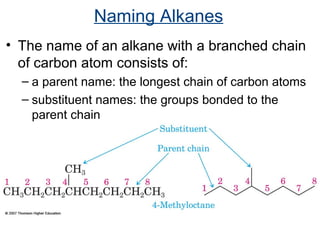
• The name of an alkane with a branched chain
of carbon atom consists of:
– a parent name: the longest chain of carbon atoms
– substituent names: the groups bonded to the
parent chain
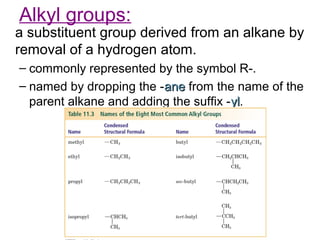
Alkyl groups:

a substituent group derived from an alkane by
removal of a hydrogen atom.
– commonly represented by the symbol R-.
– named by dropping the -ane from the name of the
parent alkane and adding the suffix - yl.
yl
Naming Alkanes
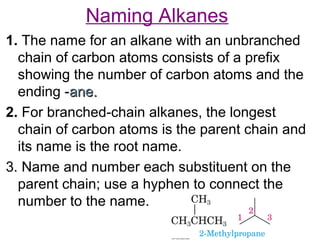
1. The name for an alkane with an unbranched
chain of carbon atoms consists of a prefix
showing the number of carbon atoms and the
ending -ane.
2. For branched-chain alkanes, the longest
chain of carbon atoms is the parent chain and
its name is the root name.
3. Name and number each substituent on the
parent chain; use a hyphen to connect the
number to the name.
Naming Alkanes…
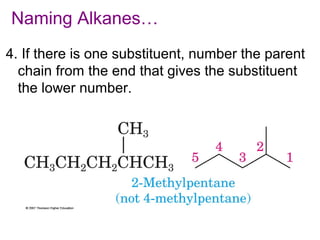
4. If there is one substituent, number the parent
chain from the end that gives the substituent
the lower number.
Naming Alkanes…
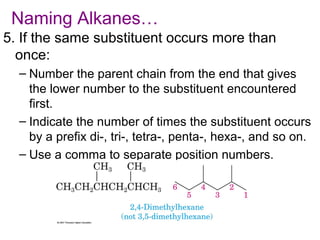
5. If the same substituent occurs more than
once:
– Number the parent chain from the end that gives
the lower number to the substituent encountered
first.
– Indicate the number of times the substituent occurs
by a prefix di-, tri-, tetra-, penta-, hexa-, and so on.
– Use a comma to separate position numbers.
Naming Alkanes…
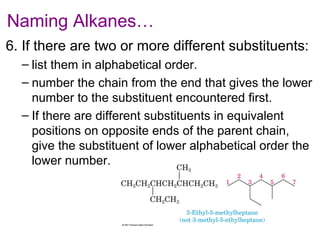
6. If there are two or more different substituents:
– list them in alphabetical order.
– number the chain from the end that gives the lower
number to the substituent encountered first.
– If there are different substituents in equivalent
positions on opposite ends of the parent chain,
give the substituent of lower alphabetical order the
lower number.
Naming Alkanes…
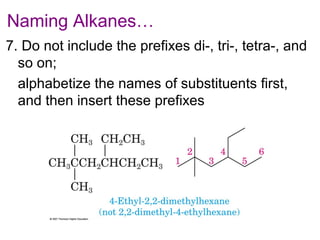
7. Do not include the prefixes di-, tri-, tetra-, and
so on;
alphabetize the names of substituents first,
and then insert these prefixes
Naming Cycloalkanes:
• Cyclic hydrocarbon: a hydrocarbon that
contains carbon atoms joined to form a ring.
• Cycloalkane: a cyclic hydrocarbon in which all
carbons of the ring are saturated.
– Cycloalkanes of ring sizes ranging from 3 to over
30 carbon atoms are found in nature.
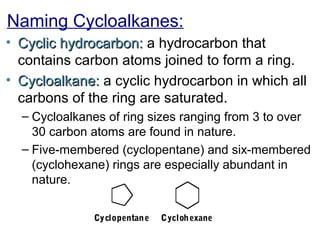
– Five-membered (cyclopentane) and six-membered
(cyclohexane) rings are especially abundant in
nature.
Cyclopentan e

Cycloh exane
• Nomenclature
– To name a cycloalkane, prefix the name of the
corresponding open-chain alkane with cyclo-, and
name each substituent on the ring.
– If there is only one substituent on the ring, there is
no need to give it a location number.
– If there are two substituents, number the ring
beginning with the substituent of lower alphabetical
order.
1

Isopropylcyclopentane

4

1-tert- Butyl-4-methylcyclohexane
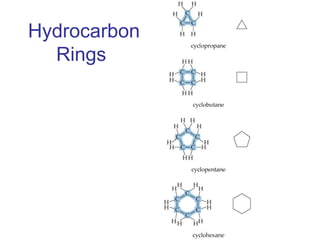
Hydrocarbon
Rings
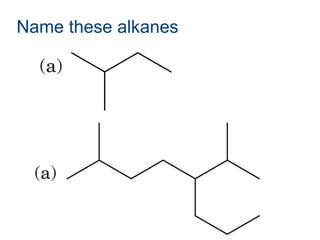
Name these alkanes
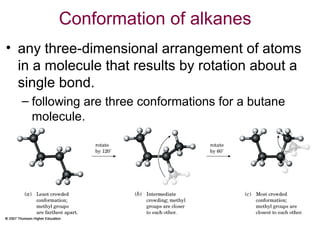
Conformation of alkanes
• any three-dimensional arrangement of atoms
in a molecule that results by rotation about a
single bond.
– following are three conformations for a butane
molecule.
Physical properties of Alkane
• The most important physical property of
alkanes and cycloalkanes is their almost
complete lack of polarity.
– The electronegativity difference between carbon
and hydrogen is 2.5 - 2.1 = 0.4 on the Pauling
scale.
– Given this small difference, we classify a C-H bond
as nonpolar covalent.
– Alkanes are nonpolar compounds and the only
interaction between their molecules are the very
weak London dispersion forces.
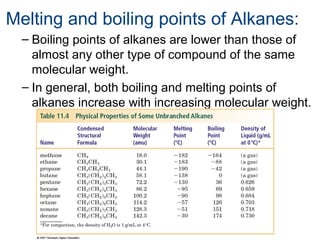
Melting and boiling points of Alkanes:
– Boiling points of alkanes are lower than those of
almost any other type of compound of the same
molecular weight.
– In general, both boiling and melting points of
alkanes increase with increasing molecular weight.
Physical properties Cont…
• Solubility: a case of “like dissolves like”.
– Alkanes are not soluble in water; they are unable
to form hydrogen bonds with water.
– Alkanes are soluble in each other.
– Alkanes are also soluble in other nonpolar organic
compounds, such as toluene and diethyl ether.

• Density
– The average density of the liquid alkanes listed in
Table 11.4 is about 0.7 g/mL; that of highermolecular-weight alkanes is about 0.8 g/mL.
– All liquid and solid alkanes are less dense than
water (1.0 g/mL) and, because they are insoluble
in water, they float on water.
Where do hydrocarbons come from?
1) Natural gas
– 90 to 95 percent methane
– 5 to 10 percent ethane, and
– a mixture of other relatively low-boiling alkanes,
chiefly propane, butane, and 2-methylpropane.

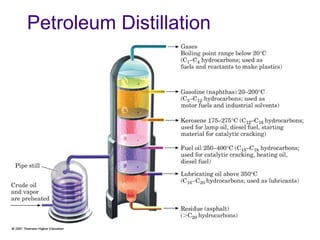
2) Petroleum
– A thick, viscous liquid mixture of thousands of
compounds, most of them hydrocarbons formed
from the decomposition of marine plants and
animals.
Petroleum Distillation
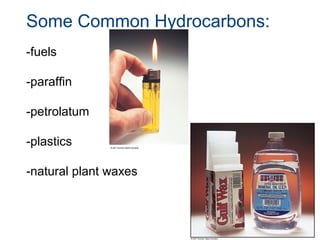
Some Common Hydrocarbons:
-fuels
-paraffin
-petrolatum
-plastics
-natural plant waxes
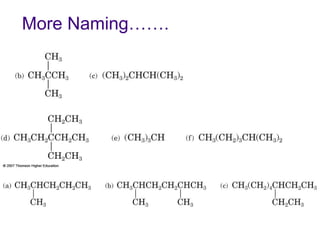
More Naming…….

Alkanes

  • 1.
  • 2.
    Hydrocarbon: a compoundcomposed of only carbon and hydrogen.
  • 3.
    Alkanes: hydrocarbons containingonly carbon-carbon single bonds. – The first two alkanes are methane and ethane.
  • 4.
    line-angle formula orskeletal formula: – A line represents a carbon-carbon bond and a line terminus represent a carbon atom. – Hydrogen atoms are not shown in line-angle formulas.
  • 5.
    The first 10alkanes with unbranched chains
  • 6.
    Constitutional isomers: compounds thathave the same molecular formula but different structural formulas (different connectivity). – For the molecular formulas CH4, C2H6, and C3H8, only one structural formula is possible; there are no constitutional isomers for these molecular formulas. – For the molecular formula C4H10, two constitutional isomers are possible.
  • 7.
    Constitutional isomers Question: dothe structural formulas in each set represent the same compound or constitutional isomers?
  • 8.
    Solution for (a): (a)They represent the same compound. Solution for (b): (b) They represent constitutional isomers.
  • 9.
    Constitutional isomers Problem: drawstructural formulas for the five constitutional isomers of molecular formula C 6H14 Solution:
  • 10.
    Number of PossibleIsomers for Selected Alkanes
  • 11.
    Naming Alkanes • TheIUPAC name of an alkane with an unbranched chain of carbon atoms consists of two parts: (1) a prefix: the number of carbon atoms in the chain. (2) the suffix -ane: shows that the compound is a -ane saturated hydrocarbon.
  • 12.
    Naming Alkanes • Thename of an alkane with a branched chain of carbon atom consists of: – a parent name: the longest chain of carbon atoms – substituent names: the groups bonded to the parent chain
  • 13.
    Alkyl groups: a substituentgroup derived from an alkane by removal of a hydrogen atom. – commonly represented by the symbol R-. – named by dropping the -ane from the name of the parent alkane and adding the suffix - yl. yl
  • 14.
    Naming Alkanes 1. Thename for an alkane with an unbranched chain of carbon atoms consists of a prefix showing the number of carbon atoms and the ending -ane. 2. For branched-chain alkanes, the longest chain of carbon atoms is the parent chain and its name is the root name. 3. Name and number each substituent on the parent chain; use a hyphen to connect the number to the name.
  • 15.
    Naming Alkanes… 4. Ifthere is one substituent, number the parent chain from the end that gives the substituent the lower number.
  • 16.
    Naming Alkanes… 5. Ifthe same substituent occurs more than once: – Number the parent chain from the end that gives the lower number to the substituent encountered first. – Indicate the number of times the substituent occurs by a prefix di-, tri-, tetra-, penta-, hexa-, and so on. – Use a comma to separate position numbers.
  • 17.
    Naming Alkanes… 6. Ifthere are two or more different substituents: – list them in alphabetical order. – number the chain from the end that gives the lower number to the substituent encountered first. – If there are different substituents in equivalent positions on opposite ends of the parent chain, give the substituent of lower alphabetical order the lower number.
  • 18.
    Naming Alkanes… 7. Donot include the prefixes di-, tri-, tetra-, and so on; alphabetize the names of substituents first, and then insert these prefixes
  • 19.
    Naming Cycloalkanes: • Cyclichydrocarbon: a hydrocarbon that contains carbon atoms joined to form a ring. • Cycloalkane: a cyclic hydrocarbon in which all carbons of the ring are saturated. – Cycloalkanes of ring sizes ranging from 3 to over 30 carbon atoms are found in nature. – Five-membered (cyclopentane) and six-membered (cyclohexane) rings are especially abundant in nature. Cyclopentan e Cycloh exane
  • 20.
    • Nomenclature – Toname a cycloalkane, prefix the name of the corresponding open-chain alkane with cyclo-, and name each substituent on the ring. – If there is only one substituent on the ring, there is no need to give it a location number. – If there are two substituents, number the ring beginning with the substituent of lower alphabetical order. 1 Isopropylcyclopentane 4 1-tert- Butyl-4-methylcyclohexane
  • 21.
  • 22.
  • 23.
    Conformation of alkanes •any three-dimensional arrangement of atoms in a molecule that results by rotation about a single bond. – following are three conformations for a butane molecule.
  • 24.
    Physical properties ofAlkane • The most important physical property of alkanes and cycloalkanes is their almost complete lack of polarity. – The electronegativity difference between carbon and hydrogen is 2.5 - 2.1 = 0.4 on the Pauling scale. – Given this small difference, we classify a C-H bond as nonpolar covalent. – Alkanes are nonpolar compounds and the only interaction between their molecules are the very weak London dispersion forces.
  • 25.
    Melting and boilingpoints of Alkanes: – Boiling points of alkanes are lower than those of almost any other type of compound of the same molecular weight. – In general, both boiling and melting points of alkanes increase with increasing molecular weight.
  • 26.
    Physical properties Cont… •Solubility: a case of “like dissolves like”. – Alkanes are not soluble in water; they are unable to form hydrogen bonds with water. – Alkanes are soluble in each other. – Alkanes are also soluble in other nonpolar organic compounds, such as toluene and diethyl ether. • Density – The average density of the liquid alkanes listed in Table 11.4 is about 0.7 g/mL; that of highermolecular-weight alkanes is about 0.8 g/mL. – All liquid and solid alkanes are less dense than water (1.0 g/mL) and, because they are insoluble in water, they float on water.
  • 27.
    Where do hydrocarbonscome from? 1) Natural gas – 90 to 95 percent methane – 5 to 10 percent ethane, and – a mixture of other relatively low-boiling alkanes, chiefly propane, butane, and 2-methylpropane. 2) Petroleum – A thick, viscous liquid mixture of thousands of compounds, most of them hydrocarbons formed from the decomposition of marine plants and animals.
  • 28.
  • 29.
  • 30.