ALKANES
Md. Saiful Islam
BPharm, MSc
North South University
Fb Group: Pharmacy Universe
Carbon
• Carbon has four valence electrons; hydrogen has one.
•
• C • H •
•
• To obtain an octet, carbon forms four bonds.
H H
• •
H  C  H H C H CH4 , methane
• •
H HH
Review
Hydrocarbons
Large family of organic compounds
Composed of only carbon and hydrogen
Saturated hydrocarbons
Alkanes
Unsaturated hydrocarbons
Alkenes, Alkynes & Aromatics
C - C C = C C C
C
C
C
C
C
C
H
H
H
H
H
H
A Kekulé structure
showing all atoms
A Kekulé structure
as a line-angle formula
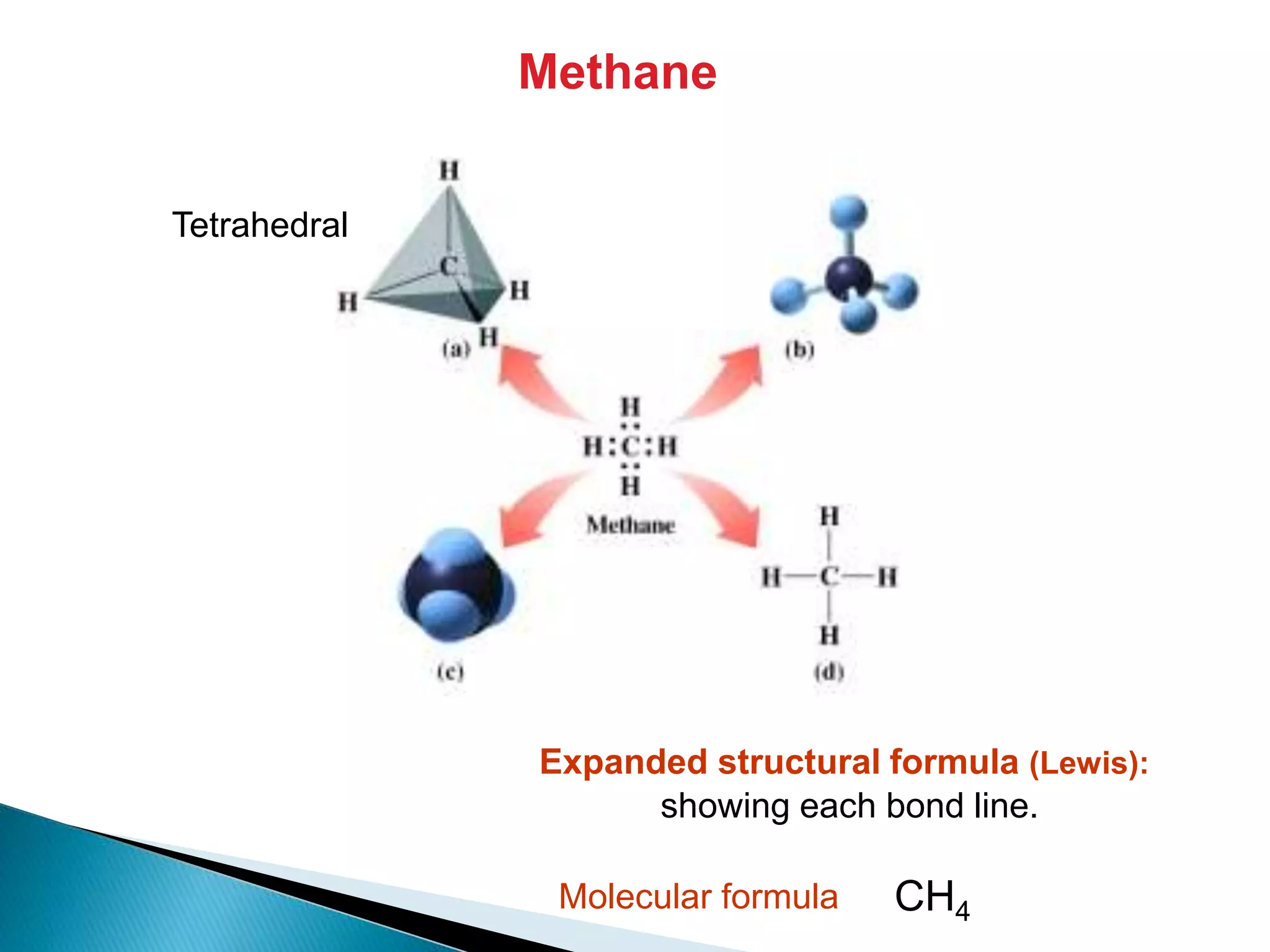
Methane
Tetrahedral
Expanded structural formula (Lewis):
showing each bond line.
CH4Molecular formula
-The most simple of hydrocarbons species
-Entirely composed of single bond and
saturated in Hydrogen
-Suffixe –ane
-General formula:
CnH2n+2 (non-cyclic)
ALKANES Characteristics:
-Same for all alkane structure (following CH4)
-Covalent, weakly polar bonds: C, H same
electronegativity
-Boiling point increase by 20 or 30 degrees for each
carbon added (except for very small alkanes, same
tendency for M.P but less regular).
-C1 to C4: gases, C5-C17: liquid, +C18: solid
-Insoluble in water, dilute acids and bases and
concentrated H2SO4
Physical properties:
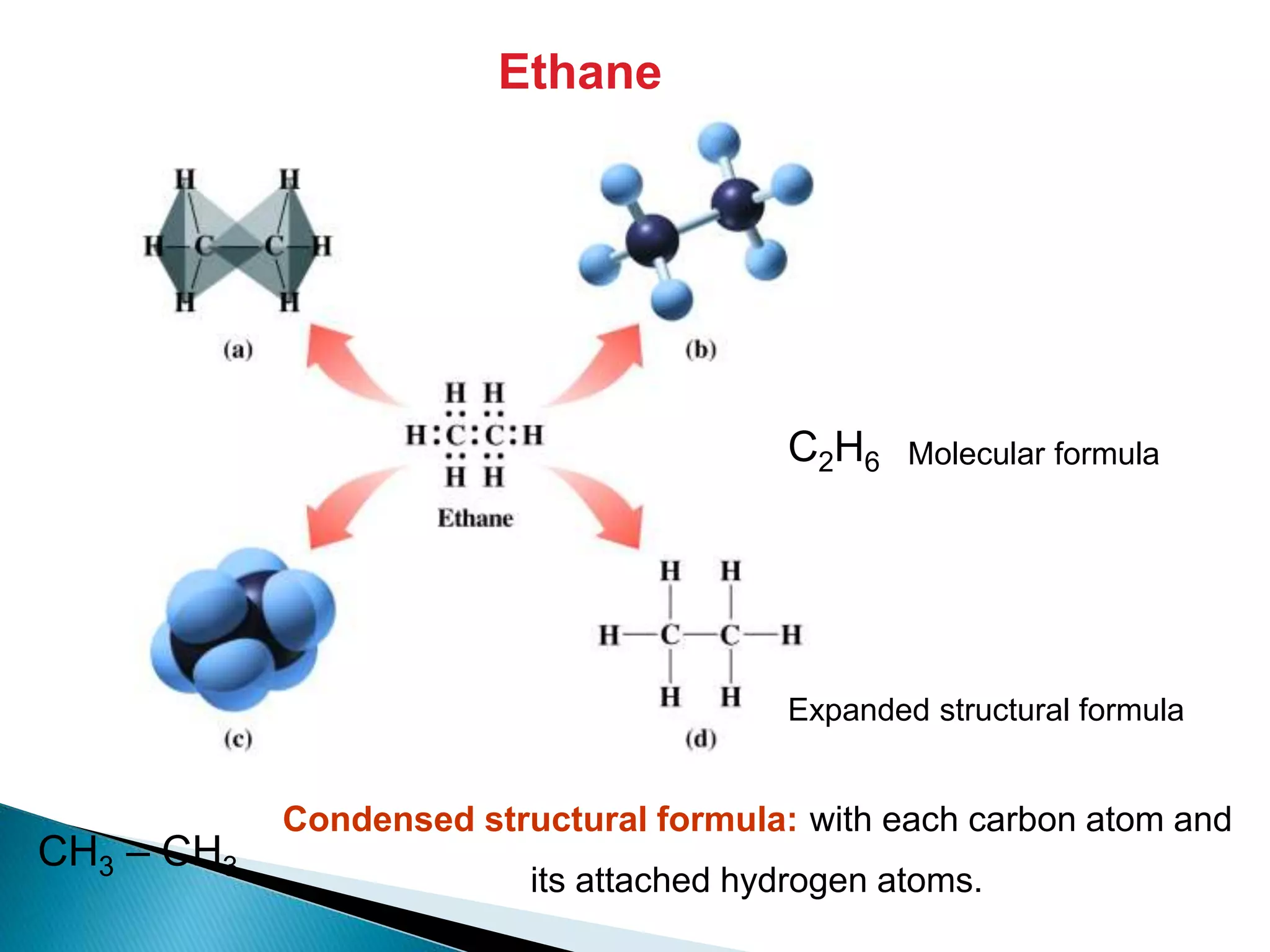
Ethane
C2H6 Molecular formula
Expanded structural formula
CH3 – CH3
Condensed structural formula: with each carbon atom and
its attached hydrogen atoms.
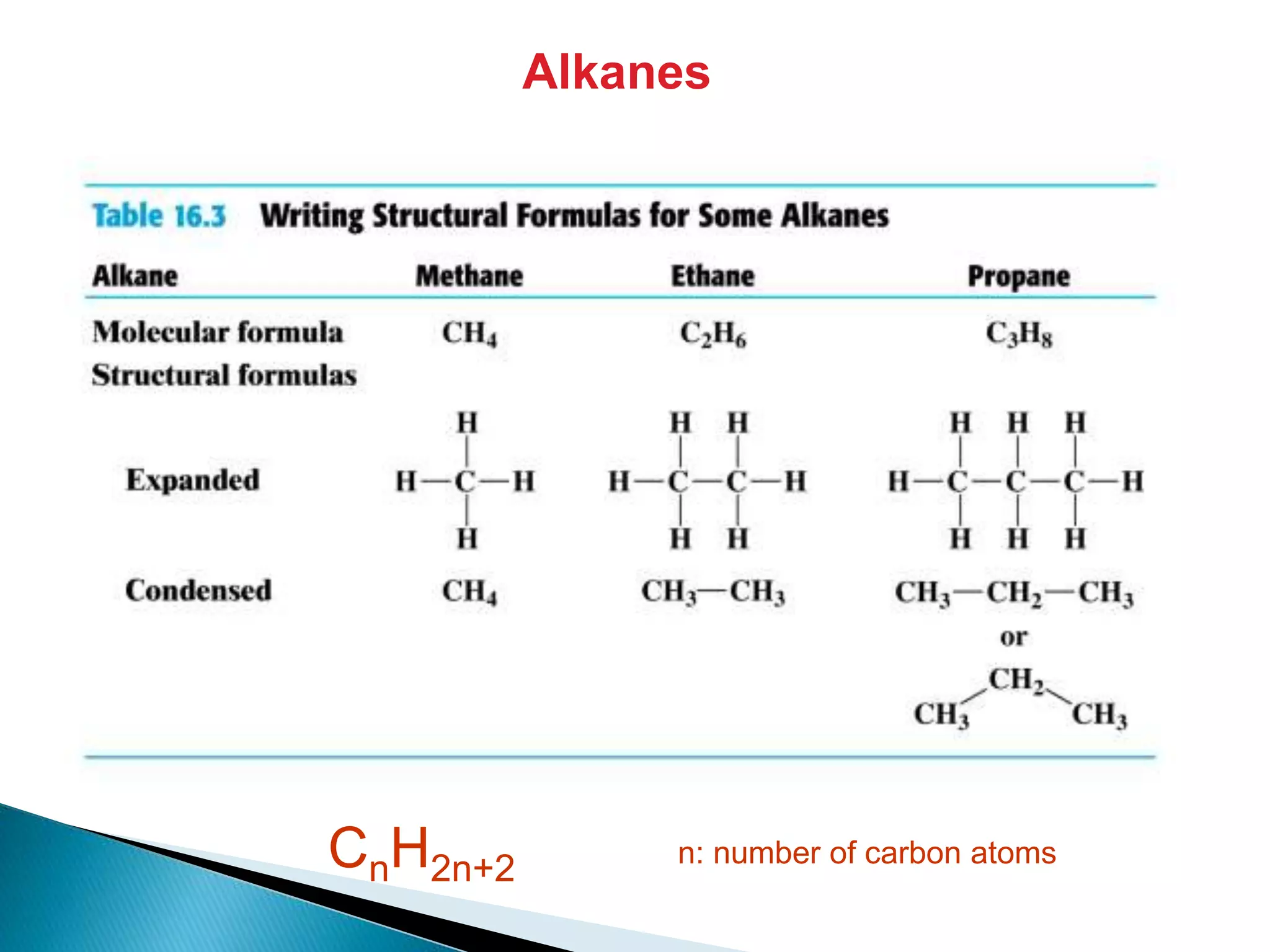
Alkanes
CnH2n+2 n: number of carbon atoms
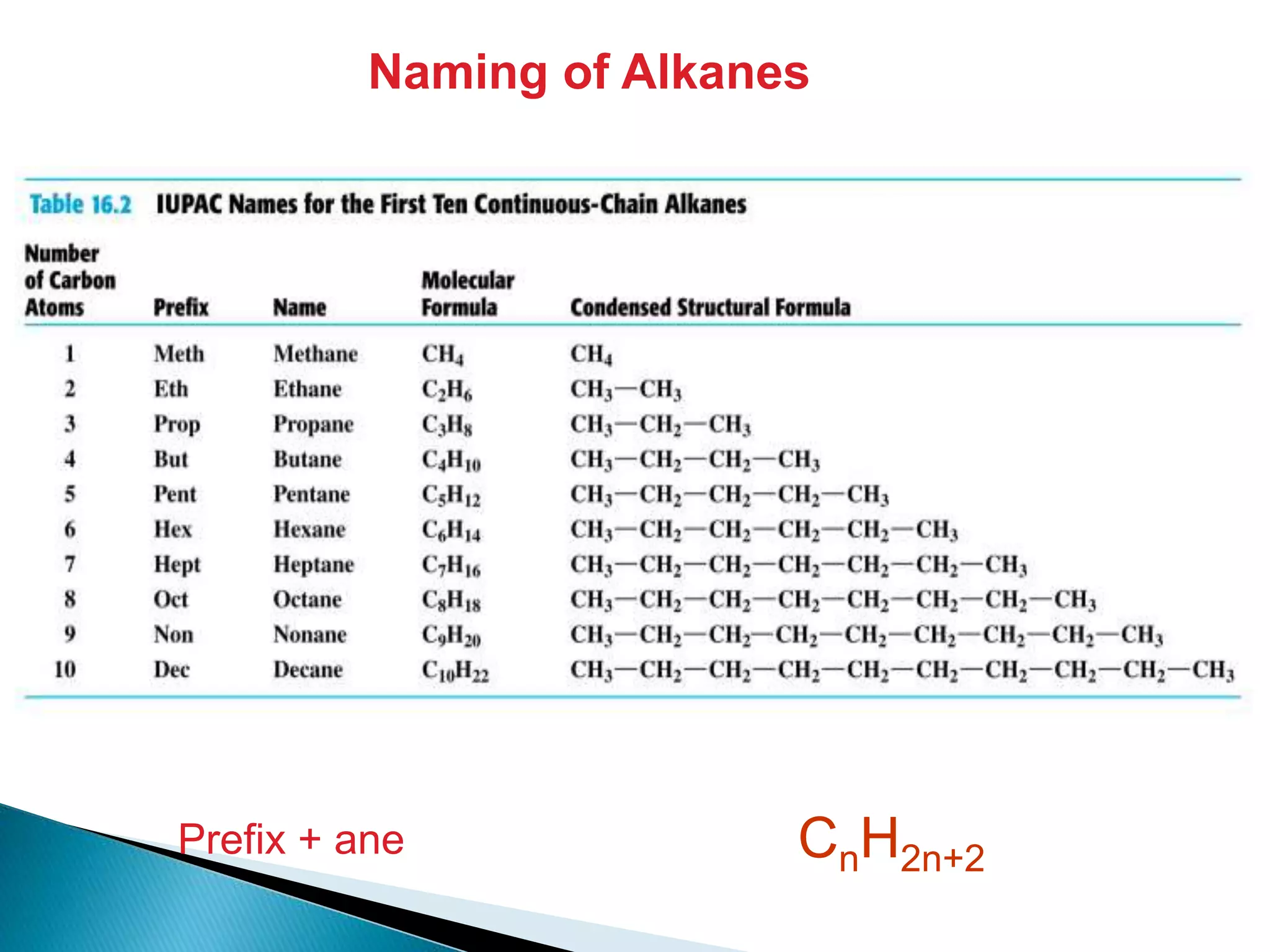
Naming of Alkanes
CnH2n+2Prefix + ane
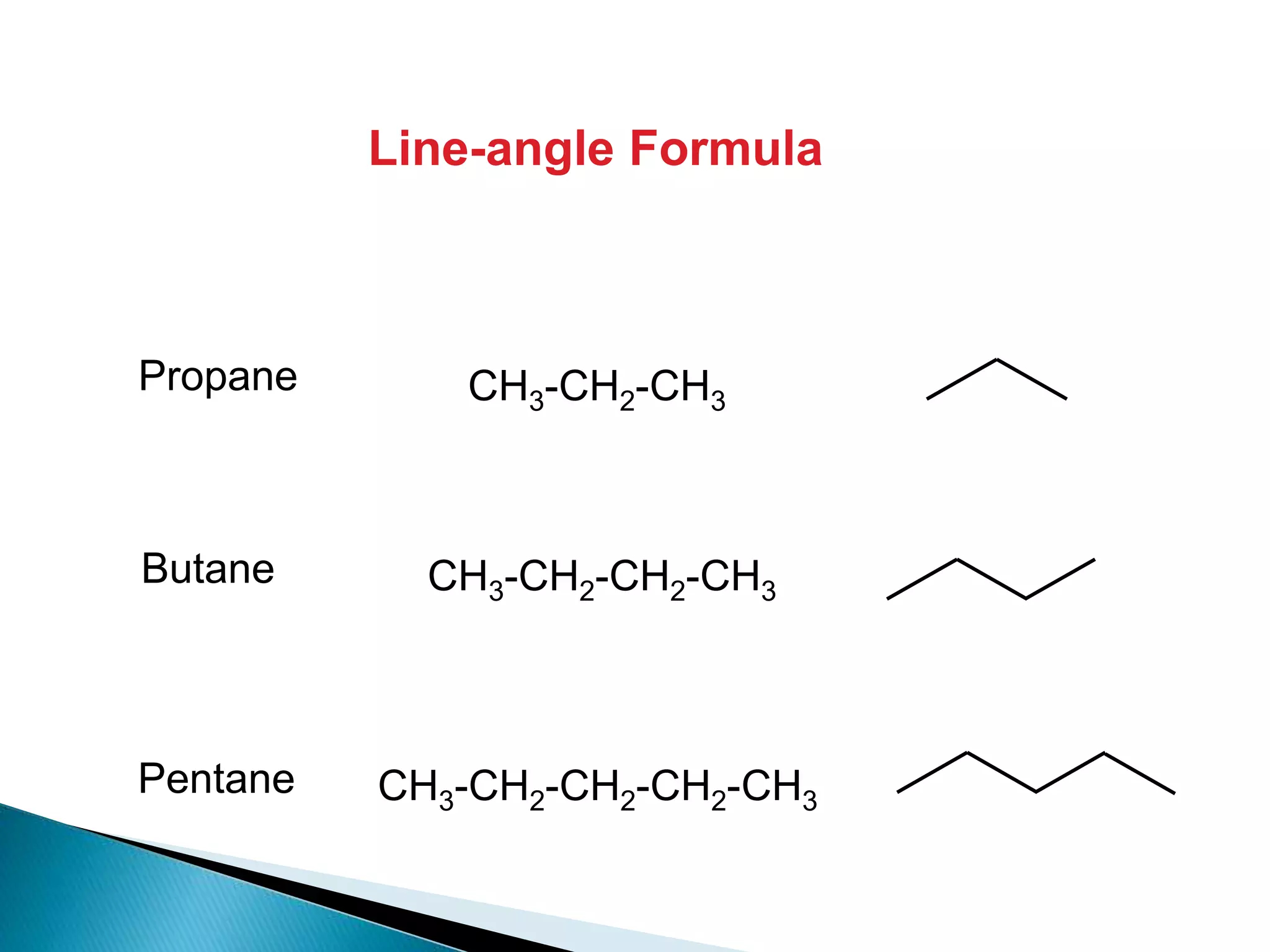
Line-angle Formula
CH3-CH2-CH2-CH2-CH3
Propane
Butane
Pentane
CH3-CH2-CH2-CH3
CH3-CH2-CH3
In the IUPAC system:
• Removing a H from an
alkane is called alkyl
group.
-ane
• Halogen atoms are
named as halo.
-ine
Naming Substituents
-OH Hydroxyl
-NO2 Nitro
-yl
-O
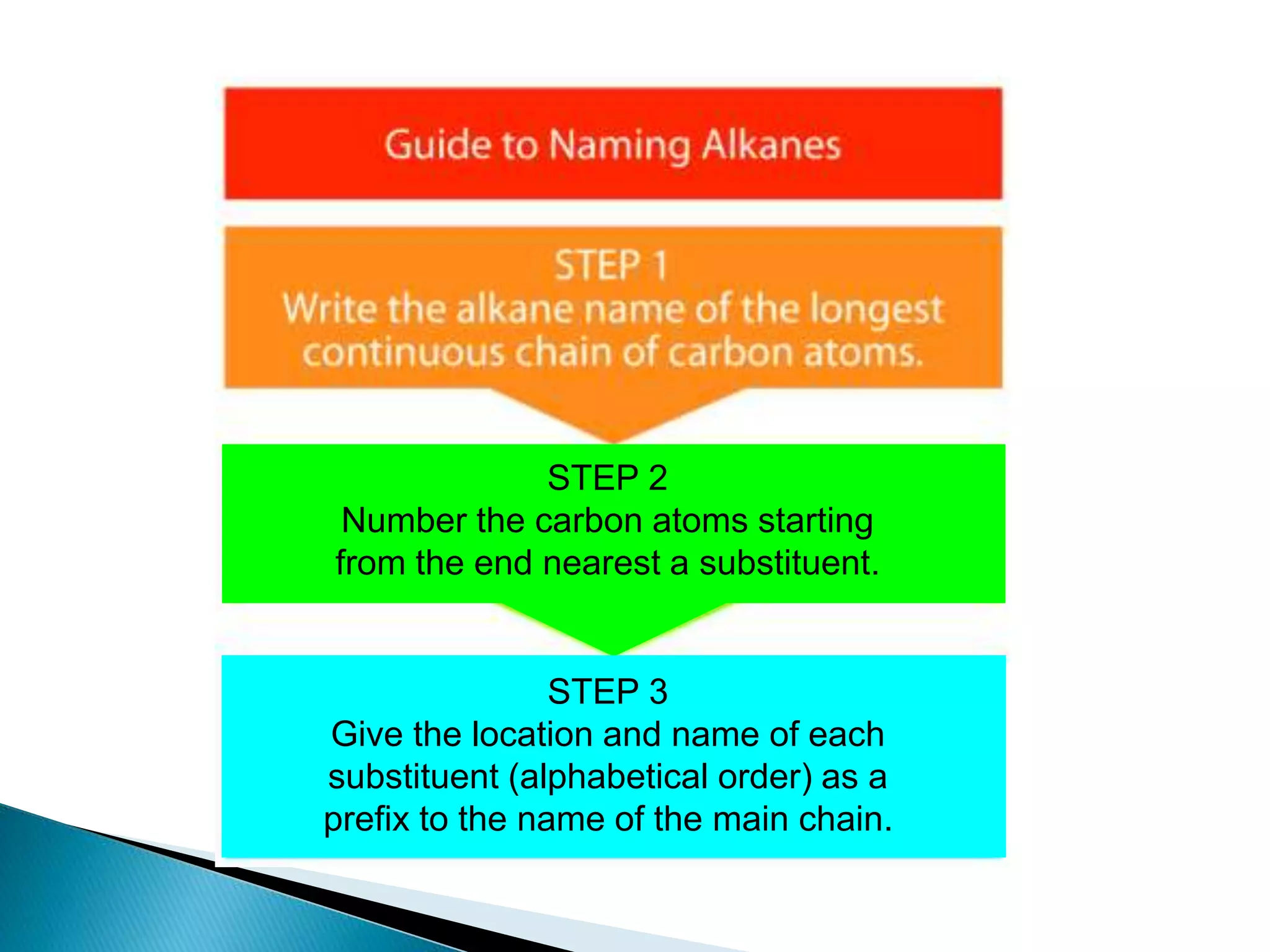
STEP 2
Number the carbon atoms starting
from the end nearest a substituent.
STEP 3
Give the location and name of each
substituent (alphabetical order) as a
prefix to the name of the main chain.
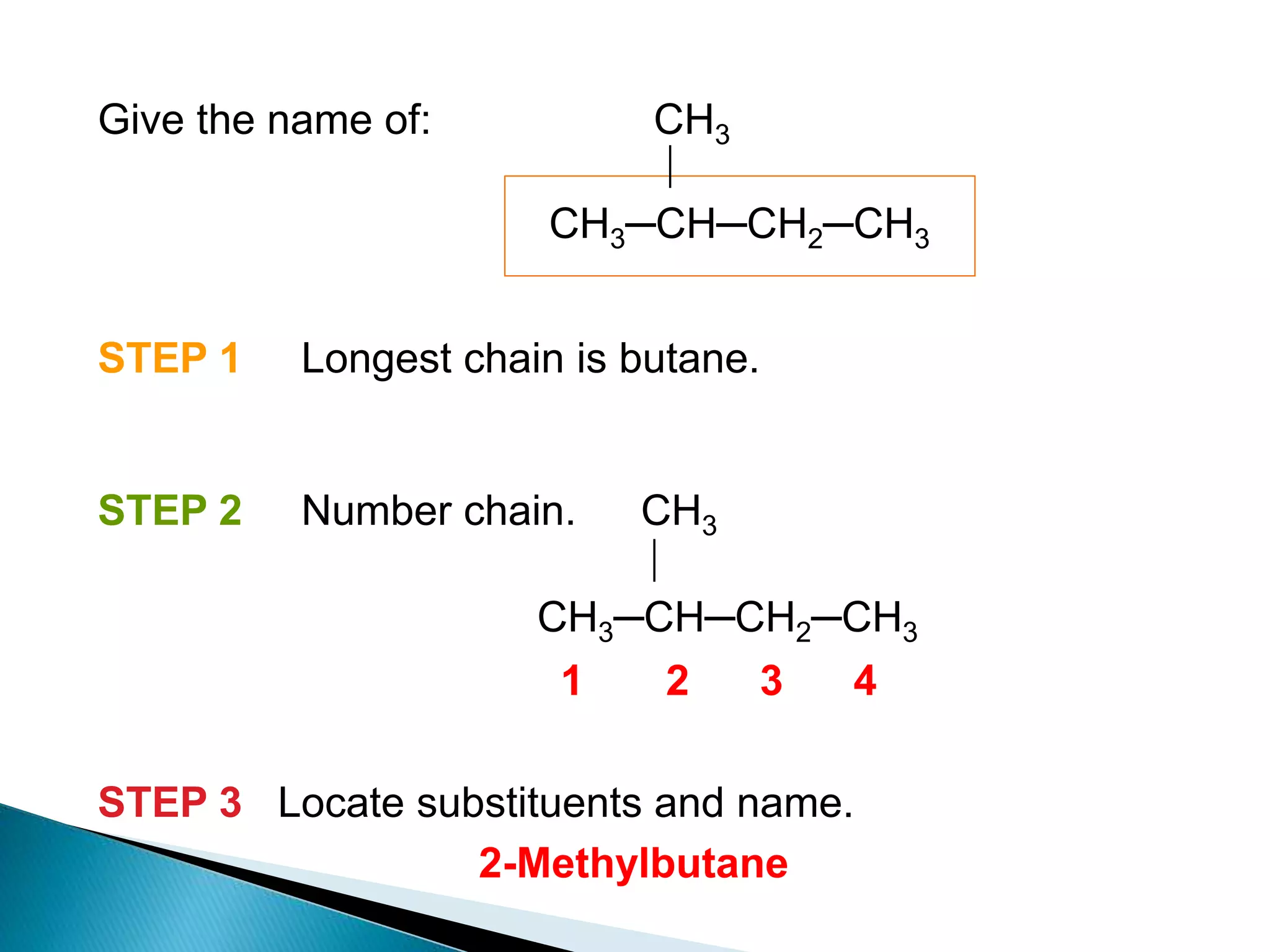
Give the name of: CH3

CH3─CH─CH2─CH3
STEP 1 Longest chain is butane.
STEP 2 Number chain. CH3

CH3─CH─CH2─CH3
1 2 3 4
STEP 3 Locate substituents and name.
2-Methylbutane
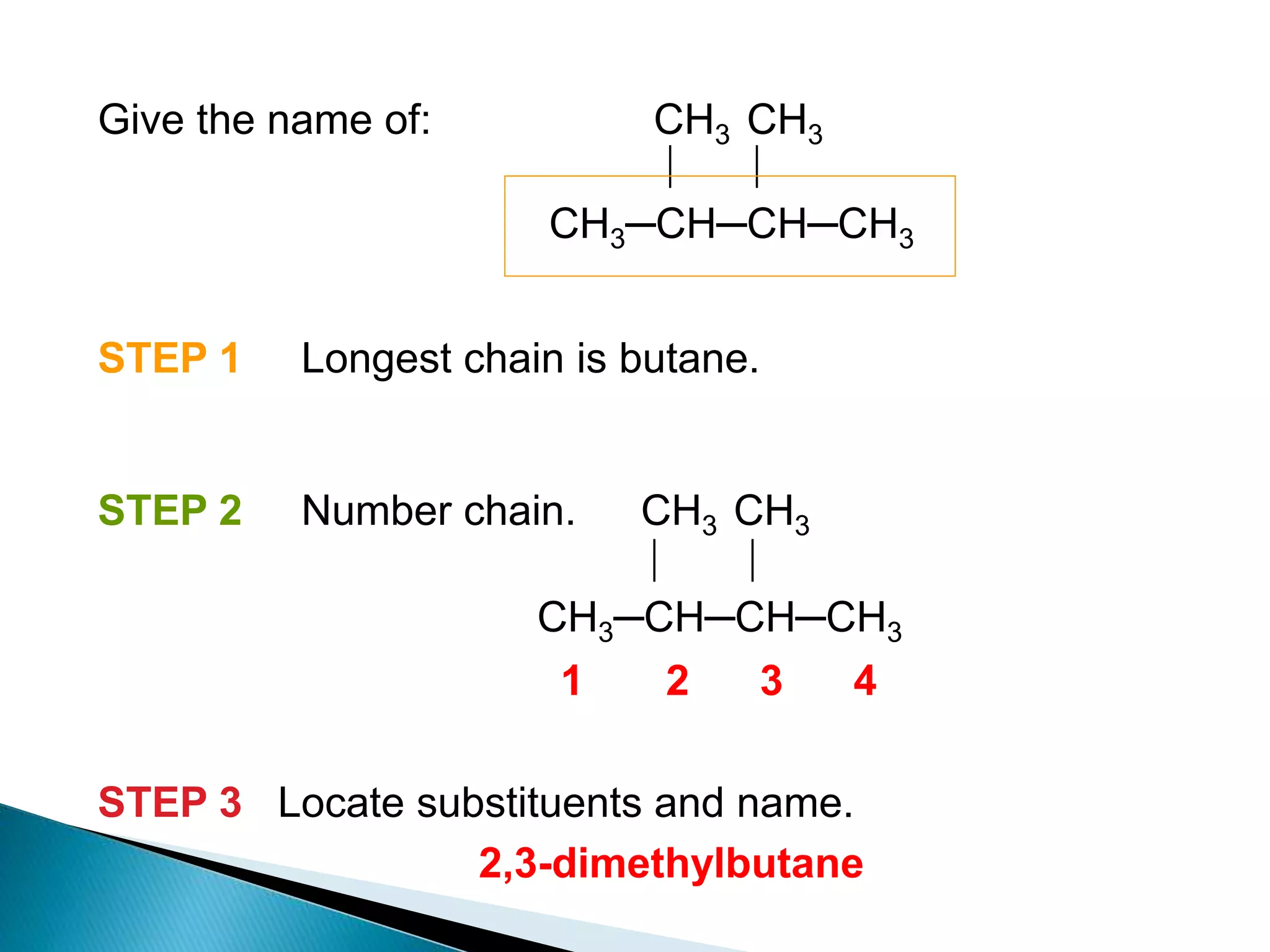
Give the name of: CH3 CH3
 
CH3─CH─CH─CH3
STEP 1 Longest chain is butane.
STEP 2 Number chain. CH3 CH3
 
CH3─CH─CH─CH3
1 2 3 4
STEP 3 Locate substituents and name.
2,3-dimethylbutane
STEP 1 Longest chain is pentane.
STEP 2 Number chain from end nearest substituent.
Cl CH3
 
CH3─CH2─CH─CH─CH3
5 4 3 2 1
STEP 3 Locate substituents and name alphabetically.
3-Chloro-2-methylpentane
Cl CH3
 
CH3─CH2─CH─CH─CH3
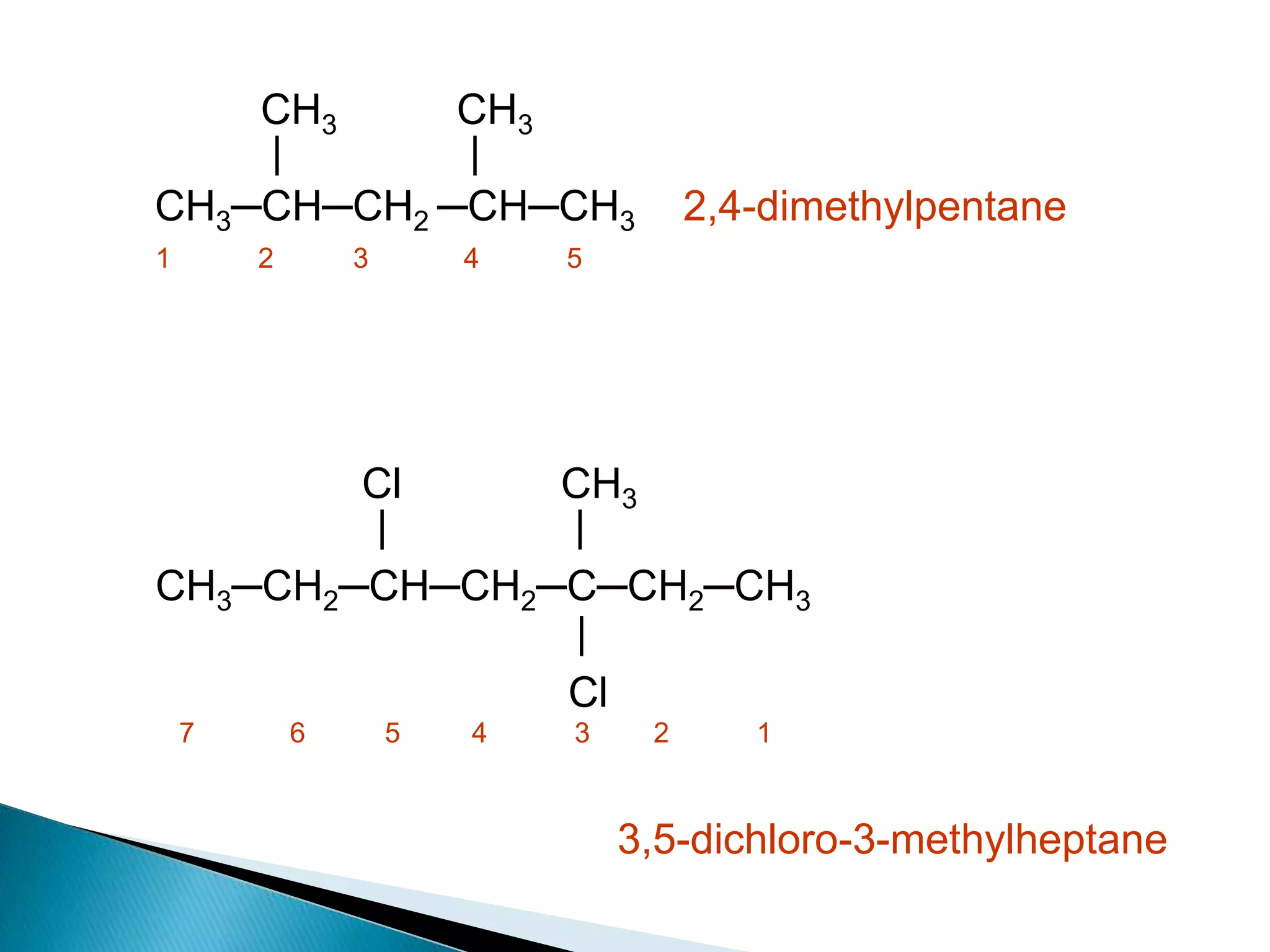
CH3 CH3
| |
CH3─CH─CH2 ─CH─CH3 2,4-dimethylpentane
1 2 3 4 5
Cl CH3
| |
CH3─CH2─CH─CH2─C─CH2─CH3
|
Cl
7 6 5 4 3 2 1
3,5-dichloro-3-methylheptane
CH2 CH3

CH3─CH─CH2─CH3
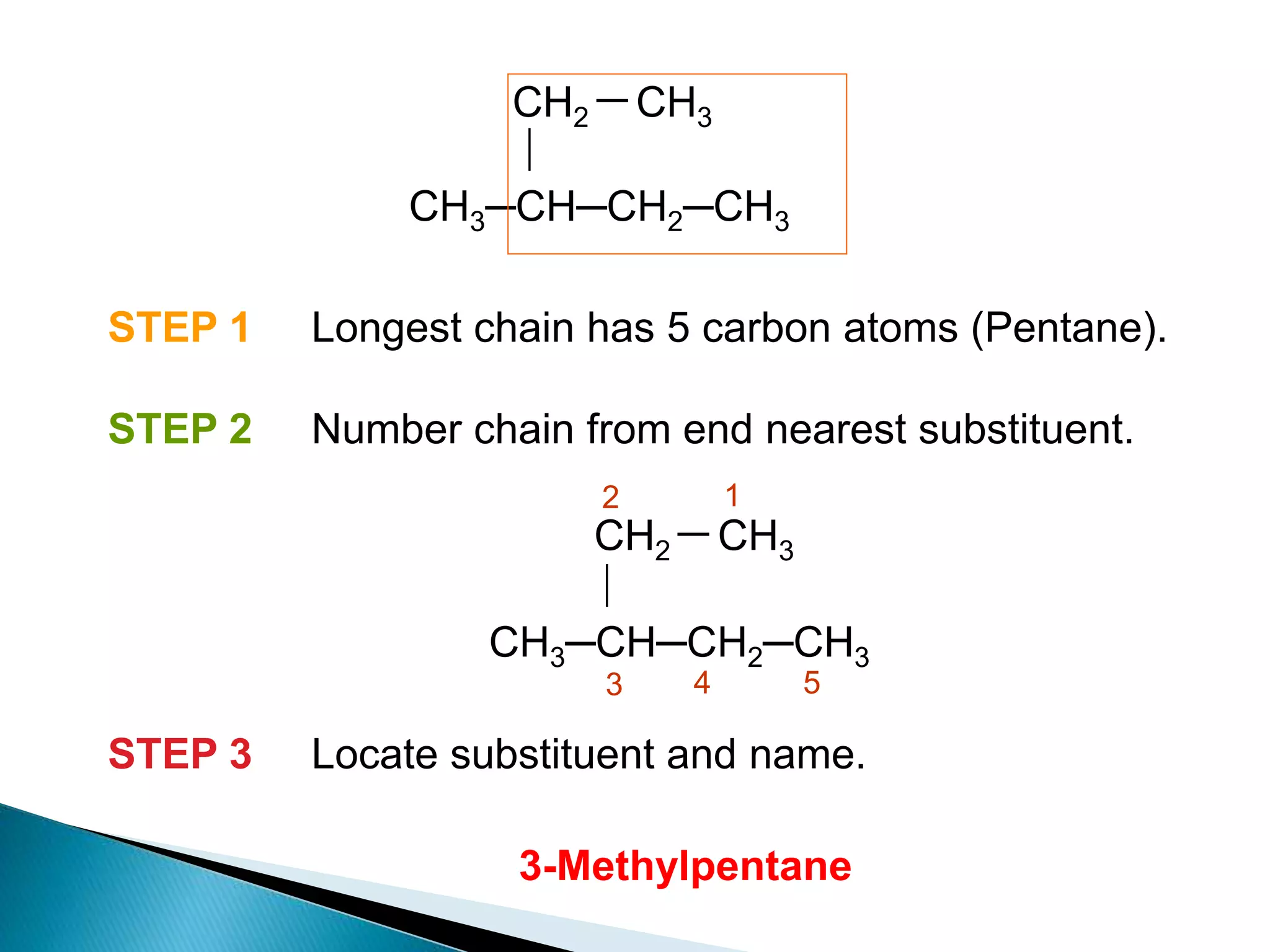
STEP 1 Longest chain has 5 carbon atoms (Pentane).
STEP 2 Number chain from end nearest substituent.
CH2 CH3

CH3─CH─CH2─CH3
STEP 3 Locate substituent and name.
3-Methylpentane
12
3 4 5
Constitutional Isomers
• Have the same molecular formula.
• Have different atom arrangements (different structural formula).
CH3CH2CH2CH3
Butane
CH3CHCH3
2-Methylpropane
CH3
C4H10
C4H10
=
=
=
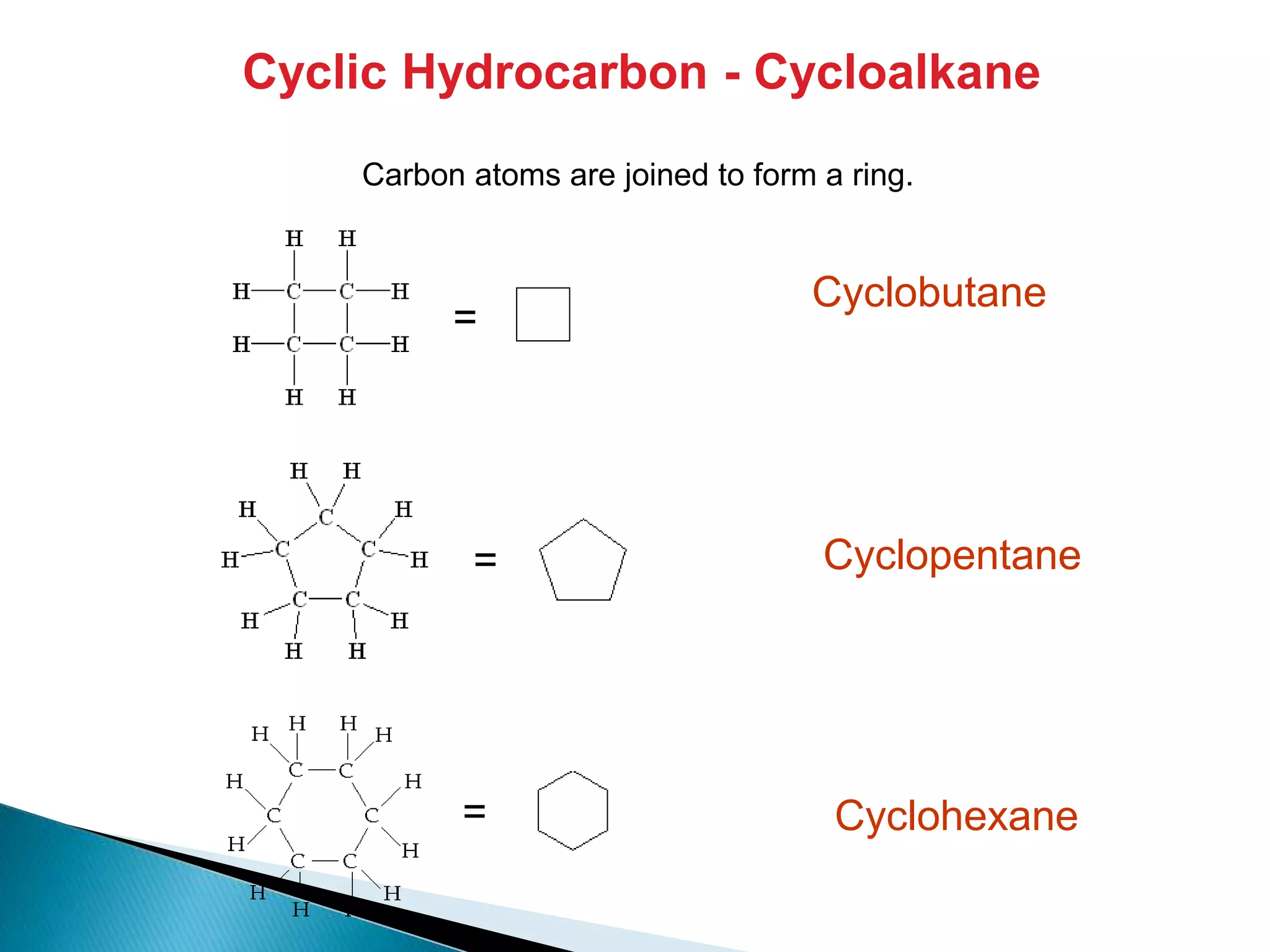
Cyclic Hydrocarbon - Cycloalkane
Cyclobutane
Cyclopentane
Cyclohexane
Carbon atoms are joined to form a ring.
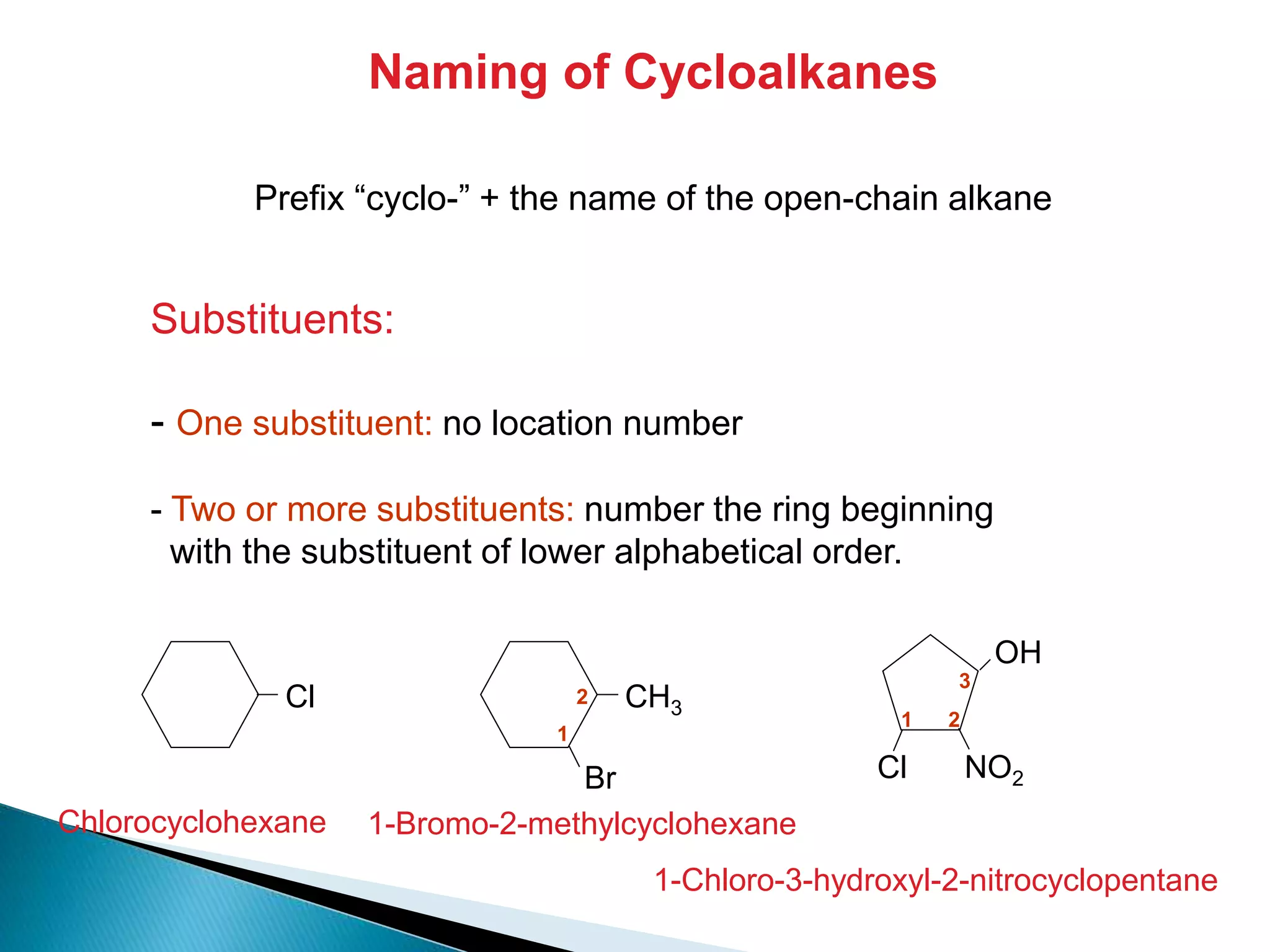
Naming of Cycloalkanes
Prefix “cyclo-” + the name of the open-chain alkane
Substituents:
- One substituent: no location number
- Two or more substituents: number the ring beginning
with the substituent of lower alphabetical order.
Chlorocyclohexane 1-Bromo-2-methylcyclohexane
1-Chloro-3-hydroxyl-2-nitrocyclopentane
Cl CH3
Br Cl NO2
OH
1
1
2
2
3
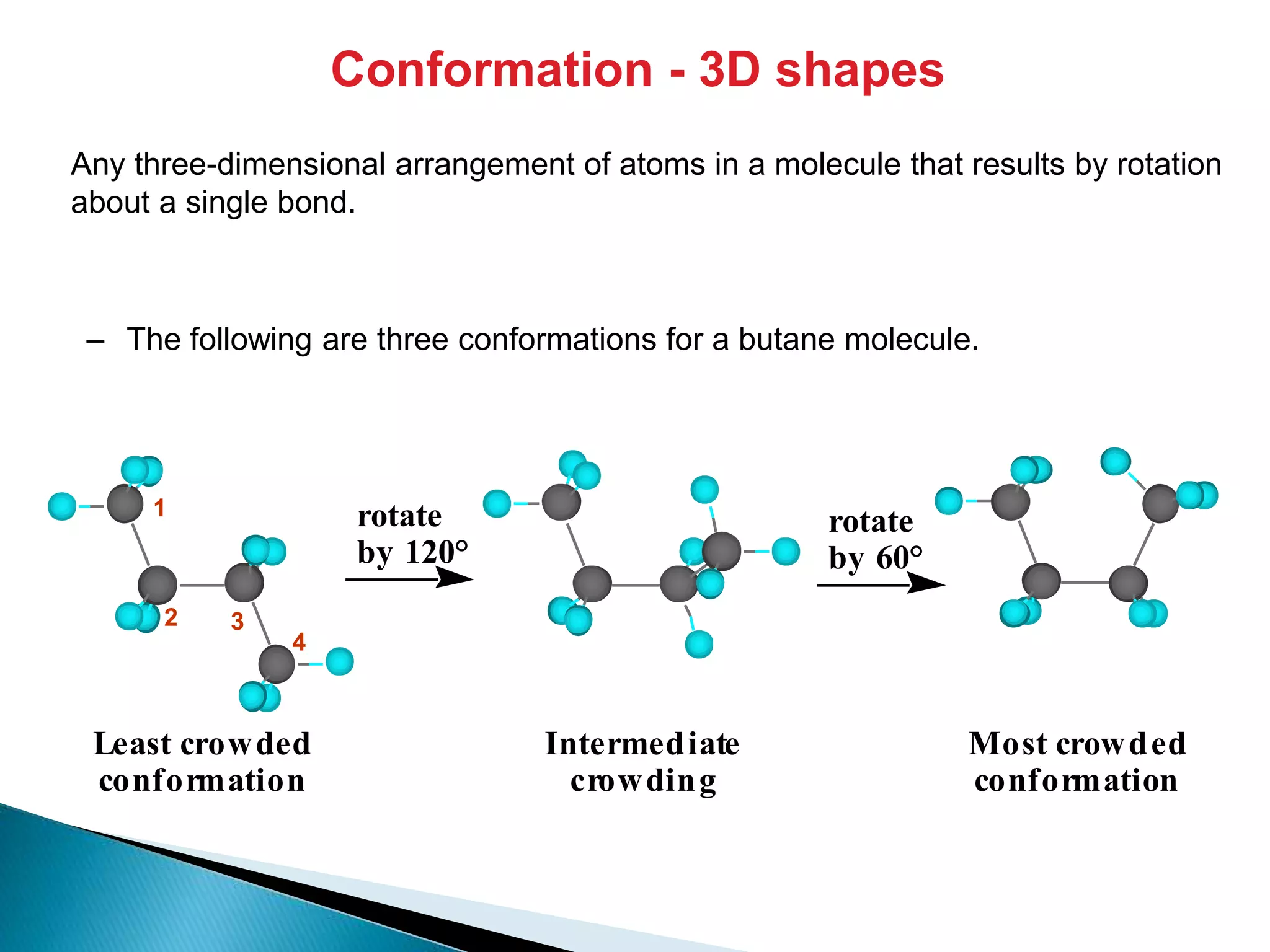
Conformation - 3D shapes
Any three-dimensional arrangement of atoms in a molecule that results by rotation
about a single bond.
– The following are three conformations for a butane molecule.
Most crowded
conformation
rotate
by 120°
rotate
by 60°
Least crowded
conformation
Intermediate
crowding
2 3
4
1
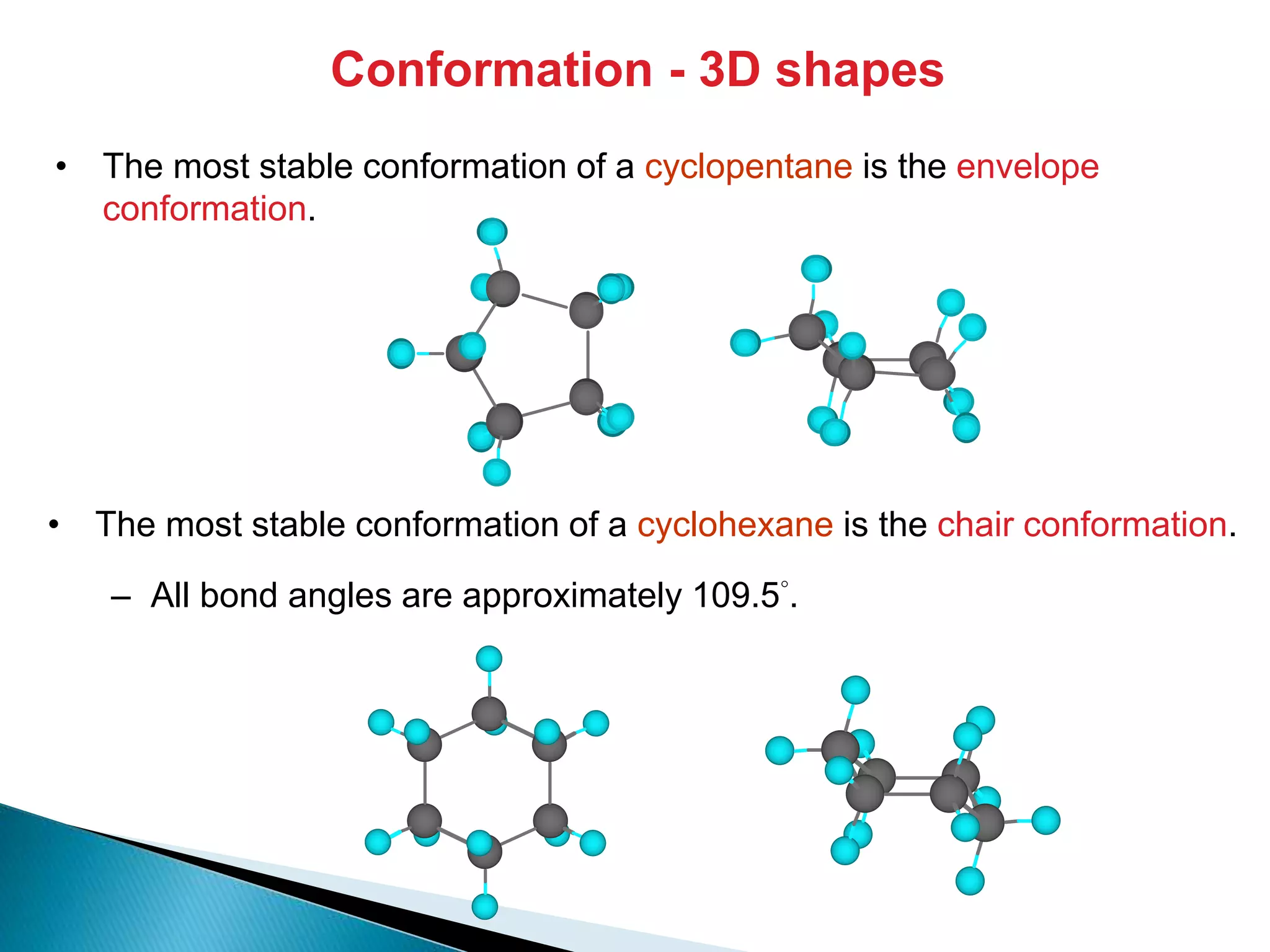
Conformation - 3D shapes
• The most stable conformation of a cyclopentane is the envelope
conformation.
• The most stable conformation of a cyclohexane is the chair conformation.
– All bond angles are approximately 109.5°.
• In a chair conformation,
– six C-H bonds are equatorial bonds.
– six C-H bonds are axial bonds.
Conformation - 3D shapes
H
H
H
HH
H
(a) Ball-and-stick model
showing all 12 hydrogens
axis through the
centerof the ring
H H
H
H
H
H
(b) The six equatorial
C-H bonds
(c) The six axial
C-H bondsEquatorial Axial
– The more stable conformation of a substituted cyclohexane ring has the
substituent group(s) as equatorial rather than axial.
Conformation - 3D shapes
CH3
Axial methylcyclohexane
CH3
Equatorial methylcyclohexane
H H H
H
More Stable
The same molecular formula and the same connectivity of their atoms,
but a different arrangement of their atoms in space.
mp & bp of cis < mp & bp of trans
Cis & Trans Stereoisomers
trans-1,2-Dimethyl-
cyclopentane
cis-1,2-Dimethyl-
cyclopentane
CH3
H
CH3
H
H
H
H
H
H
H
H
H
CH3
H3 C
H
H
H
H
H
H
Cis & Trans Stereoisomers
trans-1,4-Dimethylcyclohexane cis-1,4-Dimethylcyclohexane
H
H3 C
CH3
H
H
H3 C
H
CH3
or or
CH3
CH3
CH3
CH3
Stereoisomers: Isomers that have the same molecular formulas and the same
connectivity of their atoms but a different orientation of their atoms in space.
Boiling & melting points of Alkanes
Number of carbon atoms ↑ bp & mp ↑
Number of branches ↑ bp & mp ↓
CH3CH2CH2CH3
CH3CHCH3
CH3
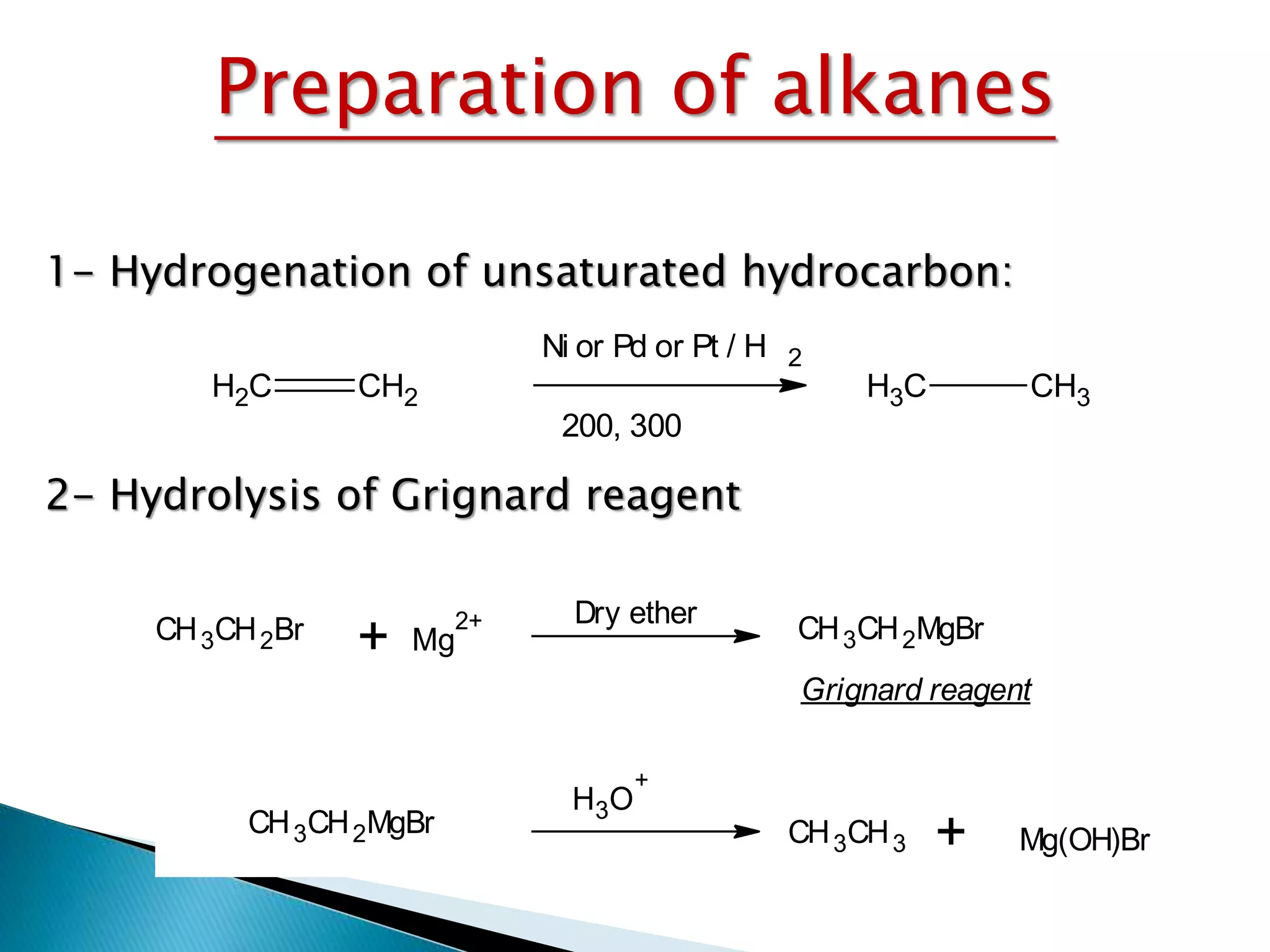
Preparation of alkanes
1- Hydrogenation of unsaturated hydrocarbon:
2- Hydrolysis of Grignard reagent
CH2 CH2
Ni or Pd or Pt / H 2
200, 300
CH3 CH3
CH3CH2Br + Mg
2+ Dry ether CH3CH2MgBr
Grignard reagent
CH3CH2MgBr
H3O
+
CH3CH3 + Mg(OH)Br
3- Reduction of alkyl halides
a) by metal and acid or by metal hydrides
b) By sodium metal (Coupling reaction)
c) By lithium dialkyl cuprate
CH3 Br2 + 2 Na CH3 CH3 + 2 NaBr
(CH3CH2)2CuLi + CH3Br CH3CH2CH3
CH3CH2CH2Br + Zn H CH3CH2CH3 + ZnBr2
CH3CH2CH2CH2Br
1) LiAlH4 / ether
2) H3O
CH3CH2CH2CH3
Chemical reactions of Alkanes
Low reactivity
1- Combustion:
• Alkanes react with oxygen.
• CO2, H2O, and energy are produced.
• Alkane + O2 CO2 + H2O + heat
CH4 + 2O2 CO2 + 2H2O + energy
2- Halogenation:
Alkanes react with Halogens.
CH4 + Cl2 CH3Cl + HCl
Heat or light
Chemical reactions of Alkanes
Low reactivity
CH3Cl+ Cl2 CH2Cl2 + HCl
CH2Cl2 + Cl2 CHCl3 + HCl
CHCl3 + Cl2 CCl4 + HCl
Heat or light
Heat or light
Heat or light
Chloromethane
Dichloromethane
Trichloromethane
Tetrachloromethane
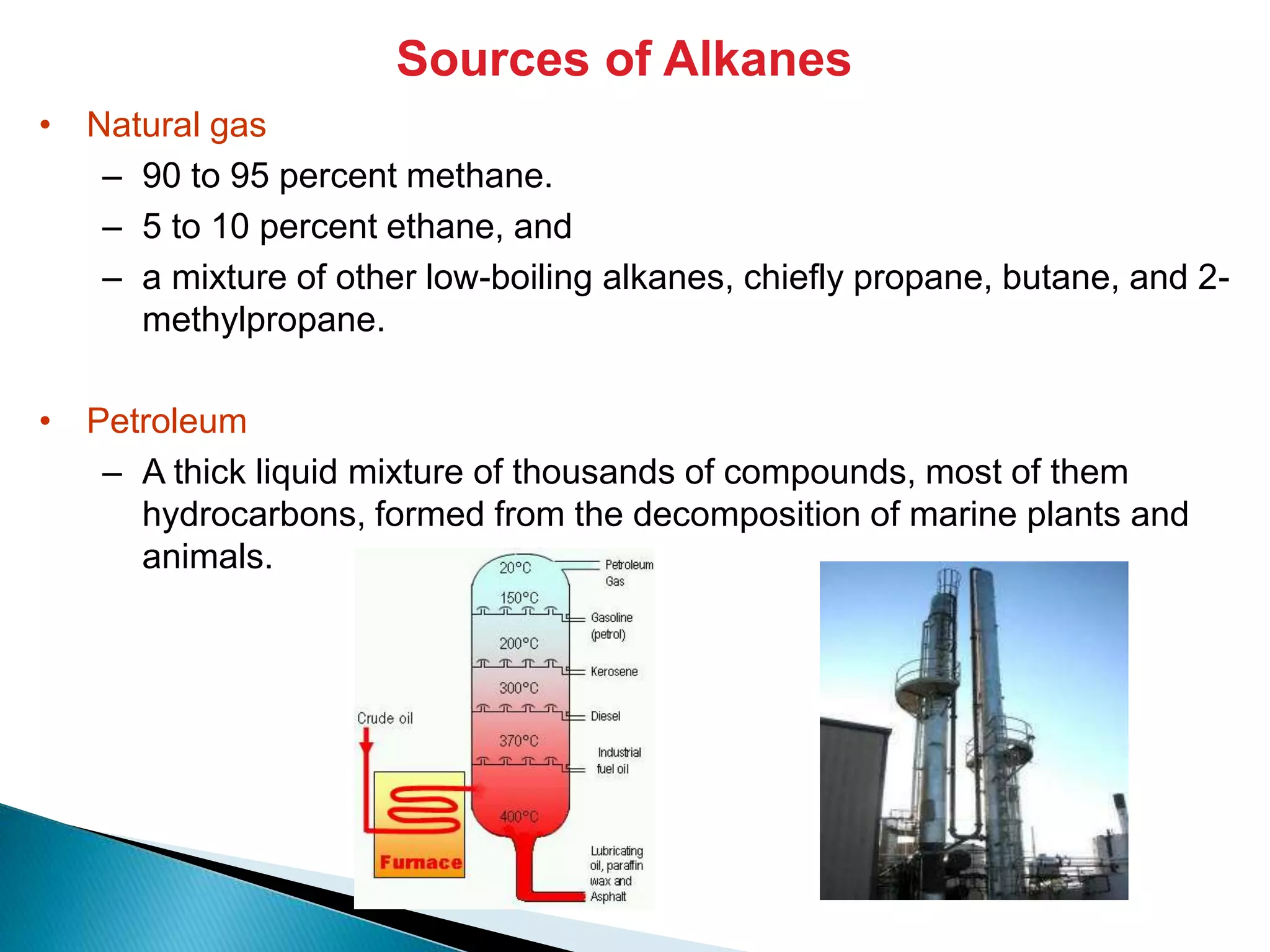
• Natural gas
– 90 to 95 percent methane.
– 5 to 10 percent ethane, and
– a mixture of other low-boiling alkanes, chiefly propane, butane, and 2-
methylpropane.
• Petroleum
– A thick liquid mixture of thousands of compounds, most of them
hydrocarbons, formed from the decomposition of marine plants and
animals.
Sources of Alkanes

alkanes

  • 1.
    ALKANES Md. Saiful Islam BPharm,MSc North South University Fb Group: Pharmacy Universe
  • 2.
    Carbon • Carbon hasfour valence electrons; hydrogen has one. • • C • H • • • To obtain an octet, carbon forms four bonds. H H • • H  C  H H C H CH4 , methane • • H HH Review
  • 3.
    Hydrocarbons Large family oforganic compounds Composed of only carbon and hydrogen Saturated hydrocarbons Alkanes Unsaturated hydrocarbons Alkenes, Alkynes & Aromatics C - C C = C C C C C C C C C H H H H H H A Kekulé structure showing all atoms A Kekulé structure as a line-angle formula
  • 4.
    Methane Tetrahedral Expanded structural formula(Lewis): showing each bond line. CH4Molecular formula
  • 5.
    -The most simpleof hydrocarbons species -Entirely composed of single bond and saturated in Hydrogen -Suffixe –ane -General formula: CnH2n+2 (non-cyclic) ALKANES Characteristics:
  • 6.
    -Same for allalkane structure (following CH4) -Covalent, weakly polar bonds: C, H same electronegativity -Boiling point increase by 20 or 30 degrees for each carbon added (except for very small alkanes, same tendency for M.P but less regular). -C1 to C4: gases, C5-C17: liquid, +C18: solid -Insoluble in water, dilute acids and bases and concentrated H2SO4 Physical properties:
  • 7.
    Ethane C2H6 Molecular formula Expandedstructural formula CH3 – CH3 Condensed structural formula: with each carbon atom and its attached hydrogen atoms.
  • 8.
  • 9.
  • 10.
  • 11.
    In the IUPACsystem: • Removing a H from an alkane is called alkyl group. -ane • Halogen atoms are named as halo. -ine Naming Substituents -OH Hydroxyl -NO2 Nitro -yl -O
  • 12.
    STEP 2 Number thecarbon atoms starting from the end nearest a substituent. STEP 3 Give the location and name of each substituent (alphabetical order) as a prefix to the name of the main chain.
  • 13.
    Give the nameof: CH3  CH3─CH─CH2─CH3 STEP 1 Longest chain is butane. STEP 2 Number chain. CH3  CH3─CH─CH2─CH3 1 2 3 4 STEP 3 Locate substituents and name. 2-Methylbutane
  • 14.
    Give the nameof: CH3 CH3   CH3─CH─CH─CH3 STEP 1 Longest chain is butane. STEP 2 Number chain. CH3 CH3   CH3─CH─CH─CH3 1 2 3 4 STEP 3 Locate substituents and name. 2,3-dimethylbutane
  • 15.
    STEP 1 Longestchain is pentane. STEP 2 Number chain from end nearest substituent. Cl CH3   CH3─CH2─CH─CH─CH3 5 4 3 2 1 STEP 3 Locate substituents and name alphabetically. 3-Chloro-2-methylpentane Cl CH3   CH3─CH2─CH─CH─CH3
  • 16.
    CH3 CH3 | | CH3─CH─CH2─CH─CH3 2,4-dimethylpentane 1 2 3 4 5 Cl CH3 | | CH3─CH2─CH─CH2─C─CH2─CH3 | Cl 7 6 5 4 3 2 1 3,5-dichloro-3-methylheptane
  • 17.
    CH2 CH3  CH3─CH─CH2─CH3 STEP 1Longest chain has 5 carbon atoms (Pentane). STEP 2 Number chain from end nearest substituent. CH2 CH3  CH3─CH─CH2─CH3 STEP 3 Locate substituent and name. 3-Methylpentane 12 3 4 5
  • 18.
    Constitutional Isomers • Havethe same molecular formula. • Have different atom arrangements (different structural formula). CH3CH2CH2CH3 Butane CH3CHCH3 2-Methylpropane CH3 C4H10 C4H10
  • 19.
    = = = Cyclic Hydrocarbon -Cycloalkane Cyclobutane Cyclopentane Cyclohexane Carbon atoms are joined to form a ring.
  • 20.
    Naming of Cycloalkanes Prefix“cyclo-” + the name of the open-chain alkane Substituents: - One substituent: no location number - Two or more substituents: number the ring beginning with the substituent of lower alphabetical order. Chlorocyclohexane 1-Bromo-2-methylcyclohexane 1-Chloro-3-hydroxyl-2-nitrocyclopentane Cl CH3 Br Cl NO2 OH 1 1 2 2 3
  • 21.
    Conformation - 3Dshapes Any three-dimensional arrangement of atoms in a molecule that results by rotation about a single bond. – The following are three conformations for a butane molecule. Most crowded conformation rotate by 120° rotate by 60° Least crowded conformation Intermediate crowding 2 3 4 1
  • 22.
    Conformation - 3Dshapes • The most stable conformation of a cyclopentane is the envelope conformation. • The most stable conformation of a cyclohexane is the chair conformation. – All bond angles are approximately 109.5°.
  • 23.
    • In achair conformation, – six C-H bonds are equatorial bonds. – six C-H bonds are axial bonds. Conformation - 3D shapes H H H HH H (a) Ball-and-stick model showing all 12 hydrogens axis through the centerof the ring H H H H H H (b) The six equatorial C-H bonds (c) The six axial C-H bondsEquatorial Axial
  • 24.
    – The morestable conformation of a substituted cyclohexane ring has the substituent group(s) as equatorial rather than axial. Conformation - 3D shapes CH3 Axial methylcyclohexane CH3 Equatorial methylcyclohexane H H H H More Stable
  • 25.
    The same molecularformula and the same connectivity of their atoms, but a different arrangement of their atoms in space. mp & bp of cis < mp & bp of trans Cis & Trans Stereoisomers trans-1,2-Dimethyl- cyclopentane cis-1,2-Dimethyl- cyclopentane CH3 H CH3 H H H H H H H H H CH3 H3 C H H H H H H
  • 26.
    Cis & TransStereoisomers trans-1,4-Dimethylcyclohexane cis-1,4-Dimethylcyclohexane H H3 C CH3 H H H3 C H CH3 or or CH3 CH3 CH3 CH3 Stereoisomers: Isomers that have the same molecular formulas and the same connectivity of their atoms but a different orientation of their atoms in space.
  • 27.
    Boiling & meltingpoints of Alkanes Number of carbon atoms ↑ bp & mp ↑ Number of branches ↑ bp & mp ↓ CH3CH2CH2CH3 CH3CHCH3 CH3
  • 28.
    Preparation of alkanes 1-Hydrogenation of unsaturated hydrocarbon: 2- Hydrolysis of Grignard reagent CH2 CH2 Ni or Pd or Pt / H 2 200, 300 CH3 CH3 CH3CH2Br + Mg 2+ Dry ether CH3CH2MgBr Grignard reagent CH3CH2MgBr H3O + CH3CH3 + Mg(OH)Br
  • 29.
    3- Reduction ofalkyl halides a) by metal and acid or by metal hydrides b) By sodium metal (Coupling reaction) c) By lithium dialkyl cuprate CH3 Br2 + 2 Na CH3 CH3 + 2 NaBr (CH3CH2)2CuLi + CH3Br CH3CH2CH3 CH3CH2CH2Br + Zn H CH3CH2CH3 + ZnBr2 CH3CH2CH2CH2Br 1) LiAlH4 / ether 2) H3O CH3CH2CH2CH3
  • 30.
    Chemical reactions ofAlkanes Low reactivity 1- Combustion: • Alkanes react with oxygen. • CO2, H2O, and energy are produced. • Alkane + O2 CO2 + H2O + heat CH4 + 2O2 CO2 + 2H2O + energy
  • 31.
    2- Halogenation: Alkanes reactwith Halogens. CH4 + Cl2 CH3Cl + HCl Heat or light Chemical reactions of Alkanes Low reactivity CH3Cl+ Cl2 CH2Cl2 + HCl CH2Cl2 + Cl2 CHCl3 + HCl CHCl3 + Cl2 CCl4 + HCl Heat or light Heat or light Heat or light Chloromethane Dichloromethane Trichloromethane Tetrachloromethane
  • 32.
    • Natural gas –90 to 95 percent methane. – 5 to 10 percent ethane, and – a mixture of other low-boiling alkanes, chiefly propane, butane, and 2- methylpropane. • Petroleum – A thick liquid mixture of thousands of compounds, most of them hydrocarbons, formed from the decomposition of marine plants and animals. Sources of Alkanes

Editor's Notes

  • #12 International union of pure and applied chemistry