Chapter One
Matter Energy and Measurement
The Central Science?
• Matter can change from one form to another:
• matter is anything that has mass and takes up
space
• Chemistry is the study of matter
1) Physical changes
2) Chemical changes
• occur when objects undergo a change that
does not change their chemical nature
Examples of physical change include:
• Change of state
• Creation or separation of a mixtures
• Physical deformation
1) Physical Properties of Matter
Those characteristics that can be
observed without changing the
substance into another substance:
 Color
 Taste
 Density (g/ml)
 Melting point
 Odor
 Hardness
 Solubility
 Boiling point
• occur when substance(s) are changed into
another substance(s), involving chemical
reactions
• A chemical reaction produces new substances
by changing the way in which atoms are
arranged
Examples include:
• rusting or oxidation
• digestion of food
• bleaching hair
• burning propane
CH3CH2CH3 + 5O2 3CO2 + 4H2O
2) Chemical Properties of Matter
Those characteristics that
can be observed when the
substance undergoes a
change in composition
 reactivity
 combustibility
Changes in Matter
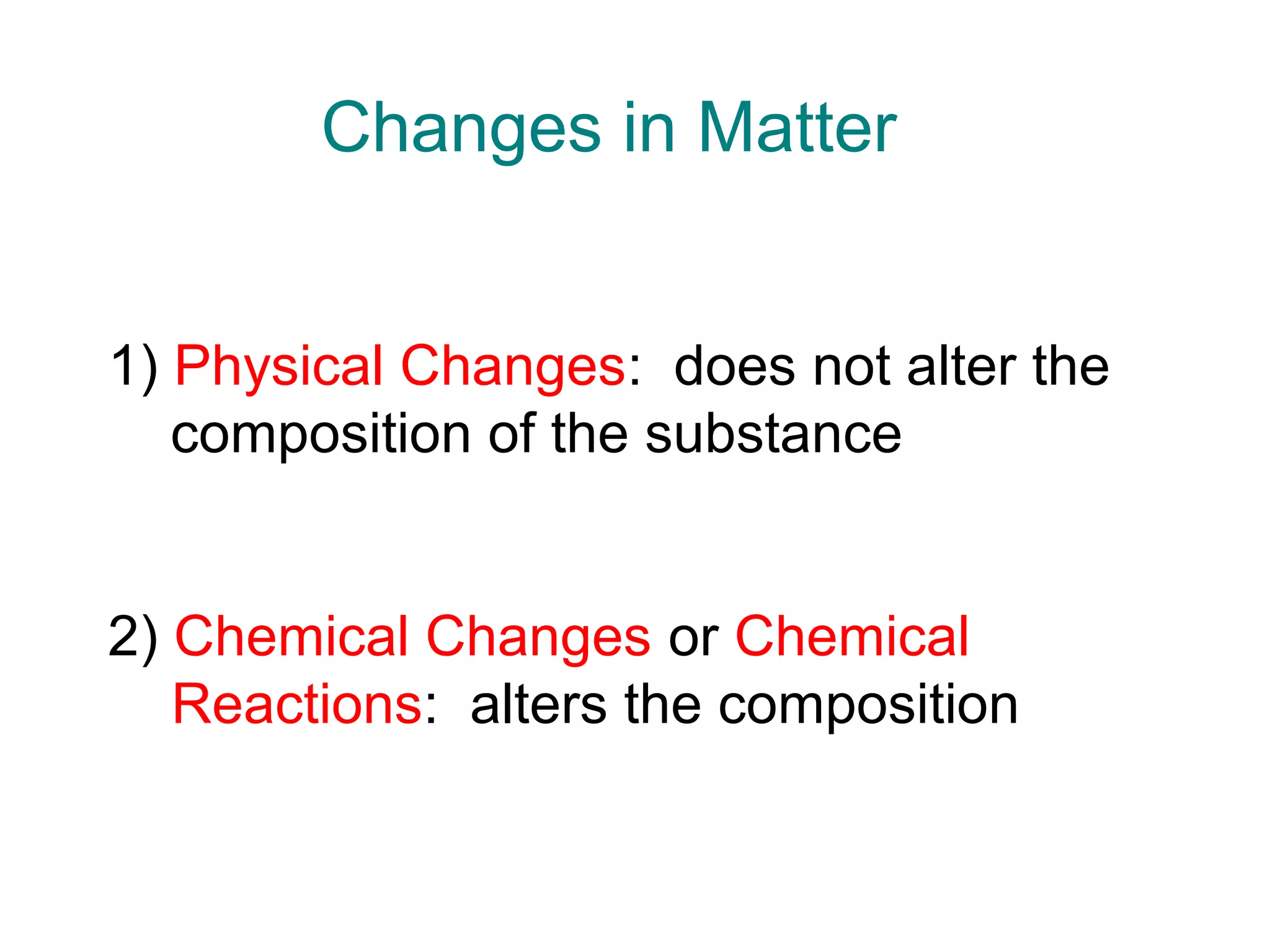
1) Physical Changes: does not alter the
composition of the substance
2) Chemical Changes or Chemical
Reactions: alters the composition
Physical or Chemical changes?
1) Melting a marshmallow
2) Burning a marshmallow
3) Cutting paper
4) Rusted nail
5) Digestion of food
6) Evaporation
7) Striking a match
8) Bleaching hair
• Fact is a statement based on direct experience
• Hypothesis is a statement that is proposed, without
actual proof, to explain the facts and their
relationships
• Theory is the formulation of an apparent relationship
of certain observed phenomena
• is the process by which scientists, collectively
and over time, endeavor to construct an
accurate representation of the world
Fact Hypothesis Theory Law
The Scientific Method
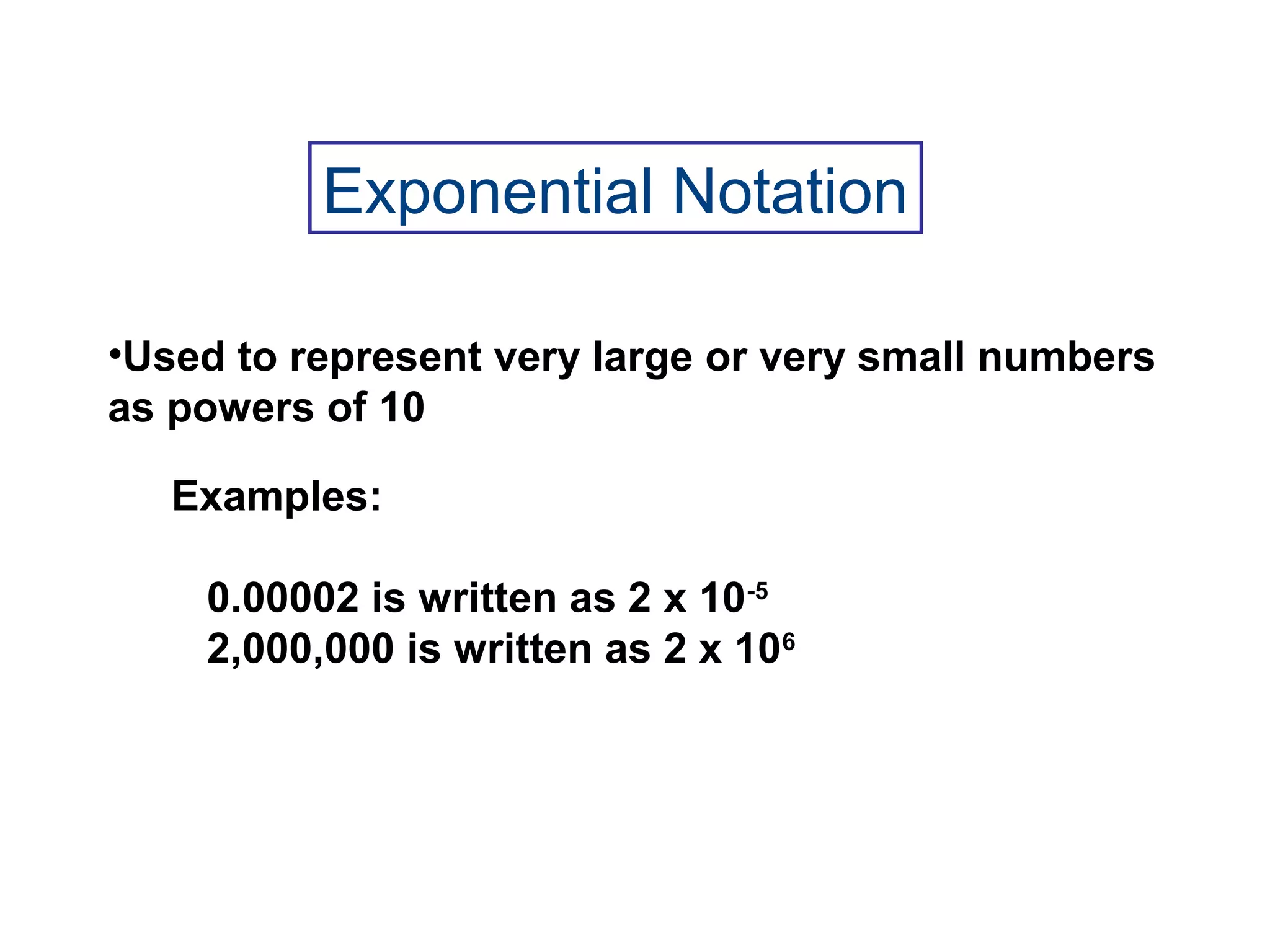
•Used to represent very large or very small numbers
as powers of 10
Examples:
0.00002 is written as 2 x 10⁻⁵
2,000,000 is written as 2 x 10⁶
Exponential Notation
• is the number of digits of a measured number
that have uncertainty only in the last digit
Rules:
1. Nonzero digits are always significant
2. Zeros at the beginning of a number are never significant
3. Zeros between nonzero digits are always significant
4. Zeros at the end of a number that contains a decimal point
are always significant
* Additional rules apply for addition and multiplication/ dividing (Appendix II)
Significant Figures
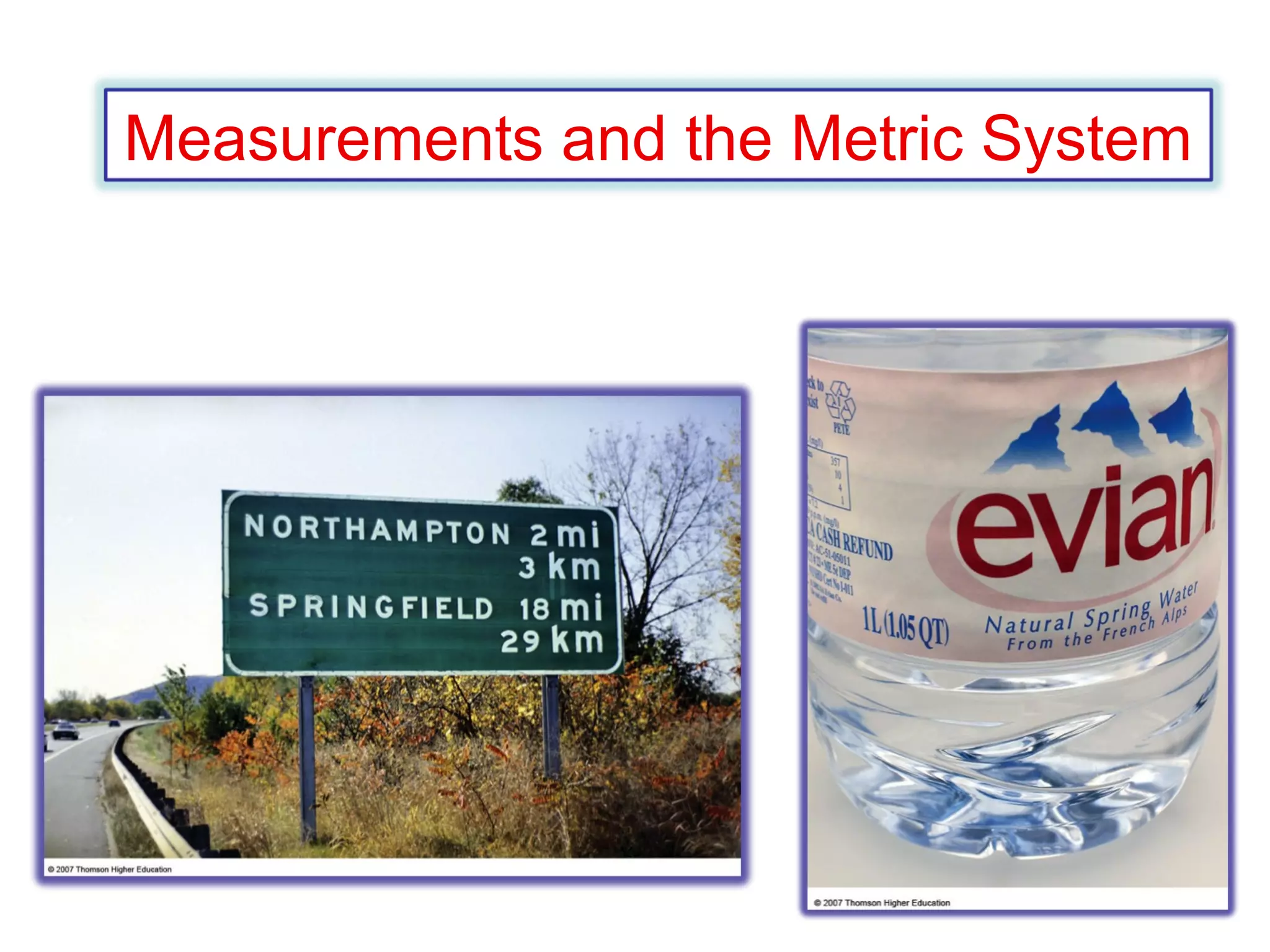
Measurements and the Metric System
• consist of 2 parts: number and unit
• The metric system uses one base unit for each
kind of measurement
Measurements
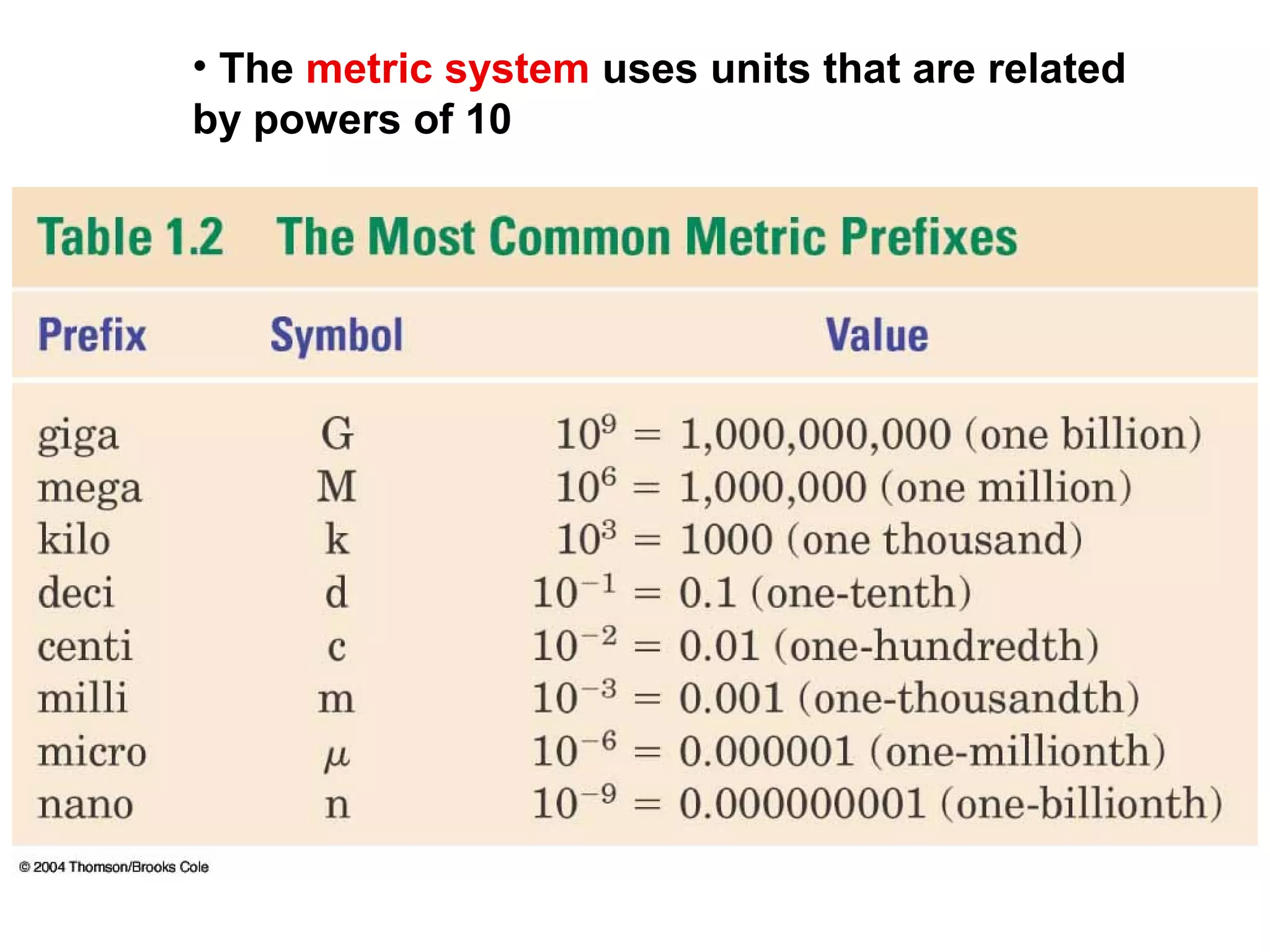
• The metric system uses units that are related
by powers of 10
• Mass vs. Weight
• Mass is the quantity of matter in an object and is
independent of weight
• Weight is the force mass experiences under the pull
of gravity
• Volume
1 mL = 1 cc
• Volume is the space occupied by that substance
temperature
degree
Celsius
degree
Fahrenheit
symbol °C °F
boiling point of water 100 212
average human body
temperature
37 98.6
average room
temperature
20 to 25 68 to 77
melting point of ice 0 32
˚F = 9/5 ˚C + 32
˚C = 5/9 (˚F – 32)
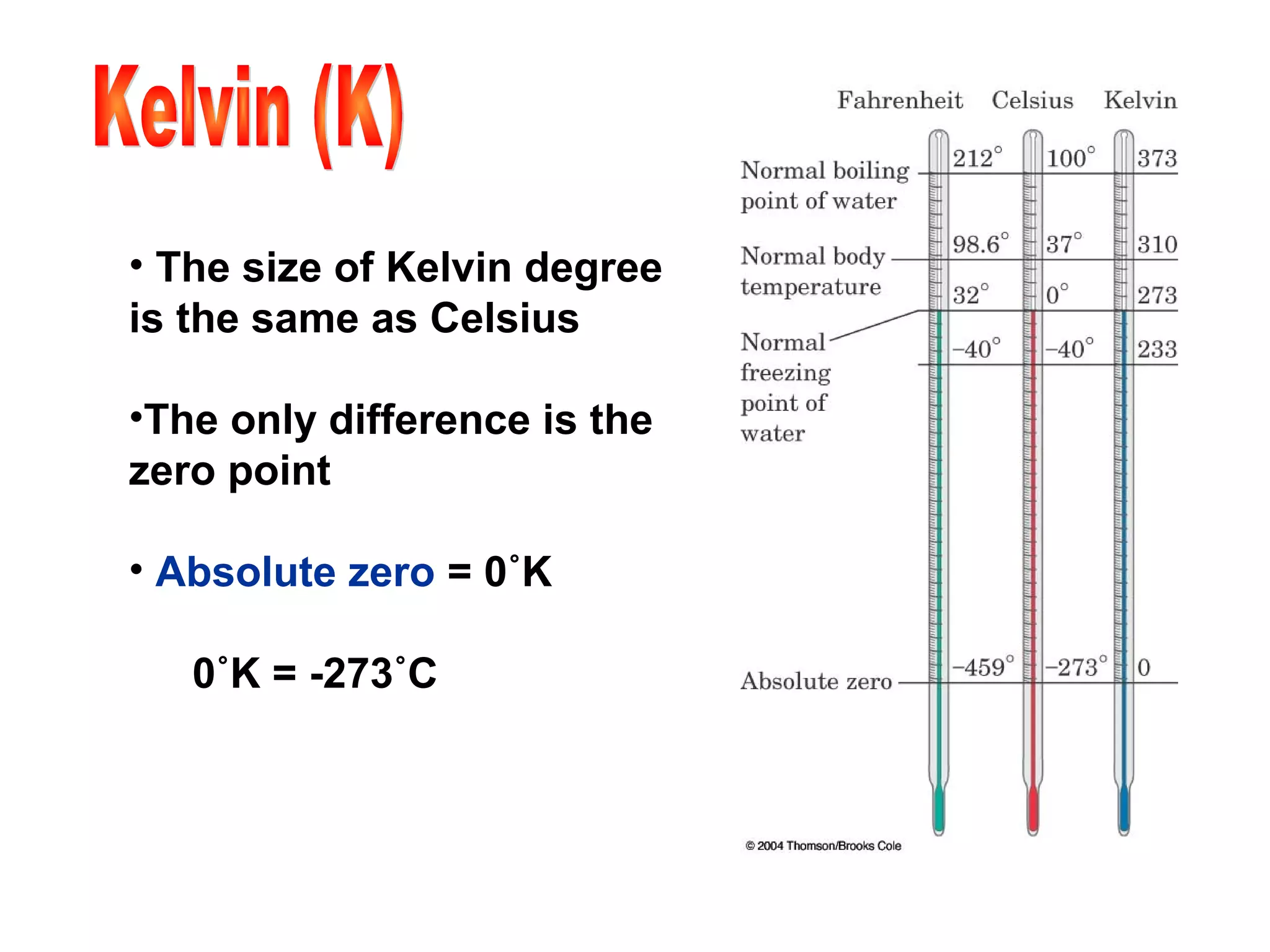
• The size of Kelvin degree
is the same as Celsius
•The only difference is the
zero point
• Absolute zero = 0˚K
0˚K = -273˚C
• converting one unit into another:
grams (g) to centigrams (mg)
pounds (lbs) to grams (g)
liters (l) to milliliters (ml)
kilometers (km) to miles
• Examples
If the speed limit is 70 km/h, what is the speed limit in miles per
hour?
70 km
1.0 hr
x
1.0 mile
1.609 km
= 44 mph
Convert 525 mm to cm
525 mm x 1m x
m1
100cm
1000 mm
= 52.5 cm
Factor Label Method for Unit Conversions
• matter can exist in 3 states: gas, liquid, and
solid
• Gases have no definite shape or volume 
highly compressible
• Liquids have no definite shape but they do
have a definite volume  slightly compressible
• Solids have a definite shape and a definite
volume  incompressible
• most substances can exist in all 3 states:
temperature dependent
The Three Physical State of Matter
• defines as mass per unit volume
• is a physical property that is constant at a
given temperature
• density usually increases with decreasing
temperature  water is an exception
• for liquids and solids: g/ml
• for gas: g/L
d =
m
d = density
m = mass
V = volumeV
• is a physical property
that is numerically the
same as density but
has no units
• specific gravity is a
comparison of density of a
substance with the density
of H2O
The density of H2O at 1˚C
is 1.00 g/ml
Urinometer
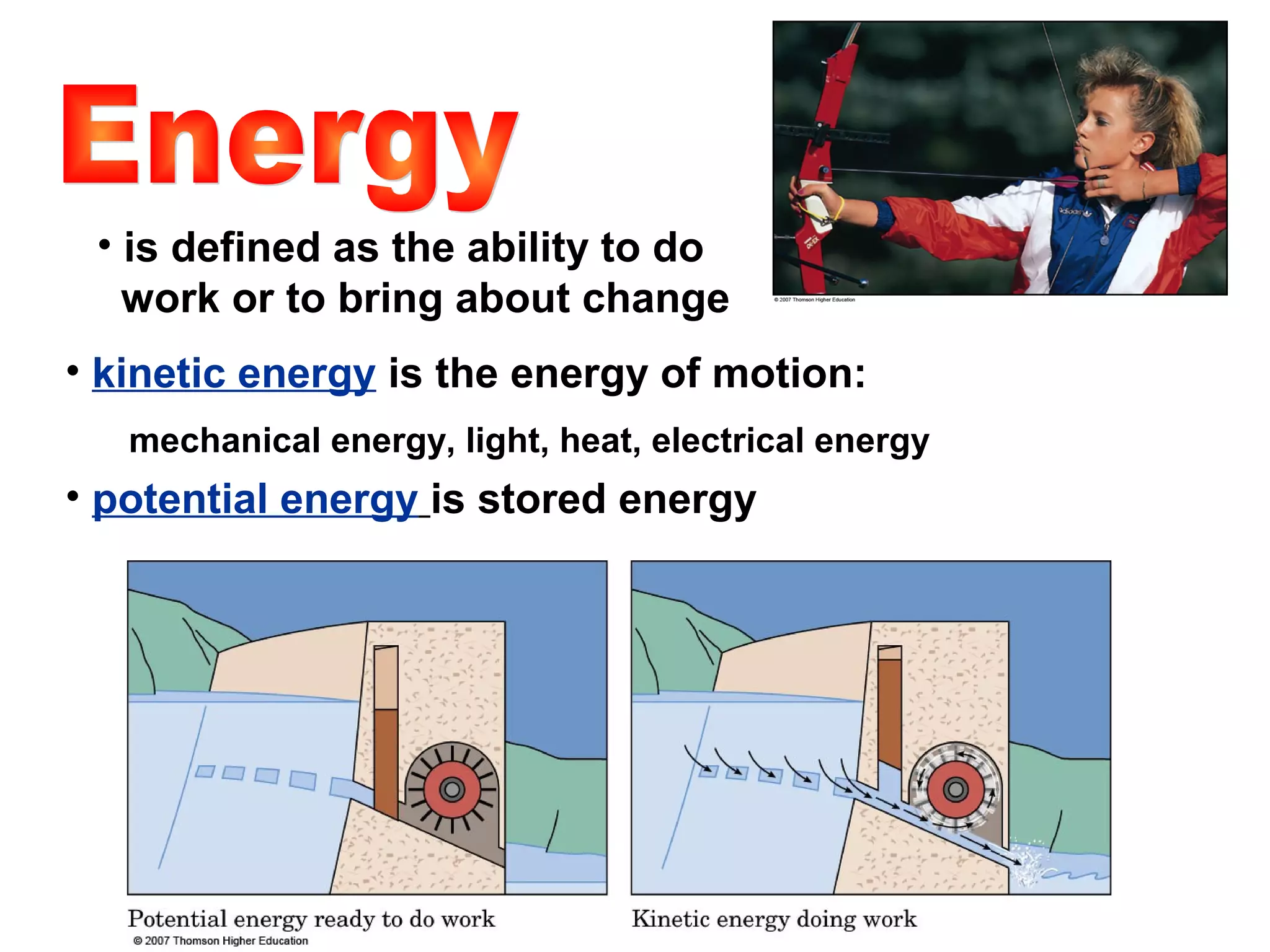
• is defined as the ability to do
work or to bring about change
• kinetic energy is the energy of motion:
mechanical energy, light, heat, electrical energy
• potential energy is stored energy
•In chemistry, the most important form of
potential energy is chemical energy
•chemical energy is stored in chemical
substances, as for example in foods such as
carbohydrates and fats it is given off when
substances take part in chemical reactions
First Law of Thermodynamics:
Law of conservation of energy
 Energy can be neither created nor
destroyed, it can only be transformed from
one form to another.
 No energy transformation is 100% efficient
 % efficiency = usable energy X 100
total energy
 Humans are only 20-25%
efficient
 Wasted energy is usually
lost as heat
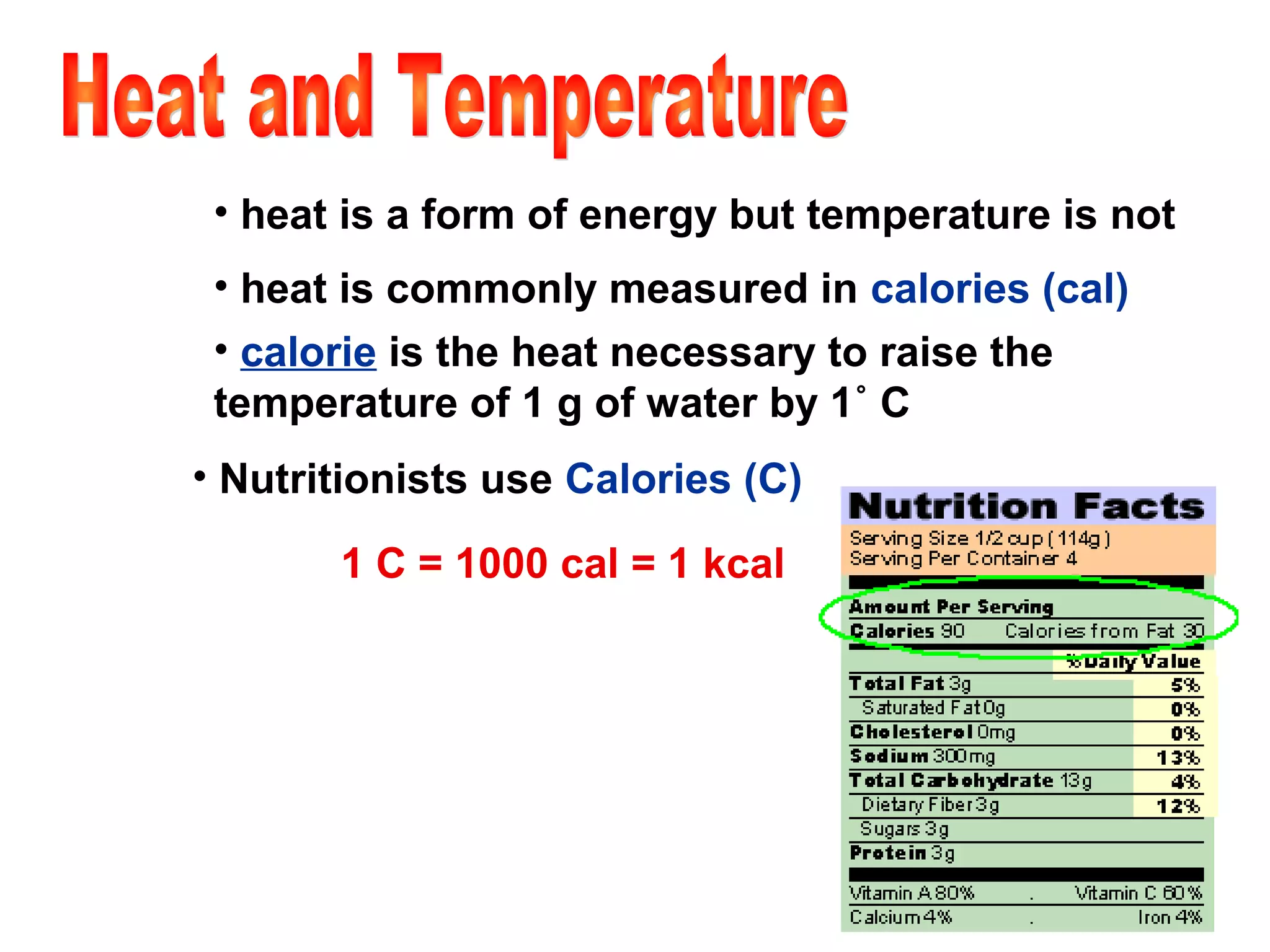
• heat is a form of energy but temperature is not
• heat is commonly measured in calories (cal)
• calorie is the heat necessary to raise the
temperature of 1 g of water by 1˚ C
• Nutritionists use Calories (C)
1 C = 1000 cal = 1 kcal
• the heat necessary to raise the temperature of
1 g of any substance by 1˚ C
Specific Heat

Chapter 1 - Chem 103

  • 1.
  • 2.
  • 3.
    • Matter canchange from one form to another: • matter is anything that has mass and takes up space • Chemistry is the study of matter 1) Physical changes 2) Chemical changes
  • 4.
    • occur whenobjects undergo a change that does not change their chemical nature Examples of physical change include: • Change of state • Creation or separation of a mixtures • Physical deformation
  • 5.
    1) Physical Propertiesof Matter Those characteristics that can be observed without changing the substance into another substance:  Color  Taste  Density (g/ml)  Melting point  Odor  Hardness  Solubility  Boiling point
  • 6.
    • occur whensubstance(s) are changed into another substance(s), involving chemical reactions • A chemical reaction produces new substances by changing the way in which atoms are arranged Examples include: • rusting or oxidation • digestion of food • bleaching hair • burning propane CH3CH2CH3 + 5O2 3CO2 + 4H2O
  • 7.
    2) Chemical Propertiesof Matter Those characteristics that can be observed when the substance undergoes a change in composition  reactivity  combustibility
  • 8.
    Changes in Matter 1)Physical Changes: does not alter the composition of the substance 2) Chemical Changes or Chemical Reactions: alters the composition
  • 9.
    Physical or Chemicalchanges? 1) Melting a marshmallow 2) Burning a marshmallow 3) Cutting paper 4) Rusted nail 5) Digestion of food 6) Evaporation 7) Striking a match 8) Bleaching hair
  • 10.
    • Fact isa statement based on direct experience • Hypothesis is a statement that is proposed, without actual proof, to explain the facts and their relationships • Theory is the formulation of an apparent relationship of certain observed phenomena • is the process by which scientists, collectively and over time, endeavor to construct an accurate representation of the world Fact Hypothesis Theory Law
  • 11.
  • 12.
    •Used to representvery large or very small numbers as powers of 10 Examples: 0.00002 is written as 2 x 10⁻⁵ 2,000,000 is written as 2 x 10⁶ Exponential Notation
  • 13.
    • is thenumber of digits of a measured number that have uncertainty only in the last digit Rules: 1. Nonzero digits are always significant 2. Zeros at the beginning of a number are never significant 3. Zeros between nonzero digits are always significant 4. Zeros at the end of a number that contains a decimal point are always significant * Additional rules apply for addition and multiplication/ dividing (Appendix II) Significant Figures
  • 14.
    Measurements and theMetric System
  • 16.
    • consist of2 parts: number and unit • The metric system uses one base unit for each kind of measurement Measurements
  • 17.
    • The metricsystem uses units that are related by powers of 10
  • 18.
    • Mass vs.Weight • Mass is the quantity of matter in an object and is independent of weight • Weight is the force mass experiences under the pull of gravity • Volume 1 mL = 1 cc • Volume is the space occupied by that substance
  • 19.
    temperature degree Celsius degree Fahrenheit symbol °C °F boilingpoint of water 100 212 average human body temperature 37 98.6 average room temperature 20 to 25 68 to 77 melting point of ice 0 32 ˚F = 9/5 ˚C + 32 ˚C = 5/9 (˚F – 32)
  • 20.
    • The sizeof Kelvin degree is the same as Celsius •The only difference is the zero point • Absolute zero = 0˚K 0˚K = -273˚C
  • 21.
    • converting oneunit into another: grams (g) to centigrams (mg) pounds (lbs) to grams (g) liters (l) to milliliters (ml) kilometers (km) to miles • Examples If the speed limit is 70 km/h, what is the speed limit in miles per hour? 70 km 1.0 hr x 1.0 mile 1.609 km = 44 mph Convert 525 mm to cm 525 mm x 1m x m1 100cm 1000 mm = 52.5 cm Factor Label Method for Unit Conversions
  • 22.
    • matter canexist in 3 states: gas, liquid, and solid • Gases have no definite shape or volume  highly compressible • Liquids have no definite shape but they do have a definite volume  slightly compressible • Solids have a definite shape and a definite volume  incompressible • most substances can exist in all 3 states: temperature dependent
  • 23.
    The Three PhysicalState of Matter
  • 24.
    • defines asmass per unit volume • is a physical property that is constant at a given temperature • density usually increases with decreasing temperature  water is an exception • for liquids and solids: g/ml • for gas: g/L d = m d = density m = mass V = volumeV
  • 25.
    • is aphysical property that is numerically the same as density but has no units • specific gravity is a comparison of density of a substance with the density of H2O The density of H2O at 1˚C is 1.00 g/ml Urinometer
  • 26.
    • is definedas the ability to do work or to bring about change • kinetic energy is the energy of motion: mechanical energy, light, heat, electrical energy • potential energy is stored energy
  • 27.
    •In chemistry, themost important form of potential energy is chemical energy •chemical energy is stored in chemical substances, as for example in foods such as carbohydrates and fats it is given off when substances take part in chemical reactions
  • 28.
    First Law ofThermodynamics: Law of conservation of energy  Energy can be neither created nor destroyed, it can only be transformed from one form to another.  No energy transformation is 100% efficient  % efficiency = usable energy X 100 total energy  Humans are only 20-25% efficient  Wasted energy is usually lost as heat
  • 29.
    • heat isa form of energy but temperature is not • heat is commonly measured in calories (cal) • calorie is the heat necessary to raise the temperature of 1 g of water by 1˚ C • Nutritionists use Calories (C) 1 C = 1000 cal = 1 kcal
  • 30.
    • the heatnecessary to raise the temperature of 1 g of any substance by 1˚ C Specific Heat