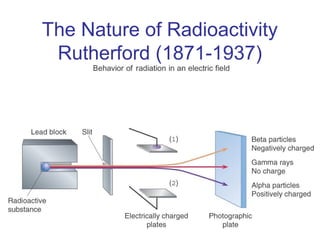
The Nature of Radioactivity
Rutherford (1871-1937)
Nuclear radiation:Nuclear radiation: radiation emitted from a
nucleus during nuclear decay
high-energy
electromagnetic radiation
one electron
charge = -1,
mass = 0.00055 amu
two protons + two neutrons
mass = 4 amu
atomic number = 2
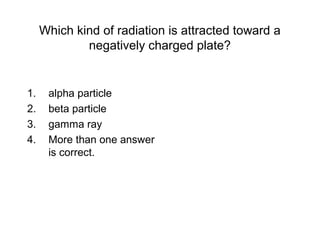
Which kind of radiation is attracted toward a
negatively charged plate?
1. alpha particle
2. beta particle
3. gamma ray
4. More than one answer
is correct.
Properties of the Three Types
of Radiation Emitted by
Radioactive Elements
Penetrating
Abilities of
Particles
Penetrating power of Radiation
(depends on energy and mass)
PENETRATING POWER
α particles cause more damage than X-rays or γ
radiation but they have very low penetrating power
and cannot pass through skin. Consequently alpha
particles are not as harmful to humans or animals as
long as they do not get into the body; if they do get
into the body, they can be the most harmful.
β particles are less damaging to tissue than α
particles but penetrate farther and so are generally
more harmful.
γ rays, which can easily penetrate skin, can be the
most dangerous and harmful form of radiation.
Gamma Rays and X-Rays
 Both gamma-rays and X-rays are forms of
electromagnetic radiation. Gamma rays have a
shorter wavelength and a higher energy than X-
rays.
GGamma emission:amma emission: In pure gamma emission,
there is no change in either the atomic number
or the mass number of the element. A nucleus
in a higher-energy state emits gamma radiation
as it returns to its ground state (its most stable
energy state).
In this example, the notation “11m” indicates
that the nucleus of boron-11 is in a higher-
energy (excited) state. In this nuclear decay, no
transmutation takes place.
γ
6
11m +B 6
11
B I’m a gamma
ray!!!
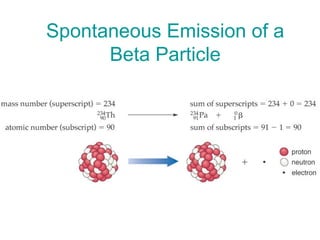
BBeta emission:eta emission: a type of nuclear decay in
which a neutron is converted to a proton and
an electron, and the electron is emitted from
the nucleus
emission of a beta particle transforms the
element into a new element with the same
mass number but an atomic number one
unit greater
Phosphorus-32, for example, is a beta
emitter
e
-1
0n0
1
H1
1
+
e-1
0
15
32
S16
32
+P
I’m an beta
particle!!!
Spontaneous Emission of a
Beta Particle
AAlpha emission:lpha emission: a type of nuclear decay in
which a helium nucleus (2 protons + 2
neutrons) is emitted from the nucleus. In
alpha emission, the new element formed has
an atomic number two units lower and a
mass number four units lower than the
original nucleus.
2
4
92
238
+Th90
234U He
2
4
84
210
+Pb82
206Po + γHe
I’m an alpha
particle!!!
Spontaneous Emission of an
Alpha Particle
Changes in Mass Number and
Atomic Number That Occur When
Radioactive Elements Decay
PPositron emission:ositron emission: a type of nuclear decay in which a
positive electron is emitted from the nucleus
In positron emission, the new element formed has an atomic
number one unit lower but the same mass number as the
original nucleus.
e+1
0
6
11
+B5
11C
I’m a positron!!!
EElectron capture:lectron capture: In electron capture an extranuclear
electron is captured by the nucleus of an atom and reacts with a
proton to form a neutron. The atomic number of the element
produced is reduced by one but the mass number remains the
same.
LieBe 7
3
0
1
7
4 →+ −
Nuclear Radiation
There are more than 300 naturally occurring isotopes
– 264 are stable (not radioactive) and the remainder are
radioactive.
– among the lighter elements, stable isotopes have
approximately the same number of protons and
neutrons: 12
6C, 16
8O, and 20
10Ne
– among the heavier elements,stability requires more
neutrons than protons; the most stable isotope of
lead, is lead-206, 124
82Pb
More than 1000 artificial isotopes have been made in
STABLE AND
UNSTABLE ISOTOPES
Black circles = stable
Red circles = unstable
(radioactive)
Up to Calcium (20 protons) all
stable isotopes have numbers
of protons=neutrons
Beyond Calcium there is
always more neutrons than
protons.
Beyond Bismuth (83 protons)
all isotopes are unstable
Radioactive Decay Series
HHalf-life of a radioisotope (talf-life of a radioisotope (t1/21/2),), the time it takes one
half of a sample of a radioisotope to decay
Half-Life of Radioisotopes
Half–life is the time
required for one-half of
any given quantity of
isotope to decay
Decay Curve
Phosphorus-32 has a half-life of 14.3 days.
What fraction of the original sample would
remain after 28.6 days?
1. 1/2
2. 1/4
3. 1/8
4. 1/16
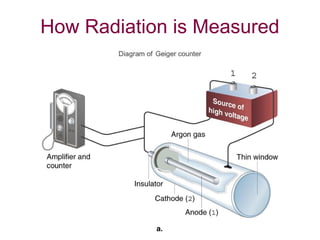
Intensity of Radiation
The Geiger-MüllerThe Geiger-Müller countercounter contains a gas such as helium
or argon. When a radioactive nucleus emits α, β,or γ
particles, these particles ionize the gas producing an
electric current between two electrodes. The current
produced is proportional to the intensity of the radiation.
How Radiation is Measured
• Intensity of any radiation decreases with the
square of the distance from the source
I1 = d2
2
I2 = d1
2
• Other measuring devices, such as scintillation
counters, have a material called phosphor that
emits a unit of light for each alpha or beta particle
or gamma ray that strikes it
• Commonly used unit of radiation intensity is the
curie (Ci) and the becquerel (Bq)
1 Ci = 3.7 X 10¹⁰
dps
1 Bq = 1.0 dps
Effects of Exposure to
Radiation
Exposure to Radon
Plants incorporate C-14 into living tissue. The percentage of C-14 in the plant is
the same as in the atmosphere. When the plant dies C-14 is no longer
incorporated but radioactive decay continues with C-14 activity decreasing over
time.
A plant that has recently died will emit 13.7 dpm/g of carbon. After 5370 years it
will emit about 7 dpm and after 11460 years about 3.5 dpm.
Humans incorporate C-14 through their diet while alive. After death C-14 is no
longer incorporated. Only decay takes place.
The ice man, lived 5300 years ago. Found in a glacier in the Alps
Phosphorus-32 has a half-life of 14.3 days.
What fraction of the original sample would
remain after 28.6 days?
1. 1/2
2. 1/4
3. 1/8
4. 1/16
Figure 3.4
Using the Half-lives of
Radioisotopes
• Radioisotopes have two main uses in medicine; diagnosis and therapy
Nuclear MedicineNuclear Medicine
Radiation DosimetryRadiation Dosimetry
– the relationship between delivered dose in roentgens (R)
and the absorbed dose in rads; exposure to 1 R of high
energy photons yields 0.97 rad in water, 0.96 rad in
muscle, and 0.93 rad in bone
– for lower-energy radiation such as soft x-rays, 1 R yields
3 rads of absorbed radiation in bone; soft tissue lets
radiation pass, but bone absorbs it, giving an X-ray
Unit What the Unit Measures SI Unit Other Units
Roentgen The amount of radiation delivered
from a radiation source.
Roentgen (R)
Rad The ratio between radiation
absorbed by a tissue and radiation
delivered tothe tissue
Gray (Gy) 1 rad = 0.01 Gy
Rem The ratio between the tissue
damage caused by a rad of
radiation and the type of radiation
Sievert (Sv) 1 rem = 0.01 Sv
– a single whole-body irradiation of 25 rem is
noticeable in blood count
– a single dose of 100 rem causes typical
symptoms of radiation sickness
– a single dose of 400 rem causes death within
one month in 50% of the exposed persons
– a single dose of 600 rem is almost invariably
lethal within a month
– it is estimated that a single dose of 50,000
rem is needed to kill bacteria, and up to 106
rem is needed to inactivate viruses
Applications of Radioisotopes
in the Home
Nuclear FusionNuclear Fusion
• The transmutation of two hydrogen nuclei
into a helium nucleus liberates energy, this
process is called nuclear fusionnuclear fusion
– all transuranium elements (elements with
atomic number greater than 92) are artificial
and have been prepared by nuclear fusion
– to prepare them, heavy nuclei are bombarded
with lighter ones
Nuclear Fission
Nuclear FissionNuclear Fission
• Nuclear fission:Nuclear fission: the fragmentation of larger
nuclei into smaller ones
– when uranium-235 is bombarded with
neutrons, it is broken into two smaller
elements
– more importantly, energy is released because
the products have less mass than the starting
materials
– the mass decrease in fission is converted into
energy
– this form of energy is called atomic energyatomic energy
Nuclear Chain Reaction
 Slow moving neutrons, 1
n , starts fission
reaction 0
 3 neutrons released for each reacting
neutron
• Nuclear fission is a chain reaction
Energy Released During
Nuclear Fission
 Einstein predicted:
E=mc2
C (speed of light) = 300,000 km/sec or
= 186, 000 miles/sec
 Even a small amount of mass when
multiplied by c2
will produce an enormous
amount of energy.
Nuclear Fission
– today more than 15% of the electrical energy in the United
States is supplied by nuclear power plants
– disposal of spent but still radioactive fuel materials is a
major long-term problem
– spent fuel contains high-level fission products together with
recoverable uranium and plutonium
– in addition, there are radioactive wastes from nuclear
weapons programs, research reactors, and so forth
Chernobyl (1986)
1. Polonium-208 is one of the α emitters studied by Marie Curie.
Write the equation for the α decay of polonium-208, and identify
the element
2. Write the balanced equation for the β decay of chromium-55.
3. High levels of radioactive radon-222 have been found in many
homes built on radium-containing rock, leading to the possibility of
health hazards. What product results from α emission by radon-222
Review Questions
4. Carbon-14, a β emitter, is a rare isotope used in dating
archaeological artifacts. Write a nuclear equation for the decay of
carbon-14.
Review Questions
5. Phosphorus-32, a radioisotope used in leukemia therapy, has a
half-life of about 14 days. Approximately what percent of a sample
remains after 8 weeks?
6. Selenium-75, a β emitter with a half-life of 120 days, is used
medically for pancreas scans. Approximately how much selenium-75
would remain from a 12.0g sample that has been stored for 1 year?
1. Polonium-208 is one of the α emitters studied by Marie Curie.
Write the equation for the α decay of polonium-208, and identify
the element
2. Write the balanced equation for the β decay of chromium-55.
3. High levels of radioactive radon-222 have been found in many
homes built on radium-containing rock, leading to the possibility of
health hazards. What product results from α emission by radon-222
Review Questions
4. Carbon-14, a β emitter, is a rare isotope used in dating
archaeological artifacts. Write a nuclear equation for the decay of
carbon-14.
5. Write a balanced nuclear equation for electron capture by
polonium-204.
6. Write a balanced nuclear equation for the positron emission
from xenon-118.
Review Questions
Review Questions
7. Phosphorus-32, a radioisotope used in leukemia therapy, has a
half-life of about 14 days. Approximately what percent of a sample
remains after 8 weeks?
8. Selenium-75, a β emitter with a half-life of 120 days, is used
medically for pancreas scans. Approximately how much selenium-75
would remain from a 0.050g sample that has been stored for 1 year?
9. If a radiation source give 75 units of radiation at a distance of 2.4 m,
at what distance would the source give 25 units of radiation?

Chapter 9

  • 1.
    The Nature ofRadioactivity Rutherford (1871-1937)
  • 2.
    Nuclear radiation:Nuclear radiation:radiation emitted from a nucleus during nuclear decay high-energy electromagnetic radiation one electron charge = -1, mass = 0.00055 amu two protons + two neutrons mass = 4 amu atomic number = 2
  • 3.
    Which kind ofradiation is attracted toward a negatively charged plate? 1. alpha particle 2. beta particle 3. gamma ray 4. More than one answer is correct.
  • 4.
    Properties of theThree Types of Radiation Emitted by Radioactive Elements
  • 5.
  • 6.
    Penetrating power ofRadiation (depends on energy and mass)
  • 7.
    PENETRATING POWER α particlescause more damage than X-rays or γ radiation but they have very low penetrating power and cannot pass through skin. Consequently alpha particles are not as harmful to humans or animals as long as they do not get into the body; if they do get into the body, they can be the most harmful. β particles are less damaging to tissue than α particles but penetrate farther and so are generally more harmful. γ rays, which can easily penetrate skin, can be the most dangerous and harmful form of radiation.
  • 8.
    Gamma Rays andX-Rays  Both gamma-rays and X-rays are forms of electromagnetic radiation. Gamma rays have a shorter wavelength and a higher energy than X- rays.
  • 9.
    GGamma emission:amma emission:In pure gamma emission, there is no change in either the atomic number or the mass number of the element. A nucleus in a higher-energy state emits gamma radiation as it returns to its ground state (its most stable energy state). In this example, the notation “11m” indicates that the nucleus of boron-11 is in a higher- energy (excited) state. In this nuclear decay, no transmutation takes place. γ 6 11m +B 6 11 B I’m a gamma ray!!!
  • 10.
    BBeta emission:eta emission:a type of nuclear decay in which a neutron is converted to a proton and an electron, and the electron is emitted from the nucleus emission of a beta particle transforms the element into a new element with the same mass number but an atomic number one unit greater Phosphorus-32, for example, is a beta emitter e -1 0n0 1 H1 1 + e-1 0 15 32 S16 32 +P I’m an beta particle!!!
  • 11.
    Spontaneous Emission ofa Beta Particle
  • 12.
    AAlpha emission:lpha emission:a type of nuclear decay in which a helium nucleus (2 protons + 2 neutrons) is emitted from the nucleus. In alpha emission, the new element formed has an atomic number two units lower and a mass number four units lower than the original nucleus. 2 4 92 238 +Th90 234U He 2 4 84 210 +Pb82 206Po + γHe I’m an alpha particle!!!
  • 13.
    Spontaneous Emission ofan Alpha Particle
  • 14.
    Changes in MassNumber and Atomic Number That Occur When Radioactive Elements Decay
  • 15.
    PPositron emission:ositron emission:a type of nuclear decay in which a positive electron is emitted from the nucleus In positron emission, the new element formed has an atomic number one unit lower but the same mass number as the original nucleus. e+1 0 6 11 +B5 11C I’m a positron!!!
  • 16.
    EElectron capture:lectron capture:In electron capture an extranuclear electron is captured by the nucleus of an atom and reacts with a proton to form a neutron. The atomic number of the element produced is reduced by one but the mass number remains the same. LieBe 7 3 0 1 7 4 →+ −
  • 17.
    Nuclear Radiation There aremore than 300 naturally occurring isotopes – 264 are stable (not radioactive) and the remainder are radioactive. – among the lighter elements, stable isotopes have approximately the same number of protons and neutrons: 12 6C, 16 8O, and 20 10Ne – among the heavier elements,stability requires more neutrons than protons; the most stable isotope of lead, is lead-206, 124 82Pb More than 1000 artificial isotopes have been made in
  • 18.
    STABLE AND UNSTABLE ISOTOPES Blackcircles = stable Red circles = unstable (radioactive) Up to Calcium (20 protons) all stable isotopes have numbers of protons=neutrons Beyond Calcium there is always more neutrons than protons. Beyond Bismuth (83 protons) all isotopes are unstable
  • 19.
  • 20.
    HHalf-life of aradioisotope (talf-life of a radioisotope (t1/21/2),), the time it takes one half of a sample of a radioisotope to decay
  • 21.
    Half-Life of Radioisotopes Half–lifeis the time required for one-half of any given quantity of isotope to decay
  • 22.
  • 24.
    Phosphorus-32 has ahalf-life of 14.3 days. What fraction of the original sample would remain after 28.6 days? 1. 1/2 2. 1/4 3. 1/8 4. 1/16
  • 25.
    Intensity of Radiation TheGeiger-MüllerThe Geiger-Müller countercounter contains a gas such as helium or argon. When a radioactive nucleus emits α, β,or γ particles, these particles ionize the gas producing an electric current between two electrodes. The current produced is proportional to the intensity of the radiation.
  • 26.
  • 27.
    • Intensity ofany radiation decreases with the square of the distance from the source I1 = d2 2 I2 = d1 2 • Other measuring devices, such as scintillation counters, have a material called phosphor that emits a unit of light for each alpha or beta particle or gamma ray that strikes it • Commonly used unit of radiation intensity is the curie (Ci) and the becquerel (Bq) 1 Ci = 3.7 X 10¹⁰ dps 1 Bq = 1.0 dps
  • 28.
    Effects of Exposureto Radiation
  • 30.
  • 31.
    Plants incorporate C-14into living tissue. The percentage of C-14 in the plant is the same as in the atmosphere. When the plant dies C-14 is no longer incorporated but radioactive decay continues with C-14 activity decreasing over time. A plant that has recently died will emit 13.7 dpm/g of carbon. After 5370 years it will emit about 7 dpm and after 11460 years about 3.5 dpm. Humans incorporate C-14 through their diet while alive. After death C-14 is no longer incorporated. Only decay takes place. The ice man, lived 5300 years ago. Found in a glacier in the Alps
  • 32.
    Phosphorus-32 has ahalf-life of 14.3 days. What fraction of the original sample would remain after 28.6 days? 1. 1/2 2. 1/4 3. 1/8 4. 1/16 Figure 3.4
  • 33.
    Using the Half-livesof Radioisotopes
  • 34.
    • Radioisotopes havetwo main uses in medicine; diagnosis and therapy Nuclear MedicineNuclear Medicine
  • 35.
    Radiation DosimetryRadiation Dosimetry –the relationship between delivered dose in roentgens (R) and the absorbed dose in rads; exposure to 1 R of high energy photons yields 0.97 rad in water, 0.96 rad in muscle, and 0.93 rad in bone – for lower-energy radiation such as soft x-rays, 1 R yields 3 rads of absorbed radiation in bone; soft tissue lets radiation pass, but bone absorbs it, giving an X-ray Unit What the Unit Measures SI Unit Other Units Roentgen The amount of radiation delivered from a radiation source. Roentgen (R) Rad The ratio between radiation absorbed by a tissue and radiation delivered tothe tissue Gray (Gy) 1 rad = 0.01 Gy Rem The ratio between the tissue damage caused by a rad of radiation and the type of radiation Sievert (Sv) 1 rem = 0.01 Sv
  • 36.
    – a singlewhole-body irradiation of 25 rem is noticeable in blood count – a single dose of 100 rem causes typical symptoms of radiation sickness – a single dose of 400 rem causes death within one month in 50% of the exposed persons – a single dose of 600 rem is almost invariably lethal within a month – it is estimated that a single dose of 50,000 rem is needed to kill bacteria, and up to 106 rem is needed to inactivate viruses
  • 37.
  • 38.
    Nuclear FusionNuclear Fusion •The transmutation of two hydrogen nuclei into a helium nucleus liberates energy, this process is called nuclear fusionnuclear fusion – all transuranium elements (elements with atomic number greater than 92) are artificial and have been prepared by nuclear fusion – to prepare them, heavy nuclei are bombarded with lighter ones
  • 39.
  • 40.
    Nuclear FissionNuclear Fission •Nuclear fission:Nuclear fission: the fragmentation of larger nuclei into smaller ones – when uranium-235 is bombarded with neutrons, it is broken into two smaller elements – more importantly, energy is released because the products have less mass than the starting materials – the mass decrease in fission is converted into energy – this form of energy is called atomic energyatomic energy
  • 41.
    Nuclear Chain Reaction Slow moving neutrons, 1 n , starts fission reaction 0  3 neutrons released for each reacting neutron
  • 42.
    • Nuclear fissionis a chain reaction
  • 43.
    Energy Released During NuclearFission  Einstein predicted: E=mc2 C (speed of light) = 300,000 km/sec or = 186, 000 miles/sec  Even a small amount of mass when multiplied by c2 will produce an enormous amount of energy.
  • 44.
    Nuclear Fission – todaymore than 15% of the electrical energy in the United States is supplied by nuclear power plants – disposal of spent but still radioactive fuel materials is a major long-term problem – spent fuel contains high-level fission products together with recoverable uranium and plutonium – in addition, there are radioactive wastes from nuclear weapons programs, research reactors, and so forth
  • 45.
  • 46.
    1. Polonium-208 isone of the α emitters studied by Marie Curie. Write the equation for the α decay of polonium-208, and identify the element 2. Write the balanced equation for the β decay of chromium-55. 3. High levels of radioactive radon-222 have been found in many homes built on radium-containing rock, leading to the possibility of health hazards. What product results from α emission by radon-222 Review Questions
  • 47.
    4. Carbon-14, aβ emitter, is a rare isotope used in dating archaeological artifacts. Write a nuclear equation for the decay of carbon-14. Review Questions 5. Phosphorus-32, a radioisotope used in leukemia therapy, has a half-life of about 14 days. Approximately what percent of a sample remains after 8 weeks? 6. Selenium-75, a β emitter with a half-life of 120 days, is used medically for pancreas scans. Approximately how much selenium-75 would remain from a 12.0g sample that has been stored for 1 year?
  • 48.
    1. Polonium-208 isone of the α emitters studied by Marie Curie. Write the equation for the α decay of polonium-208, and identify the element 2. Write the balanced equation for the β decay of chromium-55. 3. High levels of radioactive radon-222 have been found in many homes built on radium-containing rock, leading to the possibility of health hazards. What product results from α emission by radon-222 Review Questions
  • 49.
    4. Carbon-14, aβ emitter, is a rare isotope used in dating archaeological artifacts. Write a nuclear equation for the decay of carbon-14. 5. Write a balanced nuclear equation for electron capture by polonium-204. 6. Write a balanced nuclear equation for the positron emission from xenon-118. Review Questions
  • 50.
    Review Questions 7. Phosphorus-32,a radioisotope used in leukemia therapy, has a half-life of about 14 days. Approximately what percent of a sample remains after 8 weeks? 8. Selenium-75, a β emitter with a half-life of 120 days, is used medically for pancreas scans. Approximately how much selenium-75 would remain from a 0.050g sample that has been stored for 1 year? 9. If a radiation source give 75 units of radiation at a distance of 2.4 m, at what distance would the source give 25 units of radiation?